



This Grade 7 Medieval and Early Modern World lesson covers The Rise and Spread of Islam, part of the unit “Empires and faiths.” First, read the full lesson with its primary sources, maps and key terms. Then practice with the worksheet, check yourself with the quiz and get ready with the test.
In the year 622 a man left the city of Mecca on a long journey to the north. He did not leave as a ruler. He left because his life was in danger, and he went to an oasis town named Yathrib, which later took the name Medina. Within ten years he was the leader of nearly all of Arabia.
Within a hundred years the state that his followers built reached from Spain to the borders of India and China. Few events in history have changed the map and the cultures of the world so fast. Historians study how and why this happened by reading the Qur’an, the earliest histories, and the accounts of travelers, and by looking at mosques, coins, and manuscripts.
Guiding question: How did Islam begin in Arabia, why did the Muslim world expand so quickly, and how did the caliphates shape trade, learning, and the lives of people of many faiths?
1. Arabia before Islam
The Arabian Peninsula is a land of deserts, with a few oases and a fertile corner in the southwest. Most people were Bedouin, nomads who herded camels, goats, and sheep and moved from one pasture to another. They lived in tribes and clans, and loyalty to the tribe was the strongest bond. The camel made trade possible across the desert, and caravans carried incense, spices, and leather between the Indian Ocean and the cities of Syria. Two great empires lay on the borders: the Byzantine Empire to the northwest and the Sasanian Persian Empire to the northeast. A long war that ended in 628 had weakened both empires.
Mecca, in the western region called the Hijaz, was a trading town and also a shrine. In its center stood the Kaaba, a cube-shaped sanctuary that attracted pilgrims from many tribes, who honored many gods there. The leading tribe of the town, the Quraysh, controlled the shrine and profited from the caravans and pilgrims. There were also Jews and Christians in Arabia, and Arabs knew the idea of one God. Writing existed, but poetry, learned by heart, was the great art, and the Arabic language that Islam would carry across the world was already rich.
Definition: Bedouin
Arab nomads of the desert who herd animals, live in tents, and move with the seasons.
2. Muhammad and the message of Islam
The life of the Prophet
Muhammad was born in Mecca about 570 CE into the Quraysh tribe. He lost his parents young, and his grandfather and uncle raised him. As an adult he became a merchant, and he married Khadija, a wealthy businesswoman, who became his first follower. According to Islamic tradition, in about 610 CE, while he was meditating in a cave near Mecca, he received the first of a series of revelations from God through the angel Gabriel.
Muslims believe that these revelations continued for about twenty-three years and that they form the Qur’an. Muhammad began to preach that there is only one God, called Allah in Arabic, to whom all people must submit. The word Islam means “submission,” and a Muslim is one who submits.
Document 1 – The first words
Read: In the name of thy Lord Who createth, Createth man from a clot. Read: And thy Lord is the Most Bounteous, Who teacheth by the pen, Teacheth man that which he knew not. Nay, but verily man is rebellious That he thinketh himself independent! Lo! unto thy Lord is the return.
Source: the Qur’an, Surah 96 (al-‘Alaq, “The Clot”), verses 1-8, in the English translation of Marmaduke Pickthall, The Meaning of the Glorious Koran (1930). Islamic tradition holds that these were the first verses revealed to Muhammad, about 610 CE.
*Lo!: Behold. *thy, thou: old forms of “your” and “you.” *Most Bounteous: Most generous.
Commentary. The Qur’an is the central sacred text of Islam. Muslims regard it as the word of God in Arabic, and for that reason they treat a translation as an interpretation and not as the Qur’an itself. A historian does not decide whether the revelation is true, but can say that this text was recited, memorized, and studied by Muslims from the earliest times. The verses on this page begin with a command, “Read,” and mention the pen, so that learning is part of the first message. Later Muslim societies would build many schools and libraries.
Opposition in Mecca
Muhammad’s message threatened the leaders of Mecca. He taught that there is one God and that the rich had duties to the poor, and he rejected the many gods whose shrine drew pilgrims and trade to the city. The Quraysh persecuted his followers. In 622 Muhammad and his followers moved to Yathrib, whose people had invited him to act as judge between feuding clans.
This move is called the Hijra (“migration”), and the Muslim calendar begins with it, so 622 CE is year 1 of the Islamic calendar. In Medina he formed a new community, the umma, based on faith more than on tribe. After years of conflict with Mecca, including the battle of Badr in 624, Muhammad entered Mecca in 630 almost without a fight. He cleared the Kaaba of its idols and made it the holiest place of Islam. He died in 632, and by then most of the Arabian tribes had accepted Islam.
Beliefs and practices
Muslims believe in one God, in angels, in earlier prophets such as Abraham, Moses, and Jesus, in the revealed books, and in a Day of Judgment. They follow the Five Pillars of Islam, which are the basic acts of worship:
- Shahada, the declaration of faith: “There is no god but God, and Muhammad is the messenger of God.”
- Salat, prayer five times a day, facing Mecca.
- Zakat, giving a share of one’s wealth to the poor.
- Sawm, fasting during daylight in the month of Ramadan.
- Hajj, the pilgrimage to Mecca that every Muslim who is able should make once in a lifetime.
Besides the Qur’an, Muslims use the Hadith, the collected reports of what Muhammad said and did, and from these sources scholars developed sharia, Islamic law, which guided worship, family life, trade, and justice. The Qur’an also speaks about Jews and Christians as “People of the Book,” because they too received revelations. This idea shaped how Muslim states treated them.
Definition: Hijra
The migration of Muhammad and his followers from Mecca to Medina in 622 CE. It marks the first year of the Islamic calendar.
Definition: Caliph
The title of the successor of Muhammad as leader of the Muslim community. The word means “successor.” The state ruled by a caliph is called a caliphate.
3. The caliphs and the great expansion
The Rightly Guided Caliphs
When Muhammad died, he left no clear instruction about who should lead. The leaders of the community chose Abu Bakr, his close friend and father-in-law, as the first caliph (632-634). He was followed by Umar (634-644), Uthman (644-656), and Ali (656-661), Muhammad’s cousin and son-in-law. Sunni Muslims call the four the “Rightly Guided Caliphs.” Under Uthman the text of the Qur’an was set in a standard form. Disagreement over who had the right to lead led to civil war, and Ali was murdered in 661. His supporters, called the Shia (“party of Ali”), believed that leadership belonged to Ali’s family. The split between Sunni and Shia Muslims began as a political quarrel and grew into a lasting religious tradition.
Document 2 – The first caliph
Abu ‘Bakr surpassed all the Muhammadans in his austerity, his frugality, and the simplicity of his life and outward appearance. During his rule he wore but a single linen garment and a cloak. In this simple dress he gave audience to the chiefs of the noblest Arab tribes and to the kings of Yemen. The latter appeared before him dressed in richest robes, covered with gold embroideries and wearing splendid crowns. But at sight of the Caliph, shamed by his mingling of pious humility and earnest gravity, they followed his example and renounced their gorgeous attire.
Source: al-Masudi, The Meadows of Gold (Muruj al-Dhahab), about 947 CE, on Abu Bakr, the first caliph (632-634); English translation in Charles F. Horne, ed., The Sacred Books and Early Literature of the East, vol. VI (1917), modernized in the Internet Medieval Sourcebook, Fordham University.
*Muhammadans: an old Western word for Muslims. *austerity: a plain and strict way of life. *frugality: thrift.
Commentary. Al-Masudi wrote about 300 years after Abu Bakr died, so his work is not an eyewitness account. It records a story that Muslims later told to show the model of a ruler: humble, simple, and unmoved by wealth. The author uses the story to contrast the first caliphs with the luxury of the courts that came later.
Conquest
Under Umar and Uthman, Arab armies of horsemen and camel-riders defeated both empires. At the battle of the Yarmuk (636) they beat the Byzantine army and took Syria, and they entered Jerusalem about 637-638. In Persia the Sasanian state fell after the battles of al-Qadisiyya (about 636-637) and Nahavand (642). The Arabs took Egypt between 639 and 642. Several reasons explain the speed.
Decades of war had worn out the Byzantines and Persians. Many people in Syria, Egypt, and Iraq were unhappy with heavy taxes and disputes within the church, and they did not resist the newcomers. The Arab armies were mobile and united by a strong faith. And the conquerors often offered easy terms to cities that surrendered: they allowed people to keep their religion and property in return for a tax.
Document 3 – A Christian account of the conquest of Egypt
After fighting three battles with the Romans, the Muslims conquered them. So when the chief men of the city saw these things, they went to Amr, and received a certificate of security for the city, that it might not be plundered. This kind of treaty which Muhammad, the chief of the Arabs, taught them, they called the Law; and he says with regard to it: “As for the province of Egypt and any city that agrees with its inhabitants to pay the land-tax to you and to submit to your authority, make a treaty with them, and do them no injury. But plunder and take as prisoners those that will not consent to this and resist you.” For this reason the Muslims kept their hands off the province and its inhabitants
Source: Sawirus ibn al-Muqaffa, History of the Patriarchs of the Coptic Church of Alexandria, written in Arabic by a Christian bishop in the 10th century, on the conquest of Egypt (639-642); translated by Basil Evetts (1904), as reproduced in the Internet Medieval Sourcebook, Fordham University.
*Romans: the Byzantines, whom the Copts called Romans. *Amr: Amr ibn al-As, the Muslim general. *land-tax: tax on farmland.
Commentary. This text was written by a Christian bishop in Arabic, in the 10th century, so it reflects the memories of the Coptic Christians, who had been unhappy under Byzantine rule. It gives their view that the defeat was a punishment for the quarrels of the church, but it also records that the invaders gave security to the towns that submitted and paid tax. Notice that the author calls the Byzantines “Romans.”
The Umayyad Caliphate
After Ali, the governor of Syria, Muawiya, became caliph in 661 and founded the Umayyad dynasty, with its capital at Damascus. The caliphate was now hereditary. Arab armies went further. They crossed North Africa and took Carthage in 698. In 711 a force of mostly Berber soldiers under Tariq ibn Ziyad landed at the rock later called Gibraltar (Jabal Tariq, “the mountain of Tariq”) and overthrew the Visigothic kingdom of Spain, called al-Andalus in Arabic.
Others pushed to Central Asia and the Indus valley. In 732 a Muslim raiding army was beaten by Charles Martel’s Frankish army between Tours and Poitiers, which ended the northward push in Western Europe. By 750 the empire was the largest the world had yet seen.
The Umayyads built a new kind of state. Arabic became the language of government, a common coinage was introduced, and the caliph Abd al-Malik completed the Dome of the Rock in Jerusalem in 691-692, the first great monument of Islamic architecture. In the first generations, many converts to Islam who were not Arabs, called mawali, felt that they were treated as second-class members. This discontent helped to bring down the dynasty. In 750 the Abbasids, a family descended from an uncle of Muhammad, overthrew the Umayyads. A prince of the Umayyad family escaped to Spain, where he founded a separate Muslim state at Córdoba in 756.
Document 4 – The Dome of the Rock
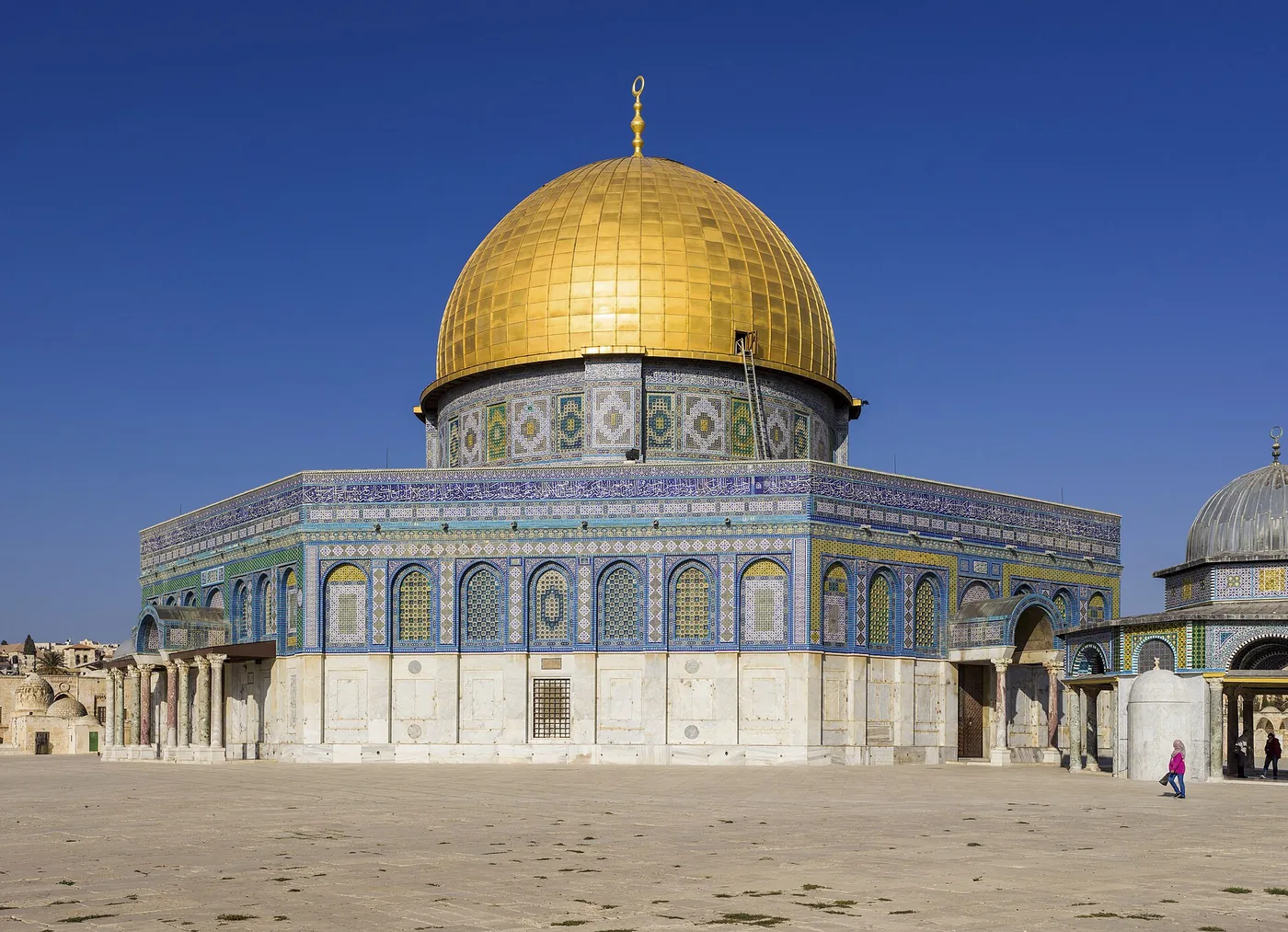
Source: photograph, Wikimedia Commons (CC BY-SA 4.0).
Commentary. The building has an octagonal plan and a golden dome, and it is covered inside and out with Qur’anic inscriptions in Arabic. It is a shrine and not a mosque for the daily prayer. Its builders borrowed the dome and the arcades from the Byzantine churches that they saw in Jerusalem, and they combined them into a new style. It shows that the Muslim rulers chose to build in the holy city of the Jews and Christians, on the Temple Mount.
4. The Abbasids and the Golden Age
Baghdad and the House of Wisdom
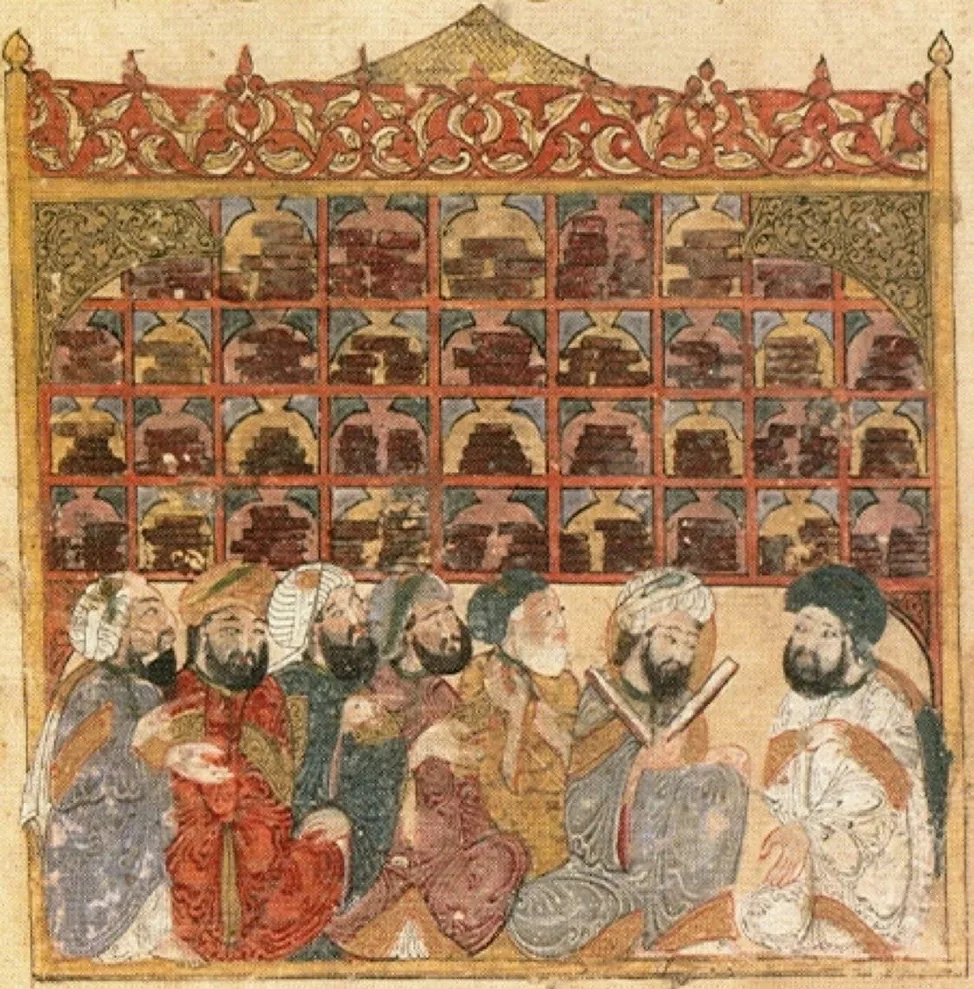
The Abbasid caliphs moved the capital east. In 762 al-Mansur founded Baghdad on the Tigris river, a round city that became one of the largest in the world. Persian officials and ideas now had great influence, and the caliphs were more like emperors than Arab chiefs. Under Harun al-Rashid (786-809) and his son al-Mamun (813-833), the caliphs supported a great movement of learning.
In Baghdad scholars, many of them Christians, Jews, and Persians as well as Muslims, translated Greek, Persian, and Indian books into Arabic. The caliph’s library and research center is known as the House of Wisdom. Paper, which Muslims learned to make from Chinese prisoners taken at the battle of Talas in 751, made books cheap and common.
Muslim scholars did far more than preserve older works. The mathematician al-Khwarizmi (about 780-850) wrote a book on solving equations whose title gave us the word algebra (from al-jabr); Arabic numerals, based on an Indian system with a zero, reached Europe through the Arabs. The doctor Ibn Sina (Avicenna, 980-1037) wrote the Canon of Medicine, which European universities used for centuries. Ibn al-Haytham (about 965-1040) experimented with light and vision in his Book of Optics. Astronomers improved the astrolabe, and geographers like al-Idrisi drew maps for the Norman king Roger II of Sicily in 1154.
Trade and cities
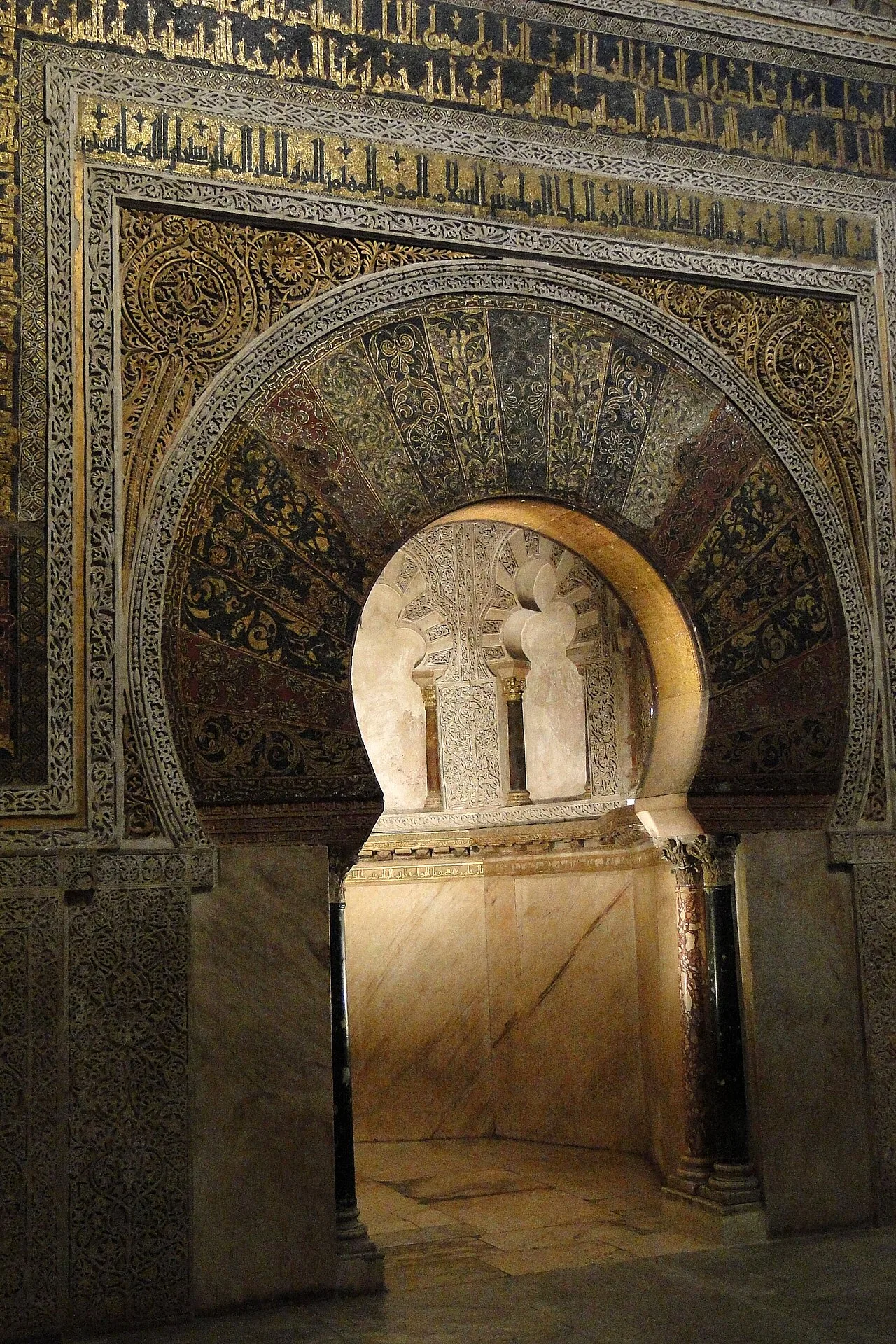
The Muslim world became a single trading zone. Merchants moved along the Silk Road to China, across the Indian Ocean to East Africa and India, and across the Sahara to West Africa, and the use of one language and one law in many places made trade safe. Cities such as Baghdad, Cairo, Damascus, and Córdoba were centers of crafts, banking, and learning. Farmers also learned new crops and irrigation methods, and sugar, cotton, rice, and citrus fruits spread westward. The mosque was the center of community life, and a typical city also had a market, a bathhouse, and a school.
Many peoples, many faiths
The Muslim rulers governed large populations of Christians, Jews, Zoroastrians, and others, who remained the majority in many regions for generations. In general, Jews and Christians were treated as dhimmis, “protected people.” They had to pay a special tax called the jizya and followed some restrictions, but they could practice their religion, keep their own courts for family matters, and serve in many professions. Their situation varied by time and place, and sometimes they faced persecution. Compared with the situation of religious minorities in medieval Europe, it was often better. Conversion to Islam happened gradually over centuries, mostly because of social and economic incentives and not by force, since the Qur’an says, “There is no compulsion in religion.”
Division and decline
By the 10th century the Abbasid caliphs had lost real power. Spain, Egypt, North Africa, and Persia were ruled by independent dynasties, and in 929 the Umayyad ruler at Córdoba even took the title of caliph. In 1055 the Seljuk Turks took Baghdad and ruled in the name of the caliph. In 1258 the Mongols captured Baghdad, killed the last Abbasid caliph, and destroyed much of the city and its libraries. Yet the Muslim world did not disappear. New states arose, and Islam continued to spread through trade, to West Africa, Southeast Asia, and the Indian Ocean coast.
- about 570 Muhammad is born in Mecca
- about 610 The first revelation, according to Islamic tradition
- 622 The Hijra to Medina (year 1 of the Islamic calendar)
- 630 Muhammad enters Mecca
- 632 Muhammad dies; Abu Bakr becomes caliph
- 636 Muslims win the battle of the Yarmuk
- 661 The Umayyad dynasty begins
- 711 Muslim forces cross into Spain
- 732 The battle of Tours and Poitiers
- 750 The Abbasids overthrow the Umayyads
- 762 Baghdad is founded
- 1258 The Mongols capture Baghdad
Key takeaways
- Islam began in Arabia with Muhammad, who in about 610 began to receive the revelations that make up the Qur’an; the Hijra of 622 begins the Islamic calendar.
- The Five Pillars are the declaration of faith, prayer, charity, fasting, and pilgrimage.
- After Muhammad’s death in 632, caliphs led the community; disagreement over the succession led to the Sunni-Shia division.
- Between 632 and 750 Muslim armies conquered an empire from Spain to Central Asia, helped by the exhaustion of Byzantium and Persia.
- The Abbasid Golden Age (about 750-1050) brought advances in mathematics, medicine, optics, and astronomy and a wide trade network.
- Muslim states governed many faiths, usually allowing Jews and Christians to practice their religion in return for a tax.

Quick review: flashcards
Tap a card to see the answer.