


This Grade 7 Medieval and Early Modern World lesson covers West African Kingdoms: Ghana, Mali and Songhai, part of the unit “Empires and faiths.” First, read the full lesson with its primary sources, maps and key terms. Then practice with the worksheet, check yourself with the quiz and get ready with the test.
In the year 1324 a caravan of astonishing size arrived in the city of Cairo. It came from the far west of the Sahara. The king of Mali, Mansa Musa, led it on his way to Mecca. Arab writers who lived in Cairo reported that he and his followers gave away so much gold. As a result, its price fell in the city for years. The story reached Europe.
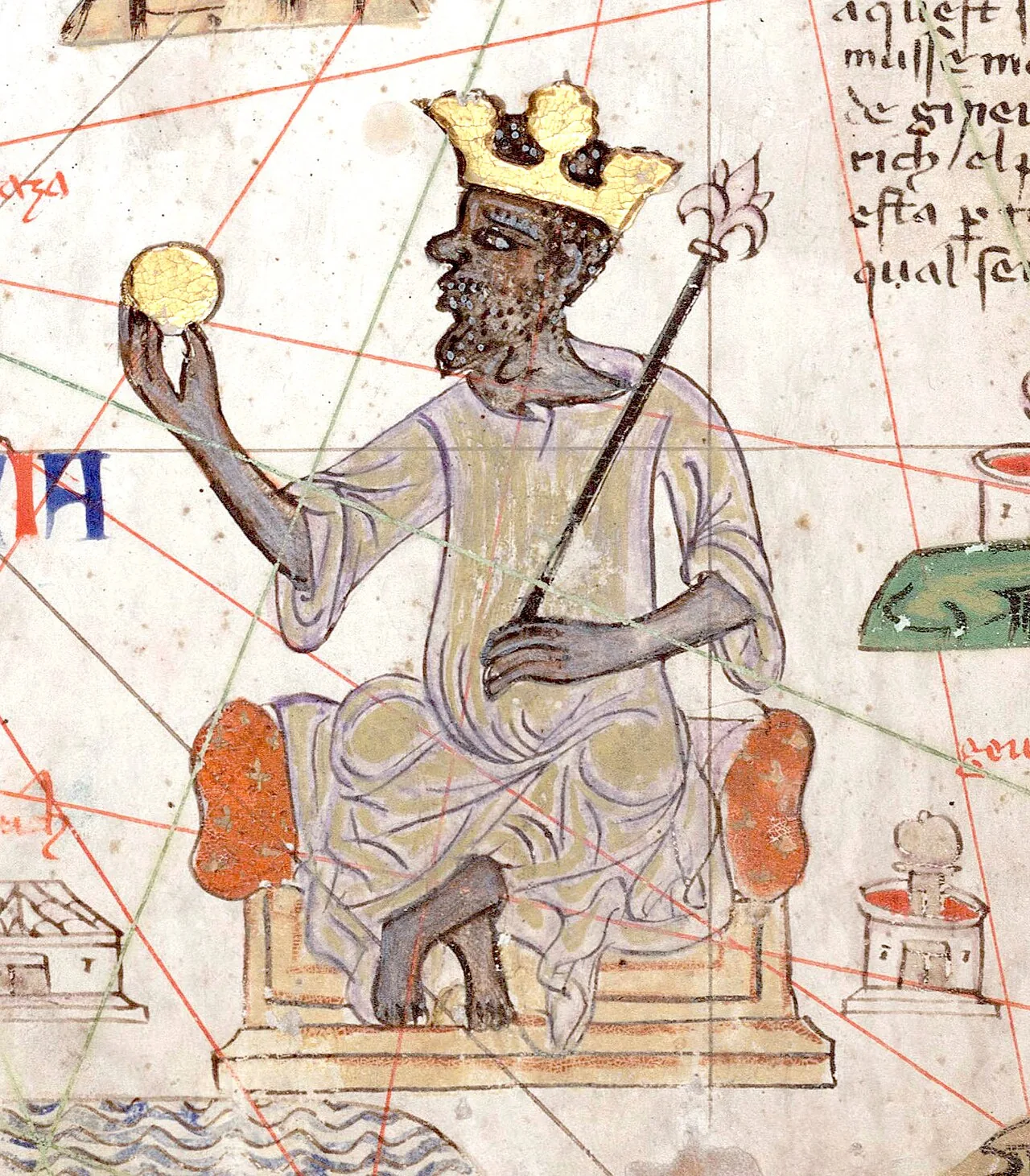
In 1375 a mapmaker on the island of Majorca drew the king of Mali on his map of the world. The king sits on a throne and holds a nugget of gold. For the first time, many Europeans and Middle Easterners learned of a rich and powerful kingdom south of the Sahara. West Africa was not a remote or isolated region. For a thousand years a trade across the world’s largest hot desert connected it to the Mediterranean world.
Guiding question: How did gold, salt, and trade across the Sahara help the kingdoms of Ghana, Mali, and Songhai to become rich and powerful, and how did Islam and learning shape their cities?
1. The land and the trade
Desert, Sahel, and river
West Africa has zones that run from east to west. In the north lies the Sahara, a desert of sand and stone. South of it is the Sahel, a belt of dry grassland. Its name means “shore” in Arabic, because travelers thought of the desert as a sea and of the Sahel as its coast. Farther south are wetter savanna and then the forests of the coast. The Niger River flows from the highlands near the Atlantic in a great curve through the Sahel. Its floods allowed farmers to grow millet, sorghum, and rice. The river was also a highway for canoes, and cities such as Djenné, Timbuktu, and Gao grew along it.
Gold for salt
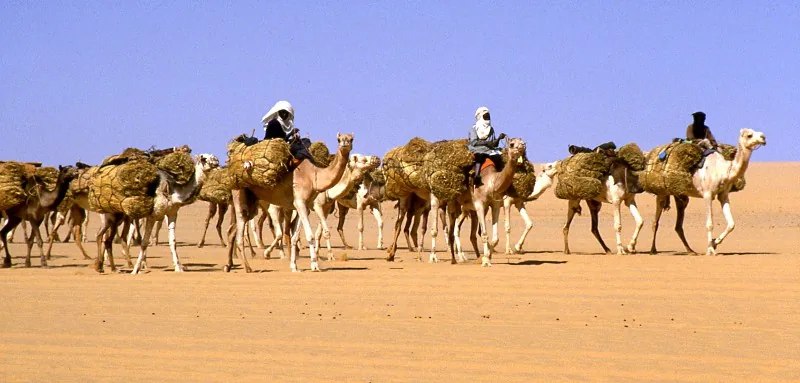
The kingdoms of the region grew rich because the resources of the north and the south were different. The forest and savanna in the south had gold. Miners washed it from river sand or dug it from shallow pits at Bambuk, Bure, and later in the Akan lands. People in the savanna had plenty of gold but little salt. They need it in a hot climate to stay healthy and to preserve food. The Sahara has salt. Workers cut it from slabs at mines such as Taghaza and Taoudenni.
Berber and Arab merchants carried the salt south and returned with gold. They also brought copper, cloth, horses, books, and beads, and they took away ivory, kola nuts, and enslaved people. The trade became large only after people began to use camels widely in the Sahara in the first centuries CE. Camels can walk for days without water. Caravans of hundreds or thousands of animals followed routes between wells, with guides who knew the desert.
Document 1 – The salt mines of the Sahara
In the sand is a salt mine; they dig for the salt, and find it in thick slabs, lying one on top. of the other, as though they had been tool-squared and laid under the surface of the earth. A camel will carry two of these slabs. No one lives at Taghaza except the slaves of the Massufa tribe, who dig for the salt; […] At Iwalatan a load of salt brings eight to ten mithqals; in the town of Malli [Mali] it sells for twenty to thirty, and sometimes as much as forty. The negroes use salt as a medium of exchange, just as gold and silver is used [elsewhere]; they cut it up into pieces and buy and sell with it.
Source: Ibn Battuta, Travels in Asia and Africa, 1325-1354, on Taghaza in the Sahara, 1352, translated by H. A. R. Gibb (London, 1929), as reproduced in the Internet Medieval Sourcebook, Fordham University.
*Taghaza: a salt-mining village in the Sahara. *Iwalatan: Walata. *mithqal: a unit of gold weight. *Malli: Mali.
Commentary. Ibn Battuta, a traveler from Morocco, saw Taghaza in 1352 on his way to Mali. He found a village built of salt, worked by enslaved miners, with no trees, only sand. He also noticed that the value of salt multiplied as it moved south. People used pieces of it like money. The passage shows that the rulers of the south, who taxed the traders, could grow rich from this exchange.
Definition: Trans-Saharan trade
The long-distance trade across the Sahara, in which caravans carried salt, cloth, and metal goods from North Africa to West Africa and brought back gold, ivory, and other goods.
Definition: Sahel
The dry belt of grassland between the Sahara and the wetter savanna of West Africa. The great trading cities and kingdoms of the region lay in the Sahel.
2. Ghana: the land of gold
The first large kingdom of the region was Ghana. Its people were the Soninke. The word ghana was the title of the king, whom the Arab writers called “the king of gold.” The people called the country itself Wagadu. The capital stood between the gold fields to the south and the desert to the north.
It was probably at the site now called Kumbi Saleh in southern Mauritania. By about 800 CE its kings controlled the trade. They taxed every load of salt and gold that entered or left. They kept the large nuggets of gold for themselves, so that only gold dust circulated. This policy kept gold scarce, and the price of gold high. The kings also owned a strong army with iron weapons and horsemen.
The most detailed description comes from the Muslim geographer al-Bakri, who lived in Spain and wrote in 1068. He never visited Ghana but collected the reports of merchants. Al-Bakri described a capital of two towns about six miles apart. One was for Muslim merchants, with a number of mosques, and one for the king, with a palace and sacred groves.
He wrote that the king practiced the traditional religion of his people and employed Muslims as interpreters and officials. Ghana weakened in the 11th century. Historians think that several causes together were responsible. Drought hurt farming and herding. Rival trade centers rose. The Almoravids, a Berber movement from the Sahara, also pressed the kingdom. By about 1200 Ghana had broken into smaller states, and a people called the Sosso took control of the region.
3. Mali: Sundiata and Mansa Musa
The founder
The Mande people built the kingdom of Mali on the upper Niger. According to oral tradition, preserved in the epic of Sundiata, a young prince named Sundiata Keita, had been lame as a child and had been exiled. He returned and defeated the Sosso king Sumanguru about 1235 at the battle of Kirina. He then took the title mansa, “emperor,” and made his capital at Niani. The griots handed down the tradition. They are hereditary storytellers and musicians who remember genealogies and tell the history of the kings. Historians use the epic carefully, because it is a poem and a legend. But it preserves the memory of how the people of Mali understood their origin.
Definition: Griot
A West African storyteller, poet, and musician. A griot keeps the oral history of a people and its rulers and passes it down from one generation to the next.
Mansa Musa
Mali reached its peak under Mansa Musa, who ruled from about 1312 to 1337. His empire stretched from the Atlantic coast to Gao, and it controlled the gold fields of Bambuk and Bure. In 1324 he set out on the hajj, the Muslim pilgrimage to Mecca. His very large caravan included servants, soldiers, and camels carrying gold.
Arab writers say that he gave so much gold to the poor and spent so much in Cairo. As a result, gold lost value there for years. The numbers given in the sources are uncertain, but all of them agree that the journey was a spectacle. The sultan of Egypt received him. Thus the pilgrimage placed Mali on the map of the Islamic world and of Europe.
Document 2 – The king of Mali on a map of 1375
Source: Catalan Atlas (1375), National Library of France; reproduction, Wikimedia Commons.
Commentary. The mapmaker never went to Africa. He knew of the king of Mali from the reports of merchants who traded in the western Mediterranean. He drew him dressed like a European king. The gold nugget is the symbol of his wealth. The map shows how famous Mansa Musa had become, nearly fifty years after his pilgrimage.
When he returned from Mecca, Mansa Musa brought back scholars, books, and an architect from Granada and Egypt. Builders raised mosques of mud brick and wood in Timbuktu and Gao, among them the Djinguereber mosque (1327). Timbuktu grew into a center of learning. A mansa ruled Mali with governors of provinces, the farbas, and a court of officials and army commanders. The people of each province kept their own rulers if they paid tribute and sent troops. About 1352-1353 the traveler Ibn Battuta spent several months at the court of Mansa Sulayman, the brother of Musa. He left the only eyewitness description of Mali.
Document 3 – The court of Mali
The negroes are of all people the most submissive to their king and the most abject in their behaviour before him. They swear by his name, saying “Mansa Sulayman ki” [in Mandingo, “the emperor Sulayman has commanded”]. If he summons any of them while he is holding an audience in his pavilion, the person summoned takes off his clothes and puts on worn garments, removes his turban and dons a dirty skullcap, and enters with his garments and trousers raised knee-high. He goes forward in an attitude of humility and dejection and knocks the ground hard with his elbows, then stands with bowed head and bent back listening to what he says. If anyone addresses the king and receives a reply from him, he uncovers his back and throws dust over his head and back, for all the world like a bather splashing himself with water.
Source: Ibn Battuta, Travels in Asia and Africa, 1325-1354, on the court of Mansa Sulayman of Mali, 1352-1353, translated by H. A. R. Gibb (London, 1929), Internet Medieval Sourcebook, Fordham University.
*abject: humble. *pavilion: a large tent or covered platform. *negroes: the word Ibn Battuta used for the black Africans he met; it is a historical term of his time.
Commentary. Ibn Battuta describes court etiquette: people who approached the king took off their good clothes, sprinkled dust on their heads, and spoke with their heads down. He thought these customs strange and even “grotesque,” because he judged them by the rules of his own society. For the Malians, they were marks of respect. The text shows that the mansa was an all-powerful king. It also shows that the people publicly remembered and confirmed his deeds.
Document 4 – Justice and security in Mali
The negroes possess some admirable qualities. They are seldom unjust, and have a greater abhorrence of injustice than any other people. Their sultan shows no mercy to anyone who is guilty of the least act of it. There is complete security in their country. Neither traveller nor inhabitant in it has anything to fear from robbers or men of violence. They do not confiscate the property of any white man who dies in their country, even if it be uncounted wealth. On the contrary, they give it into the charge of some trustworthy person among the whites, until the rightful heir takes possession of it.
Source: Ibn Battuta, Travels in Asia and Africa, 1325-1354, on the people of Mali, 1352-1353, translated by H. A. R. Gibb (London, 1929), Internet Medieval Sourcebook, Fordham University.
*abhorrence: strong dislike. *confiscate: take away by authority. *heir: the person who inherits.
Commentary. Ibn Battuta disliked some Malian customs, but he praised the justice of the people and the safety of the roads. Merchants could cross the country without fear of robbers. The property of a foreigner who died stayed safe for his heirs. This reputation for security was a major reason why the traders chose to bring their goods to Mali.
4. Songhai: the largest empire
After the death of Mansa Musa’s successors, Mali weakened through quarrels over the throne and the rebellion of provinces. In the east, Gao on the Niger had been the capital of the Songhai people since about 1000 CE. Songhai became independent of Mali in the 1400s, and its ruler Sunni Ali (about 1464-1492) turned it into an empire. He was a great soldier. He built a fleet of war canoes and a force of cavalry. Then he took Timbuktu in 1468, and in 1473 he took Djenné after a long siege. Later writers remember him as a ruler who respected the local religion as well as Islam. The scholars of Timbuktu, however, disliked him.
His successor Askia Muhammad (also known as Muhammad Ture, 1493-1528) seized power from Sunni Ali’s son. A devout Muslim, he made the pilgrimage to Mecca in 1496-1497 and received the title of caliph of the Sudan. Then he organized the empire into provinces led by governors, with a standing army, tax collectors, and a system of weights and measures. Under him Songhai reached from the Atlantic fringe to the Hausa cities, and included the salt mines of Taghaza. His reign was the golden age of Timbuktu. Writers such as the Moorish traveler Leo Africanus described the city’s wealth. He visited about 1510 and 1513 and later wrote a book on Africa in Italian.
Document 5 – Timbuktu in the early 1500s
Here are many shops of artificers, and merchants, and especially of such as weave linen and cotton cloth. And hither do the Barbarie-merchants bring cloth of Europe. […] salt is very scarce here; for it is brought hither by land from Tegaza, which is five hundred miles distant. […] The rich king of Tombuto hath many plates and sceptres of gold, some whereof weigh 1300. pounds: and he keeps a magnificent and well furnished court. […] Here are great store of doctors, judges, priests, and other learned men, that are bountifully maintained at the king’s cost and charges. And hither are brought divers manuscripts or written books out of Barbary, which are sold for more money than any other merchandise.
Source: Leo Africanus, A Geographical History of Africa, on Timbuktu about 1510-1513, in the English translation of John Pory (London, 1600), modernized spelling as published in the EEBO-TCP/EarlyPrint text; marginal notes omitted.
*artificers: craftsmen. *Barbarie: North Africa. *Tegaza: Taghaza. *sceptres: staffs carried by kings as signs of power.
Commentary. Leo Africanus was born in Granada. After his family moved to Morocco, he traveled across North Africa and the Sahara as a young diplomat. Italian pirates later captured him and presented him to Pope Leo X. An English translation of his book appeared in 1600. The text gives a view of Timbuktu at its peak: busy markets, rich merchants, a king with gold, and scholars. Note that Leo praises books as a major trade good, more profitable than other goods. That detail shows the importance of learning in the city.
Songhai did not survive for long after Askia Muhammad. His sons fought each other for power, and civil wars weakened the empire. In 1591 the sultan of Morocco, Ahmad al-Mansur, sent an army of about four thousand men across the Sahara. The soldiers had guns and cannon. At the battle of Tondibi, the Songhai army of cavalry and archers could not stand against firearms. The Moroccans took Gao and Timbuktu, but they could not rule the vast territory, and Songhai broke into small states. The great age of the Sahelian empires was over. By that time European ships were opening a new trade on the Atlantic coast.
5. Learning, faith, and art
Mosques and schools
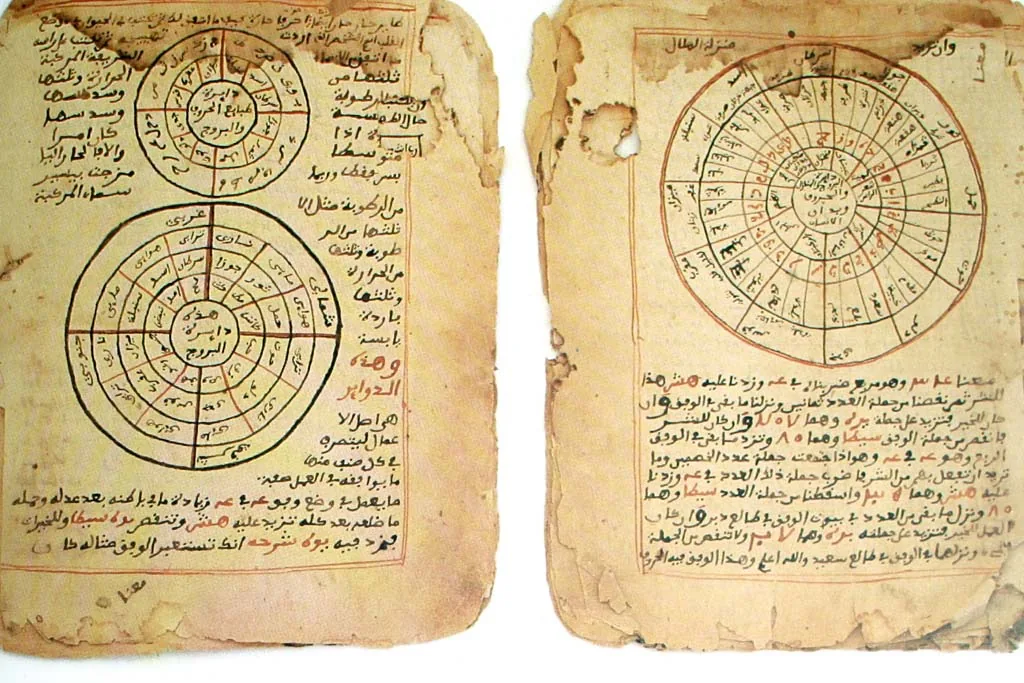
Islam reached West Africa with merchants, and rulers like Mansa Musa and Askia Muhammad supported it. Many people in the countryside kept older beliefs in ancestors and nature spirits alongside the faith. Cities such as Timbuktu became centers of study. Around the mosques of Sankore, Djinguereber, and Sidi Yahya were schools. Students there learned the Qur’an, law, grammar, astronomy, and mathematics. Scholars wrote and copied thousands of books, and their families preserved many of these manuscripts for centuries. Today, hundreds of thousands of manuscripts survive in Timbuktu and other towns. They deal with law, medicine, history, science, and poetry.
Architecture and memory
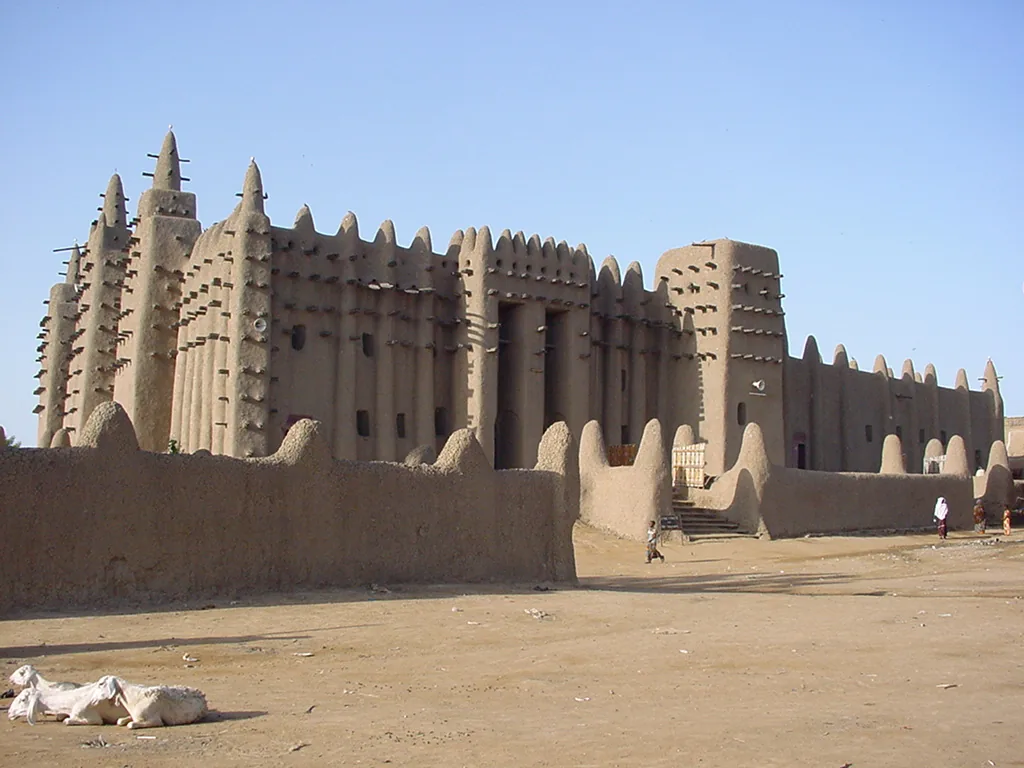
West African builders made large mosques and palaces of sun-dried mud brick (called banco). They reinforced the walls with wooden beams that stick out and serve as scaffolding for yearly repairs. The Great Mosque of Djenné is the best-known example. The community rebuilds and plasters it every year, and this practice has kept the building alive for centuries. In the same way, the griots preserve the memory of the past. People kept much of the history of the region in memory and in song, not in books.
- about 800 Ghana’s kings control the gold-salt trade
- 1068 Al-Bakri describes Ghana
- about 1235 Sundiata wins the battle of Kirina and founds Mali
- 1312-1337 Reign of Mansa Musa
- 1324 Mansa Musa’s pilgrimage to Mecca
- 1327 The Djinguereber mosque is built in Timbuktu
- 1352-1353 Ibn Battuta visits Mali
- 1468 Sunni Ali takes Timbuktu
- 1493 Askia Muhammad becomes ruler of Songhai
- 1591 Moroccan forces win at Tondibi
Key takeaways
- West African kingdoms grew rich by controlling trans-Saharan trade, which exchanged Saharan salt for gold from the south.
- Ghana (about 800-1100) was the first great kingdom; its kings taxed the gold and salt trade.
- Mali, founded by Sundiata about 1235, reached its peak under Mansa Musa (1312-1337), whose pilgrimage to Mecca in 1324 made it famous.
- Songhai, under Sunni Ali and Askia Muhammad, became the largest empire, with Gao and Timbuktu as its main cities.
- Timbuktu was a center of Islamic learning, with schools, libraries, and thousands of manuscripts.
- Songhai fell in 1591 when Morocco’s army with guns won at Tondibi.

Quick review: flashcards
Tap a card to see the answer.