


This Grade 7 Medieval and Early Modern World lesson covers The Byzantine Empire, part of the unit “Empires and faiths.” First, read the full lesson with its primary sources, maps and key terms. Then practice with the worksheet, check yourself with the quiz and get ready with the test.
On May 29, 1453, after a siege of seven weeks, Ottoman soldiers broke through the walls of Constantinople. The last emperor, Constantine XI, died in the fighting. With him ended a state that had begun in the age of Augustus. It had outlived the last western emperor, who lost his throne in 476, by nearly a thousand years. Its people never called themselves “Byzantines.” They called themselves Romans, and their ruler was the Roman emperor. Later European scholars invented the name “Byzantine.” The German historian Hieronymus Wolf first used it in 1557, and it comes from Byzantium, the old Greek town on which Constantine had built his new capital.
Guiding question: How did the Eastern Roman Empire survive for a thousand years after the fall of Rome, and what did it leave to the Mediterranean world, to Russia, and to Western Europe?
1. A new Rome on the Bosporus
The city and its location
In 330 CE the emperor Constantine dedicated a new capital on the site of Byzantium. He gave it his own name, Constantinople, “the city of Constantine.” The choice was shrewd. The city stands on a triangle of land between the Sea of Marmara, the Golden Horn, and the Bosporus. The Bosporus is the narrow strait that links the Black Sea and the Mediterranean.
Whoever held it controlled the sea route between two seas and the land route between Europe and Asia. Water protected two sides of the city. In 413, under Theodosius II, a triple line of land walls more than three miles long closed the third side. For centuries these walls stopped Goths, Huns, Avars, Persians, Arabs, Bulgars, and crusaders. They fell only to gunpowder artillery in 1453.
East and West
After the death of the emperor Theodosius in 395, his two sons divided the Roman Empire between them. Invasions tore apart the western half, with its capitals at Milan and then Ravenna. In 476 the Germanic general Odoacer removed the last western emperor. The eastern half was richer, more urban, and easier to defend, and it did not collapse. The eastern emperors kept the Roman name, Roman law, and Roman titles. Over time, however, Greek replaced Latin as the language of government and daily life. The Christian church of the East also took forms different from the church of Rome. This is why historians use the word Byzantine for the Eastern Roman Empire of the Middle Ages.
Definition: Byzantine Empire
The eastern half of the Roman Empire, which survived from 395 until 1453 with Constantinople as its capital. Its people spoke mostly Greek, followed the Orthodox form of Christianity, and called themselves Romans.
Definition: Autocrat
A ruler who holds all power and answers to no human authority. The Byzantine emperor was an autocrat, but people expected him to defend the Christian faith and to obey the law.
2. Justinian and Theodora
An ambitious emperor
The greatest ruler of the early empire was Justinian, who reigned from 527 to 565. He was the nephew of an army officer who had risen from a peasant family in the Balkans to the throne. Justinian married Theodora in 525. She was the daughter of a bear keeper at the Hippodrome and had been an actress, a low social rank. The two of them ruled as partners until she died in 548. Justinian dreamed of restoring the old Roman Empire. He had three great goals: to reconquer the lost western provinces, to give the empire one clear body of law, and to make Constantinople the most splendid city in the world.
The first test came in January 532. During a chariot-racing day in the Hippodrome, the rival fans, called the Blues and the Greens, joined together in a riot known as the Nika Revolt, after their cry “Nika!” (“Win!”). They burned much of the center of the city and proclaimed a new emperor. Justinian was ready to flee, but according to Procopius, Theodora refused to leave and said that she preferred to die an empress. The general Belisarius and his troops then trapped the crowd inside the Hippodrome. Procopius reports that they killed about thirty thousand people. The rioters had burned the old cathedral of Hagia Sophia, and Justinian used the disaster to build a new one.
Hagia Sophia
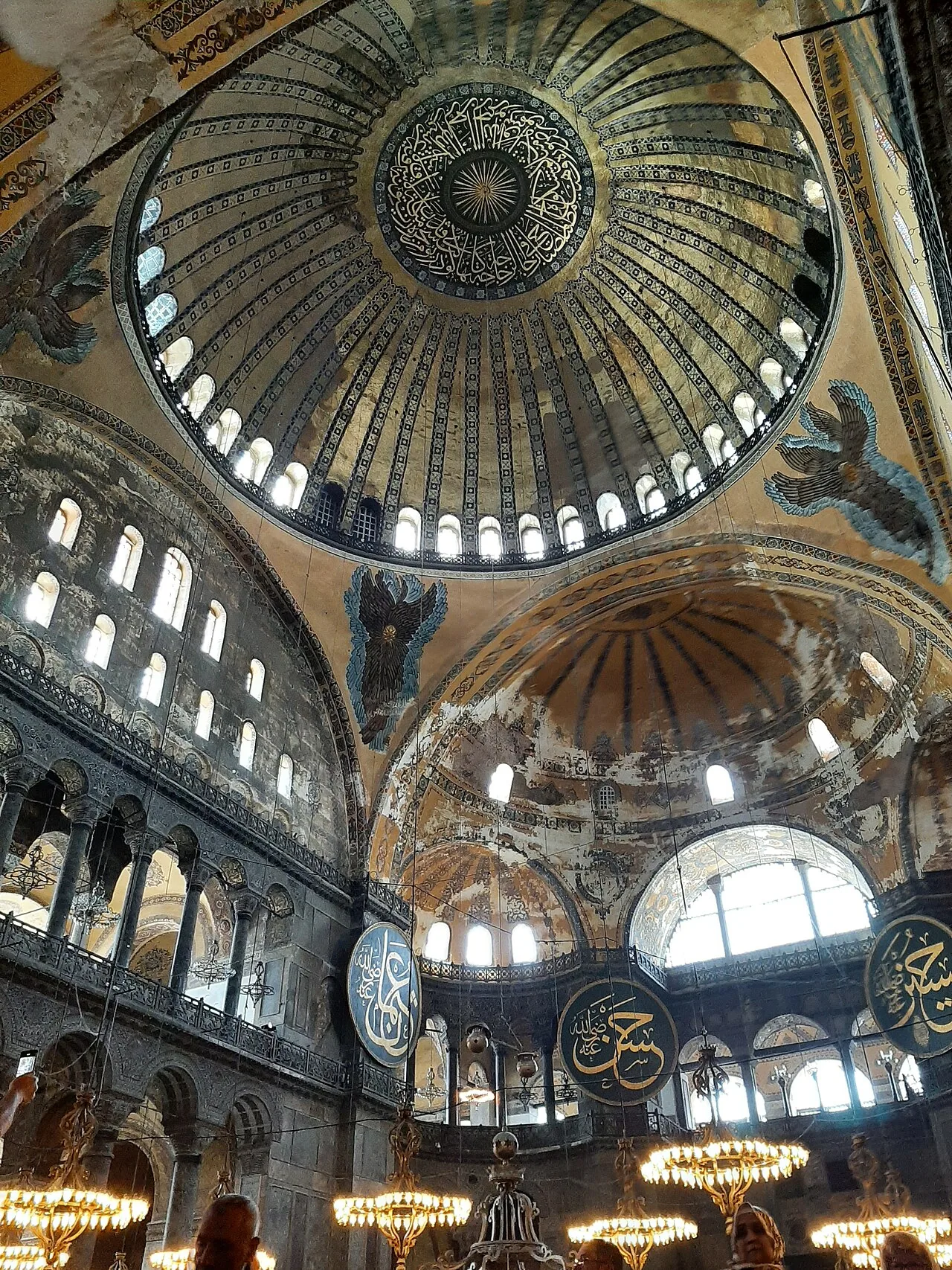
Justinian hired two scientists as architects, Anthemius of Tralles and Isidore of Miletus. They were experts in geometry and mechanics rather than builders in the usual sense. Work began in 532 and the church was dedicated on December 27, 537, only five years later. Its dome rises about 180 feet above the floor and spans about 100 feet.
It seems to float above a ring of forty windows. A later earthquake damaged the dome in 558, and builders rebuilt it and made it higher in 562. The church was the center of the Orthodox faith for nearly a thousand years. After 1453 it became a mosque, in 1935 it became a museum, and in 2020 it opened again as a mosque.
Document 1 – The Great Church
The church is singularly full of light and sunshine; you would declare that the place is not lighted by the sun from without, but that the rays are produced within itself, such an abundance of light is poured into this church […] A spherical-shaped dome standing upon this circle makes it exceedingly beautiful; from the lightness of the building, it does not appear to rest upon a solid foundation, but to cover the place beneath as though it were suspended from heaven by the fabled golden chain.
Source: Procopius, Buildings (De Aedificiis), Book I, about 560 CE, on the Great Church (Hagia Sophia), translated by W. R. Lethaby and H. Swainson, The Church of St. Sophia, Constantinople (1894), as reproduced in the Internet Medieval Sourcebook, Fordham University.
*Great Church: Hagia Sophia, “Holy Wisdom.” *the fabled golden chain: in Greek myth, a chain by which Zeus could hold up the world.
Commentary. Procopius was the secretary of Belisarius and the main historian of Justinian’s reign. In the Buildings he describes the emperor’s works, and he wrote as a court author who wanted to please the emperor. His words show what impressed a sixth-century visitor: the light, the harmony of the parts, and the dome that seems to hang from the sky. We should remember, however, that the praise is official. The same author wrote a very different book about Justinian, which we will read later in this unit.
The Code of Justinian
Roman law had grown for a thousand years. By Justinian’s time it was a mass of old statutes, decrees, and opinions that often contradicted one another. Justinian appointed a commission of lawyers led by Tribonian to put it in order.
The result, finished between 529 and 534, was the Corpus Juris Civilis, the “Body of Civil Law.” It has four parts: the Code, which collects the laws of the emperors; the Digest, which gathers the opinions of the great jurists; the Institutes, a textbook for students; and the Novels, the new laws issued after 534. The principles that the Institutes state, such as giving every person what is due to him, were studied in the law schools of medieval Europe. They shaped the civil-law systems of many countries today.
Document 2 – The aim of law
JUSTICE is the constant and perpetual wish to render every one his due. […] Jurisprudence is the knowledge of things divine and human; the science of the just and the unjust. […] The maxims of law are these: to live honesty, to hurt no one, to give every one his due.
Source: The Institutes of Justinian, Book I, Title I, issued in 533 CE at the order of the emperor Justinian (English translation as reproduced in the Internet Medieval Sourcebook, Fordham University).
*jurisprudence: the study of law. *render: give.
Commentary. The text opens a textbook and not a statute. Its authors define justice as an unchanging wish to give every person his due. They give three rules for the lawyer: live honorably, harm no one, and give each person what belongs to him. Notice that these ideas come from Roman jurists who lived long before Justinian. His commission preserved them and gave them the force of imperial law.
War, plague, and cost
Justinian’s generals did reconquer much of the Mediterranean. Belisarius destroyed the Vandal kingdom in North Africa in 533-534. The long Gothic War in Italy (535-554) was harder. It devastated the peninsula; the Byzantines also took a strip of southeastern Spain from the Visigoths in the 550s. The empire reached its greatest extent around the Mediterranean. But the cost was heavy.
Taxes were high, the army in the East was weak, and in 541-542 a plague, the first great outbreak of what is now called the Justinianic Plague, reached Constantinople from Egypt. Procopius wrote that thousands of people died every day in the capital at the worst moment. Historians think the empire lost a large share of its population. Within three years of Justinian’s death in 565, the Lombards invaded Italy, and the western gains slipped away.
3. Faith, war, and government
The emperor and the Orthodox Church
The Byzantine emperor was both a political and a religious figure. The army, the senate, and the people of the capital chose him, but the patriarch crowned him. People said that he ruled with God’s approval. He appointed bishops, called church councils, and was expected to defend the faith. The patriarch of Constantinople was the head of the eastern church. The mosaic below shows the style in which the emperor presented himself: crowned, with a halo, and in the company of the church and the army. Modern historians sometimes call this union of church and state caesaropapism, but the patriarchs often resisted the emperors. Bishops of Rome rejected the idea that an emperor could rule the church.
Document 3 – The emperor Justinian and his court
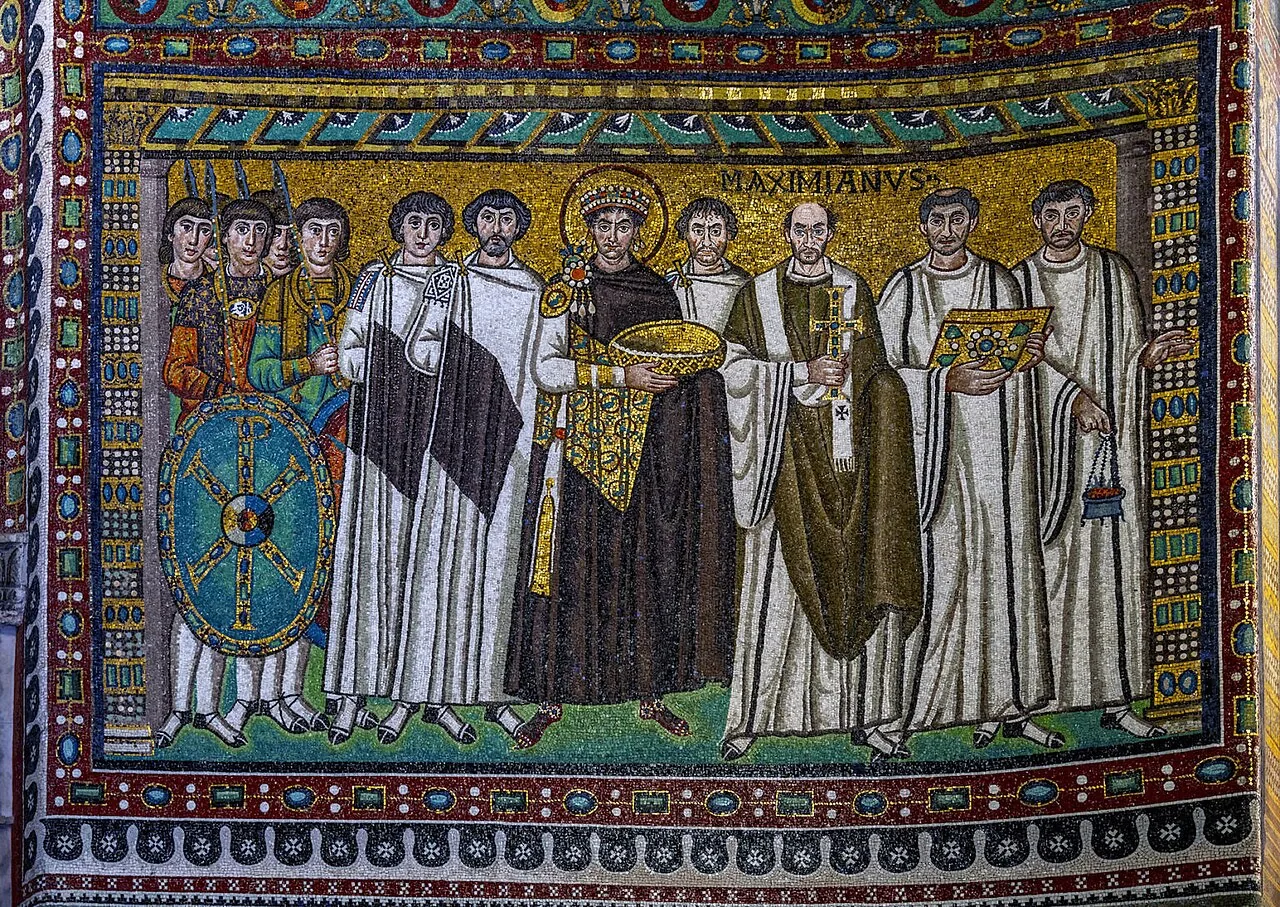
Source: mosaic in the apse of the Church of San Vitale, Ravenna, about 547 CE; photograph, Wikimedia Commons.
Commentary. The emperor stands in the center, on the same line as Bishop Maximian, and the halo around his head marks his sacred role. On his left are officials in white and on his right the soldiers, with a shield showing the Chi-Rho, the first two Greek letters of Christ’s name. Justinian never visited Ravenna. The mosaic was made after his generals took the city from the Goths in 540. It tells every visitor who rules Italy.
Defending the empire
After Justinian the empire faced one crisis after another. The Persians, the Avars, and the Slavs attacked from the east and north. In 626 Persians and Avars together besieged Constantinople, and the emperor Heraclius then defeated Persia in a bold campaign in 627-628. The victory left both empires exhausted, and a new power appeared out of Arabia.
After the battle of the Yarmuk in 636 the Arabs took Syria and Palestine, and by 642 they held Egypt. The empire lost its richest provinces, but it survived. Heraclius and his successors reorganized the army and the countryside into districts called themes, each under a military governor. In the themes, soldiers received farms and in return served in the army. Greek became the official language of government.
In 674-678 and again in 717-718 Arab fleets besieged Constantinople. The defenders used a secret weapon called Greek fire, a burning liquid that sailors sprayed from tubes on ships and that kept burning on water. Its recipe was guarded so closely that it has never been recovered. Together with the great walls, it saved the city and also saved Europe from an invasion from the southeast.
Definition: Theme
A military and administrative province of the Byzantine Empire, organized from the 7th century. The governor was a general, and soldier-farmers received land in return for service.
The dispute over icons
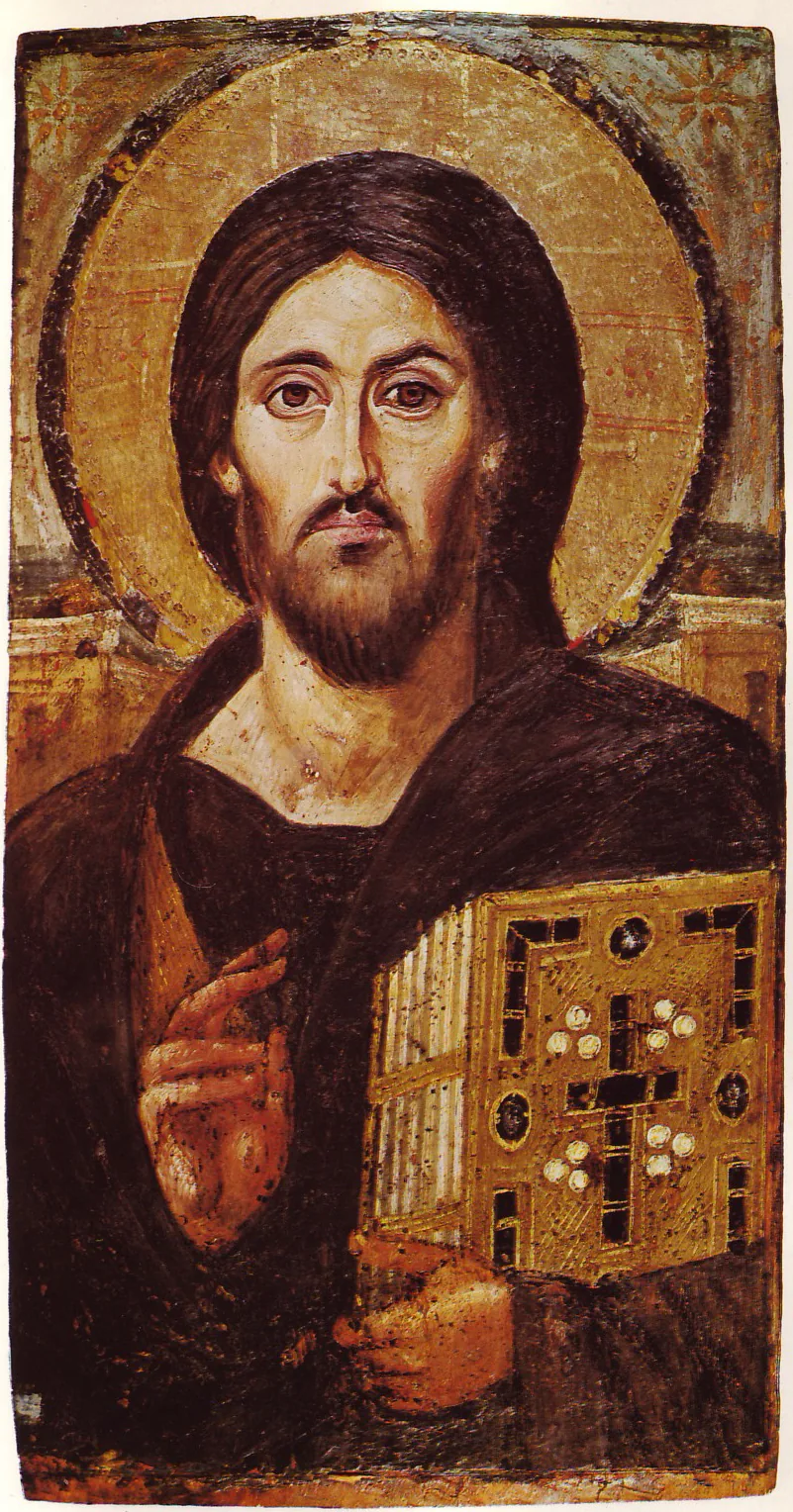
In 726 the emperor Leo III began a policy against religious images, called icons, which he and his supporters believed encouraged the worship of objects. Soldiers removed or whitewashed images, and defenders of icons, many of them monks, were punished. The period of iconoclasm, “image-breaking,” lasted, with a pause, until 843, when the empress Theodora (a different woman from Justinian’s wife), ruling for her young son, restored the icons. The dispute shows how deeply religion was woven into politics. It left a mark on Orthodox art, in which sacred images follow strict traditions and are meant to be venerated.
4. The golden age and the long decline
Trade, wealth, and Basil II
For most of the Middle Ages Constantinople was the largest and richest city in Europe. Its gold coin, the solidus (in Greek, nomisma), kept its weight and purity for centuries and was accepted from England to China. Merchants sold silk, spices, ivory, and luxury goods in its markets. Justinian had learned the secret of making silk when, according to Procopius, monks smuggled silkworm eggs out of Central Asia in hollow canes about 552. The silk industry then became an imperial monopoly. Foreign visitors, such as Liutprand of Cremona, were impressed by the wealth and also irritated by the haughty ceremonies of the court.
Document 4 – A Western ambassador in Constantinople
Liutprand, bishop of Cremona in Italy, went to Constantinople in 968 as the ambassador of the western emperor Otto I. The Byzantine emperor Nicephorus II Phocas had just told him that the Westerners were “not Romans but Lombards.” Liutprand answers him.
And he called to himself a certain number of such and called them Romans. From such nobility those are descended whom you call world-rulers, that is, emperors; whom we, namely the Lombards, Saxons, Franks, Lotharingians, Bavarians, Swabians, Burgundians, so despise, that when angry, we can call our enemies nothing more scornful than Roman-comprehending in this one thing, that is in the name of the Romans, whatever there is of contemptibility, of timidity, of avarice, of luxury, of lying: in a word, of viciousness. […] Nicephorus, exasperated by these words, commanded silence with his hand, and bade that the long narrow table should be taken away, and that I should return to my hated habitation-or, to speak more truly, my prison.
Source: Liutprand of Cremona, Embassy to Constantinople (Relatio de legatione Constantinopolitana), 968-969 CE, translated by Ernest F. Henderson, Select Historical Documents of the Middle Ages (1910), text modernized in the Internet Medieval Sourcebook, Fordham University.
*Romulus: legendary founder of Rome. *insolvent debtors: people who could not pay what they owed. *Nicephorus: the Byzantine emperor Nicephorus II Phocas (963-969).
Commentary. Liutprand writes as an angry ambassador who has had to wait in a poor house, and his words are not neutral. Still, the passage shows that in the tenth century the Byzantines considered themselves the only true Romans, and that Westerners resented them. It also shows the distance between the two Christian worlds, which were drifting apart.
The empire reached a second peak under the Macedonian dynasty. Basil II (976-1025), called the “Bulgar-slayer,” defeated the Bulgarian kingdom in 1014 and brought the Balkans back under imperial rule. When he died, the empire stretched from the Danube to northern Syria and from southern Italy to Armenia. Missionaries from Constantinople also carried Christianity and writing to the Slavs. In 863 the brothers Cyril and Methodius traveled to Moravia, and their disciples later developed the Cyrillic alphabet, still used in Russia, Ukraine, Bulgaria, and Serbia. In 988 the prince Vladimir of Kyiv accepted baptism from Constantinople, and Russia entered the Orthodox world.
Schism, defeat, and conquest
The two halves of the church had long disagreed about the pope’s authority and about points of doctrine and practice. In 1054 a papal legate placed a bull of excommunication on the altar of Hagia Sophia. The patriarch Michael Cerularius answered in kind. This Great Schism separated the Roman Catholic Church of the West from the Orthodox Church of the East, and it has lasted to the present.
Meanwhile new enemies arose. In 1071 the Seljuk Turks crushed the Byzantine army at Manzikert and captured the emperor. Within a few years the Turks took most of Anatolia, the empire’s recruiting ground. The emperor Alexios I asked the pope for soldiers, and the appeal helped to launch the First Crusade in 1095.
The Fourth Crusade and the fall
The crusaders were no friends of the empire. In 1204 the Fourth Crusade was supposed to attack Egypt, but the Venetians and a rival claimant to the throne diverted it. The crusaders then captured and plundered Constantinople. They set up a Latin Empire, and the Byzantines ruled only from exile at Nicaea until Michael VIII Palaiologos retook the city in 1261.
The restored empire was a small state of Greece, the northwest corner of Anatolia, and a few islands, caught between Serbs, Bulgars, and the rising Ottoman Turks. In 1453 Sultan Mehmed II, who was twenty-one years old, besieged the capital with a large army and huge cannon. The city fell on May 29. The empire ended, but its heritage lived on.
- 330 Constantine dedicates Constantinople
- 395 The Roman Empire is divided into East and West
- 476 The last western emperor is removed
- 527-565 Reign of Justinian
- 532-537 Hagia Sophia is built
- 636 The Arabs win at the Yarmuk
- 726-843 Iconoclasm, with a pause
- 1014 Basil II defeats the Bulgarians
- 1054 The Great Schism
- 1071 Defeat at Manzikert
- 1204 The Fourth Crusade sacks the city
- 1261 The Byzantines retake Constantinople
- 1453 The Ottomans capture Constantinople
5. The legacy of Byzantium
Byzantium’s greatest service was preservation. Its scholars copied and studied the works of Greek and Roman writers. When Constantinople fell, many Greek scholars brought manuscripts to Italy, where they helped to inspire the Renaissance. Justinian’s law became a model for European legal thought. Byzantine art, with its mosaics, domed churches, and icons, influenced Russia, the Balkans, Venice, and the Muslim world. The Orthodox Church remains one of the main branches of Christianity. Finally, the empire acted as a shield. For centuries its army and walls held back Persians, Arabs, and Turks, giving Western Europe time to develop.
Key takeaways
- The Byzantine Empire was the eastern half of the Roman Empire, with its capital at Constantinople, and it lasted until 1453.
- Justinian (527-565) built Hagia Sophia, compiled Roman law in the Corpus Juris Civilis, and reconquered parts of the West.
- The empire survived Persians and Arabs with strong walls, the theme system, and Greek fire.
- The Great Schism of 1054 divided Eastern Orthodox and Roman Catholic Christians.
- Defeat at Manzikert (1071), the Fourth Crusade (1204), and Ottoman conquest (1453) ended the empire.
- Byzantium preserved Greek and Roman learning, spread Orthodox Christianity to the Slavs, and influenced law and art.

Quick review: flashcards
Tap a card to see the answer.