


This Grade 7 Medieval and Early Modern World test covers The Byzantine Empire. Like a classroom assessment, it includes documents to analyze, knowledge questions and a short writing task. To prepare, review the lesson first, then practice with the worksheet.
Time : 50 min
The test has three parts: knowledge (32 points), documents (48 points), and a written argument (20 points). Answer in complete sentences and cite the documents.
Document 1 – The Byzantine Empire in 565
Schematic map prepared for this unit; borders and routes approximate.
Document 2 – The emperor Justinian
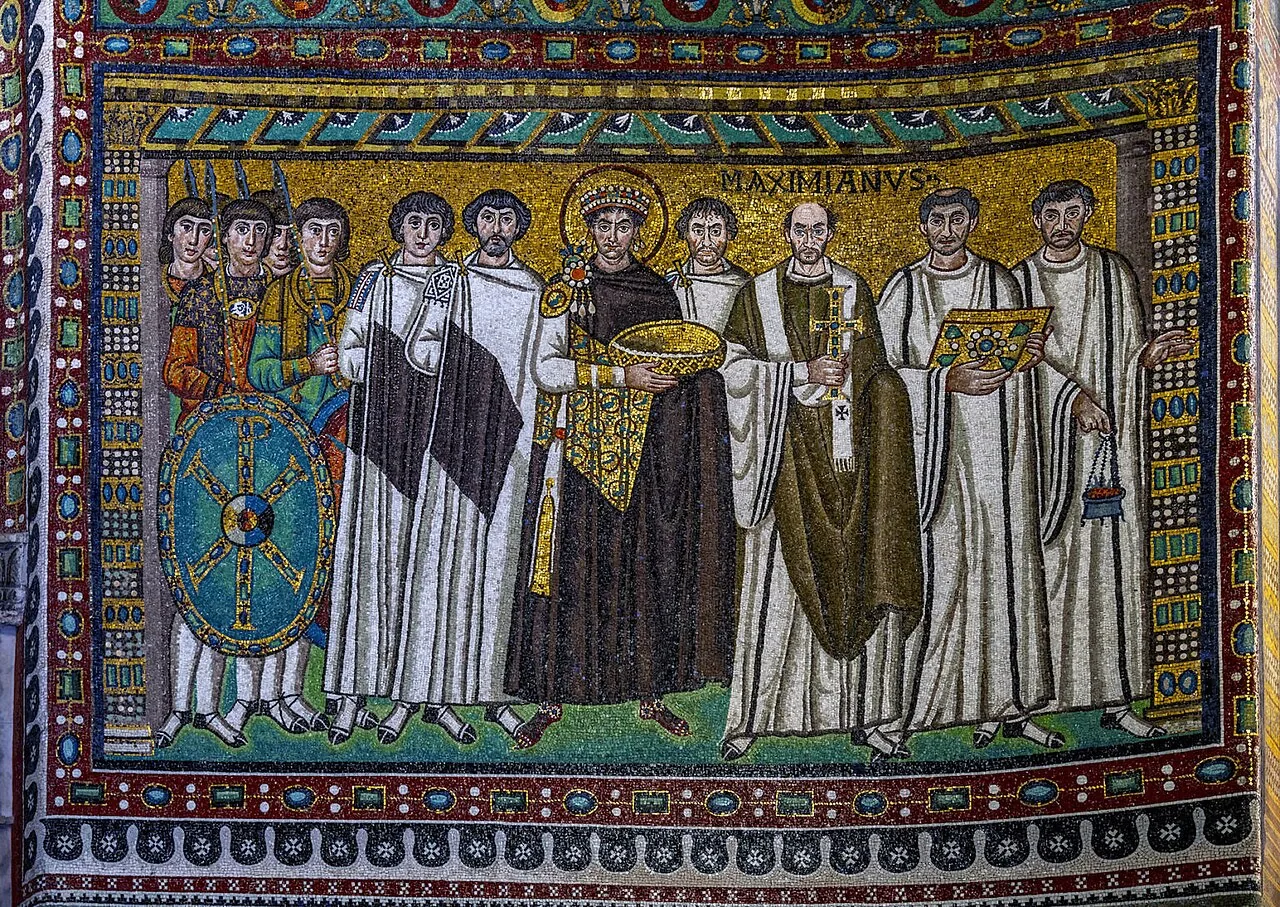
Wikimedia Commons; Church of San Vitale, Ravenna.
Document 3 – The Great Church
The church is singularly full of light and sunshine; you would declare that the place is not lighted by the sun from without, but that the rays are produced within itself, such an abundance of light is poured into this church […] A spherical-shaped dome standing upon this circle makes it exceedingly beautiful; from the lightness of the building, it does not appear to rest upon a solid foundation, but to cover the place beneath as though it were suspended from heaven by the fabled golden chain.
Source: Procopius, Buildings (De Aedificiis), Book I, about 560 CE, on the Great Church (Hagia Sophia), translated by W. R. Lethaby and H. Swainson, The Church of St. Sophia, Constantinople (1894), as reproduced in the Internet Medieval Sourcebook, Fordham University.
*Great Church: Hagia Sophia, “Holy Wisdom.” *the fabled golden chain: in Greek myth, a chain by which Zeus could hold up the world.
Procopius, Buildings, Book I (translation by W. R. Lethaby and H. Swainson, 1894).
Document 4 – Key dates
- 330 Constantine dedicates Constantinople.
- 527 Justinian becomes emperor.
- 537 Hagia Sophia is dedicated.
- 726 Leo III begins iconoclasm.
- 1054 The Great Schism.
- 1204 The Fourth Crusade captures Constantinople.
- 1453 The Ottomans take the city.
Dates as commonly given in reference works such as The Oxford Dictionary of Byzantium (1991).
Questions
- Part 1 – Knowledge. Define Byzantine Empire, theme, and iconoclasm. (12 pts)
- Part 1. Document 1: name the capital of the empire, name two regions that Justinian reconquered, and say what the red arrows show. (12 pts)
- Part 1. Explain why the Great Schism of 1054 was a turning point for Christianity. (8 pts)
- Part 2 – Documents. Document 2: present the document, describe what you see, and explain what it shows about the power of the emperor. (14 pts)
- Part 2. Document 3: present the document, say what Procopius admires in the church, and explain why we must be careful with this source. (14 pts)
- Part 2. Document 4: calculate how many years passed between the dedication of Constantinople and Justinian’s accession, between 537 and the Great Schism, and between 1204 and 1453. (10 pts)
- Part 2. Using Document 1, Document 4, and the lesson, explain two causes of the decline of the Byzantine Empire. (10 pts)
- Part 3 – Written argument. How did the Byzantine Empire survive for a thousand years after the fall of Rome? Write a paragraph or two with a claim, at least two pieces of evidence from the documents or the lesson, and your reasoning. (20 pts)


Quick review: flashcards
Tap a card to see the answer.