


This worksheet on The Byzantine Empire belongs to the Grade 7 Medieval and Early Modern World course. Its questions use primary sources, maps and timelines, and they move from basic recall to short writing tasks. Before you start, review the lesson; afterward, try the true or false quiz.
Exercise 1 : Vocabulary of the Byzantine Empire
Match each term to its meaning, then use three of the terms in sentences of your own.
- Byzantine Empire
- Autocrat
- Theme
- Iconoclasm
- Schism
- Greek fire
Meanings: (a) a break between two groups of a religion; (b) a military and administrative province; (c) the eastern half of the Roman Empire that lasted until 1453; (d) a burning liquid used as a weapon at sea; (e) a ruler with unlimited power; (f) the campaign against religious images in the 8th and 9th centuries.
Exercise 2 : Hagia Sophia in words
Document 1 – The Great Church
The church is singularly full of light and sunshine; you would declare that the place is not lighted by the sun from without, but that the rays are produced within itself, such an abundance of light is poured into this church […] A spherical-shaped dome standing upon this circle makes it exceedingly beautiful; from the lightness of the building, it does not appear to rest upon a solid foundation, but to cover the place beneath as though it were suspended from heaven by the fabled golden chain.
Source: Procopius, Buildings (De Aedificiis), Book I, about 560 CE, on the Great Church (Hagia Sophia), translated by W. R. Lethaby and H. Swainson, The Church of St. Sophia, Constantinople (1894), as reproduced in the Internet Medieval Sourcebook, Fordham University.
*Great Church: Hagia Sophia, “Holy Wisdom.” *the fabled golden chain: in Greek myth, a chain by which Zeus could hold up the world.
- Present the document (nature, author, date, context).
- What impressed Procopius about the light inside the church?
- Find the comparison that he uses to describe the dome.
- Procopius worked for the emperor. How might this affect what he wrote?
- Which details in the text can you check on the photograph of the interior of Hagia Sophia?
Exercise 3 : The aim of law
Document 1 – The aim of law
JUSTICE is the constant and perpetual wish to render every one his due. […] Jurisprudence is the knowledge of things divine and human; the science of the just and the unjust. […] The maxims of law are these: to live honesty, to hurt no one, to give every one his due.
Source: The Institutes of Justinian, Book I, Title I, issued in 533 CE at the order of the emperor Justinian (English translation as reproduced in the Internet Medieval Sourcebook, Fordham University).
*jurisprudence: the study of law. *render: give.
- Present the document (nature, author, date, context).
- How does the text define justice?
- List the three maxims of law.
- Explain how a rule such as “to hurt no one” could help a judge decide a case.
- Why did Justinian want a textbook of law for students?
Exercise 4 : A very different portrait of Justinian
Document 1 – A portrait of the emperor
This Emperor, then, was deceitful, devious, false, hypocritical, two-faced, cruel, skilled in dissembling his thought, never moved to tears by either joy or pain, though he could summon them artfully at will when the occasion demanded, a liar always, not only offhand, but in writing, and when he swore sacred oaths to his subjects in their very hearing. […] Without hesitation he wrote decrees for the plundering of countries, sacking of cities, and slavery of whole nations, for no cause whatever.
Source: Procopius, Secret History (Anecdota), chapter 8, written about 550 CE and not published in his lifetime (English translation as reproduced in the Internet Medieval Sourcebook, Fordham University).
*dissembling: hiding one’s real thoughts. *perjury: lying under oath.
- Present the document (nature, author, date, context).
- List four faults that Procopius assigns to Justinian.
- What is surprising about the fact that Procopius wrote this text?
- Why was the Secret History not published during the author’s life?
- Can a historian trust this document completely? Explain.
Exercise 5 : A mission to Constantinople
Document 1 – Liutprand in Constantinople
Liutprand, bishop of Cremona in Italy, went to Constantinople in 968 as the ambassador of the western emperor Otto I. The Byzantine emperor Nicephorus II Phocas had just told him that the Westerners were “not Romans but Lombards.” Liutprand answers him.
And he called to himself a certain number of such and called them Romans. From such nobility those are descended whom you call world-rulers, that is, emperors; whom we, namely the Lombards, Saxons, Franks, Lotharingians, Bavarians, Swabians, Burgundians, so despise, that when angry, we can call our enemies nothing more scornful than Roman-comprehending in this one thing, that is in the name of the Romans, whatever there is of contemptibility, of timidity, of avarice, of luxury, of lying: in a word, of viciousness. […] Nicephorus, exasperated by these words, commanded silence with his hand, and bade that the long narrow table should be taken away, and that I should return to my hated habitation-or, to speak more truly, my prison.
Source: Liutprand of Cremona, Embassy to Constantinople (Relatio de legatione Constantinopolitana), 968-969 CE, translated by Ernest F. Henderson, Select Historical Documents of the Middle Ages (1910), text modernized in the Internet Medieval Sourcebook, Fordham University.
*Romulus: legendary founder of Rome. *insolvent debtors: people who could not pay what they owed. *Nicephorus: the Byzantine emperor Nicephorus II Phocas (963-969).
- Present the document (nature, author, date, context).
- What does Liutprand say about the origins of the Romans?
- Why does he say that the name Roman is an insult in the West?
- What does the extract show about relations between East and West in the 10th century?
- What are two reasons to treat this text with caution?
Exercise 6 : The Roman state in a Greek city
Document 1 – Liutprand in Constantinople
Liutprand, bishop of Cremona in Italy, went to Constantinople in 968 as the ambassador of the western emperor Otto I. The Byzantine emperor Nicephorus II Phocas had just told him that the Westerners were “not Romans but Lombards.” Liutprand answers him.
And he called to himself a certain number of such and called them Romans. From such nobility those are descended whom you call world-rulers, that is, emperors; whom we, namely the Lombards, Saxons, Franks, Lotharingians, Bavarians, Swabians, Burgundians, so despise, that when angry, we can call our enemies nothing more scornful than Roman-comprehending in this one thing, that is in the name of the Romans, whatever there is of contemptibility, of timidity, of avarice, of luxury, of lying: in a word, of viciousness. […] Nicephorus, exasperated by these words, commanded silence with his hand, and bade that the long narrow table should be taken away, and that I should return to my hated habitation-or, to speak more truly, my prison.
Source: Liutprand of Cremona, Embassy to Constantinople (Relatio de legatione Constantinopolitana), 968-969 CE, translated by Ernest F. Henderson, Select Historical Documents of the Middle Ages (1910), text modernized in the Internet Medieval Sourcebook, Fordham University.
*Romulus: legendary founder of Rome. *insolvent debtors: people who could not pay what they owed. *Nicephorus: the Byzantine emperor Nicephorus II Phocas (963-969).
- Identify the two peoples who meet in the text.
- How does Liutprand try to answer the emperor’s insult?
- What does the emperor do at the end of the extract?
- Why did the Byzantines still call themselves Romans nearly 500 years after 476?
- Use the lesson to explain what language and law the Byzantine government used.
Exercise 7 : The Roman law of Justinian
Document 1 – The aim of law
JUSTICE is the constant and perpetual wish to render every one his due. […] Jurisprudence is the knowledge of things divine and human; the science of the just and the unjust. […] The maxims of law are these: to live honesty, to hurt no one, to give every one his due.
Source: The Institutes of Justinian, Book I, Title I, issued in 533 CE at the order of the emperor Justinian (English translation as reproduced in the Internet Medieval Sourcebook, Fordham University).
*jurisprudence: the study of law. *render: give.
- Which words show that law is meant to be just and not only strict?
- Copy the sentence that is a definition of jurisprudence.
- Explain the difference between a statute and a textbook.
- Give one reason why the Code of Justinian was still studied in the 12th century.
- Write one sentence that states the main idea of the extract.
Exercise 8 : Praise and blame: two Procopius texts
Document 1A – The Great Church
The church is singularly full of light and sunshine; you would declare that the place is not lighted by the sun from without, but that the rays are produced within itself, such an abundance of light is poured into this church […] A spherical-shaped dome standing upon this circle makes it exceedingly beautiful; from the lightness of the building, it does not appear to rest upon a solid foundation, but to cover the place beneath as though it were suspended from heaven by the fabled golden chain.
Source: Procopius, Buildings (De Aedificiis), Book I, about 560 CE, on the Great Church (Hagia Sophia), translated by W. R. Lethaby and H. Swainson, The Church of St. Sophia, Constantinople (1894), as reproduced in the Internet Medieval Sourcebook, Fordham University.
*Great Church: Hagia Sophia, “Holy Wisdom.” *the fabled golden chain: in Greek myth, a chain by which Zeus could hold up the world.
Document 1B – The emperor in the Secret History
This Emperor, then, was deceitful, devious, false, hypocritical, two-faced, cruel, skilled in dissembling his thought, never moved to tears by either joy or pain, though he could summon them artfully at will when the occasion demanded, a liar always, not only offhand, but in writing, and when he swore sacred oaths to his subjects in their very hearing. […] Without hesitation he wrote decrees for the plundering of countries, sacking of cities, and slavery of whole nations, for no cause whatever.
Source: Procopius, Secret History (Anecdota), chapter 8, written about 550 CE and not published in his lifetime (English translation as reproduced in the Internet Medieval Sourcebook, Fordham University).
*dissembling: hiding one’s real thoughts. *perjury: lying under oath.
- Present each document and name the author of both.
- What does each document say about Justinian or his works?
- How do the two documents differ in tone?
- Suggest two reasons why the same author wrote such different texts.
- What should a historian do when two sources by the same author disagree?
Exercise 9 : Two views of Roman identity
Document 2A – The Institutes of Justinian
JUSTICE is the constant and perpetual wish to render every one his due. […] Jurisprudence is the knowledge of things divine and human; the science of the just and the unjust. […] The maxims of law are these: to live honesty, to hurt no one, to give every one his due.
Source: The Institutes of Justinian, Book I, Title I, issued in 533 CE at the order of the emperor Justinian (English translation as reproduced in the Internet Medieval Sourcebook, Fordham University).
*jurisprudence: the study of law. *render: give.
Document 2B – Liutprand of Cremona
Liutprand, bishop of Cremona in Italy, went to Constantinople in 968 as the ambassador of the western emperor Otto I. The Byzantine emperor Nicephorus II Phocas had just told him that the Westerners were “not Romans but Lombards.” Liutprand answers him.
And he called to himself a certain number of such and called them Romans. From such nobility those are descended whom you call world-rulers, that is, emperors; whom we, namely the Lombards, Saxons, Franks, Lotharingians, Bavarians, Swabians, Burgundians, so despise, that when angry, we can call our enemies nothing more scornful than Roman-comprehending in this one thing, that is in the name of the Romans, whatever there is of contemptibility, of timidity, of avarice, of luxury, of lying: in a word, of viciousness. […] Nicephorus, exasperated by these words, commanded silence with his hand, and bade that the long narrow table should be taken away, and that I should return to my hated habitation-or, to speak more truly, my prison.
Source: Liutprand of Cremona, Embassy to Constantinople (Relatio de legatione Constantinopolitana), 968-969 CE, translated by Ernest F. Henderson, Select Historical Documents of the Middle Ages (1910), text modernized in the Internet Medieval Sourcebook, Fordham University.
*Romulus: legendary founder of Rome. *insolvent debtors: people who could not pay what they owed. *Nicephorus: the Byzantine emperor Nicephorus II Phocas (963-969).
- Present each document (nature, author, date, context).
- Which document speaks for the Byzantine state and which for a Western visitor?
- How does 2A show the Byzantines as heirs of Rome?
- How does 2B challenge the Byzantine claim to Roman identity?
- Write two sentences to explain who was right and why it was disputed.
Exercise 10 : The emperor Justinian
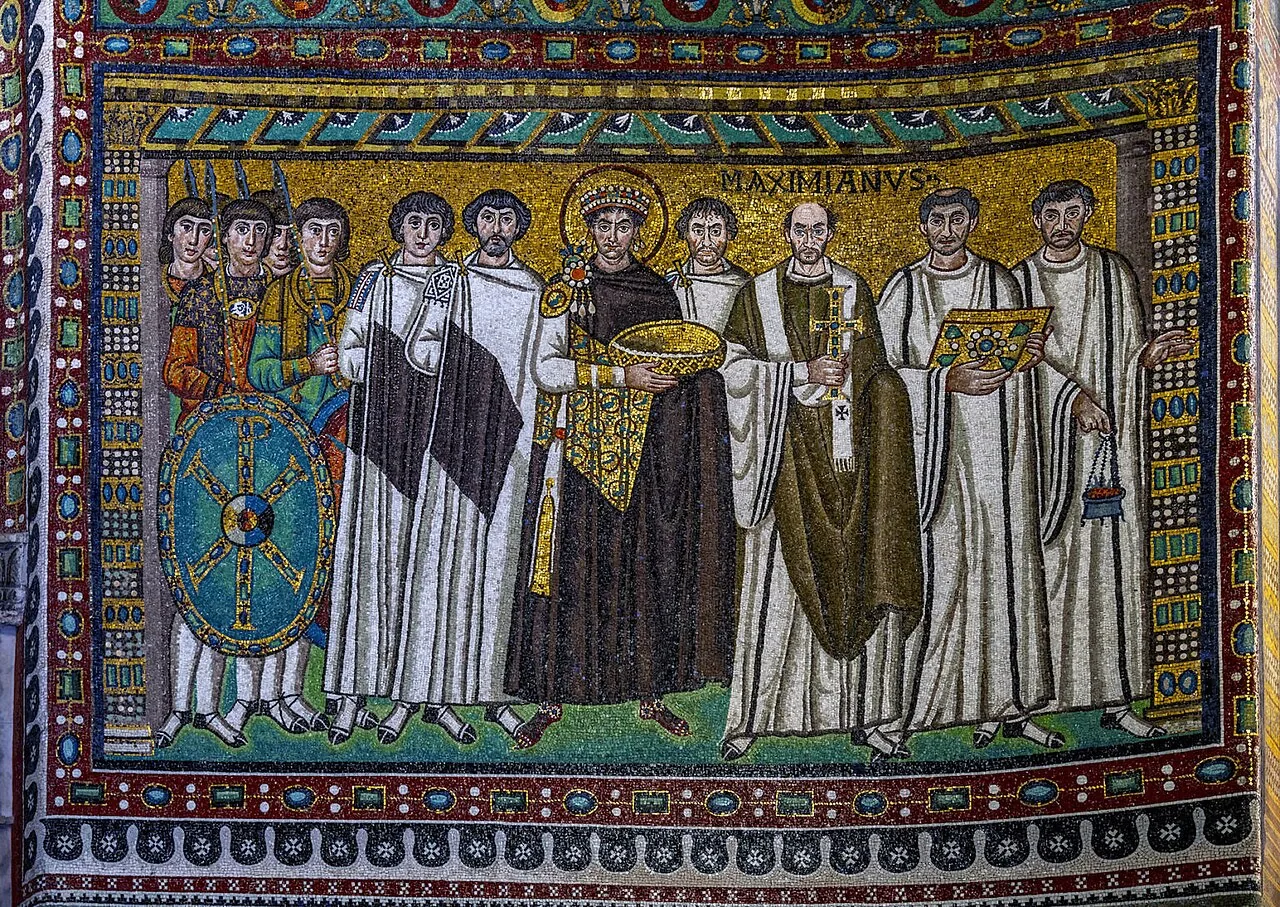
- Present the document (nature, date, place).
- Describe the emperor: his clothes, his crown, and what he holds.
- Who stands to his right and who to his left?
- What do the halo and the central position tell us about how the emperor wanted to be seen?
- The emperor never visited Ravenna. Why was the mosaic made?
Exercise 11 : The empress Theodora
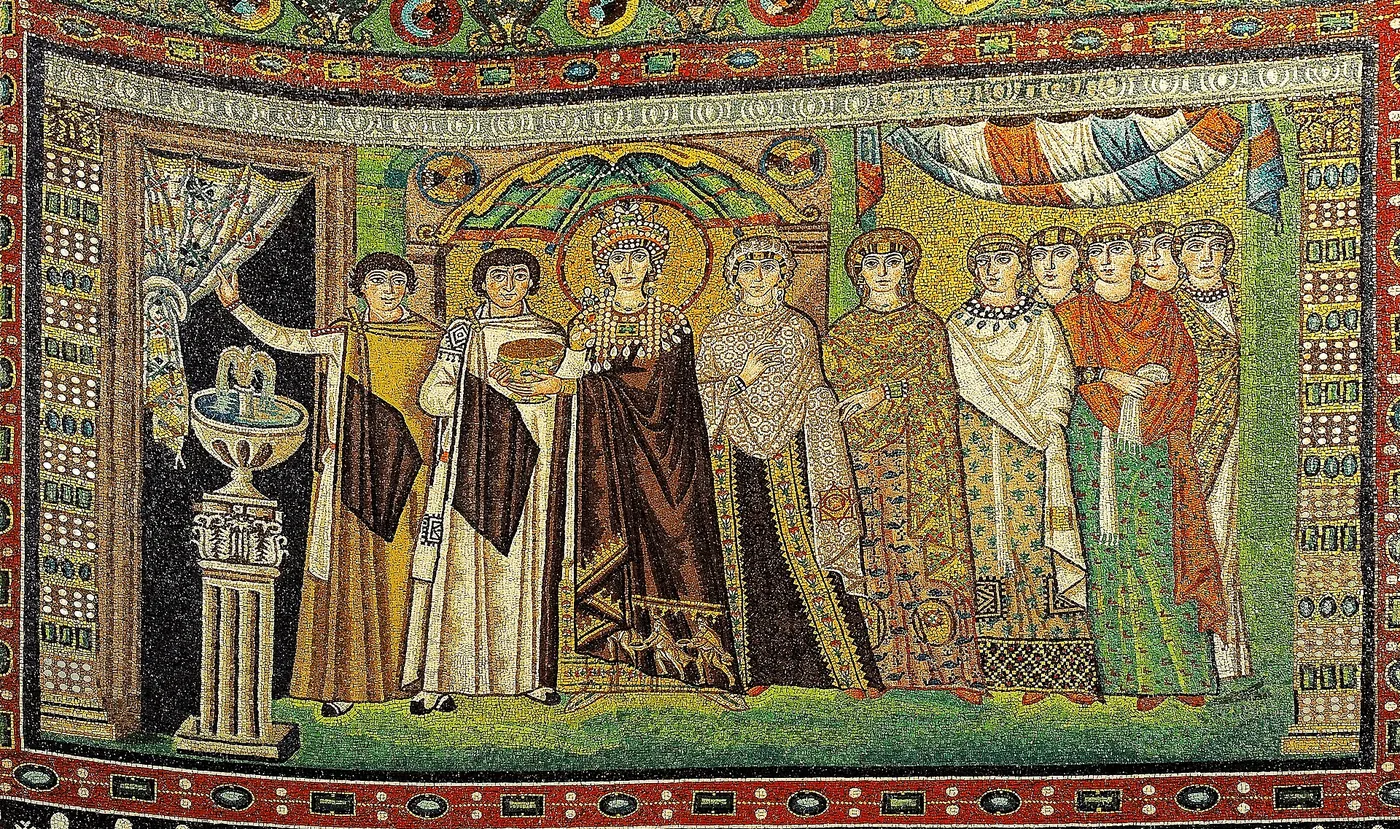
- Present the document (nature, date, place).
- Describe the empress’s clothing and jewels.
- Who is with her?
- The mosaic faces the one of Justinian. What does this suggest about her role?
- Why does a mosaic like this tell us about power and not about the real person?
Exercise 12 : Walls that saved a city
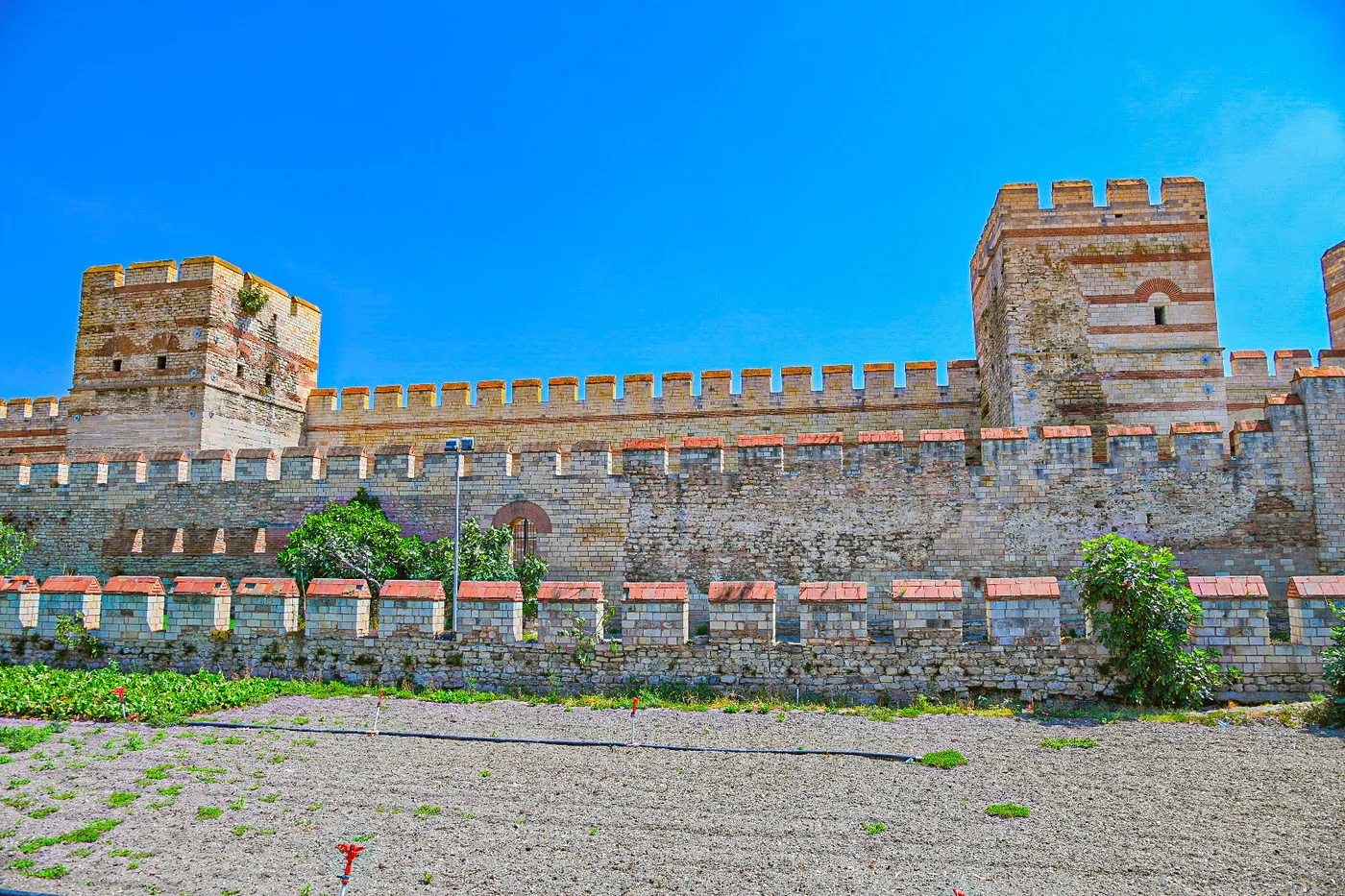
- Present the document (nature, date, place).
- Describe what you see: the towers, the walls, the battlements.
- Why did the builders make several lines of wall?
- Name two enemies that the walls stopped.
- What finally brought the walls down in 1453?
Exercise 13 : Greek fire
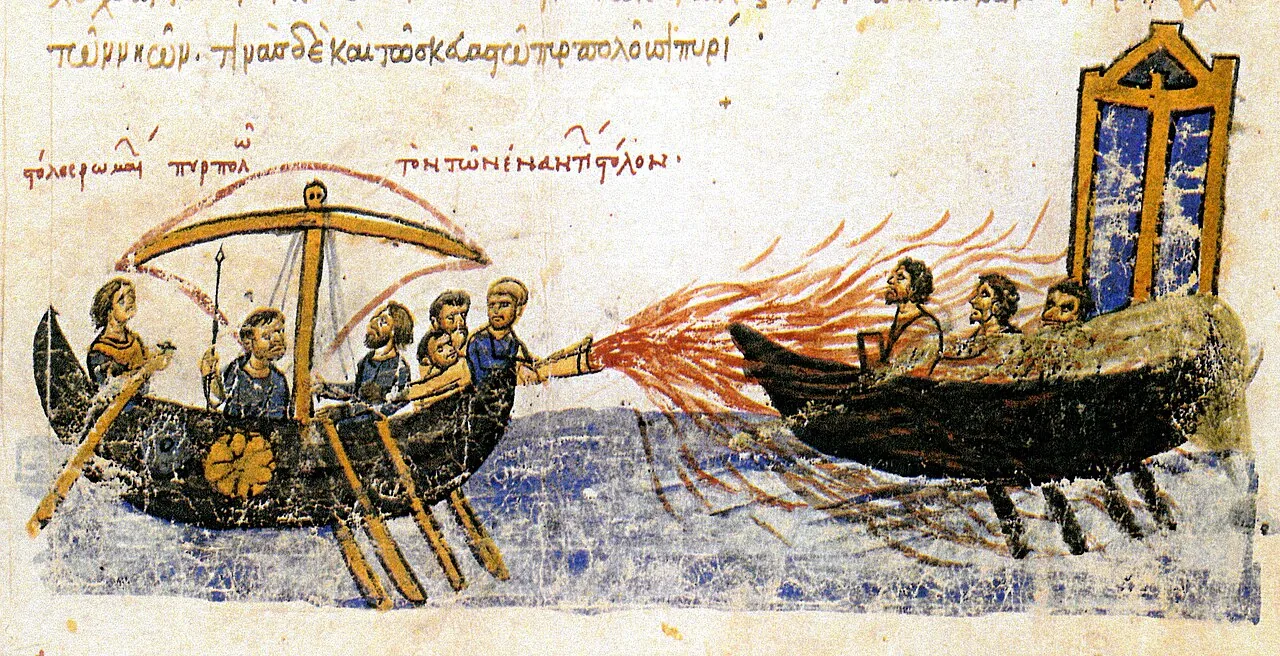
- Present the document (nature, date, place).
- Describe what the ship on the left is doing.
- Why was the weapon useful against ships?
- The recipe of Greek fire was a state secret. Why?
- Why must we be careful when we use a picture made centuries after the event?
Exercise 14 : An icon of Christ
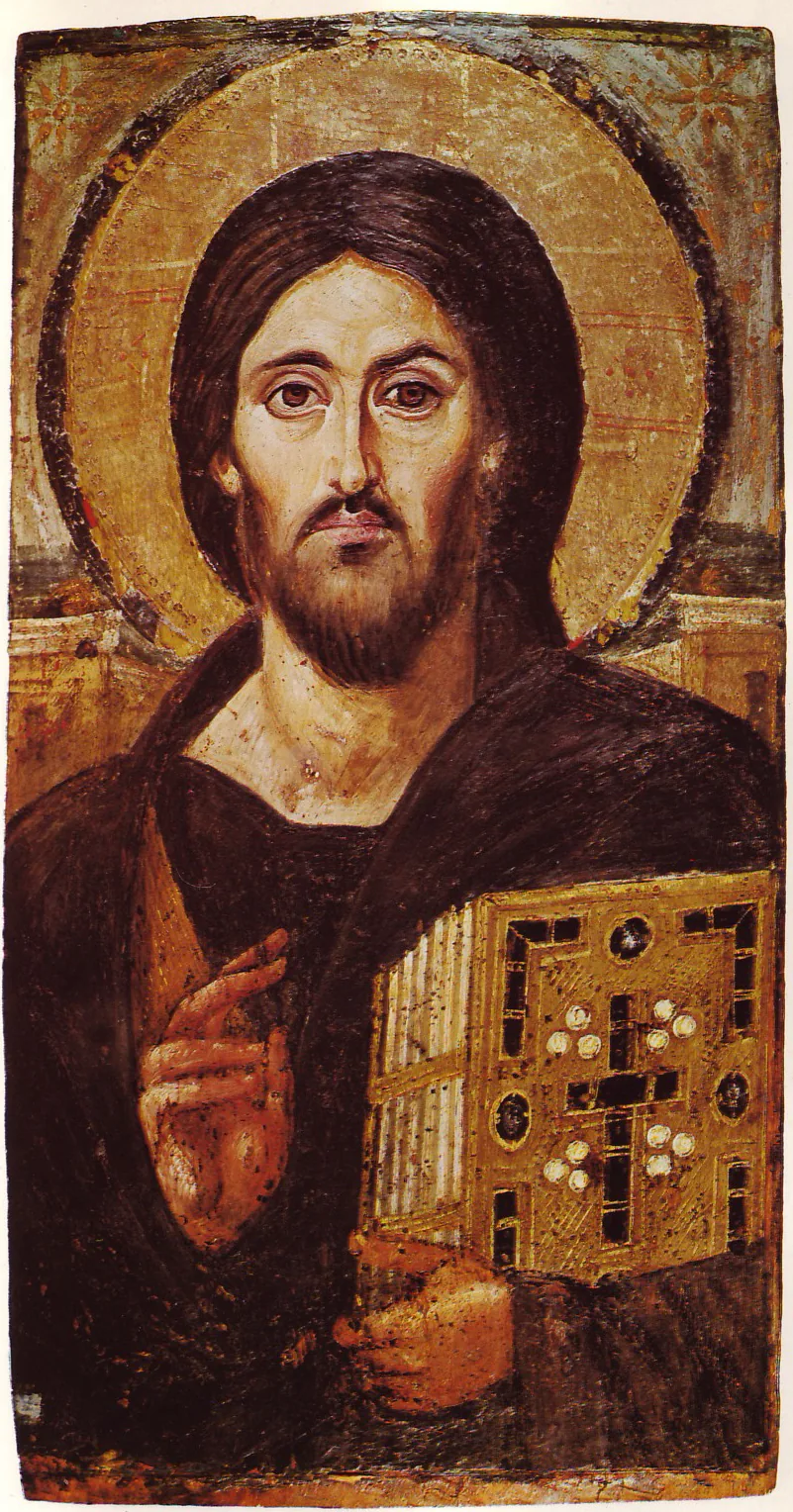
- Present the document (nature, date, place).
- Describe the figure and the objects that he holds.
- Why do you think this icon was kept safe at Sinai?
- Explain what iconoclasts believed about icons.
- Why did many Byzantines defend icons?
Exercise 15 : Emperors and reigns
Document 1 – Selected Byzantine emperors
| Emperor | Reign (CE) | Best known for |
|---|---|---|
| Justinian I | 527-565 | Hagia Sophia, Code of Justinian, reconquests |
| Heraclius | 610-641 | Defeated Persia; lost Syria and Egypt to the Arabs |
| Leo III | 717-741 | Defended the city against the Arabs; began iconoclasm |
| Basil II | 976-1025 | Defeated the Bulgarians; empire at its height |
| Alexios I | 1081-1118 | Asked the West for help; First Crusade |
| Constantine XI | 1449-1453 | Last emperor; died at the fall of Constantinople |
Source: reign dates as given in The Oxford Dictionary of Byzantium (1991). Table prepared for this unit.
- How many years did Justinian reign?
- How many years did Basil II reign?
- How many years passed between the end of Heraclius’s reign and the start of Leo III’s?
- How many years passed between the death of Basil II and the start of the reign of Alexios I?
- Which emperor on the list reigned the longest, and what does that suggest?
Exercise 16 : Locate the Byzantine world
- Match the numbers to these names: Alexandria, Antioch, Athens, Carthage, Constantinople, Jerusalem, Ravenna, Rome, Thessalonica.
- Which city sits between the Black Sea and the Mediterranean?
- Which two cities are on the coast of Africa?
- Why was the site of Constantinople a good location for a capital?
Hint: Constantinople is at the northeast corner of the Aegean Sea, beside the Bosporus.
Exercise 17 : The shrinking empire
- Which color shows the empire at its greatest extent, in the time of Justinian?
- Name two regions that Justinian held but Basil II did not.
- Which region in the east was added or held in 1025 but is not part of the 565 purple area? (Look for Armenia and the area near Manzikert.)
- Describe the empire in about 1355. How big was it?
- Suggest two reasons for the shrinking.
Exercise 18 : Order the events
Put these events in order from earliest to latest and write the date next to each.
- Fall of Constantinople to the Ottomans
- Nika Revolt
- Great Schism
- Battle of Manzikert
- Constantine dedicates Constantinople
- Fourth Crusade captures the city
Exercise 19 : How long between events?
Calculate each time span.
- From the dedication of Constantinople (330) to the fall of the western empire (476).
- From the completion of Hagia Sophia (537) to the Great Schism (1054).
- From the Fourth Crusade (1204) to the recovery of the city (1261).
- From the fall of the western empire (476) to the fall of Constantinople (1453). How many centuries is that?
Exercise 20 : Guided research: Hagia Sophia through time
Find out how the use of Hagia Sophia has changed over time. Use at least two reliable sites, such as Britannica, the Metropolitan Museum of Art (Heilbrunn Timeline of Art History), the Smarthistory site, or UNESCO. Suggested keywords: Hagia Sophia history, Hagia Sophia mosque 1453, Historic Areas of Istanbul UNESCO.
- When was the present building finished and who were its architects?
- What changes happened to the building in 1453, 1935, and 2020?
- Which features show the Christian and the Ottoman periods?
- Which sites did you use, and why do you trust them?
Hint: compare two sources; if the dates or details differ, note it.
Exercise 21 : CER paragraph: Justinian
Write a Claim, Evidence, Reasoning paragraph that answers: Was Justinian a successful emperor?
- Claim: state your position.
- Evidence: use at least two details from the documents or the lesson.
- Reasoning: explain how the evidence supports your claim.
Hint: weigh his achievements (law, Hagia Sophia, reconquest) against their costs (plague, taxes, war).
Exercise 22 : SAQ: surviving for a thousand years
Answer in complete sentences.
- Identify two reasons why Constantinople was hard to capture.
- Explain one way in which the theme system helped the empire to survive the 7th century.
- Explain one effect of the Fourth Crusade on the Byzantine Empire.
Exercise 23 : True or false? Justify
Decide whether each statement is true or false, and justify your answer.
- The people of the Byzantine Empire called themselves Byzantines.
- Hagia Sophia was built in the reign of Justinian.
- The Great Schism of 1054 divided the Christian church.
- The Byzantine Empire ended with the Fourth Crusade in 1204.
Exercise 24 : Causes and consequences: from Manzikert to 1453
Complete the chain and explain each link.
- Cause: the Seljuk Turks defeat the Byzantines at Manzikert in 1071. Effect: ______.
- Effect on relations with the West: ______.
- Effect of the Fourth Crusade in 1204: ______.
- Later consequence in 1453: ______.


Quick review: flashcards
Tap a card to see the answer.