


This Grade 8 US History to 1877 lesson covers Reconstruction, part of the unit “Division and reunion.” First, read the full lesson with its primary sources, maps and key terms. Then practice with the worksheet, check yourself with the quiz and get ready with the test.
In 1866 a Black man named Hiram Revels, born free in North Carolina, was working as a minister and teacher in Mississippi. Four years later he sat in the United States Senate. His seat had once belonged to Jefferson Davis, the president of the Confederacy. Revels was the first Black senator in American history. In the same period, formerly enslaved men voted, served on juries, ran for office, built schools, and married legally for the first time.
But at the same time, secret groups of white men in robes were beating and killing Black citizens and their white allies. By 1877 white Democrats had regained control of every Southern state. Reconstruction, the period from 1865 to 1877, was an attempt to build a new nation after the Civil War. It brought lasting changes to the Constitution, and it also fell far short of its goals.
Guiding question: How did the nation try to rebuild the South and secure freedom and equality for formerly enslaved people, and why did Reconstruction end in 1877 with its goals unmet?
1. Freedom and the question of how to rebuild
The meaning of freedom
In the spring of 1865 about four million people were free, but they had no property and often no shelter. The South was in ruins. Armies had burned cities, torn up railroads, and stripped farms. Freed people wanted to find family members whom slaveholders had sold. They also wanted to marry legally, to attend school, to worship in their own churches, and above all to own land. In January 1865, General Sherman’s Field Order No. 15 set aside coastal land from Charleston to Florida for Black families, in plots of about 40 acres. The idea became known as “forty acres and a mule.” Tens of thousands of freed people settled on the land.
Document 1 – Land for the freed people, January 1865
I. The islands from Charleston, south, the abandoned rice fields along the rivers for thirty miles back from the sea, and the country bordering the St. Johns river, Florida, are reserved and set apart for the settlement of the negroes now made free by the acts of war and the proclamation of the President of the United States. […] and the sole and exclusive management of affairs will be left to the freed people themselves, subject only to the United States military authority and the acts of Congress. […] By the laws of war, and orders of the President of the United States, the negro is free and must be dealt with as such.
Source: General William T. Sherman, Special Field Orders, No. 15, January 16, 1865. Teaching American History.
*Negro: the word used in the 1860s for Black Americans. *conscription: forced military service.
In March 1865 Congress created the Freedmen’s Bureau, an agency of the army. It gave food and medical care to refugees, set up schools, and helped freed people to make fair labor contracts. Its head was General Oliver O. Howard. Teachers, many of them Northern women and Black teachers, started schools across the South. Thousands of adults crowded into classrooms to learn to read. Black churches, which were the first major institutions that Black Americans controlled, became centers of community life.
Definition: Freedmen’s Bureau
A federal agency created in March 1865 to help formerly enslaved people with food, schools, medical care, and labor contracts. Its formal name was the Bureau of Refugees, Freedmen, and Abandoned Lands.
Lincoln, Johnson, and presidential Reconstruction
The nation had to decide on what terms the Confederate states would return. In December 1863 Lincoln proposed a lenient plan. A state could rejoin when ten percent of its 1860 voters swore loyalty to the Union and the state abolished slavery. Radical Republicans in Congress wanted stronger protection for freed people. They passed a tougher bill in 1864, but Lincoln let it die. In April 1865 an assassin killed Lincoln, and the presidency passed to Andrew Johnson of Tennessee, a Southern Democrat who had stayed loyal to the Union.
The new president pardoned most former Confederates who took an oath of loyalty. He allowed the Southern states to form new governments while Congress was not in session. He also returned much of the land of Field Order No. 15 to its former owners. Johnson believed in states’ rights and in white supremacy. He opposed any role for the federal government in protecting Black rights.
The Black Codes
The Southern governments formed under Johnson’s plan accepted the 13th Amendment. Congress had passed it in January 1865, and the states ratified it in December. But they passed the Black Codes, laws that limited the freedom of Black people. Mississippi’s laws, for example, punished Black people who had “no lawful employment” as vagrants and required them to sign yearly labor contracts. They also allowed courts to apprentice Black children to white employers. The codes aimed to keep Black workers on the plantations under conditions that resembled slavery. Many Northerners grew angry. In December 1865 the new Southern members arrived in Washington, including a former vice president of the Confederacy. Congress refused to seat them.
Definition: Black Codes
Laws that Southern states passed in 1865 and 1866 to limit the rights of formerly enslaved people. They restricted especially their freedom to choose work, to move, to own land, and to testify in court.
Document 2 – “Emancipation,” 1865
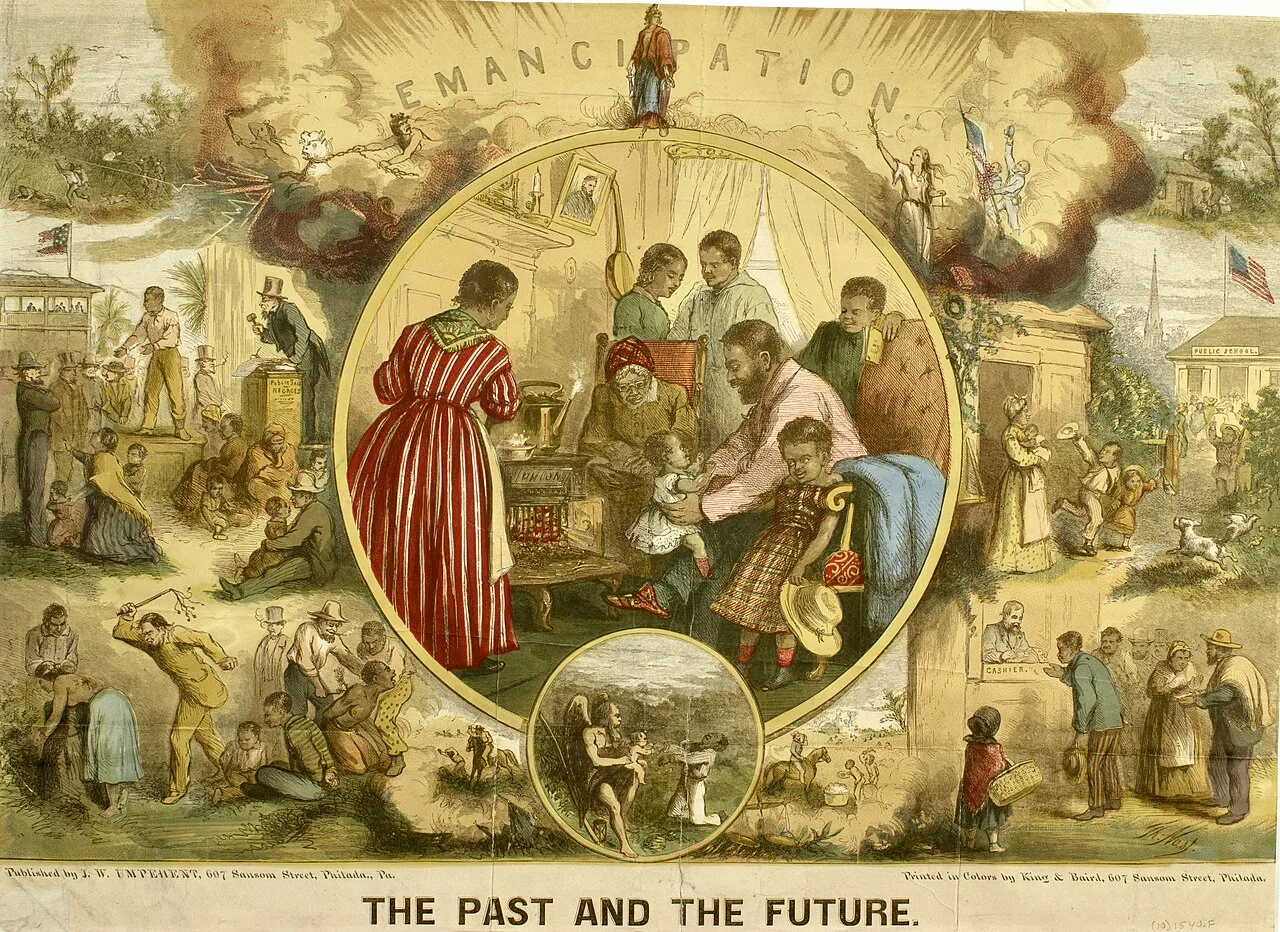
Source: Library Company of Philadelphia, via Wikimedia Commons.
The artist, Thomas Nast, was a famous cartoonist who supported the Republican cause. His print contrasts the cruelty of slavery with the hopes for freedom: home, education, and work for wages.
2. Radical Reconstruction
The amendments
In 1866 Congress passed the Civil Rights Act, which declared that Black Americans were citizens with equal rights to make contracts, own property, and use the courts. Congress overrode Johnson’s veto. Many feared that a later Congress might repeal it. Therefore, the Republicans wrote its principles into the Constitution as the 14th Amendment. Congress passed it in 1866, and it became part of the Constitution in July 1868.
It made all persons born in the United States citizens. It also forbade any state to deny anyone “the equal protection of the laws.” Violence in the South added to the pressure for change. In Memphis in May 1866 and in New Orleans in July 1866, white mobs, including police, killed dozens of Black people. In the congressional elections of 1866, voters gave the Republicans a two-thirds majority in both houses.
Document 3 – The 14th Amendment, section 1
All persons born or naturalized in the United States, and subject to the jurisdiction thereof, are citizens of the United States and of the state wherein they reside. No state shall make or enforce any law which shall abridge the privileges or immunities of citizens of the United States; nor shall any state deprive any person of life, liberty, or property, without due process of law; nor deny to any person within its jurisdiction the equal protection of the laws.
Source: Constitution of the United States, 14th Amendment, section 1, ratified July 9, 1868. Cornell Law School, Legal Information Institute.
*abridge: to reduce. *due process: fair legal procedures.
This sentence is one of the most important in the Constitution. It defines citizenship and has been the basis of many later decisions on civil rights.
Congress takes charge
In March 1867, over Johnson’s veto, Congress passed the first Reconstruction Act. It divided the ten Southern states that had not yet rejoined the Union into five military districts. A Union general commanded each district. (Tennessee had already rejoined in 1866.) To rejoin the Union, a state had to write a new constitution that gave Black men the right to vote. It also had to ratify the 14th Amendment.
Roughly 700,000 Black men registered to vote in the South. Meanwhile, the law barred many white Southerners who had supported the Confederacy from voting for a time. Johnson fought Congress at every step. He tried to dismiss his secretary of war, in violation of the Tenure of Office Act. As a result, the House impeached him in February 1868. The Senate tried him and fell one vote short of the two-thirds needed to remove him from office.
The 15th Amendment became law in February 1870. It said that the right to vote could not be denied “on account of race, color, or previous condition of servitude.” It did not mention women, which divided the women’s suffrage movement. Nor did it forbid other barriers, like literacy tests, that Southern states later used. By 1870 all the former Confederate states had rejoined the Union. Ulysses S. Grant, elected president in 1868, supported Reconstruction with the army and the courts.
Definition: Impeachment
The formal charging of a government official with wrongdoing by the House of Representatives. The Senate then holds a trial. Andrew Johnson was the first president to face impeachment. The Senate acquitted him in 1868.
3. Reconstruction governments and white resistance
Under the new state constitutions, Black and white Republicans governed the South together. Their enemies called white Southern Republicans “scalawags,” and they called Northerners who moved South “carpetbaggers.” About 2,000 Black men held public office during Reconstruction, as sheriffs, legislators, judges, and members of Congress. Sixteen Black men served in Congress, including two senators from Mississippi, Hiram Revels and later Blanche K. Bruce. The Reconstruction governments built the first public school systems in many Southern states, hospitals, roads, and railroads. They also raised taxes. Some of them were guilty of corruption, as governments elsewhere in the country were at the time. Their opponents exaggerated the corruption and said that Black voters were unfit to rule.
Sharecropping
Most freed people wanted land, but the government gave very little. Without money, most had to work for white landowners, and a system called sharecropping developed. A family farmed a plot owned by a landlord. In exchange for the land, tools, seed, and housing, the family gave him a share of the crop, often half. Merchants sold supplies on credit at high prices, and many families fell permanently into debt. Sharecropping gave Black families more independence than the gang labor of slavery, but it kept most of them poor.
Definition: Sharecropping
A system of farming in which a family works land that belongs to someone else. The family pays the owner with a share of the crop. Debts to the landlord and to the store often kept sharecroppers poor.
The Klan and white terror
White resistance was violent. Former Confederate soldiers founded the Ku Klux Klan in Tennessee in 1865-66. It and later groups such as the White League and the Red Shirts used whippings, burnings, and murder to frighten Black voters and Republican officials. In 1873 in Colfax, Louisiana, a white mob killed more than sixty Black men who had been defending a courthouse. Congress passed the Enforcement Acts of 1870 and 1871. These laws made it a federal crime to use violence to keep people from voting. President Grant sent federal troops and prosecutors to the worst areas of South Carolina. The Klan grew weaker, but the other groups continued, and the Supreme Court later weakened the law.
Document 4 – The testimony of a Klan victim, 1871
Q: What effect did [widespread whippings] have on the colored people up there-are they alarmed? A: Yes, sir; so alarmed that they did not sleep in the houses at night. Q: How many people slept out? A: I did not hear of any who did not sleep out-not at all; during last winter and spring all slept out from the effect of this excitement and fear… Men and women both.
Source: Testimony of Rev. Elias Hill, York County, South Carolina, before the Joint Select Committee on the Condition of Affairs in the Late Insurrectionary States, 1871 (Ku Klux Klan hearings). Lowcountry Digital History Initiative, College of Charleston.
*whippings: beatings with a whip.
4. The end of Reconstruction, 1873-1877
By the middle of the 1870s Northern support was fading. The Panic of 1873, a severe depression, made people worry more about jobs than about the South. Voters wanted an end to the conflict and were angry about scandals in the Grant administration. The Supreme Court narrowed the 14th Amendment in the Slaughter-House Cases (1873) and in United States v. Cruikshank (1876). In the South, white Democrats called themselves “Redeemers.” They used fraud and violence to win elections and took back state governments one by one. By the end of 1876 Republicans held only three Southern states, South Carolina, Florida, and Louisiana.
The election of 1876
The presidential election of 1876 settled the matter. The Democrat Samuel Tilden won the popular vote, but both parties disputed the electoral votes of those three states. A special commission of fifteen members, with a Republican majority, gave all the disputed votes to the Republican Rutherford B. Hayes. Southern Democrats agreed to accept the result in return for promises, including the withdrawal of federal troops from the South.
People call this bargain the Compromise of 1877. Hayes took office in March 1877, and by April the last troops had left South Carolina and Louisiana. Without federal protection, Black Southerners lost most of their political power. In the next decades Southern states passed laws that took away the vote and segregated public life. People called them Jim Crow laws.
The legacy of Reconstruction
Many people describe Reconstruction as a failure, but historians stress that it also left a legacy. The 13th, 14th, and 15th Amendments remained in the Constitution. Nearly a century later the civil rights movement used the 14th Amendment to win decisions like Brown v. Board of Education (1954). Black communities kept the schools and churches that they had built. The amendments had promised equality, and it would take another century to start to keep that promise.
- 1863 Lincoln proposes the Ten Percent Plan (December)
- Jan. 16, 1865 Sherman’s Field Order No. 15
- March 1865 Congress creates the Freedmen’s Bureau
- Dec. 1865 13th Amendment ratified; Black Codes in Mississippi
- April 1866 Civil Rights Act becomes law over Johnson’s veto
- March 1867 First Reconstruction Act
- May 1868 Johnson survives impeachment by one vote
- July 1868 14th Amendment ratified
- Feb. 1870 15th Amendment ratified
- 1877 Compromise of 1877; the last troops leave the South
Key takeaways
- Freed people wanted land, education, and the vote. The Freedmen’s Bureau helped with schools and labor contracts, but most of the land promised in Field Order No. 15 went back to former owners.
- Under President Johnson, Southern states passed Black Codes that limited Black freedom. Congress responded with the Civil Rights Act of 1866 and the 14th Amendment.
- The Reconstruction Acts of 1867 created five military districts and required Black male suffrage. The 15th Amendment (1870) protected the right to vote.
- Black and white Republicans governed the South, built schools, and elected Black officials. However, the Klan and other groups used violence to take back control.
- Reconstruction ended with the Compromise of 1877; its amendments remained in the Constitution and later inspired the civil rights movement.

Quick review: flashcards
Tap a card to see the answer.