


This worksheet on Reconstruction belongs to the Grade 8 US History to 1877 course. Its questions use primary sources, maps and timelines, and they move from basic recall to short writing tasks. Before you start, review the lesson; afterward, try the true or false quiz.
Exercise 1 : Vocabulary of Reconstruction
Match each term with its meaning, then use three of the terms in sentences of your own.
- Freedmen’s Bureau
- Black Codes
- Sharecropping
- Impeachment
- Carpetbagger
- Redeemers
Meanings: (a) Southern white Democrats who took back control of their state governments; (b) a federal agency that helped formerly enslaved people; (c) a farming system based on a share of the crop; (d) the formal charging of an official by the House; (e) Southern laws that limited the freedom of Black people; (f) the name that critics gave to Northerners who moved to the South.
Exercise 2 : Forty acres
Document 1 – Sherman’s Field Order No. 15, 1865
I. The islands from Charleston, south, the abandoned rice fields along the rivers for thirty miles back from the sea, and the country bordering the St. Johns river, Florida, are reserved and set apart for the settlement of the negroes now made free by the acts of war and the proclamation of the President of the United States. […] and the sole and exclusive management of affairs will be left to the freed people themselves, subject only to the United States military authority and the acts of Congress. […] By the laws of war, and orders of the President of the United States, the negro is free and must be dealt with as such.
Source: General William T. Sherman, Special Field Orders, No. 15, January 16, 1865. Teaching American History.
*Negro: the word used in the 1860s for Black Americans. *conscription: forced military service.
- Present the document (nature, author, date, context).
- What land does the order set aside, and for whom?
- Who is to manage the affairs of the settlements?
- President Johnson later returned most of this land to its former owners. What effect did that have on freed people?
Exercise 3 : Vagrants under the law
Document 2 – Mississippi vagrancy law, 1865
Sec 2. Be it further enacted, That all freedmen, free Negroes, and mulattoes in this state over the age of eighteen years found . . . with no lawful employment or business, or found unlawfully assembling themselves together . . . and all white persons so assembling with freedmen, free Negroes, or mulattoes, or usually associating with freedmen, free Negroes, or mulattoes on terms of equality, or living in adultery or fornication with a freedwoman, free Negro, or mulatto, shall be deemed vagrants; and, on conviction thereof, shall be fined in the sum of not exceeding, in the case of a freedman, free Negro, or mulatto, fifty dollars, and a white man, two hundred dollars, and imprisoned at the discretion of the court, the free Negro not exceeding ten days, and the white man not exceeding six months.
Source: Mississippi, “An Act to amend the vagrant laws of the state,” November 1865, section 2. Reproduced at the Center for History and New Media, George Mason University.
*freedmen: people freed from slavery. *mulattoes: people of mixed ancestry (the term was used in the law). *fornication: sexual relations outside marriage.
- Present the document (nature, author, date, context).
- Who was to be counted as a vagrant under the law?
- How were white persons treated by this law?
- Explain how a law like this could force Black workers to accept low-paid work.
Coup de pouce: what happened to a person who was fined but had no money?
Exercise 4 : A freedman answers his old master
Document 3 – Jourdon Anderson’s letter, 1865
I want to know particularly what the good chance is you propose to give me. I am doing tolerably well here; I get $25 a month, with victuals and clothing; have a comfortable home for Mandy (the folks here call her Mrs. Anderson), and the children, Milly Jane and Grundy, go to school and are learning well; the teacher says Grundy has a head for a preacher. They go to Sunday-School, and Mandy and me attend church regularly. We are kindly treated; sometimes we overhear others saying, “Them colored people were slaves” down in Tennessee. The children feel hurt when they hear such remarks, but I tell them it was no disgrace in Tennessee to belong to Col. Anderson. Many darkies would have been proud, as I used to was, to call you master.
Source: Jourdon Anderson, letter to his former master, Colonel P. H. Anderson, Dayton, Ohio, August 7, 1865. Wikisource.
*victuals: food. *darkies: an offensive word of the time that Anderson quotes from his former master’s world.
- Present the document (nature, author, date, context).
- What has Anderson achieved since gaining his freedom?
- What does he want to know before he decides whether to go back?
- What does the letter show about how freed people understood freedom?
Exercise 5 : The night riders
Document 4 – Testimony about the Klan, 1871
Q: What effect did [widespread whippings] have on the colored people up there-are they alarmed? A: Yes, sir; so alarmed that they did not sleep in the houses at night. Q: How many people slept out? A: I did not hear of any who did not sleep out-not at all; during last winter and spring all slept out from the effect of this excitement and fear… Men and women both.
Source: Testimony of Rev. Elias Hill, York County, South Carolina, before the Joint Select Committee, 1871. Lowcountry Digital History Initiative.
- Present the document (nature, witness, date, context).
- How did Black families protect themselves?
- What was the Klan trying to achieve by such violence?
- Why was it important that Congress gathered this kind of testimony?
Exercise 6 : Defining citizenship
Document 5 – The 14th Amendment
All persons born or naturalized in the United States, and subject to the jurisdiction thereof, are citizens of the United States and of the state wherein they reside. No state shall make or enforce any law which shall abridge the privileges or immunities of citizens of the United States; nor shall any state deprive any person of life, liberty, or property, without due process of law; nor deny to any person within its jurisdiction the equal protection of the laws.
Source: Constitution of the United States, 14th Amendment, section 1, ratified July 9, 1868. Cornell Law School, Legal Information Institute.
- Present the document (nature, date, context).
- Who is a citizen under the first sentence?
- List two things that no state may do under the second sentence.
- Which earlier decision of the Supreme Court did the first sentence overturn? Use the unit on slavery to answer.
Exercise 7 : The right to vote
Document 6 – The 15th Amendment
The right of citizens of the United States to vote shall not be denied or abridged by the United States or by any state on account of race, color, or previous condition of servitude. Section 2. The Congress shall have power to enforce this article by appropriate legislation.
Source: Constitution of the United States, 15th Amendment, ratified February 3, 1870. Cornell Law School, Legal Information Institute.
- Present the document (nature, date, context).
- On what grounds may the vote not be denied?
- Who is not mentioned in this amendment? Explain why this was a source of conflict.
- Name one way in which Southern states later got around the amendment.
Exercise 8 : Freedom on paper and in practice
Document A – The 13th Amendment
Neither slavery nor involuntary servitude, except as a punishment for crime whereof the party shall have been duly convicted, shall exist within the United States, or any place subject to their jurisdiction. Section 2. Congress shall have power to enforce this article by appropriate legislation.
Source: Constitution of the United States, 13th Amendment, ratified December 1865. Cornell Law School, Legal Information Institute.
Document B – The Mississippi vagrancy law
Sec 2. Be it further enacted, That all freedmen, free Negroes, and mulattoes in this state over the age of eighteen years found . . . with no lawful employment or business, or found unlawfully assembling themselves together . . . and all white persons so assembling with freedmen, free Negroes, or mulattoes, or usually associating with freedmen, free Negroes, or mulattoes on terms of equality, or living in adultery or fornication with a freedwoman, free Negro, or mulatto, shall be deemed vagrants; and, on conviction thereof, shall be fined in the sum of not exceeding, in the case of a freedman, free Negro, or mulatto, fifty dollars, and a white man, two hundred dollars, and imprisoned at the discretion of the court, the free Negro not exceeding ten days, and the white man not exceeding six months.
Source: Mississippi, “An Act to amend the vagrant laws of the state,” November 1865, section 2.
- Present each document (nature, date, authors).
- What does Document A forbid, and what exception does it contain?
- Explain how Document B tried to keep Black workers under control after the end of slavery.
- Write two sentences on how the two documents show a conflict between freedom in law and freedom in practice.
Exercise 9 : Labor contracts and wages
Document A – A Mississippi labor law, 1865
Sec 6. Be it further enacted, That All contracts for labor made with freedmen, free Negroes, and mulattoes for a longer period than one month shall be in writing and in duplicate, attested and read to said freedman, free Negro, or mulatto by a beat, city, or county officer, or two disinterested white persons of the county in which the labor is to be performed, of which each party shall have one; . . . and if the laborer shall quit the service of the employer before expiration of his term of service without good cause, he shall forfeit his wages for that year, up to the time of quitting.
Source: Mississippi, “An Act to confer civil rights on freedmen,” November 1865, section 6. Reproduced at the Center for History and New Media, George Mason University.
*attested: certified. *forfeit: to lose.
Document B – Jourdon Anderson, 1865
I want to know particularly what the good chance is you propose to give me. I am doing tolerably well here; I get $25 a month, with victuals and clothing; have a comfortable home for Mandy (the folks here call her Mrs. Anderson), and the children, Milly Jane and Grundy, go to school and are learning well; the teacher says Grundy has a head for a preacher. They go to Sunday-School, and Mandy and me attend church regularly. We are kindly treated; sometimes we overhear others saying, “Them colored people were slaves” down in Tennessee. The children feel hurt when they hear such remarks, but I tell them it was no disgrace in Tennessee to belong to Col. Anderson. Many darkies would have been proud, as I used to was, to call you master.
Source: Jourdon Anderson, letter of August 7, 1865.
- Present each document (author, date, kind of source).
- What happens to a laborer who leaves before the end of his contract, according to Document A?
- What does Anderson in Document B demand from a possible employer?
- Compare how the two documents define freedom for Black workers.
Exercise 10 : The Freedmen’s Bureau at work
Study the image.
Document 7 – A Freedmen’s Bureau office
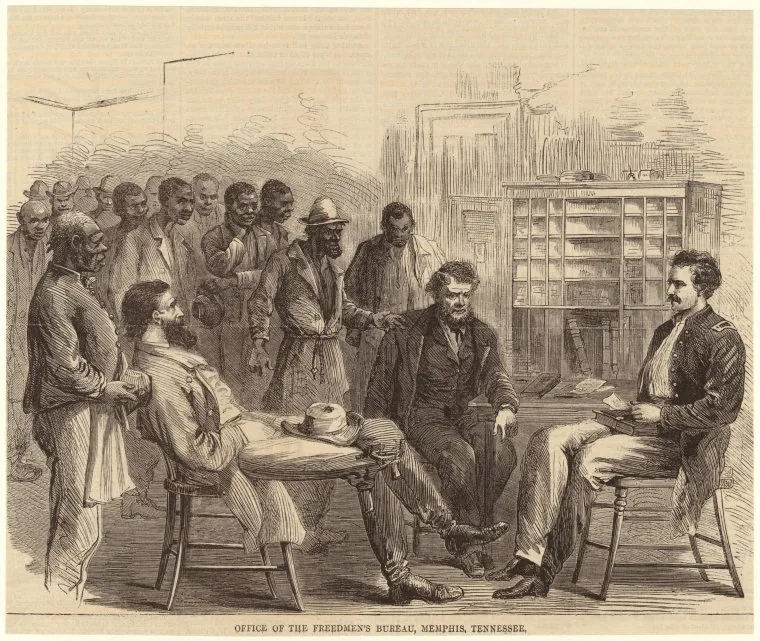
Source: Wikimedia Commons.
- Present the document (nature, place, date).
- Describe the people and the room.
- What services did the Bureau provide? Name two.
- The picture was published in a Northern magazine. What impression do you think it was meant to give?
Exercise 11 : A wedding in Vicksburg
Study the image.
Document 8 – A marriage under the Freedmen’s Bureau
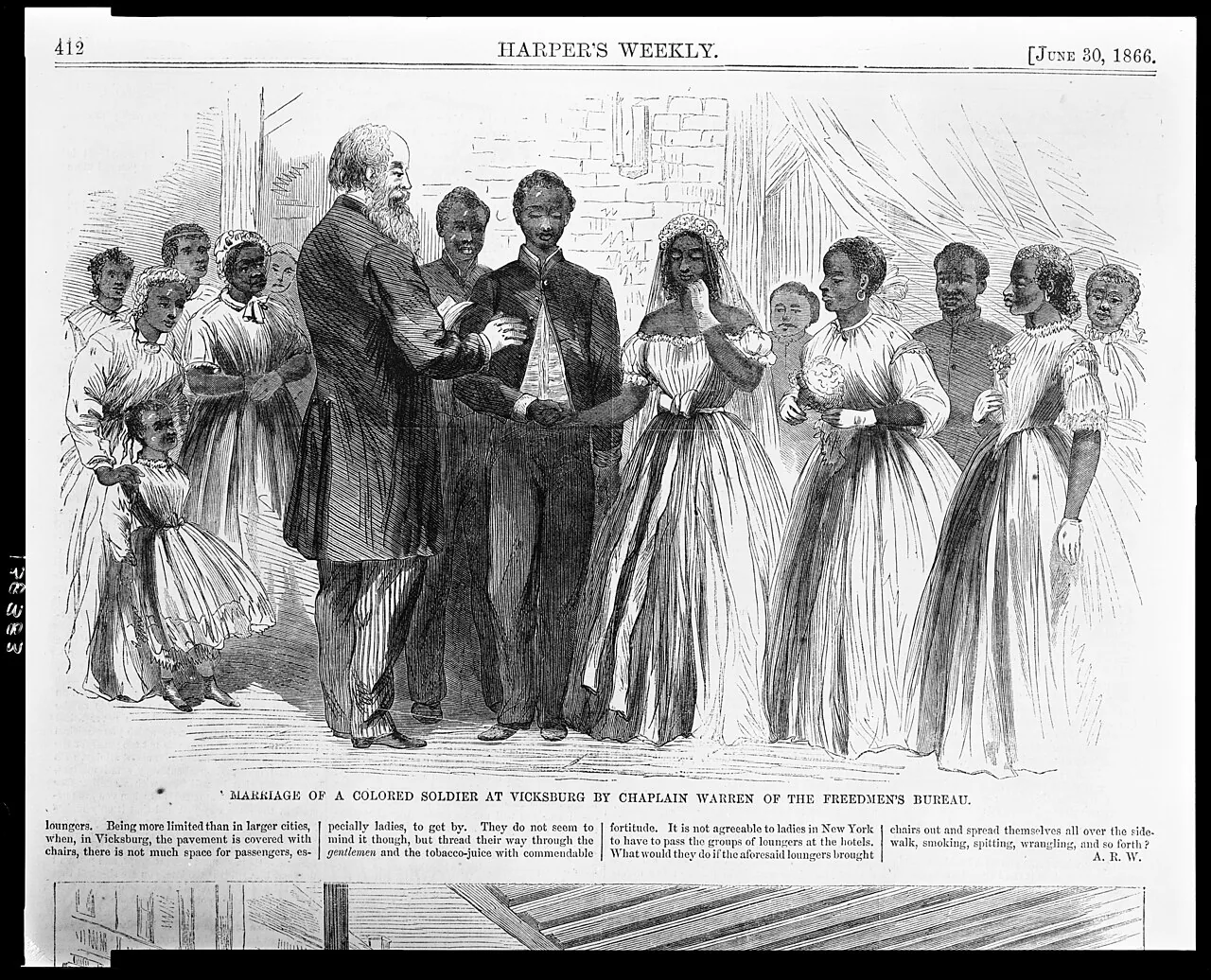
Source: Library of Congress, via Wikimedia Commons.
- Present the document (nature, place, date).
- Describe the scene.
- Why did legal marriage matter so much to formerly enslaved people?
- What does the title tell you about the role of the Bureau?
Exercise 12 : A school for freed children
Study the image.
Document 9 – The Abraham Lincoln School, New Orleans
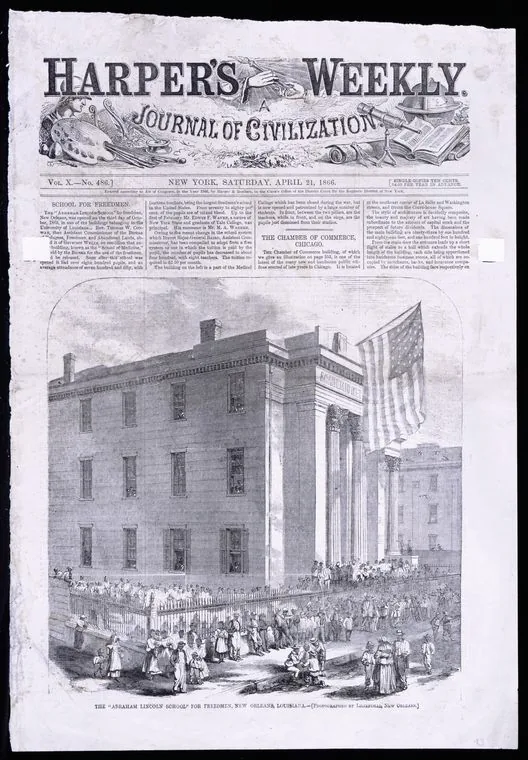
Source: Wikimedia Commons.
- Present the document (nature, date, subject).
- Describe the building and the scene in front of it.
- Why was education so important to freed people?
- Why do you think the school was named after Lincoln?
Exercise 13 : Convention or massacre?
Study the image.
Document 10 – Thomas Nast and the New Orleans riot, 1866
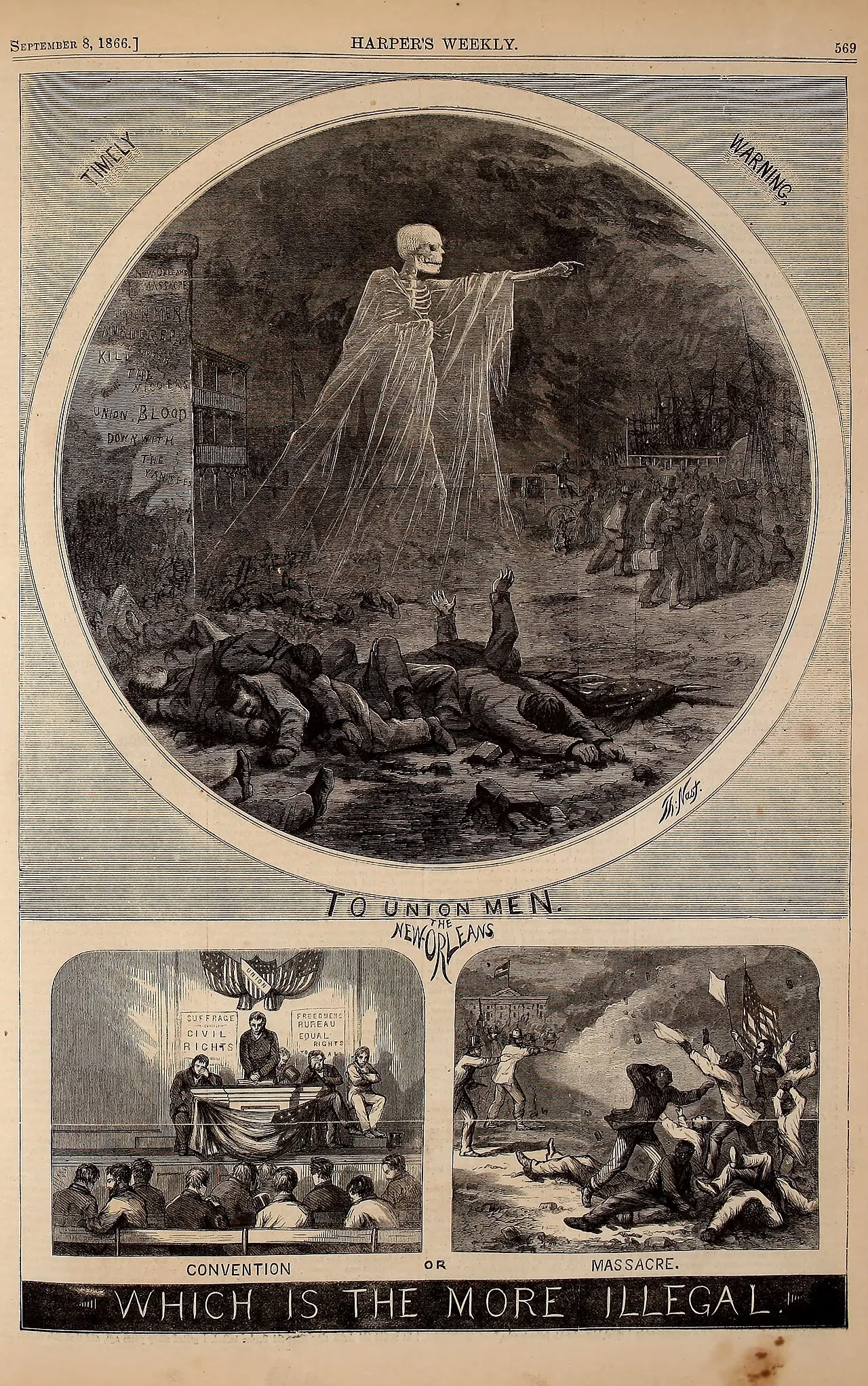
Source: Wikimedia Commons.
- Present the document (nature, author, date, event).
- Describe the three parts of the image.
- What question does the caption ask, and what answer does the artist suggest?
- How could a cartoon like this affect the elections of 1866?
Exercise 14 : The Southern states return to the Union
Study the table, then answer the questions.
Document 11 – Readmission of the former Confederate states
| Year of readmission | States |
|---|---|
| 1866 | Tennessee |
| 1868 | Arkansas, Alabama, Florida, Louisiana, North Carolina, South Carolina |
| 1870 | Virginia, Mississippi, Texas, Georgia |
Source: dates of final readmission as given in standard U.S. history references.
- How many states were readmitted in 1868? In 1870?
- Which state was readmitted first, and why was it treated differently from the others?
- How many years passed between the end of the war in 1865 and the readmission of the last states?
- Why did Congress require the states to ratify the 14th Amendment before they could return?
Exercise 15 : Map 1: the five districts
Use the map below. The legend has been removed.
- Which district included the state with the largest area? Name the state.
- Name the states in District 3.
- Why is Tennessee not in any district?
- Why do you think Congress used military districts instead of letting the states manage themselves?
Exercise 16 : Map 2: where Reconstruction ended last
Use the map below.
- Find South Carolina, Florida, and Louisiana on the map. In which districts were they in 1867?
- Which of these states have an Atlantic coast, and which a Gulf coast?
- Why were the votes of these states decisive in 1876?
- What happened to the army in these states in 1877?
Exercise 17 : Order the events
Put these events in order from earliest to latest and give the date or the year of each.
- Compromise of 1877
- Creation of the Freedmen’s Bureau
- Ratification of the 14th Amendment
- Impeachment of Andrew Johnson
- Field Order No. 15
- First Reconstruction Act
- Ratification of the 15th Amendment
Exercise 18 : How long did Reconstruction last?
Use the timeline in the lesson to answer.
- How many years passed between the end of the war in 1865 and the Compromise of 1877?
- How many years passed between the 14th Amendment (1868) and the 15th Amendment (1870)?
- How many years passed between the Compromise of 1877 and the decision in Brown v. Board of Education (1954)?
- How many years passed between the Dred Scott decision (1857) and the 14th Amendment (1868)?
Exercise 19 : Guided research: the first Black members of Congress
Complete a research card on Hiram Revels or Blanche K. Bruce.
Keywords to search: Hiram Revels first Black senator; Blanche K. Bruce Mississippi senator; Black members of Congress during Reconstruction.
Reliable sites: United States Senate (senate.gov), Library of Congress (loc.gov), National Archives (archives.gov), History, Art and Archives of the U.S. House of Representatives (history.house.gov).
- Where and when was he born, and what did he do before he entered politics?
- When did he serve in the Senate, and which seat did he hold?
- What problems did he face?
- Write two sentences on why his election was important.
Exercise 20 : CER paragraph: success or failure?
Write a paragraph in the form Claim, Evidence, Reasoning in answer to the question: Was Reconstruction a success or a failure? Use at least two pieces of evidence from the lesson.
Coup de pouce: you may argue that it was both, but you must take a clear position and support it.
Exercise 21 : SAQ: the Compromise of 1877
Answer all parts in complete sentences.
- Identify one cause of the Compromise of 1877.
- Explain one way in which Northern attitudes had changed by 1877.
- Explain one consequence of the end of federal protection for Black Southerners.
Exercise 22 : True or false? Justify
Say whether each statement is true or false, and correct the false ones.
- The Freedmen’s Bureau set up schools for freed people.
- President Johnson was removed from office in 1868.
- The 14th Amendment made all persons born in the United States citizens.
- The 15th Amendment gave women the right to vote.
- The last federal troops left the South in 1877.
Exercise 23 : Causes and consequences: Reconstruction
For each event, give one cause and one consequence.
- The Black Codes of 1865-66
- The Reconstruction Acts of 1867
- The founding of the Ku Klux Klan
- The Compromise of 1877


Quick review: flashcards
Tap a card to see the answer.