


This Grade 8 US History to 1877 lesson covers The Civil War, part of the unit “Division and reunion.” First, read the full lesson with its primary sources, maps and key terms. Then practice with the worksheet, check yourself with the quiz and get ready with the test.
In October 1862 New Yorkers lined up at Mathew Brady’s gallery on Broadway to see an exhibition called “The Dead of Antietam.” Alexander Gardner and James Gibson had taken the photographs in September, only two days after the bloodiest single day in American history. They showed bodies lying along a rail fence, in a ditch, and in a farmer’s field, as the armies had left them. A New York newspaper wrote about the exhibition.
If Brady had not laid the dead in the dooryards and along the streets, it said, he had done something very like it. Until then, Americans had read about battles in newspapers and seen them in drawings that made war look glorious. Now, for the first time, they could see what the Civil War was. It would last four years and cost about 620,000 lives. It would free about four million people from slavery and decide whether the United States would remain one country.
Guiding question: How did a war to save the Union become a war to end slavery, and how did the Union win at such a terrible cost?
1. Two sides at war, 1861-1862
Strengths and strategies
When the war began in April 1861, the Union seemed to have every advantage. Its twenty-three states had about 22 million people. The eleven states of the Confederacy had about 9 million people. Of these, about 3.5 million lived in slavery, and the Confederate government did not trust them with arms. The North had most of the nation’s factories, banks, and railroads. It had about 22,000 miles of track, against about 9,000 in the South.
It also had a navy and an established government. The South, however, had advantages of its own. It was fighting a defensive war on familiar ground, it had many able army officers, among them Robert E. Lee, and it needed only to survive to be independent. Southern leaders also hoped that Britain and France, which depended on Southern cotton, would recognize the Confederacy.
The Union plan was called the Anaconda Plan after the snake that squeezes its prey. It aimed to blockade Southern ports and take control of the Mississippi River. This would cut the Confederacy off from the world. The public, however, wanted a quick victory. In July 1861 Union troops marched out of Washington toward Richmond, the Confederate capital. They met a Confederate army at Bull Run, a creek in northern Virginia, 25 miles from Washington. Spectators had come with picnic baskets. The Confederates routed the Union army, and Americans realized that the war would be long.
Definition: Anaconda Plan
The Union strategy at the start of the war: a naval blockade of the Southern coast and a campaign to control the Mississippi River. It aimed to squeeze the Confederacy economically.
The first years of the war
In the West, an obscure Union general named Ulysses S. Grant captured Fort Henry and Fort Donelson in Tennessee in February 1862. In April, after a terrible two-day battle at Shiloh, he kept control of southern Tennessee. The two armies lost about 23,000 men killed, wounded, or missing at Shiloh, more than in all of America’s earlier wars combined. In the East, General George McClellan built the strong Army of the Potomac but moved too slowly.
In the summer of 1862 Lee drove the Union army back from Richmond. He had taken command of the Army of Northern Virginia. Lee then invaded Maryland. On September 17, 1862, the two armies met at Antietam, near Sharpsburg, Maryland. In a single day the armies lost about 23,000 soldiers killed, wounded, or missing. Lee withdrew to Virginia, and Lincoln claimed a victory.
Document 1 – The dead at Antietam
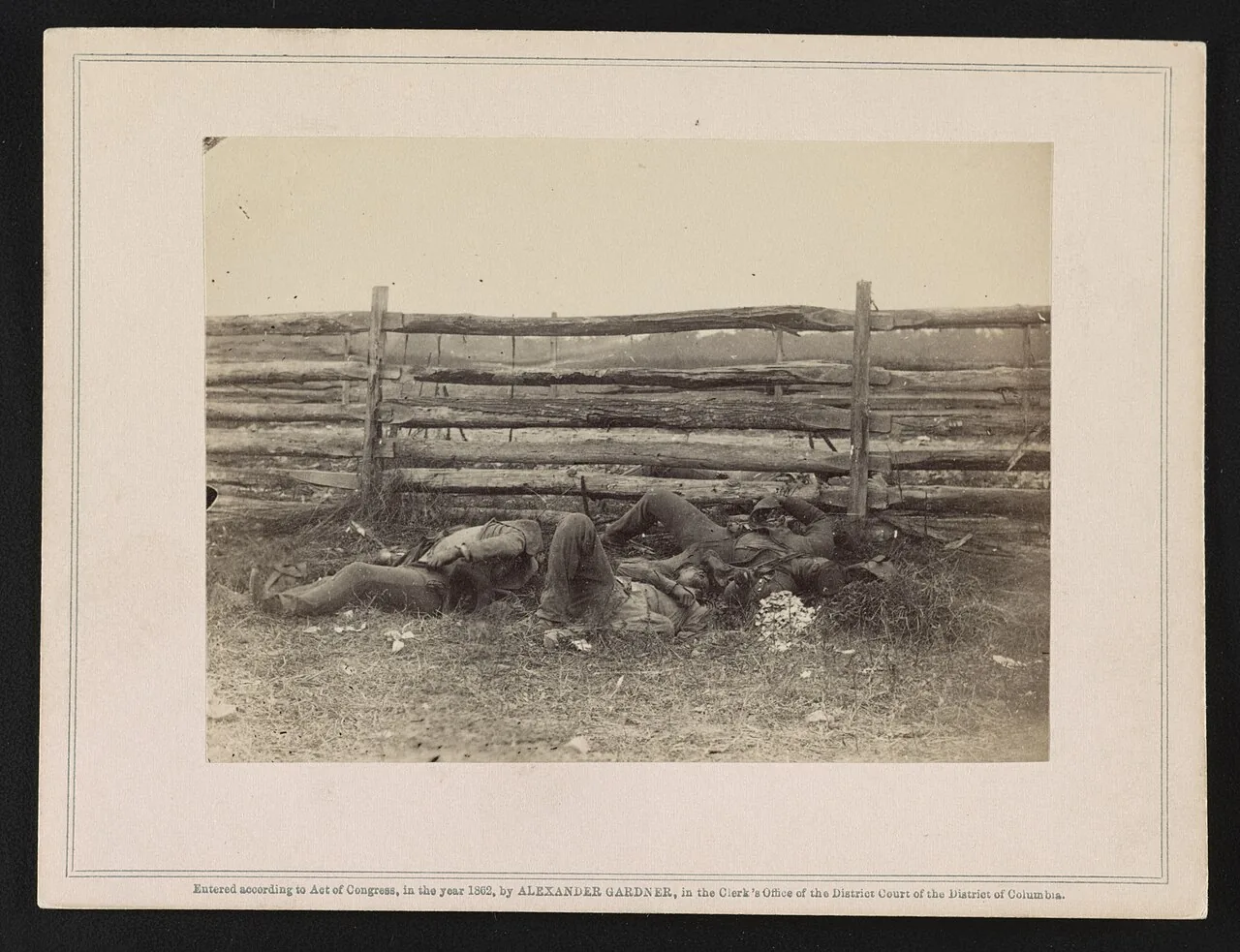
Source: Alexander Gardner, photograph, September 1862. Library of Congress, via Wikimedia Commons.
Photographers like Gardner worked slowly and could not photograph action, so their pictures show the aftermath. When New Yorkers saw them on display, the pictures changed how many Northerners thought of the war.
2. A war for freedom
Lincoln and emancipation
At first Lincoln said that the war aimed to save the Union and that he would not touch slavery in the states where it existed. He feared that an early attack on slavery would push four slave states into the Confederacy. These were Delaware, Maryland, Kentucky, and Missouri, the slave states still in the Union. But the war itself was undermining slavery. Enslaved people escaped to Union lines by the thousands, and Union generals decided not to return them. Congress passed Confiscation Acts that freed the enslaved people of rebels.
By the summer of 1862, Lincoln had decided that freeing the slaves in the rebel states would hurt the Confederacy and help the Union. In August he wrote to the newspaper editor Horace Greeley that his “paramount object” was to save the Union, whatever happened to slavery. He had already written a draft of a proclamation, but advisers told him to wait for a Union victory. After Antietam, he issued the preliminary Emancipation Proclamation on September 22, 1862. It went into effect on January 1, 1863.
What the proclamation did
The proclamation declared that all persons held as slaves in the states that were in rebellion “are, and henceforward shall be free.” It had limits. It did not apply to the border states or to areas of the Confederacy that were already under Union control. Lincoln justified it as a war measure that he could take as commander in chief. In practice, it did not free anyone at once, since the Confederate government ignored it. But it changed the war. Every advance of the Union army now meant freedom for enslaved people. It made it harder for Britain and France, which had abolished slavery, to support the Confederacy. And it allowed the Union army and navy to enlist Black soldiers.
Definition: Emancipation Proclamation
Lincoln’s order of January 1, 1863, which declared free all enslaved people in the states in rebellion against the United States.
Black soldiers
About 180,000 Black men served in the Union army, in units called the United States Colored Troops. About 19,000 more served in the navy. Most had been born in slavery. Frederick Douglass helped to recruit the 54th Massachusetts, the first Black regiment raised in the North. He told Black men that this was their hour. At first the soldiers received lower pay than white soldiers. Some regiments refused to take any pay until Congress made it equal in 1864.
On July 18, 1863, the 54th Massachusetts led a brave assault on Fort Wagner in South Carolina. Its commander, Colonel Robert Gould Shaw, died in the attack, and the regiment lost nearly half of its men. Still, the courage of the soldiers made them famous throughout the North. About 40,000 Black soldiers died, mostly from disease. Lincoln later said that without their help the Union could not have won the war.
Document 2 – Douglass calls Black men to arms
Liberty won by white men would lose half its luster. “Who would be free themselves must strike the blow.” “Better even die free, than to live slaves.” This is the sentiment of every brave colored man amongst us. There are weak and cowardly men in all nations. We have them amongst us. They tell you this is the “white man’s war”; […] Believe them not; cowards themselves, they do not wish to have their cowardice shamed by your brave example. Leave them to their timidity, or to whatever motive may hold them back. I have not thought lightly of the words I am now addressing you. The counsel I give comes of close observation of the great struggle now in progress, and of the deep conviction that this is your hour and mine.
Source: Frederick Douglass, “Men of Color, To Arms!,” broadside, March 21, 1863. Teaching American History.
*luster: shine, glory. *timidity: fear.
3. The turning point, 1863
Gettysburg and Vicksburg
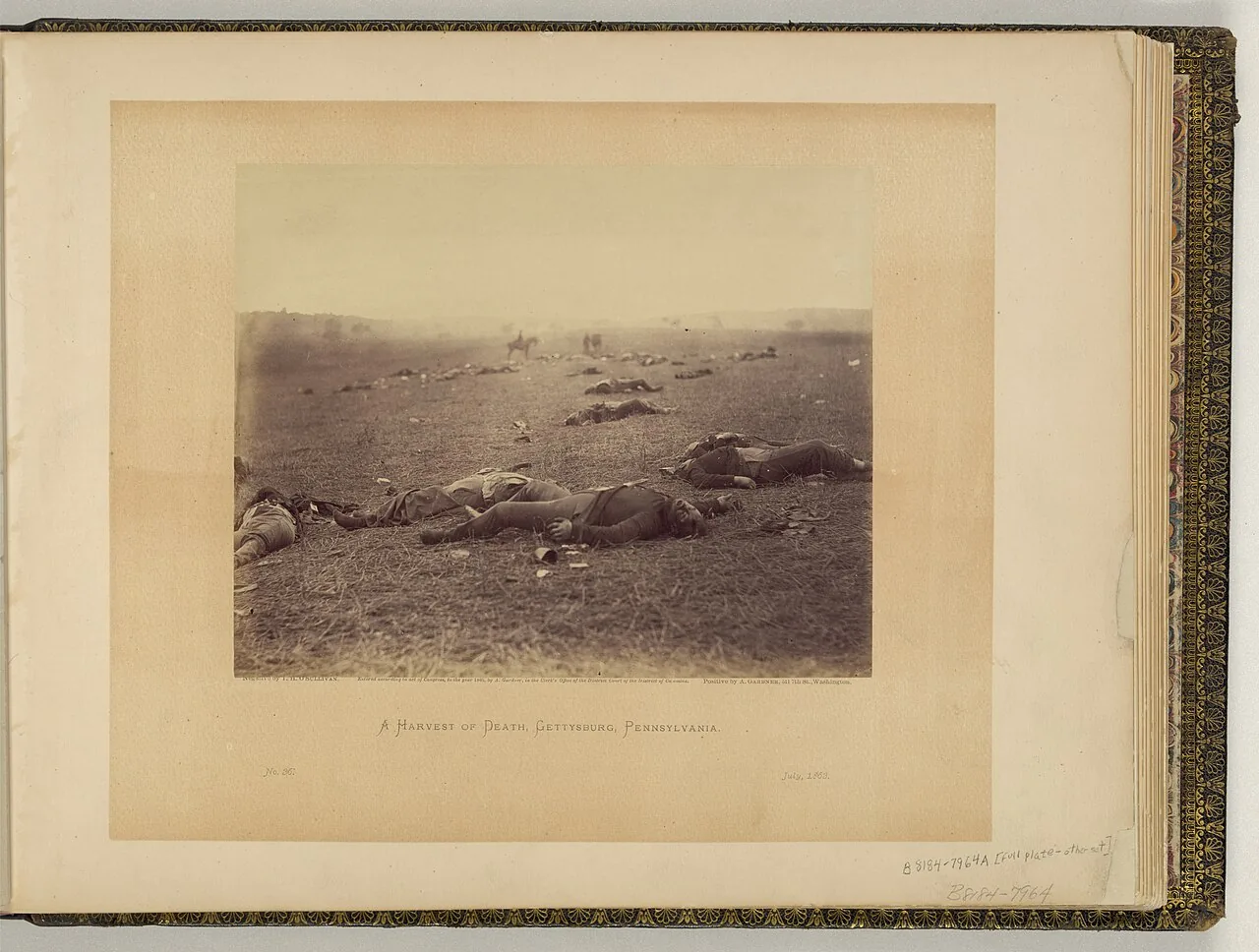
In the summer of 1863 Lee invaded the North a second time. He hoped to win a victory on Union soil that would push the North to make peace. His army met the Army of the Potomac, now commanded by General George Meade, at the small Pennsylvania town of Gettysburg. The battle lasted from July 1 to July 3. On the third day, Lee ordered an attack on the center of the Union line on Cemetery Ridge.
This attack, known as Pickett’s Charge, sent about 12,500 Confederate soldiers across an open field into artillery and rifle fire. The charge failed, and Lee retreated to Virginia. In the three days of fighting both armies lost about 50,000 men killed, wounded, captured, or missing. That made Gettysburg the bloodiest battle of the war.
On July 4, 1863, one day after Pickett’s Charge, the Confederate fortress at Vicksburg, Mississippi, surrendered to General Grant. The siege had lasted about six weeks. The Union now controlled the Mississippi River and had cut the Confederacy in two. Historians see Gettysburg and Vicksburg together as the turning point of the war. After them the South would not again have a realistic chance to win a military victory.
The Gettysburg Address and the home front
On November 19, 1863, officials dedicated a cemetery at Gettysburg for the Union soldiers who had died there. The main speaker, Edward Everett, talked for two hours. President Lincoln then spoke for about two minutes. The 272 words of the Gettysburg Address reminded the crowd that the founders had based the nation on the idea that all men are created equal. Lincoln argued that the soldiers had died so that the nation would have “a new birth of freedom.”
Document 3 – The Gettysburg Address, 1863
Fourscore and seven years ago our fathers brought forth on this continent a new nation, conceived in liberty and dedicated to the proposition that all men are created equal. […] It is for us the living rather to be dedicated here to the unfinished work which they who fought here have thus far so nobly advanced. It is rather for us to be here dedicated to the great task remaining before us–that from these honored dead we take increased devotion to that cause for which they gave the last full measure of devotion–that we here highly resolve that these dead shall not have died in vain, that this nation under God shall have a new birth of freedom, and that government of the people, by the people, for the people shall not perish from the earth.
Source: Abraham Lincoln, address at the dedication of the Soldiers’ National Cemetery, Gettysburg, Pennsylvania, November 19, 1863. Avalon Project, Yale Law School.
*fourscore: eighty. Fourscore and seven years before 1863 is 1776.
Lincoln dates the nation from 1776 and the Declaration of Independence rather than from the Constitution of 1787, which tolerated slavery. That choice suggests the new purpose he now gave to the war.
The war changed life far from the battlefields. In the North, the Republican Congress, free of Southern opposition, passed the Homestead Act, the Morrill Land-Grant College Act, and the Pacific Railway Act in 1862. It also created a national paper currency. Women served as nurses, and Clara Barton and Dorothea Dix became famous for their work in military hospitals.
Both governments drafted soldiers. The Union draft allowed rich men to pay $300 to avoid service. In July 1863 anger over it led to four days of riots in New York City, in which more than a hundred people died, many of them Black residents. In the South, the blockade caused shortages, prices soared, and women in Richmond rioted for bread in April 1863. About one Confederate soldier in four died.
4. Total war and the end of the Confederacy, 1864-1865
In March 1864 Lincoln put Grant in command of all Union armies. Grant understood that the North’s greater numbers could wear down the Confederacy. He attacked Lee’s army in Virginia in the spring of 1864 in a series of costly battles. Then he besieged Petersburg, near Richmond, which kept Lee’s army pinned down for nine months. In the West, Grant’s friend General William Tecumseh Sherman captured Atlanta, a major railroad and manufacturing center, on September 2, 1864. The victory helped Lincoln to win re-election in November against his old general McClellan. Many Northerners had feared that the war could not be won.
The March to the Sea
Sherman then cut loose from his supply lines and marched about 60,000 soldiers from Atlanta to the Atlantic coast. He reached Savannah on December 21, 1864. This March to the Sea was an example of total war. This strategy attacks the enemy’s economy and will to fight, not just its army. His soldiers tore up railroads and burned warehouses, mills, and cotton gins.
They also took food and animals from farms along a path about 60 miles wide. They did not set out to kill civilians, but the destruction caused great suffering. Thousands of formerly enslaved people followed the army. Sherman defended his methods in a letter to the mayor of Atlanta in September 1864. He said that the only way to peace was to end the war.
Definition: Total war
A way of fighting that attacks the enemy’s economy, transportation, and civilian support as well as its armies. Sherman’s March to the Sea is a well-known example.
The end at Appomattox
By the spring of 1865 the Confederacy was collapsing. Grant broke through at Petersburg. On April 2 and 3 the Confederate government abandoned Richmond. Retreating troops and looters set fires that burned the city. Lee, with his army surrounded and out of food, surrendered to Grant at the village of Appomattox Court House, Virginia, on April 9, 1865. Grant allowed the Confederate soldiers to go home with their horses and mules.
The other Confederate armies surrendered in the following weeks. In his Second Inaugural Address on March 4, 1865, Lincoln had asked Americans to finish the war “with malice toward none, with charity for all.” Five days after Appomattox, on April 14, an actor and Confederate sympathizer, John Wilkes Booth, shot Lincoln at Ford’s Theatre in Washington. The president died the next morning.
The human cost
The cost was enormous. About 620,000 soldiers died, and some historians now think that the number was closer to 750,000. About 360,000 of the dead were Union soldiers and about 260,000 were Confederate. Disease killed more soldiers than combat did. It was the deadliest war in American history. The Union survived and the Confederacy fell. Congress had passed the 13th Amendment in January 1865 to end slavery in the whole country. But the nation now had to decide what freedom would mean, and that question belongs to the era of Reconstruction.
- April 12, 1861 Confederate guns fire on Fort Sumter
- July 21, 1861 First Battle of Bull Run
- Sept. 17, 1862 Battle of Antietam; Lincoln announces the Emancipation Proclamation five days later
- Jan. 1, 1863 The Emancipation Proclamation takes effect
- July 1-3, 1863 Battle of Gettysburg; Vicksburg falls on July 4
- Nov. 19, 1863 The Gettysburg Address
- Sept. 2, 1864 Sherman captures Atlanta
- Nov. 15 – Dec. 21, 1864 Sherman’s March to the Sea
- April 9, 1865 Lee surrenders at Appomattox Court House
- April 14-15, 1865 Booth shoots Lincoln, who dies the next morning
Key takeaways
- The Union had more people, factories, and railroads, but the Confederacy fought a defensive war on its own ground. The Anaconda Plan sought to blockade the South and control the Mississippi.
- Antietam (September 1862) allowed Lincoln to issue the Emancipation Proclamation, which took effect on January 1, 1863, and turned the war into a struggle against slavery.
- About 180,000 Black men served in the Union army; the 54th Massachusetts became famous at Fort Wagner in July 1863.
- Gettysburg and Vicksburg (July 1863) were the turning point. In the Gettysburg Address, Lincoln said that the war would give the nation “a new birth of freedom.”
- Grant and Sherman used total war in 1864. Lee surrendered at Appomattox on April 9, 1865, and about 620,000 soldiers had died.

Quick review: flashcards
Tap a card to see the answer.