


This Grade 8 US History to 1877 lesson covers Slavery and Sectionalism, part of the unit “Division and reunion.” First, read the full lesson with its primary sources, maps and key terms. Then practice with the worksheet, check yourself with the quiz and get ready with the test.
On July 5, 1852, Frederick Douglass stood before an audience of several hundred people in Rochester, New York. They had gathered to celebrate the anniversary of the Declaration of Independence. Douglass had been born into slavery in Maryland, and he had escaped to freedom fourteen years earlier. He did not give the speech the audience expected. He asked them a question. What does the Fourth of July mean to an enslaved person?
His answer shocked many of them. The founders had based the United States on the promise that “all men are created equal.” Yet in 1852 more than three million people lived in bondage in the American South, and the number was growing. By the time Douglass spoke, slavery had become the most dangerous problem in American politics. It would split churches, break political parties, and finally tear the Union apart in the Civil War.
Guiding question: Why did compromise over slavery succeed in 1820 and 1850 but fail in 1860, and how did the conflict lead eleven states to leave the Union?
1. Slavery and the Southern economy
Cotton and the growth of slavery
Slavery came to English North America with the first Africans brought to Virginia in 1619. By the time of the American Revolution it existed in all thirteen colonies. In the North, where farms were small and the economy depended on trade and craftwork, slavery slowly disappeared. Between 1777 and 1804, every state from Vermont to New Jersey either ended slavery or began to end it gradually. Congress banned the importation of enslaved people from abroad in 1808, as the Constitution allowed. But slavery did not fade away in the South. It expanded, because of a new crop and a new machine.
The cotton gin
In 1793 Eli Whitney, a Yankee inventor who was staying on a Georgia plantation, built a cotton gin. This machine quickly separated the sticky seeds from short-staple cotton. Before the gin, cleaning cotton by hand was so slow that few planters grew it. After the gin, cotton became enormously profitable. British and New England textile mills wanted all the cotton they could get. Planters moved west into Alabama, Mississippi, Louisiana, and later Texas, carrying slavery with them.
Cotton production rose from a few thousand bales a year in the early 1790s to more than four million bales in 1860. By then cotton made up more than half of the value of all American exports. The enslaved population grew with it. It rose from about 700,000 in 1790 to nearly 4 million in 1860. By then enslaved people made up about one-third of all people living in the Southern states. A thriving domestic slave trade sold hundreds of thousands of people from Virginia, Maryland, and the Upper South to the cotton states of the Deep South. It broke up families along the way.
Definition: Cotton gin
A machine invented by Eli Whitney in 1793 that separated cotton fibers from their seeds. It made cotton growing so profitable that it increased the demand for enslaved labor in the South.
Life under slavery
Only a minority of white Southerners owned slaves. In 1860 roughly one white Southern family in four held at least one person in bondage. A small group of large planters, those with twenty or more enslaved workers, held the greatest wealth and political power. Most enslaved people worked in the fields, in gangs under the eye of an overseer, from sunrise until dark. Others worked as house servants, blacksmiths, carpenters, or in mills and mines. The law treated them as property.
State slave codes forbade enslaved people to travel without a pass, to testify against whites, or to carry weapons. In most states they also made it a crime to teach them to read. The law did not recognize slave marriages. Owners could sell a husband from a wife or a child from a mother. Frederick Douglass and Harriet Jacobs, two people who escaped, wrote about their lives. They described both the physical cruelty and the daily humiliation of slavery, as well as the harm it did to slaveholders themselves.
Enslaved people resisted in many ways. They slowed down their work, broke tools, and ran away. They also kept their families, religion, songs, and stories alive in the quarters. A few took up arms. In 1831 Nat Turner led a rebellion in Southampton County, Virginia, in which rebels killed about sixty white people. The state put Turner and many others to death. After the revolt Southern legislatures passed harsher slave codes. The Underground Railroad, a network of Black and white helpers, guided thousands to freedom in the North and in Canada. The most famous guide, Harriet Tubman, escaped in 1849 and returned to Maryland about thirteen times to lead others out.
Document 1 – An advertisement for a slave sale, 1769
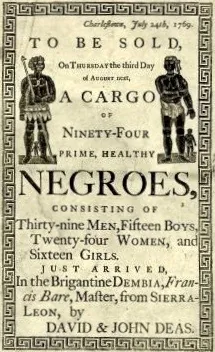
Source: broadside of David and John Deas, Charleston, South Carolina, July 24, 1769. Wikimedia Commons (detail).
The ad shows that sellers advertised enslaved people as cargo and sold them at auction. Notice the words “prime, healthy” and the way the ad counts the people by age and sex. Traders brought Africans across the Atlantic in this way until Congress ended the legal slave trade in 1808. The sale of people within the United States continued until 1865.
2. The North, the abolitionists, and the first compromises
The abolition movement
By the 1830s a growing number of Americans said that slavery was a sin that had to end. Some wanted it to end gradually, and others wanted it to end now. The most uncompromising voice was William Lloyd Garrison, a Boston printer. He began his newspaper, The Liberator, in 1831 and demanded immediate emancipation. Black abolitionists were at the center of the movement. They included Frederick Douglass, Sojourner Truth, and the many free Black people who organized churches, schools, and newspapers in the North.
In 1852 Harriet Beecher Stowe published Uncle Tom’s Cabin. This novel sold hundreds of thousands of copies and made many Northerners feel the cruelty of slavery for the first time. Southerners called such writers fanatics and argued that slavery was a “positive good.” Many Northerners were not abolitionists at all, and some of them disliked abolitionists as troublemakers. But a larger number of Northerners came to agree on one point. They believed that slavery should not spread into new territory.
Definition: Abolitionist
A person who worked to end slavery immediately and completely. Abolitionists included Black and white Americans, women and men.
The Missouri Compromise, 1820
The question of new territory first came to a crisis in 1819. Missouri asked to join the Union as a slave state. At that time there were eleven free and eleven slave states. The balance mattered because each state had two senators. Northern representatives wanted to forbid slavery in Missouri, and Southerners refused. In 1820 Congress reached the Missouri Compromise. Missouri entered as a slave state, and Maine entered as a free state. Congress also forbade slavery in the rest of the Louisiana Purchase north of the line of 36°30′ north latitude, except for Missouri itself. The compromise kept peace for about thirty years. Thomas Jefferson feared the quarrel and compared it to “a fire bell in the night.”
Mexico, new territory, and the Compromise of 1850
The war with Mexico (1846-1848) added huge territories in the Southwest and California. The old question returned: would slavery be legal there? In 1846 Representative David Wilmot proposed a ban on slavery in any land that the United States took from Mexico. The Wilmot Proviso passed the House several times, but the Senate rejected it. The discovery of gold in California in 1848 brought so many people. As a result, California asked to enter the Union as a free state in 1849.
After months of debate, Henry Clay and Stephen Douglas helped pass the Compromise of 1850, a package of laws. Congress admitted California as a free state. In Utah and New Mexico, the settlers would decide the question of slavery, an idea called popular sovereignty. Congress ended the slave trade (but not slavery) in the District of Columbia. Finally, it passed a much stricter Fugitive Slave Act to please the South.
Definition: Popular sovereignty
The idea that settlers in a territory, not Congress, should vote on whether to allow slavery there.
The Fugitive Slave Act forced Northerners to take part in slavery. Federal commissioners could order the return to the South of a person accused of escaping. The accused person could not speak in his or her own defense. In addition, a commissioner earned more for ruling in favor of the slaveholder. Slave catchers could seize free Black people in the North, and thousands of them fled to Canada. The law angered many white Northerners who had ignored the issue. Some states passed laws to protect people from slave catchers. The law did more than any speech to convince the North that the “Slave Power” was reaching into free states.
3. The collapse of compromise, 1854-1860
Kansas and Nebraska
In 1854 Senator Stephen Douglas of Illinois introduced the Kansas-Nebraska Act. He wanted a railroad to the Pacific through the northern plains. It organized two new territories and applied popular sovereignty to both of them. In effect, it repealed the Missouri Compromise. Kansas and Nebraska lay north of the 36°30′ line, where Congress had banned slavery for thirty-four years. Northerners were furious. The act destroyed the Whig Party and led to the formation of the Republican Party. This new northern party’s members agreed that slavery must not spread into the territories.
Kansas became a battleground. Settlers from Missouri crossed the border to vote illegally for slavery. Antislavery settlers from New England and the Midwest arrived with rifles. In May 1856 proslavery men attacked and burned part of the free-state town of Lawrence. In revenge, the abolitionist John Brown and his sons killed five proslavery settlers at Pottawatomie Creek. Dozens of people died in the fighting, and people called the territory “Bleeding Kansas.” The violence even reached the Senate floor.
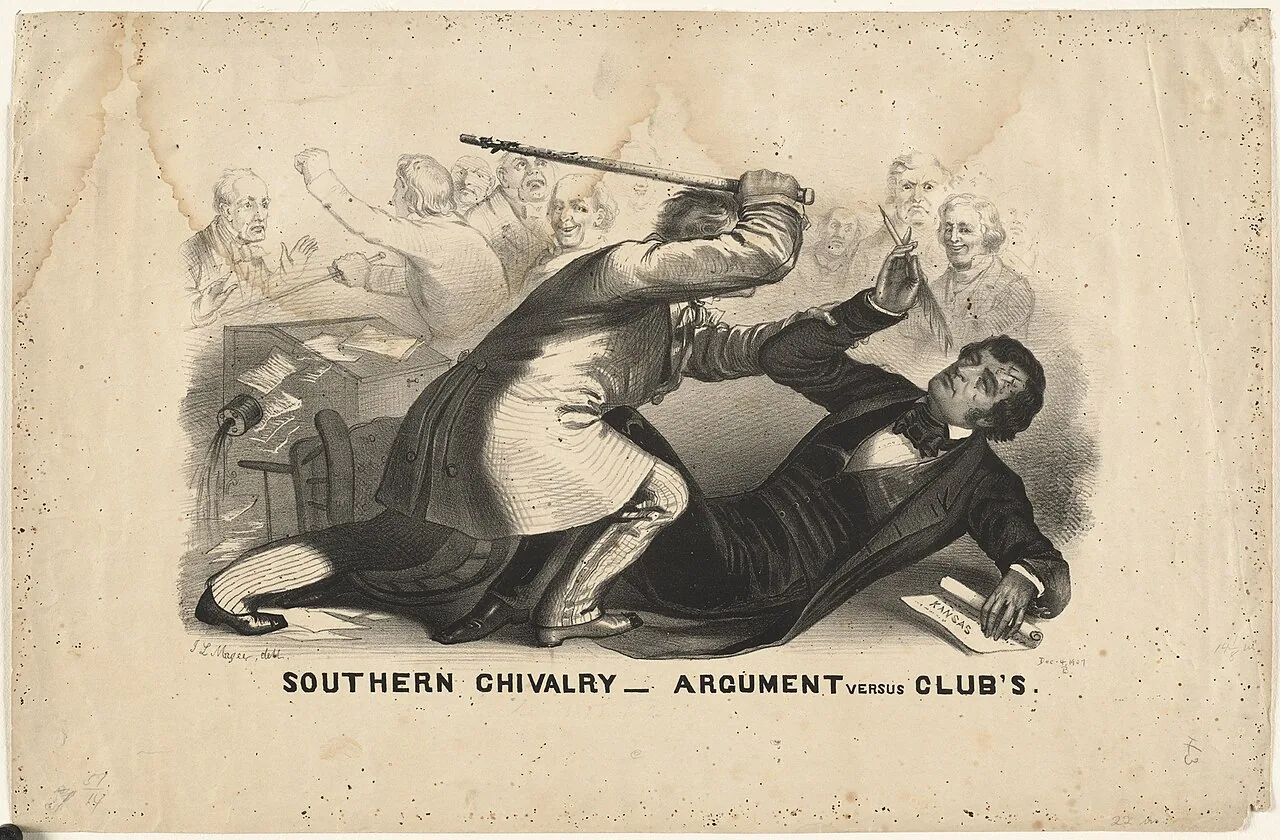
On May 22, 1856, Representative Preston Brooks of South Carolina beat Senator Charles Sumner of Massachusetts with a cane until he collapsed. Brooks acted because Sumner had insulted a relative of Brooks in a speech against the Kansas violence. Sumner needed years to recover. Many Southerners sent Brooks canes as presents, and many Northerners concluded that the South would use force to defend slavery.
Dred Scott and the Lincoln-Douglas debates
In 1857 the Supreme Court tried to end the quarrel. Dred Scott was an enslaved man whose owner had taken him to Illinois and to the Wisconsin Territory, where slavery was illegal. He sued for his freedom. On March 6, 1857, in Dred Scott v. Sandford, the Court ruled 7 to 2 against him. Chief Justice Roger Taney wrote that Black people, whether enslaved or free, were not and could not be citizens of the United States.
Therefore, they could not sue in federal court. Taney also ruled that Congress had no power to forbid slavery in the territories. This meant that the Missouri Compromise had been unconstitutional all along. Southerners cheered. The decision seemed to mean that slavery could go anywhere, and that alarmed Republicans.
In 1858 Abraham Lincoln, a lawyer from Illinois, ran for the Senate against Stephen Douglas. He had served one term in Congress. Accepting the nomination, he said that “a house divided against itself cannot stand.” He added that the country could not remain “half slave and half free.” In seven debates from August to October, the two men argued about slavery in the territories.
Douglas said that the people of a territory could keep slavery out by refusing to pass the laws that protect it. This answer, called the Freeport Doctrine, angered Southern Democrats. Lincoln lost the election, because the legislature chose senators in those days. Still, the debates made him known across the country. Neither man argued for full equality between the races. However, Lincoln called slavery a moral wrong, and Douglas said that he did not care whether voters approved it or not.
Document 2 – “What to the slave is the Fourth of July?”
What, to the American slave, is your 4th of July? I answer: a day that reveals to him, more than all other days in the year, the gross injustice and cruelty to which he is the constant victim. To him, your celebration is a sham; your boasted liberty, an unholy license; your national greatness, swelling vanity; your sounds of rejoicing are empty and heartless; your denunciations of tyrants, brass fronted impudence; your shouts of liberty and equality, hollow mockery; your prayers and hymns, your sermons and thanksgivings, with all your religious parade, and solemnity, are, to him, mere bombast, fraud, deception, impiety, and hypocrisy—a thin veil to cover up crimes which would disgrace a nation of savages.
Source: Frederick Douglass, speech delivered at Rochester, New York, July 5, 1852. Text from Wikisource.
*brass fronted impudence: shameless boldness. *impiety: disrespect for God.
Douglass was addressing white citizens who had come to honor the Declaration of Independence. He did not attack the principles of the Declaration. He attacked the nation for failing to live by them.
The crisis grew in October 1859. John Brown had become convinced that only violence could end slavery. He led twenty-one men, five of them Black, in a raid on the federal arsenal at Harpers Ferry, Virginia (now West Virginia). He hoped to seize weapons and start a slave uprising. No uprising came. United States Marines commanded by Colonel Robert E. Lee captured Brown after two days, and Virginia hanged him on December 2, 1859. Many Northerners honored him as a martyr. Southerners took this as proof that the North wished to bring about a slave revolt.
4. The election of 1860 and secession
The election of 1860 showed how divided the nation had become. The Democratic Party split in two, with Stephen Douglas as the Northern candidate and John C. Breckinridge of Kentucky as the Southern candidate. A fourth party, the Constitutional Union Party, nominated John Bell of Tennessee. The Republicans chose Abraham Lincoln. Lincoln promised not to touch slavery where it already existed, but he opposed its spread into the territories. He was not even on the ballot in ten Southern states. Still, he won every free state and became president with about 40 percent of the popular vote and 180 of 303 electoral votes.
Secession and war
Many Southern leaders believed that a Republican president threatened their way of life. On December 20, 1860, South Carolina voted to leave the Union. People call this act secession. By February 1, 1861, six more states of the Deep South had followed: Mississippi, Florida, Alabama, Georgia, Louisiana, and Texas. Their leaders wrote declarations that named slavery as the reason. Delegates met in Montgomery, Alabama, and formed the Confederate States of America, with Jefferson Davis as president.
In his inaugural address on March 4, 1861, President Lincoln promised that he would not attack the South. However, he said that the Union was perpetual and that secession was illegal. On April 12, 1861, Confederate cannon opened fire on Fort Sumter in the harbor of Charleston, South Carolina. The Union garrison surrendered. Lincoln called for 75,000 volunteers to put down the rebellion. In response, Virginia, Arkansas, Tennessee, and North Carolina also seceded, which brought the Confederacy to eleven states. The war had begun.
Definition: Secession
The formal withdrawal of a state from the Union. Eleven Southern states seceded in 1860 and 1861 and formed the Confederate States of America.
Why the war came
Historians debate the causes of the Civil War. The people who made the decisions at the time, however, were clear. The Mississippi convention of 1861 began its declaration with the statement that its position was “thoroughly identified with the institution of slavery.” Lincoln said in his Second Inaugural Address in 1865 that slavery “was somehow the cause of the war.” Differences over tariffs and states’ rights existed, but the central issue was whether the nation would allow slavery to expand.
- 1793 Eli Whitney builds the cotton gin
- 1820 The Missouri Compromise
- 1831 Garrison starts The Liberator; Nat Turner’s rebellion
- 1850 The Compromise of 1850 and the Fugitive Slave Act
- 1854 The Kansas-Nebraska Act; Republicans form their party
- 1857 The Dred Scott decision
- 1859 John Brown’s raid on Harpers Ferry
- 1860 Lincoln wins the election; South Carolina secedes in December
- 1861 The Confederacy forms; Fort Sumter, April 12
Key takeaways
- The cotton gin made cotton very profitable and increased the demand for enslaved labor. By 1860 the South held nearly 4 million enslaved people.
- The Missouri Compromise (1820) and the Compromise of 1850 kept the peace by dividing new land between slave and free states. However, each compromise left the basic question unanswered.
- The Fugitive Slave Act (1850), the Kansas-Nebraska Act (1854), and the Dred Scott decision (1857) convinced many Northerners that slavery was spreading. They also convinced many Southerners that the North was hostile.
- Lincoln’s election in 1860 led seven Southern states to secede; after Fort Sumter (April 1861) four more joined the Confederacy.
- Abolitionists, including Frederick Douglass and Harriet Tubman, and the enslaved people themselves played a major role in forcing the nation to face the issue.

Quick review: flashcards
Tap a card to see the answer.