


This Grade 8 US History to 1877 lesson covers Industry, Immigration and Reform in the 1800s, part of the unit “A growing nation.” First, read the full lesson with its primary sources, maps and key terms. Then practice with the worksheet, check yourself with the quiz and get ready with the test.
In 1836 a girl of about eleven, Harriet Hanson, walked out of a cotton mill in Lowell, Massachusetts, with hundreds of older women. They were protesting a cut in their wages. She was a “doffer,” one of the youngest workers, who replaced full spools on the spinning frames. Later she wrote that she told her friends she would go too when she saw the older girls leave.
Her reason was simple: she was not afraid. Fifty years later, as Harriet Robinson, she wrote the story down. Her account shows an America that was changing fast. In her lifetime farms gave way to factories, and canals and railroads tied the country together. Millions of immigrants arrived. Reformers asked whether a nation founded on equality had lived up to its promise.
Guiding question: How did factories, new transportation, immigration, and reform movements change life in the United States between about 1800 and 1860, and who benefited from the changes?
1. The factory and the transportation revolutions
From the workshop to the mill
In the early 1800s most Americans lived and worked on farms. Goods such as cloth came from home or from artisans in small shops. The Industrial Revolution began in Britain, which tried to keep its machines secret. In 1790 Samuel Slater, an English mechanic, opened a water-powered cotton mill in Pawtucket, Rhode Island. He had memorized the design of spinning machines. The Embargo Act (1807) and the War of 1812 cut off British goods and encouraged Americans to make their own.
The most famous of the new mill towns was Lowell, Massachusetts. A Boston merchant, Francis Cabot Lowell, had visited British factories. In 1813 he built a mill at Waltham that carried out all the steps of making cloth under one roof. After his death, his partners founded a new town on the Merrimack River and named it Lowell. By the 1830s it was a leading center of cotton textiles.
The owners recruited young unmarried women from New England farms. They lived in company boardinghouses under strict rules, worked about thirteen to fourteen hours a day, and sent money home. For many it was their first paid work. The mills were not equally kind to every worker. When owners cut wages, the women organized strikes, in 1834 and in 1836.
Definition: Industrial Revolution
the change from making goods by hand at home or in small shops to making them by machine in factories. These machines were powered at first by water and then by steam. In the United States the change began in New England textile mills in the 1790s and spread widely after 1815.
Document 1 – Life in the Lowell mills
The working hours of all the girls extended from five o’clock in the morning until seven in the evening, with one half-hour each, for breakfast and dinner. Even the doffers were forced to be on duty nearly fourteen hours a day. […] Those of the mill-girls who had homes generally worked from eight to ten months in the year; the rest of the time was spent with parents or friends.
Source: Harriet H. Robinson, “Early Factory Labor in New England,” in Massachusetts Bureau of Statistics of Labor, Fourteenth Annual Report (Boston, 1883), pp. 380-392; text from the Internet Modern History Sourcebook, Fordham University.
*doffers: the youngest mill workers, who removed full bobbins and put empty ones in place.
Commentary. Harriet Robinson wrote this account in 1883, in her seventies. It is a memory, not a record made at the time. She was a member of the first generation of mill workers and defended her friends against critics. Her memory may therefore have been softer than the experience of all the workers. Even so, the numbers she gives are clear. The workday of about fourteen hours is the “greatest hardship” she remembers. Its length led to the ten-hour movement that followed.
Document 2 – The workers’ magazine
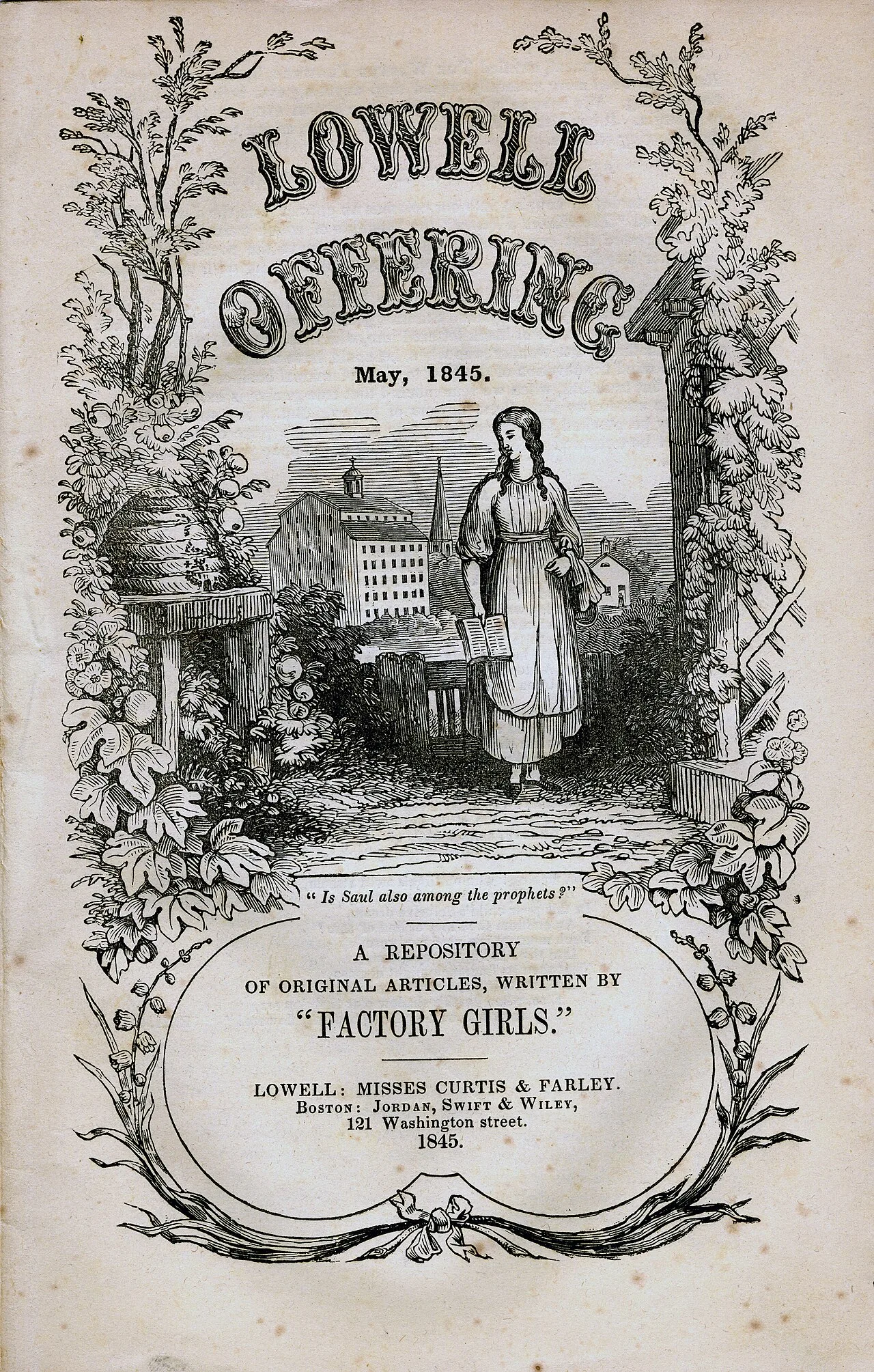
Source: National Park Service, Lowell National Historical Park (image on Wikimedia Commons).
Across the South, a different machine changed history. In 1793 Eli Whitney invented the cotton gin, which quickly separated the seeds from short-staple cotton. The northern mills needed raw cotton, and the cotton gin made growing cotton very profitable in the South. The result was an enormous growth of slavery. The number of enslaved people in the country rose from about 700,000 in 1790 to nearly four million by 1860. The same cotton joined the industrial North and the slaveholding South, even though they were growing apart politically. Whitney also promoted the idea of interchangeable parts. These standardized pieces later allowed factories to make guns, clocks, and sewing machines in great numbers.
Roads, canals, and rails
In 1800 it could take weeks to haul goods over bad roads from the coast to the interior. Over the next sixty years, a transportation revolution tied the country together. The National Road, begun in 1811, ran from Cumberland, Maryland, across the Appalachians. In 1807 Robert Fulton’s steamboat, the Clermont, made a trip up the Hudson River from New York to Albany. Soon steamboats carried goods and people upstream on the Mississippi and the Ohio. The greatest change, however, was the canal.
New York governor DeWitt Clinton pushed for the Erie Canal. Workers began it on July 4, 1817, and it opened on October 26, 1825. It was 363 miles long and linked the Hudson River at Albany with Lake Erie at Buffalo. Skeptics called it “Clinton’s Ditch.” Thousands of workers, many of them Irish immigrants, dug it largely by hand.
It cost about $7 million, and it repaid the state many times over. Freight rates fell from about $100 a ton by wagon to about $10 a ton by canal. Grain and lumber from the West flowed east while settlers and manufactured goods flowed west. New York City became the nation’s greatest port, and cities such as Rochester, Syracuse, and Buffalo grew along the canal.
Document 3 – The canal at work
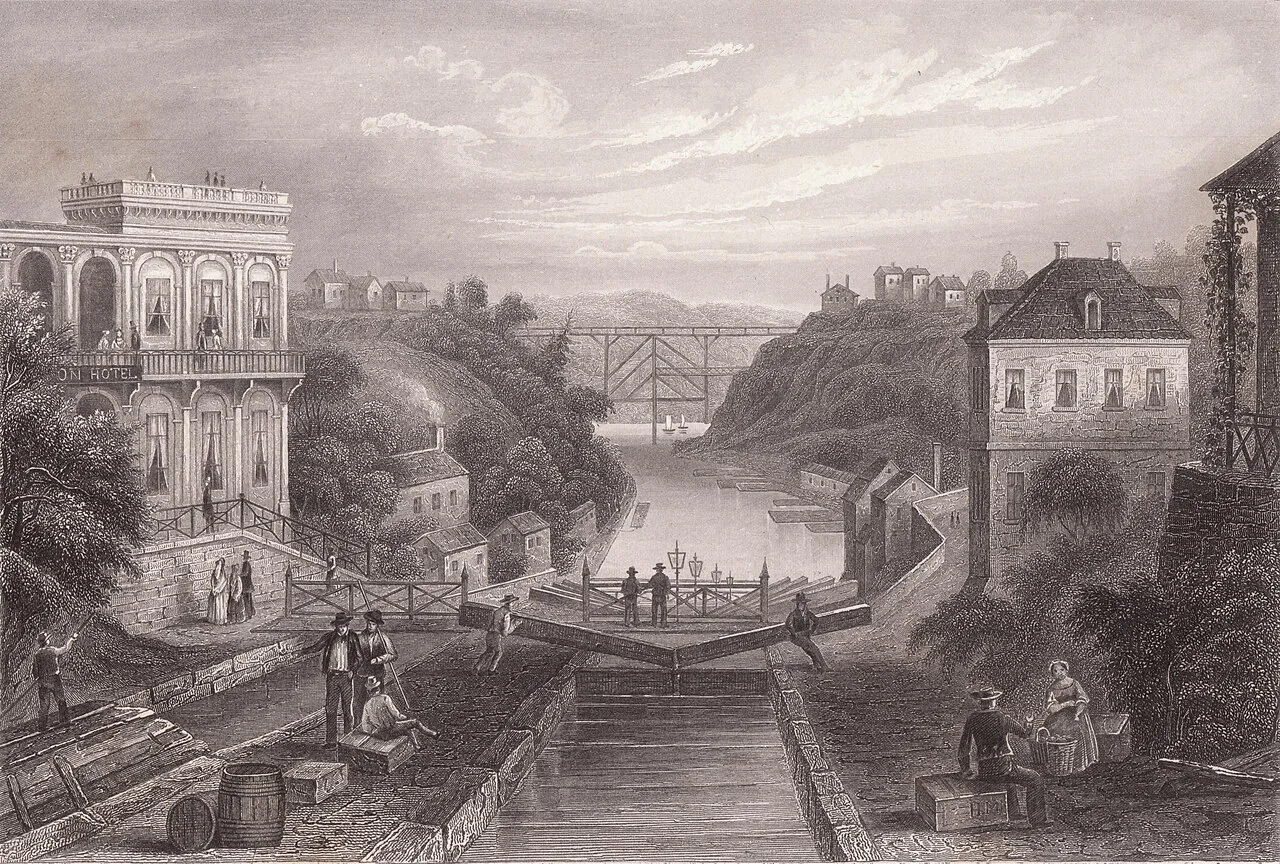
Source: engraving, about 1855 (image on Wikimedia Commons).
Railroads followed. The Baltimore and Ohio Railroad began running trains in 1830. By 1860 there were about 30,000 miles of track, most of it in the North. In 1844 Samuel Morse sent the first message by telegraph, from Washington to Baltimore: “What hath God wrought.” Farmers also gained new tools.
John Deere’s steel plow (1837) cut through the heavy prairie soil, and Cyrus McCormick’s reaper (1830s) sped up the harvest. Together these changes created a national market. Farmers in the Midwest could sell wheat in New York and even in Europe, and in return they bought factory goods. They also drew people into cities. Around 7 percent of Americans lived in towns of 2,500 or more in 1820. By 1860 about 20 percent did.
2. A nation of immigrants
Before 1820 fewer than a quarter of a million immigrants came in each decade. Many of them were English, Scottish, or from the German states. After 1830 the numbers grew sharply. Some 5 million immigrants arrived between 1820 and 1860. Most came from Ireland and Germany. In Ireland, the potato blight of 1845 began a famine that killed about a million people.
Another million or more emigrated within a few years, many of them to American port cities such as Boston and New York. Irish Catholics worked on canals and railroads, in mills, and as servants. The Germans included farmers, craftspeople, and political refugees after the failed revolutions of 1848. They settled in the Midwest, in cities such as Milwaukee, St. Louis, and Cincinnati. A smaller number of Chinese came to California after the Gold Rush of 1849.
Nativism and its targets
Immigrants met a mixed welcome. They provided cheap labor and built canals, railroads, and cities, but many native-born Protestants distrusted Catholics and foreigners. This nativism flared in riots and in churches burned in Philadelphia in 1844. It also appeared in the American Party, nicknamed the Know-Nothings, which in the 1850s demanded a longer wait before immigrants could become citizens. Enslaved people and free Black Americans, who also worked in the cities, faced barriers of their own. Northern states usually barred them from voting, and discrimination kept many out of skilled trades.
Definition: temperance movement
a reform movement of the 1800s that urged people to drink less alcohol or none at all. It grew out of the Second Great Awakening. Many women supported it because they saw drinking as a threat to family life.
Definition: nativism
a policy or attitude that favors the interests of people born in a country over those of immigrants, often combined with prejudice. In the 1840s and 1850s it targeted especially Irish and German Catholics.
Document 4 – Arrival
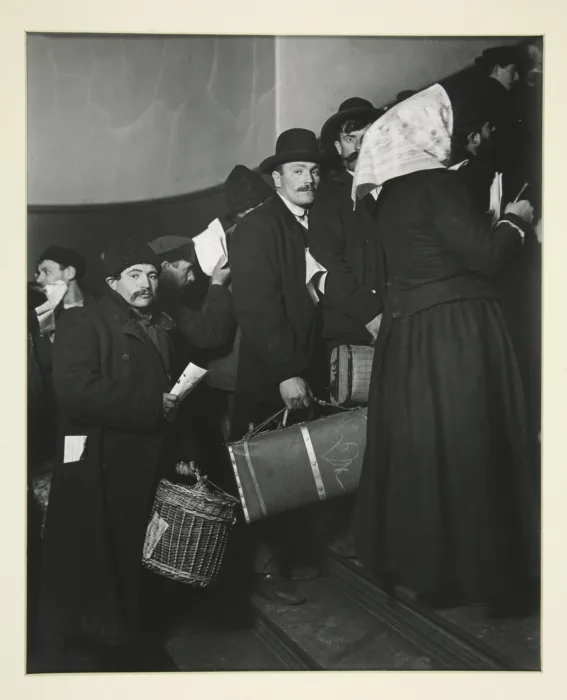
Source: photograph by Lewis Hine, about 1905 (image on Wikimedia Commons).
Commentary. This photograph dates from about 1905, in the later wave of immigration after the period in this chapter. It shows the first experience of America at Ellis Island, the great station that opened in 1892. Lewis Hine, a social reformer, used a camera to show immigrants as individuals. The people carry baskets and bundles, wear their heavy clothes from home, and hold papers. Later in the century, immigration grew even more. More than five million people came in the 1880s alone, as the table in the exercises shows.
Document 5 – The sonnet on the statue
Not like the brazen giant of Greek fame, With conquering limbs astride from land to land; Here at our sea-washed, sunset gates shall stand A mighty woman with a torch, whose flame Is the imprisoned lightning, and her name Mother of Exiles. From her beacon-hand Glows world-wide welcome; her mild eyes command The air-bridged harbor that twin cities frame. “Keep, ancient lands, your storied pomp!” cries she With silent lips. “Give me your tired, your poor, Your huddled masses yearning to breathe free, The wretched refuse of your teeming shore. Send these, the homeless, tempest-tost to me, I lift my lamp beside the golden door!
Source: Emma Lazarus, “The New Colossus,” sonnet written November 1883 to raise money for the pedestal of the Statue of Liberty; text from Wikisource. (Line breaks are shown with slashes.)
*brazen: made of bronze. *wretched refuse: unwanted people. *tempest-tost: tossed by storms.
Commentary. Emma Lazarus wrote this sonnet in 1883 for an auction to raise money for the pedestal of the Statue of Liberty. The statue was dedicated in 1886. People placed the poem on a plaque inside the pedestal only in 1903. The poem treats the statue as a welcoming mother, not a conqueror. It makes immigrants part of the national story. It reflects an ideal. In practice, laws such as the Chinese Exclusion Act of 1882 closed the door to some people.
3. Reform movements
Many Americans of this era believed that they could improve society. A wave of religious revival, the Second Great Awakening, swept through towns and farms between the 1790s and the 1840s. Preachers such as Charles Finney led it and taught that people could choose to do good. Out of this faith, and out of the optimism of the age, came many reform movements.
Temperance, schools, and asylums
The temperance movement argued that alcohol caused poverty, crime, and violence in families. It won many members, including large numbers of women. In education, Horace Mann became secretary of the new Massachusetts Board of Education in 1837. He campaigned for common schools, free public schools open to all children, with trained teachers and longer school years. Dorothea Dix visited jails and almshouses in Massachusetts. In 1843 she reported that people with mental illness lived chained in filthy conditions. Her work helped to create new state hospitals.
Document 6 – The school as the “great equalizer”
Education, then, beyond all other devices of human origin, is the great equalizer of the conditions of men–the balance-wheel of the social machinery. […] But I mean that it gives each man the independence and the means, by which he can resist the selfishness of other men. It does better than to disarm the poor of their hostility towards the rich; it prevents being poor.
Source: Horace Mann, Twelfth Annual Report of the Secretary of the Massachusetts Board of Education, 1848; text from the ETSU History Department document collection.
*equalizer: something that makes people equal. *balance-wheel: the part of a machine that keeps it steady. *disarm: remove.
Commentary. Mann’s words, written in 1848, show the main hope of the school reformers. They hoped that education would give each person the independence to resist the power of others and so reduce poverty. He addressed the people of Massachusetts, where public schools were common. He spoke for the state’s businessmen and reformers, many of whom also wanted schools to teach order and habits for work. In practice, black children were often excluded or sent to separate schools. In the South, no schools for enslaved people existed. Teaching enslaved people to read was illegal in most Southern states.
Abolition and women’s rights
The most powerful reform movement was abolitionism, the demand to end slavery. William Lloyd Garrison began his newspaper, The Liberator, in 1831 and demanded immediate emancipation. Reformers founded the American Anti-Slavery Society in 1833. Black Americans were at the heart of the movement. Frederick Douglass escaped from slavery in 1838 and published his autobiography in 1845. Sojourner Truth, a former slave who became a powerful speaker, also moved audiences. Women took part in large numbers, but many antislavery conventions did not allow them to speak. Two of them, Elizabeth Cady Stanton and Lucretia Mott, met at the world antislavery convention in London in 1840. They decided to hold a convention on women’s rights.
The convention met on July 19-20, 1848, in Seneca Falls, New York. About 300 people attended. Stanton drafted the Declaration of Sentiments, modeled on the Declaration of Independence. It listed the ways in which women were denied rights. They could not vote, they lost property when they married, and most professions, colleges, and the pulpit were closed to them. Of the 300 attendees, 100 signed the declaration: 68 women and 32 men. The resolution calling for women’s suffrage was the most controversial. It passed narrowly after Frederick Douglass spoke in its favor.
Document 7 – The Declaration of Sentiments
We hold these truths to be self-evident: that all men and women are created equal; that they are endowed by their Creator with certain inalienable rights; that among these are life, liberty, and the pursuit of happiness; that to secure these rights governments are instituted, deriving their just powers from the consent of the governed. […] The history of mankind is a history of repeated injuries and usurpations on the part of man toward woman, having in direct object the establishment of an absolute tyranny over her.
Source: Declaration of Sentiments, Seneca Falls Woman’s Rights Convention, July 19-20, 1848, as printed in Elizabeth Cady Stanton, Susan B. Anthony, and Matilda Joslyn Gage, eds., History of Woman Suffrage, vol. 1 (1881), chapter 4; text from Wikisource.
*inalienable: that cannot be taken away. *usurpations: seizures of power.
Commentary. The authors copied the form of the Declaration of Independence and changed its words to include women. It says, “all men and women are created equal.” By naming “the history of mankind” as one of “repeated injuries and usurpations,” they used the arguments of the Revolution. They turned them against the laws of their own time. Stanton and others printed the document in 1881 in History of Woman Suffrage, which is the source of the text we have today.
Document 8 – Remembering the signers
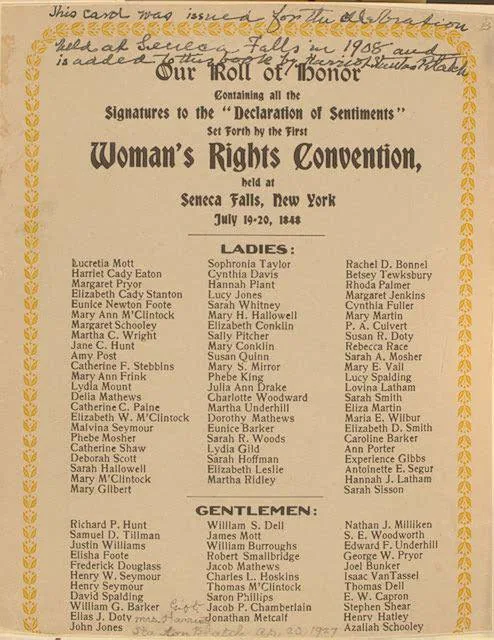
Source: souvenir card of 1908 (image on Wikimedia Commons).
Other experiments of the age, such as the utopian communities of New Harmony in Indiana (1825) and Brook Farm in Massachusetts (1841), tried to build ideal societies on a small scale. The Transcendentalists, among them Ralph Waldo Emerson and Henry David Thoreau, wrote about the importance of the individual conscience. Few of these communities lasted. Still, reform had a lasting effect. Public schools, women’s rights, and the abolition of slavery all grew out of the reform energy of the 1830s and 1840s.
4. Why this period matters
In sixty years, the United States changed from a country of farmers to the beginning of an industrial nation. Factories, canals, and railroads created a national economy and made new fortunes. They also created a class of wage earners, mostly women and immigrants, who worked long hours for low pay. The immigrants who arrived helped to build the country, and also met prejudice. Reformers pressed the nation to live up to its stated ideals. They created the movements that would carry through the Civil War and beyond. The cotton trade tied together the economy of the North and the slave economy of the South. The question of slavery, which reformers were already raising, would soon divide the country.
- 1790 Slater opens the first successful American cotton mill, Pawtucket, Rhode Island
- 1793 Eli Whitney invents the cotton gin
- 1813 Boston Manufacturing Company mill at Waltham
- 1825 Erie Canal opens
- 1831 Garrison begins The Liberator
- 1836 Lowell mill women strike; Mann leads Massachusetts schools from 1837
- 1844 Morse sends the first telegraph message
- 1845-1852 Irish famine; mass emigration to the United States
- 1848 Seneca Falls Convention
- 1892 Ellis Island opens
Key takeaways
- The Industrial Revolution reached the United States in the 1790s and changed work, first in New England textile mills such as those in Lowell.
- The cotton gin made cotton profitable and increased slavery in the South.
- Roads, steamboats, canals (the Erie Canal, 1825), railroads, and the telegraph created a national market.
- Millions of immigrants, mostly Irish and German, arrived between 1820 and 1860 and faced nativism.
- Reformers worked on temperance, schools (Horace Mann), asylums (Dorothea Dix), the abolition of slavery, and women’s rights.
- The Seneca Falls Convention (1848) produced the Declaration of Sentiments, which demanded equal rights for women, including the vote.

Quick review: flashcards
Tap a card to see the answer.