


This worksheet on Industry, Immigration and Reform in the 1800s belongs to the Grade 8 US History to 1877 course. Its questions use primary sources, maps and timelines, and they move from basic recall to short writing tasks. Before you start, review the lesson; afterward, try the true or false quiz.
Exercise 1 : Vocabulary of industry and reform
Match each term with its meaning, then use three terms in sentences.
- doffer
- cotton gin
- canal
- nativism
- temperance
- abolitionism
- suffrage
(a) the movement to end slavery; (b) the right to vote; (c) a machine that separates cotton fiber from seeds; (d) an artificial waterway for boats; (e) opposition to immigrants in favor of native-born people; (f) a young mill worker who replaced full bobbins with empty ones; (g) the movement to reduce or end the drinking of alcohol.
Exercise 2 : A day in the mill
Document 1 – Harriet Robinson on mill hours
The working hours of all the girls extended from five o’clock in the morning until seven in the evening, with one half-hour each, for breakfast and dinner. Even the doffers were forced to be on duty nearly fourteen hours a day. […] Those of the mill-girls who had homes generally worked from eight to ten months in the year; the rest of the time was spent with parents or friends.
Source: Harriet H. Robinson, “Early Factory Labor in New England,” in Massachusetts Bureau of Statistics of Labor, Fourteenth Annual Report (Boston, 1883), pp. 380-392; text from the Internet Modern History Sourcebook, Fordham University.
*doffers: the youngest mill workers.
- Present the document (nature, author, date, context). How long after the events was it written?
- What were the working hours of the mill girls?
- What did the doffers do, and how much were they paid?
- What did the author call the greatest hardship of these children?
- What are the benefits and limits of a memory written fifty years later?
Exercise 3 : The Lowell strike of 1836
Document 1 – The strike
One of the first strikes that ever took place in this country was in Lowell in 1836. When it was announced that the wages were to be cut down, great indignation was felt, and it was decided to strike or “turn out” en masse. This was done. The mills were shut down, and the girls went from their several corporations in procession to the grove on Chapel Hill, and listened to incendiary speeches from some early labor reformers. […] It is hardly necessary to say that, so far as practical results are concerned, this strike did no good. The corporation would not come to terms. The girls were soon tired of holding out, and they went back to their work at the reduced rate of wages.
Source: Harriet H. Robinson, “Early Factory Labor in New England,” in Massachusetts Bureau of Statistics of Labor, Fourteenth Annual Report (Boston, 1883), pp. 380-392; text from the Internet Modern History Sourcebook, Fordham University.
*turn out: go on strike. *incendiary: inflammatory.
- Present the document (nature, author, date).
- Why did the women decide to strike?
- What did they do during the strike?
- What was the result?
- Write one sentence stating a claim about the strike, and support it with evidence from the text.
Exercise 4 : Women and money
Document 1 – The status of women
We can hardly realize what a change the cotton factory made in the status of the working women. Hitherto woman had always been a money saving rather than a money earning, member of the community. Her labor could command but small return. […] At this time woman had no property rights. A widow could be left without her share of her husband’s (or the family) property, an ” incumbrance” to his estate. A father could make his will without reference to his daughter’s share of the inheritance.
Source: Harriet H. Robinson, “Early Factory Labor in New England,” in Massachusetts Bureau of Statistics of Labor, Fourteenth Annual Report (Boston, 1883), pp. 380-392; text from the Internet Modern History Sourcebook, Fordham University.
*hitherto: until then. *incumbrance: a burden.
- Present the document (nature, author, date).
- What changed for working women when the mills opened?
- What legal rights did women lack, according to the text?
- Why was the cotton mill important for unmarried women?
Exercise 5 : Education as the equalizer
Document 1 – Horace Mann (1848)
Education, then, beyond all other devices of human origin, is the great equalizer of the conditions of men–the balance-wheel of the social machinery. […] But I mean that it gives each man the independence and the means, by which he can resist the selfishness of other men. It does better than to disarm the poor of their hostility towards the rich; it prevents being poor.
Source: Horace Mann, Twelfth Annual Report of the Secretary of the Massachusetts Board of Education, 1848; text from the ETSU History Department document collection.
*equalizer: something that makes people equal. *balance-wheel: the part of a machine that keeps it steady.
- Present the document (nature, author, date).
- What does Mann mean by “the great equalizer of the conditions of men”?
- How, in his view, does education help a person resist “the selfishness of other men”?
- Why did businessmen as well as reformers support public schools?
- Whom did Mann leave out when he spoke of “each man”?
Exercise 6 : The Declaration of Sentiments
Document 1 – Seneca Falls, 1848
We hold these truths to be self-evident: that all men and women are created equal; that they are endowed by their Creator with certain inalienable rights; that among these are life, liberty, and the pursuit of happiness; that to secure these rights governments are instituted, deriving their just powers from the consent of the governed. […] The history of mankind is a history of repeated injuries and usurpations on the part of man toward woman, having in direct object the establishment of an absolute tyranny over her.
Source: Declaration of Sentiments, Seneca Falls Woman’s Rights Convention, July 19-20, 1848, as printed in Elizabeth Cady Stanton, Susan B. Anthony, and Matilda Joslyn Gage, eds., History of Woman Suffrage, vol. 1 (1881), chapter 4; text from Wikisource.
*inalienable: that cannot be taken away. *usurpations: seizures of power.
- Present the document (nature, authors, date, place).
- Which earlier document does it copy? Which words are changed?
- What does it say about the “history of mankind”?
- Why would the authors choose this model?
Exercise 7 : Women and the law
Document 2A – Harriet Robinson (1883)
We can hardly realize what a change the cotton factory made in the status of the working women. Hitherto woman had always been a money saving rather than a money earning, member of the community. Her labor could command but small return. […] At this time woman had no property rights. A widow could be left without her share of her husband’s (or the family) property, an ” incumbrance” to his estate. A father could make his will without reference to his daughter’s share of the inheritance.
Source: Harriet H. Robinson, “Early Factory Labor in New England,” in Massachusetts Bureau of Statistics of Labor, Fourteenth Annual Report (Boston, 1883), pp. 380-392; text from the Internet Modern History Sourcebook, Fordham University.
Document 2B – The Declaration of Sentiments (1848)
He has never permitted her to exercise her inalienable right to the elective franchise. He has compelled her to submit to laws, in the formation of which she had no voice. […] He has made her, if married, in the eye of the law, civilly dead. He has taken from her all right in property, even to the wages she earns.
Source: Declaration of Sentiments, Seneca Falls Woman’s Rights Convention, July 19-20, 1848, as printed in Elizabeth Cady Stanton, Susan B. Anthony, and Matilda Joslyn Gage, eds., History of Woman Suffrage, vol. 1 (1881), chapter 4; text from Wikisource.
*franchise: the right to vote.
- Present each document in one sentence.
- What do both say about women and property?
- Which document adds political complaints? Name one.
- Why is Document 2B a call for change, while Document 2A is a description?
Exercise 8 : Equality in two documents
Document 3A – Seneca Falls (1848)
We hold these truths to be self-evident: that all men and women are created equal; that they are endowed by their Creator with certain inalienable rights; that among these are life, liberty, and the pursuit of happiness; that to secure these rights governments are instituted, deriving their just powers from the consent of the governed. […] The history of mankind is a history of repeated injuries and usurpations on the part of man toward woman, having in direct object the establishment of an absolute tyranny over her.
Source: Declaration of Sentiments, Seneca Falls Woman’s Rights Convention, July 19-20, 1848, as printed in Elizabeth Cady Stanton, Susan B. Anthony, and Matilda Joslyn Gage, eds., History of Woman Suffrage, vol. 1 (1881), chapter 4; text from Wikisource.
Document 3B – Horace Mann (1848)
Education, then, beyond all other devices of human origin, is the great equalizer of the conditions of men–the balance-wheel of the social machinery. […] But I mean that it gives each man the independence and the means, by which he can resist the selfishness of other men. It does better than to disarm the poor of their hostility towards the rich; it prevents being poor.
Source: Horace Mann, Twelfth Annual Report of the Secretary of the Massachusetts Board of Education, 1848; text from the ETSU History Department document collection.
- Present each document.
- Both were written in 1848. What idea of equality does each express?
- How could Mann’s hope for schools help the cause of the signers at Seneca Falls?
- What groups does each document seem to leave out?
Exercise 9 : Words of welcome
Document 1 – The New Colossus (1883)
Not like the brazen giant of Greek fame, With conquering limbs astride from land to land; Here at our sea-washed, sunset gates shall stand A mighty woman with a torch, whose flame Is the imprisoned lightning, and her name Mother of Exiles. From her beacon-hand Glows world-wide welcome; her mild eyes command The air-bridged harbor that twin cities frame. “Keep, ancient lands, your storied pomp!” cries she With silent lips. “Give me your tired, your poor, Your huddled masses yearning to breathe free, The wretched refuse of your teeming shore. Send these, the homeless, tempest-tost to me, I lift my lamp beside the golden door!
Source: Emma Lazarus, “The New Colossus,” sonnet written November 1883 to raise money for the pedestal of the Statue of Liberty; text from Wikisource. (Line breaks are shown with slashes.)
*brazen: made of bronze. *tempest-tost: tossed by storms.
- Present the document (nature, author, date, purpose).
- How does the poet contrast the Statue of Liberty with the Colossus of Rhodes?
- Whom does the statue invite?
- Why might the poem be called an ideal, rather than a description of the law?
Exercise 10 : The canal
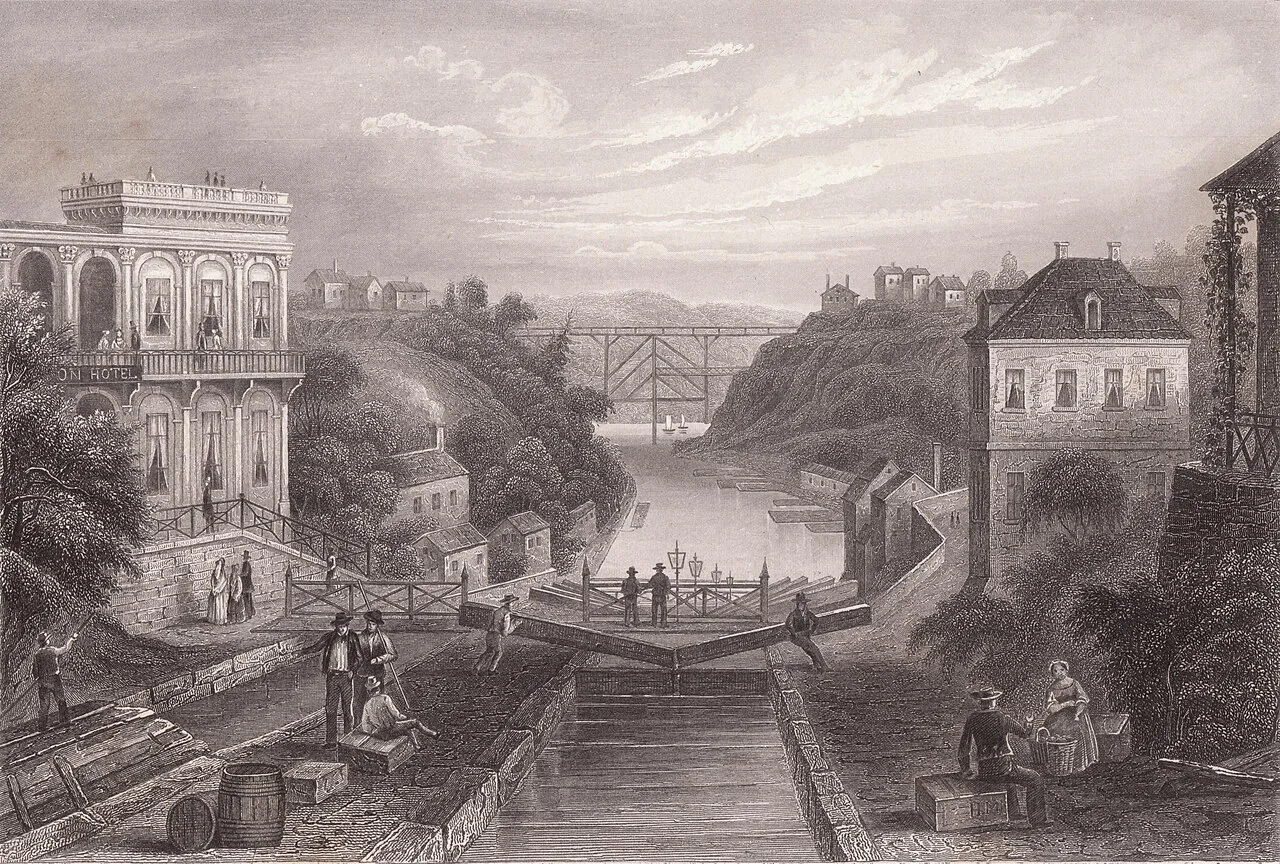
- Present the document (nature, date, place).
- Describe the canal, the locks, and the buildings.
- What activities do the people show?
- How can a picture like this help a historian study the canal, and what are its limits?
Exercise 11 : A factory girls' magazine
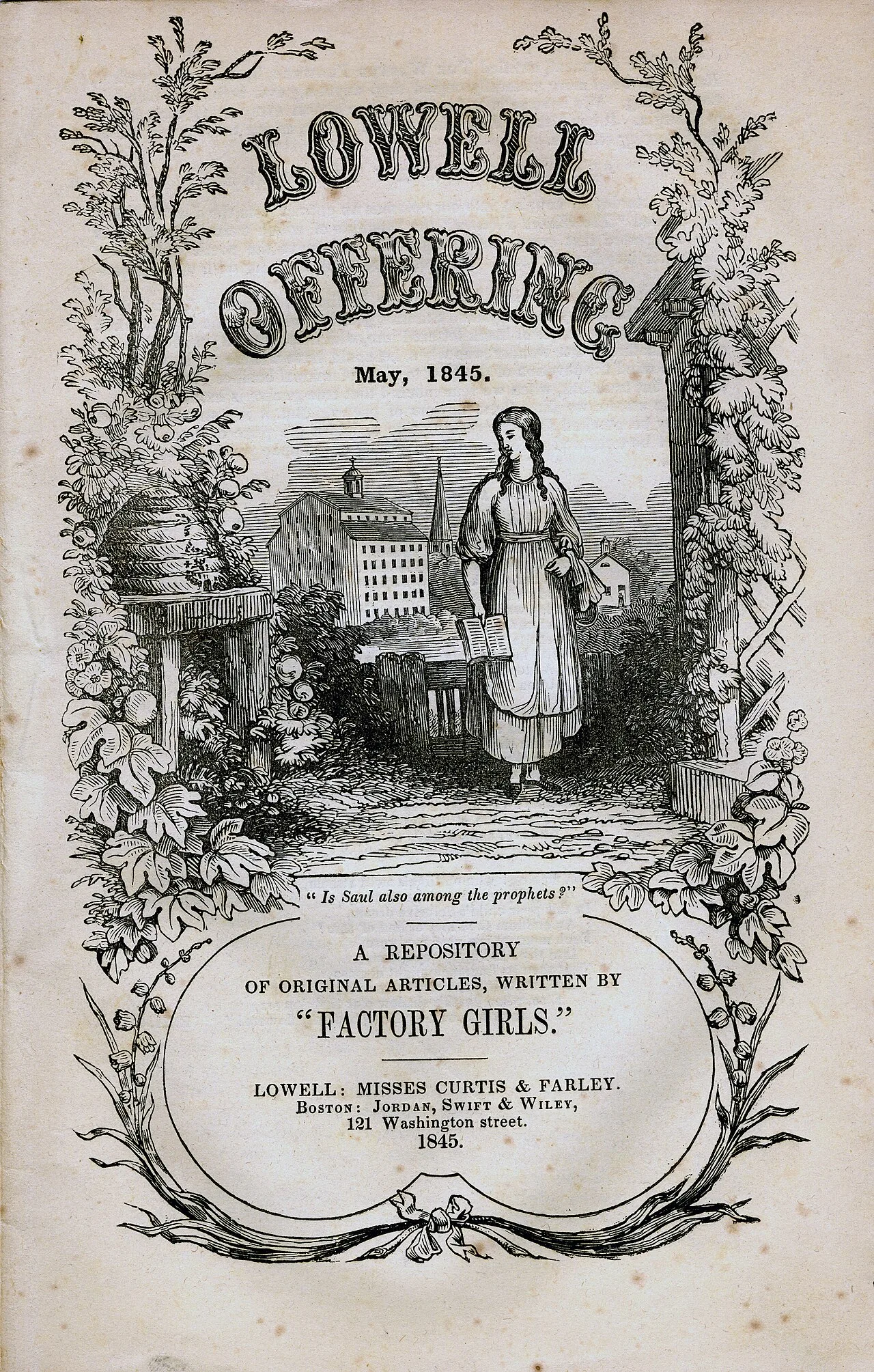
- Present the document (nature, date, place).
- Describe the picture on the title page.
- What does the text say about the authors?
- Why did mill women write and publish a magazine?
Exercise 12 : Workers organize
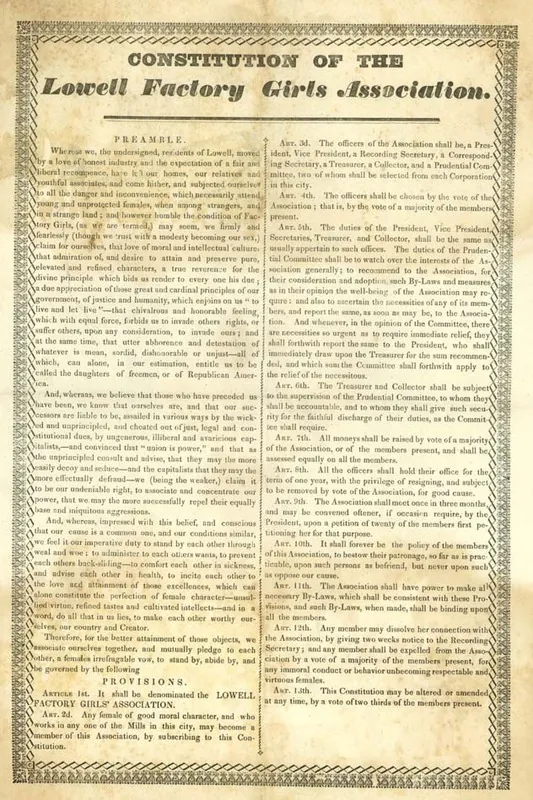
- Present the document (nature, group, period).
- What does the layout suggest about the nature of the document?
- Why would women workers write a constitution?
- What does it tell us about the Lowell women beyond their labor?
Exercise 13 : Arrival at Ellis Island
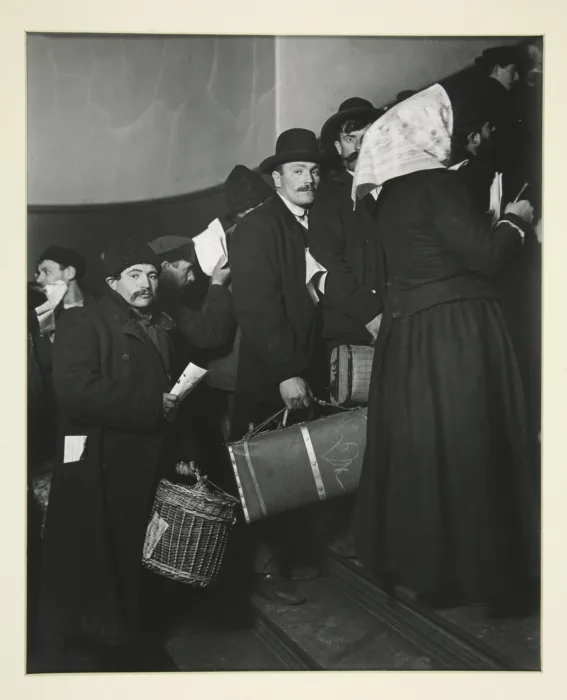
- Present the document (nature, photographer, date, place).
- Describe what the people wear and carry.
- What do you see in the background?
- Hine was a reformer. How might that have shaped what he chose to photograph?
Exercise 14 : Immigration by decade
Document 1 – Immigration to the United States
| Decade | Immigrants (arrivals) |
|---|---|
| 1821-1830 | 143,439 |
| 1831-1840 | 599,125 |
| 1841-1850 | 1,713,251 |
| 1851-1860 | 2,598,214 |
| 1861-1870 | 2,314,824 |
| 1871-1880 | 2,812,191 |
| 1881-1890 | 5,246,613 |
| 1891-1900 | 3,687,564 |
Source: U.S. Department of Homeland Security, Yearbook of Immigration Statistics, Table 1, “Persons obtaining lawful permanent resident status,” and earlier Census Bureau series (arrivals by decade; early figures are less reliable and should be treated as approximate).
- In which decade did immigration first exceed one million? Which decade had the highest number?
- By how many times did arrivals grow from 1831-1840 to 1841-1850? (Round to the nearest whole number.)
- What events help to explain the rise in 1841-1850?
- Why must we be careful with the earlier figures?
Exercise 15 : The Erie Canal in numbers
Document 1 – The Erie Canal
| Fact | Figure |
|---|---|
| Construction begun | July 4, 1817 |
| Opened | October 26, 1825 |
| Length | 363 miles |
| Cost | about $7 million |
| Freight cost per ton, before the canal (approx.) | about $100 |
| Freight cost per ton, on the canal (approx.) | about $10 |
Source: New York State Canal Corporation and National Park Service, Erie Canalway National Heritage Corridor; freight costs are rounded estimates and vary by year.
- How many years did it take to build the canal?
- By what percentage did freight costs fall?
- Explain how lower freight costs helped farmers and cities.
Exercise 16 : Ports of arrival
- Identify the numbered ports: 1 the Massachusetts port near Lowell; 2 the largest city at the end of the Erie Canal route; 3 the Pennsylvania city of the Declaration of Independence; 4 the Maryland port where the B&O Railroad began; 5 the port at the mouth of the Mississippi.
- Which two ports are the farthest apart?
- Which port gave access to the Mississippi valley by water?
Exercise 17 : The Erie Canal route
- Which city lies at the eastern end of the canal, and which at the western end?
- Name two cities on the canal between them.
- Which river did freight follow from the canal to the sea?
- Locate Seneca Falls. Why might it be easy to reach by canal from other places in New York?
Exercise 18 : Order the events
Put these events in order and write the date next to each.
- Seneca Falls Convention
- The Erie Canal opens
- Eli Whitney invents the cotton gin
- Garrison begins The Liberator
- Samuel Slater opens a mill at Pawtucket
- Samuel Morse sends the first telegraph message
Exercise 19 : How long between events?
Calculate each period.
- From the beginning to the opening of the Erie Canal (1817 to 1825).
- From the Lowell strike (1836) to the Seneca Falls Convention (1848).
- From Slater’s mill (1790) to the telegraph (1844).
- From the Seneca Falls Convention (1848) to the opening of Ellis Island (1892).
Exercise 20 : Guided research: Seneca Falls
Find out more about the Seneca Falls Convention of 1848. Use at least two reliable sites, such as the National Park Service, the Library of Congress, or the National Archives. Suggested keywords: Women’s Rights National Historical Park, Declaration of Sentiments Library of Congress, Elizabeth Cady Stanton Lucretia Mott.
- Who organized the convention, and where was it held?
- How many people signed the Declaration of Sentiments, and how many were women?
- Which demand was the most controversial, and who spoke in its favor?
- Which sites did you use, and why do you trust them?
Hint: look for the Wesleyan Chapel and for the numbers 68 and 32.
Exercise 21 : CER paragraph: who benefited?
Write a Claim, Evidence, Reasoning paragraph that answers: Who benefited most from the transportation revolution of the early 1800s?
- Claim: state your position.
- Evidence: use at least two details from the lesson or the documents.
- Reasoning: explain how the evidence supports your claim.
Hint: think about farmers, merchants, immigrants, and the cities along the canal.
Exercise 22 : SAQ: nativism
Answer in complete sentences.
- Explain what nativism was.
- Identify one group that was the target of nativism in the 1840s and 1850s.
- Explain one cause of nativism.
Exercise 23 : True or false? Justify
Say whether each statement is true or false and justify your answer with a fact from the lesson.
- The Erie Canal connected the Hudson River with Lake Erie.
- The Lowell mills hired mostly young single women from New England farms.
- The Lowell strike of 1836 won higher wages.
- Seneca Falls was held in 1848.
- The cotton gin reduced the demand for enslaved labor.
Exercise 24 : Causes and consequences: reform
Complete the chain with at least two causes and two consequences.
- Cause 1: ?
- Cause 2: ?
- Event: women hold the Seneca Falls Convention in 1848.
- Consequence 1: ?
- Consequence 2: ?
Hint: think of the abolitionist movement and the London convention of 1840.


Quick review: flashcards
Tap a card to see the answer.