


This Grade 8 US History to 1877 test covers Industry, Immigration and Reform in the 1800s. Like a classroom assessment, it includes documents to analyze, knowledge questions and a short writing task. To prepare, review the lesson first, then practice with the worksheet.
Time : 50 min
The test has three parts: knowledge (34 points), documents (48 points), and a written argument (18 points). Answer in complete sentences and cite the documents.
Document 1 – The Erie Canal and the Northeast
Natural Earth data.
Document 2 – Immigrants at Ellis Island
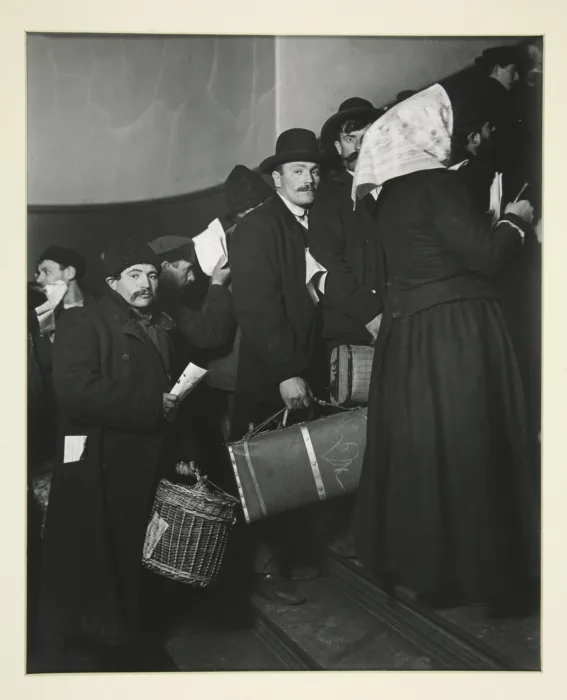
Lewis Hine, about 1905, via Wikimedia Commons.
Document 3 – The Lowell strike of 1836
One of the first strikes that ever took place in this country was in Lowell in 1836. When it was announced that the wages were to be cut down, great indignation was felt, and it was decided to strike or “turn out” en masse. This was done. The mills were shut down, and the girls went from their several corporations in procession to the grove on Chapel Hill, and listened to incendiary speeches from some early labor reformers. […] It is hardly necessary to say that, so far as practical results are concerned, this strike did no good. The corporation would not come to terms. The girls were soon tired of holding out, and they went back to their work at the reduced rate of wages.
Source: Harriet H. Robinson, “Early Factory Labor in New England,” in Massachusetts Bureau of Statistics of Labor, Fourteenth Annual Report (Boston, 1883), pp. 380-392; text from the Internet Modern History Sourcebook, Fordham University.
*turn out: go on strike. *incendiary: inflammatory.
Source: Harriet H. Robinson, “Early Factory Labor in New England,” in Massachusetts Bureau of Statistics of Labor, <em>Fourteenth Annual Report</em> (Boston, 1883), pp. 380-392; text from the Internet Modern History Sourcebook, Fordham University.
Document 4 – The Declaration of Sentiments (1848)
He has never permitted her to exercise her inalienable right to the elective franchise. He has compelled her to submit to laws, in the formation of which she had no voice. […] He has made her, if married, in the eye of the law, civilly dead. He has taken from her all right in property, even to the wages she earns.
Source: Declaration of Sentiments, Seneca Falls Woman’s Rights Convention, July 19-20, 1848, as printed in Elizabeth Cady Stanton, Susan B. Anthony, and Matilda Joslyn Gage, eds., History of Woman Suffrage, vol. 1 (1881), chapter 4; text from Wikisource.
*franchise: the right to vote.
Source: Declaration of Sentiments, Seneca Falls Woman’s Rights Convention, July 19-20, 1848, as printed in Elizabeth Cady Stanton, Susan B. Anthony, and Matilda Joslyn Gage, eds., <em>History of Woman Suffrage</em>, vol. 1 (1881), chapter 4; text from Wikisource.
Document 5 – Immigration by decade
| Decade | Immigrants (arrivals) |
|---|---|
| 1821-1830 | 143,439 |
| 1831-1840 | 599,125 |
| 1841-1850 | 1,713,251 |
| 1851-1860 | 2,598,214 |
| 1861-1870 | 2,314,824 |
Source: U.S. Department of Homeland Security, Yearbook of Immigration Statistics, Table 1, “Persons obtaining lawful permanent resident status,” and earlier Census Bureau series (arrivals by decade; early figures are less reliable and should be treated as approximate).
U.S. Department of Homeland Security, Yearbook of Immigration Statistics.
Questions
- Part 1 – Knowledge. Define Industrial Revolution, nativism, and abolitionism. (12 pts)
- Part 1. Document 1: name the cities at the eastern and western ends of the Erie Canal and the river that connects the canal to New York City. (10 pts)
- Part 1. Name two new forms of transportation or communication of the early 1800s and explain one effect of the Erie Canal. (12 pts)
- Part 2 – Documents. Document 2: present the document and explain what it shows about immigration in the later 1800s. (12 pts)
- Part 2. Document 3: present the document and explain why the women went on strike and what happened. (14 pts)
- Part 2. Document 4: present the document and name two rights that the authors say were denied to women. (12 pts)
- Part 2. Document 5: calculate how many more immigrants arrived in 1851-1860 than in 1831-1840, and explain one cause of the increase. (10 pts)
- Part 3 – Written argument. To what extent did the changes of the early 1800s improve life for ordinary Americans? Write a paragraph or two with a claim, at least two pieces of evidence from the documents or the lesson, and your reasoning. (18 pts)


Quick review: flashcards
Tap a card to see the answer.