


This Grade 8 US History to 1877 test covers The Age of Jackson and Westward Expansion. Like a classroom assessment, it includes documents to analyze, knowledge questions and a short writing task. To prepare, review the lesson first, then practice with the worksheet.
Time : 50 min
The test has three parts: knowledge (34 points), documents (48 points), and a written argument (18 points). Answer in complete sentences and cite the documents.
Document 1 – Lands added between 1845 and 1848
Natural Earth data; boundaries simplified.
Document 2 – Andrew Jackson
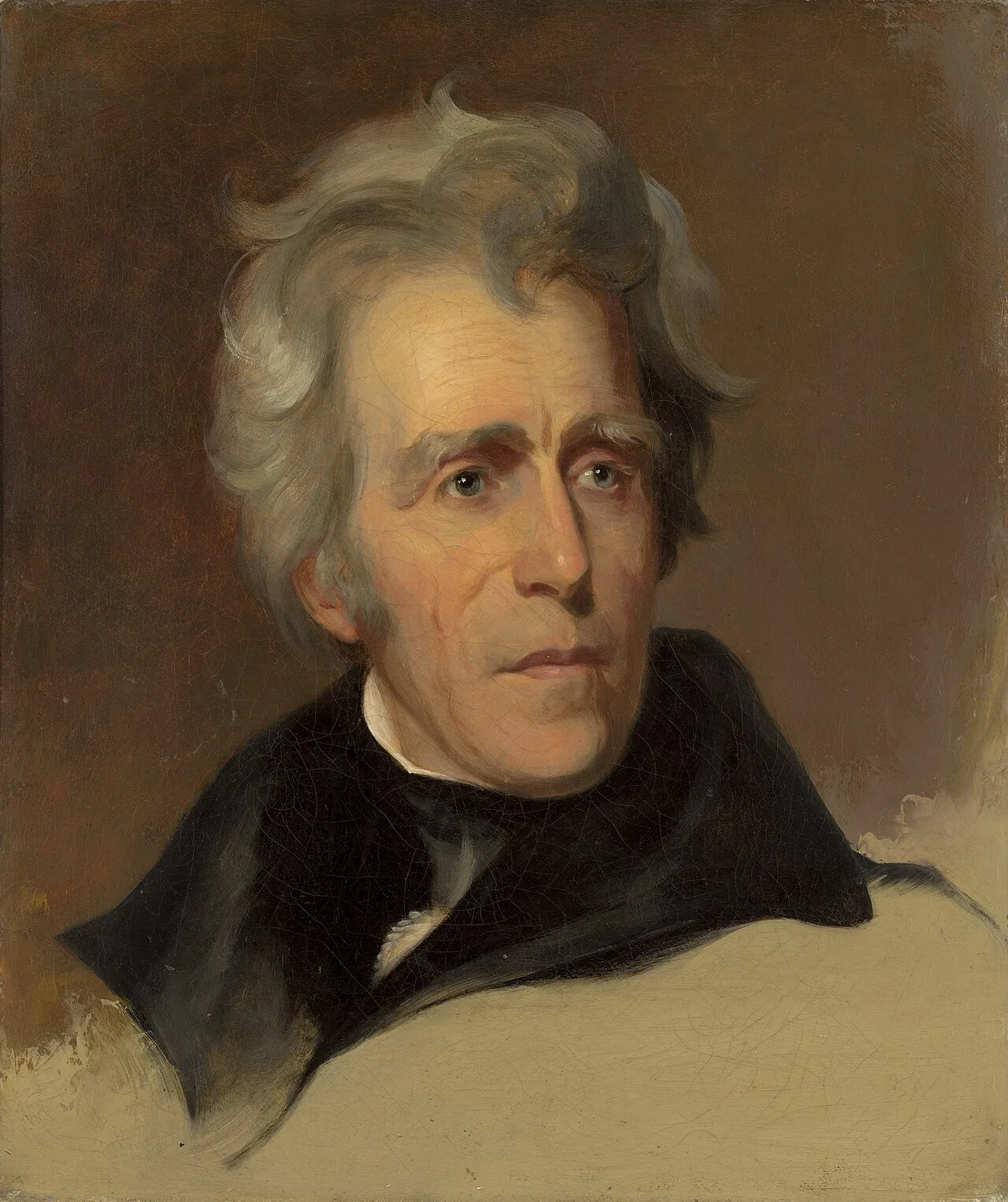
Thomas Sully, 1845, National Gallery of Art, via Wikimedia Commons.
Document 3 – Jackson on removal
Humanity has often wept over the fate of the aborigines of this country, and Philanthropy has been long busily employed in devising means to avert it, but its progress has never for a moment been arrested, and one by one have many powerful tribes disappeared from the earth. To follow to the tomb the last of his race and to tread on the graves of extinct nations excite melancholy reflections. But true philanthropy reconciles the mind to these vicissitudes as it does to the extinction of one generation to make room for another.
Source: President Andrew Jackson, Second Annual Message to Congress (second State of the Union address), December 6, 1830; text from Wikisource.
*aborigines: original inhabitants. *philanthropy: concern for others.
Source: President Andrew Jackson, Second Annual Message to Congress (second State of the Union address), December 6, 1830; text from Wikisource.
Document 4 – The Cherokee reply
We wish to remain on the land of our fathers. We have a perfect and original right to remain without interruption or molestation. The treaties with us, and laws of the United States made in pursuance of treaties, guaranty our residence, and our privileges and secure us against intruders. Our only request is, that these treaties may be fulfilled, and these laws executed. But if we are compelled to leave our court, we see nothing but ruin before us.
Source: Address of the Committee and Council of the Cherokee Nation, in General Council Convened, to the People of the United States, 1830; text from Wikisource.
*guaranty: guarantee. *molestation: harassment.
Source: Address of the Committee and Council of the Cherokee Nation, in General Council Convened, to the People of the United States, 1830; text from Wikisource.
Document 5 – Key dates
- 1828 Jackson elected
- 1830 Indian Removal Act
- 1832 Bank veto; Worcester v. Georgia
- 1835 Treaty of New Echota
- 1836 Texas independence
- 1838-1839 Trail of Tears
- 1845 Texas annexed
- 1848 Treaty of Guadalupe Hidalgo
Dates from standard reference works.
Questions
- Part 1 – Knowledge. Define nullification, Manifest Destiny, and cession. (12 pts)
- Part 1. Name two Native nations of the Southeast that were removed, and give one reason that settlers and states wanted their lands. (10 pts)
- Part 1. Document 1: name the areas A, B, and C, and say how each joined the United States (treaty, annexation, or purchase). (12 pts)
- Part 2 – Documents. Document 2: present the document and explain two ways in which Jackson was popular with ordinary voters. (12 pts)
- Part 2. Documents 3 and 4: present each document and compare how they describe the future of Native nations. (16 pts)
- Part 2. Document 4: explain the legal argument of the Cherokee and say whether the government followed it. (12 pts)
- Part 2. Document 5: calculate the years between the Removal Act and the Trail of Tears, and between Texas independence and annexation. (8 pts)
- Part 3 – Written argument. To what extent did the United States live up to its democratic ideals in the age of Jackson? Write a paragraph or two with a claim, at least two pieces of evidence from the documents or the lesson, and your reasoning. (18 pts)


Quick review: flashcards
Tap a card to see the answer.