


This worksheet on The Age of Jackson and Westward Expansion belongs to the Grade 8 US History to 1877 course. Its questions use primary sources, maps and timelines, and they move from basic recall to short writing tasks. Before you start, review the lesson; afterward, try the true or false quiz.
Exercise 1 : Vocabulary of the age of Jackson
Match each term with its meaning, then use three terms in sentences.
- spoils system
- nullification
- removal
- syllabary
- annexation
- Manifest Destiny
- cession
(a) the belief that Americans were meant to spread across the continent; (b) the claim that a state can cancel a federal law within its borders; (c) a writing system in which each symbol stands for a syllable; (d) adding a territory to a country; (e) the practice of giving government jobs to supporters of the winning party; (f) land given up to another country by treaty; (g) the forced movement of Native nations away from their homelands.
Exercise 2 : Jackson and the Bank
Document 1 – The Bank veto (1832)
It is to be regretted that the rich and powerful too often bend the acts of government to their selfish purposes. Distinctions in society will always exist under every just government. Equality of talents, of education, or of wealth can not be produced by human institutions. In the full enjoyment of the gifts of Heaven and the fruits of superior industry, economy, and virtue, every man is equally entitled to protection by law; but when the laws undertake to add to these natural and just advantages artificial distinctions, to grant titles, gratuities, and exclusive privileges, to make the rich richer and the potent more powerful, the humble members of society-the farmers, mechanics, and laborers-who have neither the time nor the means of securing like favors to themselves, have a right to complain of the injustice of their Government.
Source: President Andrew Jackson, veto message regarding the Bank of the United States, July 10, 1832; text from the Avalon Project, Yale Law School.
*potent: powerful. *gratuities: gifts.
- Present the document (nature, author, date, context).
- According to Jackson, what happens when government grants “exclusive privileges”?
- Which groups does he call the “humble members of society”?
- What does he mean by “equal protection”?
- Why might the message have been written for voters as well as for Congress?
Exercise 3 : Removal in the president's words
Document 1 – Jackson on removal (1830)
Humanity has often wept over the fate of the aborigines of this country, and Philanthropy has been long busily employed in devising means to avert it, but its progress has never for a moment been arrested, and one by one have many powerful tribes disappeared from the earth. To follow to the tomb the last of his race and to tread on the graves of extinct nations excite melancholy reflections. But true philanthropy reconciles the mind to these vicissitudes as it does to the extinction of one generation to make room for another.
Source: President Andrew Jackson, Second Annual Message to Congress (second State of the Union address), December 6, 1830; text from Wikisource.
*aborigines: original inhabitants. *philanthropy: concern for others.
- Present the document (nature, author, date, context).
- How does Jackson describe the fate of Native nations?
- What does he mean by “true philanthropy” in this sentence?
- Which claim does he make about the earlier peoples of the continent?
- Why must we read such a text with care, even though it is an official source?
Coup de pouce: identify what Jackson wants his readers to accept, and ask who is not speaking in this document.
Exercise 4 : A Cherokee petition
Document 1 – Memorial of the Cherokees
But now the scene has changed. The strength of the red man has become weakness. As his neighbors increased in numbers, his power became less and less, and now, of the many powerful tribes who once covered these United States, only a few are to be seen—a few whom a sweeping pestilence has left. The Northern tribes, who were once so numerous and powerful, are now nearly extinct. Thus it has happened to the red man of America. Shall we, who are remnants, share the same fate?
Source: Memorial of the Cherokees to the Senate and House of Representatives of the United States, 1829 (English text), National Archives, Records of the U.S. House of Representatives; text from Wikisource.
*pestilence: epidemic disease.
- Present the document (nature, authors, addressee, date).
- How do the authors describe the early relations between settlers and Native people?
- What has changed, according to the text?
- What question do they ask at the end?
- Why did the authors address Congress rather than the president?
Exercise 5 : We wish to remain
Document 1 – The Cherokee address to the American people (1830)
We wish to remain on the land of our fathers. We have a perfect and original right to remain without interruption or molestation. The treaties with us, and laws of the United States made in pursuance of treaties, guaranty our residence, and our privileges and secure us against intruders. Our only request is, that these treaties may be fulfilled, and these laws executed. But if we are compelled to leave our court, we see nothing but ruin before us.
Source: Address of the Committee and Council of the Cherokee Nation, in General Council Convened, to the People of the United States, 1830; text from Wikisource.
*guaranty: guarantee. *molestation: harassment.
- Present the document (nature, authors, date).
- What do the Cherokee ask?
- Which two legal arguments do they use?
- Why do they fear the land in the West?
- Write one sentence that states the authors’ claim and one that gives evidence.
Exercise 6 : Two voices on removal
Document 2A – President Jackson (1830)
Humanity has often wept over the fate of the aborigines of this country, and Philanthropy has been long busily employed in devising means to avert it, but its progress has never for a moment been arrested, and one by one have many powerful tribes disappeared from the earth. To follow to the tomb the last of his race and to tread on the graves of extinct nations excite melancholy reflections. But true philanthropy reconciles the mind to these vicissitudes as it does to the extinction of one generation to make room for another.
Source: President Andrew Jackson, Second Annual Message to Congress (second State of the Union address), December 6, 1830; text from Wikisource.
Document 2B – The Cherokee council (1830)
We wish to remain on the land of our fathers. We have a perfect and original right to remain without interruption or molestation. The treaties with us, and laws of the United States made in pursuance of treaties, guaranty our residence, and our privileges and secure us against intruders. Our only request is, that these treaties may be fulfilled, and these laws executed. But if we are compelled to leave our court, we see nothing but ruin before us.
Source: Address of the Committee and Council of the Cherokee Nation, in General Council Convened, to the People of the United States, 1830; text from Wikisource.
- Present each document in one sentence.
- How does each document describe the future of the Cherokee?
- Which of the two relies on law and treaties? Quote a phrase.
- Explain why historians need both documents to understand removal.
Exercise 7 : Soldiers and council
Document 3A – General Scott (1838)
The President of the United States has sent me with a powerful army to cause you, in obedience to the treaty of 1835, to join that part of your people who are already established on the other side of the Mississippi. Unhappily the two years which were allowed for the purpose you have suffered to pass away without following, and without making any preparation to follow; and now, or by the time that this solemn address shall reach your distant settlements, the emigration must be commenced in haste, but I hope without disorder. I have no power, by granting a further delay, to correct the error that you have committed. The full-moon of May is already on the wane, and before another shall have passed away every Cherokee man, woman, and child in those States must be in motion to join their brethren in the West.
Source: General Winfield Scott, proclamation “To the Cherokee people remaining in North Carolina, Georgia, Tennessee, and Alabama,” May 1838, as quoted in Helen Hunt Jackson, A Century of Dishonor (1881), chapter 8; text from Wikisource.
Document 3B – The Cherokee council (1838)
The present condition of the Cherokee people is such that all dispute as to the time of emigration is set at rest. Being already severed from their homes and their property, their persons being under the absolute control of the commanding general, and being altogether dependent on the benevolence and humanity of that high officer for the suspension of their transportation to the West at a season and under circumstances in which sickness and death were to be apprehended to an alarming extent, all inducements to prolong their stay in this country are taken away. And however strong their attachment to the homes of their fathers may be, their interests and their wishes are now to depart as early as may be consistent with their safety.
Source: Reply of the council of the Cherokee Nation to General Scott, 1838, as quoted in Helen Hunt Jackson, A Century of Dishonor (1881), chapter 8; text from Wikisource.
- Present each document (author, date, context).
- What does General Scott ask the Cherokee to do, and what does he fear?
- How does the Cherokee council describe its situation?
- Compare the tone of the two documents.
- Why do the Cherokee ask to manage the removal themselves?
Exercise 8 : Words of law
Document 1 – The Indian Removal Act (1830)
Be it enacted by the Senate and House of Representatives of the United States of America, in Congress assembled, That it shall and may be lawful for the President of the United States to cause so much of any territory belonging to the United States, west of the river Mississippi, not included in any state or organized territory, and to which the Indian title has been extinguished, as he may judge necessary, to be divided into a suitable number of districts, for the reception of such tribes or nations of Indians as may choose to exchange the lands where they now reside, and remove there; and to cause each of said districts to be so described by natural or artificial marks, as to be easily distinguished from every other.
Source: Indian Removal Act, Section 1, signed May 28, 1830; text from Wikisource.
*extinguished: ended. *districts: regions.
- Present the document (nature, date).
- Whom does the law allow to move Native nations, and where?
- Does the text order the Native nations to leave? Explain.
- In practice, how did treaties become a tool of pressure?
Exercise 9 : A nation of readers
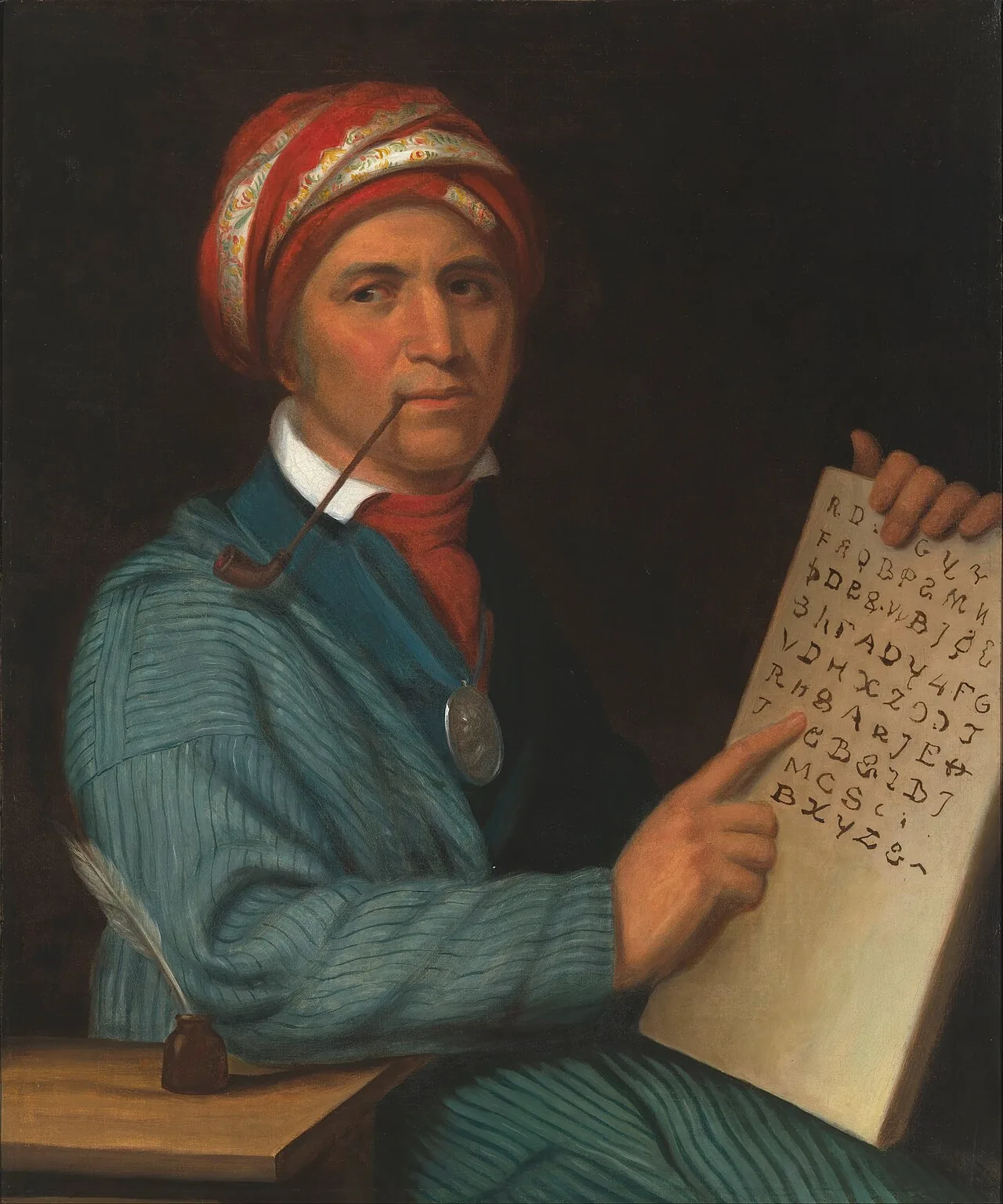
- Present the document (nature, artist, date, subject).
- Describe the man’s clothing and what he holds.
- What does the tablet show?
- What does this image suggest about the Cherokee in the 1820s?
- Why might a portrait by an artist outside the nation present the subject in a particular way?
Exercise 10 : A newspaper in two languages
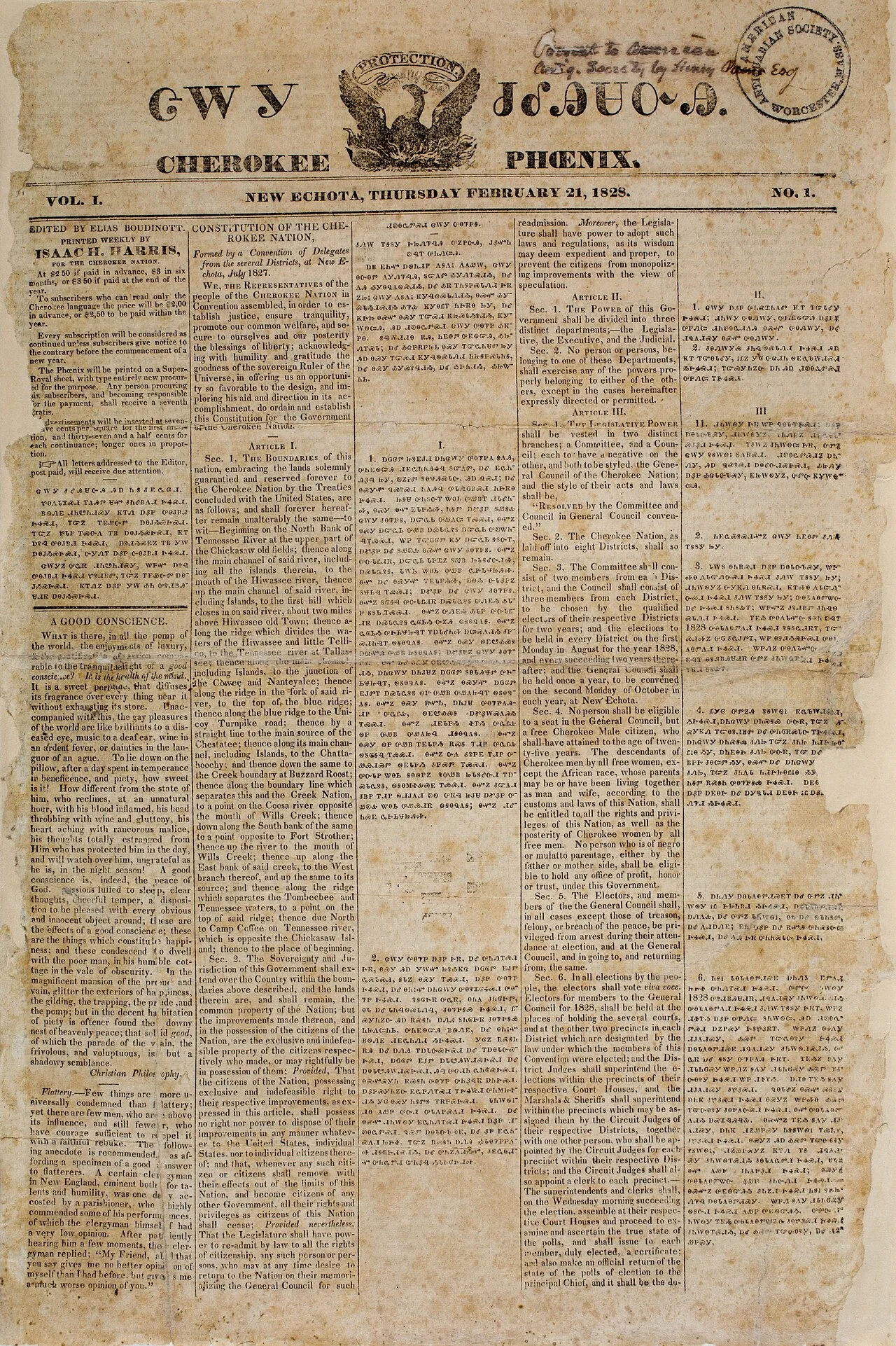
- Present the document (nature, date, place).
- Describe the title and the layout of the front page.
- What does the use of the Cherokee syllabary in the title tell you?
- Why would the Cherokee start a newspaper in 1828, the year of Jackson’s election?
Exercise 11 : Signatures against a treaty
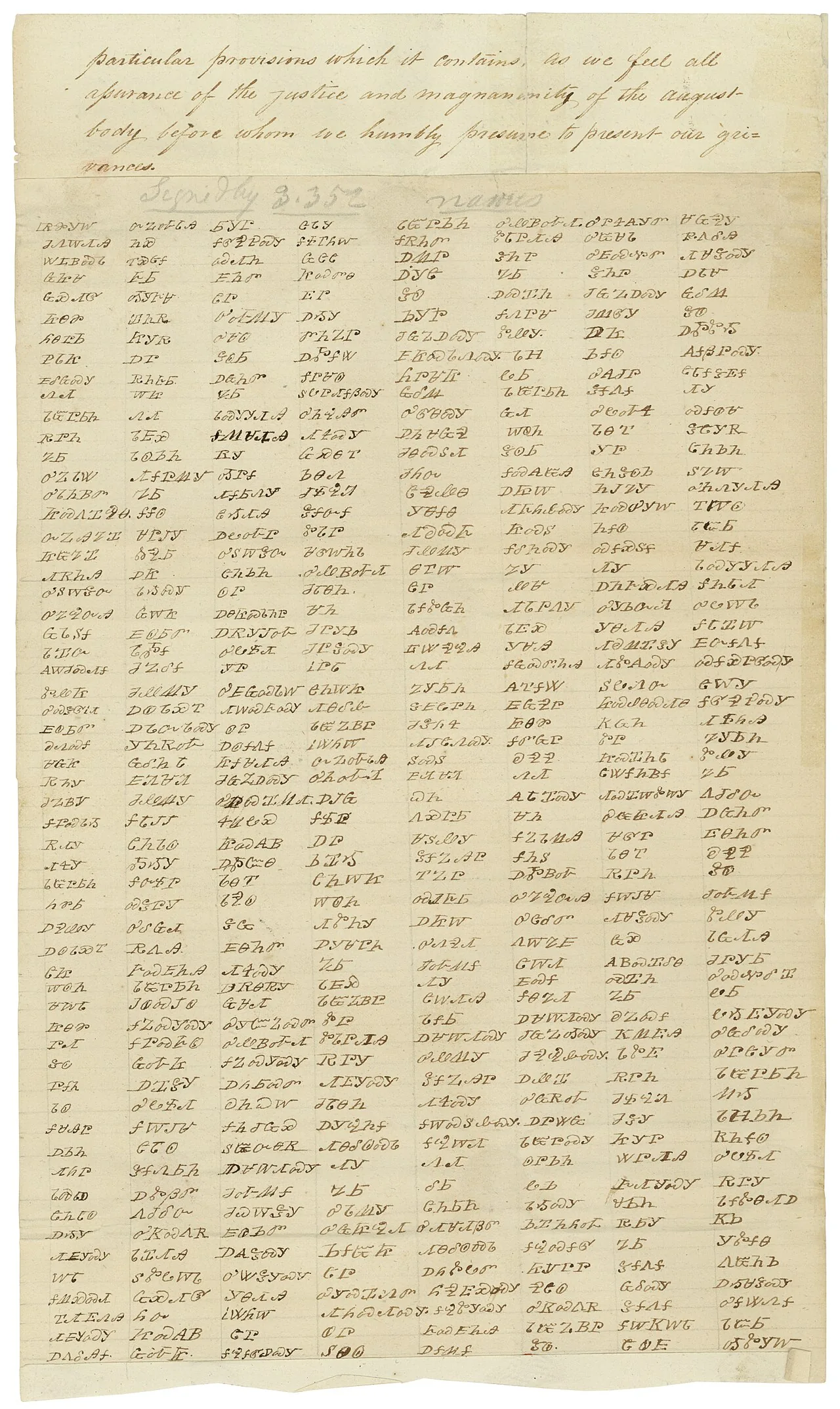
- Present the document (nature, date, location).
- What do you see on the page?
- What was the purpose of collecting so many names?
- What happened to the petition in the Senate?
Exercise 12 : The spirit of the age
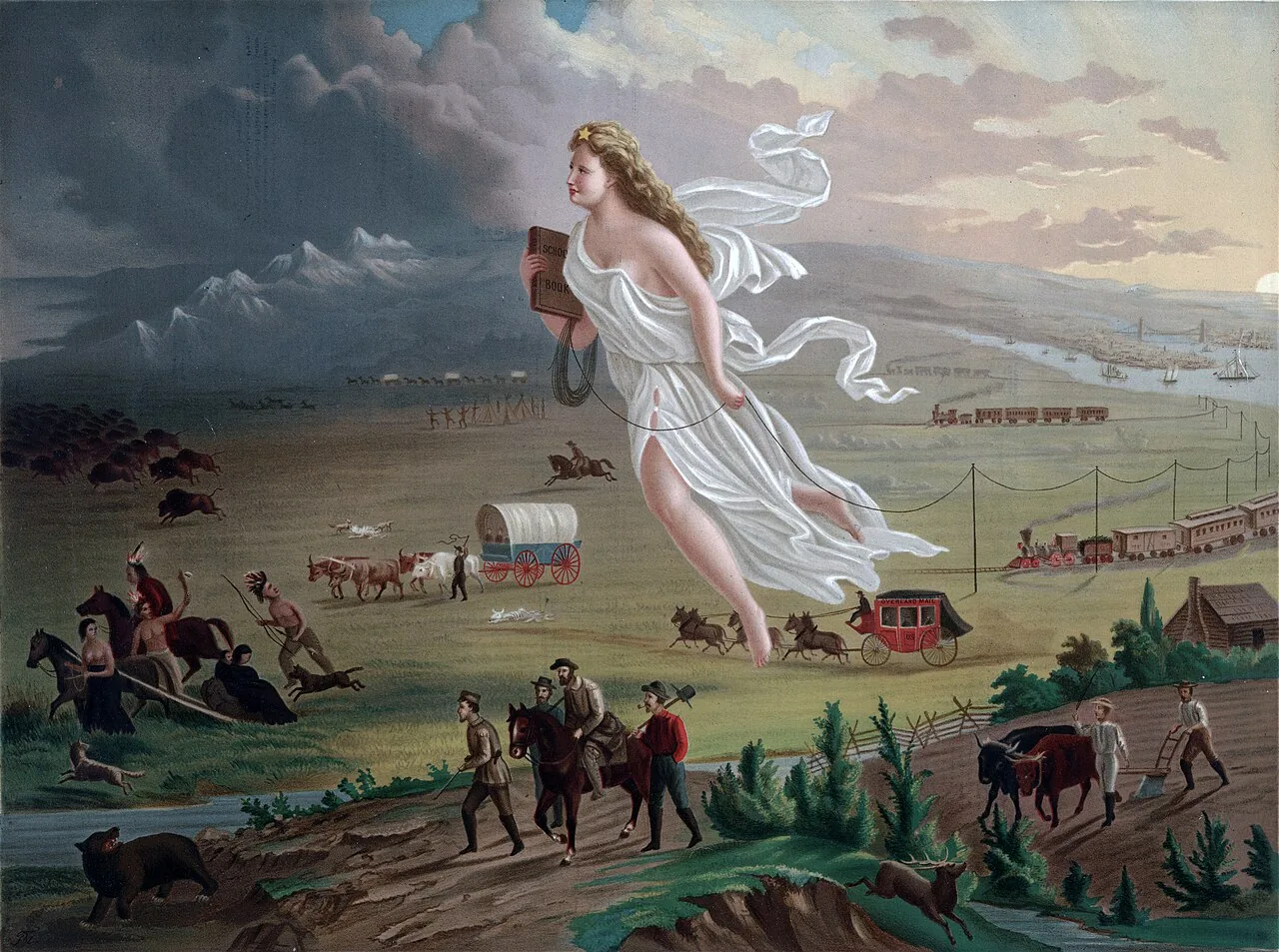
- Present the document (nature, artist, date). Is it from the period of the chapter?
- Describe the central figure and what she carries.
- Which groups of people are shown, and which direction do they move?
- What does the painting say about Manifest Destiny?
- Why can it be used as evidence for ideas, but not for facts about the 1840s?
Exercise 13 : Counting the population
Document 1 – Population of the United States
| Year | Population |
|---|---|
| 1820 | 9,638,453 |
| 1830 | 12,866,020 |
| 1840 | 17,069,453 |
| 1850 | 23,191,876 |
Source: U.S. Census Bureau, decennial censuses of 1820 to 1850 (enslaved people are included; Native Americans not taxed were not counted).
- By how many people did the population grow between 1820 and 1830? Between 1840 and 1850?
- Calculate the growth from 1820 to 1850 as a rough percentage (nearest ten percent).
- How does this growth help to explain the demand for new land?
Exercise 14 : Removal at a glance
Document 1 – The southeastern nations
| Nation | Treaty | Main removal years |
|---|---|---|
| Choctaw | Dancing Rabbit Creek, 1830 | 1831-1833 |
| Creek | Cusseta, 1832 | 1836-1837 |
| Chickasaw | Pontotoc Creek, 1832 | 1837-1838 |
| Cherokee | New Echota, 1835 | 1838-1839 |
| Seminole | Payne’s Landing, 1832 | Second Seminole War, 1835-1842 |
Source: National Park Service, Trail of Tears National Historic Trail, and standard reference works; years are approximate.
- Which nation was removed first? Which last?
- How many years passed between the Removal Act (1830) and the Trail of Tears?
- What was different about the Seminole experience?
Exercise 15 : Map the Trail of Tears
- Identify the numbered points: 1 the capital of the Cherokee nation (Georgia); 2 the river landing in Tennessee where many started; 3 the Tennessee city on the northern route; 4 the Missouri town near the Mississippi crossing; 5 the Cherokee capital in the West; 6 the large river city to the north.
- Name the nations marked A, B, and C.
- Which direction did the Cherokee travel?
Exercise 16 : Routes and rivers
- Name the two kinds of routes shown on the map.
- Which rivers formed part of the water route?
- Why did the overland route cross the Mississippi near Cape Girardeau?
- Why were winter crossings dangerous?
Exercise 17 : Map the new lands
- Identify the three shaded areas A, B, and C, and say how each joined the United States.
- Identify the numbered places: 1 a Texas city with a famous mission; 2 the port that became the center of the Gold Rush; 3 the capital of New Mexico; 4 the city in the Oregon Country; 5 a southeastern state that pressed for Cherokee removal.
Exercise 18 : Order the events
Put these events in order and write the date next to each.
- Treaty of Guadalupe Hidalgo
- Indian Removal Act
- Battle of San Jacinto
- Jackson elected president
- Oregon Treaty
- Treaty of New Echota
Exercise 19 : How long between events?
Calculate each period.
- From the Indian Removal Act to the Trail of Tears (1830 to 1838).
- From the Alamo (1836) to the annexation of Texas (1845).
- From the Treaty of Guadalupe Hidalgo (1848) to the Gadsden Purchase (1853).
- From Jackson’s election to the closing of the Second Bank charter (1828 to 1836).
Exercise 20 : Guided research: the Trail of Tears
Find out about the Trail of Tears National Historic Trail. Use at least two reliable sites, such as the National Park Service, the Cherokee Nation, or the Library of Congress. Suggested keywords: Trail of Tears National Historic Trail, Cherokee Nation removal history, John Ross Cherokee chief.
- Who led the Cherokee resistance to removal?
- How many Cherokee were removed, and how many died?
- Through which states did the routes pass?
- Which sites did you use, and why do you trust them?
Hint: look for the number 4,000 and for the names of the states on the northern route.
Exercise 21 : CER paragraph: Jackson and democracy
Write a Claim, Evidence, Reasoning paragraph that answers: Was Andrew Jackson a champion of democracy?
- Claim: state your position.
- Evidence: use at least two details from the lesson or the documents.
- Reasoning: explain how the evidence supports your claim.
Hint: ask whose democracy he served, and whom he excluded.
Exercise 22 : SAQ: Manifest Destiny
Answer in complete sentences.
- Explain what the phrase Manifest Destiny meant to its supporters.
- Identify one event that the idea helped to justify.
- Explain one criticism that opponents made.
Exercise 23 : True or false? Justify
Say whether each statement is true or false and justify your answer with a fact from the lesson.
- The Indian Removal Act ordered the army to move all Native nations at once.
- The Supreme Court ruled in Worcester v. Georgia that Georgia laws did not apply in Cherokee land.
- Texas was annexed in 1845.
- The Treaty of Guadalupe Hidalgo ended the war with Mexico.
- Jackson supported the Second Bank of the United States.
Exercise 24 : Causes and consequences: removal
Complete the chain with at least two causes and two consequences.
- Cause 1: ?
- Cause 2: ?
- Event: the Cherokee are removed in 1838.
- Consequence 1: ?
- Consequence 2: ?
Hint: think of Georgia, gold, the Treaty of New Echota, and the Indian Territory.


Quick review: flashcards
Tap a card to see the answer.