


This worksheet on The Early Republic: Washington to Jefferson belongs to the Grade 8 US History to 1877 course. Its questions use primary sources, maps and timelines, and they move from basic recall to short writing tasks. Before you start, review the lesson; afterward, try the true or false quiz.
Exercise 1 : Vocabulary of the early republic
Match each term with its meaning, then use three of the terms in sentences about the 1790s.
- Cabinet
- excise tax
- impressment
- neutrality
- Federalist
- judicial review
- embargo
(a) the power of courts to cancel laws that break the Constitution; (b) a ban on trade; (c) the forced service of sailors in a foreign navy; (d) a supporter of a strong national government and of Hamilton’s plans; (e) a group of department heads who advise the president; (f) staying out of other countries’ wars; (g) a tax on a product made or sold inside the country.
Coup de pouce: for each word, look back at the definitions and the commentary in the lesson.
Exercise 2 : Washington warns the nation
Document 1 – Washington’s Farewell Address
The great rule of conduct for us in regard to foreign nations is in extending our commercial relations, to have with them as little political connection as possible. […] So far as we have already formed engagements, let them be fulfilled with perfect good faith. Here let us stop. Europe has a set of primary interests which to us have none; or a very remote relation. Hence she must be engaged in frequent controversies, the causes of which are essentially foreign to our concerns.
Source: George Washington, Farewell Address, published September 19, 1796; text from the Avalon Project, Yale Law School.
*engagements: treaties and promises already made. *essentially: basically.
- Present the document (nature, author, date, context). Why was it printed rather than spoken?
- According to the author, what is the “great rule of conduct” for foreign affairs?
- What reasons does he give for staying out of European quarrels?
- Explain what he means by “our detached and distant situation” (use a map if you wish).
- Why might a retiring president choose to write such a message to the people?
Exercise 3 : Jefferson on opinion and unity
Document 1 – The first inaugural address
But every difference of opinion is not a difference of principle. We have called by different names brethren of the same principle. We are all Republicans, we are all Federalists. If there be any among us who would wish to dissolve this Union or to change its republican form, let them stand undisturbed as monuments of the safety with which error of opinion may be tolerated where reason is left free to combat it.
Source: Thomas Jefferson, First Inaugural Address, March 4, 1801; text from the Avalon Project, Yale Law School.
*brethren: brothers. *monuments: reminders.
- Present the document (nature, author, date, context).
- Explain the sentence “every difference of opinion is not a difference of principle.”
- What does Jefferson say should be done to people who want to “dissolve this Union”?
- Why would he say “We are all Republicans, we are all Federalists” after the election of 1800?
- Write one sentence that states his claim, and one that gives evidence from the text.
Exercise 4 : Marshall and the power of the courts
Document 1 – Marbury v. Madison
It is emphatically the province and duty of the Judicial Department to say what the law is. […] So, if a law be in opposition to the Constitution, if both the law and the Constitution apply to a particular case, so that the Court must either decide that case conformably to the law, disregarding the Constitution, or conformably to the Constitution, disregarding the law, the Court must determine which of these conflicting rules governs the case. This is of the very essence of judicial duty.
Source: Chief Justice John Marshall, opinion of the Court in Marbury v. Madison, 5 U.S. (1 Cranch) 137, February 24, 1803; text from Wikisource.
*province: area of responsibility.
- Present the document (nature, author, date, context).
- According to Marshall, what is the duty of the judges?
- What must a court do if a law and the Constitution conflict?
- Explain in your own words why this reasoning gives courts the power to cancel laws.
- Why was this decision more important than the case itself?
Exercise 5 : A treaty and its promises
Document 1 – The Louisiana Purchase Treaty
The inhabitants of the ceded territory shall be incorporated in the Union of the United States and admitted as soon as possible according to the principles of the federal Constitution to the enjoyment of all these rights, advantages and immunities of citizens of the United States, and in the mean time they shall be maintained and protected in the free enjoyment of their liberty, property and the Religion which they profess.
Source: Treaty between the United States and the French Republic (Louisiana Purchase Treaty), Article III, April 30, 1803; text from the Avalon Project, Yale Law School.
*incorporated: made part of. *immunities: protections.
- Present the document (nature, countries involved, date).
- What does Article III promise to the people who live in the territory?
- What will happen to them “in the mean time”?
- Which groups living in the territory are not mentioned in the text?
- Why is it important to remember that the treaty was signed by France and the United States and not by the people who lived there?
Exercise 6 : The Sedition Act
Document 1 – The Sedition Act (1798)
if any person shall write, print, utter or publish, or shall cause or procure to be written, printed, uttered or published, or shall knowingly and willingly assist or aid in writing, printing, uttering or publishing any false, scandalous and malicious writing or writings against the government of the United States, or either house of the Congress of the United States, or the President of the United States, with intent to defame the said government, or either house of the said Congress, or the said President, or to bring them, or either of them, into contempt or disrepute;
Source: An Act in Addition to the Act, Entitled “An Act for the Punishment of Certain Crimes Against the United States” (Sedition Act), Section 2, July 14, 1798; text from the Avalon Project, Yale Law School.
*utter: say aloud. *disrepute: loss of respect.
- Present the document (nature, date, context).
- Which writings does the law punish?
- Which persons and bodies does it protect?
- Which amendment of the Bill of Rights could be used to attack this law, and why?
- Who was likely to be punished under it, and why did Republicans consider it a political weapon?
Coup de pouce: the First Amendment protects freedom of speech and of the press.
Exercise 7 : Two views of dissent
Document 1A – The Sedition Act (1798)
if any person shall write, print, utter or publish, or shall cause or procure to be written, printed, uttered or published, or shall knowingly and willingly assist or aid in writing, printing, uttering or publishing any false, scandalous and malicious writing or writings against the government of the United States, or either house of the Congress of the United States, or the President of the United States, with intent to defame the said government, or either house of the said Congress, or the said President, or to bring them, or either of them, into contempt or disrepute;
Source: An Act in Addition to the Act, Entitled “An Act for the Punishment of Certain Crimes Against the United States” (Sedition Act), Section 2, July 14, 1798; text from the Avalon Project, Yale Law School.
*utter: say aloud.
Document 1B – Jefferson’s first inaugural (1801)
But every difference of opinion is not a difference of principle. We have called by different names brethren of the same principle. We are all Republicans, we are all Federalists. If there be any among us who would wish to dissolve this Union or to change its republican form, let them stand undisturbed as monuments of the safety with which error of opinion may be tolerated where reason is left free to combat it.
Source: Thomas Jefferson, First Inaugural Address, March 4, 1801; text from the Avalon Project, Yale Law School.
- Present each document in one sentence.
- How does each document treat people who criticize or oppose the government?
- Which view of free expression is closer to the First Amendment? Justify your answer.
- Explain why the two documents were written only three years apart.
Exercise 8 : Washington and Jefferson on alliances
Document 2A – Washington (1796)
The great rule of conduct for us in regard to foreign nations is in extending our commercial relations, to have with them as little political connection as possible. […] So far as we have already formed engagements, let them be fulfilled with perfect good faith. Here let us stop. Europe has a set of primary interests which to us have none; or a very remote relation. Hence she must be engaged in frequent controversies, the causes of which are essentially foreign to our concerns.
Source: George Washington, Farewell Address, published September 19, 1796; text from the Avalon Project, Yale Law School.
Document 2B – Jefferson (1801)
Equal and exact justice to all men, of whatever state or persuasion, religious or political; peace, commerce, and honest friendship with all nations, entangling alliances with none; […] freedom of religion; freedom of the press, and freedom of person under the protection of the habeas corpus, and trial by juries impartially selected.
Source: Thomas Jefferson, First Inaugural Address, March 4, 1801; text from the Avalon Project, Yale Law School.
*persuasion: belief. *habeas corpus: the right not to be held in prison without a court hearing.
- Present each document (author, date, kind of text).
- Find the phrases that express the same idea about foreign nations.
- Jefferson also lists other principles. Name two of them.
- Why do both men use the word “friendship” or “good faith” while also warning against alliances?
Exercise 9 : Portrait of a president
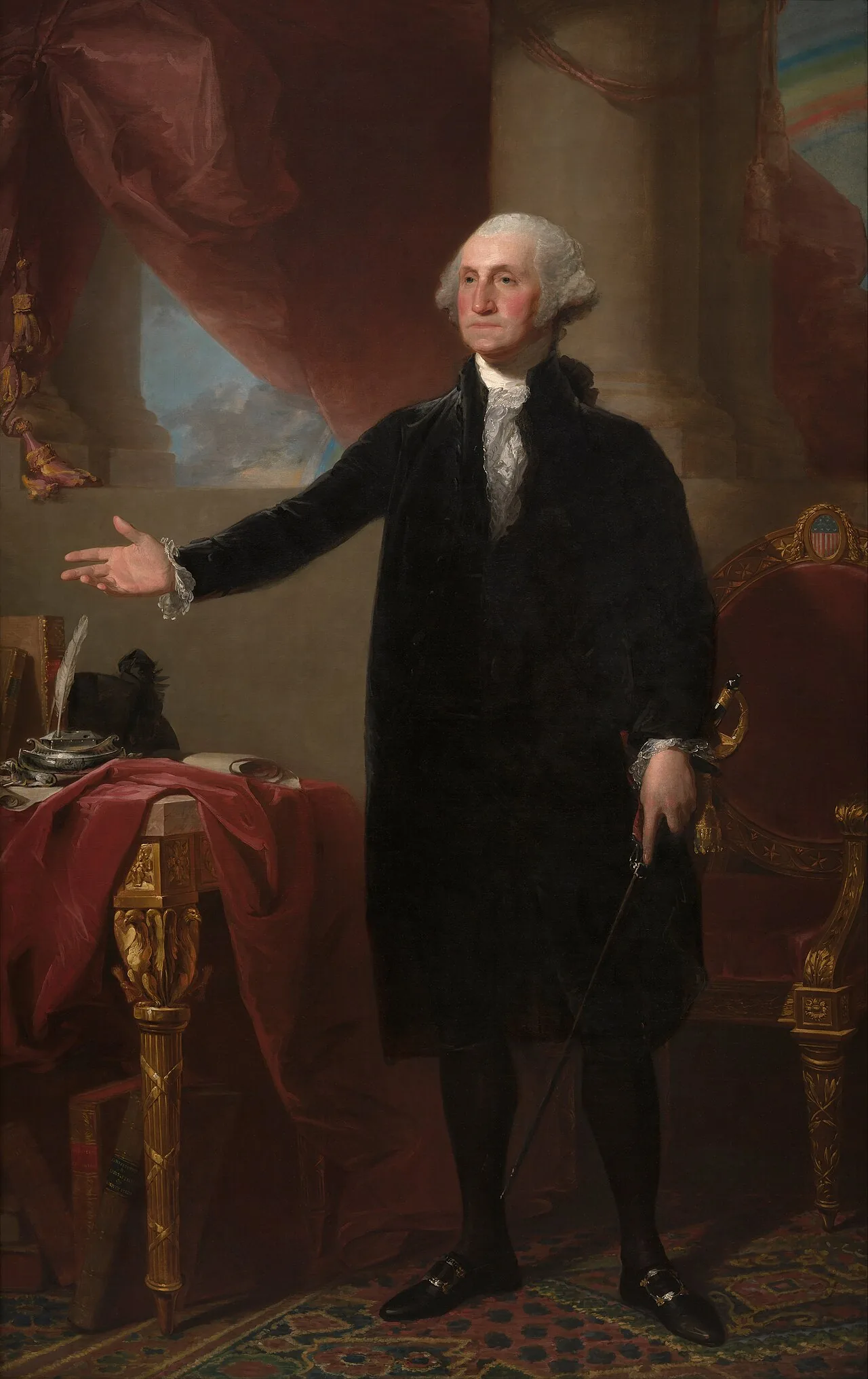
- Present the document (nature, artist, date, place of conservation).
- Describe Washington’s clothing, posture, and surroundings.
- What objects does the painter include, and what might they suggest about the president?
- Why would the artist choose civilian dress for the first president, instead of a military uniform?
- Why must we be careful when using a painting like this as evidence for how Washington actually looked or acted?
Exercise 10 : Mapping the West
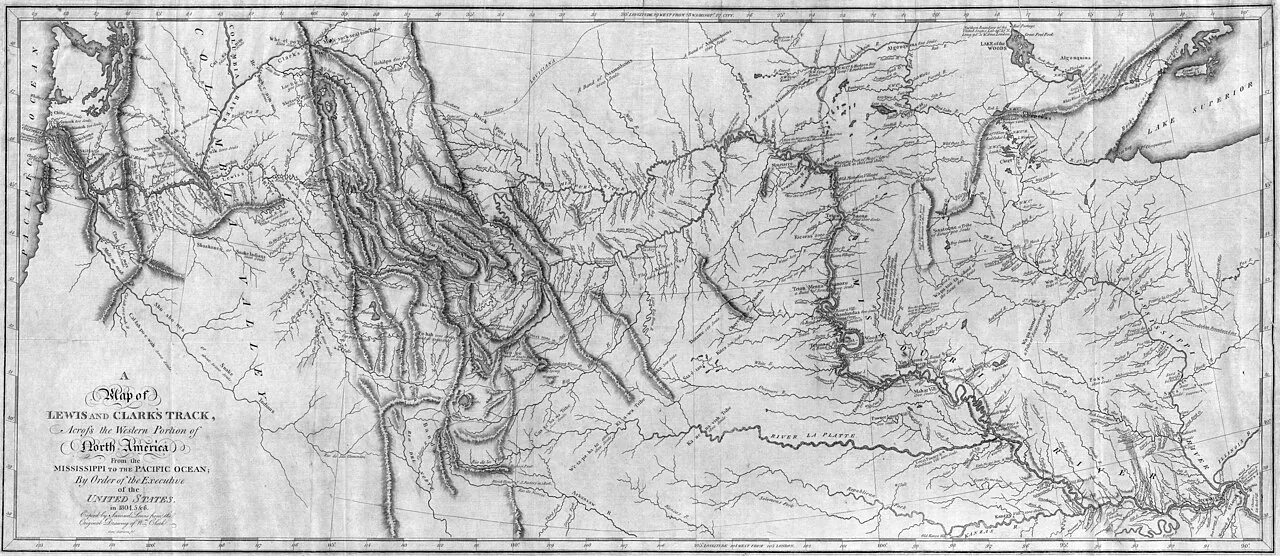
- Present the document (nature, date, subject).
- Which features of the land can you recognize on the map?
- What parts of the map seem to be accurate, and what parts look uncertain?
- Who might have provided information for this map besides the explorers?
- What was the purpose of this map for the American government?
Exercise 11 : The Chief Justice
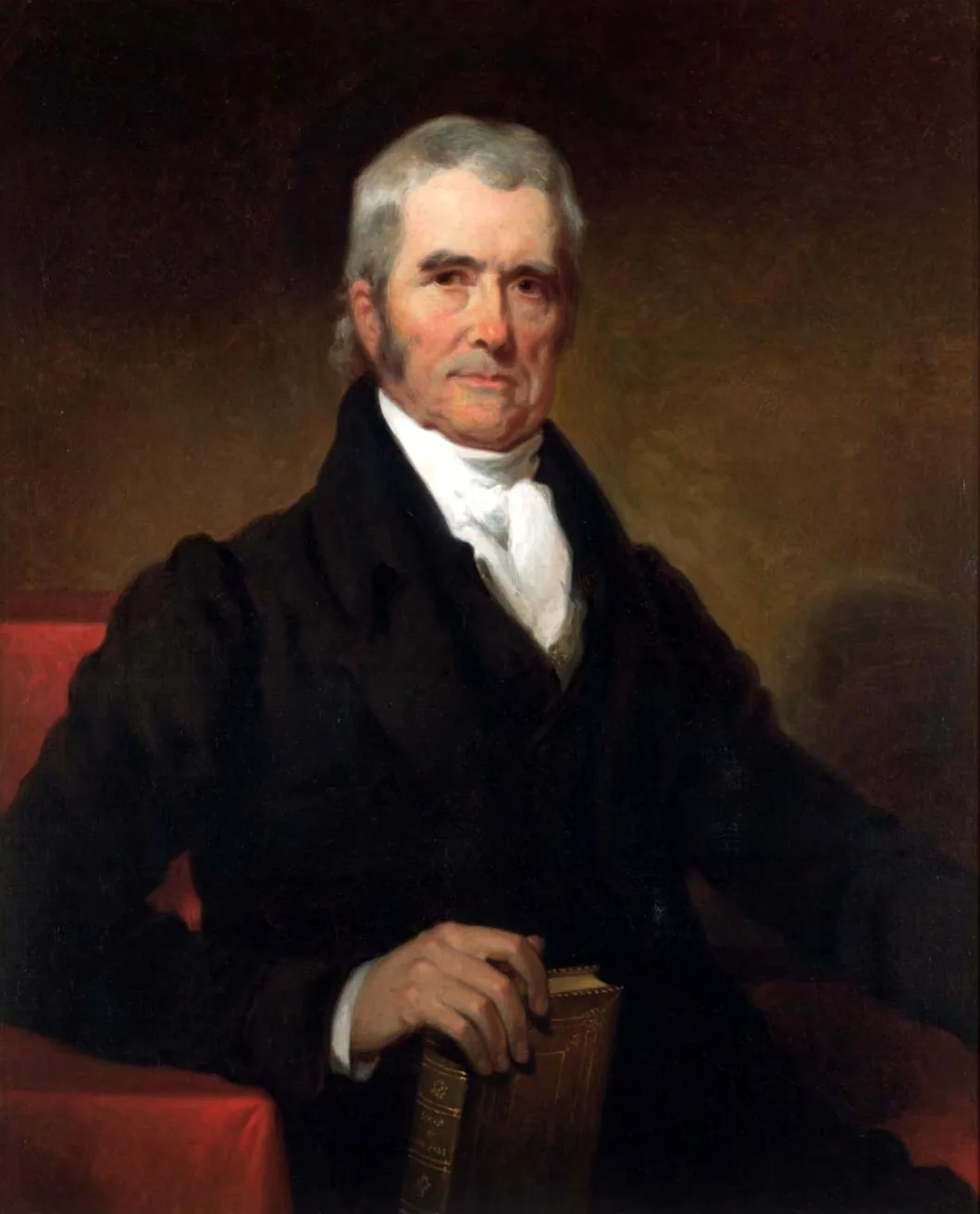
- Present the document (nature, artist, date).
- Describe the man’s clothing and what he holds.
- What does the expression and the setting suggest about the role of a judge?
- Marshall served as Chief Justice from 1801 to 1835. Why might his long service matter for the Court?
Exercise 12 : Where the Purchase fits
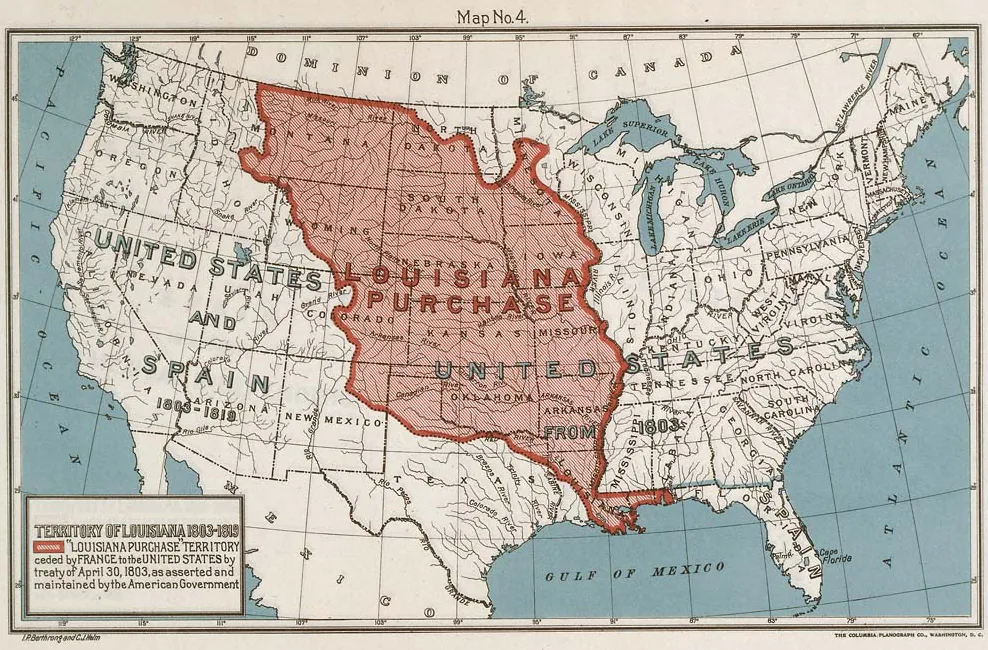
- Present the document (nature, subject).
- Which bodies of water form parts of the boundary or border the purchase?
- Which other countries owned land near the territory, according to the map?
- Why was the port of New Orleans so important to Americans in 1803?
Exercise 13 : A growing population
Document 1 – Population of the United States
| Year | Population |
|---|---|
| 1790 | 3,929,214 |
| 1800 | 5,308,483 |
| 1810 | 7,239,881 |
Source: U.S. Census Bureau, decennial censuses of 1790, 1800, and 1810. The census counted enslaved people but did not count most Native Americans living outside states and territories.
- By how many people did the population grow between 1790 and 1800?
- By how many people did it grow between 1800 and 1810?
- Calculate the growth from 1790 to 1810, as a rough percentage (round to the nearest ten percent).
- Give one reason the population was growing quickly in this period.
Exercise 14 : Locate the places
- Identify the numbered places: 1 the capital that was built on the Potomac River; 2 the port whose control Jefferson wanted; 3 the city near which the Corps of Discovery began its trip (a river-city on the Mississippi); 4 the city in western Pennsylvania, near the center of the Whiskey Rebellion; 5 the Ohio battlefield of 1794; 6 the winter camp of 1804-1805.
- Match the places to the names: Fallen Timbers, St. Louis, Fort Mandan, New Orleans, Pittsburgh, Washington, D.C.
- Which of the numbered places lay inside the territory bought in 1803?
Coup de pouce: use the map in the lesson as a guide, and remember that 1-6 are listed by their location.
Exercise 15 : The shape of the Purchase
- Name the river along which the expedition traveled for most of the first part of its journey.
- Between which two places did the route run? Give the starting point and the winter camp of 1804-1805.
- Name the ocean that the explorers reached and the fort where they spent the winter of 1805-1806.
- Which direction did the expedition travel (give the main directions)?
- Name two states of today that were included, at least in part, in the Louisiana Purchase.
Exercise 16 : Put the events in order
Put these events in order from earliest to latest and write the date next to each.
- Marbury v. Madison
- The Whiskey Rebellion
- Washington takes the oath of office
- The Alien and Sedition Acts
- The Louisiana Purchase Treaty
- The Embargo Act
Exercise 17 : How long between events?
Use the dates in the lesson to calculate each period.
- From Washington’s inauguration (1789) to Jefferson’s inauguration (1801).
- From the Alien and Sedition Acts (1798) to the election of 1800 (Jefferson’s victory).
- From the beginning of the Lewis and Clark expedition (May 1804) to its return (September 1806): give the answer in years and months, approximately.
- How many presidents served between 1789 and 1809? Name them.
Exercise 18 : Guided research: Sacagawea and the expedition
Find out about the role of Sacagawea in the Lewis and Clark expedition. Use at least two reliable sites, such as the National Park Service, the Library of Congress, or the Smithsonian. Suggested keywords: Sacagawea National Park Service, Lewis and Clark journals Library of Congress, Corps of Discovery Shoshone.
- Which Native nation did she belong to, and where did the expedition meet her?
- What help did she give the explorers?
- What did Lewis and Clark learn from other Native nations along the route?
- Which sites did you use, and why do you trust them?
Hint: look for the winter at Fort Mandan, the Shoshone horses, and the role of interpreters.
Exercise 19 : CER paragraph: judicial review
Write a Claim, Evidence, Reasoning paragraph that answers: Was Marbury v. Madison a turning point for the Supreme Court?
- Claim: state your position.
- Evidence: use at least two details from the lesson or Document 5.
- Reasoning: explain how the evidence supports your claim.
Hint: think about what the Court could do before 1803 and what it could do afterward.
Exercise 20 : SAQ: the first two parties
Answer in complete sentences.
- Identify one leader and one belief of the Federalists.
- Identify one leader and one belief of the Democratic-Republicans.
- Explain one way in which the two parties disagreed about the Constitution.
Exercise 21 : True or false? Justify
Say whether each statement is true or false and justify your answer with a fact from the lesson.
- The Sedition Act protected criticism of the president.
- The Louisiana Purchase nearly doubled the size of the United States.
- Washington ran for a third term in 1796.
- Marbury v. Madison established judicial review.
- Jefferson was certain that the president had the constitutional power to buy Louisiana.
Exercise 22 : Causes and consequences: the Alien and Sedition Acts
Complete the chain with at least one cause and two consequences.
- Cause: the XYZ Affair and the Quasi-War with France.
- Event: the Federalists pass the Alien and Sedition Acts (1798).
- Consequence 1: ?
- Consequence 2: ?
Hint: think of the Kentucky and Virginia Resolutions and the election of 1800.


Quick review: flashcards
Tap a card to see the answer.