


This worksheet on The Constitution and the Bill of Rights belongs to the Grade 8 US History to 1877 course. Its questions use primary sources, maps and timelines, and they move from basic recall to short writing tasks. Before you start, review the lesson; afterward, try the true or false quiz.
Exercise 1 : Vocabulary of the Constitution
Match each term with its meaning, then use three of the terms in sentences about the Constitution.
- Federalism
- Ratify
- Amendment
- Separation of powers
- Checks and balances
- Anti-Federalist
(a) a change or addition to the Constitution; (b) a person who opposed the Constitution without a bill of rights; (c) division of power between the national and state governments; (d) to approve formally; (e) dividing government into branches with separate duties; (f) ways in which each branch can limit the others.
Exercise 2 : A league of friendship
Document 1 – The Articles of Confederation
Each state retains its sovereignty, freedom, and independence, and every power, jurisdiction, and right, which is not by this Confederation expressly delegated to the United States, in Congress assembled. […] The said States hereby severally enter into a firm league of friendship with each other, for their common defense, the security of their liberties, and their mutual and general welfare, binding themselves to assist each other, against all force offered to, or attacks made upon them, or any of them, on account of religion, sovereignty, trade, or any other pretense whatever.
Source: Articles of Confederation, adopted by Congress November 15, 1777, ratified March 1, 1781 (Articles II and III); text from the Avalon Project, Yale Law School.
*sovereignty: supreme power. *pretense: reason or excuse.
- Present the document (nature, date, context).
- What powers does each state keep, according to Article II?
- Which words show that the union was a loose association?
- Why might a government of this kind have appealed to Americans in the 1780s?
- Which weakness of the Articles can you infer from this text?
Exercise 3 : We the People
Document 2 – The Preamble to the Constitution
We the People of the United States, in Order to form a more perfect Union, establish Justice, insure domestic Tranquility, provide for the common defence, promote the general Welfare, and secure the Blessings of Liberty to ourselves and our Posterity, do ordain and establish this Constitution for the United States of America.
Source: Constitution of the United States, signed September 17, 1787, Preamble; text from the National Archives.
*ordain: to put into law. *Posterity: future generations.
- Present the document (nature, date, context).
- Who, according to the text, creates the Constitution?
- List three purposes of the new government that are named in the Preamble.
- Compare the opening words with Article II of the Articles of Confederation. What has changed?
Exercise 4 : The supreme law
Document 3 – The Supremacy Clause
This Constitution, and the Laws of the United States which shall be made in Pursuance thereof; and all Treaties made, or which shall be made, under the Authority of the United States, shall be the supreme Law of the Land; and the Judges in every State shall be bound thereby, any Thing in the Constitution or Laws of any State to the Contrary notwithstanding.
Source: Constitution of the United States, 1787, Article VI (the Supremacy Clause); text from the National Archives.
*Pursuance: carrying out. *notwithstanding: in spite of.
- Present the document (nature, article, date).
- What does the clause say is the “supreme Law of the Land”?
- Who is bound by this law?
- Explain why this clause was important for solving the problems of the Articles of Confederation.
Exercise 5 : Why separate the powers?
Document 4 – The Federalist, no. 51
But what is government itself, but the greatest of all reflections on human nature? If men were angels, no government would be necessary. If angels were to govern men, neither external nor internal controls on government would be necessary. In framing a government which is to be administered by men over men, the great difficulty lies in this: you must first enable the government to control the governed; and in the next place oblige it to control itself.
Source: James Madison (or Alexander Hamilton; the authorship is debated), The Federalist, no. 51, February 6, 1788 (published as Publius); text from the Avalon Project, Yale Law School.
*reflections: judgments. *controls: limits.
- Present the document (nature, author, date, context).
- What does the author mean by “the greatest of all reflections on human nature”?
- What two tasks does he say a government must perform?
- Match this passage with a feature of the Constitution.
Exercise 6 : A warning against a large republic
Document 5 – Brutus no. 1, 1787
In a republic, the manners, sentiments, and interests of the people should be similar. If this be not the case, there will be a constant clashing of opinions; and the representatives of one part will be continually striving against those of the other. This will retard the operations of government, and prevent such conclusions as will promote the public good. If we apply this remark to the condition of the United States, we shall be convinced that it forbids that we should be one government. The United States includes a variety of climates. The productions of the different parts of the union are very variant, and their interests, of consequence, diverse.
Source: Brutus (probably Robert Yates), Anti-Federalist Papers, no. 1, October 18, 1787; text from the Online Library of Liberty.
*sentiments: feelings and opinions.
- Present the document (nature, author, date, context).
- According to Brutus, what must the people of a republic have in common?
- How does he describe the United States?
- What conclusion does he draw?
- Do you find the argument convincing? Use evidence.
Exercise 7 : Freedoms in the First Amendment
Document 6 – The First Amendment
Congress shall make no law respecting an establishment of religion, or prohibiting the free exercise thereof; or abridging the freedom of speech, or of the press; or the right of the people peaceably to assemble, and to petition the Government for a redress of grievances.
Source: The Bill of Rights, First Amendment, proposed September 25, 1789, ratified December 15, 1791; text from the Avalon Project, Yale Law School.
*abridging: reducing. *redress: correction of a wrong.
- Present the document (nature, date, context).
- List the five freedoms protected in this amendment.
- Whose actions does the amendment limit?
- Which of these freedoms was denied to colonists in Massachusetts, according to what you learned about Roger Williams?
Exercise 8 : Planning the West
Document 7 – The Northwest Ordinance, Article 3
Religion, morality, and knowledge, being necessary to good government and the happiness of mankind, schools and the means of education shall forever be encouraged. […] The utmost good faith shall always be observed towards the Indians; their lands and property shall never be taken from them without their consent; and, in their property, rights, and liberty, they shall never be invaded or disturbed, unless in just and lawful wars authorized by Congress; but laws founded in justice and humanity, shall from time to time be made for preventing wrongs being done to them, and for preserving peace and friendship with them.
Source: The Northwest Ordinance, July 13, 1787 (Article 3); text from the Avalon Project, Yale Law School.
*utmost: highest. *wrongs: unjust acts.
- Present the document (nature, date, context).
- What does the ordinance promise about schools?
- What does it promise about the Indians? Quote the key phrase.
- The United States later took most of the land in this territory from Native nations. What does this tell you about the promise?
Exercise 9 : Large or small republic?
Document 8 – Madison, Federalist no. 10, 1787
A republic, by which I mean a government in which the scheme of representation takes place, opens a different prospect, and promises the cure for which we are seeking. Let us examine the points in which it varies from pure democracy, and we shall comprehend both the nature of the cure and the efficacy which it must derive from the Union. […] The two great points of difference between a democracy and a republic are: first, the delegation of the government, in the latter, to a small number of citizens elected by the rest; secondly, the greater number of citizens, and greater sphere of country, over which the latter may be extended.
Source: James Madison (writing as Publius), The Federalist, no. 10, November 22, 1787; text from the Avalon Project, Yale Law School.
*faction: a group that works for its own interest. *sphere: area.
Document 9 – Brutus no. 1, 1787
In a republic, the manners, sentiments, and interests of the people should be similar. If this be not the case, there will be a constant clashing of opinions; and the representatives of one part will be continually striving against those of the other. This will retard the operations of government, and prevent such conclusions as will promote the public good. If we apply this remark to the condition of the United States, we shall be convinced that it forbids that we should be one government. The United States includes a variety of climates. The productions of the different parts of the union are very variant, and their interests, of consequence, diverse.
Source: Brutus (probably Robert Yates), Anti-Federalist Papers, no. 1, October 18, 1787; text from the Online Library of Liberty.
*sentiments: feelings and opinions.
- Present each document (author, date, position).
- What does Madison say a republic offers that a pure democracy does not?
- How do Madison and Brutus differ on the size of the country?
- Which argument do you find stronger? Explain with evidence from the documents and the lesson.
Exercise 10 : Two governments compared
Document 10 – The Articles of Confederation, 1781
Each state retains its sovereignty, freedom, and independence, and every power, jurisdiction, and right, which is not by this Confederation expressly delegated to the United States, in Congress assembled. […] The said States hereby severally enter into a firm league of friendship with each other, for their common defense, the security of their liberties, and their mutual and general welfare, binding themselves to assist each other, against all force offered to, or attacks made upon them, or any of them, on account of religion, sovereignty, trade, or any other pretense whatever.
Source: Articles of Confederation, adopted by Congress November 15, 1777, ratified March 1, 1781 (Articles II and III); text from the Avalon Project, Yale Law School.
*sovereignty: supreme power.
Document 11 – The Constitution, Article VI, 1787
This Constitution, and the Laws of the United States which shall be made in Pursuance thereof; and all Treaties made, or which shall be made, under the Authority of the United States, shall be the supreme Law of the Land; and the Judges in every State shall be bound thereby, any Thing in the Constitution or Laws of any State to the Contrary notwithstanding.
Source: Constitution of the United States, 1787, Article VI (the Supremacy Clause); text from the National Archives.
*Pursuance: carrying out.
- Present each document (nature, date).
- Which document leaves power with the states? Which makes national law supreme?
- Describe one problem under the Articles that the Supremacy Clause could solve.
- Why might Anti-Federalists have worried about the second document?
Exercise 11 : Two compromises on slavery
Document 12 – The Northwest Ordinance, Article 6, 1787
There shall be neither slavery nor involuntary servitude in the said territory, otherwise than in the punishment of crimes whereof the party shall have been duly convicted: Provided, always, That any person escaping into the same, from whom labor or service is lawfully claimed in any one of the original States
Source: The Northwest Ordinance, July 13, 1787 (Article 6); text from the Avalon Project, Yale Law School.
*servitude: forced labor.
Document 13 – The Constitution, Article I, 1787
Representatives and direct Taxes shall be apportioned among the several States which may be included within this Union, according to their respective Numbers, which shall be determined by adding to the whole Number of free Persons, including those bound to Service for a Term of Years, and excluding Indians not taxed, three fifths of all other Persons.
Source: Constitution of the United States, 1787, Article I, Section 2, clause 3 (the Three-Fifths Clause, later replaced by the Fourteenth Amendment, 1868); text from the National Archives.
*apportioned: divided and assigned.
- Present each document (nature, date).
- What does each document do about slavery?
- Which document limits slavery? Which strengthens the political power of slaveholders?
- Both were written in 1787. What does this show about American attitudes to slavery at the time?
Exercise 12 : The signing in a painting
Document 14 – Christy, Scene at the Signing of the Constitution
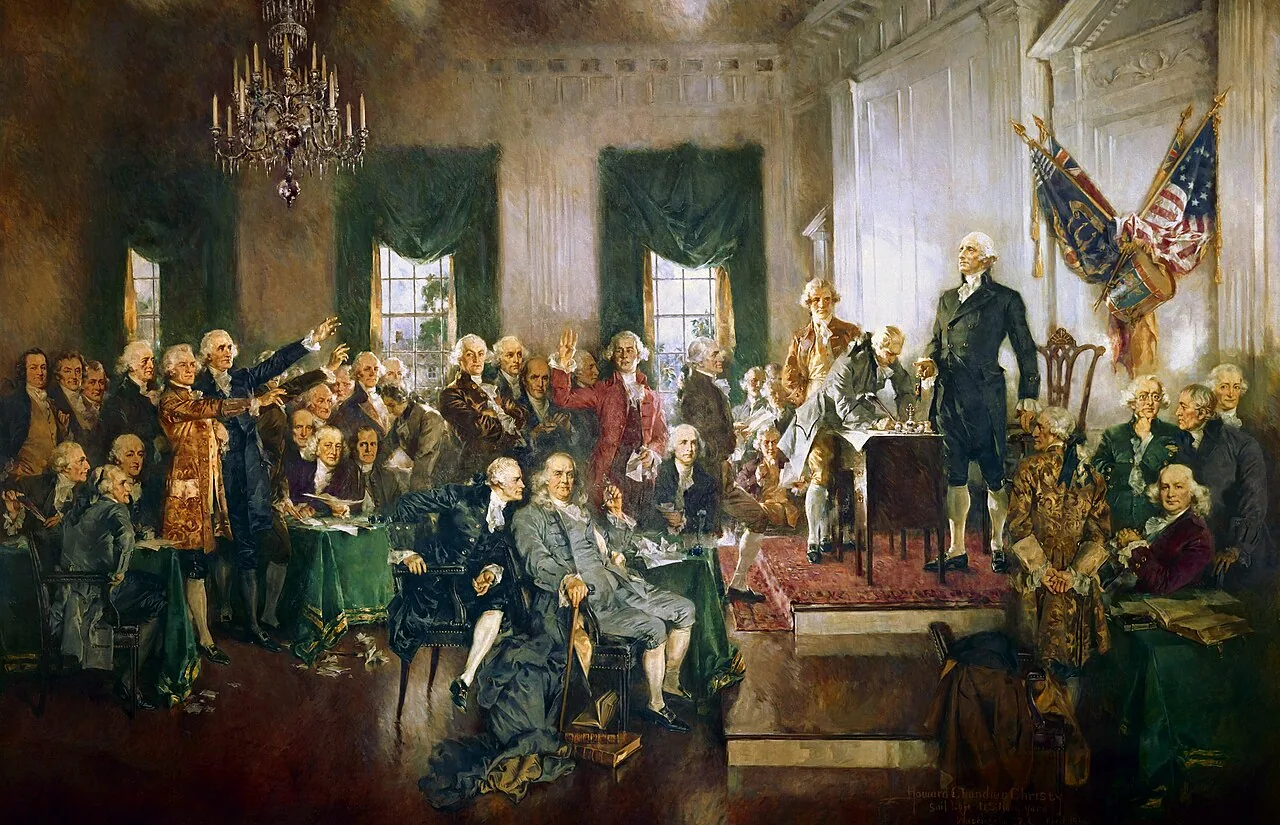
Source: Howard Chandler Christy, 1940, U.S. Capitol.
- Present the document (nature, artist, date).
- Describe the setting and the arrangement of the men. Who stands at the right?
- The painter worked in 1940. What does this tell you about the picture as evidence?
- Which groups of Americans are not shown among the signers?
Exercise 13 : The Father of the Constitution
Document 15 – Portrait of James Madison
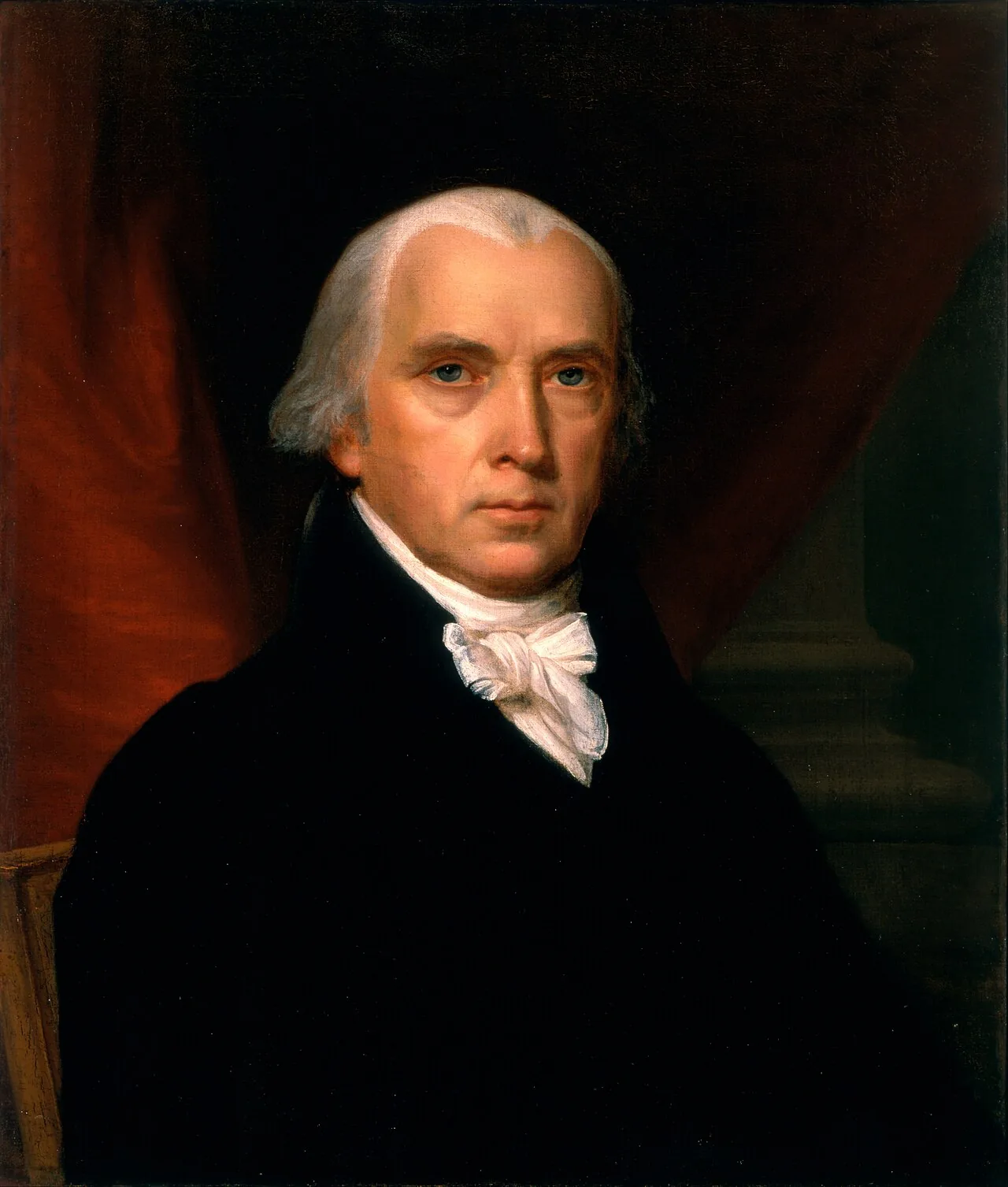
Source: John Vanderlyn, 1816.
- Present the document (nature, artist, date).
- Describe Madison’s clothing and expression.
- Using the lesson, name two things that Madison did to shape the Constitution and the Bill of Rights.
- Why do you think a portrait made in 1816 could be a limited source about 1787?
Exercise 14 : Selling the Constitution
Document 16 – The Federalist, title page, 1788
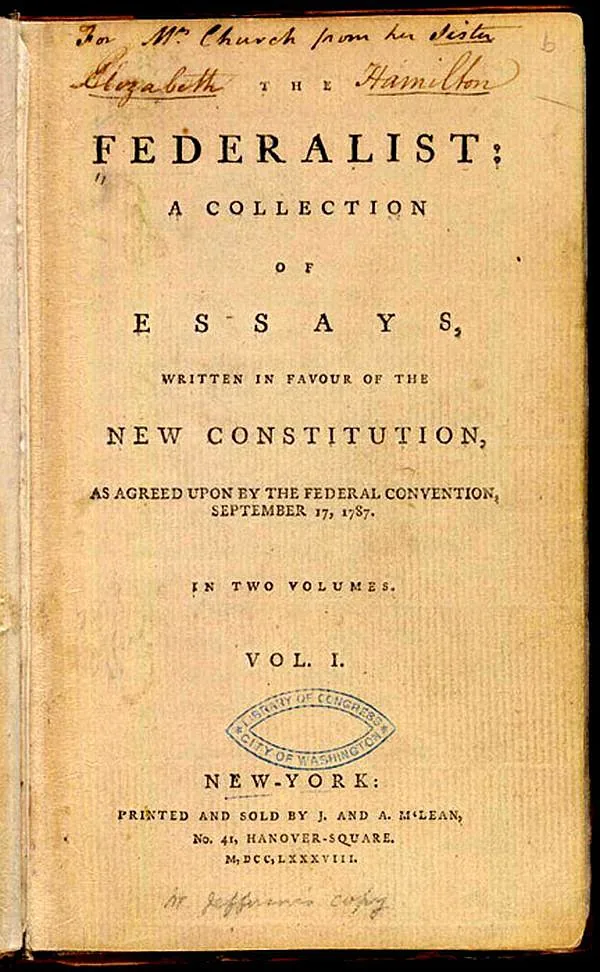
Source: first edition, New York, 1788.
- Present the document (nature, place, date).
- Read the title. What do the words say about the purpose of the book?
- Why were the essays printed in newspapers before they became a book?
- What can the form of this document (a printed book) tell you about how political ideas spread in 1788?
Exercise 15 : Guarding rights
Document 17 – The Bill of Rights today
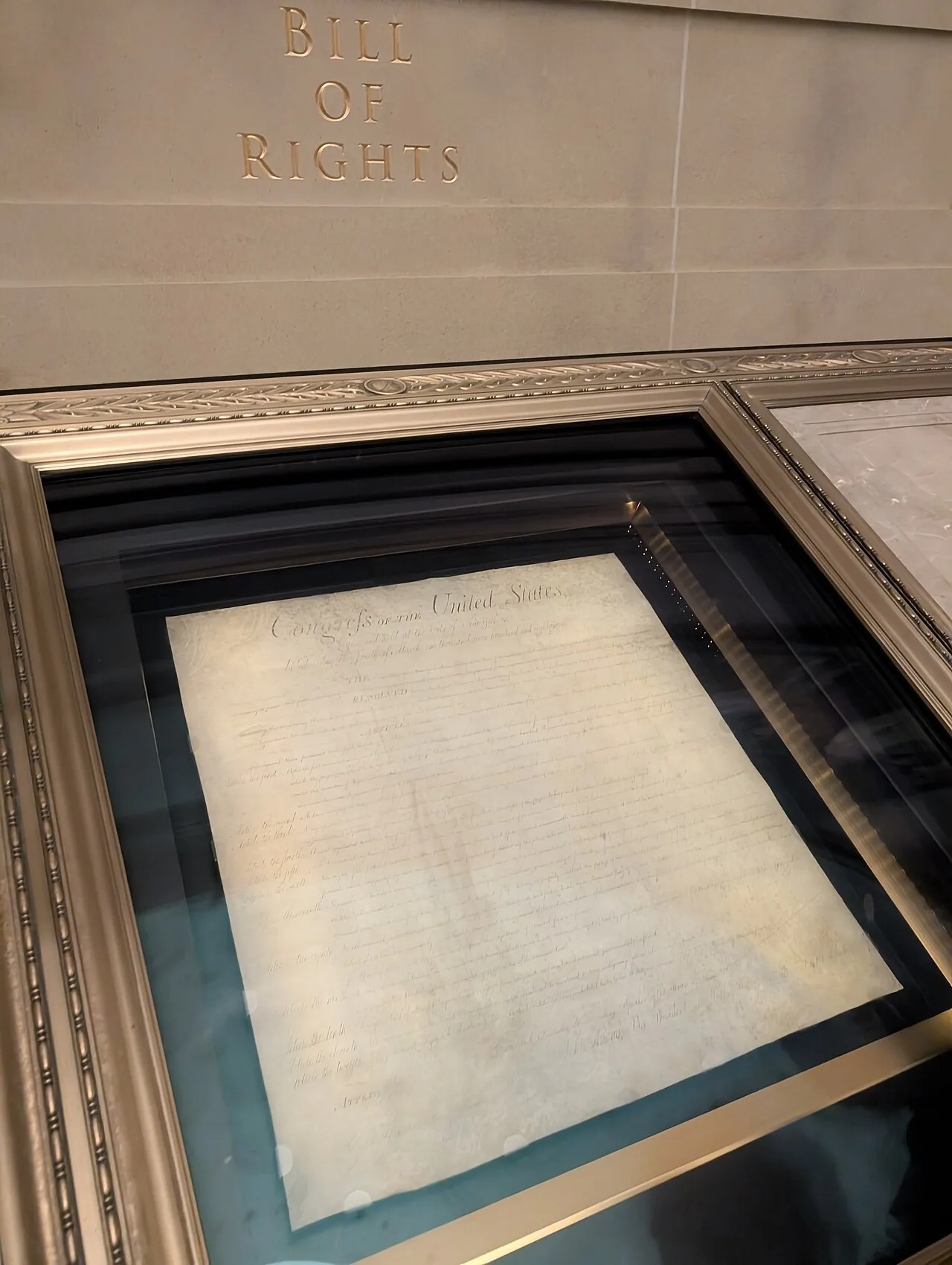
Source: photograph, National Archives, Washington, D.C.
- Present the document (nature, place).
- Describe how the document is displayed. Why might it be displayed this way?
- When was the Bill of Rights ratified, and how many amendments does it contain?
- Why did Anti-Federalists insist on adding it?
Exercise 16 : Population in 1790
Document 18 – The First Census, 1790
| State | Population in 1790 |
|---|---|
| Virginia | 747,610 |
| Pennsylvania | 434,373 |
| North Carolina | 393,751 |
| Massachusetts (including Maine) | 378,787 |
| New York | 340,120 |
| Georgia | 82,548 |
| Rhode Island | 68,825 |
| Delaware | 59,094 |
Source: U.S. Census Bureau, Return of the Whole Number of Persons within the Several Districts of the United States (First Census, 1790). Populations include enslaved people.
- Which state had the most people and which the fewest in this table?
- About how many times larger was Virginia than Delaware? (Divide and round.)
- Under the Great Compromise, how many senators does each of these states have? How many representatives would Virginia have received compared with Delaware if seats followed population?
- Explain why the large and small states disagreed at the Convention.
Exercise 17 : Map 1: Four states
Use the map to answer the questions.
- Match each letter with a state: Pennsylvania, Massachusetts, Virginia, and New York.
- Which of these states ratified the Constitution first, and which last?
- Which one is also the place where the convention met?
- Why was the position of Virginia and New York important in 1788?
Exercise 18 : Map 2: The Northwest Territory
Use the map to answer the questions.
- Which river formed the southern boundary and which the western boundary?
- Name two present-day states that were formed from this territory.
- What did Article 6 of the Ordinance say about slavery in this territory?
- Explain why the Ohio River later became a dividing line in American history.
Exercise 19 : Put the events in order
Put these events in order from earliest to latest, and write the date next to each one: (a) the Bill of Rights is ratified; (b) Shays’ Rebellion; (c) the Great Compromise; (d) New Hampshire ratifies the Constitution; (e) the Articles of Confederation take effect; (f) Washington is inaugurated; (g) the Northwest Ordinance.
Exercise 20 : How long between events?
Calculate each interval.
- From the Articles of Confederation (1781) to the Constitution (1787).
- From the signing of the Constitution (1787) to the Bill of Rights (1791).
- From the Declaration of Independence (1776) to the Constitution (1787).
- From the first state to ratify (December 1787) to the last (May 1790).
Exercise 21 : Guided research: Shays' Rebellion
Mini-investigation: why did Shays’ Rebellion alarm American leaders?
- Search for: “Shays’ Rebellion Springfield arsenal 1787,” “Daniel Shays Massachusetts debts,” “Massachusetts Historical Society Shays.” Reliable sites: the Massachusetts Historical Society, the National Archives, and the Library of Congress.
- Fill in a card: Who took part? What were their grievances? How did the government respond?
- Find a reaction by George Washington or another leader.
- Write three sentences: how did the rebellion affect the decision to hold the Constitutional Convention?
Exercise 22 : CER paragraph: a bill of rights?
Write a paragraph using the Claim-Evidence-Reasoning model.
Question: Did the Constitution need a bill of rights? Take a position.
- State a claim.
- Give at least two pieces of evidence from the lesson or the documents.
- Explain how your evidence supports your claim.
Coup de pouce: consider Brutus’s concerns and Madison’s promise in Virginia.
Exercise 23 : SAQ: the Great Compromise
Answer in complete sentences.
- Identify the problem that the Great Compromise solved.
- Explain how the Great Compromise organized Congress.
- Describe one way in which the Three-Fifths Compromise affected the power of the Southern states.
Exercise 24 : True or false? Justify
Decide whether each statement is true or false. If it is false, correct it.
- Under the Articles of Confederation, Congress could tax the states directly.
- The Constitutional Convention met in Philadelphia in 1787.
- Nine states had to ratify the Constitution before it took effect.
- The Bill of Rights was included in the original Constitution.
- The Northwest Ordinance banned slavery north of the Ohio River.
Exercise 25 : Causes and consequences: from weakness to reform
Complete the chain, then answer the question.
Cause: a weak national government under the Articles → Event: Shays’ Rebellion, 1786-1787 → Reaction: ? → Consequence: ?
- Name two weaknesses of the Articles.
- Explain how the Annapolis Convention led to the Philadelphia Convention.
- Explain how the Anti-Federalists influenced the final outcome of the ratification debate.


Quick review: flashcards
Tap a card to see the answer.