


This Grade 8 US History to 1877 test covers The Constitution and the Bill of Rights. Like a classroom assessment, it includes documents to analyze, knowledge questions and a short writing task. To prepare, review the lesson first, then practice with the worksheet.
Time : 50 min
The test has three parts: knowledge (32 points), documents (48 points), and a written argument (20 points). Answer in complete sentences and cite the documents.
Document 1 – Document 1 – The thirteen states and ratification
Map prepared for this unit from Natural Earth data; locations approximate.
Document 2 – Document 2 – Federalist no. 10, 1787
A republic, by which I mean a government in which the scheme of representation takes place, opens a different prospect, and promises the cure for which we are seeking. Let us examine the points in which it varies from pure democracy, and we shall comprehend both the nature of the cure and the efficacy which it must derive from the Union. […] The two great points of difference between a democracy and a republic are: first, the delegation of the government, in the latter, to a small number of citizens elected by the rest; secondly, the greater number of citizens, and greater sphere of country, over which the latter may be extended.
Source: James Madison (writing as Publius), The Federalist, no. 10, November 22, 1787; text from the Avalon Project, Yale Law School.
*faction: a group that works for its own interest. *sphere: area.
Avalon Project, Yale Law School.
Document 3 – Document 3 – The signing of the Constitution
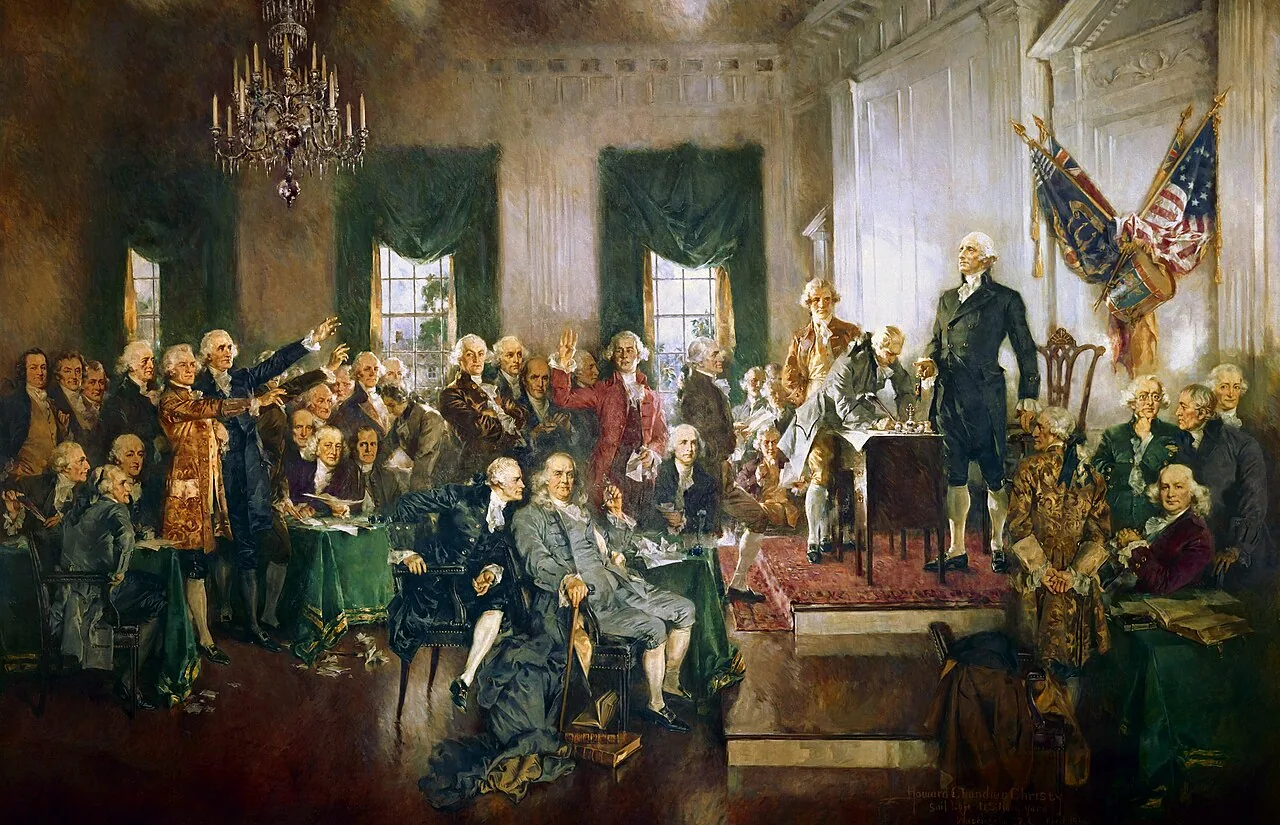
Wikimedia Commons.
Document 4 – Document 4 – Population in 1790
| State | Population in 1790 |
|---|---|
| Virginia | 747,610 |
| Massachusetts (including Maine) | 378,787 |
| Delaware | 59,094 |
U.S. Census Bureau, First Census, 1790.
Questions
- Part 1 – Knowledge. Define federalism, ratify, and amendment. (12 pts)
- Part 1. Document 1: which state ratified first and which last? Name two states that ratified after New Hampshire became the ninth. (12 pts)
- Part 1. Name two weaknesses of the Articles of Confederation and explain one. (8 pts)
- Part 2 – Documents. Document 2: present the document and explain Madison’s argument for a large republic. (14 pts)
- Part 2. Document 3: present the document, describe what you see, and explain why a historian must use it with caution. (14 pts)
- Part 2. Document 4: calculate about how many times larger Virginia was than Delaware (round to the nearest whole number), and explain how this figure helps explain the dispute over representation. (10 pts)
- Part 2. Using Document 1, Document 2, and the lesson, explain two reasons why the Federalists and Anti-Federalists disagreed. (10 pts)
- Part 3 – Written argument. How did the debate over ratification lead to the Bill of Rights? Write a paragraph or two with a claim, at least two pieces of evidence from the documents or the lesson, and your reasoning. (20 pts)


Quick review: flashcards
Tap a card to see the answer.