


This Grade 8 US History to 1877 test covers The Revolutionary War. Like a classroom assessment, it includes documents to analyze, knowledge questions and a short writing task. To prepare, review the lesson first, then practice with the worksheet.
Time : 50 min
The test has three parts: knowledge (32 points), documents (48 points), and a written argument (20 points). Answer in complete sentences and cite the documents.
Document 1 – Document 1 – Battles of the Revolution
Map prepared for this unit from Natural Earth data; locations approximate.
Document 2 – Document 2 – Thomas Paine, December 1776
THESE are the times that try men’s souls. The summer soldier and the sunshine patriot will, in this crisis, shrink from the service of their country; but he that stands by it now, deserves the love and thanks of man and woman. Tyranny, like hell, is not easily conquered; yet we have this consolation with us, that the harder the conflict, the more glorious the triumph. What we obtain too cheap, we esteem too lightly: it is dearness only that gives every thing its value. Heaven knows how to put a proper price upon its goods; and it would be strange indeed if so celestial an article as FREEDOM should not be highly rated.
Source: Thomas Paine, The American Crisis, no. 1, December 23, 1776 (opening paragraph); text from ushistory.org.
*summer soldier: a soldier who serves only in easy times.
ushistory.org.
Document 3 – Document 3 – Washington crossing the Delaware
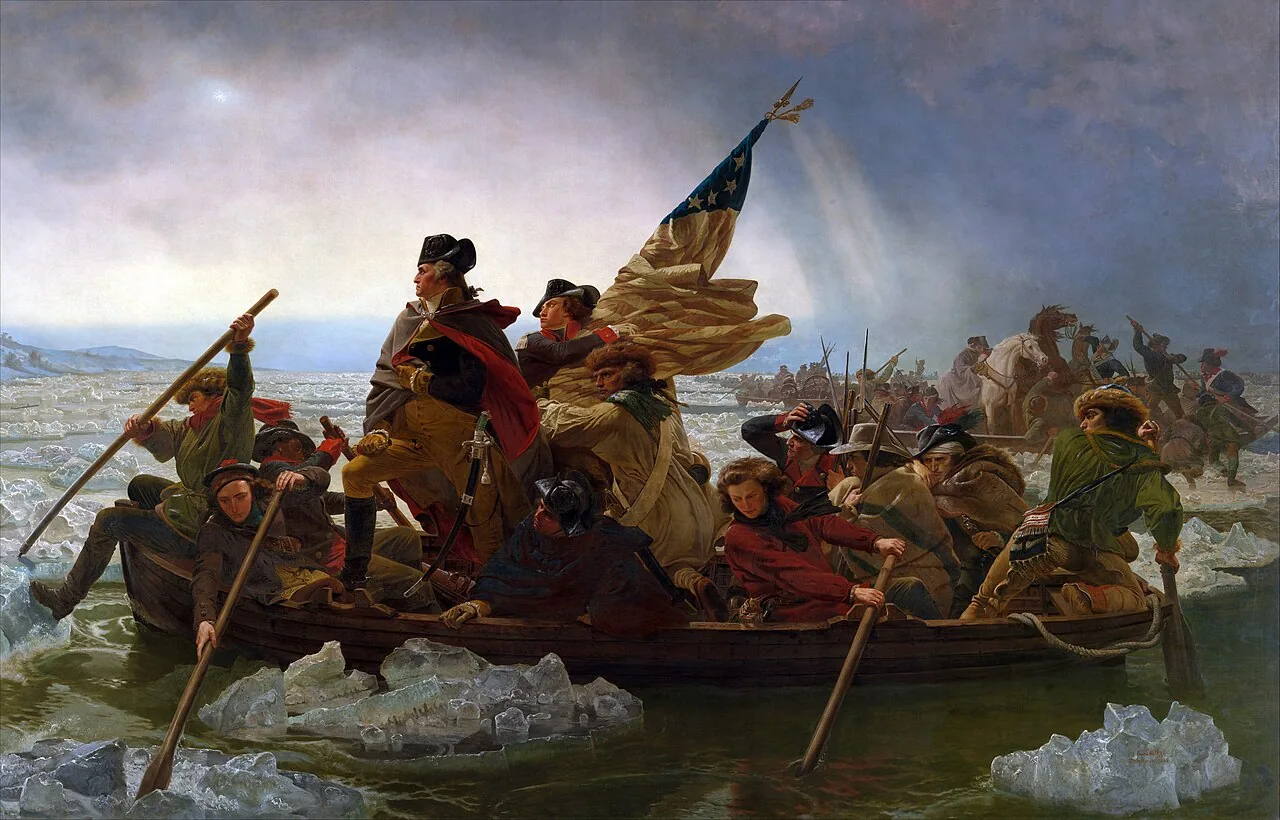
Wikimedia Commons.
Document 4 – Document 4 – Turning points
| Battle | Date | Approximate numbers |
|---|---|---|
| Trenton | December 26, 1776 | more than 900 Hessians captured |
| Saratoga | October 17, 1777 | about 5,700 British surrender |
| Yorktown | October 19, 1781 | about 7,000 British surrender |
Standard references; figures rounded.
Questions
- Part 1 – Knowledge. Define alliance, Hessians, and natural rights. (12 pts)
- Part 1. Document 1: name the battle shown in Virginia and the battle shown in New York, and say which one led to the French alliance. (12 pts)
- Part 1. Name two events of 1775 and 1776 that led from protest to a declaration of independence, and explain one. (8 pts)
- Part 2 – Documents. Document 2: present the document and explain why Paine wrote it. What does he ask of his readers? (14 pts)
- Part 2. Document 3: present the document, describe what you see, and explain two reasons why historians treat it with caution. (14 pts)
- Part 2. Document 4: calculate how many years separate Trenton from Yorktown, and how many more men surrendered at Yorktown than at Saratoga. (10 pts)
- Part 2. Using Document 1, Document 4, and the lesson, explain two ways in which the French alliance helped win the war. (10 pts)
- Part 3 – Written argument. How did the Americans win the Revolutionary War against a much stronger empire? Write a paragraph or two with a claim, at least two pieces of evidence from the documents or the lesson, and your reasoning. (20 pts)


Quick review: flashcards
Tap a card to see the answer.