


This worksheet on The Revolutionary War belongs to the Grade 8 US History to 1877 course. Its questions use primary sources, maps and timelines, and they move from basic recall to short writing tasks. Before you start, review the lesson; afterward, try the true or false quiz.
Exercise 1 : Vocabulary of the war
Match each term with its meaning, then use three of the terms in sentences about the war.
- Continental Army
- Natural rights
- Hessians
- Alliance
- Treaty
- Loyalist
(a) German soldiers hired by Britain; (b) the army created by the Second Continental Congress; (c) a written agreement between nations, such as one that ends a war; (d) a colonist who stayed loyal to Britain; (e) rights, such as life and liberty, that people are born with; (f) an agreement between nations to help each other, especially in war.
Exercise 2 : We hold these truths
Document 1 – The Declaration of Independence
We hold these truths to be self-evident: That all men are created equal; that they are endowed by their Creator with certain unalienable rights; that among these are life, liberty, and the pursuit of happiness; that, to secure these rights, governments are instituted among men, deriving their just powers from the consent of the governed; that whenever any form of government becomes destructive of these ends, it is the right of the people to alter or to abolish it, and to institute new government, laying its foundation on such principles, and organizing its powers in such form, as to them shall seem most likely to effect their safety and happiness.
Source: The Declaration of Independence, adopted by the Continental Congress, July 4, 1776 (second paragraph); text from the Avalon Project, Yale Law School.
*unalienable: that cannot be taken away.
- Present the document (nature, author, date, context).
- List three rights named in the passage.
- According to the text, why do people create governments?
- What does the text say that people may do if a government destroys these rights?
- Explain one way in which Americans in 1776 did not live up to the words of this passage.
Exercise 3 : The charges against the king
Document 2 – A list of grievances
He has kept among us, in times of peace, standing armies, without the consent of our legislatures. He has affected to render the military independent of, and superior to, the civil power. He has combined with others to subject us to a jurisdiction foreign to our Constitution and unacknowledged by our laws, giving his assent to their acts of pretended legislation: For quartering large bodies of armed troops among us; For protecting them, by a mock trial, from punishment for any murders which they should commit on the inhabitants of these states; For cutting off our trade with all parts of the world; For imposing taxes on us without our consent; For depriving us, in many cases, of the benefits of trial by jury;
Source: The Declaration of Independence, July 4, 1776 (part of the list of grievances against King George III); text from the Avalon Project, Yale Law School.
*legislatures: lawmaking bodies. *pretended: false.
- Present the document (nature, author, date, context).
- Choose three grievances in the text and say what they are about.
- Match two of the grievances with events in the lesson on the causes of the Revolution.
- Why do you think the authors listed so many complaints?
Exercise 4 : These are the times
Document 3 – Thomas Paine, The American Crisis
THESE are the times that try men’s souls. The summer soldier and the sunshine patriot will, in this crisis, shrink from the service of their country; but he that stands by it now, deserves the love and thanks of man and woman. Tyranny, like hell, is not easily conquered; yet we have this consolation with us, that the harder the conflict, the more glorious the triumph. What we obtain too cheap, we esteem too lightly: it is dearness only that gives every thing its value. Heaven knows how to put a proper price upon its goods; and it would be strange indeed if so celestial an article as FREEDOM should not be highly rated.
Source: Thomas Paine, The American Crisis, no. 1, December 23, 1776 (opening paragraph); text from ushistory.org.
*summer soldier: a soldier who serves only in easy times.
- Present the document (nature, author, date, context).
- Explain the phrases “summer soldier” and “sunshine patriot.”
- What reason does Paine give for believing that victory will be worth a great struggle?
- Why would Washington have wanted this text read to his troops in December 1776?
Exercise 5 : Freedom offered by the governor
Document 4 – Lord Dunmore’s Proclamation, 1775
I do require every Person capable of bearing Arms, to resort to His Majesty’s STANDARD, or be looked upon as Traitors to His Majesty’s Crown and Government, and thereby become liable to the Penalty the Law inflicts upon such Offences; such as forfeiture of Life, confiscation of Lands, &c. &c. And I do hereby further declare all indented Servants, Negroes, or others, (appertaining to Rebels,) free that are able and willing to bear Arms, they joining His Majesty’s Troops as soon as may be, for the more speedily reducing this Colony to a proper Sense of their Duty, to His Majesty’s Crown and Dignity.
Source: John Murray, Earl of Dunmore, royal governor of Virginia, Proclamation, aboard the ship William off Norfolk, November 7, 1775; text from Wikisource.
*appertaining: belonging.
- Present the document (nature, author, date, context).
- Whom does Dunmore call on to join the royal side? What does he offer to some of them?
- Whose enslaved people does the offer cover? What does this tell you about Dunmore’s motive?
- How might enslaved people, slaveholders, and Patriot leaders each have reacted?
Exercise 6 : Remember the Ladies
Document 5 – Abigail Adams to John Adams, 1776
I long to hear that you have declared an independency — and by the way in the new Code of Laws which I suppose it will be necessary for you to make I desire you would Remember the Ladies, and be more generous and favourable to them than your ancestors. Do not put such unlimited power into the hands of the Husbands. Remember all Men would be tyrants if they could. If perticuliar care and attention is not paid to the Laidies we are determined to foment a Rebelion, and will not hold ourselves bound by any Laws in which we have no voice, or Representation.
Source: Abigail Adams to John Adams, Braintree, Massachusetts, March 31, 1776; Massachusetts Historical Society, Adams Family Papers. Spelling of the original.
*foment: stir up.
- Present the document (nature, author, date, context).
- What request does Abigail Adams make of the men making the new laws?
- What does she warn will happen if the request is ignored?
- Find the words in her letter that echo the slogan of the Revolution, and explain why that is effective.
Exercise 7 : The end of the war
Document 6 – The Treaty of Paris, 1783, Article 1
Article 1: His Brittanic Majesty acknowledges the said United States, viz., New Hampshire, Massachusetts Bay, Rhode Island and Providence Plantations, Connecticut, New York, New Jersey, Pennsylvania, Maryland, Virginia, North Carolina, South Carolina and Georgia, to be free sovereign and independent states, that he treats with them as such, and for himself, his heirs, and successors, relinquishes all claims to the government, propriety, and territorial rights of the same and every part thereof.
Source: The Definitive Treaty of Peace between the United States and Great Britain (Treaty of Paris), September 3, 1783, Article 1; text from the Avalon Project, Yale Law School.
*relinquishes: gives up.
- Present the document (nature, parties, date, context).
- Name the former colonies that Britain recognizes.
- What does Britain give up in this article?
- Why was it important that Britain recognized the states as “free sovereign and independent”?
Exercise 8 : Equality: words and reality
Document 7 – The Declaration of Independence, 1776
We hold these truths to be self-evident: That all men are created equal; that they are endowed by their Creator with certain unalienable rights; that among these are life, liberty, and the pursuit of happiness; that, to secure these rights, governments are instituted among men, deriving their just powers from the consent of the governed; that whenever any form of government becomes destructive of these ends, it is the right of the people to alter or to abolish it, and to institute new government, laying its foundation on such principles, and organizing its powers in such form, as to them shall seem most likely to effect their safety and happiness.
Source: The Declaration of Independence, adopted by the Continental Congress, July 4, 1776 (second paragraph); text from the Avalon Project, Yale Law School.
*unalienable: that cannot be taken away.
Document 8 – Lord Dunmore’s Proclamation, 1775
I do require every Person capable of bearing Arms, to resort to His Majesty’s STANDARD, or be looked upon as Traitors to His Majesty’s Crown and Government, and thereby become liable to the Penalty the Law inflicts upon such Offences; such as forfeiture of Life, confiscation of Lands, &c. &c. And I do hereby further declare all indented Servants, Negroes, or others, (appertaining to Rebels,) free that are able and willing to bear Arms, they joining His Majesty’s Troops as soon as may be, for the more speedily reducing this Colony to a proper Sense of their Duty, to His Majesty’s Crown and Dignity.
Source: John Murray, Earl of Dunmore, royal governor of Virginia, Proclamation, aboard the ship William off Norfolk, November 7, 1775; text from Wikisource.
*appertaining: belonging.
- Present each document (author, date).
- Which document speaks of equality and rights, and which offers freedom to some enslaved people?
- How do the motives of the two authors differ?
- What does the comparison show about slavery and the American Revolution?
Exercise 9 : Rights for whom?
Document 9 – Abigail Adams, March 1776
I long to hear that you have declared an independency — and by the way in the new Code of Laws which I suppose it will be necessary for you to make I desire you would Remember the Ladies, and be more generous and favourable to them than your ancestors. Do not put such unlimited power into the hands of the Husbands. Remember all Men would be tyrants if they could. If perticuliar care and attention is not paid to the Laidies we are determined to foment a Rebelion, and will not hold ourselves bound by any Laws in which we have no voice, or Representation.
Source: Abigail Adams to John Adams, Braintree, Massachusetts, March 31, 1776; Massachusetts Historical Society, Adams Family Papers. Spelling of the original.
*foment: stir up.
Document 10 – The Declaration, July 1776
We hold these truths to be self-evident: That all men are created equal; that they are endowed by their Creator with certain unalienable rights; that among these are life, liberty, and the pursuit of happiness; that, to secure these rights, governments are instituted among men, deriving their just powers from the consent of the governed; that whenever any form of government becomes destructive of these ends, it is the right of the people to alter or to abolish it, and to institute new government, laying its foundation on such principles, and organizing its powers in such form, as to them shall seem most likely to effect their safety and happiness.
Source: The Declaration of Independence, adopted by the Continental Congress, July 4, 1776 (second paragraph); text from the Avalon Project, Yale Law School.
*instituted: set up.
- Present each document (author, date).
- Which phrases from the Declaration could be used by women to support Adams’s request?
- Why do you think the Declaration says “all men” and does not mention women?
- How does the comparison show that ideas of the Revolution could be turned toward new goals?
Exercise 10 : A declaration in paint
Document 11 – Trumbull’s Declaration of Independence
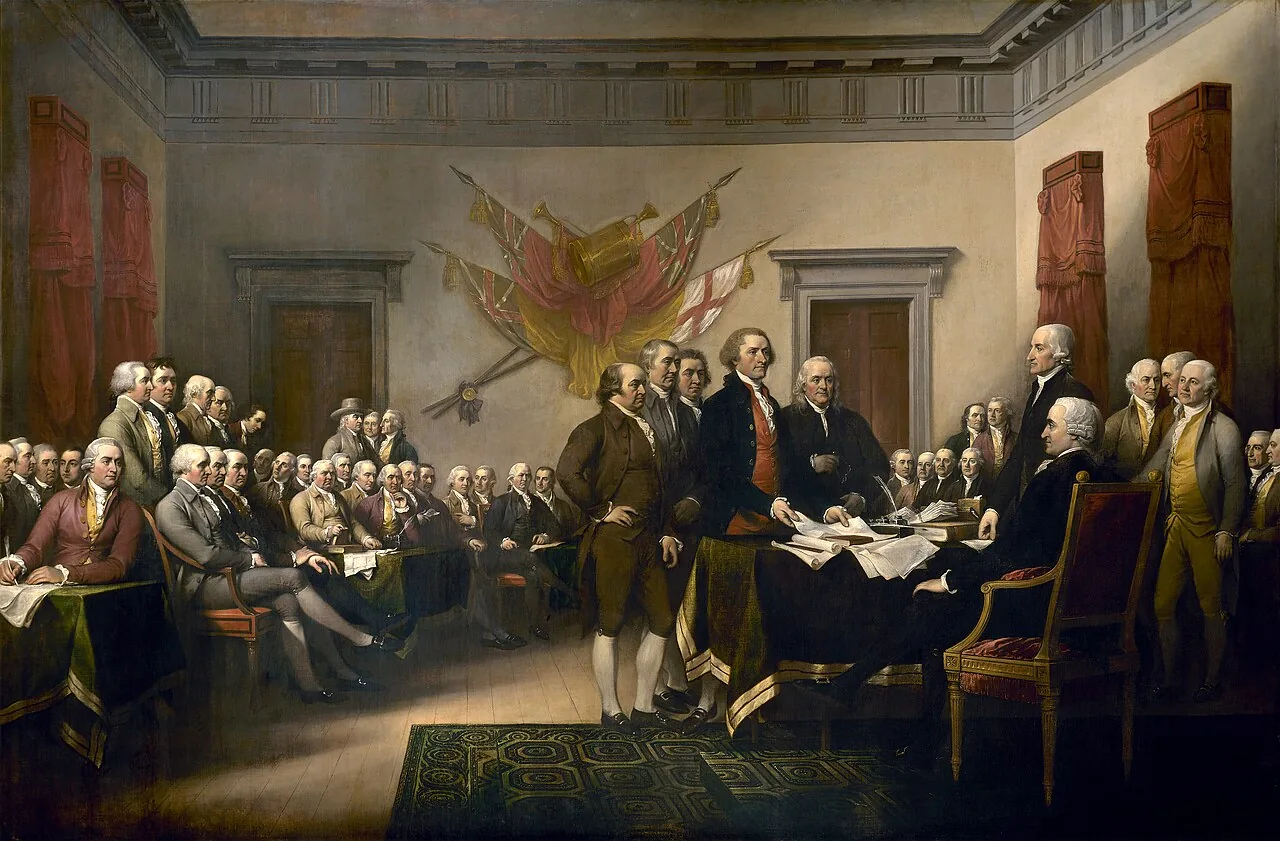
Source: John Trumbull, 1819, U.S. Capitol.
- Present the document (nature, artist, date).
- Describe the room and the arrangement of the men.
- The painting was finished in 1819, forty-three years after the events. How does this affect its value as evidence?
- What message did the painter want to give to Americans of 1819?
Exercise 11 : Washington crosses the Delaware
Document 12 – Leutze, Washington Crossing the Delaware
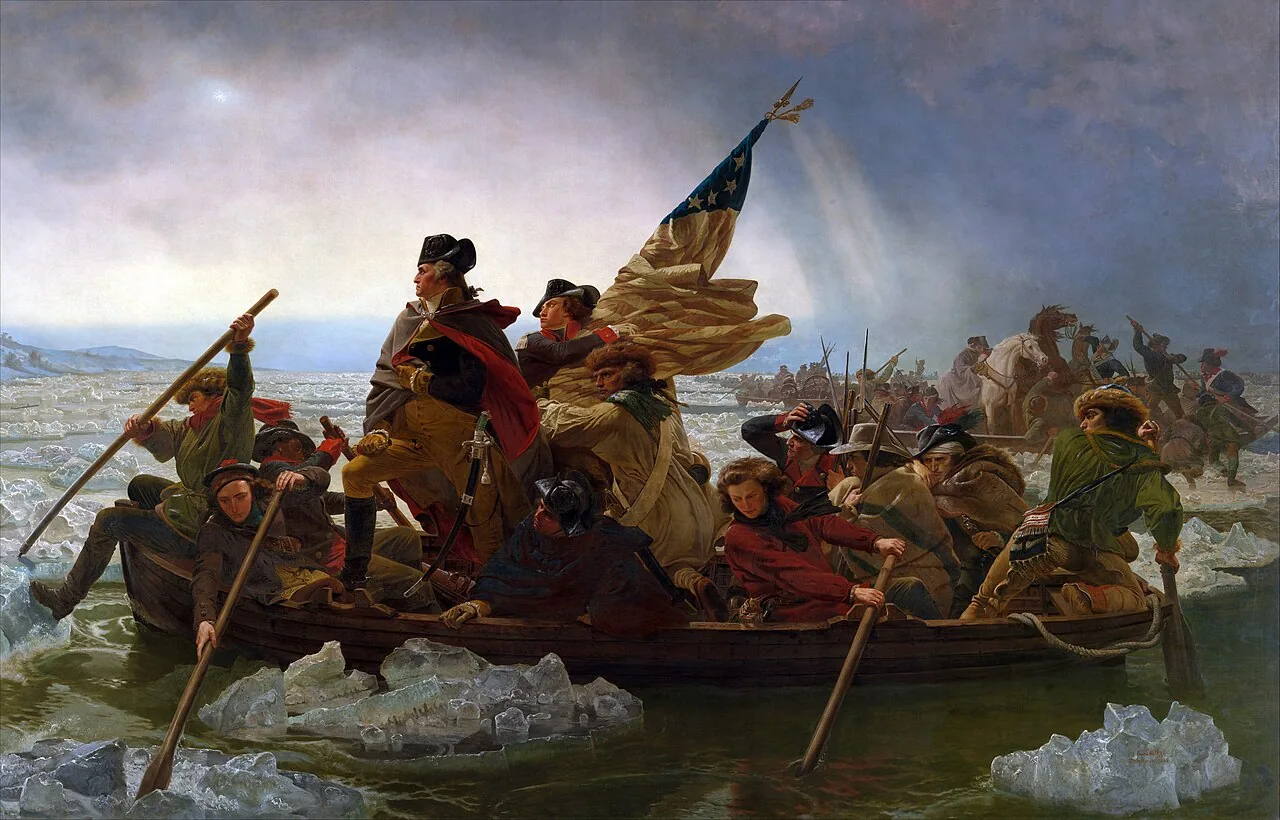
Source: Emanuel Leutze, 1851, Metropolitan Museum of Art.
- Present the document (nature, artist, date).
- Describe Washington’s pose and the other figures in the boat.
- Identify two details that historians believe to be inaccurate.
- Why do you think the painting became so famous?
Exercise 12 : Yorktown
Document 13 – Trumbull’s Surrender of Lord Cornwallis
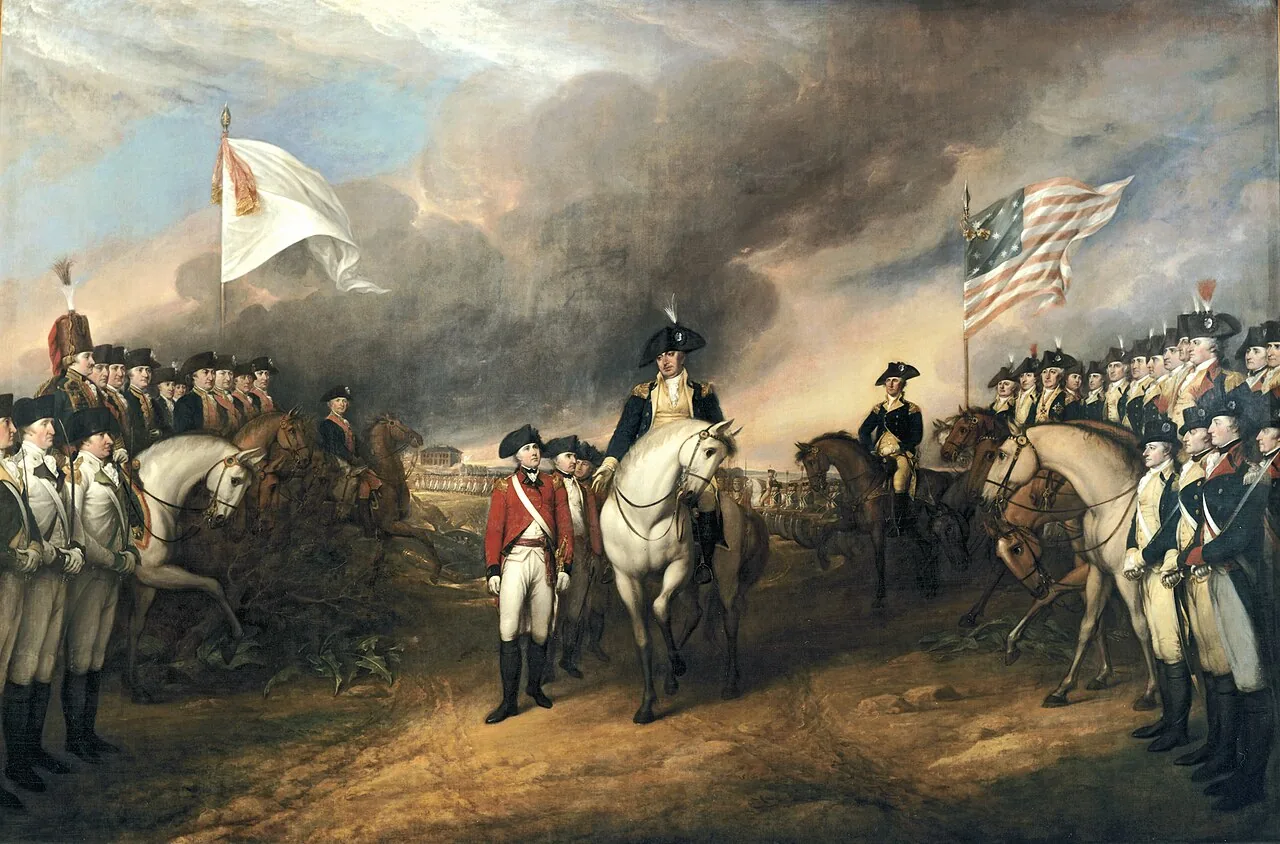
Source: John Trumbull, 1820.
- Present the document (nature, artist, date).
- Describe the two lines of soldiers. Who stands on each side?
- Cornwallis was absent. Who is in the center, and why?
- What can you tell from the picture about the importance of France?
Exercise 13 : The peacemakers
Document 14 – West, American Commissioners
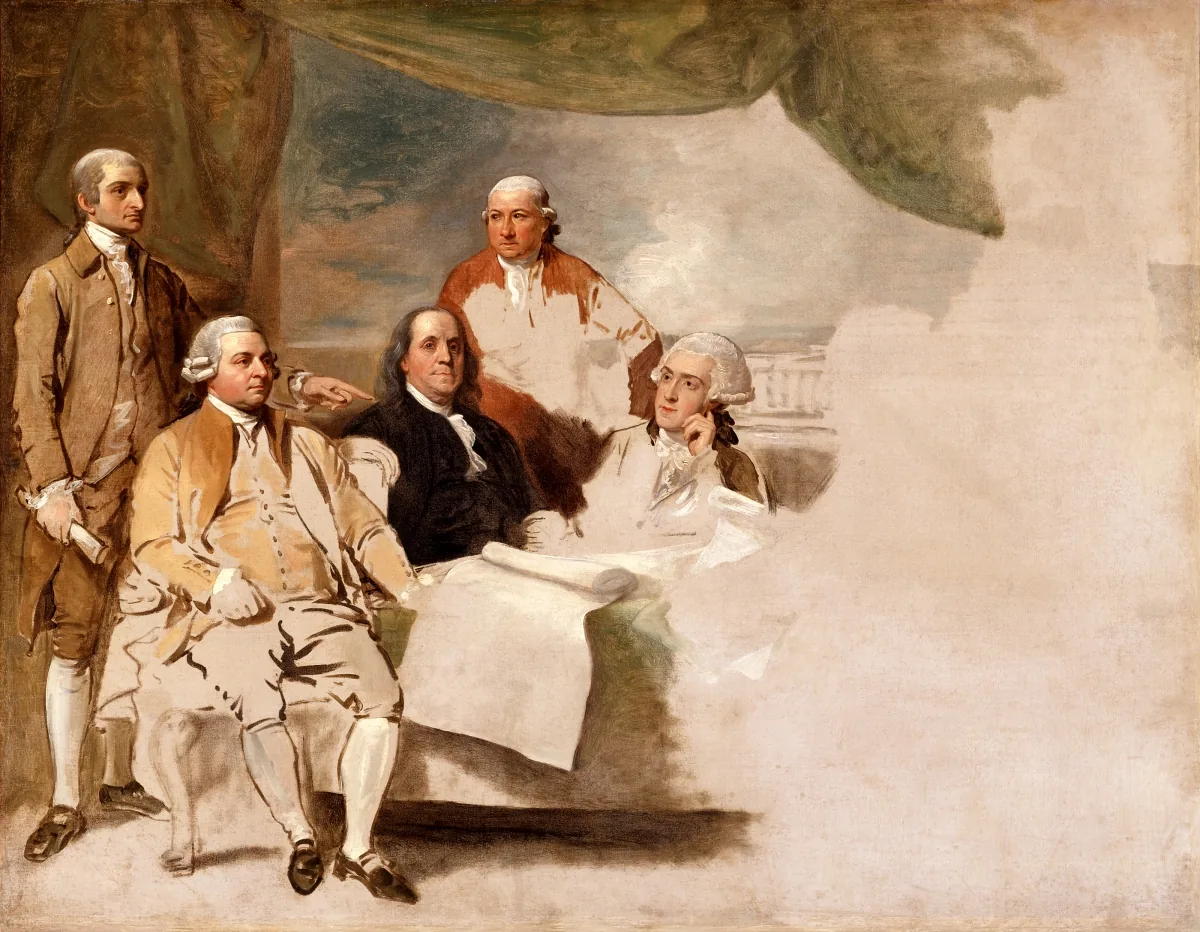
Source: Benjamin West, 1783-1784, unfinished.
- Present the document (nature, artist, date).
- Name the figures if you can, using the caption.
- Why is the right side of the painting empty?
- What does the unfinished painting suggest about the peace negotiations?
Exercise 14 : Turning points in numbers
Document 15 – Five turning points
| Battle | Date | Result | Approximate numbers |
|---|---|---|---|
| Bunker Hill | June 17, 1775 | British take the hill | British losses over 1,000; American about 450 |
| Trenton | December 26, 1776 | American victory | more than 900 Hessians captured |
| Saratoga | October 17, 1777 | British army surrenders | about 5,700 men |
| Charleston | May 12, 1780 | British capture the city | about 5,000 Americans captured |
| Yorktown | October 19, 1781 | British army surrenders | about 7,000 men |
Source: standard references (National Park Service; Library of Congress). Figures are rounded estimates.
- Which battle ended with the largest British surrender? Which with the largest American?
- How many years passed between Saratoga and Yorktown?
- Why was Bunker Hill considered a moral victory for the Americans, although they lost the hill?
- Name one result of the victory at Saratoga that is not in the table.
Exercise 15 : Map 1: Where the war was fought
Use the map to answer the questions.
- Match each number with a place: Lexington and Concord, Trenton, Saratoga, Yorktown, and Charleston.
- In which colony was each of points 2 and 4 located?
- Which two sites are in the South?
- Why might Britain have thought the South was a good place to fight after 1778?
Exercise 16 : Map 2: The new nation
Use the map to answer the questions.
- What river formed the western boundary of the United States?
- Which European power controlled the land to the south of the 31st parallel, and which to the west of the river?
- Which water bodies formed part of the northern boundary?
- Explain why the size of the new country posed a challenge for its government.
Exercise 17 : Put the events in order
Put these events in order from earliest to latest, and write the date next to each one: (a) Saratoga; (b) the Declaration of Independence is adopted; (c) Lexington and Concord; (d) Treaty of Paris; (e) Yorktown; (f) French alliance; (g) Trenton.
Exercise 18 : How long between events?
Calculate each interval.
- From Lexington (1775) to the Declaration (1776).
- From the Declaration (1776) to the Treaty of Paris (1783).
- From Lexington (1775) to Yorktown (1781).
- From the Treaty of Paris (1783) to today.
Exercise 19 : Guided research: women in the Revolution
Mini-investigation: what did women do during the war?
- Search for: “Deborah Sampson Continental Army,” “Abigail Adams letters Massachusetts Historical Society,” “Women in the American Revolution National Park Service.” Reliable sites: the Massachusetts Historical Society, the National Park Service, and the Library of Congress.
- Fill in a card for two women: name, what she did, source of your information.
- Find one example of a woman who supported the Patriots and one example of a woman who supported Britain or who was enslaved.
- Write three sentences: how did the war change the lives of women, and what did it leave unchanged?
Exercise 20 : CER paragraph: why did the Americans win?
Write a paragraph using the Claim-Evidence-Reasoning model.
Question: Which factor was most important in the American victory: Washington’s leadership, the French alliance, or the difficulty of the terrain? Take a position.
- State a claim.
- Give at least two pieces of evidence from the lesson or documents.
- Explain how your evidence supports your claim.
Coup de pouce: think of Saratoga, Valley Forge, Yorktown, and the size of the country.
Exercise 21 : SAQ: the Declaration of Independence
Answer in complete sentences.
- Identify one idea from the second paragraph of the Declaration of Independence.
- Explain one reason the authors included a list of grievances.
- Describe one group of people to whom the principles of the Declaration did not fully apply in 1776.
Exercise 22 : True or false? Justify
Decide whether each statement is true or false. If it is false, correct it.
- George Washington commanded the Continental Army.
- The Declaration of Independence was adopted on July 4, 1776.
- The Battle of Saratoga convinced France to ally with the United States.
- Cornwallis surrendered at Saratoga.
- The Treaty of Paris of 1783 gave the United States land west to the Mississippi River.
Exercise 23 : Causes and consequences: Saratoga to Yorktown
Complete the chain, then answer the question.
Cause: American victory at Saratoga, 1777 → Event: French alliance, 1778 → Result: ? → Consequence: ?
- Name two kinds of help that France provided.
- Explain how the British change of strategy led to Yorktown.
- Explain one long-term consequence of the American victory.


Quick review: flashcards
Tap a card to see the answer.