


This worksheet on Causes of the American Revolution belongs to the Grade 8 US History to 1877 course. Its questions use primary sources, maps and timelines, and they move from basic recall to short writing tasks. Before you start, review the lesson; afterward, try the true or false quiz.
Exercise 1 : Vocabulary of protest
Match each term with its meaning, then use three of the terms in sentences about the 1760s.
- Boycott
- Repeal
- Duty
- Patriot
- Loyalist
- Representation
(a) to cancel a law; (b) a colonist who supported resistance to Britain; (c) a refusal to buy goods as a protest; (d) a colonist who stayed loyal to Britain; (e) having elected delegates who speak for you in a government; (f) a tax on goods brought into a country.
Coup de pouce: reread the definitions and commentary in the lesson.
Exercise 2 : Closing the West
Document 1 – The Proclamation of 1763
And whereas it is just and reasonable, and essential to our Interest, and the Security of our Colonies, that the several Nations or Tribes of Indians with whom We are connected, and who live under our Protection, should not be molested or disturbed in the Possession of such Parts of Our Dominions and Territories as, not having been ceded to or purchased by Us, are reserved to them. or any of them, as their Hunting Grounds.
Source: King George III, Royal Proclamation, October 7, 1763 (the Proclamation of 1763); text from the Avalon Project, Yale Law School. Punctuation as in the Avalon text.
*Pleasure: command. *Hunting Grounds: lands used by Native peoples for hunting.
- Present the document (nature, author, date, context).
- What does the king say about the Native nations?
- What is the king forbidding the governors to do?
- The text gives a reason for protecting Native lands. Describe one more reason that Britain had for the policy.
- Why would a colonist who wanted land in the Ohio country be unhappy?
Exercise 3 : Resolving to be heard
Document 2 – The Stamp Act Congress, 1765
That it is inseparably essential to the freedom of a people, and the undoubted right of Englishmen, that no taxes be imposed on them, but with their own consent, given personally, or by their representatives. That the people of these colonies are not, and from their local circumstances cannot be, represented in the House of Commons in Great-Britain. That the only representatives of the people of these colonies, are persons chosen therein by themselves, and that no taxes ever have been, or can be constitutionally imposed on them, but by their respective legislatures.
Source: Resolutions of the Stamp Act Congress, New York, October 19, 1765 (resolutions 3 to 5); text from the Avalon Project, Yale Law School.
*supplies: money voted by a legislature.
- Present the document (nature, author, date, context).
- Which principle do the delegates state in the first sentence?
- Why do they say that Parliament cannot represent the colonists?
- According to the delegates, which bodies may tax the colonies?
- Do the delegates demand independence? Support your answer.
Exercise 4 : Parliament speaks
Document 3 – The Declaratory Act, 1766
That the said colonies and plantations in America have been, are, and of right ought to be, subordinate unto, and dependent upon the imperial crown and parliament of Great Britain; […] to bind the colonies and people of America, subjects of the crown of Great Britain, in all cases whatsoever
Source: The Declaratory Act, Parliament of Great Britain, March 18, 1766; text from the Avalon Project, Yale Law School. Parts of the law are omitted.
*plantations: colonies. *subordinate: lower in rank.
- Present the document (nature, author, date, context).
- What does the law say about the relationship of the colonies to Great Britain?
- What power does Parliament claim?
- Why might Parliament have passed this law on the same day that it repealed the Stamp Act?
Exercise 5 : Punishing a port
Document 4 – The Boston Port Act, 1774
WHEREAS dangerous commotions and insurrections have been fomented and raised in the town of Boston, in the province of Massachusets Bay, in New England, by divers ill-affected persons, to the subversion of his Majestys government, and to the utter destruction of the publick peace, and good order of the said town; in which commotions and insurrections certain valuable cargoes of teas, being the property of the East India Company, and on board certain vessels lying within the bay or harbour of Boston, were seized and destroyed: And whereas, in the present condition of the said town and harbour, the commerce of his Majestys subjects cannot be safely carried on there, nor the customs payable to his Majesty duly collected;
Source: The Boston Port Act, Parliament of Great Britain, March 31, 1774 (opening paragraph); text from the Avalon Project, Yale Law School. Spelling of the original.
*divers: various. *customs: taxes on imported goods.
- Present the document (nature, author, date, context).
- According to the law, what happened in Boston?
- Who does the law blame, and whom does it punish?
- Why might colonists outside Massachusetts feel that this law threatened them too?
Exercise 6 : Rights listed in Philadelphia
Document 5 – The First Continental Congress, 1774
Resolved, N.C.D. 1. That they are entitled to life, liberty and property: and they have never ceded to any foreign power whatever, a right to dispose of either without their consent. […] Resolved, 4. That the foundation of English liberty, and of all free government, is a right in the people to participate in their legislative council: and as the English colonists are not represented, and from their local and other circumstances, cannot properly be represented in the British parliament, they are entitled to a free and exclusive power of legislation in their several provincial legislatures, where their right of representation can alone be preserved, in all cases of taxation and internal polity, subject only to the negative of their sovereign, in such manner as has been heretofore used and accustomed:
Source: Declaration and Resolves of the First Continental Congress, Philadelphia, October 14, 1774 (resolutions 1 and 4); text from the Avalon Project, Yale Law School.
*immunities: protections. *polity: government.
- Present the document (nature, author, date, context).
- What three rights do the delegates claim in Resolve 1?
- What do they say about the legislative power in Resolve 4?
- Compare this document with the resolutions of 1765. What has changed, and what has not?
Exercise 7 : Give me liberty
Document 6 – Patrick Henry, 1775
Our chains are forged! Their clanking may be heard on the plains of Boston! The war is inevitable–and let it come! I repeat it, sir, let it come. It is in vain, sir, to extenuate the matter. Gentlemen may cry, Peace, Peace– but there is no peace. The war is actually begun! The next gale that sweeps from the north will bring to our ears the clash of resounding arms! Our brethren are already in the field! Why stand we here idle? What is it that gentlemen wish? What would they have? Is life so dear, or peace so sweet, as to be purchased at the price of chains and slavery? Forbid it, Almighty God! I know not what course others may take; but as for me, give me liberty or give me death!
Source: Patrick Henry, speech to the Virginia Convention, Richmond, March 23, 1775. No one wrote down his words on the day: the text comes from the biographer William Wirt (1817), who built it from the memories of people who heard it. Avalon Project.
*extenuate: make seem less serious.
- Present the document (nature, speaker, date, context).
- Describe the mood of the speech. Quote two phrases that show it.
- The note says that no one recorded Henry’s words that day. How should this affect the way you use the text?
- What does the speech show about the situation in Virginia in March 1775?
Exercise 8 : Two sides of an argument
Document 7 – The Stamp Act Congress, 1765
That it is inseparably essential to the freedom of a people, and the undoubted right of Englishmen, that no taxes be imposed on them, but with their own consent, given personally, or by their representatives. That the people of these colonies are not, and from their local circumstances cannot be, represented in the House of Commons in Great-Britain. That the only representatives of the people of these colonies, are persons chosen therein by themselves, and that no taxes ever have been, or can be constitutionally imposed on them, but by their respective legislatures.
Source: Resolutions of the Stamp Act Congress, New York, October 19, 1765 (resolutions 3 to 5); text from the Avalon Project, Yale Law School.
*supplies: money voted by a legislature.
Document 8 – The Declaratory Act, 1766
That the said colonies and plantations in America have been, are, and of right ought to be, subordinate unto, and dependent upon the imperial crown and parliament of Great Britain; […] to bind the colonies and people of America, subjects of the crown of Great Britain, in all cases whatsoever
Source: The Declaratory Act, Parliament of Great Britain, March 18, 1766; text from the Avalon Project, Yale Law School. Parts of the law are omitted.
*plantations: colonies.
- Present each document (author, date, place).
- State the main claim of each document about who may make laws and taxes for the colonies.
- Why can the two claims not both be right?
- What might each side have done to avoid conflict?
Exercise 9 : From petition to independence
Document 9 – The First Continental Congress, 1774
Resolved, N.C.D. 1. That they are entitled to life, liberty and property: and they have never ceded to any foreign power whatever, a right to dispose of either without their consent. […] Resolved, 4. That the foundation of English liberty, and of all free government, is a right in the people to participate in their legislative council: and as the English colonists are not represented, and from their local and other circumstances, cannot properly be represented in the British parliament, they are entitled to a free and exclusive power of legislation in their several provincial legislatures, where their right of representation can alone be preserved, in all cases of taxation and internal polity, subject only to the negative of their sovereign, in such manner as has been heretofore used and accustomed:
Source: Declaration and Resolves of the First Continental Congress, Philadelphia, October 14, 1774 (resolutions 1 and 4); text from the Avalon Project, Yale Law School.
*immunities: protections.
Document 10 – Thomas Paine, Common Sense, 1776
Society in every state is a blessing, but government even in its best state is but a necessary evil; in its worst state an intolerable one; for when we suffer, or are exposed to the same miseries by a government, which we might expect in a country without government, our calamity is heightened by reflecting that we furnish the means by which we suffer. Government, like dress, is the badge of lost innocence; the palaces of kings are built on the ruins of the bowers of paradise.
Source: Thomas Paine, Common Sense, Philadelphia, published January 10, 1776; Project Gutenberg.
*necessary evil: something unpleasant but needed. *prudence: good judgment.
- Present each document (author, date, place).
- How does each author view the British government and the king?
- What view of government does Paine express in this passage?
- Explain how the change in tone between the two documents shows how opinion changed in a little over a year.
Exercise 10 : Join or die
Document 11 – Franklin’s cartoon
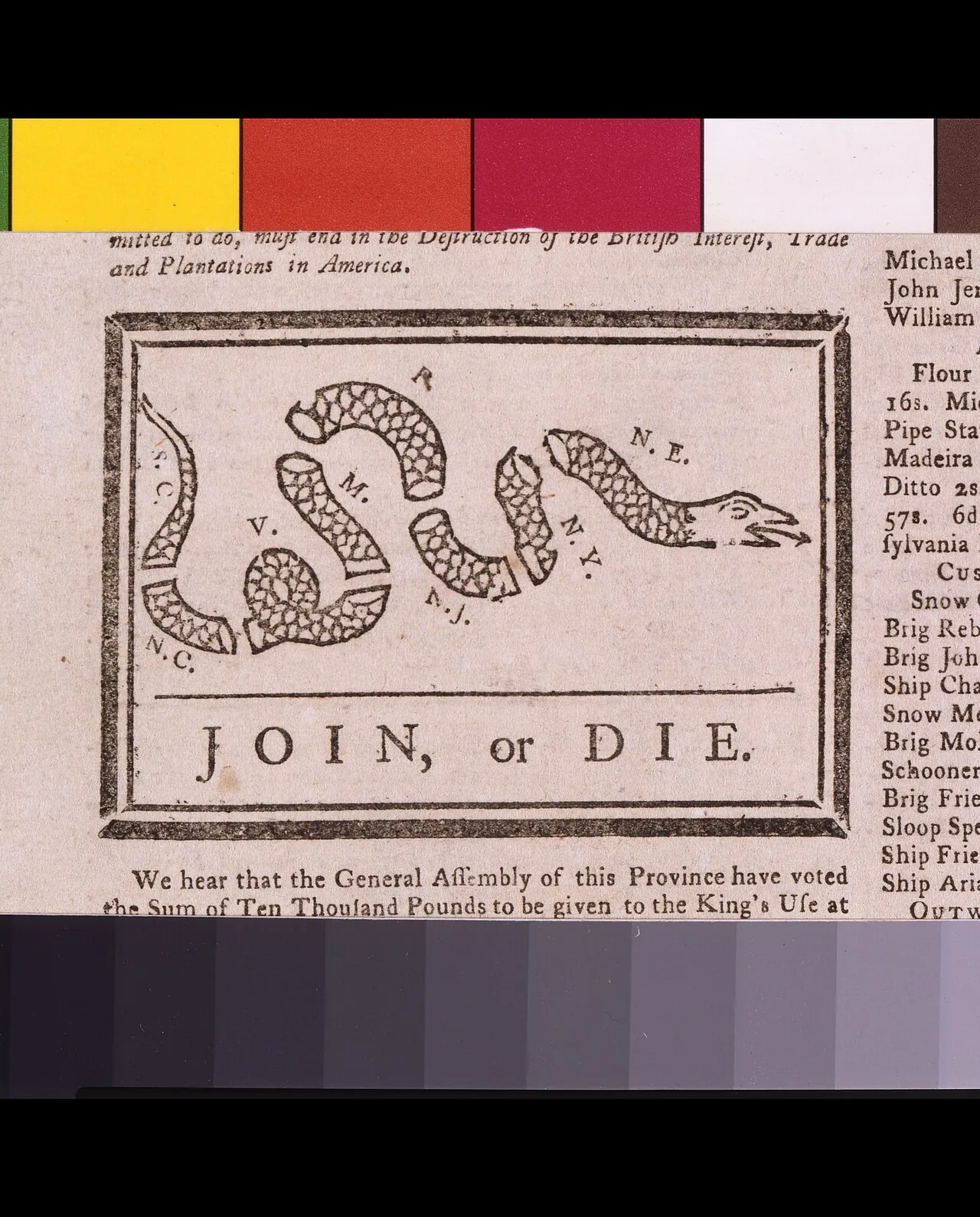
Source: Pennsylvania Gazette, May 9, 1754, Library of Congress.
- Present the document (nature, author, date, context).
- Describe what you see. What do the parts of the snake represent?
- What message does the cartoon send? Why did Franklin choose a snake?
- Why do you think colonists used this cartoon again in the 1760s and 1770s?
Exercise 11 : The Boston Massacre in print
Document 12 – Paul Revere’s engraving, 1770
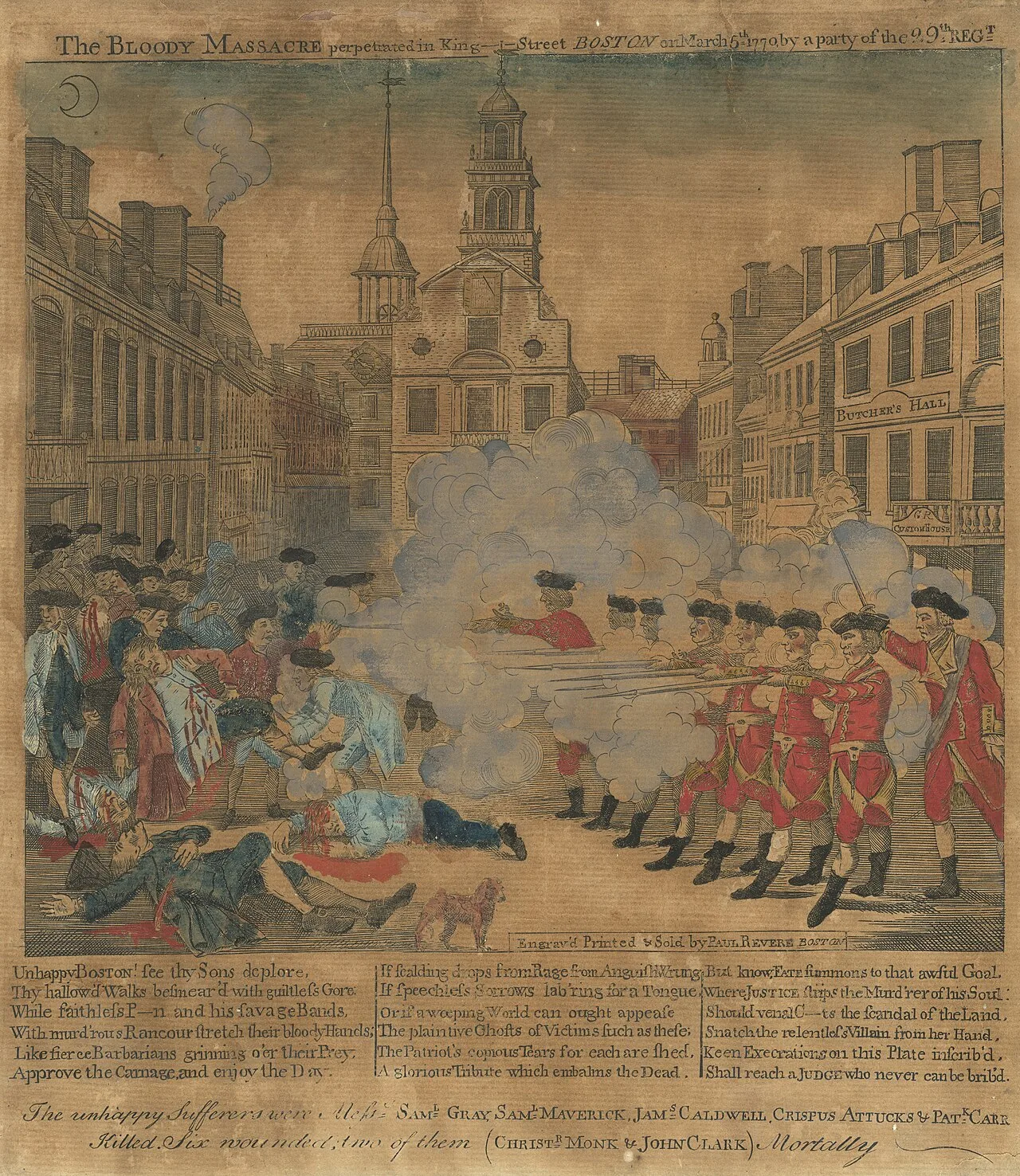
Source: National Gallery of Art, Washington.
- Present the document (nature, artist, date).
- Describe the positions of the soldiers and the crowd.
- Identify two details that favor the colonists’ side.
- Why is the print more useful as evidence of colonial opinion than as an accurate record of what happened?
Exercise 12 : The tea in the harbor
Document 13 – The Destruction of Tea at Boston Harbor
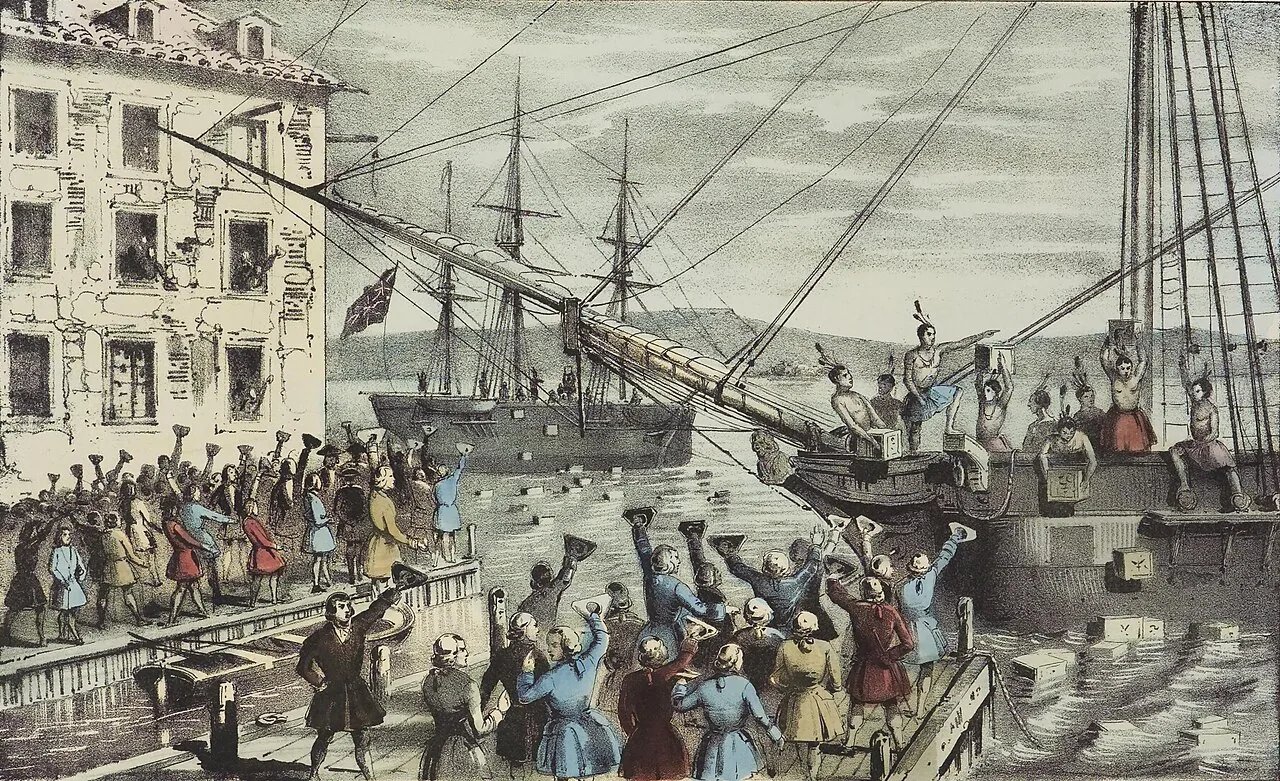
Source: Nathaniel Currier, 1846.
- Present the document (nature, artist, date).
- Describe the people and actions in the picture.
- The picture was made in 1846. How does the date affect its use as evidence?
- Some colonists, including Benjamin Franklin, thought the destruction of the tea was wrong and offered to pay for it. Explain why people disagreed about the action.
Exercise 13 : A law posted for all to read
Document 14 – Bostonians read the Stamp Act
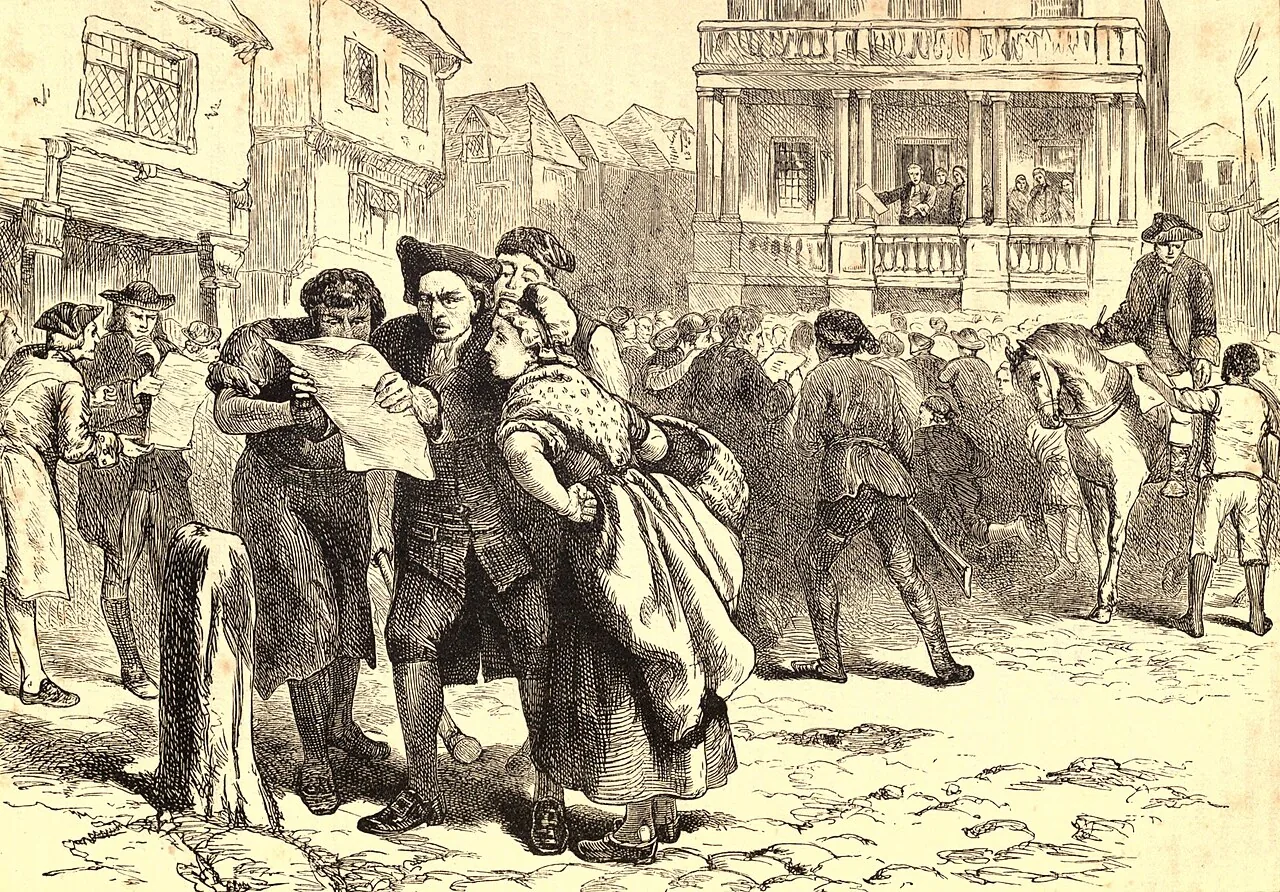
Source: nineteenth-century engraving, artist unknown.
- Present the document (nature, subject, date shown).
- Describe the faces and gestures of the people.
- Using the lesson, explain why the Stamp Act affected so many different people.
- Why is it important that the artist made this long after 1765?
Exercise 14 : Numbers on the road to revolution
Document 15 – Some numbers, 1763-1774
| Date | Event | Number |
|---|---|---|
| 1763 | British national debt at the end of the French and Indian War | about 130 million pounds (almost double the prewar debt) |
| 1764 | Sugar Act: duty on molasses per gallon | cut from 6 pence to 3 pence |
| 1765 | Stamp Act Congress | 27 delegates from 9 colonies |
| 1770 | Boston Massacre | 5 colonists killed |
| 1773 | Boston Tea Party | 342 chests of tea destroyed (about 46 tons) |
| 1774 | First Continental Congress | 56 delegates from 12 colonies |
Source: standard references (Library of Congress; Massachusetts Historical Society). Debt figures are approximate.
- By how many pence did the Sugar Act cut the molasses duty? By what fraction?
- How many more colonies were represented in 1774 than in 1765?
- Why was the large debt important in explaining British policy after 1763?
- The Sugar Act lowered a tax. Why, then, did colonists still complain?
Exercise 15 : Map 1: Places of the crisis
Use the map to answer the questions.
- Match each number with a place: Boston, Philadelphia, Quebec, Fort Duquesne, and Williamsburg.
- The dashed line is the Proclamation Line. On which side of it are places 1, 2, and 5? On which side is place 4?
- Which letter marks the Indian Reserve, and which marks the territory of Spanish Louisiana?
- Why might the French and Indian War have started at the place marked 4?
Exercise 16 : Map 2: North America after the war
Use the map to answer the questions.
- Which country gained Quebec, and which gained Florida in 1763?
- Which power controlled the land west of the Mississippi?
- Give two reasons why settlers wanted to cross the dashed line.
- What does the map suggest about why Britain wanted to control settlement in the Indian Reserve?
Exercise 17 : Put the events in order
Put these events in order from earliest to latest, and write the date next to each one: (a) Boston Tea Party; (b) Treaty of Paris ends the French and Indian War; (c) Stamp Act; (d) Boston Massacre; (e) Common Sense is published; (f) First Continental Congress meets; (g) Join, or Die cartoon appears.
Exercise 18 : How long between events?
Calculate each interval.
- From the Treaty of Paris (1763) to the Boston Tea Party (1773).
- From the Stamp Act (1765) to its repeal (1766).
- From the Boston Massacre (1770) to the first fighting at Lexington and Concord (1775).
- From the beginning of the French and Indian War (1754) to Common Sense (1776).
Exercise 19 : Guided research: the Boston Massacre trial
Mini-investigation: why did the British soldiers get a fair trial in Boston?
- Search for: “Boston Massacre trial John Adams,” “Captain Thomas Preston verdict,” “Massachusetts Historical Society Boston Massacre.” Reliable sites: the Massachusetts Historical Society, the National Archives, and the Library of Congress.
- Fill in a card: Who defended the soldiers? Who was found guilty, and of what? What was their punishment?
- Why did Adams agree to defend the soldiers, even though he was a Patriot?
- Write three sentences about what the trial shows about the rule of law.
Exercise 20 : CER paragraph: was the Tea Party justified?
Write a paragraph using the Claim-Evidence-Reasoning model.
Question: Was the destruction of the tea at Boston a justified protest? Take a position.
- State a claim.
- Give at least two pieces of evidence from the lesson or documents.
- Explain how your evidence supports your claim.
Coup de pouce: weigh the principle of “no taxation without representation” against the destruction of private property.
Exercise 21 : SAQ: the Proclamation of 1763
Answer in complete sentences.
- Identify one reason the British government issued the Proclamation of 1763.
- Explain one reason that many colonists opposed it.
- Describe one effect of the Proclamation on relations between Britain and the colonies.
Exercise 22 : True or false? Justify
Decide whether each statement is true or false. If it is false, correct it.
- The Stamp Act was the first direct tax that Parliament placed on the colonists.
- The Declaratory Act repealed the Stamp Act.
- The Boston Tea Party took place in 1773.
- The First Continental Congress asked for independence in 1774.
- Every colony sent delegates to the First Continental Congress.
Exercise 23 : Causes and consequences: from Stamp Act to repeal
Complete the chain, then answer the question.
Cause: the war debt → Event: the Stamp Act, 1765 → Reaction: ? → Consequence: ?
- Name two forms of colonial protest against the Stamp Act.
- Explain why the boycott helped to bring about the repeal.
- Explain how the Declaratory Act kept the dispute alive.


Quick review: flashcards
Tap a card to see the answer.