


This Grade 8 US History to 1877 lesson covers Causes of the American Revolution, part of the unit “Colonies to nation.” First, read the full lesson with its primary sources, maps and key terms. Then practice with the worksheet, check yourself with the quiz and get ready with the test.
On the evening of March 5, 1770, a crowd gathered in front of the Customs House in King Street, Boston. It was cold, snow lay on the ground, and the town had been angry for a long time. Since 1768, British soldiers had camped in a city of about 16,000 people. Someone threw snowballs and insults at a sentry; more soldiers came; shots rang out.
When the smoke cleared, three men lay dead and two more would soon die. Within weeks the silversmith Paul Revere had printed a picture of the scene, and shops sold it in every colony. The shooting did not itself cause a revolution. However, it showed how far trust between Britain and its colonies had fallen only seven years after the greatest British victory of the century.
Guiding question: Why did a war that the colonists helped Britain win lead, within twelve years, to a colonial rebellion against British rule?
1. A victory that carried a bill, 1754-1765
The French and Indian War
By the 1750s, Britain and France both claimed the land west of the Appalachian Mountains, in the valley of the Ohio River. In 1754 a young Virginia officer named George Washington led a small force to the Ohio country. There he had to surrender at Fort Necessity. That clash began the French and Indian War (1754-1763), a part of a larger global conflict known in Europe as the Seven Years’ War. Most Native nations in the region sided with France, which wanted their trade and land less than the British did.
However, the Iroquois League stayed mostly neutral. In 1754 Benjamin Franklin published a cartoon showing a snake cut in pieces with the words “Join, or Die.” It urged the colonies to unite against the French. Delegates from seven colonies met at Albany that summer and approved Franklin’s plan for a union. But no colony’s legislature would accept it. The colonies, jealous of one another, did not yet think of themselves as one people.
Document 1 – Join, or Die, 1754
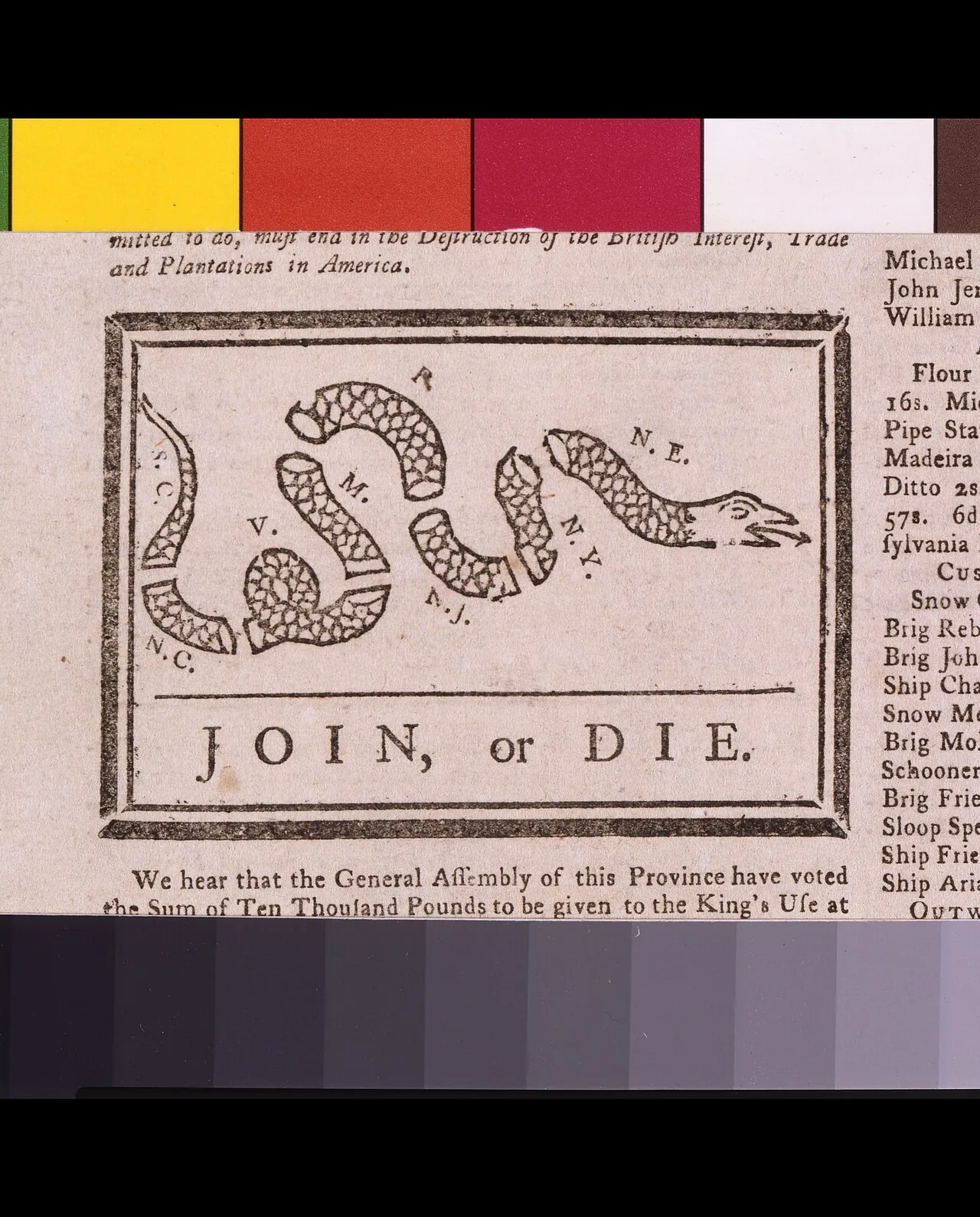
Source: Benjamin Franklin, Pennsylvania Gazette, May 9, 1754, Library of Congress (image on Wikimedia Commons).
The snake was a familiar warning that a divided body dies. Franklin drew it to persuade the colonies to unite against the French and their Native allies. Twenty years later, colonists revived the cartoon in their protests against Britain, and it became a symbol of the Revolution.
The war went badly for Britain at first. In 1755 the French near Fort Duquesne, where Pittsburgh now stands, destroyed an army under General Edward Braddock. Then William Pitt, the British leader, sent money and troops in great numbers. British forces captured the fortress of Louisbourg in 1758. In September 1759 they defeated the French on the Plains of Abraham outside Quebec City. Both commanders, Wolfe and Montcalm, died there. Montreal fell in 1760.
By the Treaty of Paris of February 10, 1763, France gave Canada and almost all of its land east of the Mississippi River to Britain. Spain, which had lost Florida to the British, received Louisiana, west of the river, from France. For the American colonists, the French threat had disappeared. For Britain, the cost was enormous. Its national debt had almost doubled, from about 75 million pounds before the war to about 130 million pounds in 1763 (approximate figures).
The Proclamation of 1763
Soon after peace, Native nations led by the Ottawa leader Pontiac attacked British forts in the Great Lakes and Ohio country. After the war, the British government decided that settlers pushing west caused too many conflicts. It also decided that it would need a standing army in America, some 10,000 soldiers, to keep order. On October 7, 1763, King George III issued the Proclamation of 1763. It drew a line along the crest of the Appalachians and reserved the land to the west for Native peoples. Colonial governors could not grant lands there, and the king ordered settlers to leave.
Document 2 – The Proclamation of 1763
And whereas it is just and reasonable, and essential to our Interest, and the Security of our Colonies, that the several Nations or Tribes of Indians with whom We are connected, and who live under our Protection, should not be molested or disturbed in the Possession of such Parts of Our Dominions and Territories as, not having been ceded to or purchased by Us, are reserved to them. or any of them, as their Hunting Grounds.
Source: King George III, Royal Proclamation, October 7, 1763 (the Proclamation of 1763); text from the Avalon Project, Yale Law School. Punctuation as in the Avalon text.
*Pleasure: command. *Patents, Warrants of Survey: legal papers granting land.
Commentary. The Proclamation presents the line as a favor to the Native peoples, who were “not to be molested or disturbed.” Britain’s real aims were to avoid expensive wars and to control land sales. Colonists such as George Washington had hoped to claim land in the Ohio country. They saw the line as a betrayal after a war in which they had fought and bled. In practice the line was impossible to enforce, and thousands of settlers crossed it. Still, the Proclamation was among the first British decisions that colonists felt Britain had made without their voice.
Definition: Proclamation Line
the boundary drawn by the Proclamation of 1763 along the Appalachian Mountains. Settlers were forbidden to buy or settle land west of it, which was reserved for Native nations.
2. Taxes, protest, and troops, 1764-1770
To pay the war debt and the cost of defending the colonies, Parliament decided that the colonists should pay a larger share. Colonists had paid few taxes directly to Britain. In 1764 the Sugar Act lowered the duty on imported molasses from six pence to three pence per gallon but promised to enforce it strictly. It also set up courts without juries to try smugglers.
The next year Parliament passed the Stamp Act (March 22, 1765). It required a tax stamp on newspapers, legal papers, licenses, pamphlets, and even playing cards. Parliament had never before laid a direct tax on the colonists. Parliament believed it was acting fairly. British taxes were far higher at home, and the money would pay for the soldiers who defended America.
Definition: representation
the idea that people should have elected delegates who speak for them in the government that rules them. Colonists said that, since they elected no one to Parliament, Parliament could not tax them: “no taxation without representation.”
Colonists replied that the issue was not the size of the tax but who had the right to impose it. They had no members in Parliament, and British leaders answered that Parliament spoke for all subjects through “virtual representation.” Colonists rejected this. The reaction was swift. In Virginia, Patrick Henry offered resolutions against the Act in May 1765.
In Boston, a crowd led by a group calling itself the Sons of Liberty hung an effigy of a stamp agent. The crowd destroyed the house of Lieutenant Governor Thomas Hutchinson in August. That October, delegates from nine colonies met in New York in the Stamp Act Congress. It was the first time many colonies acted together, and it issued a list of rights. Merchants agreed to boycott British goods, which hurt English trade.
Document 3 – The Stamp Act Congress, 1765
That it is inseparably essential to the freedom of a people, and the undoubted right of Englishmen, that no taxes be imposed on them, but with their own consent, given personally, or by their representatives. That the people of these colonies are not, and from their local circumstances cannot be, represented in the House of Commons in Great-Britain. That the only representatives of the people of these colonies, are persons chosen therein by themselves, and that no taxes ever have been, or can be constitutionally imposed on them, but by their respective legislatures.
Source: Resolutions of the Stamp Act Congress, New York, October 19, 1765 (resolutions 3 to 5); text from the Avalon Project, Yale Law School.
*Englishmen: here, all British subjects. *supplies: money voted by a legislature.
Commentary. The delegates did not demand independence. They called themselves loyal subjects and accepted “due subordination” to Parliament in other matters. What they insisted on was a principle: that no one could take their property without their consent, given “personally, or by their representatives.” The colonies had their own elected assemblies, and none had members in the House of Commons. Therefore they argued that only those assemblies could tax them.
Document 4 – Reading the Stamp Act
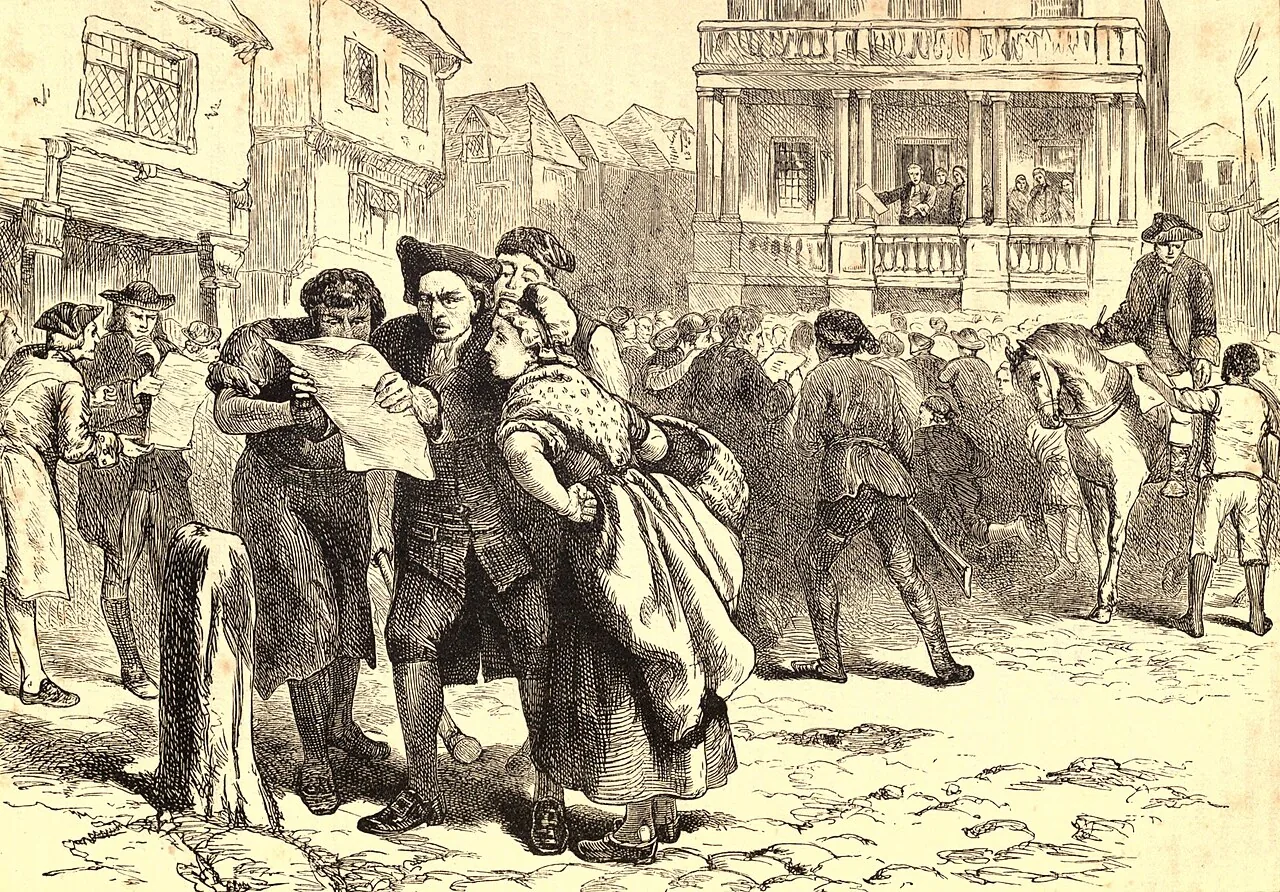
Source: engraving, 1800s, artist unknown (image on Wikimedia Commons).
The picture shows ordinary Bostonians gathered around a posted copy of the law, worried and angry. The Stamp Act touched many people at once: printers, lawyers, merchants, and anyone who bought a newspaper or signed a contract. That helps explain why the protest was so broad.
The boycott worked. In March 1766 Parliament repealed the Stamp Act, to great celebration in the colonies. But on the same day, it passed the Declaratory Act, to make plain that Parliament held power over the colonies.
Document 5 – The Declaratory Act, 1766
That the said colonies and plantations in America have been, are, and of right ought to be, subordinate unto, and dependent upon the imperial crown and parliament of Great Britain; […] to bind the colonies and people of America, subjects of the crown of Great Britain, in all cases whatsoever
Source: The Declaratory Act, Parliament of Great Britain, March 18, 1766; text from the Avalon Project, Yale Law School. Parts of the law are omitted.
*plantations: colonies. *subordinate: lower in rank, under the authority of.
Commentary. The Act states that the colonies are “subordinate unto, and dependent upon” Parliament, which could make laws “in all cases whatsoever.” Supporters in London saw it as simply stating the law. Many colonists did not pay attention to this statement at first. However, it showed that the two sides disagreed about the nature of the empire, and the argument would grow harder.
In 1767 Parliament tried again, with the Townshend Acts, which put duties on glass, lead, paint, paper, and tea imported into the colonies. Colonists said this too was a tax dressed up as a trade duty. John Dickinson of Pennsylvania wrote a series of widely read essays, Letters from a Farmer in Pennsylvania (1767-1768). They argued that Parliament could regulate trade but not tax for revenue. Boycotts began again. In 1768 Britain sent troops to Boston to protect customs officers.
Living together in a small town, soldiers and townspeople quarreled and fought. On March 5, 1770, a crowd confronted a squad of soldiers, who fired. The soldiers killed five colonists, among them Crispus Attucks, a man of African and Native descent. A Boston court tried the soldiers, and the Patriot lawyer John Adams defended them. The court found all but two not guilty, and it branded the two convicted of manslaughter on the thumb. Parliament repealed most of the Townshend duties in April 1770 but kept the duty on tea.
Document 6 – The Boston Massacre in a print
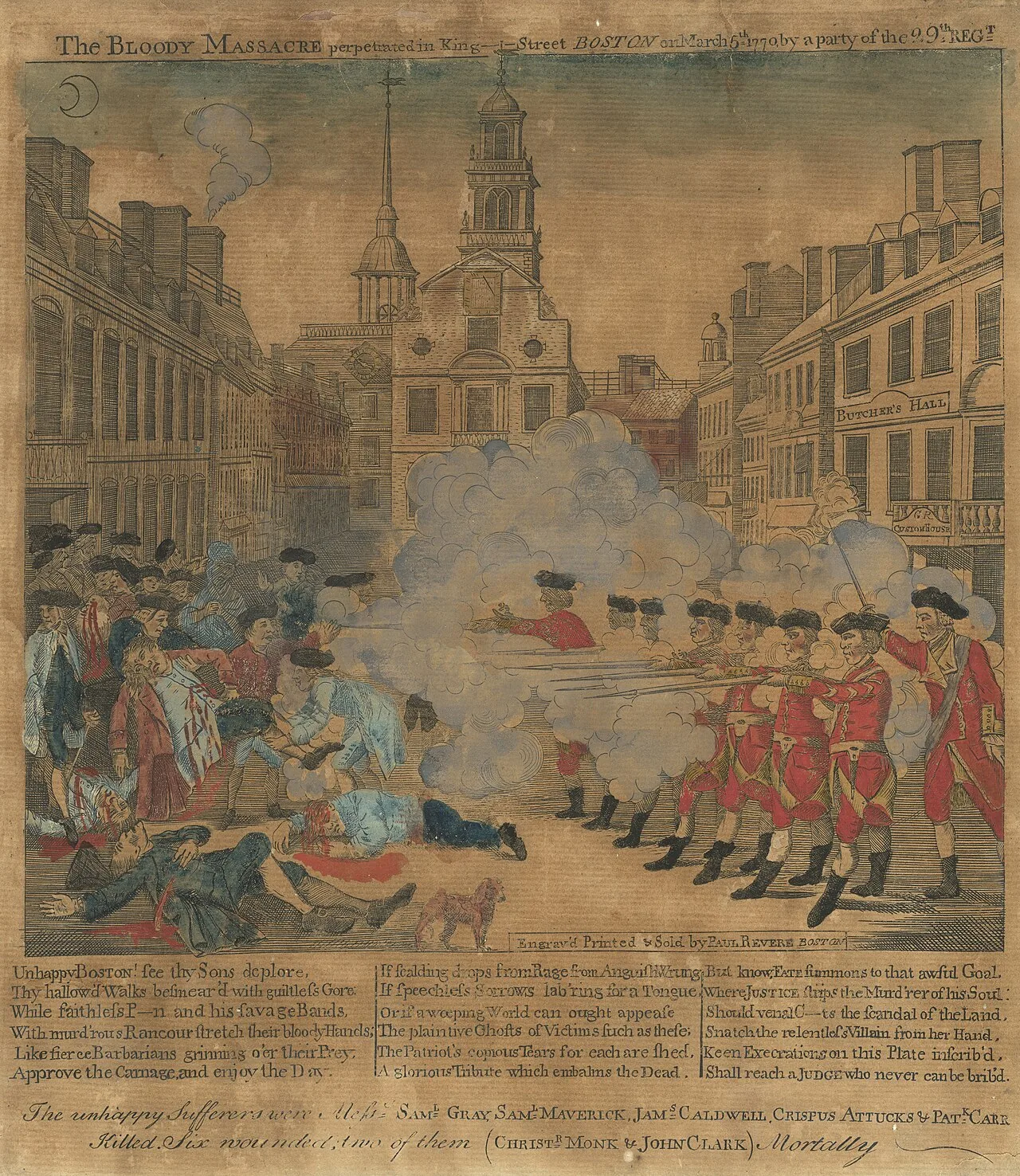
Source: Paul Revere, 1770, after Henry Pelham, National Gallery of Art (image on Wikimedia Commons).
Revere’s print shows the soldiers standing in a neat line and firing on a calm and unarmed crowd. An officer raises a sword to give the order. The artist placed a sign “Butcher’s Hall” on the Customs House. Evidence from the trials suggests the scene was more confused, with an angry crowd and a lone sentry in danger. The print was propaganda, and printers copied it widely.
3. From tea to rebellion, 1773-1776
For three years there was a calm. Then in 1773 Parliament passed the Tea Act to rescue the East India Company, which held about 17 million pounds of unsold tea. The act allowed the Company to sell tea in America at a low price, below even the price of smuggled Dutch tea. At the same time, it kept the Townshend duty.
Colonists saw a trick: if they bought the cheap tea, they would be accepting Parliament’s right to tax them. In Boston, the governor refused to let three tea ships leave without unloading. On the night of December 16, 1773, about 100 men, some in disguise as Mohawk, boarded the ships. They dumped 342 chests of tea into the harbor, about 46 tons.
Document 7 – The Destruction of Tea at Boston Harbor
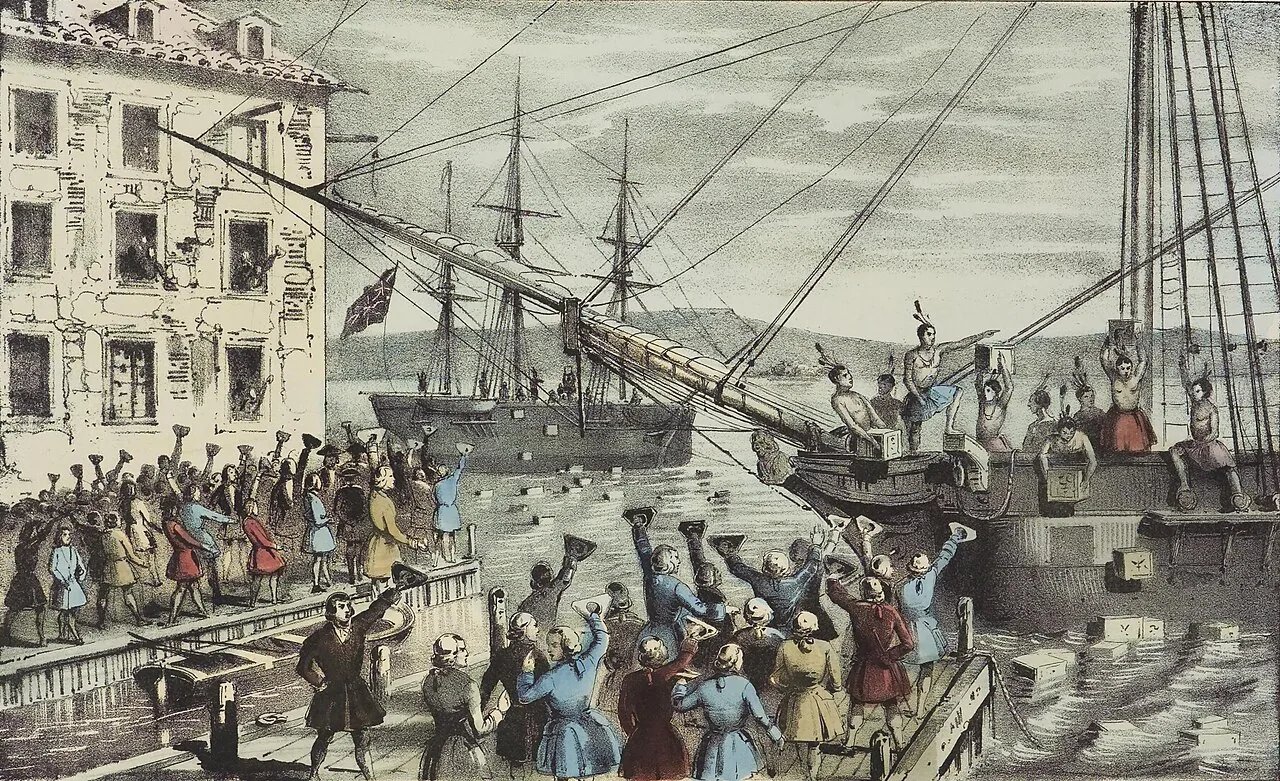
Source: Nathaniel Currier, 1846, lithograph (image on Wikimedia Commons).
Currier made this picture long after the event; the name “Boston Tea Party” came into use only in the 1830s. Notice the crowd on the wharf waving hats, which gives the scene a festive air. The protesters took care to damage nothing but the tea. This was their way of showing that they were acting for a principle, not for plunder.
Parliament responded in 1774 with four laws that colonists called the Intolerable Acts. The Boston Port Act closed the harbor until Boston paid for the tea. The Massachusetts Government Act put most of the colony’s offices under the king’s control and limited town meetings. Another law allowed British officials accused of crimes to stand trial in England. A new Quartering Act let officers house soldiers in occupied buildings. The same year the Quebec Act extended the province of Quebec to the Ohio River. Many colonists saw this as another blow to their western hopes. General Thomas Gage, commander of the army, became governor of Massachusetts.
Document 8 – The Boston Port Act, 1774
WHEREAS dangerous commotions and insurrections have been fomented and raised in the town of Boston, in the province of Massachusets Bay, in New England, by divers ill-affected persons, to the subversion of his Majestys government, and to the utter destruction of the publick peace, and good order of the said town; in which commotions and insurrections certain valuable cargoes of teas, being the property of the East India Company, and on board certain vessels lying within the bay or harbour of Boston, were seized and destroyed: And whereas, in the present condition of the said town and harbour, the commerce of his Majestys subjects cannot be safely carried on there, nor the customs payable to his Majesty duly collected;
Source: The Boston Port Act, Parliament of Great Britain, March 31, 1774 (opening paragraph); text from the Avalon Project, Yale Law School. Spelling of the original.
*divers: various. *fomented: stirred up. *customs: taxes on imported goods.
Commentary. The Act blames “ill-affected persons” for the destruction of the tea and punishes the whole town. In the eyes of other colonists, this was an attack on every colony. If Parliament could shut down Boston’s commerce without a trial, it could do so to any town. Money, food, and supplies flowed to Boston from the other colonies.
In September 1774 fifty-six delegates from twelve colonies (all but Georgia) met in Philadelphia as the First Continental Congress. They approved a boycott of British goods and sent a list of rights to the king. But they did not ask for independence. In March 1775 Patrick Henry urged the Virginia Convention to prepare for war. His words, as his biographer later recorded them, ended with the line that later schoolchildren memorized. Fighting began a month later, on April 19, 1775, at Lexington and Concord, Massachusetts.
Document 9 – Patrick Henry, March 1775
Our chains are forged! Their clanking may be heard on the plains of Boston! The war is inevitable–and let it come! I repeat it, sir, let it come. It is in vain, sir, to extenuate the matter. Gentlemen may cry, Peace, Peace– but there is no peace. The war is actually begun! The next gale that sweeps from the north will bring to our ears the clash of resounding arms! Our brethren are already in the field! Why stand we here idle? What is it that gentlemen wish? What would they have? Is life so dear, or peace so sweet, as to be purchased at the price of chains and slavery? Forbid it, Almighty God! I know not what course others may take; but as for me, give me liberty or give me death!
Source: Patrick Henry, speech to the Virginia Convention, Richmond, March 23, 1775. No one wrote down his words on the day: the text comes from the biographer William Wirt (1817), who built it from the memories of people who heard it. Avalon Project.
*extenuate: make seem less serious. *brethren: brothers, fellow colonists.
Commentary. The speech is famous, but historians treat it with care. There is no record of the words from 1775. The biographer wrote the text down forty-two years later, so the polished phrases may be his. Even so, the speech tells us something real about the mood in Virginia in 1775: for many colonists the time for petitions was over.
Definition: boycott
a refusal to buy or use certain goods as a form of protest. Colonial merchants and consumers used boycotts of British goods to pressure Parliament without using force.
Patriots and Loyalists
Colonists did not all take the same side. Patriots supported resistance. Loyalists, perhaps one in five white colonists, remained loyal to Britain, some from conviction and some from fear of disorder. Many others tried to stay out of it. What moved many people toward independence was not a single law but a growing sense that Britain would not respect the colonists’ rights.
In January 1776, Thomas Paine, an English-born writer who had arrived in Philadelphia only a year before, published Common Sense. This pamphlet attacked monarchy itself and urged Americans to form their own government. It sold an estimated 100,000 copies or more within the year, an enormous number for the time. By the spring of 1776 the colonies were at war. The question was no longer whether to resist but whether to separate.
- 1754 The French and Indian War begins; Franklin’s Join, or Die cartoon appears.
- 1763 The Treaty of Paris ends the war; the Proclamation Line is issued.
- 1765 The Stamp Act is passed; the Stamp Act Congress meets.
- 1770 Boston Massacre: five colonists are killed.
- 1773 The Boston Tea Party, December 16.
- 1774 The Intolerable Acts; the First Continental Congress meets.
- 1775 Fighting begins at Lexington and Concord, April 19.
- 1776 Thomas Paine publishes Common Sense.
Key takeaways
- The French and Indian War (1754-1763) removed France from North America but left Britain with a huge debt and new territory to govern.
- The Proclamation of 1763 closed the land west of the Appalachians to settlers and angered colonists.
- Parliament’s taxes (Sugar Act, Stamp Act, Townshend duties, Tea Act) raised a question of principle: no taxation without representation.
- Colonists resisted by boycotts, petitions, and protests, and acted together in the Stamp Act Congress and the First Continental Congress.
- The Boston Massacre (1770) and the Boston Tea Party (1773) led to the Intolerable Acts of 1774.
- By 1776, Common Sense had turned many colonists from resistance to independence.

Quick review: flashcards
Tap a card to see the answer.