


This Grade 8 US History to 1877 lesson covers The Revolutionary War, part of the unit “Colonies to nation.” First, read the full lesson with its primary sources, maps and key terms. Then practice with the worksheet, check yourself with the quiz and get ready with the test.
On the night of April 18, 1775, lanterns glowed in the steeple of the Old North Church in Boston. Paul Revere and William Dawes then rode out through the countryside to warn that British troops were on the march. At dawn the next day, about seventy Massachusetts militiamen faced several hundred British regulars on the green at Lexington.
They were called minutemen because they were ready to turn out at a minute’s notice. A shot rang out, no one knows from which side, and eight colonists died. By nightfall, the British column had marched to Concord and searched for hidden military supplies. Then it fought its way back to Boston under fire from men hiding behind walls and trees. The war had begun, and it would last more than eight years.
Guiding question: How did the colonies, which had no regular army, no treasury, and no central government, defeat the strongest empire in the world and win recognition as an independent nation?
1. From Lexington to independence, 1775-1776
After Lexington and Concord, thousands of militiamen from across New England surrounded the British army in Boston. In May 1775, the Second Continental Congress met in Philadelphia and took charge of the war. In June it created the Continental Army and chose George Washington of Virginia as its commander. It chose him partly because he was a respected soldier and partly to bring the southern colonies into a war that had begun in New England.
On June 17, 1775, British troops stormed Breed’s Hill, next to Bunker Hill, outside Boston. They took the hill, but at a cost of more than 1,000 casualties, about twice the American losses. The Americans proved that they could stand against regulars. In March 1776, Washington forced the British out of Boston by placing cannon on Dorchester Heights. Henry Knox had brought the cannon from captured Fort Ticonderoga. General William Howe then sailed away with his army and about 1,000 Loyalists.
The road to independence
Even then, most colonists still hoped to stay in the empire. In July 1775 Congress sent the king the Olive Branch Petition. But George III refused to read it and declared the colonies in rebellion. In 1776 attitudes changed fast. Thomas Paine’s Common Sense argued for independence. In the spring one colony after another told its delegates to vote for it.
On June 7 Richard Henry Lee of Virginia proposed that “these United Colonies are, and of right ought to be, free and independent States.” Congress appointed a committee of five to write a statement of the reasons. The members were John Adams, Benjamin Franklin, Thomas Jefferson, Roger Sherman, and Robert Livingston. Jefferson, a 33-year-old Virginian known for his writing, wrote most of the draft in Philadelphia. On July 2 Congress voted for independence. On July 4 it approved the final wording of the Declaration of Independence.
Definition: natural rights
the idea, drawn from Enlightenment thinkers such as John Locke, that all people are born with rights, such as life and liberty, that no government may take away. The Declaration of Independence bases its claims on natural rights.
Principles and grievances
The Declaration has three parts: a statement of principles, a long list of grievances against the king, and the announcement of independence. The first part is the one Americans remember. It says that all men are created equal and that governments get their power from the consent of the governed. The second part lists specific complaints, such as keeping armies among the people, taxing them without their consent, and cutting off trade.
Document 1 – The Declaration of Independence, 1776
We hold these truths to be self-evident: That all men are created equal; that they are endowed by their Creator with certain unalienable rights; that among these are life, liberty, and the pursuit of happiness; that, to secure these rights, governments are instituted among men, deriving their just powers from the consent of the governed; that whenever any form of government becomes destructive of these ends, it is the right of the people to alter or to abolish it, and to institute new government, laying its foundation on such principles, and organizing its powers in such form, as to them shall seem most likely to effect their safety and happiness.
Source: The Declaration of Independence, adopted by the Continental Congress, July 4, 1776 (second paragraph); text from the Avalon Project, Yale Law School.
*unalienable: that cannot be taken away. *instituted: set up.
Commentary. These sentences make an argument. People have rights, governments exist to protect them, and when a government destroys those rights the people may replace it. Jefferson wrote these words in a country where about one-fifth of the people lived in slavery. Congress cut from his draft a passage that blamed the king for the slave trade. The same sentence did not apply, in practice, to women, Native Americans, or enslaved people. Later reformers, such as Frederick Douglass and the women at Seneca Falls, used its language. They demanded that Americans live up to it.
Document 2 – The Declaration in a painting
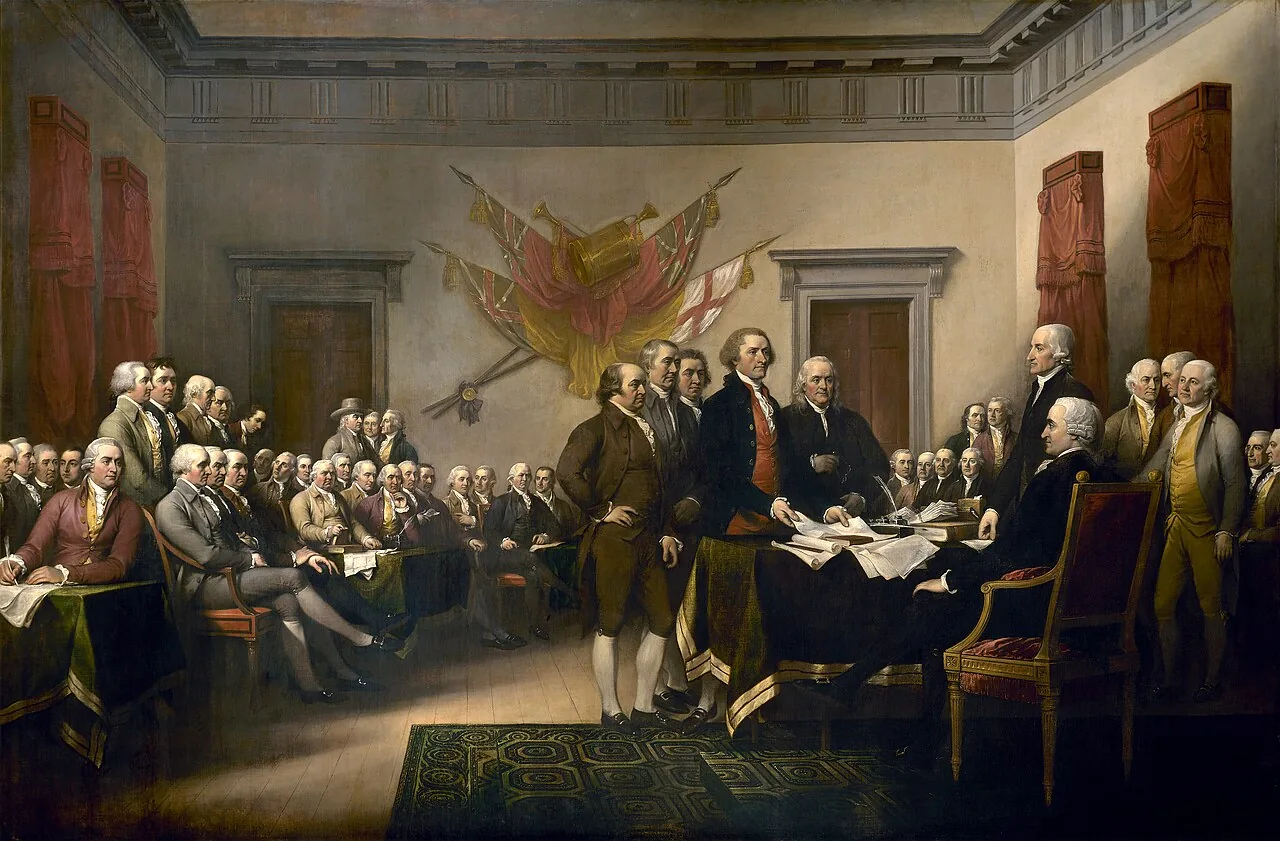
Source: John Trumbull, 1819, U.S. Capitol (image on Wikimedia Commons).
Trumbull, a former aide of Washington, painted this scene decades later. It does not show the signing; it shows the committee presenting its draft in June. The delegates were never all in the room at the same time. Therefore the picture is a tribute to the Founders, not a snapshot. Trumbull took trouble to paint real faces, and he visited many of the men to sketch them.
2. The war in the North, 1776-1778
Britain now sent its largest force ever across the Atlantic. In the summer of 1776, General William Howe landed about 30,000 men on Staten Island. They included thousands of German soldiers hired from their princes, called Hessians. He defeated Washington at the Battle of Long Island in August and drove him out of New York City. By December the Continental Army had dwindled to a few thousand tired men who retreated across New Jersey and the Delaware River. Moreover, many enlistments were about to expire. The Revolution seemed about to collapse.
Definition: Hessians
German soldiers hired by the British government from German princes, mostly from the state of Hesse, to fight in America. About 30,000 served in the war.
Document 3 – Thomas Paine, December 1776
THESE are the times that try men’s souls. The summer soldier and the sunshine patriot will, in this crisis, shrink from the service of their country; but he that stands by it now, deserves the love and thanks of man and woman. Tyranny, like hell, is not easily conquered; yet we have this consolation with us, that the harder the conflict, the more glorious the triumph. What we obtain too cheap, we esteem too lightly: it is dearness only that gives every thing its value. Heaven knows how to put a proper price upon its goods; and it would be strange indeed if so celestial an article as FREEDOM should not be highly rated.
Source: Thomas Paine, The American Crisis, no. 1, December 23, 1776 (opening paragraph); text from ushistory.org.
*summer soldier: a soldier who serves only in easy times. *sunshine patriot: someone loyal only in good times.
Commentary. Paine wrote The American Crisis while he was marching with the army in retreat. Washington had it read to the troops. The phrases “summer soldier” and “sunshine patriot” speak to men who were thinking of going home. Paine does not hide the danger; he argues that freedom is worth a high price.
On the night of December 25-26, 1776, Washington led about 2,400 men across the ice-choked Delaware River in a storm. He marched them nine miles to Trenton, New Jersey, and surprised a garrison of Hessians, capturing more than 900. A week later he won again at Princeton. These small victories restored hope and revived enlistments.
Document 4 – Washington crossing the Delaware
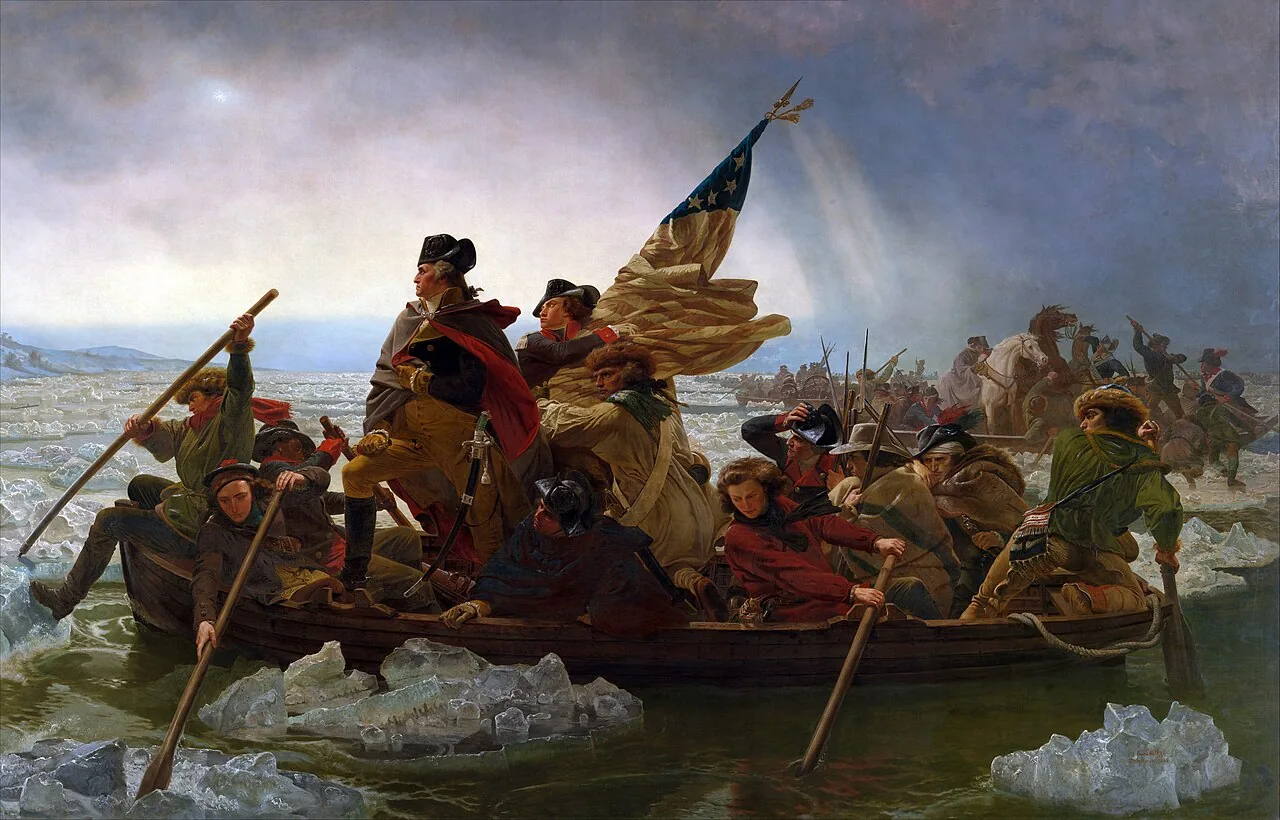
Source: Emanuel Leutze, 1851, Metropolitan Museum of Art (image on Wikimedia Commons).
A German-born American painted this picture in Germany in 1851. He wanted to inspire the democratic revolutions of 1848 in Europe. It contains errors. The real crossing was at night. The boats were long, low river boats, and the men would not have stood in that way. Congress did not adopt the flag shown, the Stars and Stripes, until June 1777. It is a powerful example of how Americans later imagined the war.
Saratoga and the French alliance
The turning point came in 1777. British General John Burgoyne led an army south from Canada toward Albany. However, American forces under Horatio Gates and Benedict Arnold stopped him. On October 17, 1777, he surrendered about 5,700 men at Saratoga, New York. The victory convinced France, which had been secretly sending supplies, that the Americans could win. In February 1778 France signed a treaty of alliance with the United States. French money, ships, and soldiers would prove decisive. Spain and the Netherlands also joined the war against Britain, turning a colonial rebellion into a world war.
Definition: alliance
a formal agreement between nations to help one another, especially in war. The French alliance of 1778 gave the United States an army, a navy, and loans it could not have obtained alone.
While the Americans were beating Burgoyne, Howe took Philadelphia, the American capital, in September 1777. Washington’s army spent the winter of 1777-1778 at Valley Forge, Pennsylvania. About 12,000 men suffered there from cold, hunger, and disease, and about 2,000 died. A Prussian-born officer, Baron von Steuben, trained them in drill and discipline. As a result, by spring they were a more professional army.
3. Who fought, and what was at stake
The war divided Americans. Patriots supported independence; Loyalists, who may have been about one in five white colonists, stayed with Britain. Some Loyalists raised troops. Patriots attacked others, took their property, or drove them out. When the war ended, roughly 60,000 or more Loyalists left the United States for Canada, Britain, and the Caribbean. The fighting in the Carolinas and Georgia was especially bitter, a civil war between neighbors.
African Americans took part on both sides. Probably about 5,000 Black men served in the Continental forces. They included the 1st Rhode Island Regiment, which consisted largely of formerly enslaved men promised freedom for service. The British also offered freedom to enslaved people of Patriot owners. In November 1775 Virginia’s royal governor, Lord Dunmore, issued a proclamation freeing enslaved people who joined the royal forces. Hundreds joined and thousands fled to British lines during the war, and some later left for Nova Scotia and Britain. The British made the offer for military reasons, and neither side freed most enslaved people in the colonies.
Document 5 – Lord Dunmore’s Proclamation, 1775
I do require every Person capable of bearing Arms, to resort to His Majesty’s STANDARD, or be looked upon as Traitors to His Majesty’s Crown and Government, and thereby become liable to the Penalty the Law inflicts upon such Offences; such as forfeiture of Life, confiscation of Lands, &c. &c. And I do hereby further declare all indented Servants, Negroes, or others, (appertaining to Rebels,) free that are able and willing to bear Arms, they joining His Majesty’s Troops as soon as may be, for the more speedily reducing this Colony to a proper Sense of their Duty, to His Majesty’s Crown and Dignity.
Source: John Murray, Earl of Dunmore, royal governor of Virginia, Proclamation, aboard the ship William off Norfolk, November 7, 1775; text from Wikisource.
*indented Servants: workers bound by contract. *appertaining: belonging.
Commentary. Dunmore wanted to weaken the rebels. His offer covered only enslaved people “appertaining to Rebels,” so it was a wartime tactic. Even so, it frightened slaveholders in the South, and some who had doubted independence now supported it. It also showed enslaved people that they could win freedom by siding with the British, and many risked their lives to reach British lines. Many Americans, including some who spoke of freedom, held people in slavery, and the Revolution left that contradiction unresolved.
Women managed farms and businesses while men were away. They also ran boycotts, raised money, nursed soldiers, and followed the army as cooks, laundresses, and nurses. A few, such as Deborah Sampson, disguised themselves to fight. Abigail Adams, the wife of John Adams, wrote to her husband in Philadelphia in March 1776 as Congress was debating independence.
Document 6 – Abigail Adams to John Adams, 1776
I long to hear that you have declared an independency — and by the way in the new Code of Laws which I suppose it will be necessary for you to make I desire you would Remember the Ladies, and be more generous and favourable to them than your ancestors. Do not put such unlimited power into the hands of the Husbands. Remember all Men would be tyrants if they could. If perticuliar care and attention is not paid to the Laidies we are determined to foment a Rebelion, and will not hold ourselves bound by any Laws in which we have no voice, or Representation.
Source: Abigail Adams to John Adams, Braintree, Massachusetts, March 31, 1776; Massachusetts Historical Society, Adams Family Papers. Spelling of the original.
*foment: stir up. *perticuliar, Laidies, Rebelion: spellings of the original.
Commentary. Abigail Adams asked that the new laws “Remember the Ladies.” She also warned that women would not feel bound by laws in which they had “no voice, or Representation,” echoing the colonists’ own slogan. John Adams answered with a joke, and Congress did nothing. But the letter shows that women were thinking about the meaning of liberty, a question that would arise again in the 1800s.
The war also forced Native nations to choose sides. Most of the Iroquois Six Nations divided. The Mohawk, Seneca, Cayuga, and Onondaga supported Britain, and the Oneida and Tuscarora supported the Americans. In 1779 Washington sent General John Sullivan to burn Iroquois towns. The Treaty of Paris that ended the war did not mention any Native nation, even though it affected their lands.
4. The war in the South and the road to peace, 1778-1783
After Saratoga, the British changed their strategy and moved the fighting to the South, where they counted on Loyalist support. They captured Savannah in December 1778 and Charleston in May 1780. At Charleston they took about 5,000 American soldiers prisoner, the largest American surrender of the war. But in the Carolina backcountry, the war became a guerrilla war. Patriot militia destroyed a Loyalist force at Kings Mountain in October 1780. At Cowpens in January 1781, General Daniel Morgan won a victory that was a model of tactics. General Nathanael Greene, who avoided a decisive battle and wore the British down, forced Lord Cornwallis to retreat toward the coast.
Cornwallis then moved into Virginia and camped at Yorktown on the Chesapeake Bay. Washington, with the French army of General Rochambeau, marched about 450 miles from New York to Virginia. Meanwhile, a French fleet under Admiral de Grasse blocked the bay. Trapped, Cornwallis surrendered on October 19, 1781, with about 7,000 men. As they marched out, according to tradition, a British band played a tune called “The World Turned Upside Down.”
Document 7 – The surrender at Yorktown
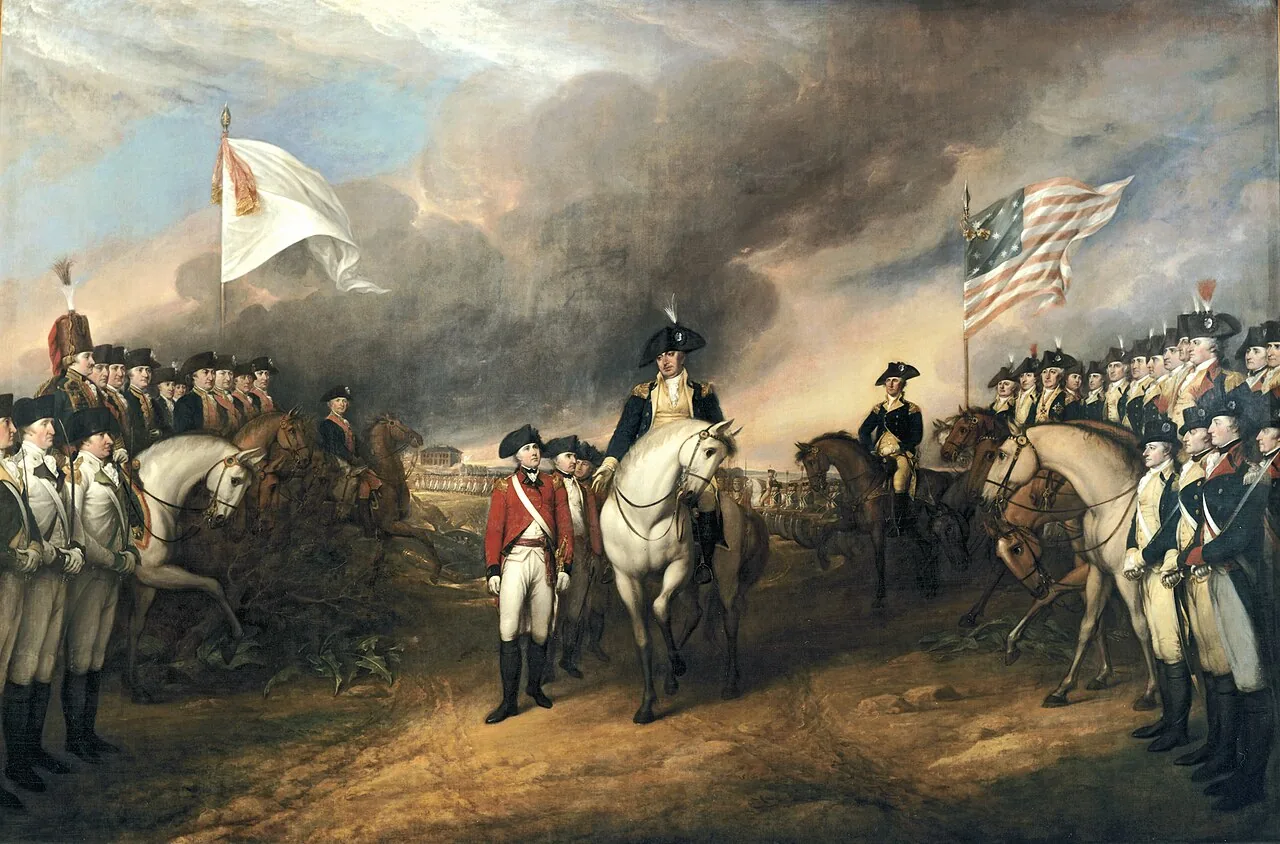
Source: John Trumbull, 1820, oil on canvas (image on Wikimedia Commons).
The painting shows British troops stacking arms between files of American troops on the right and French troops on the left. Trumbull gave the French equal space, which fits the facts: French soldiers and sailors made the victory possible. He also shows Washington on the right, on horseback.
Fighting went on in small clashes for another year. However, Britain’s government fell, and in 1782 the two sides began talks in Paris. The American negotiators, Benjamin Franklin, John Adams, and John Jay, ignored instructions from Congress to follow French advice. Instead, they negotiated directly with Britain. The two sides signed the Treaty of Paris on September 3, 1783.
Document 8 – The Treaty of Paris, 1783
Article 1: His Brittanic Majesty acknowledges the said United States, viz., New Hampshire, Massachusetts Bay, Rhode Island and Providence Plantations, Connecticut, New York, New Jersey, Pennsylvania, Maryland, Virginia, North Carolina, South Carolina and Georgia, to be free sovereign and independent states, that he treats with them as such, and for himself, his heirs, and successors, relinquishes all claims to the government, propriety, and territorial rights of the same and every part thereof.
Source: The Definitive Treaty of Peace between the United States and Great Britain (Treaty of Paris), September 3, 1783, Article 1; text from the Avalon Project, Yale Law School.
*relinquishes: gives up. *propriety: ownership.
Commentary. Britain recognized the thirteen states by name, as “free sovereign and independent states.” The treaty gave the new nation boundaries that reached from the Atlantic to the Mississippi River. They also reached from the Great Lakes to Florida, which Spain had regained. This was a much larger country than the thirteen colonies had been. It also left unsettled issues, such as the debts that Americans owed to British merchants, the treatment of Loyalists, and British forts in the Northwest. The British did not give up those forts for another dozen years.
In all, about 25,000 American soldiers and sailors died in the war. About 6,800 of them died in battle, and the rest died mostly from disease and in British prison ships. Victory had many causes. These included Washington’s leadership and the army’s survival, the help of France, the difficulty of conquering a huge country, and the support of many ordinary citizens. In 1783 the United States had won its independence. But it had not yet built a government that could hold the states together. That was the next task.
- 1775 Fighting begins at Lexington and Concord; Washington commands the Continental Army.
- 1776 The Declaration of Independence is adopted on July 4.
- 1776 Washington crosses the Delaware and wins at Trenton on December 26.
- 1777 The Americans win at Saratoga; Washington’s army winters at Valley Forge.
- 1778 France signs an alliance with the United States.
- 1781 Cornwallis surrenders at Yorktown on October 19.
- 1783 The Treaty of Paris recognizes American independence.
Key takeaways
- The war began at Lexington and Concord (April 1775); the Second Continental Congress created the Continental Army under George Washington.
- The Declaration of Independence (1776) said that governments get their power from the consent of the governed.
- Trenton and Princeton restored hope in 1776-1777; Saratoga (1777) led to the French alliance in 1778.
- African Americans, women, Native Americans, and Loyalists were all part of the war, and their experiences varied widely.
- The war ended with the siege of Yorktown in 1781, which was won with French help, and the Treaty of Paris of 1783.
- The United States won independence and land to the Mississippi, but it still needed a stronger government.

Quick review: flashcards
Tap a card to see the answer.