


This Grade 8 US History to 1877 lesson covers The Constitution and the Bill of Rights, part of the unit “A new government.” First, read the full lesson with its primary sources, maps and key terms. Then practice with the worksheet, check yourself with the quiz and get ready with the test.
In the summer of 1787, the delegates kept the windows of the State House in Philadelphia shut, even in the heat. Outside, the city was hot, and guards stood at the doors. Inside, fifty-five men, most of them lawyers, planters, and merchants, were meeting in secret. They had to decide how to govern a nation of nearly four million people. The old government, the Articles of Confederation, was breaking down.
The delegates had come only to repair it, but they did something bolder. They wrote a new plan of government. When they finished on September 17, 1787, Benjamin Franklin, who was eighty-one, looked at the sun painted on the back of Washington’s chair. According to tradition, he remarked that he had often wondered whether it was rising or setting. Now, he said, he knew it was rising.
Guiding question: Why did Americans replace the Articles of Confederation with the Constitution, and how did the debate over ratification lead to the Bill of Rights?
1. The Articles of Confederation, 1781-1787
The Articles of Confederation set up the first national government of the United States. Delegates drafted the Articles in 1777, and all thirteen states ratified them in March 1781. Americans had just fought a war against a distant government that taxed and ruled them. Therefore they created a government with very little power. The states kept their independence. The national government was a single body, the Congress, in which each state had one vote.
Document 1 – The Articles of Confederation
Each state retains its sovereignty, freedom, and independence, and every power, jurisdiction, and right, which is not by this Confederation expressly delegated to the United States, in Congress assembled. […] The said States hereby severally enter into a firm league of friendship with each other, for their common defense, the security of their liberties, and their mutual and general welfare, binding themselves to assist each other, against all force offered to, or attacks made upon them, or any of them, on account of religion, sovereignty, trade, or any other pretense whatever.
Source: Articles of Confederation, adopted by Congress November 15, 1777, ratified March 1, 1781 (Articles II and III); text from the Avalon Project, Yale Law School.
*sovereignty: supreme power. *pretense: reason or excuse.
Commentary. Article II says that each state keeps “its sovereignty, freedom, and independence” and every power not expressly given to Congress. Article III calls the union “a firm league of friendship”. Notice the words: it was a league of states, not one nation governing individuals. That was exactly what the people of the 1780s wanted, but it proved too weak.
Under the Articles, Congress could declare war, make treaties, and borrow money. However, it could not tax, and it could not regulate trade among the states or with other countries. It had no president and no national courts. It needed the votes of nine states to pass an important law, and the agreement of all thirteen to amend the Articles. The states printed their own money, and some taxed one another’s goods. Congress had to ask the states for money, and they often refused. Britain kept its forts in the Northwest and shut American ships out of the West Indies. Spain closed the Mississippi River to American trade. Congress could do little about either.
The government did have achievements. The Land Ordinance of 1785 set up a system of surveying western land into townships six miles square. Each township reserved one section for public schools. The Northwest Ordinance of 1787 created the Northwest Territory, the land north of the Ohio River and east of the Mississippi. It also explained how Congress could divide the territory into states. These states would join the Union as equals once they had 60,000 free inhabitants.
Document 2 – The Northwest Ordinance, Article 6
There shall be neither slavery nor involuntary servitude in the said territory, otherwise than in the punishment of crimes whereof the party shall have been duly convicted: Provided, always, That any person escaping into the same, from whom labor or service is lawfully claimed in any one of the original States
Source: The Northwest Ordinance, July 13, 1787 (Article 6); text from the Avalon Project, Yale Law School.
*servitude: forced labor. *fugitive: a person escaping.
Commentary. Article 6 banned slavery in the territory north of the Ohio River, the first time the national government limited slavery. But the clause had limits. It did not free anyone already held there, and it required the return of people who escaped from slavery in the original states. Still, it meant that Ohio, Indiana, Illinois, Michigan, and Wisconsin would enter the Union as free states. This decision had major results in the Civil War.
The weakness of the Articles became painfully clear in 1786 and 1787. After the war, farmers in western Massachusetts, struggling with debts and taxes, closed the courts to stop officials from seizing their land. In January 1787 Daniel Shays, a former Continental Army captain, led a force that marched on the arsenal at Springfield, but the militia drove it off. Shays’ Rebellion was small. However, it frightened leaders such as George Washington and James Madison, who feared that the government could not keep order. In September 1786, delegates from five states met at Annapolis and called for a convention in Philadelphia to revise the Articles. Congress agreed.
2. The Philadelphia Convention, 1787
Fifty-five delegates from twelve states attended the convention between May and September 1787. Rhode Island refused to send anyone. The delegates elected George Washington to preside. Benjamin Franklin of Pennsylvania was the oldest. James Madison of Virginia, a quiet and well-read man of thirty-six, came with a plan and took careful notes. People remember him as the “Father of the Constitution.” Thomas Jefferson and John Adams were abroad as diplomats, and Patrick Henry, who opposed a strong government, refused to attend. The delegates voted to keep their debates secret, so that they could speak freely and change their minds.
Representation and the Great Compromise
They soon decided to write a new constitution. The first big fight was over representation. The Virginia Plan, introduced by Edmund Randolph, called for a two-house Congress with seats in both houses based on population. This favored large states like Virginia. The New Jersey Plan, presented by William Paterson, proposed one house with one vote for each state, as under the Articles. After weeks of dispute, a committee proposed the Great Compromise, also called the Connecticut Compromise. Congress adopted it on July 16. The House of Representatives would be based on population, and the Senate would give each state two senators.
Definition: Great Compromise
the agreement of 1787 that gave Congress two houses: a House of Representatives, with seats based on each state’s population, and a Senate, with two senators from every state regardless of size.
The slavery compromises
A second dispute was about slavery. Delegates from the South wanted enslaved people to count as part of the population when Congress divided seats, but not when it assigned taxes. Delegates from the North said the opposite. The result was the Three-Fifths Compromise: three-fifths of the enslaved population would count toward both representation and taxation.
The convention also agreed that Congress could not ban the slave trade before 1808. Moreover, it added a clause requiring the return of people who escaped from slavery. Some delegates, among them Gouverneur Morris of Pennsylvania, spoke against slavery, but most put the unity of the states first. These compromises gave slaveholding states more power in Congress and the Electoral College. They also left the question of slavery for the future to settle.
Document 3 – The Three-Fifths Clause
Representatives and direct Taxes shall be apportioned among the several States which may be included within this Union, according to their respective Numbers, which shall be determined by adding to the whole Number of free Persons, including those bound to Service for a Term of Years, and excluding Indians not taxed, three fifths of all other Persons.
Source: Constitution of the United States, 1787, Article I, Section 2, clause 3 (the Three-Fifths Clause, later replaced by the Fourteenth Amendment, 1868); text from the National Archives.
*apportioned: divided and assigned. *Persons bound to Service: indentured servants.
Commentary. The Constitution never uses the word “slave.” The clause speaks of “all other Persons” and counts them as three-fifths. It was a political bargain that valued the enslaved as less than full persons. Because they could not vote, it gave their owners extra power in Congress. After the Civil War, the Fourteenth Amendment (1868) replaced the clause and counted all persons.
The framers also built a system to prevent any one group from holding too much power. The Constitution divides power among three branches. Congress makes the laws (Article I), the president carries them out (Article II), and the courts decide cases (Article III). Each branch can check the others. For example, the president can veto laws, Congress can override a veto and impeach officials, and the Senate approves judges. This is separation of powers, with checks and balances. The Constitution also divides power between the national government and the states, a system called federalism. And the Supremacy Clause makes the Constitution and national laws “the supreme Law of the Land.”
Definition: federalism
a system of government in which a national government and state governments share power. Each level has its own powers, and the national Constitution is supreme.
Document 4 – The Preamble
We the People of the United States, in Order to form a more perfect Union, establish Justice, insure domestic Tranquility, provide for the common defence, promote the general Welfare, and secure the Blessings of Liberty to ourselves and our Posterity, do ordain and establish this Constitution for the United States of America.
Source: Constitution of the United States, signed September 17, 1787, Preamble; text from the National Archives.
*ordain: to put into law. *Posterity: future generations.
Commentary. The Preamble begins “We the People,” not “We the States.” This marks the change from the Articles: the authority comes from the people. It also lists the goals of the government: a more perfect union, justice, peace at home, defense, the general welfare, and liberty. The delegates signed on September 17, 1787; 39 of the 42 delegates present signed.
Document 5 – The signing in a painting
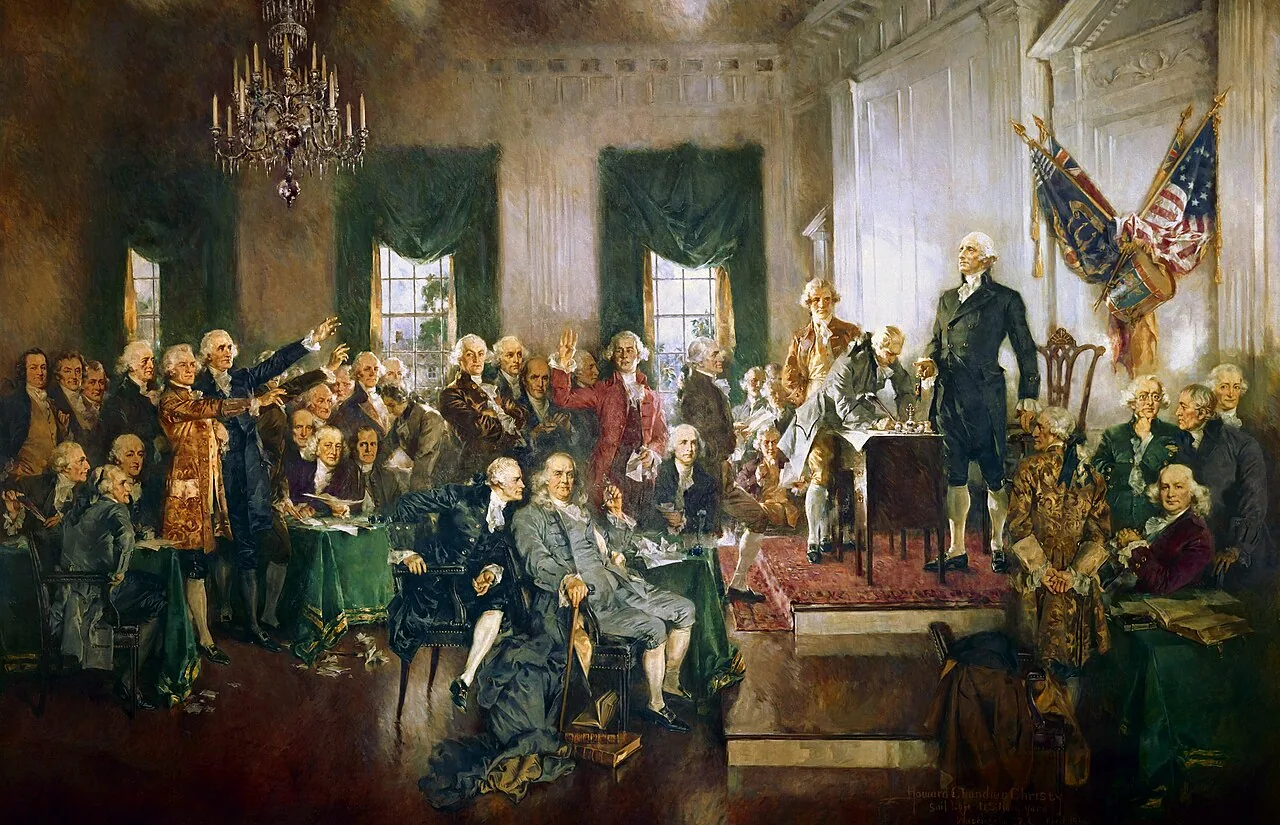
Source: Howard Chandler Christy, 1940, U.S. Capitol (image on Wikimedia Commons).
Christy painted this scene for the 150th anniversary of the Constitution. Washington stands on the platform at right, and Franklin sits near the center. The artist worked more than 150 years after the event and arranged delegates in a grand setting. Therefore the picture reflects how Americans honor the Framers. It leaves out the fact that the delegates were an all-male, all-white group.
3. The debate over ratification, 1787-1790
The Constitution would go into effect when nine of the thirteen states approved it. Each state held a special convention, with delegates whom the people elected. The country split into two camps. The Federalists, including Madison, Alexander Hamilton, and John Jay, supported the Constitution. The Anti-Federalists, including Patrick Henry, George Mason, and writers who used the name Brutus, feared that the new government would be too strong. They thought it would take away the powers of states and the liberties of people. Federalists said that only a strong national government could pay the debts, protect trade, and keep order.
Hamilton, Madison, and Jay wrote eighty-five essays signed “Publius,” later collected as The Federalist, to persuade New Yorkers. Madison’s essay no. 10 argued that a large republic would protect liberty better than a small one. The reason was that it would contain so many different groups that no single group, or faction, could easily dominate.
Document 6 – Federalist no. 10
A republic, by which I mean a government in which the scheme of representation takes place, opens a different prospect, and promises the cure for which we are seeking. Let us examine the points in which it varies from pure democracy, and we shall comprehend both the nature of the cure and the efficacy which it must derive from the Union. […] The two great points of difference between a democracy and a republic are: first, the delegation of the government, in the latter, to a small number of citizens elected by the rest; secondly, the greater number of citizens, and greater sphere of country, over which the latter may be extended.
Source: James Madison (writing as Publius), The Federalist, no. 10, November 22, 1787; text from the Avalon Project, Yale Law School.
*faction: a group that works for its own interest against the common good. *sphere: area.
Commentary. Madison turns an old idea upside down. Thinkers such as Montesquieu had said that republics must be small. Madison argued that in a large republic, with many interests and religions, majorities would be harder to form. They would also be less likely to trample on minorities. Elected representatives would also “refine and enlarge the public views.” Federalist no. 51 added that the branches should divide power and check one another, because “if men were angels, no government would be necessary.”
Document 7 – Brutus no. 1, an Anti-Federalist reply
In a republic, the manners, sentiments, and interests of the people should be similar. If this be not the case, there will be a constant clashing of opinions; and the representatives of one part will be continually striving against those of the other. This will retard the operations of government, and prevent such conclusions as will promote the public good. If we apply this remark to the condition of the United States, we shall be convinced that it forbids that we should be one government. The United States includes a variety of climates. The productions of the different parts of the union are very variant, and their interests, of consequence, diverse.
Source: Brutus (probably Robert Yates), Anti-Federalist Papers, no. 1, October 18, 1787; text from the Online Library of Liberty.
*sentiments: feelings and opinions. *diverse: different.
Commentary. Brutus argues the opposite of Madison. He says that a republic works only if citizens share similar interests. He also says that the United States, with its wide variety of climates, products, and interests, was too large for one center to govern. Anti-Federalists also pointed out that the Constitution contained no bill of rights. Many people wanted a promise in writing that the government could not take away free speech, trial by jury, or freedom of religion.
Document 8 – The Federalist, title page
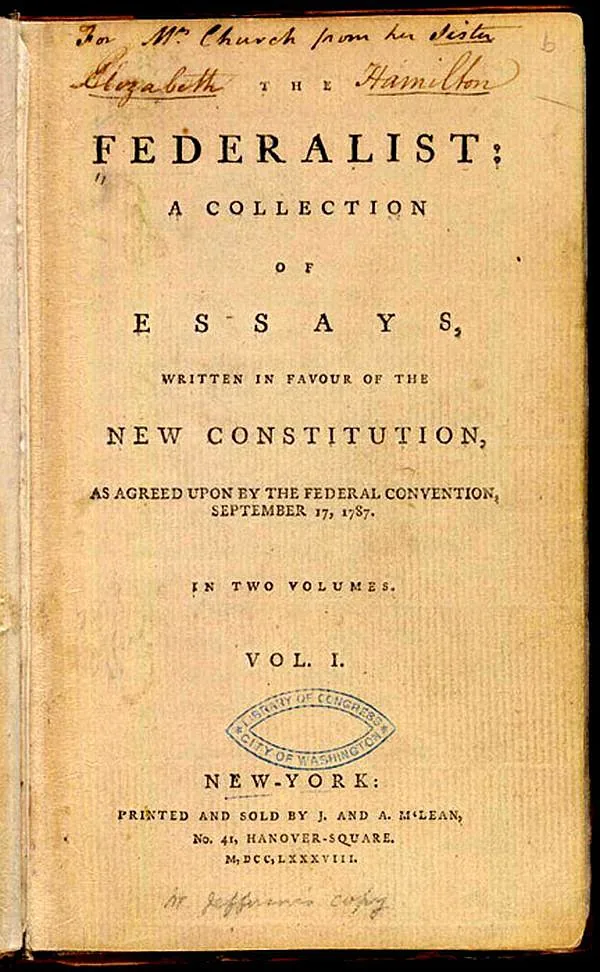
Source: first edition, J. and A. McLean, New York, 1788 (image on Wikimedia Commons).
The essays first appeared in New York newspapers between October 1787 and May 1788. This title page comes from the book edition, which appeared in two volumes in 1788. Thomas Jefferson later called it “the best commentary on the principles of government” ever written. However, the authors themselves wrote it as political advocacy.
Delaware was the first to ratify, unanimously, on December 7, 1787. Pennsylvania, New Jersey, Georgia, Connecticut, and Massachusetts followed. The Massachusetts vote was close, 187 to 168. Federalists won it after they promised to support amendments. New Hampshire became the ninth state on June 21, 1788, putting the Constitution into effect.
Virginia, which had the largest population, and New York, a key state, had still not decided. Virginia ratified on June 25, 1788, by a vote of 89 to 79. New York followed on July 26, 1788, by 30 to 27. North Carolina waited until November 1789, and Rhode Island until May 1790. In the first national election, the electors chose George Washington as president. He took the oath of office in New York City on April 30, 1789.
4. The Bill of Rights, 1789-1791
Many states had ratified only with a request for amendments. In the first Congress, James Madison took the lead in drafting amendments. He had once thought a bill of rights unnecessary, but he wanted in part to keep a promise he had made to voters in Virginia. Congress approved twelve amendments in September 1789 and sent them to the states. Ten were ratified by December 15, 1791, when Virginia gave the vote needed, and they became the Bill of Rights.
Definition: amendment
a change or addition to the Constitution. Two-thirds of Congress (or a national convention requested by the states) must propose an amendment, and three-fourths of the states must ratify it.
The First Amendment protects freedom of religion, speech, the press, assembly, and petition. The Second protects the right to keep and bear arms, and the Third forbids quartering soldiers in homes in peacetime without consent, recalling the British Quartering Acts. The Fourth protects against unreasonable searches and seizures. The Fifth through the Eighth protect people accused of crimes.
They give the right to a grand jury and protection from double jeopardy and self-incrimination. They also give the right to a speedy and public trial by jury and protection from cruel and unusual punishment. The Ninth says that listing some rights does not mean that the people lack other rights. The Tenth says that powers not given to the national government belong to the states or the people.
Document 9 – The First Amendment
Congress shall make no law respecting an establishment of religion, or prohibiting the free exercise thereof; or abridging the freedom of speech, or of the press; or the right of the people peaceably to assemble, and to petition the Government for a redress of grievances.
Source: The Bill of Rights, First Amendment, proposed September 25, 1789, ratified December 15, 1791; text from the Avalon Project, Yale Law School.
*abridging: reducing. *redress: correction of a wrong.
Commentary. The amendment begins “Congress shall make no law,” so at first it limited only the national government, not the states. After the Civil War, the courts used the Fourteenth Amendment (1868) to apply most of the Bill of Rights to the states as well. The rights in the First Amendment, such as free speech and the free exercise of religion, build on ideas from Roger Williams, William Penn, and the Revolutionary generation’s complaints against Britain.
Document 10 – The author of the amendments
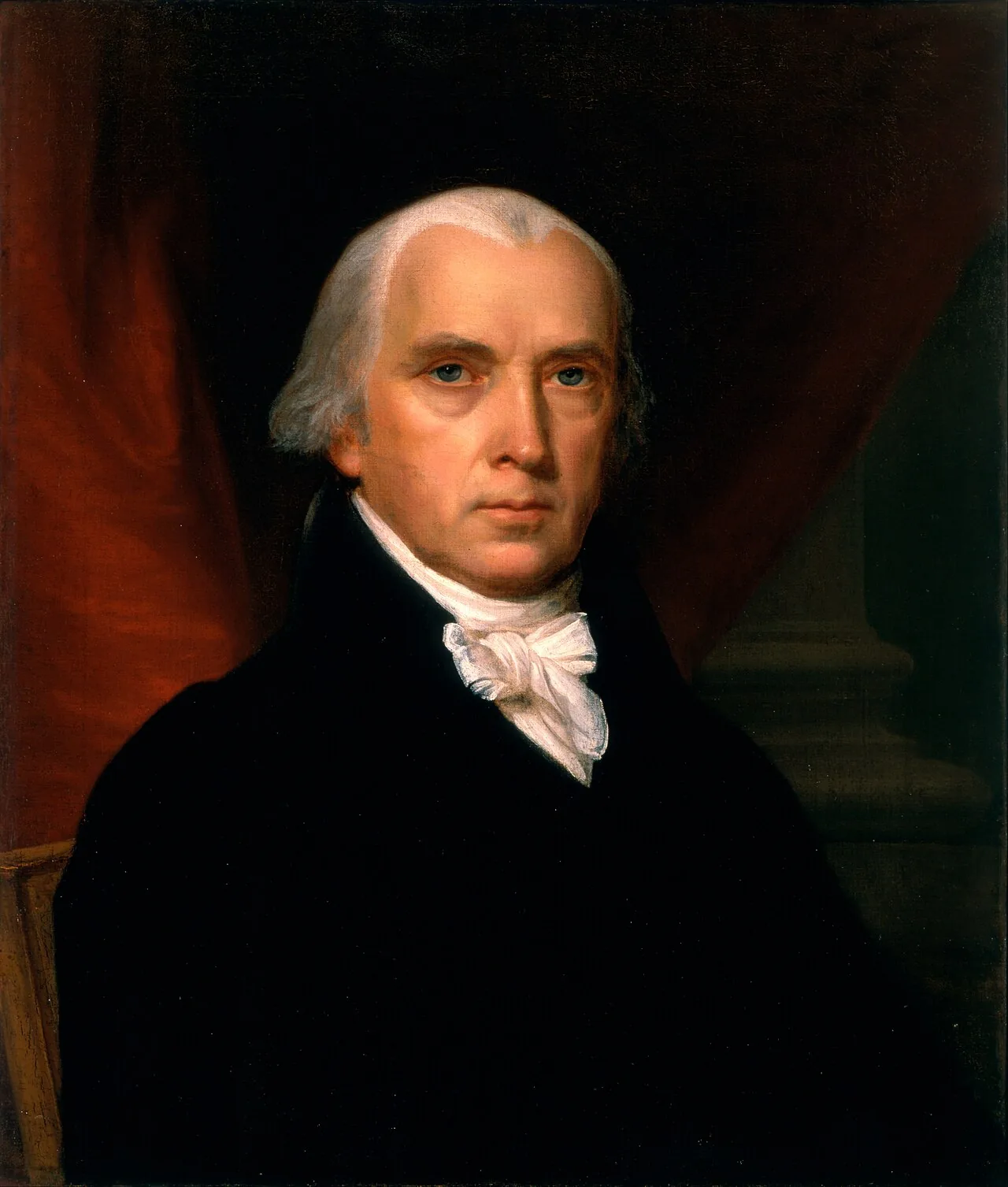
Source: John Vanderlyn, 1816 (image on Wikimedia Commons).
Madison was a small man, about five feet four inches tall, and he was shy in public. But he was the most important thinker at the convention. The portrait shows him as president, many years after he drafted the Bill of Rights.
Americans have amended the Constitution only twenty-seven times, but the document has lasted for more than two centuries. Its authors made it flexible. They gave Congress power to make laws “necessary and proper” to carry out its duties, and they provided a way to amend the text. The Constitution also left some questions unsettled, above all slavery and the rights of women and Native Americans. Americans would debate these questions for generations.
- 1781 The Articles of Confederation take effect after Maryland ratifies.
- 1785 The Land Ordinance sets up a system for surveying western lands.
- 1786-1787 Shays’ Rebellion in Massachusetts.
- 1787 The Constitutional Convention meets in Philadelphia, May to September; the Northwest Ordinance is passed in July.
- 1788 New Hampshire becomes the ninth state to ratify the Constitution, June 21.
- 1789 George Washington becomes president, April 30.
- 1791 The Bill of Rights is ratified, December 15.
Key takeaways
- The Articles of Confederation (1781) created a weak government that could not tax, regulate trade, or enforce laws.
- The Northwest Ordinance (1787) set up a way for new states to join the Union and banned slavery north of the Ohio River.
- The Constitutional Convention of 1787 created a stronger government with three branches, separation of powers, checks and balances, and federalism.
- The Great Compromise and the Three-Fifths Compromise settled conflicts over representation and slavery.
- Federalists supported ratification; Anti-Federalists feared a strong government and demanded a bill of rights.
- The Bill of Rights (1791) added ten amendments that protect individual liberties.

Quick review: flashcards
Tap a card to see the answer.