


This Grade 8 US History to 1877 lesson covers The Early Republic: Washington to Jefferson, part of the unit “A new government.” First, read the full lesson with its primary sources, maps and key terms. Then practice with the worksheet, check yourself with the quiz and get ready with the test.
Focus question : How did the first presidents turn the Constitution into a working government, and how did the conflicts of the 1790s and the Louisiana Purchase shape the nation Jefferson inherited?
On Inauguration Day in 1801, Thomas Jefferson walked from his boarding house to the unfinished Capitol in a small, half-built city on the Potomac River. There was no parade of soldiers and no coach. Eleven years earlier, the government had been a few clerks in a rented building in New York. Yet the country had changed in a way that no one in 1789 could have been sure of. It had survived. Two leaders had given up power peacefully. The capital had moved, and the courts had begun to test the Constitution. The nation was about to double in size.
Guiding question: How did the first presidents turn the words of the Constitution into a working government, and how did the quarrels of the 1790s shape the United States that Jefferson inherited?
1. George Washington builds the new government (1789-1797)
George Washington took the oath of office on April 30, 1789, in New York City. It was the first capital under the new Constitution. The Constitution described a president, a Congress, and a Supreme Court, but it left most of the details empty. Washington knew that every decision would become a precedent. He asked people to call him simply “Mr. President.” He named department heads who met with him as a Cabinet. Then he served two terms and stepped down. In 1790 the capital moved to Philadelphia for ten years. Meanwhile, workers built a new federal city, Washington, D.C., along the Potomac. The site was a compromise between North and South.
Congress went quickly to work. The Judiciary Act of 1789 set up the federal court system. It had a Supreme Court with six justices, thirteen district courts, and three circuit courts. In 1791 the states ratified the first ten amendments, the Bill of Rights. These amendments protected freedom of religion, speech, and the press, and the rights of the accused. Washington’s Cabinet included two men whose ideas would divide the country. They were Alexander Hamilton, the Secretary of the Treasury, and Thomas Jefferson, the Secretary of State.
Hamilton’s financial plan
The new nation was deep in debt from the Revolutionary War. Hamilton believed that a strong national government needed good credit. Therefore, he proposed that the federal government pay the war debts in full and take over the debts of the states. He also asked Congress to charter a Bank of the United States. The Bank would hold federal money and issue a stable paper currency. Hamilton wanted to raise revenue through tariffs and an excise tax on whiskey. Congress accepted the debt plan in 1790 after Hamilton, Jefferson, and James Madison struck a bargain. Southern leaders accepted the plan, and in return the capital went to the Potomac. Congress chartered the Bank in 1791.
Jefferson and Madison opposed the Bank. They read the Constitution strictly and argued that it said nothing about creating a bank. Hamilton answered that the “necessary and proper” clause let Congress use any reasonable means to carry out its listed powers. This was the first great argument over how to interpret the Constitution, and it never fully ended. Washington sided with Hamilton and signed the Bank bill.
Definition: excise tax
a tax on the making or sale of a product inside a country. The federal excise tax on whiskey, passed in 1791, angered farmers on the frontier. They often turned their grain into whiskey because it was easier to carry over the mountains than bulky grain.
The tax led to the first serious test of federal authority. In 1794, farmers in western Pennsylvania attacked tax collectors in the Whiskey Rebellion. Washington called out about 13,000 militiamen from four states and rode part of the way with them. The rebellion collapsed without a battle. The government had shown that it would enforce its laws, although some critics said the response was too heavy.
War in Europe, and the nation’s place in the world
In 1793 France, which had overthrown its king, went to war with Great Britain. Americans split into two camps. Many Republicans sympathized with the French Revolution, while Federalists valued trade with Britain and feared revolutionary disorder. Washington issued the Neutrality Proclamation in April 1793, declaring that the United States would stay out of the conflict. But British ships stopped American vessels, seized cargo, and forced sailors into the Royal Navy, a practice called impressment. Britain also still kept forts on American soil in the Northwest.
Washington sent John Jay to London. The Jay Treaty (1794) did not end impressment, but Britain agreed to leave its forts in the Northwest and to open some trade. It was bitterly unpopular among Republicans, yet the Senate ratified it in 1795, and it kept the peace. The same year, Pinckney’s Treaty with Spain opened the Mississippi River to American shipping.
It also gave Americans the right to store goods at New Orleans, which mattered greatly to farmers in Kentucky and Tennessee. In the Ohio country, American troops under General Anthony Wayne defeated a confederation of Native nations at the Battle of Fallen Timbers in 1794. As a result, the Treaty of Greenville (1795) forced the Native nations to give up most of present-day Ohio.
Washington’s farewell
In 1796 Washington refused to run for a third term. His Farewell Address appeared in a Philadelphia newspaper that September. In it he warned the country against two dangers: the spirit of political parties, and permanent entanglement in the quarrels of Europe.
Document 1 – Washington on foreign nations
The great rule of conduct for us in regard to foreign nations is in extending our commercial relations, to have with them as little political connection as possible. […] So far as we have already formed engagements, let them be fulfilled with perfect good faith. Here let us stop. Europe has a set of primary interests which to us have none; or a very remote relation. Hence she must be engaged in frequent controversies, the causes of which are essentially foreign to our concerns.
Source: George Washington, Farewell Address, published September 19, 1796; text from the Avalon Project, Yale Law School.
*engagements: treaties and promises already made. *essentially: basically.
Commentary. Washington wrote the Farewell Address near the end of his second term, with help from Alexander Hamilton, and he never delivered it as a speech. Instead, he had it printed for citizens to read. The advice to avoid “permanent alliances” suited a weak young country that needed time to grow. It later became a cornerstone of American foreign policy. However, historians note that Washington was speaking of permanent alliances, and he allowed “temporary alliances for extraordinary emergencies.”
Document 2 – The president as Americans pictured him
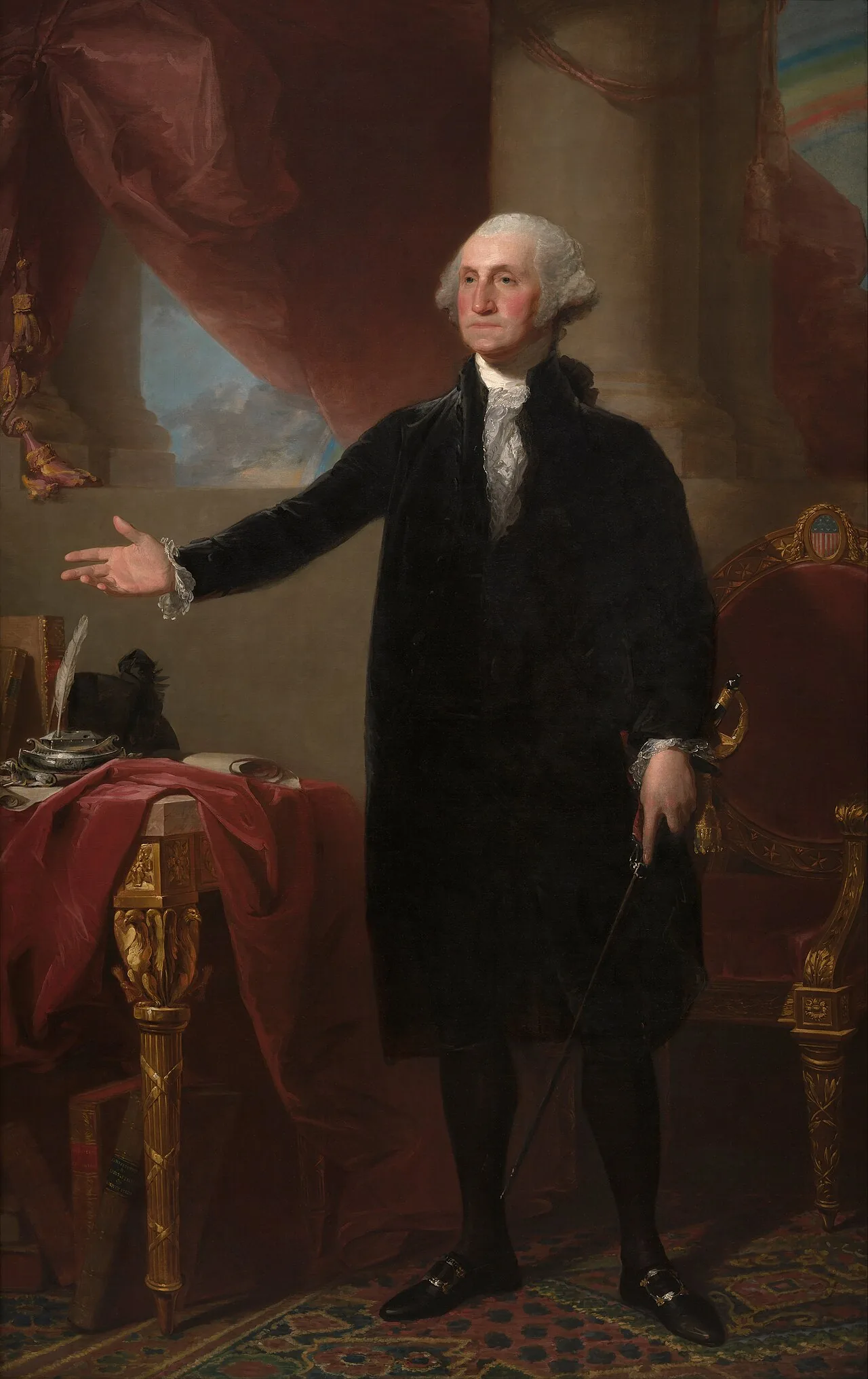
Source: Gilbert Stuart, 1796, National Portrait Gallery, Smithsonian Institution (image on Wikimedia Commons).
Commentary. Stuart painted Washington in plain black clothing, not in a uniform or a crown. The table, books, and sword show a leader who relied on law and civilian rule. Artists copied the picture for the United States, and it went as a gift to a British admirer, the Marquess of Lansdowne. That is why it is called the Lansdowne portrait. It helped make Washington the model of what an American president should look like.
2. Parties, a crisis, and the Revolution of 1800
Washington had warned against political parties, but by the middle of the 1790s two had formed. The Federalists, led by Hamilton and later by John Adams, wanted a strong national government and a national bank. They also supported manufacturing and trade, and they wanted good relations with Britain. The Democratic-Republicans (often just called Republicans), led by Jefferson and Madison, wanted to protect the powers of the states. They favored farmers and a limited federal government, and they were friendlier to France. Newspapers took sides, and the quarrels were often bitter.
Definition: political party
an organized group of people who share ideas about government and try to win elections to put those ideas into action. The Constitution does not mention parties, and many leaders of the founding generation distrusted them.
In the election of 1796, the Federalist John Adams won the presidency with 71 electoral votes. Jefferson, with 68, became vice president under the rules of the time. Adams soon faced a crisis with France. In 1797, American diplomats went to Paris to settle the dispute over attacks on American ships. There three French agents (called X, Y, and Z in the American reports) demanded a bribe before talks could begin. The XYZ Affair outraged the public. An undeclared naval conflict, the Quasi-War, followed in 1798-1800, fought at sea in the Caribbean and the Atlantic.
The Alien and Sedition Acts
Federalists in Congress used the crisis to pass four laws in 1798, known together as the Alien and Sedition Acts. Three of them dealt with immigrants. They raised the residency requirement for citizenship from five years to fourteen. They also gave the president the power to expel foreigners he judged dangerous. The fourth, the Sedition Act, made it a crime to publish false and malicious writing against the government, Congress, or the president. Officials charged about two dozen people, most of them Republican editors, and courts convicted ten. Critics said it silenced opposition and violated the First Amendment.
Document 3 – The Sedition Act of 1798
if any person shall write, print, utter or publish, or shall cause or procure to be written, printed, uttered or published, or shall knowingly and willingly assist or aid in writing, printing, uttering or publishing any false, scandalous and malicious writing or writings against the government of the United States, or either house of the Congress of the United States, or the President of the United States, with intent to defame the said government, or either house of the said Congress, or the said President, or to bring them, or either of them, into contempt or disrepute;
Source: An Act in Addition to the Act, Entitled “An Act for the Punishment of Certain Crimes Against the United States” (Sedition Act), Section 2, July 14, 1798; text from the Avalon Project, Yale Law School.
*utter: say aloud. *defame: damage the good name of. *disrepute: loss of respect.
Commentary. The law punished speech that was “false, scandalous and malicious” and aimed at the government. However, it did not list the vice president, who was Jefferson, the leader of the opposition, among the officials it protected. Defenders said that truth was a defense. Opponents answered that in a heated election, officials could decide what was false. Jefferson and Madison wrote the Kentucky and Virginia Resolutions (1798-1799). These argued that the states could judge when the national government went beyond the Constitution. Historians still debate the doctrine they introduced, but the resolutions kept alive the idea that the people could protest against unjust laws.
The election of 1800
The election of 1800 was fierce. Jefferson and his running mate, Aaron Burr, each received 73 electoral votes. This happened because the Constitution at that time did not let electors name a separate choice for vice president. The tie went to the House of Representatives, which voted thirty-six times before choosing Jefferson in February 1801. The Twelfth Amendment (1804) later fixed the problem by requiring separate ballots for president and vice president. What mattered most was the transfer of power. Defeated Federalists accepted the result, and the government passed from one party to another without violence. Jefferson later called it the “revolution of 1800.”
Document 4 – Jefferson calls for unity
But every difference of opinion is not a difference of principle. We have called by different names brethren of the same principle. We are all Republicans, we are all Federalists. If there be any among us who would wish to dissolve this Union or to change its republican form, let them stand undisturbed as monuments of the safety with which error of opinion may be tolerated where reason is left free to combat it.
Source: Thomas Jefferson, First Inaugural Address, March 4, 1801; text from the Avalon Project, Yale Law School.
*brethren: brothers, fellow citizens. *monuments: reminders.
Commentary. Jefferson spoke these words on March 4, 1801, after a bruising campaign. He offered peace to the Federalists and defined the principle that people may disagree without being enemies of the republic. Notice that he uses the party names in a new way. He says that in principle all citizens are both republicans, who believe in government by the people’s representatives, and federalists, who support the Union.
3. Jefferson’s presidency (1801-1809)
The Supreme Court claims judicial review
Just before he left office, Adams filled many new judgeships with Federalists, nicknamed the “midnight judges.” Adams named William Marbury a justice of the peace for the District of Columbia. However, no one delivered his commission before Jefferson took office. Jefferson’s Secretary of State, James Madison, then refused to hand it over. Marbury asked the Supreme Court to order Madison to deliver it.
In Marbury v. Madison (1803), Chief Justice John Marshall wrote that Marbury had a right to his commission. However, the Court could not order Madison to deliver it. The part of the Judiciary Act of 1789 that gave the Court that power went beyond what the Constitution allowed. Marshall had avoided a direct fight with Jefferson while claiming a far greater power for the Court.
Definition: judicial review
the power of courts to decide whether a law or government action fits the Constitution, and to strike it down if it does not. The Constitution does not use the phrase. The Supreme Court first used the power against an act of Congress in Marbury v. Madison (1803).
Document 5 – Marshall on the duty of the courts
It is emphatically the province and duty of the Judicial Department to say what the law is. […] So, if a law be in opposition to the Constitution, if both the law and the Constitution apply to a particular case, so that the Court must either decide that case conformably to the law, disregarding the Constitution, or conformably to the Constitution, disregarding the law, the Court must determine which of these conflicting rules governs the case. This is of the very essence of judicial duty.
Source: Chief Justice John Marshall, opinion of the Court in Marbury v. Madison, 5 U.S. (1 Cranch) 137, February 24, 1803; text from Wikisource.
*Judicial Department: the courts. *conformably: in agreement with.
Commentary. This passage is the foundation of judicial review. Marshall reasons in steps. Judges must apply the law, and the Constitution is the highest law. So when an ordinary law conflicts with it, the judge must follow the Constitution. Notice the phrase “of necessity,” which makes the power seem natural rather than something seized. Jefferson disliked the idea that judges, not elected officials, would have the last word. However, he could not complain about the result, since the Court had ruled in his favor.
Document 6 – The Chief Justice
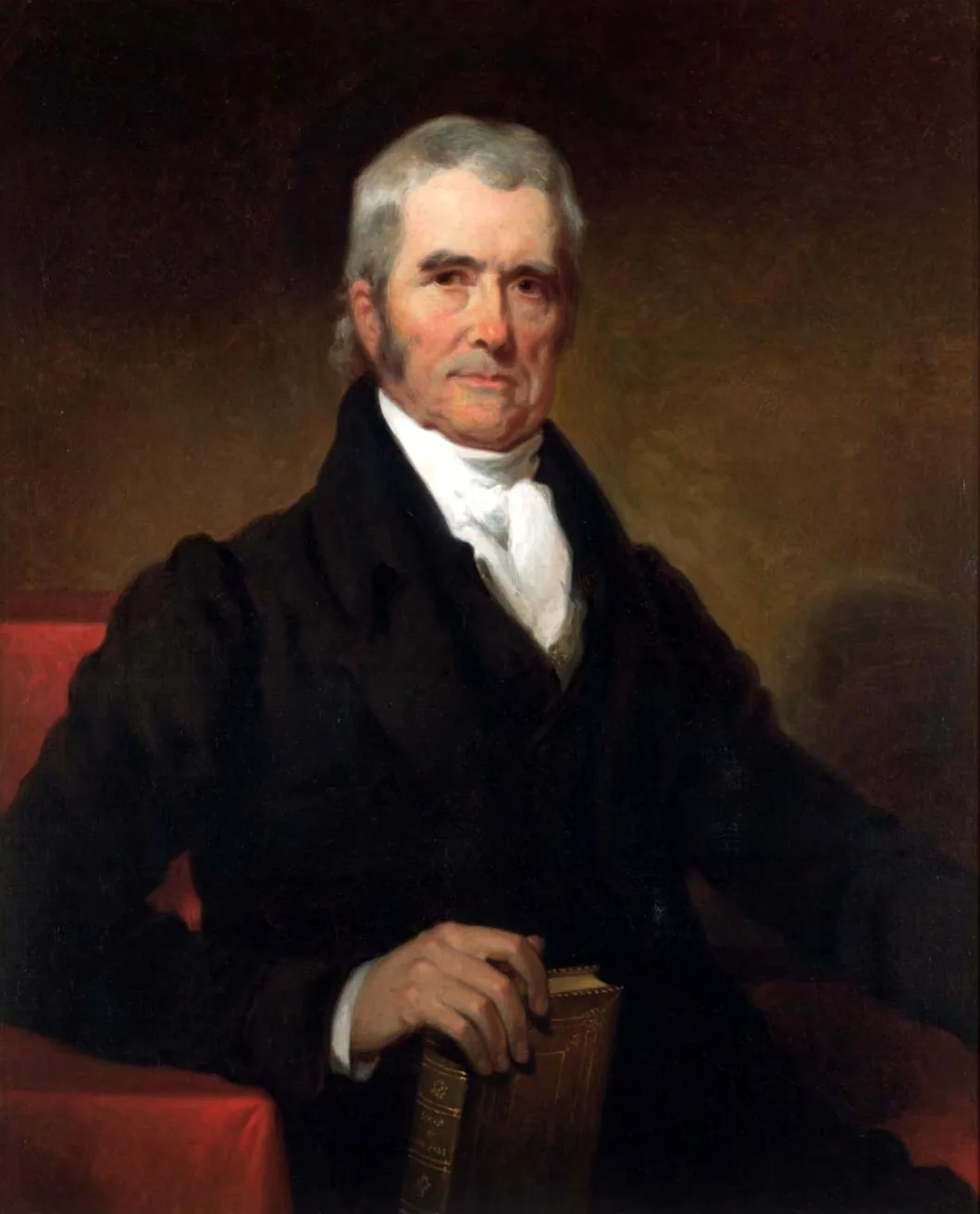
Source: Henry Inman, 1832 (image on Wikimedia Commons).
The Louisiana Purchase
The biggest event of Jefferson’s presidency was the Louisiana Purchase. In 1800 Spain secretly gave the huge territory of Louisiana back to France, then led by Napoleon Bonaparte. The territory stretched from the Mississippi River to the Rocky Mountains. Jefferson feared that a strong France controlling New Orleans could choke American trade. Farmers west of the Appalachians sent their goods down the Mississippi. He sent James Monroe to help the American minister in Paris, Robert Livingston, buy New Orleans and its land.
Napoleon’s plans changed. A successful revolt of enslaved people led by Toussaint Louverture and yellow fever had destroyed his army in Saint-Domingue (now Haiti). He also needed money for war with Britain. Instead of selling only New Orleans, the French offered the whole of Louisiana for $15 million. The territory, of about 828,000 square miles, nearly doubled the size of the United States. The treaty is dated April 30, 1803. Jefferson had doubts about whether the Constitution gave the president the power to buy land. Still, he decided that the chance was too great to lose, and the Senate approved the treaty in October 1803.
Document 7 – What the treaty promised
The inhabitants of the ceded territory shall be incorporated in the Union of the United States and admitted as soon as possible according to the principles of the federal Constitution to the enjoyment of all these rights, advantages and immunities of citizens of the United States, and in the mean time they shall be maintained and protected in the free enjoyment of their liberty, property and the Religion which they profess.
Source: Treaty between the United States and the French Republic (Louisiana Purchase Treaty), Article III, April 30, 1803; text from the Avalon Project, Yale Law School.
*incorporated: made part of. *immunities: protections. *maintained: supported.
Commentary. Article III promised that the people living in Louisiana, including French and Spanish settlers and free people of African descent, would eventually enjoy the rights of American citizens. Meanwhile, it promised to protect their liberty, property, and religion. It does not mention the Native nations who had lived on those lands for centuries. No one had consulted them. It also did not end slavery in Louisiana, which was legal there. The purchase opened the way for the spread of slavery into new territory. This became one of the most explosive questions of the next fifty years.
Lewis and Clark
Even before the purchase was final, Jefferson had asked Congress to pay for an expedition to explore the West. He chose his secretary, Meriwether Lewis, who invited William Clark to share command. The Corps of Discovery left near St. Louis in May 1804 and traveled up the Missouri River. It spent the winter of 1804-1805 near the Mandan villages in present-day North Dakota.
There they hired Toussaint Charbonneau, a French-Canadian trader, and his wife Sacagawea. She was a Shoshone woman who served as interpreter and guide, and she traveled with her infant son. York, an enslaved man owned by Clark, also took part and did hard physical work. The group crossed the Rocky Mountains with help from Shoshone and Nez Perce people. It reached the Pacific in November 1805, and returned to St. Louis in September 1806. They described hundreds of plants and animals, drew maps, and met many Native nations.
Document 8 – The map that came back
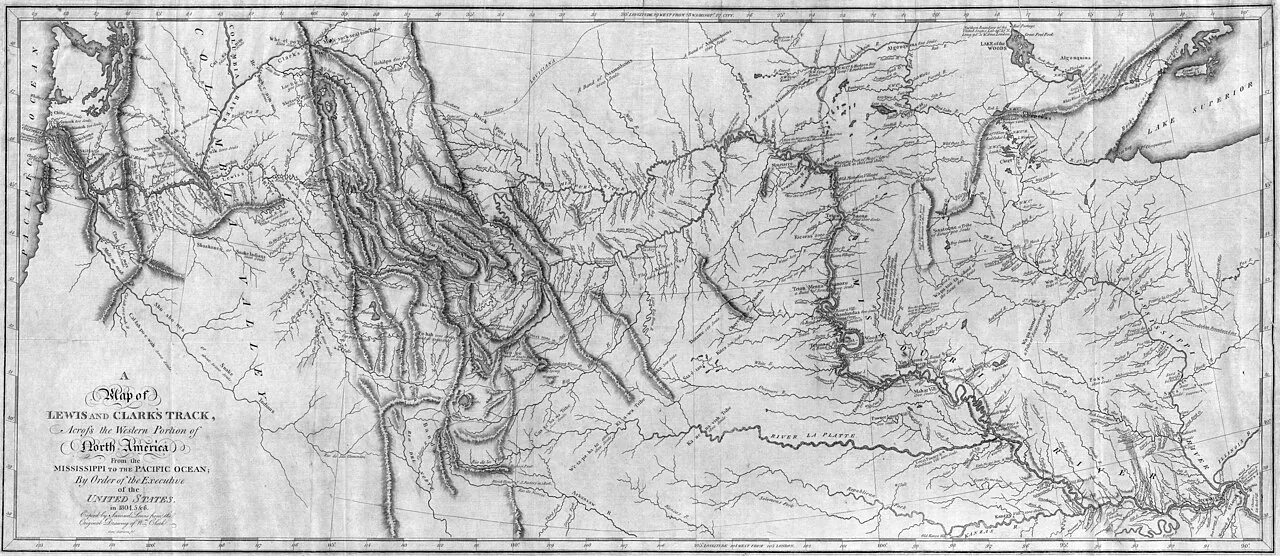
Source: Library of Congress, via Wikimedia Commons.
Commentary. This map was drawn from William Clark’s work and from what Native people told the explorers. It shows a river system for the West, but it also shows how little Americans knew. The map shows the mountains as a single chain, and large parts of it are blank. The expedition did not find an easy water route to the Pacific, which Jefferson had hoped for.
The end of the Jefferson years
In Europe, the war between Britain and Napoleon grew worse, and both sides interfered with American shipping. In June 1807 a British warship, the Leopard, attacked the American frigate Chesapeake and took four sailors. Jefferson chose economic pressure rather than war. The Embargo Act of December 1807 banned American ships from trading with foreign ports. It hurt American merchants, farmers, and sailors more than it hurt Britain. Congress repealed it in March 1809, just before Jefferson left office. On January 1, 1808, the ban on the importation of enslaved Africans took effect. Congress had passed it in 1807 under the Constitution. However, slavery inside the country continued to grow, and so did the domestic slave trade.
Over these twenty years the population grew from about 3.9 million in 1790 to 7.2 million in 1810. The nation had a new capital, a working government, and two competing parties. In addition, it had a Supreme Court with the power to review laws and a western territory twice as large as the original country. It was also a nation in which slavery was spreading, and in which Native nations were losing land. Those tensions would shape the chapters that follow.
4. Why this period matters
The first presidents did not simply carry out the Constitution; they filled it in. Washington created habits of office, including the Cabinet and the two-term tradition. Hamilton showed how a national government could use money and credit. The Alien and Sedition crisis showed how fragile free speech could be during a foreign threat, and how the voters could correct it. The election of 1800 proved that power could change hands peacefully. Marbury v. Madison gave the Supreme Court a lasting role. The Louisiana Purchase set the direction of westward expansion. When you meet these themes again, in Jackson’s presidency and in the disputes over slavery, remember that they began here.
- 1789 Washington inaugurated; Judiciary Act creates the federal courts
- 1791 Bill of Rights ratified; Bank of the United States chartered
- 1794-1795 Whiskey Rebellion; Jay Treaty; Pinckney’s Treaty
- 1796 Washington’s Farewell Address; Adams elected
- 1798 XYZ Affair; Alien and Sedition Acts
- 1800-1801 Election of 1800; Jefferson inaugurated
- 1803 Marbury v. Madison; Louisiana Purchase
- 1804-1806 Lewis and Clark expedition
- 1807 Embargo Act
- 1808 Ban on the importation of enslaved Africans takes effect
Key takeaways
- Washington set precedents: a Cabinet, a two-term limit, and neutrality in European wars.
- Hamilton’s financial plan and the Bank divided Americans over how to read the Constitution. The argument produced the first two parties, Federalists and Democratic-Republicans.
- The Alien and Sedition Acts (1798) limited speech and immigrants; the Kentucky and Virginia Resolutions protested them.
- The election of 1800 transferred power peacefully from one party to another.
- Marbury v. Madison (1803) established judicial review.
- The Louisiana Purchase (1803), for $15 million, nearly doubled the nation; Lewis and Clark explored it, with essential help from Native people, including Sacagawea.

Quick review: flashcards
Tap a card to see the answer.