


This Grade 8 US History to 1877 lesson covers The Thirteen Colonies, part of the unit “Colonies to nation.” First, read the full lesson with its primary sources, maps and key terms. Then practice with the worksheet, check yourself with the quiz and get ready with the test.
In the summer of 1607, about one hundred men and boys stepped off three small ships onto a swampy island in a river that the English named the James. A company of London investors had sent them to find gold and a passage to Asia. They found neither. Within a year most of them were dead of disease, hunger, and fighting. The survivors lived because the Powhatan people, whose land it was, traded corn to them.
Yet that unpromising camp, which the settlers called Jamestown, was the start of something enormous. Over the next 125 years, English settlers and enslaved Africans built thirteen colonies along the Atlantic coast. By 1770 about two million people lived in them. They had formed habits of self-government that would one day make them want independence.
Guiding question: Why did people from Europe and Africa come to the thirteen colonies, and how did differences in land, religion, and labor create three distinct regions with shared ideas about self-government?
1. Settling the colonies, 1607-1732
Virginia and the Chesapeake
The Virginia Company of London founded Jamestown in 1607, the first permanent English settlement in North America. The early years were terrible. In the winter of 1609-1610, known as the Starving Time, most of the colonists died. The colony survived when John Rolfe began growing a sweet variety of tobacco in 1612. Tobacco sold well in England, and planters wanted more land and more workers. At first many of the workers were indentured servants. These English men and women agreed to work for a master for four to seven years in return for the cost of the voyage.
In August 1619 a privateer ship carrying captured Africans landed about twenty enslaved people at Point Comfort, near Jamestown. Over the next decades, Virginia and Maryland turned increasingly to enslaved labor. In 1619 the colonists also elected the first representative assembly in English America, the House of Burgesses. Lord Baltimore founded Maryland in 1634 as a refuge for English Catholics. In 1649 it passed an Act of Toleration that protected the rights of Christians who believed in the Trinity.
Definition: indentured servant
a person who agreed to work for a master for a fixed number of years, usually four to seven, in exchange for the cost of the voyage to America and, often, food and lodging.
Pilgrims and Puritans in New England
The first colonists of New England came for religion. In 1620 a group of about one hundred English men, women, and children crossed the Atlantic on the Mayflower. Many of them were Separatists who had left the Church of England. They had meant to land near the Hudson River, but storms and shoals drove them to Cape Cod, outside the lands covered by their charter.
Before they went ashore, the adult men aboard signed an agreement to govern themselves, now called the Mayflower Compact. Half of them died during the first winter. However, the colony survived with the help of Wampanoag leaders such as Massasoit, and of Tisquantum (Squanto), who had learned English during an earlier captivity in Europe.
Document 1 – The Mayflower Compact, 1620
We, whose names are underwritten, the Loyal Subjects of our dread Sovereign Lord King James, […] Having undertaken for the Glory of God, and Advancement of the Christian Faith, and the Honour of our King and Country, a Voyage to plant the first Colony in the northern Parts of Virginia; Do by these Presents, solemnly and mutually, in the Presence of God and one another, covenant and combine ourselves together into a civil Body Politick, for our better Ordering and Preservation, and Furtherance of the Ends aforesaid: And by Virtue hereof do enact, constitute, and frame, such just and equal Laws, Ordinances, Acts, Constitutions, and Officers, from time to time, as shall be thought most meet and convenient for the general Good of the Colony; unto which we promise all due Submission and Obedience.
Source: The Mayflower Compact, signed at Cape Cod, November 11, 1620 (Old Style); text from the Avalon Project, Yale Law School.
*Body Politick: a community that governs itself by its own laws. *Furtherance: help toward a goal.
Commentary. The Compact was not a constitution, and it did not claim independence: the signers called themselves “Loyal Subjects” of King James. But it did something new. Without a royal order, they joined together to make “just and equal Laws” for “the general Good of the Colony,” and promised to obey them. Women, servants, and enslaved or hired workers did not sign. Later Americans saw in the Compact an early example of government that rests on an agreement among the governed.
Document 2 – Imagining the signing
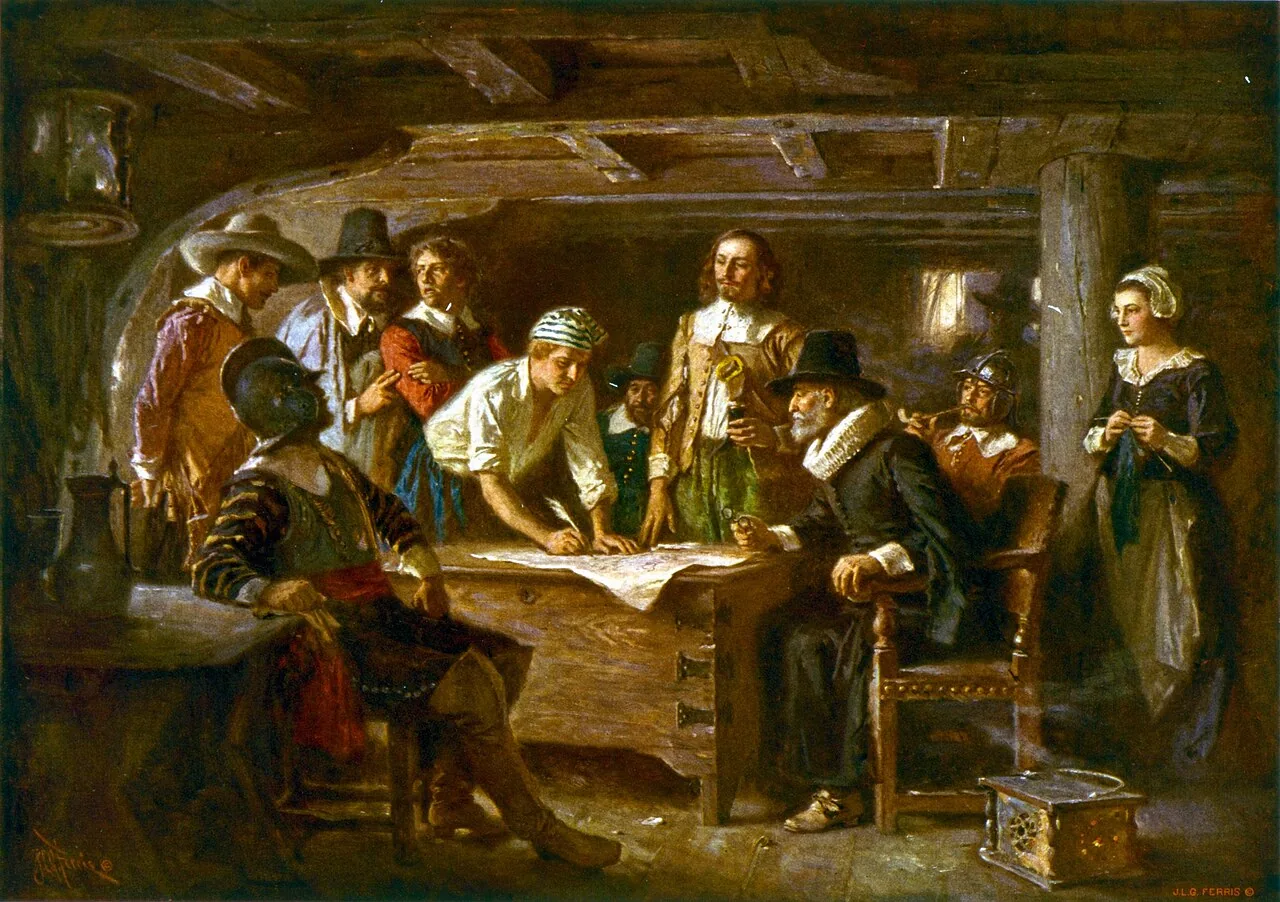
Source: Jean Leon Gerome Ferris, c. 1900, Library of Congress (image on Wikimedia Commons).
The painting shows men in black and brown clothing around a table, with the ship’s timbers behind them. Painters in the 1800s and early 1900s often made the Pilgrims into national heroes. No artist saw the signing. Therefore historians treat the picture as evidence of how Americans later remembered the event, not of what happened in 1620.
The Puritans of Massachusetts
A much larger group of Puritans followed. The Puritans wanted to purify the Church of England of practices they thought had no basis in the Bible. Officials persecuted them at home. Between 1630 and about 1640, some 20,000 of them sailed to Massachusetts Bay under their governor, John Winthrop. Winthrop told the settlers they must work as one body and that the world would watch them, like “a citty upon a hill.” Puritans built their towns around a meetinghouse, and the men who owned property and belonged to the church voted in town meetings.
The Puritans were not tolerant of dissent. In 1635 the colony banished Roger Williams, who argued that the government should not punish people for their religious beliefs. He founded Providence in 1636, the beginning of Rhode Island, where people of many faiths were welcome. The colony banished Anne Hutchinson, a woman who held religious meetings in her home, in 1637-1638. Thomas Hooker led settlers west to the Connecticut River, and Connecticut adopted the Fundamental Orders in 1639. Massachusetts also passed a law in 1647 requiring towns to set up schools, one reason that literacy was high in New England.
Definition: Puritans
English Protestants who wanted to purify the Church of England of practices they believed were not found in the Bible. Many of them left for New England in the 1630s.
Document 3 – Winthrop on the new community
For this end, wee must be knitt together, in this worke, as one man. Wee must entertaine each other in brotherly affection. Wee must be willing to abridge ourselves of our superfluities, for the supply of other’s necessities. Wee must uphold a familiar commerce together in all meekeness, gentlenes, patience and liberality. Wee must delight in eache other; make other’s conditions our oune; rejoice together, mourne together, labour and suffer together, allwayes haueving before our eyes our commission and community in the worke, as members of the same body. […] For wee must consider that wee shall be as a citty upon a hill. The eies of all people are uppon us.
Source: John Winthrop, A Modell of Christian Charity, a lay sermon written in 1630 aboard the Arbella; text from the Hanover Historical Texts Project. Spelling of the original.
*superfluities: extras. *by-word: an example of failure that people repeat.
Commentary. Winthrop wrote this sermon in 1630, before the ships landed. He did not say the colony was perfect. He said the settlers had made a covenant with God and that the world would judge them. The phrase “city upon a hill” comes from the New Testament, and later presidents quoted it as a picture of American purpose. In 1630 it was a warning as much as a boast. If the community failed to live up to its promises, it would become “a by-word through the world.”
The Middle Colonies and the South
In 1624 the Dutch founded New Netherland, with the port of New Amsterdam on Manhattan Island. It was a trading colony, home to Dutch, Walloon, German, Jewish, and African people. Some of them lived in slavery. In 1664 an English fleet took the colony without a battle and renamed it New York for the king’s brother, the Duke of York. The English split New Jersey off the same year. In 1681 King Charles II granted a huge charter to the Quaker William Penn.
Penn founded Pennsylvania as a “holy experiment” with religious freedom, fair dealing with the Lenape, and a capital called Philadelphia, “the city of brotherly love.” Delaware broke off from Pennsylvania in 1704 with its own assembly. In the South, the king chartered Carolina in 1663, and settlers founded Charles Town (later Charleston) in 1670. Many early settlers came from the English sugar island of Barbados. They brought the idea of large plantations worked by enslaved people. James Oglethorpe founded Georgia, the last colony, in 1732 as a buffer against Spanish Florida. At first it banned slavery, but the ban ended in 1751.
- 1607 Jamestown, the first permanent English settlement, is founded in Virginia.
- 1619 The House of Burgesses meets, and the first enslaved Africans arrive in Virginia.
- 1620 The Pilgrims sign the Mayflower Compact at Cape Cod.
- 1630 The Puritans found the Massachusetts Bay Colony.
- 1636 Roger Williams founds Providence, Rhode Island.
- 1664 England takes New Netherland and renames it New York.
- 1681 William Penn receives the charter for Pennsylvania.
- 1732 Georgia, the thirteenth colony, is founded.
2. Three regions, three ways of life
The thirteen colonies are usually grouped into three regions, which differed in climate, soil, and the ways people made a living.
The New England colonies (Massachusetts, New Hampshire, Connecticut, and Rhode Island) had thin, rocky soil and long winters. Families farmed small plots for their own use. The region’s wealth came from the sea: fishing, whaling, shipbuilding, and trade with the West Indies and Europe. Towns were close together, and religion and education were central to community life. The Middle colonies (New York, New Jersey, Pennsylvania, and Delaware) had richer soil, rivers that carried goods to the coast, and a mixture of English, Dutch, German, Scots-Irish, and African people.
They grew wheat and other grains. People therefore called them the “breadbasket colonies,” and Philadelphia and New York became busy ports. The Southern colonies (Maryland, Virginia, North Carolina, South Carolina, and Georgia) had a long growing season. Planters grew tobacco in the Chesapeake region and rice and indigo (a blue dye) in the Carolinas and Georgia. Enslaved Africans did most of the field work on the large plantations. A few wealthy planters held much of the land, wealth, and political power.
Trade and the Navigation Acts
Definition: mercantilism
an economic idea, common in Europe in the 1600s and 1700s, that a country grows strong by selling more than it buys. Under this theory, colonies existed to supply raw materials to the mother country and to buy its manufactured goods.
Britain governed its colonies by this idea. Parliament passed Navigation Acts in 1651, 1660, and 1663. These laws required colonists to ship certain goods, such as tobacco and sugar, only to England. They also required colonists to carry their goods on English or colonial ships. For most of the first half of the 1700s, Britain enforced the laws loosely, a policy later called salutary neglect. Colonists traded widely, and few of them thought of the system as a burden.
3. Self-government and the rights of the English
By 1775 eight of the thirteen colonies were royal colonies, with a governor appointed by the king. Three were proprietary colonies (Maryland, Pennsylvania, and Delaware), owned by a family or individual. Two (Connecticut and Rhode Island) were charter colonies that elected their own governors. In every colony, however, the people elected an assembly, and most property-owning white men could vote. The assemblies decided how to raise and spend local taxes.
As a result, the colonists came to see this power over the purse as the heart of their rights. Colonists also thought of themselves as English subjects with ancient rights such as trial by jury. The Magna Carta (1215) and the English Bill of Rights (1689) had made these rights part of the law. These ideas were not for everyone. Women could not vote, nor could enslaved people, free Black men in most places, or Native Americans. But the habit of self-government, shared across all three regions, mattered more than any single law.
Definition: assembly
a body of representatives elected by the people of a colony. Colonial assemblies made laws and controlled taxes, and the House of Burgesses of Virginia, first met in 1619, was the oldest.
Document 4 – Penn on freedom of conscience, 1701
BECAUSE no People can be truly happy, though under the greatest Enjoyment of Civil Liberties, if abridged of the Freedom of their Consciences, as to their Religious Profession and Worship: […] I do hereby grant and declare, That no Person or Persons, inhabiting in this Province or Territories, who shall confess and acknowledge One almighty God, the Creator, Upholder and Ruler of the World; and profess him or themselves obliged to live quietly under the Civil Government, shall be in any Case molested or prejudiced, in his or their Person or Estate, because of his or their conscientious Persuasion or Practice, nor be compelled to frequent or maintain any religious Worship, Place or Ministry, contrary to his or their Mind, or to do or super any other Act or Thing, contrary to their religious Persuasion.
Source: William Penn, Charter of Privileges Granted by William Penn to the Inhabitants of Pennsylvania and Territories, October 28, 1701; text from the Avalon Project, Yale Law School.
*abridged: cut short. *molested: troubled or harmed.
Commentary. Penn’s Charter of Privileges gave Pennsylvania’s people a legislature and guaranteed freedom of worship to anyone who believed in one God. Like Maryland’s law of 1649, it protected only some beliefs, and officeholders had to profess faith in Jesus Christ. Yet it went much further than the Church of England in England or the Puritans in Massachusetts. Penn’s colony drew Quakers, Lutherans, Mennonites, Catholics, and Jews, and its freedom of conscience later influenced the First Amendment.
Document 5 – Penn and the Lenape in art
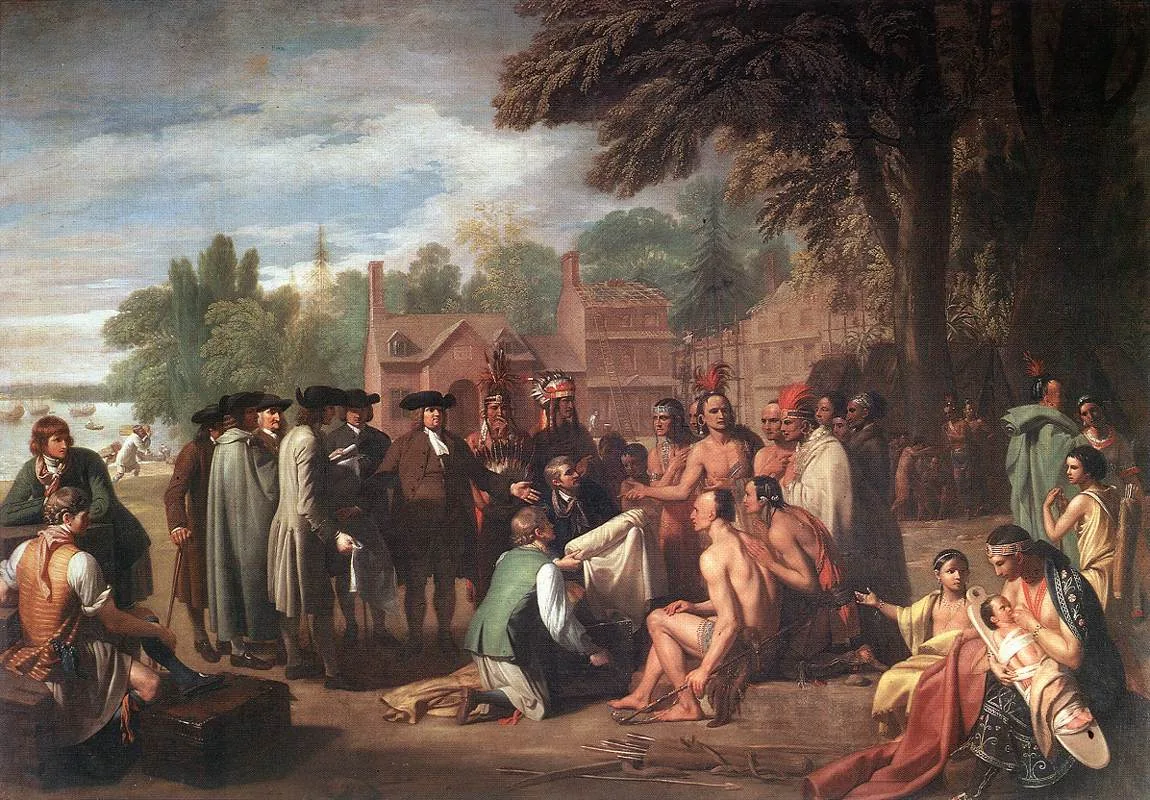
Source: Benjamin West, 1771-1772, Pennsylvania Academy of the Fine Arts (image on Wikimedia Commons).
West, a Pennsylvanian who lived in London, painted Penn making a peaceful agreement with the Lenape beneath a great elm. The picture is idealized. Penn was in his late thirties at the treaty, not stout and elderly as West shows him. Later, Pennsylvania leaders broke his promises to the Lenape, whom settlers pushed west during the 1700s.
4. Slavery, trade, and a growing society
Slavery in the Atlantic world
Enslaved people lived in every colony. Between about 1500 and 1866, slave traders forced roughly 12 million Africans onto ships bound for the Americas, and about 10.7 million survived the voyage. Traders brought only a small fraction, roughly 400,000, to the territory that became the United States. Most went to Brazil and the Caribbean, where sugar plantations worked people to death. By 1770 about 460,000 people of African descent, nearly all of them enslaved, lived in the thirteen colonies, one person in five.
The ships of the slave trade crossed the Atlantic in a pattern that textbooks often call the triangular trade. New England rum and goods went to West Africa. Ships carried enslaved Africans to the West Indies on the Middle Passage. Sugar and molasses then returned to New England, where people made them into rum. Historians now stress that real trade routes were more complex than a neat triangle. Still, the pattern shows how the economies of Africa, the Caribbean, and North America depended on one another.
Document 6 – An African boy remembers the voyage
The closeness of the place, and the heat of the climate, added to the number in the ship, which was so crowded that each had scarcely room to turn himself, almost suffocated us. This produced copious perspirations, so that the air soon became unfit for respiration, from a variety of loathsome smells, and brought on a sickness among the slaves, of which many died, thus falling victims to the improvident avarice, as I may call it, of their purchasers. This wretched situation was again aggravated by the galling of the chains, now become insupportable; and the filth of the necessary tubs, into which the children often fell, and were almost suffocated. The shrieks of the women, and the groans of the dying, rendered the whole a scene of horror almost inconceivable.
Source: Olaudah Equiano, The Interesting Narrative of the Life of Olaudah Equiano, 1789, chapter 2 (the voyage across the Atlantic); Project Gutenberg.
*perspirations: sweat. *pestilential: deadly and foul.
Commentary. Olaudah Equiano became enslaved as a child. A British naval officer bought him, and he bought his freedom in 1766. He later became a leader in the British abolition movement, and his autobiography (1789) was an international best seller. Historians have debated where he was born, since some records suggest South Carolina. However, his description of the Middle Passage matches other accounts and the evidence of the ships themselves. Compare it with the plan of a slave ship below.
Document 7 – The plan of the slave ship Brookes
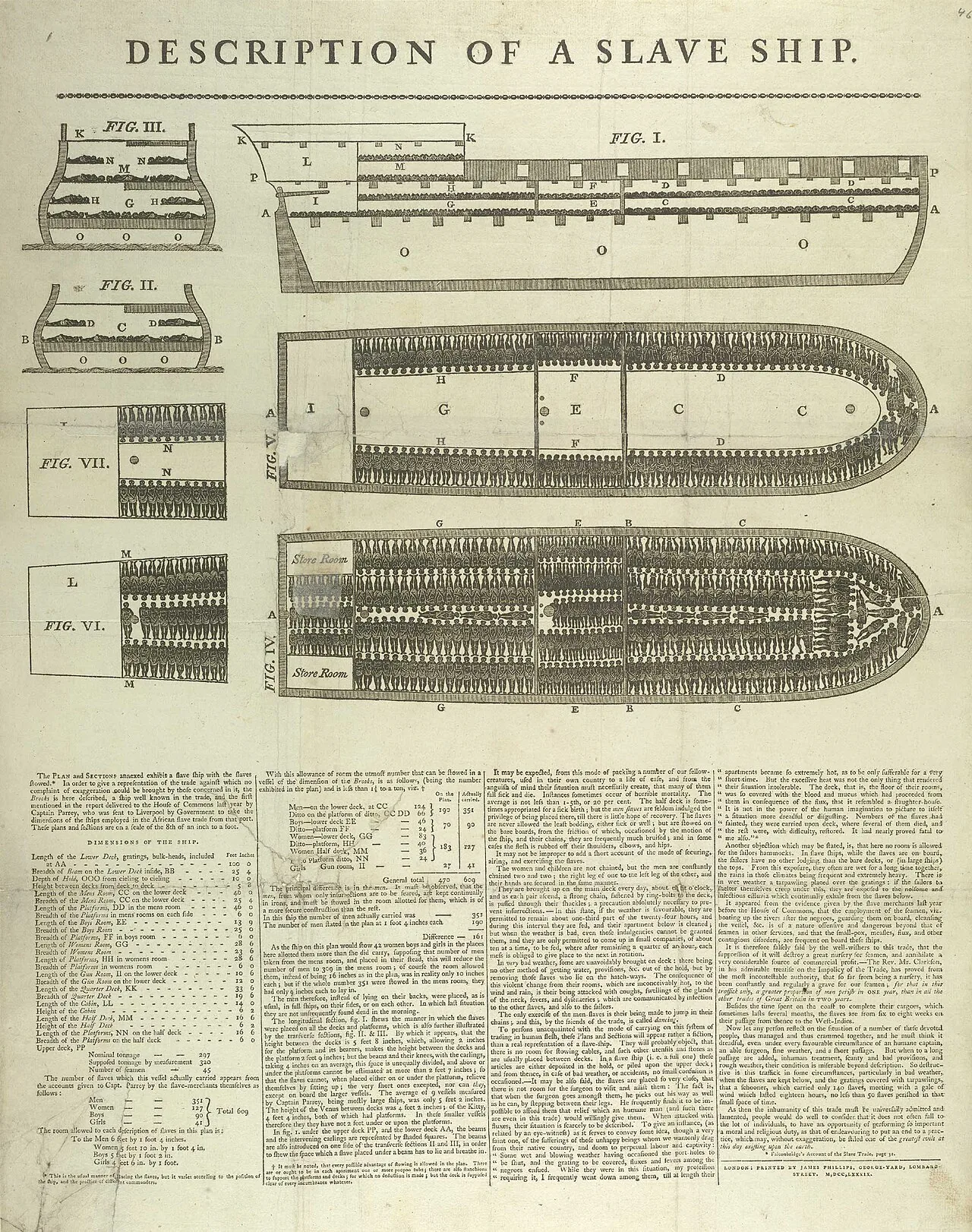
Source: print by James Phillips, London, 1789, British Library (image on Wikimedia Commons).
British opponents of the slave trade printed thousands of copies of this plan in 1788-1789 to show how tightly the ships packed people. The figures drawn in the holds are tiny, lying side by side, with less than two feet of headroom on the lower decks. The picture is propaganda, but it is based on actual measurements.
Enslaved people resisted in many ways, from slowing their work to running away. In September 1739, about twenty enslaved people near the Stono River in South Carolina took weapons and marched toward Spanish Florida, where Spain had promised freedom. White militia defeated them, and South Carolina responded with a harsher slave code.
People, ideas, and conflict
The colonies grew very fast. Large families, cheap land, and a steady flow of immigrants from Germany, Scotland, Ireland, and Africa made the population grow. It rose from about 250,000 in 1700 to more than two million by 1770. The Enlightenment, a European movement that urged people to use reason, spread through the colonies through newspapers, almanacs, and libraries. Benjamin Franklin of Philadelphia was its best-known American voice. Meanwhile, preachers such as Jonathan Edwards and George Whitefield led the Great Awakening, a wave of religious revivals in the 1730s and 1740s. These revivals brought crowds out of the churches and into the fields. They also gave many ordinary people the confidence to question authority.
For Native Americans, colonial growth meant lost land, new diseases, and war. In 1675-1676, King Philip’s War, named for the Wampanoag leader Metacom, killed many hundreds of colonists and a far greater number of Native people. Colonists sold many Native survivors into slavery. Within a few decades after the war, Native nations of southern New England had lost most of their land.
Document 8 – A printer starts a library
And now I set on foot my first project of a public nature, that for a subscription library. I drew up the proposals, got them put into form by our great scrivener, Brockden, and, by the help of my friends in the Junto, procured fifty subscribers of forty shillings each to begin with, and ten shillings a year for fifty years, the term our company was to continue. We afterwards obtain’d a charter, the company being increased to one hundred: this was the mother of all the North American subscription libraries, now so numerous.
Source: Benjamin Franklin, Autobiography, written 1771-1790, on the founding of the Library Company of Philadelphia (1731); Project Gutenberg.
*scrivener: a person who writes legal papers. *Junto: a club of tradesmen that Franklin founded in 1727 to discuss ideas.
Commentary. Franklin was a printer who started with almost nothing and rose through hard work. The library he describes, founded in 1731, still exists. It shows how colonial people used their spare money to learn together. It also shows how Franklin believed that a community of readers made better citizens.
Document 9 – Colonial population, 1700-1780
| Year | Population of the colonies (rounded) |
|---|---|
| 1700 | 251,000 |
| 1720 | 466,000 |
| 1740 | 906,000 |
| 1760 | 1,594,000 |
| 1770 | 2,148,000 |
| 1780 | 2,780,000 |
Source: U.S. Census Bureau, Historical Statistics of the United States, Colonial Times to 1970, series Z 1; estimates rounded to the nearest thousand.
Key takeaways
- English settlement began at Jamestown in 1607; by 1732 there were thirteen colonies founded for profit, religion, and refuge.
- The New England, Middle, and Southern colonies differed in economy and society: fishing and trade, grain and many peoples, and plantation crops grown by enslaved workers.
- Colonists elected assemblies, expected the rights of English subjects, and developed strong traditions of self-government.
- The Mayflower Compact (1620) and Penn’s Charter of Privileges (1701) are early documents of consent and religious freedom.
- Slavery existed in every colony; about 400,000 Africans were brought to the future United States, and about one colonist in five in 1770 was of African descent.
- The population grew from about 250,000 in 1700 to more than 2 million in 1770.

Quick review: flashcards
Tap a card to see the answer.