


This worksheet on The Thirteen Colonies belongs to the Grade 8 US History to 1877 course. Its questions use primary sources, maps and timelines, and they move from basic recall to short writing tasks. Before you start, review the lesson; afterward, try the true or false quiz.
Exercise 1 : Vocabulary of the colonies
Match each term with its meaning, then use three of the terms in sentences about colonial life.
- Indentured servant
- Puritan
- Mercantilism
- Assembly
- Middle Passage
- Salutary neglect
(a) the voyage that carried enslaved Africans across the Atlantic; (b) British policy of loose enforcement of trade laws in the first half of the 1700s; (c) a person who worked for a master for several years to pay for the passage to America; (d) a body of elected representatives who make laws for a colony; (e) a settler who wanted to purify the Church of England; (f) the idea that colonies exist to make the mother country richer.
Coup de pouce: look back at the definitions in the lesson.
Exercise 2 : A promise to govern ourselves
Document 1 – The Mayflower Compact
We, whose names are underwritten, the Loyal Subjects of our dread Sovereign Lord King James, […] Having undertaken for the Glory of God, and Advancement of the Christian Faith, and the Honour of our King and Country, a Voyage to plant the first Colony in the northern Parts of Virginia; Do by these Presents, solemnly and mutually, in the Presence of God and one another, covenant and combine ourselves together into a civil Body Politick, for our better Ordering and Preservation, and Furtherance of the Ends aforesaid: And by Virtue hereof do enact, constitute, and frame, such just and equal Laws, Ordinances, Acts, Constitutions, and Officers, from time to time, as shall be thought most meet and convenient for the general Good of the Colony; unto which we promise all due Submission and Obedience.
Source: The Mayflower Compact, signed at Cape Cod, November 11, 1620 (Old Style); text from the Avalon Project, Yale Law School.
*Body Politick: a community that governs itself by its own laws.
- Present the document (nature, author, date, context).
- Why did the signers feel they needed an agreement before landing?
- Which words show that they still considered themselves subjects of the king?
- Which words show that they intended to make their own laws?
- Who did not sign? What does this tell you about the limits of self-government in 1620?
Coup de pouce: the lesson explains that the Pilgrims landed outside the territory of their charter.
Exercise 3 : A city upon a hill
Document 2 – John Winthrop, 1630
For this end, wee must be knitt together, in this worke, as one man. Wee must entertaine each other in brotherly affection. Wee must be willing to abridge ourselves of our superfluities, for the supply of other’s necessities. Wee must uphold a familiar commerce together in all meekeness, gentlenes, patience and liberality. Wee must delight in eache other; make other’s conditions our oune; rejoice together, mourne together, labour and suffer together, allwayes haueving before our eyes our commission and community in the worke, as members of the same body. […] For wee must consider that wee shall be as a citty upon a hill. The eies of all people are uppon us.
Source: John Winthrop, A Modell of Christian Charity, a lay sermon written in 1630 aboard the Arbella; text from the Hanover Historical Texts Project. Spelling of the original.
*superfluities: extras. *by-word: a name used as an example of failure.
- Present the document (nature, author, date, context).
- What does Winthrop ask each member of the community to do for the others?
- What does he mean when he says that “the eies of all people are uppon us”?
- Does Winthrop describe the colony as a success already achieved? Support your answer with a phrase.
Exercise 4 : Freedom of conscience in Pennsylvania
Document 3 – Penn’s Charter of Privileges, 1701
BECAUSE no People can be truly happy, though under the greatest Enjoyment of Civil Liberties, if abridged of the Freedom of their Consciences, as to their Religious Profession and Worship: […] I do hereby grant and declare, That no Person or Persons, inhabiting in this Province or Territories, who shall confess and acknowledge One almighty God, the Creator, Upholder and Ruler of the World; and profess him or themselves obliged to live quietly under the Civil Government, shall be in any Case molested or prejudiced, in his or their Person or Estate, because of his or their conscientious Persuasion or Practice, nor be compelled to frequent or maintain any religious Worship, Place or Ministry, contrary to his or their Mind, or to do or super any other Act or Thing, contrary to their religious Persuasion.
Source: William Penn, Charter of Privileges Granted by William Penn to the Inhabitants of Pennsylvania and Territories, October 28, 1701; text from the Avalon Project, Yale Law School.
*abridged: cut short. *molested: troubled or harmed.
- Present the document (nature, author, date, context).
- What reason does Penn give for protecting freedom of conscience?
- Whom does the charter protect, and whom does it leave out? Use the wording of the text.
- Why might a persecuted minority in Europe have been drawn to Pennsylvania?
Exercise 5 : Crossing the Atlantic in chains
Document 4 – Olaudah Equiano arrives on the coast
The first object which saluted my eyes when I arrived on the coast was the sea, and a slave ship, which was then riding at anchor, and waiting for its cargo. These filled me with astonishment, which was soon converted into terror when I was carried on board. I was immediately handled and tossed up to see if I were sound by some of the crew; […] I was now persuaded that I had gotten into a world of bad spirits, and that they were going to kill me.
Source: Olaudah Equiano, The Interesting Narrative of the Life of Olaudah Equiano, or Gustavus Vassa, the African, 1789, chapter 2; Project Gutenberg.
*copper: a large metal cooking pot.
- Present the document (nature, author, date, context).
- What were the first things that Equiano saw, and how did he react?
- Why did he believe he had come to “a world of bad spirits”?
- This account was written decades after the events. How should a historian weigh that fact when using it as evidence?
Coup de pouce: think about what a person remembers best after a terrifying experience, and what may change in a memory over time.
Exercise 6 : A young printer arrives in Philadelphia
Document 5 – Benjamin Franklin, Autobiography
Then I asked for a three-penny loaf, and was told they had none such. So not considering or knowing the difference of money, and the greater cheapness nor the names of his bread, I made him give me three-penny worth of any sort. He gave me, accordingly, three great puffy rolls. […] I was surpriz’d at the quantity, but took it, and, having no room in my pockets, walk’d off with a roll under each arm, and eating the other. Thus I went up Market-street as far as Fourth-street, passing by the door of Mr. Read, my future wife’s father; when she, standing at the door, saw me, and thought I made, as I certainly did, a most awkward, ridiculous appearance.
Source: Benjamin Franklin, Autobiography, written 1771-1790, describing his arrival in Philadelphia in October 1723; Project Gutenberg.
*puffy rolls: large soft breads.
- Present the document (nature, author, date, context).
- Describe Franklin’s appearance and behavior as he walks through Philadelphia.
- Why do you think Franklin included the story of Miss Read watching him?
- What does the passage suggest about the opportunities in a colonial port city for a young person with no money?
Exercise 7 : Two visions of a good society
Document 6 – Winthrop, Massachusetts Bay, 1630
For this end, wee must be knitt together, in this worke, as one man. Wee must entertaine each other in brotherly affection. Wee must be willing to abridge ourselves of our superfluities, for the supply of other’s necessities. Wee must uphold a familiar commerce together in all meekeness, gentlenes, patience and liberality. Wee must delight in eache other; make other’s conditions our oune; rejoice together, mourne together, labour and suffer together, allwayes haueving before our eyes our commission and community in the worke, as members of the same body. […] For wee must consider that wee shall be as a citty upon a hill. The eies of all people are uppon us.
Source: John Winthrop, A Modell of Christian Charity, a lay sermon written in 1630 aboard the Arbella; text from the Hanover Historical Texts Project. Spelling of the original.
*by-word: a name used as an example of failure.
Document 7 – Penn, Pennsylvania, 1701
BECAUSE no People can be truly happy, though under the greatest Enjoyment of Civil Liberties, if abridged of the Freedom of their Consciences, as to their Religious Profession and Worship: […] I do hereby grant and declare, That no Person or Persons, inhabiting in this Province or Territories, who shall confess and acknowledge One almighty God, the Creator, Upholder and Ruler of the World; and profess him or themselves obliged to live quietly under the Civil Government, shall be in any Case molested or prejudiced, in his or their Person or Estate, because of his or their conscientious Persuasion or Practice, nor be compelled to frequent or maintain any religious Worship, Place or Ministry, contrary to his or their Mind, or to do or super any other Act or Thing, contrary to their religious Persuasion.
Source: William Penn, Charter of Privileges Granted by William Penn to the Inhabitants of Pennsylvania and Territories, October 28, 1701; text from the Avalon Project, Yale Law School.
*molested: troubled or harmed.
- Present each document (author, date, place).
- What holds the community together in each document?
- How does each document treat people who hold other religious beliefs?
- Explain one similarity and one difference between the two colonies.
Coup de pouce: Winthrop speaks of a community of believers; Penn speaks of a government that protects conscience.
Exercise 8 : The voyage in words and in a picture
Document 8 – Equiano on the voyage
The closeness of the place, and the heat of the climate, added to the number in the ship, which was so crowded that each had scarcely room to turn himself, almost suffocated us. This produced copious perspirations, so that the air soon became unfit for respiration, from a variety of loathsome smells, and brought on a sickness among the slaves, of which many died, thus falling victims to the improvident avarice, as I may call it, of their purchasers. This wretched situation was again aggravated by the galling of the chains, now become insupportable; and the filth of the necessary tubs, into which the children often fell, and were almost suffocated. The shrieks of the women, and the groans of the dying, rendered the whole a scene of horror almost inconceivable.
Source: Olaudah Equiano, The Interesting Narrative of the Life of Olaudah Equiano, 1789, chapter 2 (the voyage across the Atlantic); Project Gutenberg.
*pestilential: deadly and foul.
Document 9 – Plan of the slave ship Brookes
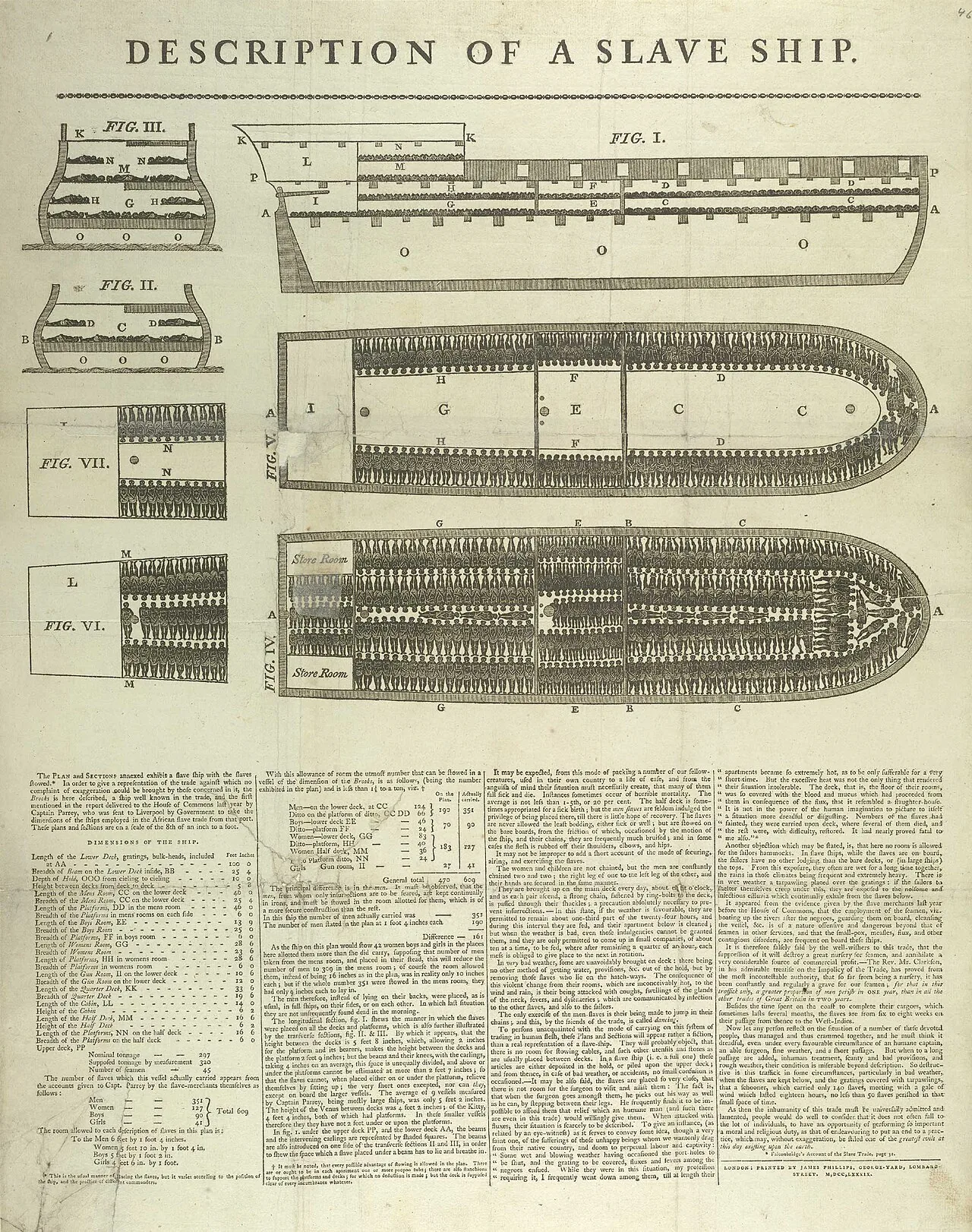
Source: print by James Phillips, London, 1789, British Library.
- Present each document (nature, author or maker, date).
- Which details in Equiano’s text can you match with the plan?
- What was the purpose of each document? Who was the audience?
- Which of the two documents gives better evidence of the feelings of the enslaved people? Which gives better evidence of the size and layout of a ship? Explain.
Exercise 9 : Imagining the Mayflower Compact
Document 10 – A painting of the Compact
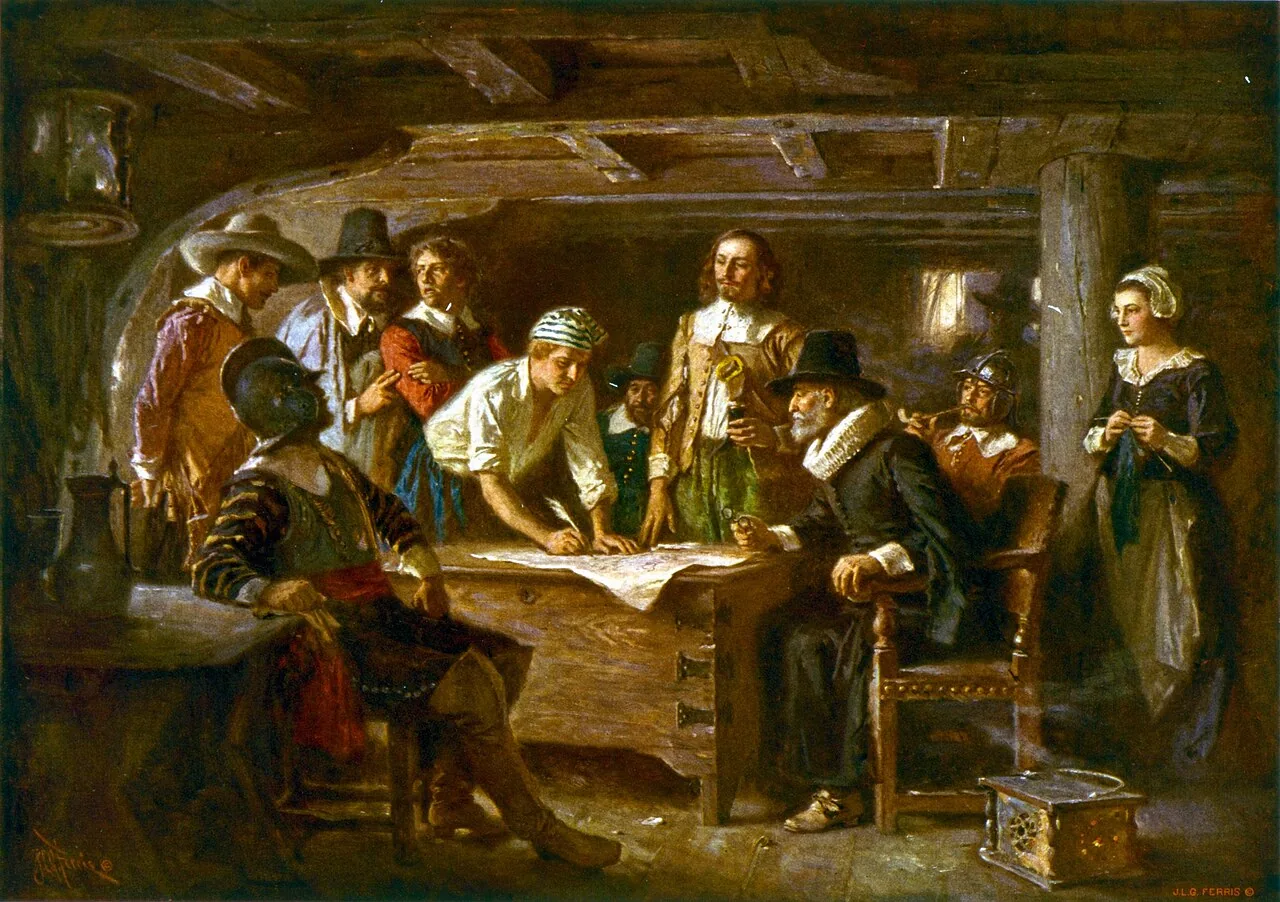
Source: Jean Leon Gerome Ferris, c. 1900, Library of Congress.
- Present the document (nature, artist, date).
- Describe what you see: the people, the setting, and the objects.
- The artist worked almost 300 years after the event. What does this tell you about the picture as evidence?
- What message do you think the painter wanted viewers to take from the scene?
Exercise 10 : Penn and the Lenape
Document 11 – Benjamin West, Penn’s Treaty with the Indians
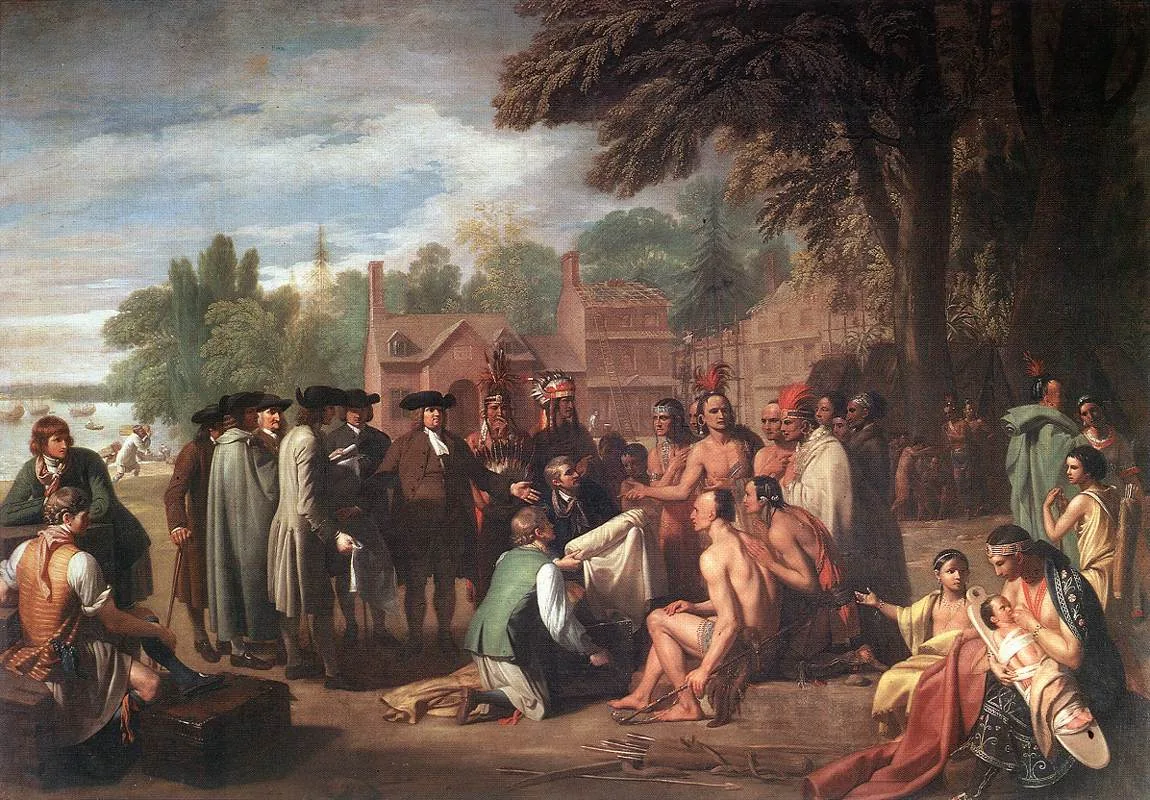
Source: Benjamin West, 1771-1772, Pennsylvania Academy of the Fine Arts.
- Present the document (nature, artist, date).
- Describe how West arranged the figures. Who stands near the center?
- West painted about ninety years after the treaty. Which features of the painting may be invented?
- What impression of Pennsylvania’s relations with the Lenape did West want to create?
Exercise 11 : The Philadelphia citizen
Document 12 – Portrait of Benjamin Franklin
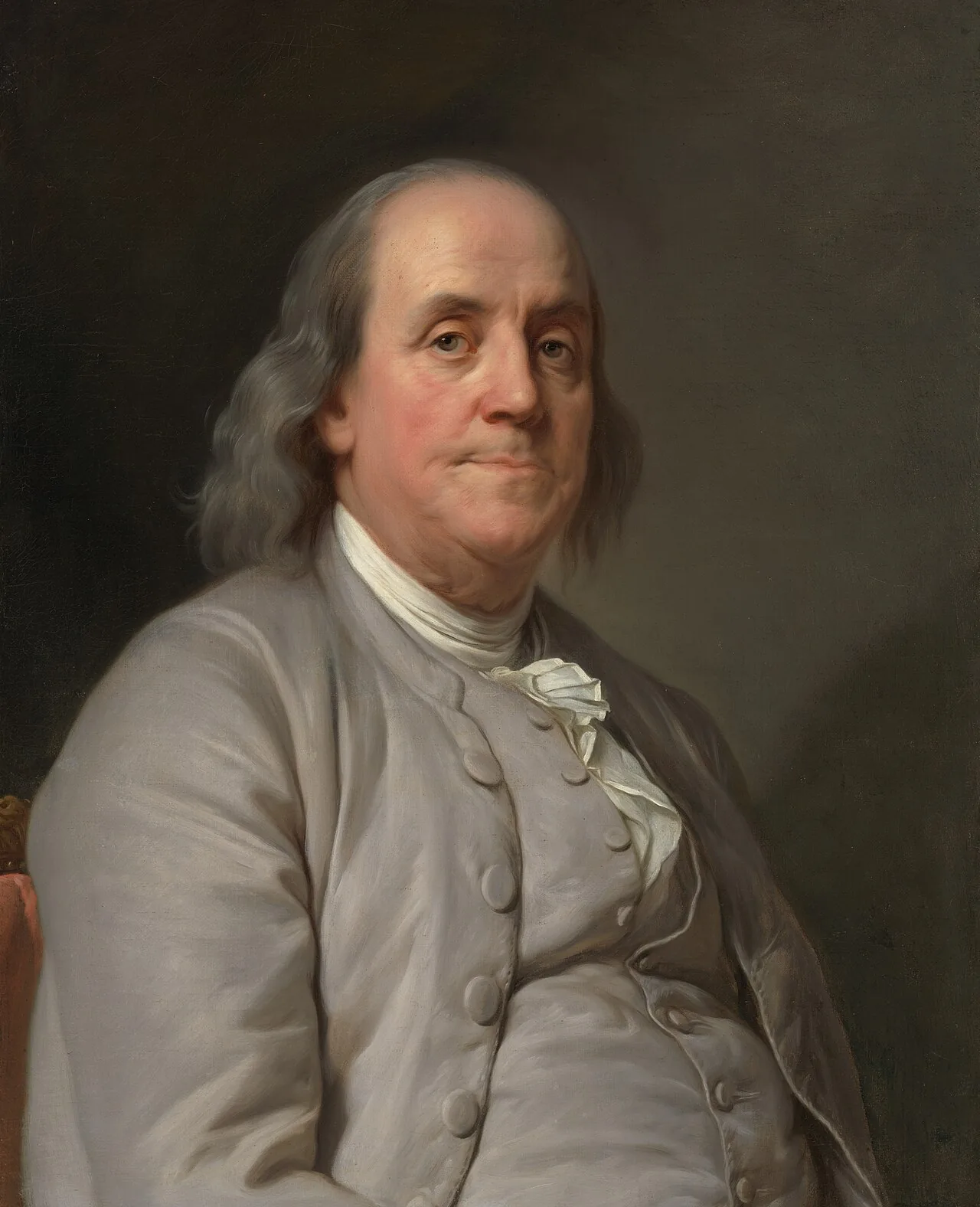
Source: Joseph Siffred Duplessis, 1770s-1780s, oil on canvas.
- Present the document (nature, artist, subject).
- Describe Franklin’s clothes, face, and pose.
- Why might Franklin have chosen to be painted in plain clothes while he was in France?
- Use the lesson to name two things that Franklin did for his city.
Exercise 12 : Equiano portrays himself
Document 13 – Frontispiece of Equiano’s autobiography, 1789
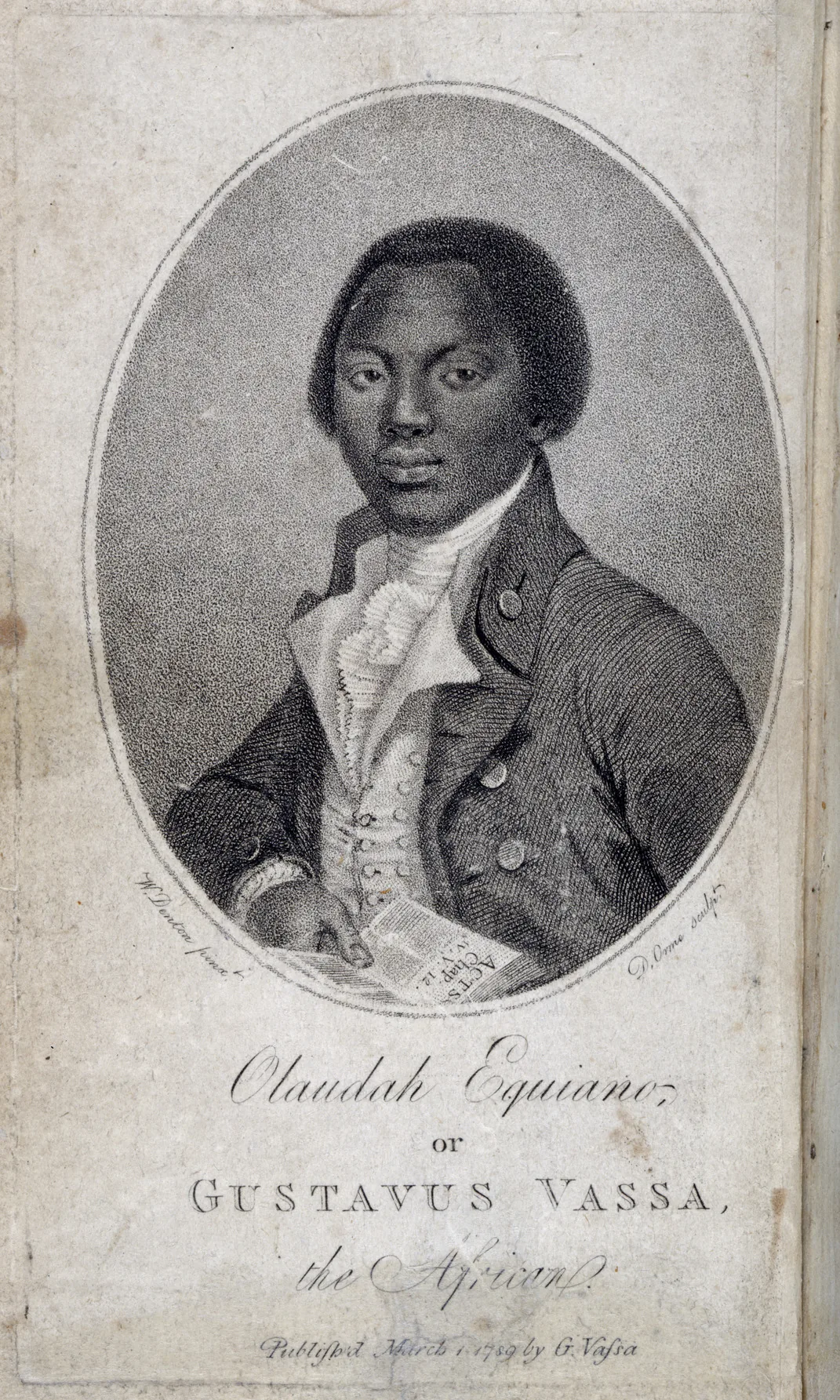
Source: first edition, London, 1789, British Library.
- Present the document (nature, date, place of publication).
- Describe the man’s clothing and expression.
- Why might Equiano have wanted to be shown as a well-dressed gentleman holding a book?
- How does this picture challenge ideas that supporters of slavery spread about African people?
Exercise 13 : Population growth
Document 14 – Colonial population, 1700-1780
| Year | Population (rounded) |
|---|---|
| 1700 | 251,000 |
| 1720 | 466,000 |
| 1740 | 906,000 |
| 1760 | 1,594,000 |
| 1770 | 2,148,000 |
| 1780 | 2,780,000 |
Source: U.S. Census Bureau, Historical Statistics of the United States, Colonial Times to 1970, series Z 1; figures rounded.
- By about how many times did the population grow between 1700 and 1770? (Divide and round.)
- In which 20-year period did the population grow most in absolute numbers?
- Give two causes of growth mentioned in the lesson.
- Why did a growing population make it harder for Britain to rule the colonies?
Exercise 14 : Map 1: Places of settlement
Use the map to answer the questions.
- Match each number with one of these places: Plymouth, Jamestown, Philadelphia, Charleston, New York, and Savannah.
- Which of these is in New England? Which are in the Middle colonies?
- Which of these places was founded first? Which last?
- Explain why the rivers and harbors on this map helped trade.
Coup de pouce: use Map 1 in the lesson as a model.
Exercise 15 : Map 2: The Atlantic trade
Use the map to answer the questions.
- Match each place with its number: Boston, West Africa (Gold Coast), Jamaica in the West Indies, and Charleston.
- Which two points were linked by the Middle Passage?
- Name two goods that moved along the leg from the West Indies to New England.
- Explain why historians say the “triangle” was only a simplified picture of the slave trade.
Exercise 16 : Put the events in order
Put these events in order from earliest to latest, and write the date next to each one: (a) Pennsylvania receives its charter; (b) the first enslaved Africans arrive in Virginia; (c) the Puritans found Massachusetts Bay; (d) Georgia is founded; (e) the Pilgrims sign the Mayflower Compact; (f) Jamestown is founded; (g) England takes New Netherland.
Exercise 17 : How long between events?
Calculate each interval and say in which century the second event happened.
- From the founding of Jamestown (1607) to the Mayflower Compact (1620).
- From Penn’s charter (1681) to Georgia (1732).
- From Jamestown (1607) to the founding of Georgia (1732).
- From the first Africans in Virginia (1619) to the ban on importing enslaved people in 1808.
Exercise 18 : Guided research: Jamestown and the Powhatan
Mini-investigation: what was life like in early Jamestown, and how did the Powhatan people respond?
- Search for: “Jamestown Starving Time,” “Powhatan Confederacy Wahunsenaca,” “Historic Jamestowne.” Reliable sites: Historic Jamestowne (Colonial National Historical Park, nps.gov), the Library of Congress, and Encyclopedia Virginia.
- Fill in a card: Who was Wahunsenaca (Chief Powhatan)? What did the English want from the Powhatan? What did the Powhatan want from the English?
- Find two causes of the deaths in the Starving Time.
- Write three sentences: how did tobacco change Jamestown?
Exercise 19 : CER paragraph: what held the colonies together?
Write a paragraph using the Claim-Evidence-Reasoning model.
Question: Which was more important in shaping the thirteen colonies, religion or economic opportunity? Take a position.
- State a claim.
- Give at least two pieces of evidence from the lesson or the documents.
- Explain how your evidence supports your claim.
Coup de pouce: religion drove Massachusetts and Pennsylvania; economic goals drove Virginia and Georgia’s trade.
Exercise 20 : SAQ: three regions
Answer in complete sentences.
- Identify one way the economy of New England differed from that of the Southern colonies.
- Explain one reason for the difference.
- Describe one way that the Middle colonies were different from both regions.
Exercise 21 : True or false? Justify
Decide whether each statement is true or false. If it is false, correct it.
- The House of Burgesses was the first elected assembly in English America.
- The Mayflower Compact declared independence from England.
- Most enslaved Africans carried across the Atlantic were taken to the thirteen colonies.
- Roger Williams founded Rhode Island after being banished from Massachusetts.
- Salutary neglect means that Britain strictly enforced its trade laws.
Exercise 22 : Causes and consequences: slavery in the colonies
Complete the chain, then answer the question.
Cause: tobacco, rice, and indigo grown for sale → Event: planters demand a large labor force → Consequence: ?
- Name the consequence that explains why the number of enslaved people grew.
- Give two ways that enslaved people resisted.
- Explain one long-term consequence of slavery for the thirteen colonies.


Quick review: flashcards
Tap a card to see the answer.