


This Grade 8 US History to 1877 test covers The Thirteen Colonies. Like a classroom assessment, it includes documents to analyze, knowledge questions and a short writing task. To prepare, review the lesson first, then practice with the worksheet.
Time : 50 min
The test has three parts: knowledge (32 points), documents (48 points), and a written argument (20 points). Answer in complete sentences and cite the documents.
Document 1 – Document 1 – The thirteen colonies
Map prepared for this unit from Natural Earth data; regions simplified and approximate.
Document 2 – Document 2 – Equiano on arriving at the coast
The first object which saluted my eyes when I arrived on the coast was the sea, and a slave ship, which was then riding at anchor, and waiting for its cargo. These filled me with astonishment, which was soon converted into terror when I was carried on board. I was immediately handled and tossed up to see if I were sound by some of the crew; […] I was now persuaded that I had gotten into a world of bad spirits, and that they were going to kill me.
Source: Olaudah Equiano, The Interesting Narrative of the Life of Olaudah Equiano, or Gustavus Vassa, the African, 1789, chapter 2; Project Gutenberg.
*copper: a large metal cooking pot.
Project Gutenberg.
Document 3 – Document 3 – Penn and the Lenape
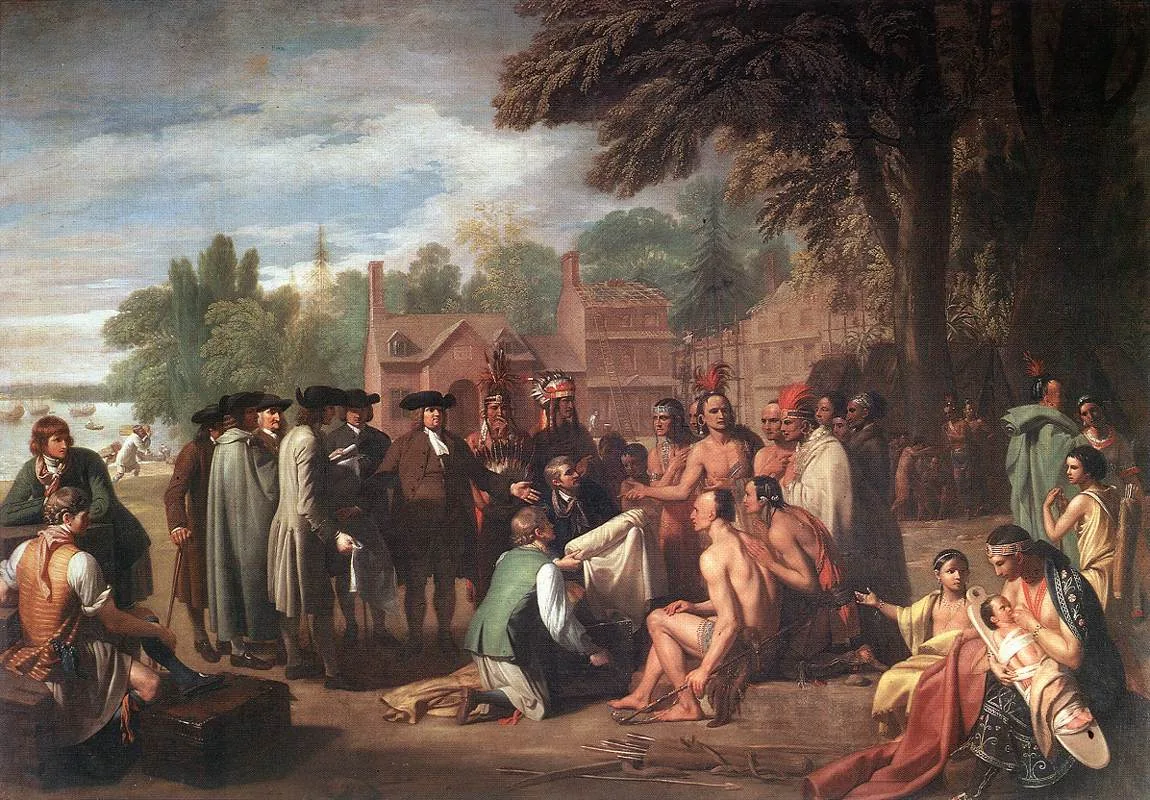
Wikimedia Commons.
Document 4 – Document 4 – Colonial population
| Year | Population (rounded) |
|---|---|
| 1700 | 251,000 |
| 1740 | 906,000 |
| 1770 | 2,148,000 |
U.S. Census Bureau, Historical Statistics of the United States, series Z 1; figures rounded.
Questions
- Part 1 – Knowledge. Define indentured servant, assembly, and mercantilism. (12 pts)
- Part 1. Document 1: name the three regions shown and one economic activity typical of each. (12 pts)
- Part 1. Explain why the Mayflower Compact is important in the history of self-government. (8 pts)
- Part 2 – Documents. Document 2: present the document and describe Equiano’s feelings. Why would an account like this have helped abolitionists? (14 pts)
- Part 2. Document 3: present the document, describe the scene, and explain why a historian must be careful in using it as evidence of what happened in the 1680s. (14 pts)
- Part 2. Document 4: calculate by how many times the population grew between 1700 and 1770 (round to the nearest whole number), and name two causes of growth. (10 pts)
- Part 2. Using Document 1 and the lesson, explain two ways in which geography affected how the New England and Southern colonies earned a living. (10 pts)
- Part 3 – Written argument. Despite their differences, the thirteen colonies shared ideas about self-government. Write a paragraph or two with a claim, at least two pieces of evidence from the documents or the lesson, and your reasoning. (20 pts)


Quick review: flashcards
Tap a card to see the answer.