


This US History Grade 11 test covers The Civil Rights Movement. Like a classroom assessment, it includes documents to analyze, knowledge questions and a short writing task. To prepare, review the lesson first, then practice with the worksheet.
Time : 50 min
The test has three parts: knowledge (30 points), documents (50 points), and a written argument (20 points). Answer in complete sentences and cite the documents.
Document 1 – Document 1 – Segregated schools in 1954 and civil rights sites
Map prepared for this unit from Natural Earth data.
Document 2 – Document 2 – Warren, <em>Brown v. Board of Education</em>, 1954
We conclude that, in the field of public education, the doctrine of “separate but equal” has no place. Separate educational facilities are inherently unequal. Therefore, we hold that the plaintiffs and others similarly situated for whom the actions have been brought are, by reason of the segregation complained of, deprived of the equal protection of the laws guaranteed by the Fourteenth Amendment. This disposition makes unnecessary any discussion whether such segregation also violates the Due Process Clause of the Fourteenth Amendment.
Source: Chief Justice Earl Warren, opinion of the Court, Brown v. Board of Education of Topeka, 347 U.S. 483, May 17, 1954 (holding); text from Wikisource.
*doctrine: official principle. *inherently: by its very nature.
Wikisource.
Document 3 – Document 3 – Elizabeth Eckford, Little Rock, 1957
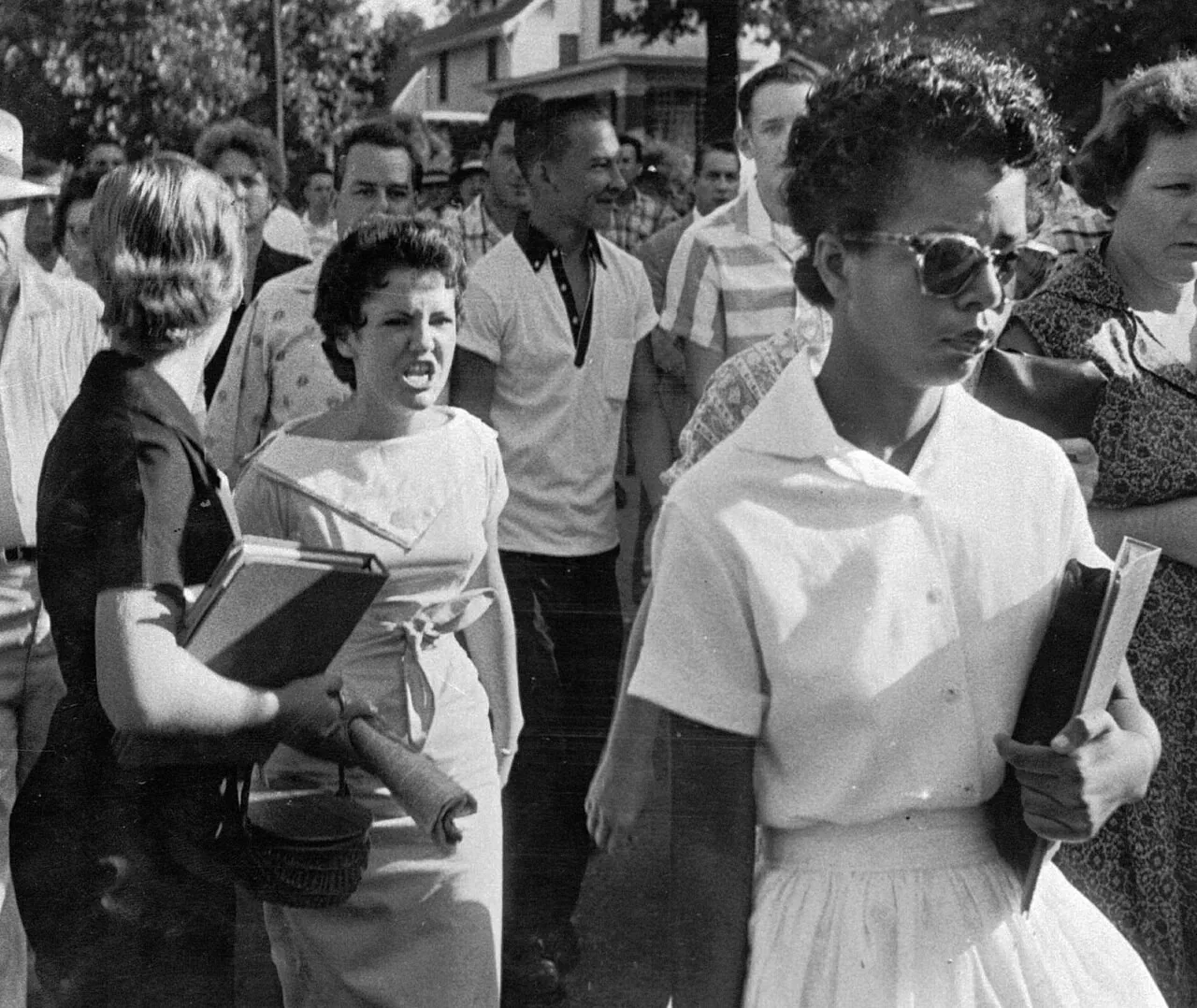
Wikimedia Commons.
Document 4 – Document 4 – Black voter registration
| State | 1964 | 1969 |
|---|---|---|
| Alabama | 19.3 percent | 61.3 percent |
| Mississippi | 6.7 percent | 66.5 percent |
Wikipedia, “Voting Rights Act,” citing scholarly and official sources.
Questions
- Part 1 – Knowledge. Define Jim Crow, sit-in, and massive resistance. (12 pts)
- Part 1. Document 1: what does the red color show, and what does the orange color show? Name two cities of Alabama on the map. (10 pts)
- Part 1. Name two methods of nonviolent direct action used by the movement and give a place and a date for each. (8 pts)
- Part 2 – Documents. Document 2: present the document, state the holding, and explain its importance. (14 pts)
- Part 2. Document 3: present the document, describe what you see, and explain how the event ended. (14 pts)
- Part 2. Document 4: calculate the increase in registration in each state (in percentage points) and explain why the increase was greater in Mississippi. (12 pts)
- Part 2. Using Documents 2 and 3 and the lesson, explain why the Brown decision did not immediately end school segregation. (10 pts)
- Part 3 – Written argument. To what extent did the civil rights movement achieve its goals between 1954 and 1965? Write a paragraph or two with a claim, at least two pieces of evidence, and your reasoning. (20 pts)


Quick review: flashcards
Tap a card to see the answer.