


This worksheet on The Civil Rights Movement belongs to the US History Grade 11 course. Its questions use primary sources, maps and timelines, and they move from basic recall to short writing tasks. Before you start, review the lesson; afterward, try the true or false quiz.
Exercise 1 : Vocabulary of the civil rights movement
Match each term with its definition, then use each term in a sentence.
- Jim Crow
- Boycott
- Sit-in
- Freedom Rider
- Filibuster
- Massive resistance
Definitions: (a) refusal to buy or use something as a protest; (b) a protester who sat at a segregated counter until served or arrested; (c) a long speech used by senators to block a vote; (d) a person who rode buses to test the ban on segregation in interstate travel; (e) the system of segregation laws and customs; (f) the effort by Southern leaders to block school integration.
Exercise 2 : Harlan’s dissent
Document 1 – Harlan dissenting, Plessy v. Ferguson, 1896
The white race deems itself to be the dominant race in this country. And so it is, in prestige, in achievements, in education, in wealth, and in power. So, I doubt not, it will continue to be for all time, if it remains true to its great heritage, and holds fast to the principles of constitutional liberty. But in view of the constitution, in the eye of the law, there is in this country no superior, dominant, ruling class of citizens. There is no caste here. Our constitution is color-blind, and neither knows nor tolerates classes among citizens. In respect of civil rights, all citizens are equal before the law. The humblest is the peer of the most powerful.
Source: Justice John Marshall Harlan, dissenting opinion, Plessy v. Ferguson, 163 U.S. 537, May 18, 1896; text from the Legal Information Institute, Cornell Law School.
*dominant: ruling. *caste: a rigid hereditary social class.
- Present the document (nature, author, date, context).
- What does Harlan admit about white attitudes?
- What does he say the Constitution does not allow?
- Why did later lawyers for the NAACP use this opinion?
Exercise 3 : A question of education
Document 2 – Chief Justice Warren, Brown, 1954
Today, education is perhaps the most important function of state and local governments. Compulsory school attendance laws and the great expenditures for education both demonstrate our recognition of the importance of education to our democratic society. It is required in the performance of our most basic public responsibilities, even service in the armed forces. It is the very foundation of good citizenship. Today it is a principal instrument in awakening the child to cultural values, in preparing him for later professional training, and in helping him to adjust normally to his environment. In these days, it is doubtful that any child may reasonably be expected to succeed in life if he is denied the opportunity of an education.
Source: Chief Justice Earl Warren, opinion of the Court, Brown v. Board of Education of Topeka, 347 U.S. 483, May 17, 1954 (on education); text from Wikisource.
*compulsory: required by law.
- Present the document (nature, author, date).
- Why does Warren say that education is so important?
- What does he say about a child who is denied an education?
- How does this reasoning prepare for the decision?
Exercise 4 : The holding in <em>Brown</em>
Document 3 – The holding in Brown, 1954
We conclude that, in the field of public education, the doctrine of “separate but equal” has no place. Separate educational facilities are inherently unequal. Therefore, we hold that the plaintiffs and others similarly situated for whom the actions have been brought are, by reason of the segregation complained of, deprived of the equal protection of the laws guaranteed by the Fourteenth Amendment. This disposition makes unnecessary any discussion whether such segregation also violates the Due Process Clause of the Fourteenth Amendment.
Source: Chief Justice Earl Warren, opinion of the Court, Brown v. Board of Education of Topeka, 347 U.S. 483, May 17, 1954 (holding); text from Wikisource.
*doctrine: official principle. *inherently: by its very nature.
- Present the document (nature, author, date).
- What doctrine does the Court reject?
- Which amendment is cited?
- Which earlier case does this overturn in part?
Exercise 5 : Equality in the armed forces
Document 4 – Executive Order 9981, 1948
It is hereby declared to be the policy of the President that there shall be equality of treatment and opportunity for all persons in the armed services without regard to race, color, religion or national origin. This policy shall be put into effect as rapidly as possible, having due regard to the time required to effectuate any necessary changes without impairing efficiency or morale.
Source: Harry S. Truman, Executive Order 9981, Establishing the President’s Committee on Equality of Treatment and Opportunity in the Armed Services, July 26, 1948; text from the National Archives.
*equality of treatment: equal treatment.
- Present the document (nature, author, date).
- What policy does it declare?
- What phrase shows that change might be slow?
- Explain why the desegregation of the army was important for the later movement.
Exercise 6 : Defiance in Congress
Document 5 – The Southern Manifesto, 1956
We regard the decisions of the Supreme Court in the school cases as a clear abuse of judicial power. It climaxes a trend in the Federal Judiciary undertaking to legislate, in derogation of the authority of Congress, and to encroach upon the reserved rights of the States and the people. The original Constitution does not mention education. Neither does the 14th Amendment nor any other amendment. The debates preceding the submission of the 14th Amendment clearly show that there was no intent that it should affect the system of education maintained by the States.
Source: Declaration of Constitutional Principles (the “Southern Manifesto”), read in Congress, March 12, 1956; text from Wikisource.
*derogation: lessening of the authority. *encroach: intrude upon.
- Present the document (nature, signers, date).
- What accusation do the signers make against the Supreme Court?
- What argument do they make about the 14th Amendment?
- What important point does the text leave out?
Exercise 7 : Law and order at Little Rock
Document 6 – Eisenhower, September 24, 1957
In accordance with that responsibility, I have today issued an Executive Order directing the use of troops under Federal authority to aid in the execution of Federal law at Little Rock, Arkansas. This became necessary when my Proclamation of yesterday was not observed, and the obstruction of justice still continues. It is important that the reasons for my action be understood by all our citizens. As you know, the Supreme Court of the United States has decided that separate public educational facilities for the races are inherently unequal and therefore compulsory school segregation laws are unconstitutional.
Source: Dwight D. Eisenhower, radio and television address to the American people on the situation in Little Rock, September 24, 1957; text from the American Presidency Project.
*obstruction: act of blocking.
- Present the document (nature, author, date, context).
- What action does Eisenhower announce?
- Why does he say it became necessary?
- How does he describe the Supreme Court’s decision?
Exercise 8 : “Their cause must be our cause too”
Document 7 – Johnson, March 15, 1965
Their cause must be our cause too. Because it is not just Negroes, but really it is all of us, who must overcome the crippling legacy of bigotry and injustice. And we shall overcome. As a man whose roots go deeply into Southern soil I know how agonizing racial feelings are. I know how difficult it is to reshape the attitudes and the structure of our society. But a century has passed, more than a hundred years, since the Negro was freed. And he is not fully free tonight.
Source: Lyndon B. Johnson, special message to Congress, “The American Promise,” March 15, 1965; text from the American Presidency Project.
*legacy: what is left from the past. *bigotry: intolerance.
- Present the document (nature, author, date, context).
- Whose cause does Johnson say is also his own?
- What does he say about his own background?
- Why was it significant for a president to use these words?
Exercise 9 : Ending discrimination with money
Document 8 – Civil Rights Act of 1964, Title VI
SEC. 601. No person in the United States shall, on the ground of race, color, or national origin, be excluded from participation in, be denied the benefits of, or be subjected to discrimination under any program or activity receiving Federal financial assistance.
Source: Civil Rights Act of 1964, signed July 2, 1964, Title VI, Section 601; text from the National Archives.
*discrimination: unfair treatment. *federal financial assistance: money from the national government.
- Present the document (nature, date).
- On what grounds is discrimination forbidden?
- In what kinds of programs?
- Explain why this section was powerful in the South.
Exercise 10 : Protecting the vote
Document 9 – Voting Rights Act of 1965, Section 2
SEC. 2. No voting qualification or prerequisite to voting, or standard, practice, or procedure shall be imposed or applied by any State or political subdivision to deny or abridge the right of any citizen of the United States to vote on account of race or color.
Source: Voting Rights Act of 1965, signed August 6, 1965, Section 2; text from the National Archives.
*prerequisite: a requirement. *abridge: reduce.
- Present the document (nature, date).
- What practices are forbidden?
- Which constitutional amendment does this law enforce?
- Why were earlier laws not enough?
Exercise 11 : Plessy and Brown
Document 10 – Harlan, 1896
The white race deems itself to be the dominant race in this country. And so it is, in prestige, in achievements, in education, in wealth, and in power. So, I doubt not, it will continue to be for all time, if it remains true to its great heritage, and holds fast to the principles of constitutional liberty. But in view of the constitution, in the eye of the law, there is in this country no superior, dominant, ruling class of citizens. There is no caste here. Our constitution is color-blind, and neither knows nor tolerates classes among citizens. In respect of civil rights, all citizens are equal before the law. The humblest is the peer of the most powerful.
Source: Justice John Marshall Harlan, dissenting opinion, Plessy v. Ferguson, 163 U.S. 537, May 18, 1896; text from the Legal Information Institute, Cornell Law School.
*dominant: ruling. *caste: a rigid hereditary social class.
Document 11 – Warren, 1954
We conclude that, in the field of public education, the doctrine of “separate but equal” has no place. Separate educational facilities are inherently unequal. Therefore, we hold that the plaintiffs and others similarly situated for whom the actions have been brought are, by reason of the segregation complained of, deprived of the equal protection of the laws guaranteed by the Fourteenth Amendment. This disposition makes unnecessary any discussion whether such segregation also violates the Due Process Clause of the Fourteenth Amendment.
Source: Chief Justice Earl Warren, opinion of the Court, Brown v. Board of Education of Topeka, 347 U.S. 483, May 17, 1954 (holding); text from Wikisource.
*doctrine: official principle.
- Present each document (author, date, role).
- What do both documents say about equality?
- What is the difference in the reasoning?
- Explain how one dissent became the basis of a unanimous decision.
Exercise 12 : Court and Congress
Document 12 – Warren, 1954
Today, education is perhaps the most important function of state and local governments. Compulsory school attendance laws and the great expenditures for education both demonstrate our recognition of the importance of education to our democratic society. It is required in the performance of our most basic public responsibilities, even service in the armed forces. It is the very foundation of good citizenship. Today it is a principal instrument in awakening the child to cultural values, in preparing him for later professional training, and in helping him to adjust normally to his environment. In these days, it is doubtful that any child may reasonably be expected to succeed in life if he is denied the opportunity of an education.
Source: Chief Justice Earl Warren, opinion of the Court, Brown v. Board of Education of Topeka, 347 U.S. 483, May 17, 1954 (on education); text from Wikisource.
*compulsory: required by law.
Document 13 – Southern Manifesto, 1956
We regard the decisions of the Supreme Court in the school cases as a clear abuse of judicial power. It climaxes a trend in the Federal Judiciary undertaking to legislate, in derogation of the authority of Congress, and to encroach upon the reserved rights of the States and the people. The original Constitution does not mention education. Neither does the 14th Amendment nor any other amendment. The debates preceding the submission of the 14th Amendment clearly show that there was no intent that it should affect the system of education maintained by the States.
Source: Declaration of Constitutional Principles (the “Southern Manifesto”), read in Congress, March 12, 1956; text from Wikisource.
*derogation: lessening. *encroach: intrude upon.
- Present each document (author, date).
- How does each document describe the role of education?
- Which uses the idea of states’ rights?
- Evaluate which document reflects the Constitution better.
Exercise 13 : Law and protest
Document 14 – The Civil Rights Act, 1964
SEC. 601. No person in the United States shall, on the ground of race, color, or national origin, be excluded from participation in, be denied the benefits of, or be subjected to discrimination under any program or activity receiving Federal financial assistance.
Source: Civil Rights Act of 1964, signed July 2, 1964, Title VI, Section 601; text from the National Archives.
*discrimination: unfair treatment.
Document 15 – The Voting Rights Act, 1965
SEC. 2. No voting qualification or prerequisite to voting, or standard, practice, or procedure shall be imposed or applied by any State or political subdivision to deny or abridge the right of any citizen of the United States to vote on account of race or color.
Source: Voting Rights Act of 1965, signed August 6, 1965, Section 2; text from the National Archives.
*prerequisite: a requirement.
- Present each document (nature, date).
- What does each law prohibit?
- Which events pushed Congress to pass each law?
- Which law do you think changed American politics more? Defend your answer.
Exercise 14 : Arrest of a boycott leader
Document 16 – Rosa Parks, 1956
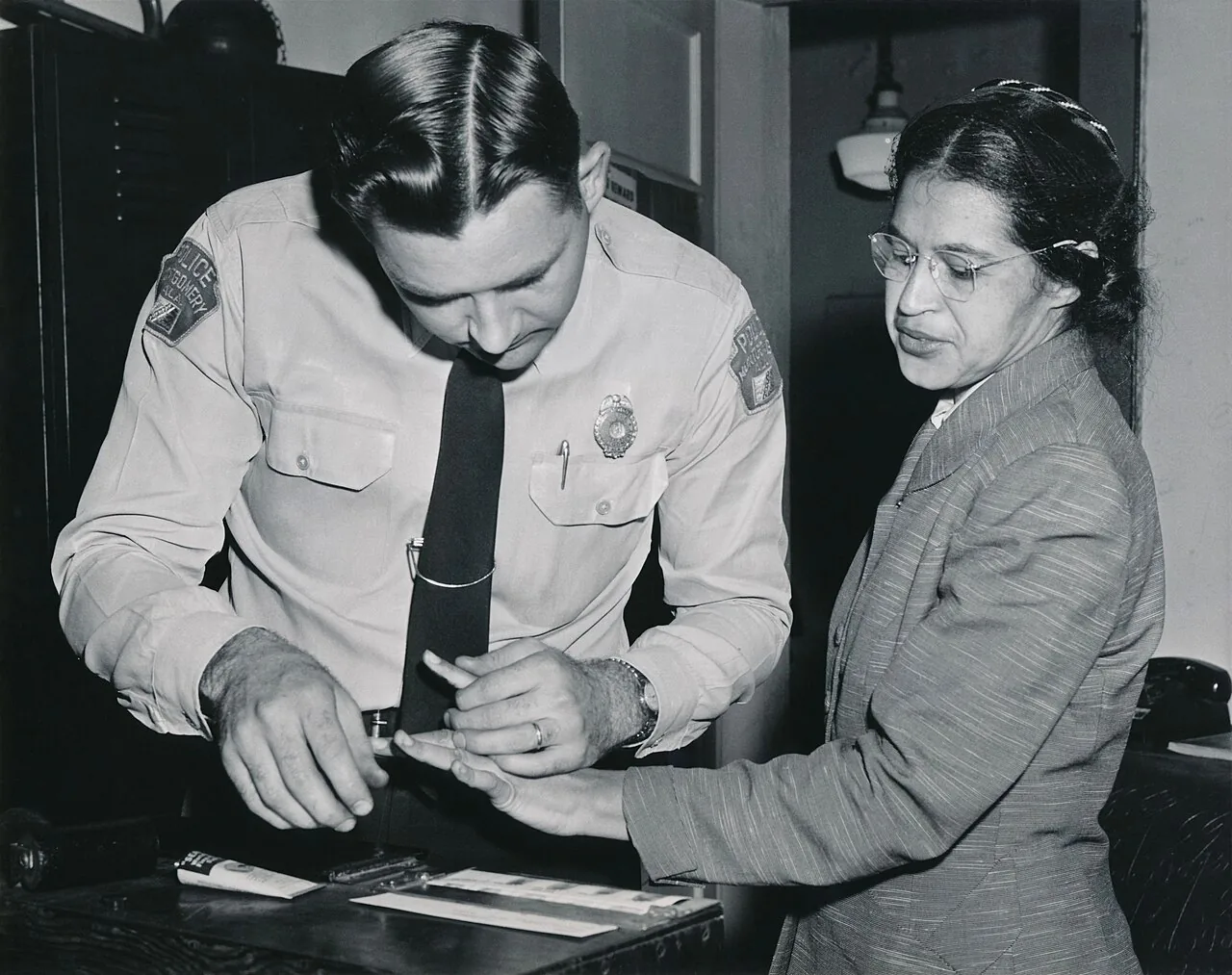
Source: Gene Herrick, Associated Press, February 22, 1956.
- Present the document (nature, photographer, date, place).
- Describe the two people and what the officer is doing.
- The photograph is often linked to December 1955. What does the caption say about the real date?
- Why is it important for a historian to check the date of a famous image?
Exercise 15 : Walking into school
Document 17 – Elizabeth Eckford, September 4, 1957
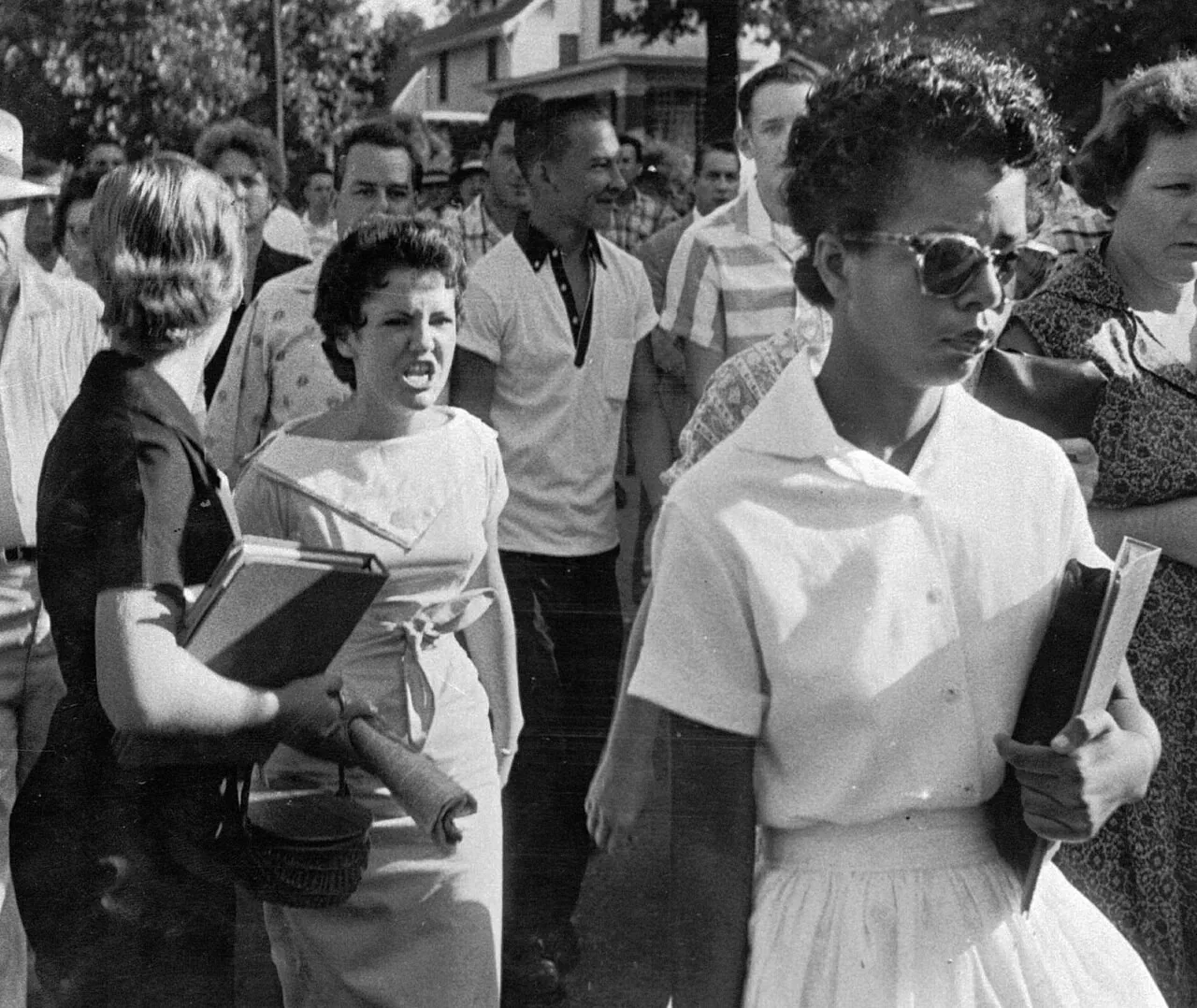
Source: Will Counts, 1957.
- Present the document (nature, photographer, date, place).
- Describe the girl in the foreground and the crowd behind her.
- What does her posture and expression suggest?
- Explain why photographs and television changed national opinion about segregation.
Exercise 16 : Four students in Greensboro
Document 18 – The Greensboro sit-in, 1960
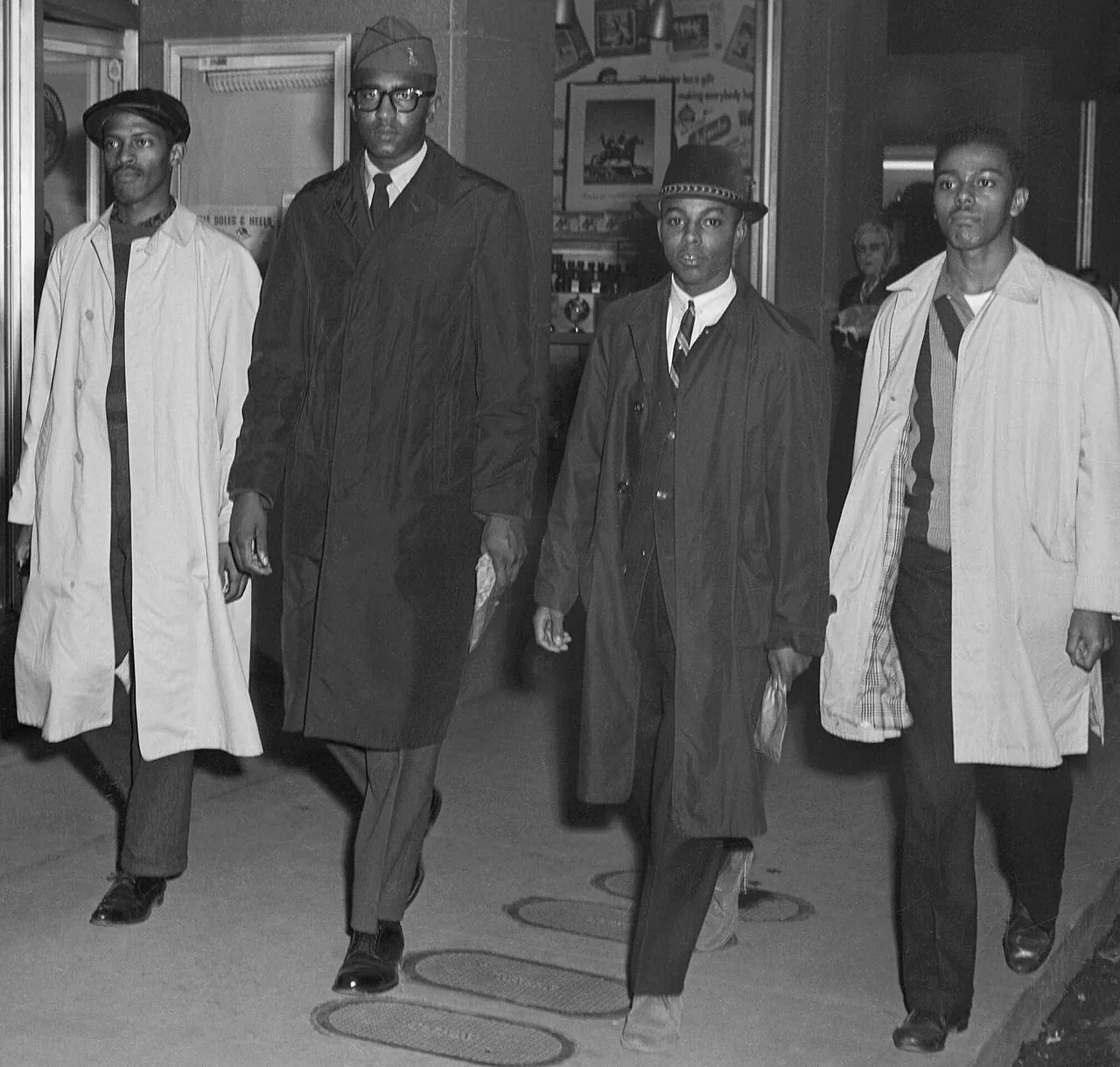
Source: Jack Moebes, Greensboro, North Carolina, February 1960.
- Present the document (nature, photographer, date, place).
- Describe the four young men.
- What did the sit-in movement do that earlier legal efforts had not?
- How did this action lead to SNCC?
Exercise 17 : A burning bus
Document 19 – Anniston, May 14, 1961
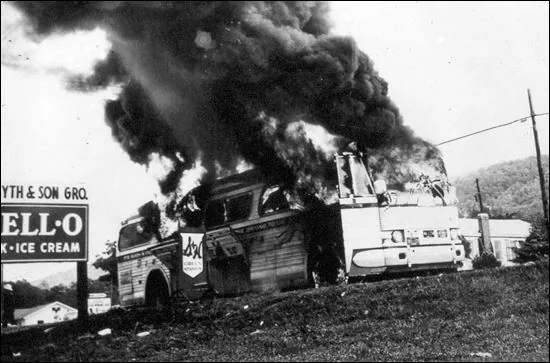
Source: U.S. National Park Service.
- Present the document (nature, source, date, place).
- Describe what you see.
- Why did the Freedom Riders ride buses through the South?
- How did the national government respond?
Exercise 18 : The crowd at the Lincoln Memorial
Document 20 – The March on Washington, 1963
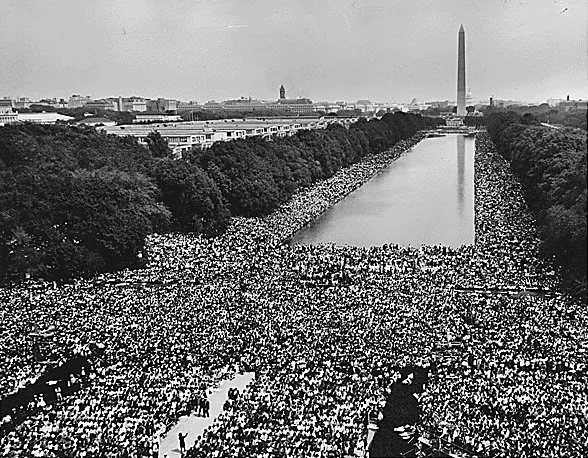
Source: U.S. Information Agency, August 28, 1963.
- Present the document (nature, source, date, place).
- Describe the landscape and the crowd.
- What does the size of the crowd show?
- Name two leaders of the march and one demand.
Exercise 19 : Signing the Voting Rights Act
Document 21 – Johnson and King, August 6, 1965
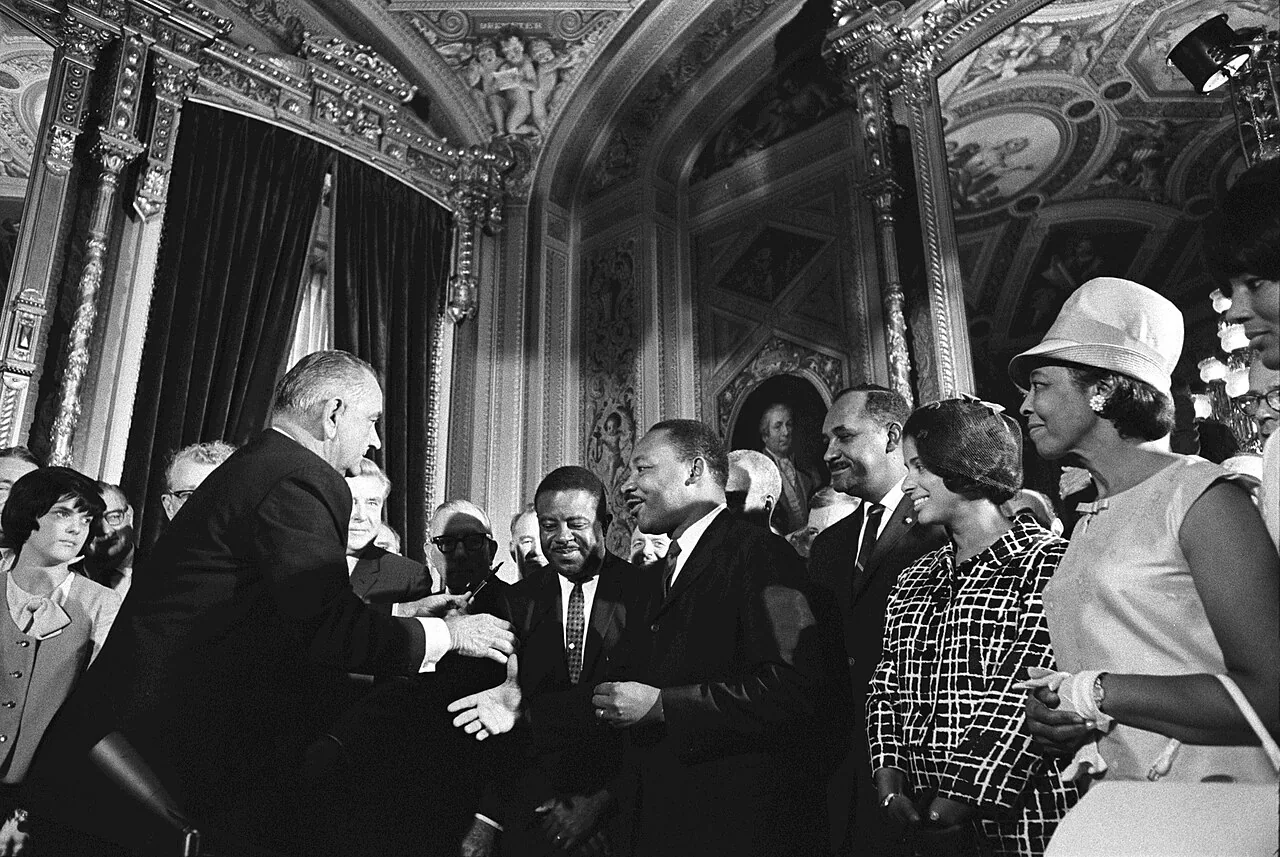
Source: Yoichi Okamoto, 1965.
- Present the document (nature, photographer, date, place).
- Describe the main people and the setting.
- What does the photograph show about the relationship between the president and the movement?
- Why can a photograph like this overstate the unity of the movement?
Exercise 20 : The vote in numbers
| Measure | Figure |
|---|---|
| States requiring segregated public schools in 1954 | 17 states and the District of Columbia |
| Members of Congress who signed the Southern Manifesto, 1956 | 101 (19 senators and 82 representatives) |
| Estimated participants in the March on Washington, 1963 | about 250,000 (most widely cited estimate) |
| Black adults registered to vote in Alabama, 1964 and 1969 | 19.3 percent and 61.3 percent |
| Black adults registered to vote in Mississippi, 1964 and 1969 | 6.7 percent and 66.5 percent |
Source: Wikipedia, “Brown v. Board of Education,” “Southern Manifesto,” “March on Washington for Jobs and Freedom,” and “Voting Rights Act,” citing scholarly and official sources.
- Calculate the increase in Black voter registration in Alabama and in Mississippi, in percentage points.
- Which state had the lower starting figure, and by how many points did it differ from the other?
- Explain why the registration figures rose so sharply after 1965.
- What other evidence would you need to say that the Voting Rights Act caused the rise?
Exercise 21 : Map: segregated schools and movement sites
- What does the red color show?
- In which city, shown in a state shaded orange, was the case that gave its name to the 1954 decision?
- Name the cities of Alabama shown on the map.
- Which city shown was the site of the 1957 school crisis, and in which state?
Exercise 22 : Locate the movement
- Identify the places: 1 Topeka; 2 city of the 1955-56 bus boycott; 3 city of the 1960 sit-in; 4 city of the 1957 school crisis; 5 city of the 1963 campaign with police dogs and fire hoses; 6 city of Bloody Sunday; 7 the capital of the United States; 8 the capital of Mississippi.
- Explain how two of these places are linked to the two great laws of 1964 and 1965.
Exercise 23 : Order the events
Put these events in order: (a) Voting Rights Act; (b) Montgomery bus boycott begins; (c) Brown v. Board of Education; (d) Greensboro sit-in; (e) Little Rock Nine; (f) Civil Rights Act; (g) March on Washington; (h) Plessy v. Ferguson.
Exercise 24 : Durations
- How many years passed between Plessy (1896) and Brown (1954)?
- How long was the gap between Brown and the Civil Rights Act (1954 to 1964)?
- How many months passed between the Civil Rights Act (July 1964) and the Voting Rights Act (August 1965)?
- How many years passed between Brown and the Voting Rights Act?
Exercise 25 : Guided research: voices of the movement
Use the Library of Congress (loc.gov), the National Archives (archives.gov), or the Civil Rights History Project (loc.gov/collections/civil-rights-history-project).
- Search for: Little Rock Nine, Freedom Summer, or Selma to Montgomery march.
- Choose one oral history, photograph, or document and fill in a card: title, creator, date, place, type of source.
- Explain what the source tells you about the movement.
- Explain one limit of the source.
Exercise 26 : CER paragraph: courts or protest?
Write a paragraph with a Claim, Evidence, and Reasoning, answering the question: Which was more important in ending legal segregation, court decisions or mass protest? Use at least two pieces of evidence from the lesson.
Exercise 27 : SAQ: nonviolent direct action
Answer in complete sentences.
- Identify one example of nonviolent direct action between 1955 and 1963.
- Explain how television affected the success of the movement.
- Describe one way in which the movement continued to face limits after 1965.
Exercise 28 : True or false? Justify
Decide whether each statement is true or false. If it is false, correct it.
- The Supreme Court ruled in Plessy that segregation was unconstitutional.
- The Brown decision was unanimous.
- Rosa Parks was arrested in Montgomery in December 1955.
- The Civil Rights Act of 1964 was passed without a filibuster.
- The Voting Rights Act of 1965 banned literacy tests and similar devices.
Exercise 29 : Stimulus-based multiple choice
Stimulus
We conclude that, in the field of public education, the doctrine of “separate but equal” has no place. Separate educational facilities are inherently unequal. Therefore, we hold that the plaintiffs and others similarly situated for whom the actions have been brought are, by reason of the segregation complained of, deprived of the equal protection of the laws guaranteed by the Fourteenth Amendment. This disposition makes unnecessary any discussion whether such segregation also violates the Due Process Clause of the Fourteenth Amendment.
Source: Chief Justice Earl Warren, opinion of the Court, Brown v. Board of Education of Topeka, 347 U.S. 483, May 17, 1954 (holding); text from Wikisource.
*doctrine: official principle. *inherently: by its nature.
- This decision directly overturned the principle of which earlier case in the field of education? (A) Marbury v. Madison; (B) Plessy v. Ferguson; (C) Korematsu v. United States; (D) Schechter v. United States.
- Which amendment is the basis of the ruling? (A) First; (B) Fourteenth; (C) Nineteenth; (D) Twenty-fourth.
- Which response from Southern leaders followed this decision? (A) the Southern Manifesto and massive resistance; (B) immediate integration; (C) the Marshall Plan; (D) the GI Bill.


Quick review: flashcards
Tap a card to see the answer.