


This worksheet on Vietnam and the 1960s belongs to the US History Grade 11 course. Its questions use primary sources, maps and timelines, and they move from basic recall to short writing tasks. Before you start, review the lesson; afterward, try the true or false quiz.
Exercise 1 : Vocabulary of the 1960s
Match each term with its meaning, then use three of the terms in sentences about the 1960s.
- Quarantine
- Nonviolent direct action
- Great Society
- Domino theory
- Vietnamization
- Credibility gap
(a) the distance between what officials said about a war and what people saw; (b) a naval blockade of offensive weapons; (c) the belief that one communist victory would lead to others; (d) protest without violence, such as sit-ins and marches; (e) Johnson’s program of domestic reform; (f) Nixon’s policy of turning the fighting over to South Vietnamese forces.
Exercise 2 : Pay any price
Document 1 – Kennedy’s inaugural address
Let every nation know, whether it wishes us well or ill, that we shall pay any price, bear any burden, meet any hardship, support any friend, oppose any foe, in order to assure the survival and the success of liberty. […] And so, my fellow Americans: ask not what your country can do for you–ask what you can do for your country. My fellow citizens of the world: ask not what America will do for you, but what together we can do for the freedom of man.
Source: John F. Kennedy, Inaugural Address, January 20, 1961; text from the Avalon Project, Yale Law School.
*burden: a heavy duty. *foe: enemy.
- Present the document (nature, author, date, context).
- List the five things the United States promises to do.
- Who is the audience, besides Americans? Quote words that show it.
- Explain how this promise could lead the United States into wars far from home.
Look at the words after “we shall pay any price”.
Exercise 3 : Beware the military-industrial complex
Document 2 – Eisenhower’s farewell address
In the councils of government, we must guard against the acquisition of unwarranted influence, whether sought or unsought, by the military-industrial complex. The potential for the disastrous rise of misplaced power exists and will persist. We must never let the weight of this combination endanger our liberties or democratic processes. We should take nothing for granted. Only an alert and knowledgeable citizenry can compel the proper meshing of the huge industrial and military machinery of defense with our peaceful methods and goals, so that security and liberty may prosper together.
Source: Dwight D. Eisenhower, Farewell Address (the “military-industrial complex” speech), January 17, 1961; text from the Avalon Project, Yale Law School.
*acquisition: gaining. *meshing: fitting together.
- Present the document (nature, author, date, context).
- What danger does Eisenhower describe?
- What does he say can protect the nation against it?
- Why does his warning have more weight coming from a former general?
Exercise 4 : Two presidents, one month
Document 1 – Kennedy, January 20, 1961
Let every nation know, whether it wishes us well or ill, that we shall pay any price, bear any burden, meet any hardship, support any friend, oppose any foe, in order to assure the survival and the success of liberty. […] And so, my fellow Americans: ask not what your country can do for you–ask what you can do for your country. My fellow citizens of the world: ask not what America will do for you, but what together we can do for the freedom of man.
Source: John F. Kennedy, Inaugural Address, January 20, 1961; text from the Avalon Project, Yale Law School.
Document 2 – Eisenhower, January 17, 1961
In the councils of government, we must guard against the acquisition of unwarranted influence, whether sought or unsought, by the military-industrial complex. The potential for the disastrous rise of misplaced power exists and will persist. We must never let the weight of this combination endanger our liberties or democratic processes. We should take nothing for granted. Only an alert and knowledgeable citizenry can compel the proper meshing of the huge industrial and military machinery of defense with our peaceful methods and goals, so that security and liberty may prosper together.
Source: Dwight D. Eisenhower, Farewell Address (the “military-industrial complex” speech), January 17, 1961; text from the Avalon Project, Yale Law School.
- Present each document in one sentence.
- What does each speaker ask of the American people?
- Compare how each speaker treats the cost of the Cold War.
- Which warning proved closer to what happened in the 1960s? Use evidence from the lesson.
Exercise 5 : A new medium
Document 1 – The first televised presidential debate
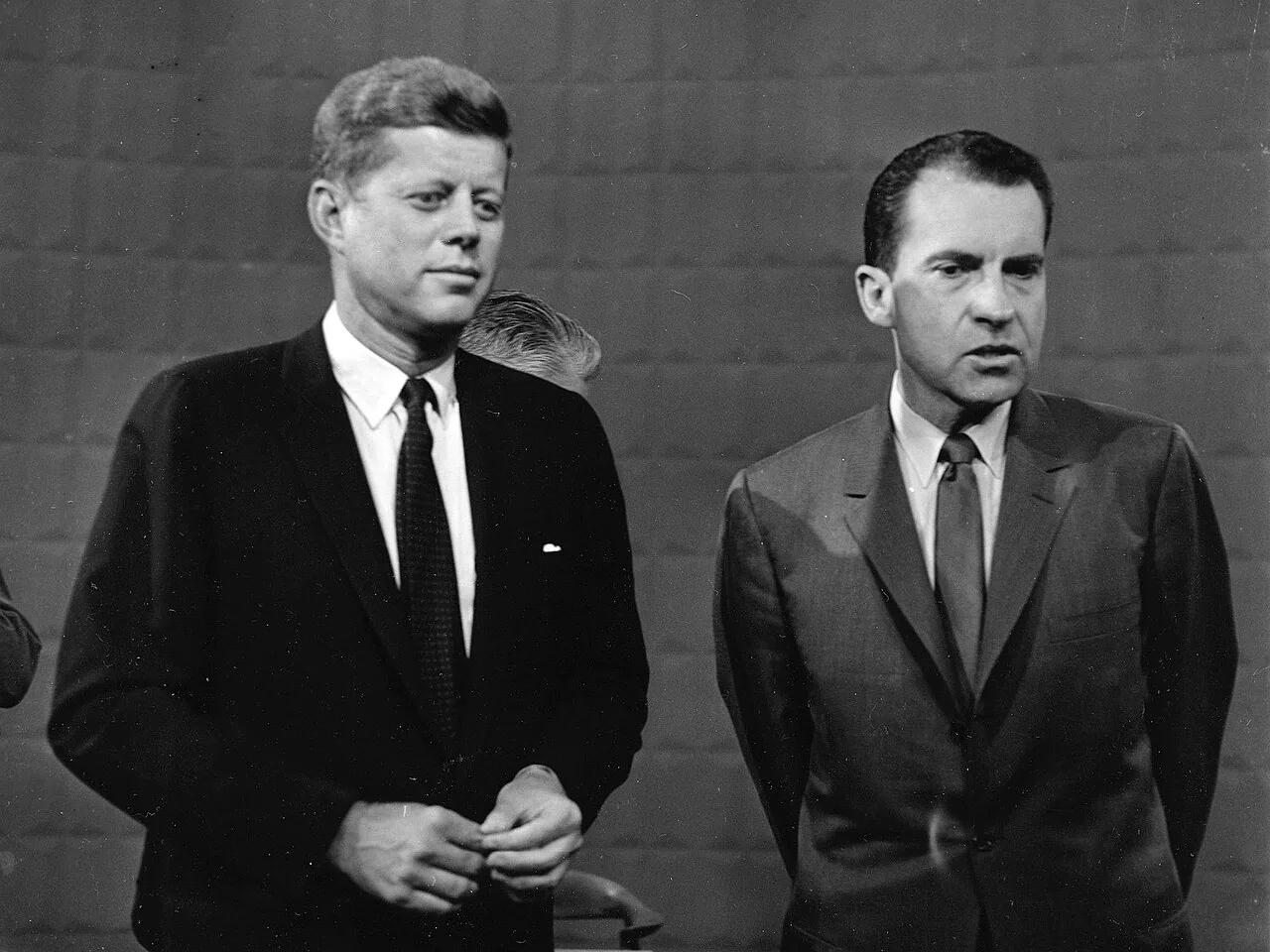
Source: Associated Press photograph, September 26, 1960 (Wikimedia Commons).
- Present the document (nature, date, place).
- Describe the two men: their clothing, posture, and expressions.
- Why was television important to the 1960 campaign?
- What can a historian not learn from this photograph?
Exercise 6 : Evidence from the air
Document 1 – A U-2 photograph of Cuba
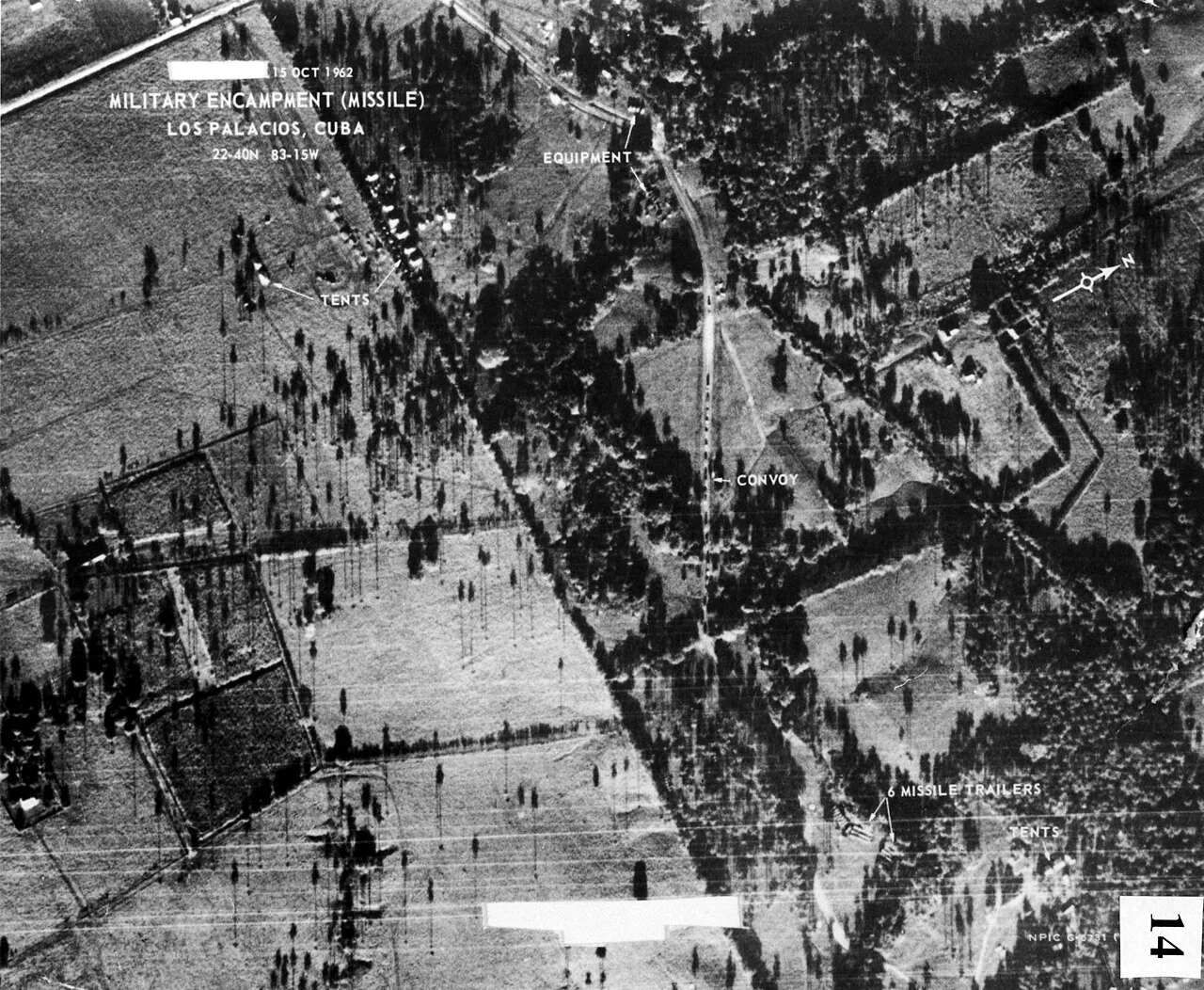
Source: U.S. Air Force, October 15, 1962 (Wikimedia Commons).
- Present the document (nature, date, place).
- Identify three features that the labels point out.
- Why would the president need photographs like this before he spoke to the nation?
- Why might a government show such a photograph in public?
Exercise 7 : The quarantine speech
Document 1 – Kennedy’s address, October 22, 1962
I have directed the Armed Forces to prepare for any eventualities; and I trust that in the interest of both the Cuban people and the Soviet technicians at the sites, the hazards to all concerned of continuing this threat will be recognized. Third: It shall be the policy of this Nation to regard any nuclear missile launched from Cuba against any nation in the Western Hemisphere as an attack by the Soviet Union on the United States, requiring a full retaliatory response upon the Soviet Union.
Source: John F. Kennedy, Radio and Television Report to the American People on the Soviet Arms Buildup in Cuba, October 22, 1962; text from the American Presidency Project, University of California, Santa Barbara.
*hemisphere: half of the world; here, the Americas. *retaliatory: in return for an attack.
- Present the document (nature, author, date, context).
- What policy does Kennedy announce in the third point?
- Explain why this policy made the crisis more dangerous.
- How did the crisis end on October 28?
Exercise 8 : Locate the Cuban Missile Crisis
- Name the city numbered 1 and the American city numbered 2.
- What is located at point 3, on the southeastern end of Cuba, and at point 4?
- What does the letter A show, and why was its distance from Florida important to Americans?
- Explain in two sentences why Americans felt threatened by missiles in Cuba.
Exercise 9 : We shall overcome
Document 1 – Johnson, March 15, 1965
Their cause must be our cause too. Because it is not just Negroes, but really it is all of us, who must overcome the crippling legacy of bigotry and injustice. And we shall overcome. […] As a man whose roots go deeply into Southern soil I know how agonizing racial feelings are. I know how difficult it is to reshape the attitudes and the structure of our society. But a century has passed, more than a hundred years, since the Negro was freed. And he is not fully free tonight.
Source: Lyndon B. Johnson, Special Message to the Congress: The American Promise, March 15, 1965; text from the American Presidency Project, University of California, Santa Barbara.
*bigotry: hatred of people because of their race or beliefs. *legacy: what is handed down from the past.
- Present the document (nature, author, date, context).
- What movement and what slogan does Johnson adopt?
- Who does he say must “overcome”?
- Why might a southern president’s use of this slogan have had a strong effect?
Exercise 10 : Law and photograph
Document 1 – The Civil Rights Act of 1964
All persons shall be entitled to the full and equal enjoyment of the goods, services, facilities, and privileges, advantages, and accommodations of any place of public accommodation, as defined in this section, without discrimination or segregation on the ground of race, color, religion, or national origin.
Source: Civil Rights Act of 1964, Title II, Section 201(a), signed July 2, 1964; text from the National Archives.
*accommodations: lodging, meals, and similar services.
Document 2 – The signing, July 2, 1964
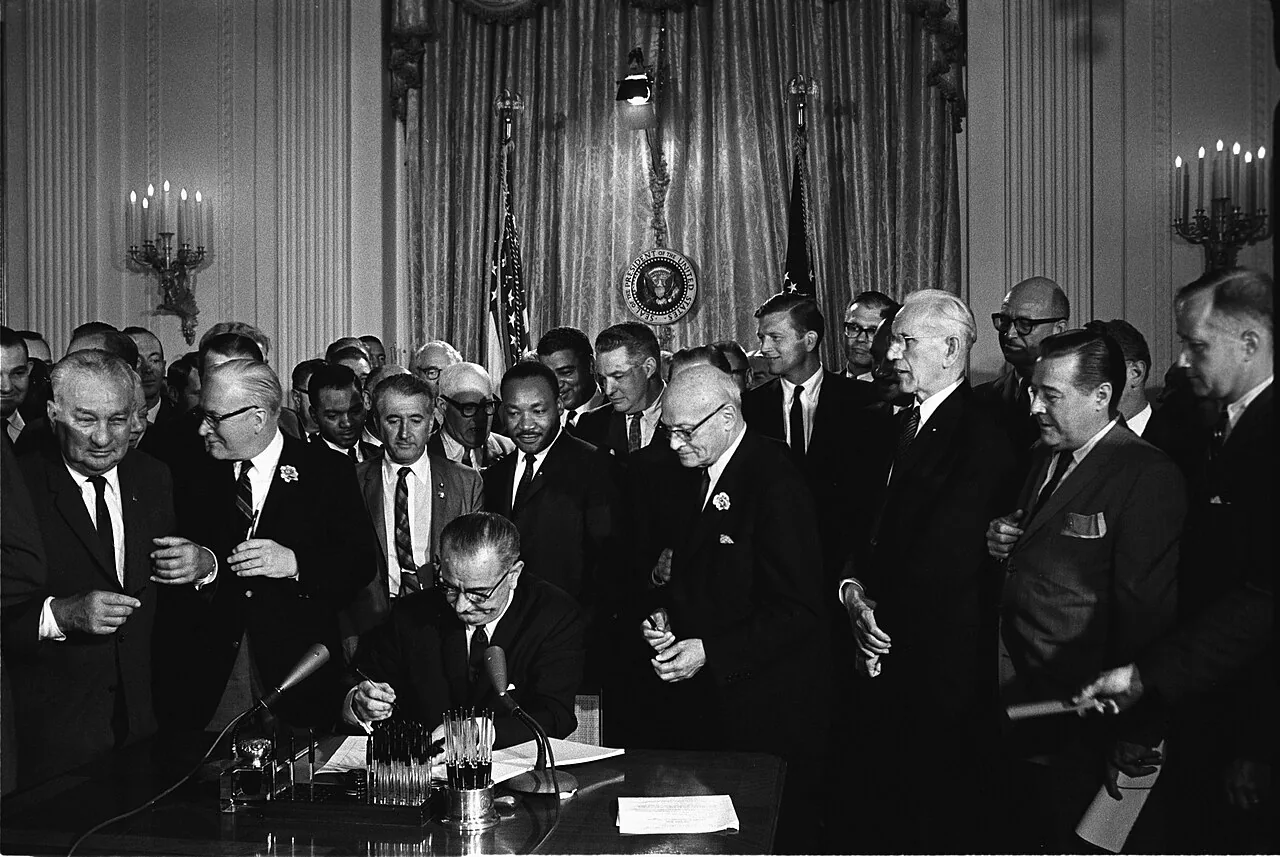
Source: Cecil Stoughton, White House Press Office (Wikimedia Commons).
- Present each document (nature, author, date).
- What does Document 1 forbid?
- What does Document 2 show about who took part in the signing?
- How do the two documents together help a historian? What does each leave out?
Exercise 11 : A quarter of a million
Document 1 – The March on Washington
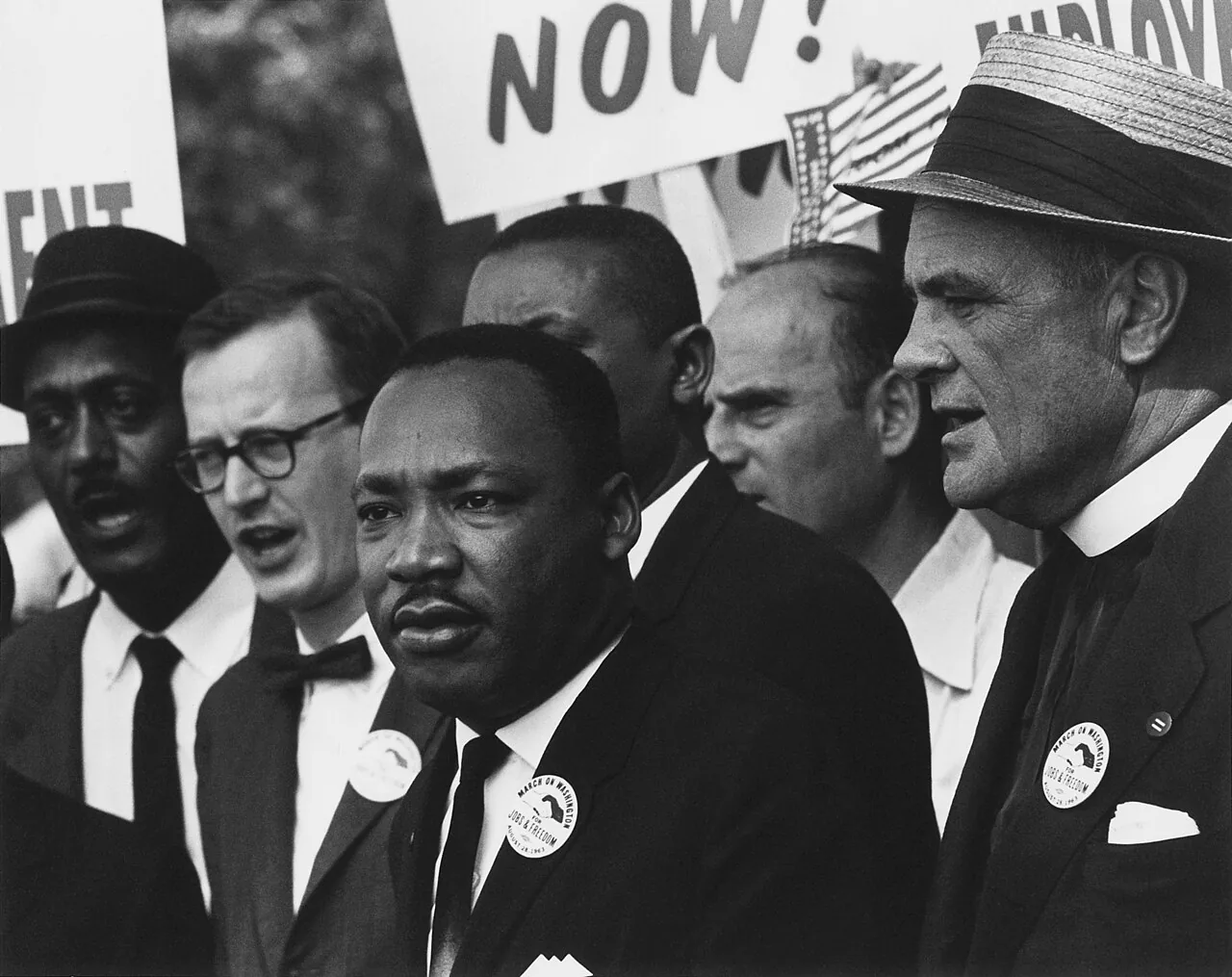
Source: Rowland Scherman, August 28, 1963 (Wikimedia Commons).
- Present the document (nature, date, place).
- Who is identified in the caption?
- The most widely cited estimate of the crowd is 250,000. Why would a march of this size have an effect on Congress?
- The march was called a march “for Jobs and Freedom.” Why both words?
Exercise 12 : The right to vote
Document 1 – The Voting Rights Act of 1965, Section 2
No voting qualification or prerequisite to voting, or standard, practice, or procedure shall be imposed or applied by any State or political subdivision to deny or abridge the right of any citizen of the United States to vote on account of race or color.
Source: Voting Rights Act of 1965, Section 2, signed August 6, 1965; text from the National Archives.
*prerequisite: a requirement. *abridge: to reduce.
- Present the document (nature, date, context).
- What practices does it ban?
- Which constitutional amendment does the law enforce, and what does that amendment say?
- Why were new federal rules needed ninety-five years after that amendment was ratified?
Exercise 13 : A blank check?
Document 1 – The Gulf of Tonkin Resolution
That the Congress approves and supports the determination of the President, as Commander in Chief, to take all necessary measures to repel any armed attack against the forces of the United States and to prevent further aggression. […] Section 2. The United States regards as vital to its national interest and to world peace the maintenance of international peace and security in southeast Asia. Consonant with the Constitution of the United States and the Charter of the United Nations and in accordance with its obligations under the Southeast Asia Collective Defense Treaty, the United States is, therefore, prepared, as the President determines, to take all necessary steps, including the use of armed force, to assist any member or protocol state of the Southeast Asia Collective Defense Treaty requesting assistance in defense of its freedom.
Source: Joint Resolution of Congress, H.J. Res. 1145 (the Gulf of Tonkin Resolution), August 7, 1964; text from the Avalon Project, Yale Law School.
*aggression: an attack. *protocol state: a state covered by the Southeast Asia Treaty protocol.
- Present the document (nature, date, context).
- Quote the words that give the president power.
- Does the resolution declare war? Explain.
- Why did some members of Congress later say they had given away too much power?
Exercise 14 : Two ways to share the decision
Document 1 – The Gulf of Tonkin Resolution, 1964
That the Congress approves and supports the determination of the President, as Commander in Chief, to take all necessary measures to repel any armed attack against the forces of the United States and to prevent further aggression. […] Section 2. The United States regards as vital to its national interest and to world peace the maintenance of international peace and security in southeast Asia. Consonant with the Constitution of the United States and the Charter of the United Nations and in accordance with its obligations under the Southeast Asia Collective Defense Treaty, the United States is, therefore, prepared, as the President determines, to take all necessary steps, including the use of armed force, to assist any member or protocol state of the Southeast Asia Collective Defense Treaty requesting assistance in defense of its freedom.
Source: Joint Resolution of Congress, H.J. Res. 1145 (the Gulf of Tonkin Resolution), August 7, 1964; text from the Avalon Project, Yale Law School.
Document 2 – The War Powers Resolution, 1973
It is the purpose of this joint resolution to fulfill the intent of the framers of the Constitution of the United States and insure that the collective judgement of both the Congress and the President will apply to the introduction of United States Armed Forces into hostilities, or into situations where imminent involvement in hostilities is clearly indicated by the circumstances, and to the continued use of such forces in hostilities or in such situations.
Source: War Powers Resolution, Section 2(a), passed over President Nixon’s veto on November 7, 1973; text from the Avalon Project, Yale Law School.
*insure: here, make certain. *hostilities: acts of war.
- Present each document in one sentence.
- What does each give to the president, or limit?
- How are the two texts linked historically?
- Write two sentences explaining why Congress passed the second text.
Exercise 15 : The silent majority
Document 1 – Nixon, November 3, 1969
And so tonight–to you, the great silent majority of my fellow Americans–I ask for your support. I pledged in my campaign for the Presidency to end the war in a way that we could win the peace. I have initiated a plan of action which will enable me to keep that pledge. The more support I can have from the American people, the sooner that pledge can be redeemed; for the more divided we are at home, the less likely the enemy is to negotiate at Paris. Let us be united for peace. Let us also be united against defeat.
Source: Richard M. Nixon, Address to the Nation on the War in Vietnam (the “Silent Majority” speech), November 3, 1969; text from the American Presidency Project, University of California, Santa Barbara.
*redeemed: carried out. *negotiate: to bargain to reach an agreement.
- Present the document (nature, author, date, context).
- Who are the “silent majority”? Who does the term leave out?
- What two things does Nixon ask Americans to be united about?
- Write a short paragraph explaining how this speech tried to answer the anti-war movement.
Exercise 16 : Troops and helicopters
Document 1 – An air assault in 1966
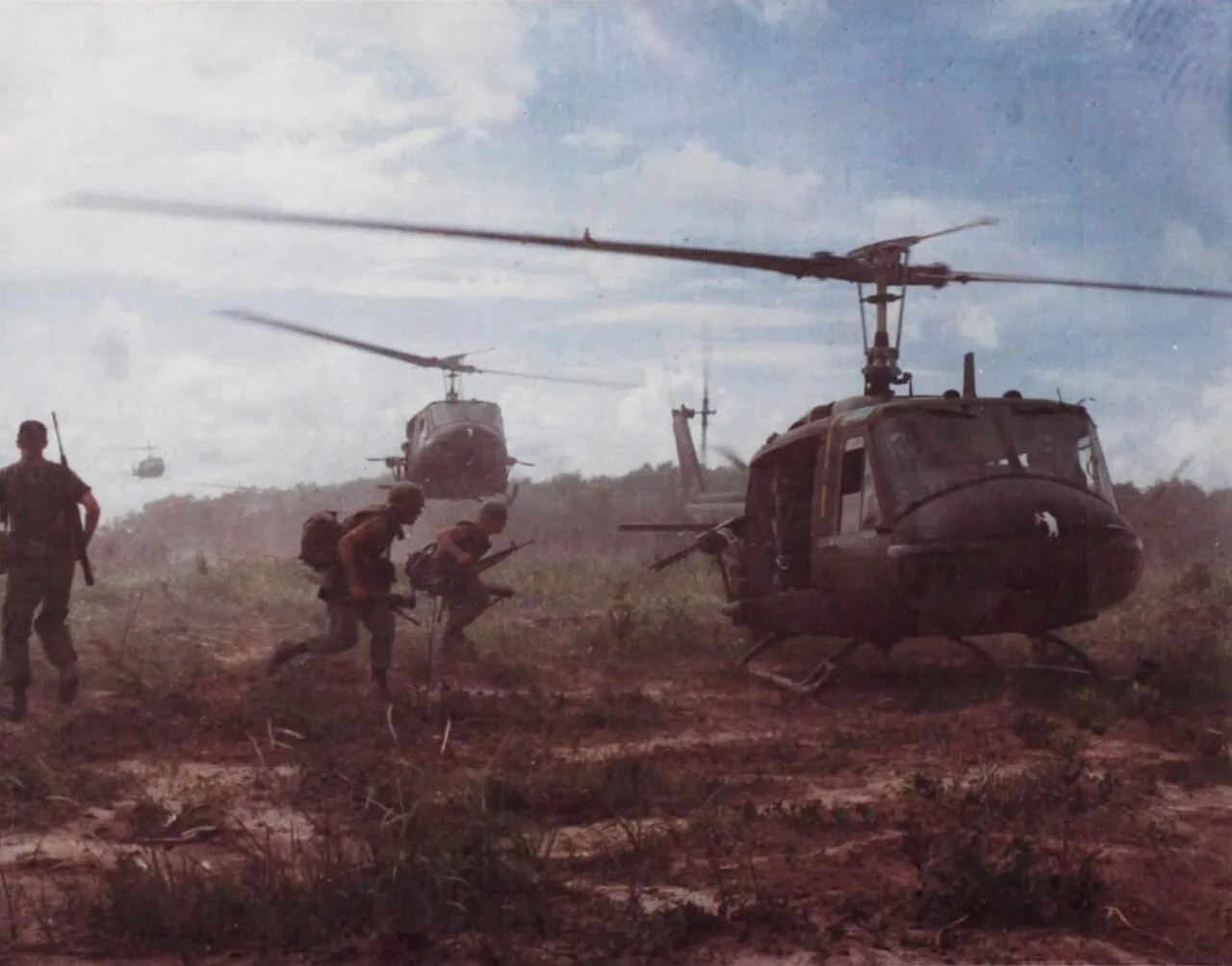
Source: SFC James K. F. Dung, U.S. Army, May 16, 1966 (Wikimedia Commons).
- Present the document (nature, date, place).
- Describe what the soldiers and the helicopters are doing.
- How did helicopters change the way the war was fought?
- Why can a photograph taken by the army not tell the whole story of the war?
Exercise 17 : Kent State and the speech
Document 1 – Kent State, May 4, 1970
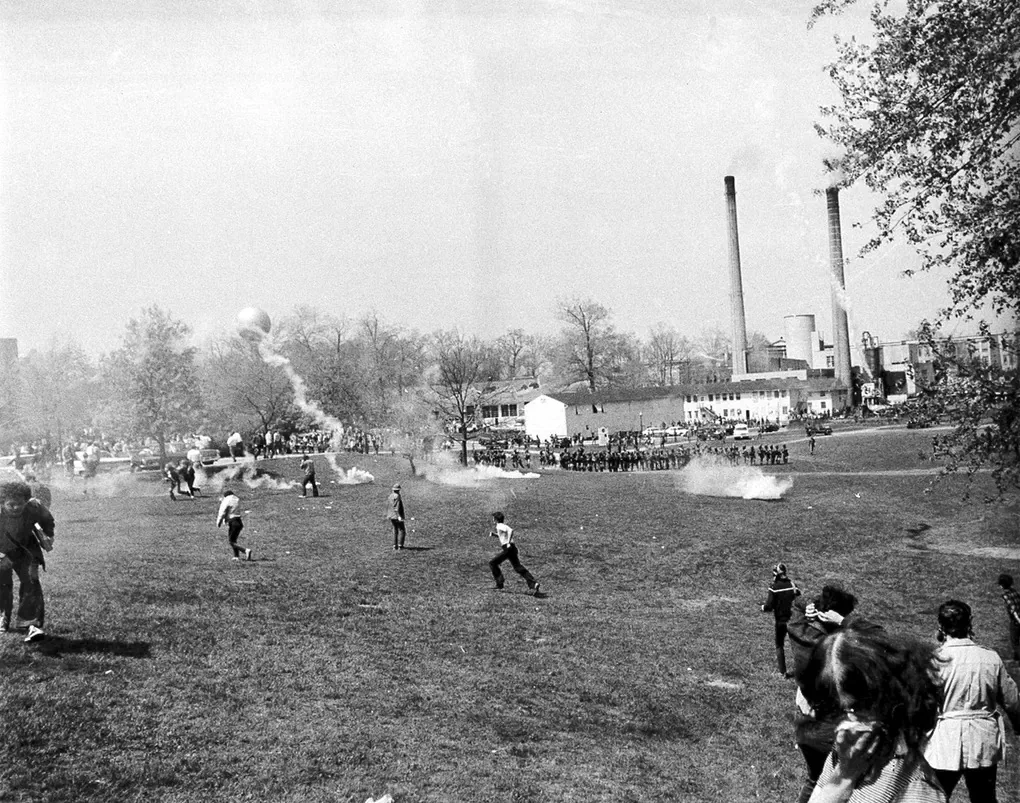
Source: Larry Stoddard, photograph, May 4, 1970 (Wikimedia Commons).
Document 2 – Nixon, November 3, 1969
And so tonight–to you, the great silent majority of my fellow Americans–I ask for your support. I pledged in my campaign for the Presidency to end the war in a way that we could win the peace. I have initiated a plan of action which will enable me to keep that pledge. The more support I can have from the American people, the sooner that pledge can be redeemed; for the more divided we are at home, the less likely the enemy is to negotiate at Paris. Let us be united for peace. Let us also be united against defeat.
Source: Richard M. Nixon, Address to the Nation on the War in Vietnam (the “Silent Majority” speech), November 3, 1969; text from the American Presidency Project, University of California, Santa Barbara.
- Present each document in one sentence.
- What does Document 1 show about the state of the country in 1970?
- How does Document 2 help explain the divisions in Document 1?
- Why is it important to use other evidence in addition to Document 1 to learn what happened at Kent State?
Exercise 18 : Locate Vietnam
- Name the city numbered 1, the capital of North Vietnam, and the city numbered 2, the capital of South Vietnam.
- What is the dashed line labeled A, and what did it divide?
- Name the former French fort numbered 5, where the French were defeated in 1954.
- Why was the country labeled B important to the war, even though it was not a belligerent at first?
Exercise 19 : Reading numbers: unemployment in the 1960s
The table gives the annual average unemployment rate in the United States.
| Year | Unemployment rate (%) |
|---|---|
| 1960 | 5.5 |
| 1961 | 6.7 |
| 1963 | 5.6 |
| 1965 | 4.5 |
| 1967 | 3.8 |
| 1969 | 3.5 |
Source: U.S. Bureau of Labor Statistics, annual averages of the civilian unemployment rate (series UNRATE, Federal Reserve Bank of St. Louis, FRED).
- Present the document (nature, source, period).
- By how many percentage points did the rate fall from 1961 to 1969?
- Name two government programs of the period that might have contributed to the change, and one other factor.
- What does the table not tell us about the Great Society?
Exercise 20 : Order the events
Put these events in order from earliest to latest, then give the year of each.
- Kent State shootings
- Cuban Missile Crisis
- Voting Rights Act
- Tet Offensive
- March on Washington
- Paris Peace Accords
- Gulf of Tonkin Resolution
- Fall of Saigon
Exercise 21 : Durations
Use the dates in the lesson to answer.
- How many years passed between the Gulf of Tonkin Resolution (1964) and the Paris Peace Accords (1973)?
- How many years between the Brown decision (1954) and the Civil Rights Act (1964)?
- How many months between the Tet Offensive (January 1968) and the election of November 1968?
- How many years did the United States have combat troops in Vietnam, from the landing at Da Nang (1965) to the last departure (1973)?
Exercise 22 : Guided research: the Vietnam Veterans Memorial or the Freedom Riders
Choose one topic and write a one-page summary based on reliable sources.
- Topic A: the Vietnam Veterans Memorial in Washington. Search: Vietnam Veterans Memorial design Maya Lin National Park Service.
- Topic B: the Freedom Rides of 1961. Search: Freedom Riders 1961 CORE Library of Congress.
Reliable sites: the National Park Service (nps.gov), the Library of Congress (loc.gov), the National Archives (archives.gov), the Smithsonian (si.edu). For each source, write the author or organization and the date.
- Who created the memorial, or who organized the Freedom Rides?
- When and where did the event take place?
- Why was it controversial or dangerous at the time?
- What is its legacy today?
Exercise 23 : CER paragraph: the Tet Offensive
Write a Claim-Evidence-Reasoning paragraph: Was the Tet Offensive a turning point in the Vietnam War? Use at least two pieces of evidence from the lesson.
Evidence: the military result for the attackers, what the government had said before, what Johnson did on March 31.
Exercise 24 : SAQ: the civil rights laws
Answer all parts in two or three sentences each.
- Identify one event of 1963 or 1965 that helped to persuade Congress to pass a civil rights law.
- Explain how that event affected public opinion.
- Identify one limit of the laws of 1964 and 1965.
Exercise 25 : True or false? Justify
Say whether each statement is true or false. If it is false, correct it.
- The Cuban Missile Crisis ended when the United States invaded Cuba.
- The Civil Rights Act of 1964 banned discrimination in public places and in employment.
- The Gulf of Tonkin Resolution was a formal declaration of war.
- The Tet Offensive was a military victory for the communists in the field.
- Nixon ended the draft and brought all combat troops home in 1973.
Exercise 26 : Causes and consequences of the war
Copy and complete the chain with one fact for each step.
- Cause: the domino theory.
- Event: the Gulf of Tonkin Resolution.
- Escalation: Rolling Thunder and the troop buildup.
- Turning point: the Tet Offensive.
- Consequence: the War Powers Resolution and a lasting distrust of government.


Quick review: flashcards
Tap a card to see the answer.