


This US History Grade 11 lesson covers Vietnam and the 1960s, part of the unit “Postwar America.” First, read the full lesson with its primary sources, maps and key terms. Then practice with the worksheet, check yourself with the quiz and get ready with the test.
On February 1, 1960, four Black freshmen from North Carolina Agricultural and Technical College sat down at the lunch counter of the Woolworth’s store in Greensboro and asked for coffee. The counter was for whites only, and the waitress refused to serve them. They stayed until closing time and came back the next day with more students.
Within weeks, sit-ins had spread to dozens of cities. That quiet act opened a decade in which Americans argued, marched, voted, and fought over the meaning of freedom at home and abroad. By 1975 the nation had a new body of civil rights law, a larger federal government, and a deep distrust of its own leaders. It had also lost a war in Southeast Asia.
Guiding question: How did the Cold War, the civil rights movement, and the war in Vietnam change American government and society between 1960 and 1975?
1. Kennedy and the Cold War, 1960-1963
The presidential election of 1960 was one of the closest of the century. The Democratic candidate, Senator John F. Kennedy of Massachusetts, was 43 years old and the first Catholic to win a major party nomination since 1928. His opponent was Vice President Richard M. Nixon. In September they met in the first televised debates between presidential candidates. Millions of Americans watched, and many remembered a calm, confident Kennedy beside a tense Nixon. Television had become part of American politics, and it would shape the way people saw both the campaign trail and, later, the war in Vietnam.
Document 1 – The first televised debate
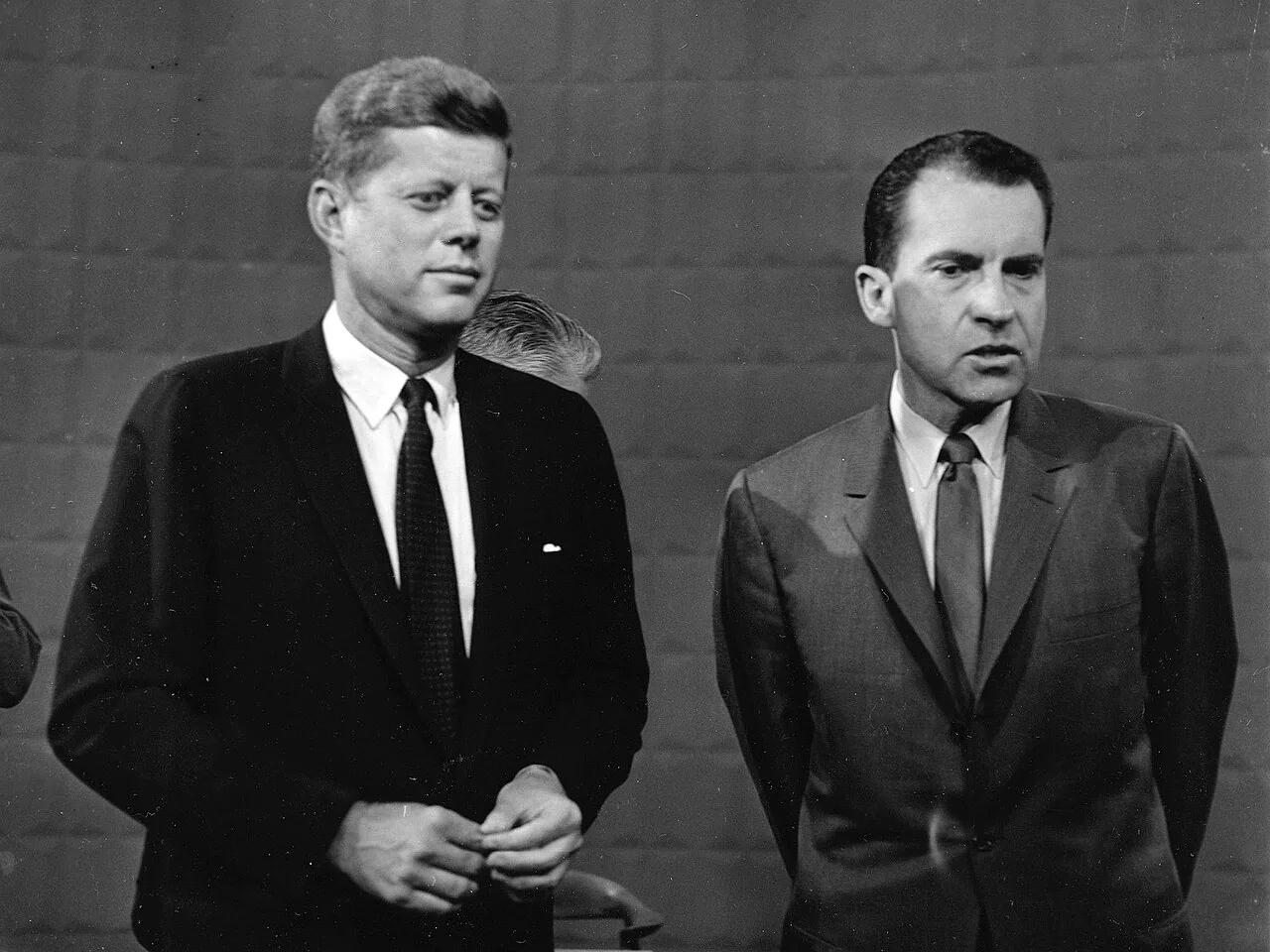
Source: Associated Press photograph, September 26, 1960 (image on Wikimedia Commons).
The photograph dates from before the debate began. It shows two men of different generations at the start of a contest that millions would watch at home. A photograph like this one does not tell us who won; it shows us how the candidates presented themselves to the new medium.
Kennedy won by a narrow margin and took office as the youngest man ever elected president. In his inaugural address, he called on Americans to accept the burdens of the Cold War. That long rivalry between the United States and the Soviet Union had begun after World War II. Three days earlier, outgoing President Dwight D. Eisenhower had given a very different warning in his farewell address.
Document 2 – Kennedy’s inaugural address
Let every nation know, whether it wishes us well or ill, that we shall pay any price, bear any burden, meet any hardship, support any friend, oppose any foe, in order to assure the survival and the success of liberty. […] And so, my fellow Americans: ask not what your country can do for you–ask what you can do for your country. My fellow citizens of the world: ask not what America will do for you, but what together we can do for the freedom of man.
Source: John F. Kennedy, Inaugural Address, January 20, 1961; text from the Avalon Project, Yale Law School.
*burden: a heavy duty. *foe: enemy.
Commentary. The speech promises that the United States will “pay any price, bear any burden” to defend liberty. It speaks to the world as much as to Americans, and it ends with a call to service. The same sentence that makes a promise to friends also makes a threat to enemies. Cuba and Vietnam would test many of the commitments that Kennedy and his successors made in the name of liberty.
Document 3 – Eisenhower’s farewell address
In the councils of government, we must guard against the acquisition of unwarranted influence, whether sought or unsought, by the military-industrial complex. The potential for the disastrous rise of misplaced power exists and will persist. We must never let the weight of this combination endanger our liberties or democratic processes. We should take nothing for granted. Only an alert and knowledgeable citizenry can compel the proper meshing of the huge industrial and military machinery of defense with our peaceful methods and goals, so that security and liberty may prosper together.
Source: Dwight D. Eisenhower, Farewell Address (the “military-industrial complex” speech), January 17, 1961; text from the Avalon Project, Yale Law School.
*acquisition: gaining. *meshing: fitting together.
Commentary. Eisenhower, a five-star general, warned that the close ties between the armed forces and the arms industry could threaten democratic government. He did not oppose a strong defense; he asked for “an alert and knowledgeable citizenry” to keep security and liberty together. The phrase “military-industrial complex” became a standard way to describe those ties in later debates.
Kennedy’s “New Frontier” mixed idealism with confrontation. In March 1961 he created the Peace Corps, which sent American volunteers to work in teaching, farming, and health in developing countries. A month later, a force of Cuban exiles trained by the Central Intelligence Agency landed at the Bay of Pigs in Cuba, hoping to overthrow Fidel Castro. Castro had taken power in 1959 and allied his country with the Soviet Union. The invasion failed within days, and it embarrassed the new administration. In August 1961 East Germany built the Berlin Wall, which divided the city and stopped East Germans from fleeing to the West.
The Cuban Missile Crisis, October 1962
The most dangerous moment of the Cold War came in October 1962. On October 14, an American U-2 spy plane photographed construction sites in Cuba that analysts identified as bases for Soviet medium-range ballistic missiles. These missiles could reach much of the eastern United States. Kennedy met in secret with a group of advisers for several days and weighed options that ranged from an air strike to an invasion. He chose a naval quarantine, a blockade of offensive weapons headed for Cuba, and announced it on television on October 22.
Document 4 – A reconnaissance photograph
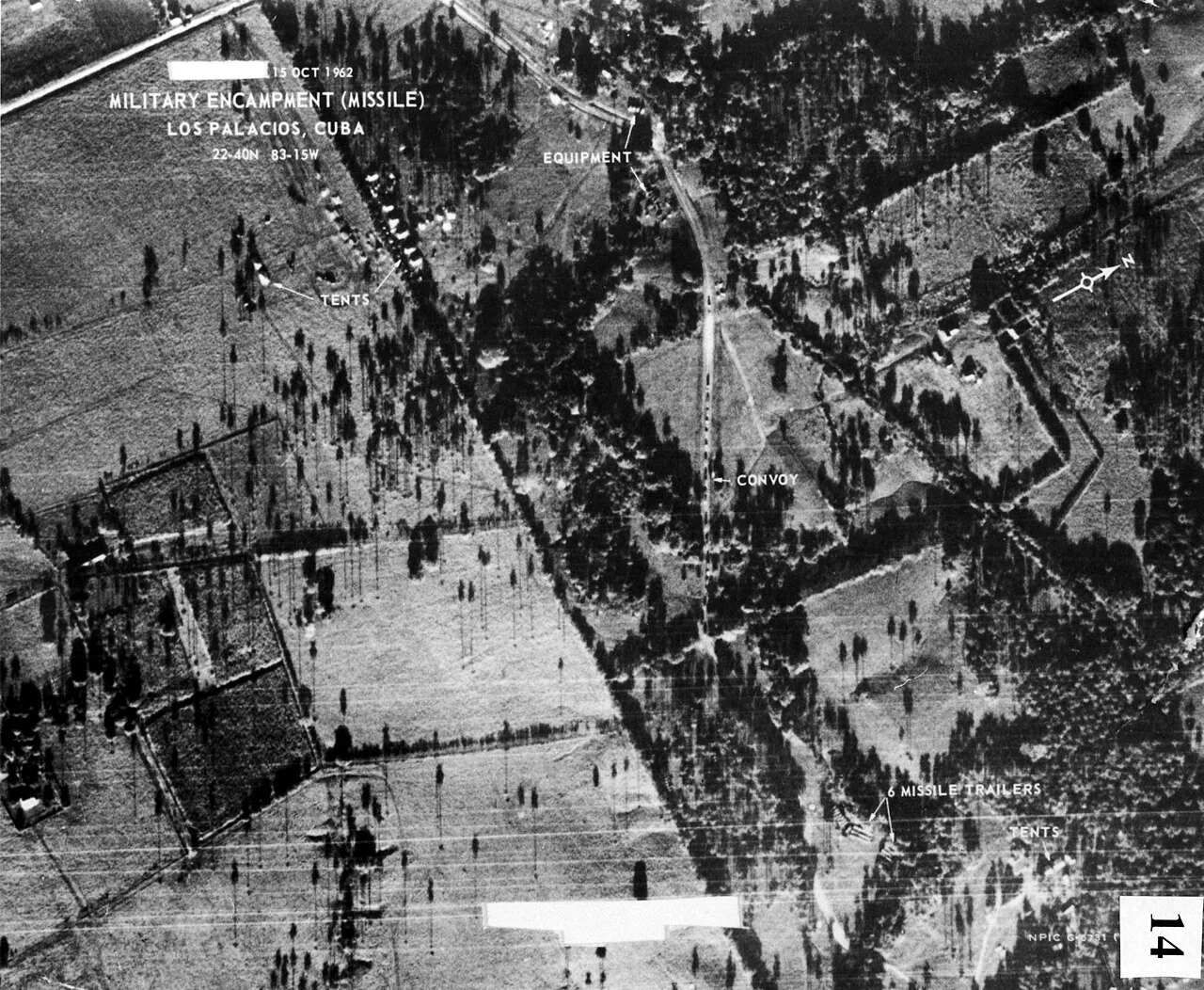
Source: U.S. Air Force U-2 photograph, October 15, 1962 (image on Wikimedia Commons).
Analysts at the National Photographic Interpretation Center studied images like this one to identify missiles, launchers, and support vehicles. The analysts added the labels on the print. Officials later showed the photograph to the public and at the United Nations as evidence.
Document 5 – Kennedy’s address, October 22, 1962
I have directed the Armed Forces to prepare for any eventualities; and I trust that in the interest of both the Cuban people and the Soviet technicians at the sites, the hazards to all concerned of continuing this threat will be recognized. Third: It shall be the policy of this Nation to regard any nuclear missile launched from Cuba against any nation in the Western Hemisphere as an attack by the Soviet Union on the United States, requiring a full retaliatory response upon the Soviet Union.
Source: John F. Kennedy, Radio and Television Report to the American People on the Soviet Arms Buildup in Cuba, October 22, 1962; text from the American Presidency Project, University of California, Santa Barbara.
*hemisphere: half of the world; here, the Americas. *retaliatory: in return for an attack.
Commentary. Kennedy states a new rule: the United States would treat a missile fired from Cuba at any nation in the Western Hemisphere as a Soviet attack on the United States. That meant that a mistake or a local incident could lead to nuclear war between the two superpowers. For about a week, American and Soviet ships and aircraft faced each other. On October 28, Soviet Premier Nikita Khrushchev announced that the missiles would be removed. In exchange, the United States promised not to invade Cuba, and, in a part of the settlement kept secret for years, agreed to remove its own missiles from Turkey.
After the crisis, the two powers took steps to lower the risk of war. They set up a direct telephone and teletype link between Washington and Moscow, the “hotline.” In August 1963, they signed, with Britain, the Limited Test Ban Treaty, which banned nuclear tests in the atmosphere, in space, and under water. On November 22, 1963, President Kennedy was assassinated while riding in a motorcade in Dallas, Texas. Vice President Lyndon B. Johnson took the oath of office a few hours later aboard the presidential plane.
2. The civil rights movement, 1960-1968
The Greensboro sit-in was one of many actions in the struggle for Black equality. The Supreme Court had ruled in Brown v. Board of Education (1954) that segregated public schools were unconstitutional, and the Montgomery bus boycott of 1955 and 1956 had made Martin Luther King Jr. a national leader. In the early 1960s the movement became a mass movement based on nonviolent direct action. Students formed the Student Nonviolent Coordinating Committee (SNCC) in 1960. In 1961, Black and white Freedom Riders rode buses through the South to test the ban on segregation in interstate travel. Mobs attacked them in Alabama.
Definition: nonviolent direct action
a method of protest in which people openly break unjust laws or refuse to obey unjust customs, such as segregation, without using violence, and accept the consequences. Sit-ins, boycotts, and marches are examples.
In the spring of 1963, King and local leaders led demonstrations in Birmingham, Alabama. There police used dogs and fire hoses against marchers, many of them children. Television and newspaper pictures shocked the country. On June 11, Kennedy called civil rights a moral issue and sent a bill to Congress. That night, the NAACP leader Medgar Evers was shot and killed outside his home in Jackson, Mississippi. On August 28, 1963, about 250,000 people gathered at the Lincoln Memorial for the March on Washington for Jobs and Freedom. There King gave his “I Have a Dream” speech.
Document 6 – The March on Washington
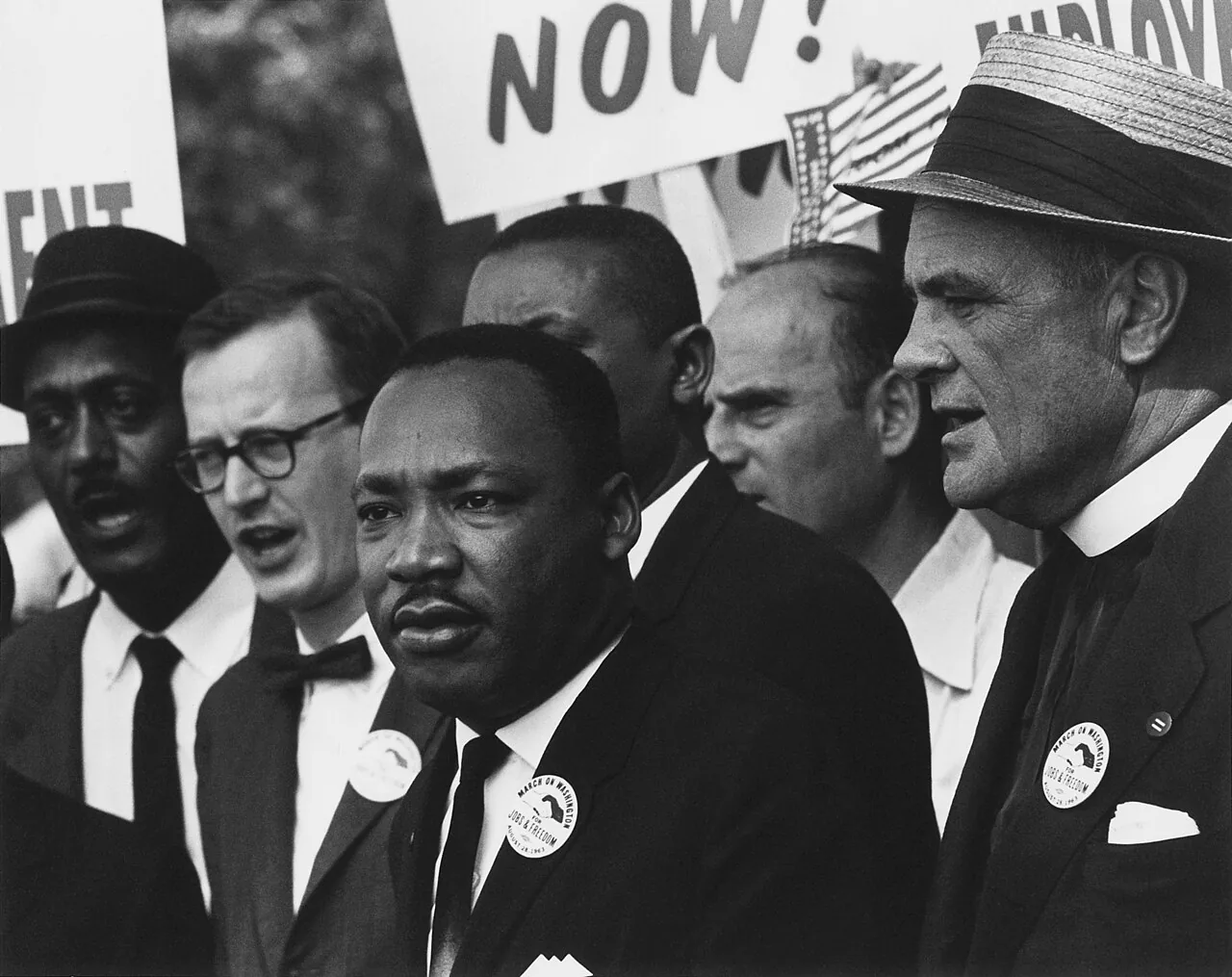
Source: Rowland Scherman, photograph, August 28, 1963, National Archives (image on Wikimedia Commons).
The most widely cited estimate of the crowd is 250,000 people, and observers believed that most of the marchers were Black. The march combined demands for civil rights legislation with demands for jobs and a higher minimum wage.
After Kennedy’s death, President Johnson, a Texan who had been the Senate majority leader, used his political skill to push the civil rights bill through Congress. The Civil Rights Act of 1964 banned discrimination in hotels, restaurants, and other places of public accommodation and barred segregation in public facilities. It also outlawed discrimination in employment on the basis of race, color, religion, sex, or national origin. Southern senators held up the bill with a filibuster for weeks, but it passed, and Johnson signed it on July 2.
Document 7 – Johnson signs the Civil Rights Act
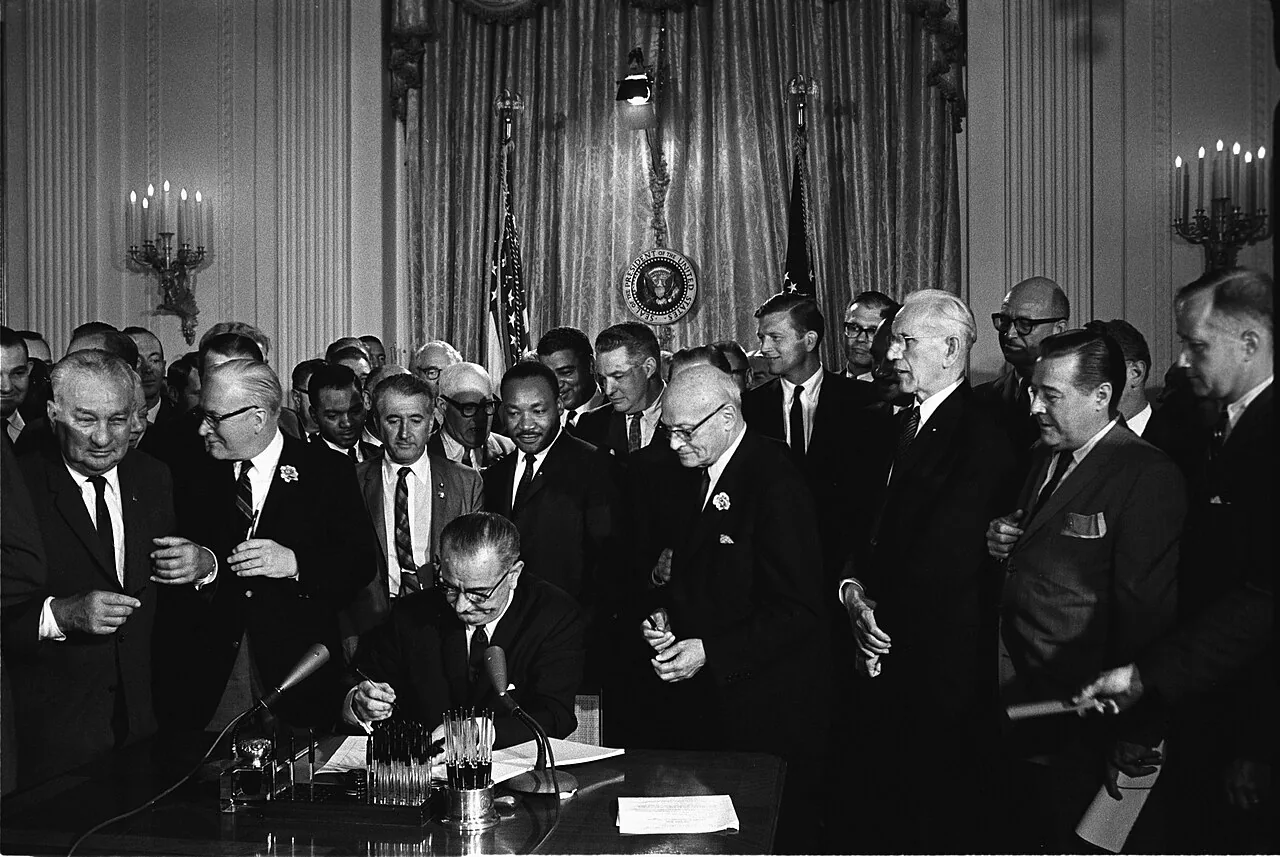
Source: Cecil Stoughton, White House Press Office, July 2, 1964 (image on Wikimedia Commons).
Johnson sits at a table and signs the bill with a pen while the guests stand behind him. The photograph was taken by an official White House photographer, so it records the event as the government wished it to be remembered.
Document 8 – Title II of the Civil Rights Act
All persons shall be entitled to the full and equal enjoyment of the goods, services, facilities, and privileges, advantages, and accommodations of any place of public accommodation, as defined in this section, without discrimination or segregation on the ground of race, color, religion, or national origin.
Source: Civil Rights Act of 1964, Title II, Section 201(a), signed July 2, 1964; text from the National Archives.
*accommodations: lodging, meals, and similar services. *segregation: the forced separation of people by race.
Commentary. The text is plain legal language. It guarantees “full and equal enjoyment” of public places and bans discrimination “on the ground of race, color, religion, or national origin.” The words “full and equal” recall the language of the Fourteenth Amendment. The law relied on the power of Congress to regulate commerce, and the Supreme Court upheld it in 1964.
In the summer of 1964, hundreds of volunteers, many of them white college students, traveled to Mississippi for Freedom Summer to register Black voters and to teach in “freedom schools.” Segregationists murdered three young civil rights workers, James Chaney, Andrew Goodman, and Michael Schwerner, near Philadelphia, Mississippi. The 24th Amendment, ratified in January 1964, had banned poll taxes in federal elections. Even so, Black citizens in the South still faced literacy tests, intimidation, and violence when they tried to register.
The turning point came in Selma, Alabama, in 1965. On March 7, which became known as Bloody Sunday, state troopers attacked marchers led by John Lewis and Hosea Williams. The marchers were crossing the Edmund Pettus Bridge on the road to Montgomery. Television carried the pictures to the nation. A week later, the president addressed a joint session of Congress and asked it to pass a voting rights bill.
Document 9 – Johnson’s voting rights speech
Their cause must be our cause too. Because it is not just Negroes, but really it is all of us, who must overcome the crippling legacy of bigotry and injustice. And we shall overcome. […] As a man whose roots go deeply into Southern soil I know how agonizing racial feelings are. I know how difficult it is to reshape the attitudes and the structure of our society. But a century has passed, more than a hundred years, since the Negro was freed. And he is not fully free tonight.
Source: Lyndon B. Johnson, Special Message to the Congress: The American Promise, March 15, 1965; text from the American Presidency Project, University of California, Santa Barbara.
*bigotry: hatred of people because of their race or beliefs. *legacy: what is handed down from the past.
Commentary. Johnson, a white Southerner, adopts the slogan of the movement: “we shall overcome.” He argues that civil rights are not a regional or a Black cause alone but a national one. The phrase “the crippling legacy of bigotry and injustice” places the problem in the long history of the country. The speech was written to persuade members of Congress and television viewers alike.
The Voting Rights Act of 1965, signed on August 6, banned literacy tests and sent federal examiners to counties with a history of discrimination. Registration of Black voters in the South rose sharply in the following years. But the new laws did not end inequality in housing, jobs, and schools in Northern and Western cities. Riots broke out in the Watts section of Los Angeles in August 1965 and in Newark and Detroit in 1967.
Some young activists, such as Stokely Carmichael, called for “Black Power.” Meanwhile, the assassination of Malcolm X in February 1965 had deprived the movement of another leading voice. On April 4, 1968, King was shot and killed in Memphis, Tennessee, where he had gone to support striking sanitation workers. Riots followed in many cities.
3. The Great Society
Johnson wanted to be remembered for what he did at home. In a speech in May 1964, he called for a Great Society, a country that would use its wealth to end poverty and racial injustice. After he won the presidency in his own right in November 1964, defeating the conservative Republican Senator Barry Goldwater by a landslide, he had large Democratic majorities in Congress. Between 1964 and 1966, they passed an unusual number of laws.
Definition: Great Society
the name given to President Johnson’s program of domestic reform in the mid-1960s, which included the War on Poverty, Medicare and Medicaid, federal aid to education, and civil rights laws.
The Economic Opportunity Act of 1964 launched the “War on Poverty” with programs such as Head Start for preschool children, the Job Corps for young people, and VISTA, a domestic volunteer service. In April 1965 the Elementary and Secondary Education Act sent federal money to schools in poor districts. In July 1965, Johnson signed Medicare, health insurance for Americans over 65, and Medicaid, which helped pay medical costs for the poor.
The Immigration and Nationality Act of 1965 ended the national-origins quota system, which since the 1920s had favored immigrants from northern and western Europe. It set up a system based on family ties and skills. Over time it changed the origins of American immigrants, who came increasingly from Asia and Latin America.
Critics and results
The programs had critics. Conservatives said that they expanded the government and discouraged work, and some liberals said that the War on Poverty never received enough money. Historians still debate how much it achieved, but they agree that Medicare, Medicaid, and federal school aid became lasting parts of American life. The cost of the war in Vietnam, however, soon competed with the cost of the Great Society for attention and funds.
4. The war in Vietnam
From advisers to war
Vietnam had been a French colony. After the Vietnamese nationalist forces led by Ho Chi Minh defeated the French at Dien Bien Phu in May 1954, the Geneva Accords divided the country temporarily at the 17th parallel. Ho Chi Minh’s communist government ruled the North from Hanoi. In the South, Ngo Dinh Diem, an anticommunist, refused to hold the national elections called for in 1956.
American leaders from Truman to Eisenhower had given money and advisers to the French and then to Diem, because they believed in the domino theory: if South Vietnam became communist, its neighbors would follow. A communist-led insurgency in the South, the National Liberation Front, whose fighters the Americans called the Viet Cong, grew rapidly after 1960.
Definition: domino theory
the belief held by many American leaders in the 1950s and 1960s that if one country in a region fell to communism, neighboring countries would fall one after another, like a row of dominoes.
Kennedy raised the number of American military advisers in South Vietnam from a few hundred to at least sixteen thousand by the time of his death. In November 1963, the United States accepted a coup by South Vietnamese generals in which Diem was killed. Instability in Saigon followed. In August 1964, North Vietnamese torpedo boats attacked the destroyer USS Maddox in the Gulf of Tonkin on August 2, and the administration reported a second attack on August 4. Later research has cast serious doubt on whether the second attack occurred. Johnson asked Congress for authority to respond, and on August 7 it passed the Gulf of Tonkin Resolution.
Document 10 – The Gulf of Tonkin Resolution
That the Congress approves and supports the determination of the President, as Commander in Chief, to take all necessary measures to repel any armed attack against the forces of the United States and to prevent further aggression. […] Section 2. The United States regards as vital to its national interest and to world peace the maintenance of international peace and security in southeast Asia. Consonant with the Constitution of the United States and the Charter of the United Nations and in accordance with its obligations under the Southeast Asia Collective Defense Treaty, the United States is, therefore, prepared, as the President determines, to take all necessary steps, including the use of armed force, to assist any member or protocol state of the Southeast Asia Collective Defense Treaty requesting assistance in defense of its freedom.
Source: Joint Resolution of Congress, H.J. Res. 1145 (the Gulf of Tonkin Resolution), August 7, 1964; text from the Avalon Project, Yale Law School.
*aggression: an attack. *protocol state: a state covered by the Southeast Asia Treaty protocol (South Vietnam, Laos, Cambodia).
Commentary. Congress approved the president’s “determination” to take “all necessary measures” and, in Section 2, “all necessary steps, including the use of armed force.” It was not a declaration of war, but Johnson later treated it as authority for a large war. The House passed it 416 to 0, and in the Senate only two members, Wayne Morse of Oregon and Ernest Gruening of Alaska, voted no. Within a few years, many members of Congress felt that they had given away too much power.
Escalation and stalemate, 1965-1968
In March 1965, the air campaign called Operation Rolling Thunder began to bomb North Vietnam, and on March 8 the first American combat troops, Marines, came ashore at Da Nang. General William Westmoreland, the American commander, used a strategy of “search and destroy,” sending units by helicopter to find and fight the enemy. He measured success by the number of enemy killed, the “body count.” The troop level kept rising and reached a peak of 543,400 in April 1969. Because many young men were drafted, the war reached into nearly every town.
Document 11 – Soldiers and helicopters
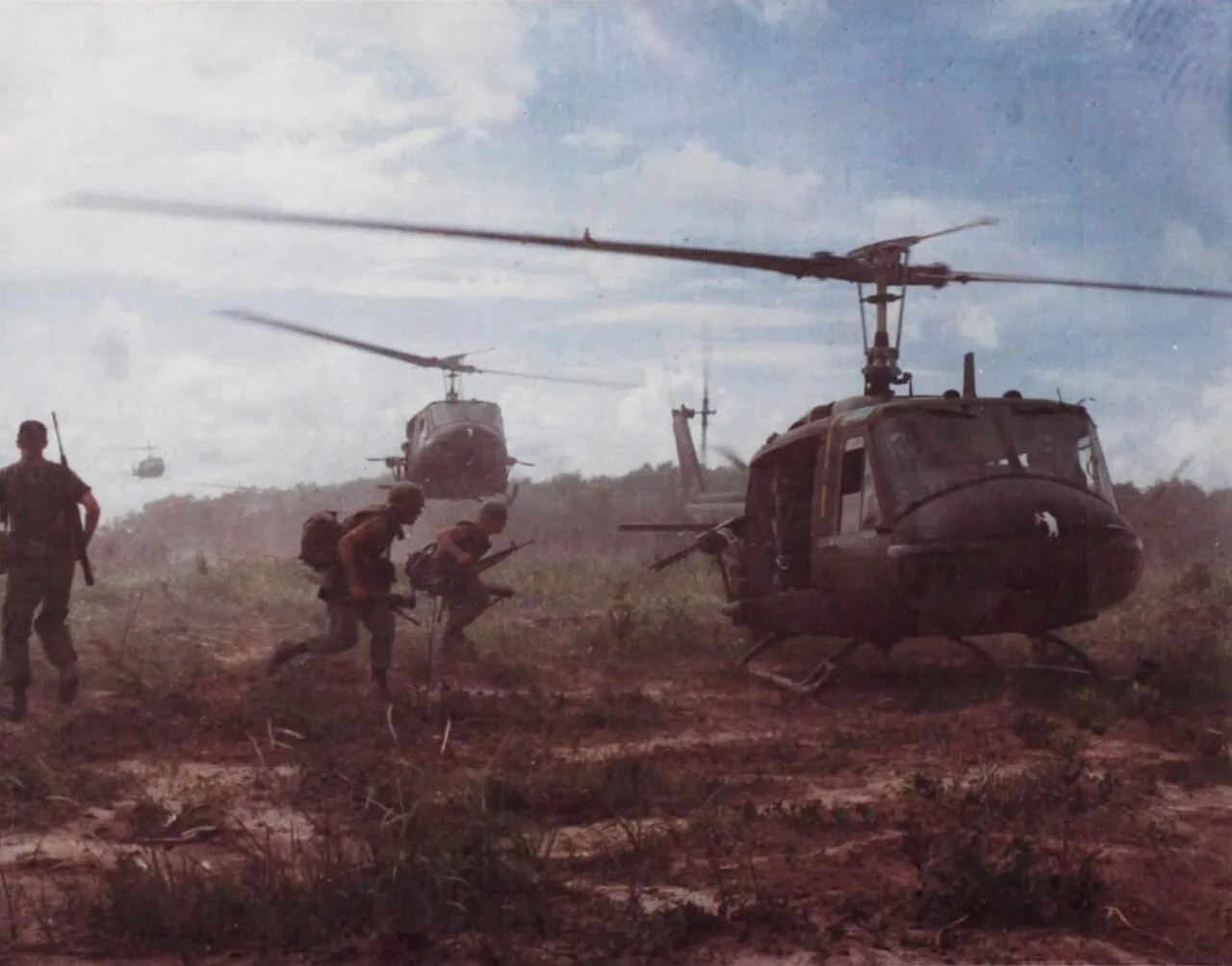
Source: SFC James K. F. Dung, U.S. Army, May 16, 1966, National Archives (image on Wikimedia Commons).
The helicopter allowed American units to move quickly across rough country, but it did not solve the central problem. The enemy could avoid battle, retreat across the border into Laos or Cambodia, and return. Meanwhile, the Ho Chi Minh Trail, a network of paths through Laos and Cambodia, carried men and supplies south.
The war on the ground
The war was fought in the villages and the jungle against a guerrilla enemy as well as against regular units of the North Vietnamese Army. American planes dropped huge tonnages of bombs, and the military sprayed chemical defoliants such as Agent Orange to strip the forest cover. The fighting drove millions of Vietnamese civilians from their homes. At home, the administration told the public that progress was being made. The difference between what officials said and what reporters and soldiers saw was called the “credibility gap.”
The Tet Offensive
On January 30 and 31, 1968, during the lunar new year holiday called Tet, communist forces attacked cities and bases across South Vietnam. Some even briefly entered the grounds of the American embassy in Saigon. American and South Vietnamese forces drove the attackers back with heavy losses, and the Tet Offensive was a military defeat for them. But it was a political turning point in the United States. After the government had claimed that the end was in sight, the scale of the attack shocked Americans. On March 31, Johnson announced a partial halt to the bombing of North Vietnam, offered to open peace talks, and said that he would not run for another term.
5. A divided nation, 1968-1975
The year 1968 was one of the most turbulent in American history. After King was killed in April, Senator Robert F. Kennedy, a candidate for the Democratic nomination who had spoken against the war, was shot in Los Angeles on June 5 and died the next day. In August, police and anti-war demonstrators clashed in the streets of Chicago during the Democratic National Convention. In November, Nixon narrowly defeated Vice President Hubert Humphrey, with the segregationist Governor George Wallace of Alabama winning five Southern states as a third-party candidate.
Nixon promised an “honorable end” to the war. His policy, called Vietnamization, was to withdraw American troops gradually while training and equipping South Vietnamese forces to do the fighting. At the same time he continued heavy bombing and, in 1970, sent troops into Cambodia to destroy enemy bases. Anti-war protest had grown on college campuses and in the streets, and many Americans were angry at the protesters. Nixon appealed to those who did not demonstrate.
Document 12 – The “Silent Majority” speech
And so tonight–to you, the great silent majority of my fellow Americans–I ask for your support. I pledged in my campaign for the Presidency to end the war in a way that we could win the peace. I have initiated a plan of action which will enable me to keep that pledge. The more support I can have from the American people, the sooner that pledge can be redeemed; for the more divided we are at home, the less likely the enemy is to negotiate at Paris. Let us be united for peace. Let us also be united against defeat.
Source: Richard M. Nixon, Address to the Nation on the War in Vietnam (the “Silent Majority” speech), November 3, 1969; text from the American Presidency Project, University of California, Santa Barbara.
*redeemed: carried out. *negotiate: to bargain to reach an agreement.
Commentary. Nixon asks for the support of the “great silent majority” of Americans and warns against a divided country. The speech separates the protesters from the larger group of citizens who were not protesting. It was a political message as well as a statement about the war, and it helped him build a coalition of voters that would support him in the 1972 election.
The announcement of the Cambodian operation, on April 30, 1970, set off protests on many campuses. At Kent State University in Ohio, students gathered on May 4, and the Ohio National Guard fired into the crowd, killing four students and wounding nine others. Ten days later, police killed two students at Jackson State College in Mississippi. Many colleges closed for a time.
In June 1971 the New York Times began to publish the Pentagon Papers, a secret government study of the war. Daniel Ellsberg had leaked it, and it showed that officials had often misled the public. The Supreme Court ruled that the government could not stop publication. The 26th Amendment, ratified in July 1971, lowered the voting age to 18, in part because young men who could be drafted at 18 could not vote.
Document 13 – Kent State, May 4, 1970
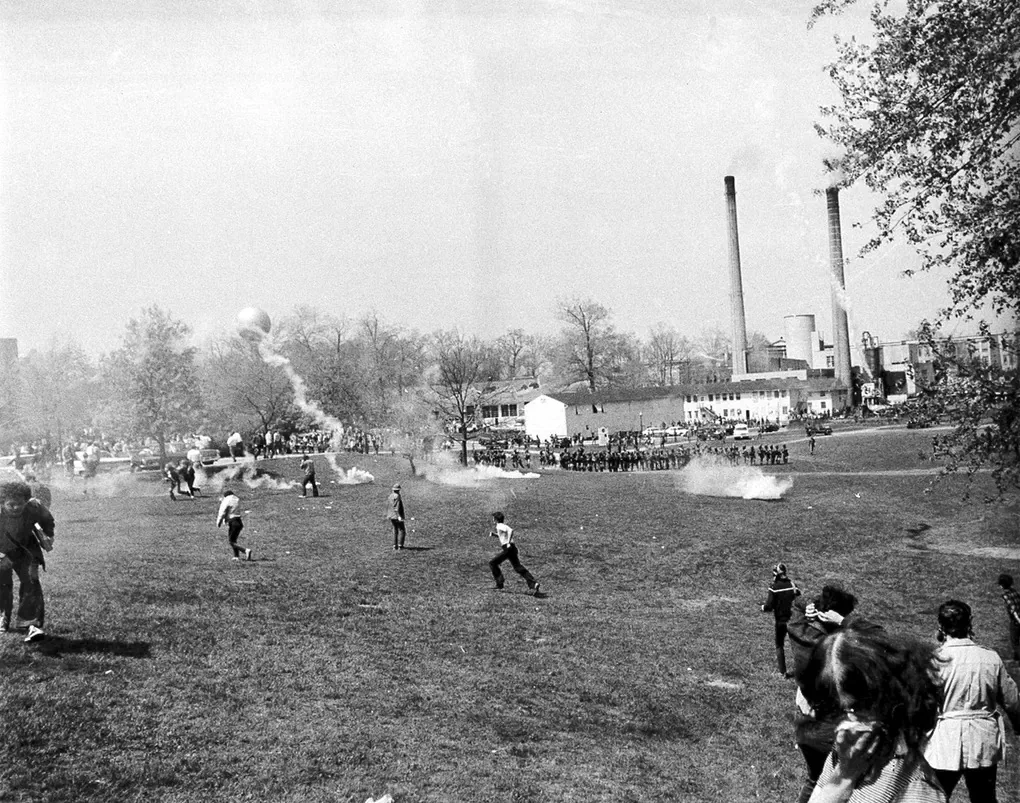
Source: Larry Stoddard, photograph, May 4, 1970 (image on Wikimedia Commons).
The picture shows tear gas, students running, and a line of Guardsmen in the distance. It does not show the shooting itself, so it must be read with other evidence. It shows how close the soldiers and the students were in an open space.
Negotiations dragged on in Paris. After a last round of heavy bombing in December 1972, the United States, North Vietnam, South Vietnam, and the Viet Cong signed the Paris Peace Accords on January 27, 1973. American combat troops left by the end of March, and the draft ended. Fighting continued between North and South, and on April 30, 1975, North Vietnamese tanks entered Saigon and the South Vietnamese government surrendered. More than 58,000 Americans had died, and the number of Vietnamese dead, soldiers and civilians, was in the millions according to most estimates. Congress had already reacted to the way the war began. In November 1973 it passed the War Powers Resolution over Nixon’s veto.
Document 14 – The War Powers Resolution
It is the purpose of this joint resolution to fulfill the intent of the framers of the Constitution of the United States and insure that the collective judgement of both the Congress and the President will apply to the introduction of United States Armed Forces into hostilities, or into situations where imminent involvement in hostilities is clearly indicated by the circumstances, and to the continued use of such forces in hostilities or in such situations.
Source: War Powers Resolution, Section 2(a), passed over President Nixon’s veto on November 7, 1973; text from the Avalon Project, Yale Law School.
*insure: here, make certain. *hostilities: acts of war.
Commentary. The resolution says that its purpose is to ensure that Congress and the president share the decision to send troops into hostilities. It requires the president to report to Congress after sending forces into combat. Presidents have disagreed with Congress over whether the law limits their power as commander in chief, and the argument has continued in later conflicts.
Other movements and legacies
The 1960s also changed American society in other ways. Betty Friedan’s The Feminine Mystique (1963) questioned the idea that women should be only wives and mothers. The National Organization for Women was founded in 1966. Title IX of the Education Amendments of 1972 banned sex discrimination in schools that received federal money. Cesar Chavez led farm workers in California, Native American activists claimed treaty rights, and the Stonewall riots in New York City in June 1969 became a symbol for the gay rights movement. In July 1969, Neil Armstrong and Buzz Aldrin landed on the Moon, fulfilling Kennedy’s goal for the space program. For a few days, a divided country shared a moment of pride.
The legacy of the decade is mixed. Civil rights laws ended legal segregation and opened the vote to Black Southerners. Medicare and Medicaid helped millions. But the war left Americans less trusting of government. Many veterans came home to indifference or hostility. The memorial to those who died, the Vietnam Veterans Memorial in Washington, dedicated in 1982, lists their names on a wall of black granite. Political leaders now debated, whenever they considered using force abroad, whether the nation was risking “another Vietnam.”
- Feb. 1, 1960 Greensboro sit-in begins.
- Oct. 1962 Cuban Missile Crisis.
- Aug. 28, 1963 March on Washington.
- Nov. 22, 1963 President Kennedy is assassinated.
- July 2, 1964 Civil Rights Act is signed.
- Aug. 7, 1964 Gulf of Tonkin Resolution.
- Aug. 6, 1965 Voting Rights Act is signed.
- Jan. 30, 1968 Tet Offensive.
- May 4, 1970 Kent State shootings.
- Jan. 27, 1973 Paris Peace Accords.
- Apr. 30, 1975 Saigon falls.
Key takeaways
- The Cuban Missile Crisis (1962) brought the United States and the Soviet Union close to nuclear war and led to a hotline and a test ban treaty.
- The civil rights movement used nonviolent direct action to win the Civil Rights Act of 1964 and the Voting Rights Act of 1965.
- The Great Society added Medicare, Medicaid, and federal aid to education and widened the role of the federal government.
- The Gulf of Tonkin Resolution (1964) gave the president broad power; American troops in Vietnam peaked at 543,400 in 1969.
- The Tet Offensive (1968) turned many Americans against the war, and Johnson did not seek reelection.
- Nixon withdrew troops by Vietnamization; the Paris Accords (1973) ended direct U.S. combat, and Saigon fell in 1975.
- The war left lasting distrust of government and led Congress to pass the War Powers Resolution (1973).

Quick review: flashcards
Tap a card to see the answer.