


This US History Grade 11 lesson covers From Watergate to Reagan, part of the unit “Recent America.” First, read the full lesson with its primary sources, maps and key terms. Then practice with the worksheet, check yourself with the quiz and get ready with the test.
Shortly after midnight on June 17, 1972, a security guard at the Watergate office complex in Washington noticed that someone had taped a door open. Then police arrested five men inside the headquarters of the Democratic National Committee. In addition, they carried cameras, lock-picking tools, and listening equipment. The break-in looked like a small crime, but over the next two years the effort to cover it up brought down a president, and the public’s trust in government fell to a new low. Within a decade, the nation had been through an energy crisis, a hostage crisis, a deep recession, and a conservative political revival that changed the direction of the country.
Guiding question: How did Watergate and the troubles of the 1970s lead to the rise of the conservative movement and to Reagan’s presidency?
1. Watergate and the end of the Nixon presidency
The burglars had ties to the Committee for the Re-Election of the President, Nixon’s campaign organization. The president said that no one in the White House had taken part, and in November 1972 he won reelection by a landslide, carrying forty-nine states. But reporters for the Washington Post, Bob Woodward and Carl Bernstein, kept following the story, and a federal judge, John Sirica, pressed the burglars to talk. In 1973 the Senate created a committee, led by Senator Sam Ervin of North Carolina, to hold public hearings, which television networks broadcast to the nation.
Document 1 – The Senate Watergate hearings
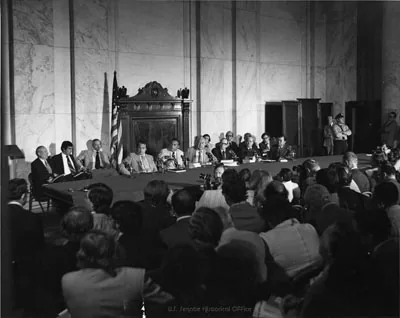
Source: U.S. Senate Historical Office, 1973 (image on Wikimedia Commons).
Television showed hearings like this one in the summer of 1973. Americans watched White House aides testify under oath about what the president knew. The Senate Historical Office photographed the hearing room as part of its record of the Senate’s work.
The hearings revealed that the president had a secret system that recorded conversations in the Oval Office. Special prosecutor Archibald Cox demanded the tapes. On October 20, 1973, Nixon ordered Cox fired, and both the attorney general and the deputy attorney general resigned rather than carry out the order, an event called the “Saturday Night Massacre.” As a result, public anger grew. Also, in that same month, Vice President Spiro Agnew had resigned because of a separate corruption case, and Nixon appointed Representative Gerald R. Ford of Michigan to replace him.
Definition: executive privilege
the claim that a president may keep some communications private from Congress and the courts to protect the confidentiality of advice. In United States v. Nixon (1974), the Supreme Court said the claim was not absolute.
In July 1974 the Supreme Court ruled unanimously, in United States v. Nixon, that the president had to turn over the tapes. In the same week, the House Judiciary Committee approved articles of impeachment charging obstruction of justice, abuse of power, and contempt of Congress. A tape released in early August showed that Nixon had ordered the FBI investigation of the break-in stopped only days after it happened. As a result, his support in Congress collapsed. On the evening of August 8, he went on television to announce his resignation.
Document 2 – Nixon’s resignation speech
I have never been a quitter. To leave office before my term is completed is abhorrent to every instinct in my body. But as President, I must put the interests of America first. America needs a full-time President and a full-time Congress, particularly at this time with problems we face at home and abroad. To continue to fight through the months ahead for my personal vindication would almost totally absorb the time and attention of both the President and the Congress in a period when our entire focus should be on the great issues of peace abroad and prosperity without inflation at home.
Source: Richard M. Nixon, Address to the Nation Announcing Decision To Resign the Office of President, August 8, 1974; text from the American Presidency Project, University of California, Santa Barbara.
*abhorrent: hateful. *vindication: proof of innocence.
Commentary. Nixon does not admit that he committed a crime. He says that he has “never been a quitter” and presents his departure as a sacrifice made for the good of the country, because the fight to defend himself would occupy the president and Congress when they should be dealing with “peace abroad and prosperity without inflation at home.” He became the only president in American history to resign.
Document 3 – Nixon’s farewell to his staff
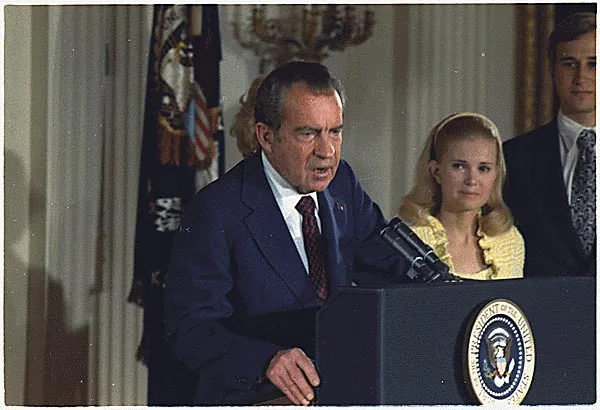
Source: White House Photo Office Collection, National Archives, August 9, 1974 (image on Wikimedia Commons).
The White House photographer took the photograph on the morning that Nixon left office. It records the occasion from the point of view of the presidential staff, in which his family stood beside him, and does not show the reaction of the public or of Congress.
Gerald Ford, who had never won an election for president or vice president, took the oath of office on the day Nixon left.
Document 4 – Ford takes office
My fellow Americans, our long national nightmare is over. Our Constitution works; our great Republic is a government of laws and not of men. Here the people rule. But there is a higher Power, by whatever name we honor Him, who ordains not only righteousness but love, not only justice but mercy. As we bind up the internal wounds of Watergate, more painful and more poisonous than those of foreign wars, let us restore the golden rule to our political process, and let brotherly love purge our hearts of suspicion and of hate.
Source: Gerald R. Ford, Remarks on Taking the Oath of Office, August 9, 1974; text from the American Presidency Project, University of California, Santa Barbara.
*ordains: commands or establishes. *purge: to cleanse.
Commentary. Ford declares that “our long national nightmare is over.” He stresses that the Constitution has worked and that the nation is “a government of laws and not of men.” The tone aims to calm the country. A month later, on September 8, he granted Nixon a full pardon for any federal crimes he might have committed in office.
Document 5 – The pardon
Theirs is an American tragedy in which we all have played a part. It could go on and on and on, or someone must write the end to it. I have concluded that only I can do that, and if I can, I must.
Source: Gerald R. Ford, Remarks on Signing a Proclamation Granting Pardon to Richard Nixon, September 8, 1974; text from the American Presidency Project, University of California, Santa Barbara.
*conscience: sense of right and wrong. *predecessor: the person who held the office before.
Commentary. Ford says that the Nixon case is “an American tragedy” and that “someone must write the end to it.” Many Americans were angry that Nixon never went to trial, and some suspected a deal, which Ford denied. However, the pardon probably cost Ford support in the election of 1976. Congress passed a series of reforms in the 1970s: stronger campaign finance rules in 1974, amendments to the Freedom of Information Act, and the Ethics in Government Act of 1978, which created independent counsels to investigate high officials.
2. Energy, economy, and Carter, 1973-1980
In October 1973, after the Yom Kippur War between Israel and its Arab neighbors, Arab members of OPEC placed an oil embargo on countries that had supported Israel, among them the United States. As a result, prices rose sharply and gasoline became scarce. Americans waited in long lines at gas stations, and the government asked drivers to save fuel. The embargo ended in 1974, but it had shown that the economy depended on foreign oil.
Document 6 – Waiting for gasoline
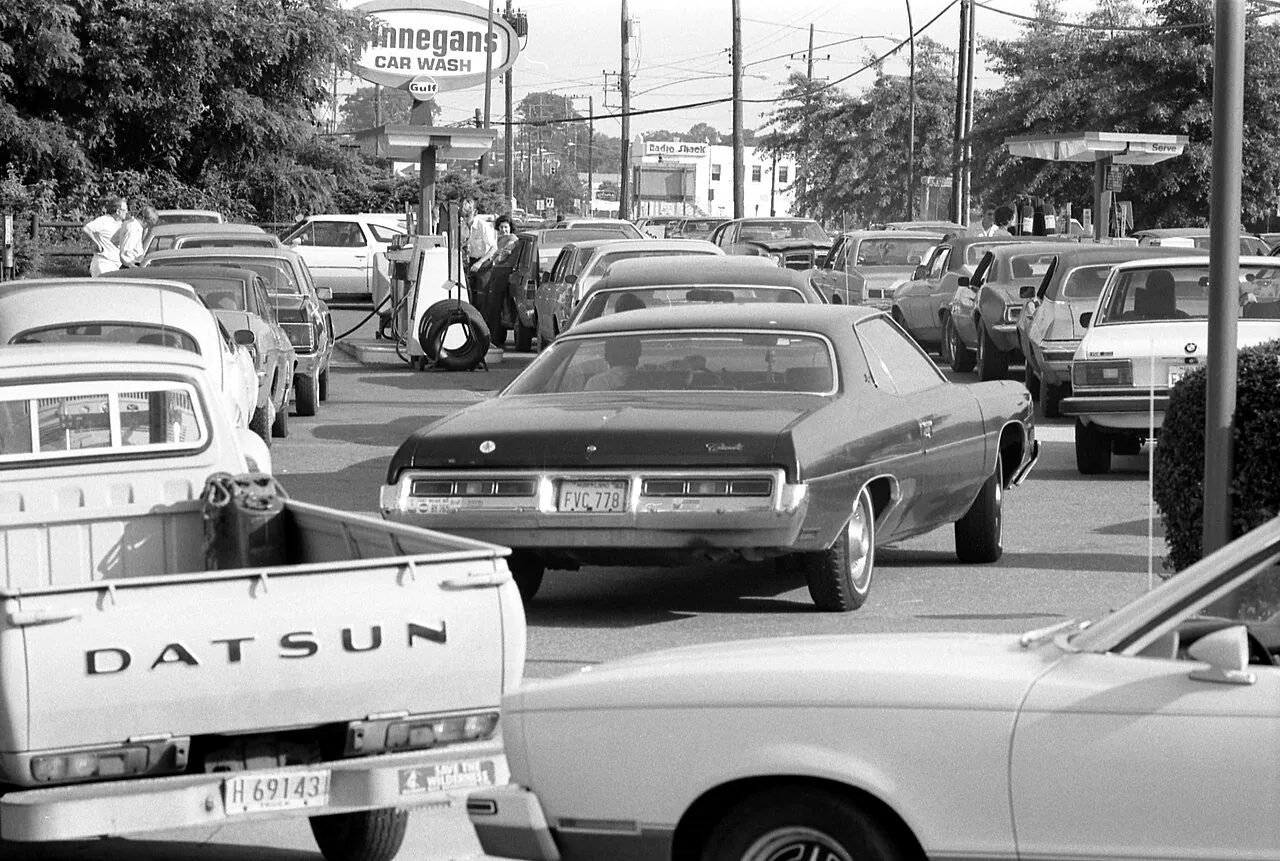
Source: Warren K. Leffler, photograph, June 15, 1979, Library of Congress (image on Wikimedia Commons).
This photograph shows a second round of shortages in 1979, after the Iranian revolution cut oil exports. The long line of cars shows how fuel supply affected daily life.
The decade brought stagflation, a combination of slow economic growth, high unemployment, and high inflation, which economists had believed could not occur at the same time. Also, factory jobs in the Northeast and Midwest disappeared as industries faced competition from Japan and Germany. The table in the exercises shows how unemployment and inflation rose.
Definition: stagflation
a combination of economic stagnation (slow growth and high unemployment) and inflation (rising prices), which seemed unusual because high unemployment usually comes with low inflation.
Voters elected Jimmy Carter, a peanut farmer and former governor of Georgia, in 1976. As an outsider who promised honesty, he suited the mood after Watergate. He created the Department of Energy, asked Americans to conserve, and signed laws that deregulated the airline industry. In March 1979, an accident at the Three Mile Island nuclear plant in Pennsylvania caused a partial meltdown, and public fear of nuclear power grew. In August Carter appointed Paul Volcker to head the Federal Reserve, and the Fed soon raised interest rates sharply to fight inflation.
Document 7 – Three Mile Island
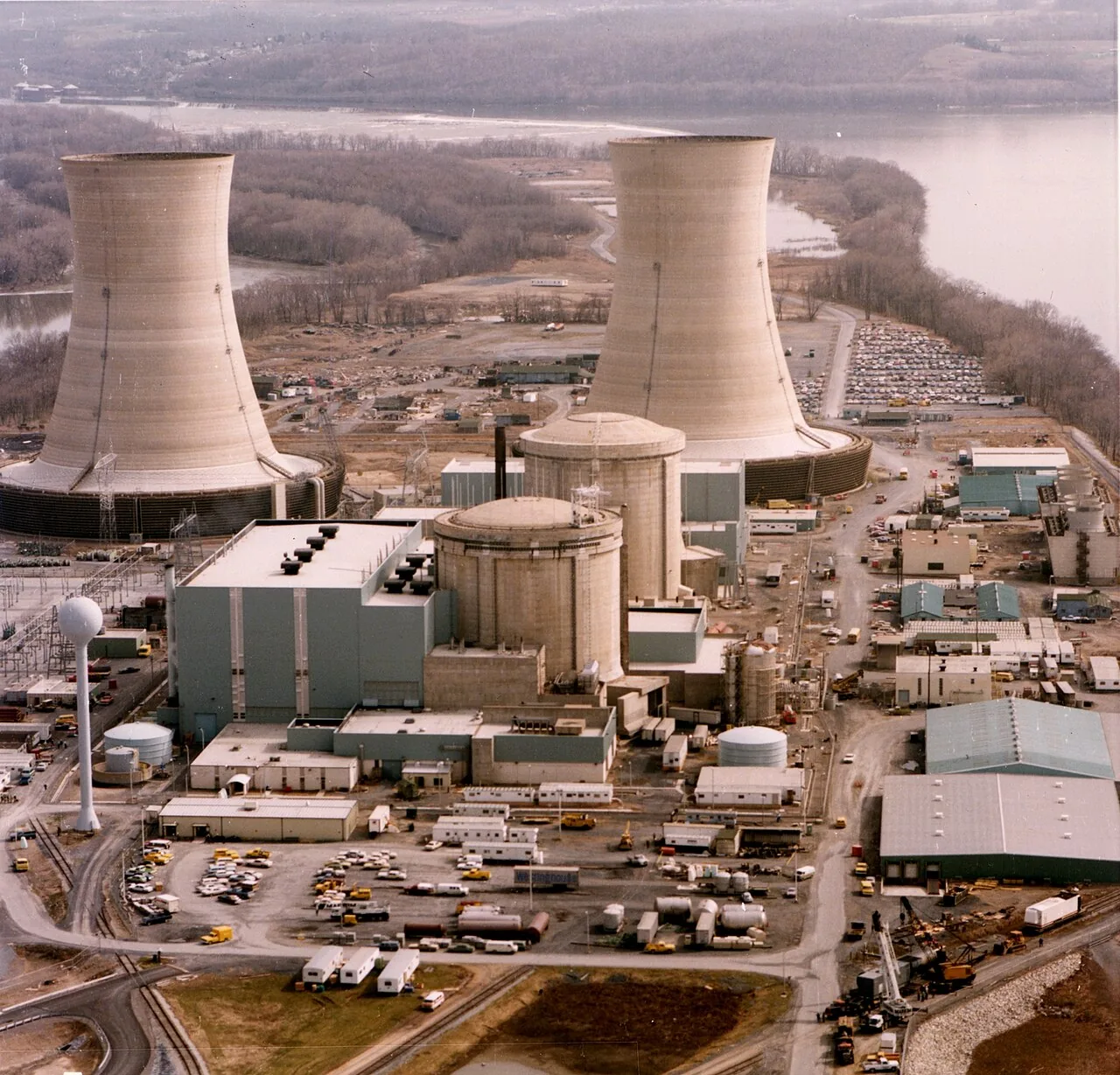
Source: U.S. Department of Energy, 1979 (image on Wikimedia Commons).
The photograph dates from 1979, the year of the accident. The two large towers are cooling towers; the reactors are in the smaller domes. The accident led to new safety rules for nuclear plants.
On July 15, 1979, Carter spoke to the nation on television about energy. He did not use the word “malaise,” but critics gave the speech that name.
Document 8 – Carter on a crisis of confidence
It is a crisis of confidence. It is a crisis that strikes at the very heart and soul and spirit of our national will. We can see this crisis in the growing doubt about the meaning of our own lives and in the loss of a unity of purpose for our Nation. The erosion of our confidence in the future is threatening to destroy the social and the political fabric of America. The confidence that we have always had as a people is not simply some romantic dream or a proverb in a dusty book that we read just on the Fourth of July.
Source: Jimmy Carter, Address to the Nation on Energy and National Goals (the “malaise” speech), July 15, 1979; text from the American Presidency Project, University of California, Santa Barbara.
*erosion: wearing away. *fabric: the structure that holds a society together.
Commentary. Carter argues that the central problem is not oil but a loss of faith in the future. He calls it a “crisis of confidence” that “strikes at the very heart and soul and spirit of our national will.” The speech pleased many people at first, but critics said that it blamed the people instead of leading them, and a few days later Carter asked his cabinet members to submit their resignations and replaced several of them.
Peace in the Middle East and crisis in Iran
Carter’s greatest success was in diplomacy. In September 1978 he invited President Anwar Sadat of Egypt and Prime Minister Menachem Begin of Israel to Camp David, the presidential retreat in Maryland. After thirteen days, the two leaders agreed on two documents, a framework for peace between Egypt and Israel and a framework for a wider settlement in the Middle East. In March 1979, Egypt and Israel signed a peace treaty at the White House. Israel returned the Sinai Peninsula to Egypt by 1982. As a result, Egypt became the first Arab country to recognize Israel. Islamist extremists in his own army assassinated Sadat in 1981.
Document 9 – The Camp David Accords
Taking these factors into account, the parties are determined to reach a just, comprehensive, and durable settlement of the Middle East conflict through the conclusion of peace treaties based on Security Council resolutions 242 and 338 in all their parts. Their purpose is to achieve peace and good neighborly relations. They recognize that for peace to endure, it must involve all those who have been most deeply affected by the conflict.
Source: The Camp David Accords: A Framework for Peace in the Middle East, September 17, 1978; text from the Avalon Project, Yale Law School.
*durable: lasting. *Security Council resolutions 242 and 338: United Nations resolutions of 1967 and 1973 on the Arab-Israeli conflict.
Commentary. The parties say that they want “a just, comprehensive, and durable settlement.” The framework rested on United Nations resolutions 242 and 338. It dealt with Egypt and Israel directly, but the part about the West Bank and Gaza and the rights of the Palestinians was put off until later negotiations, and many of those questions remain unresolved.
Document 10 – The handshake
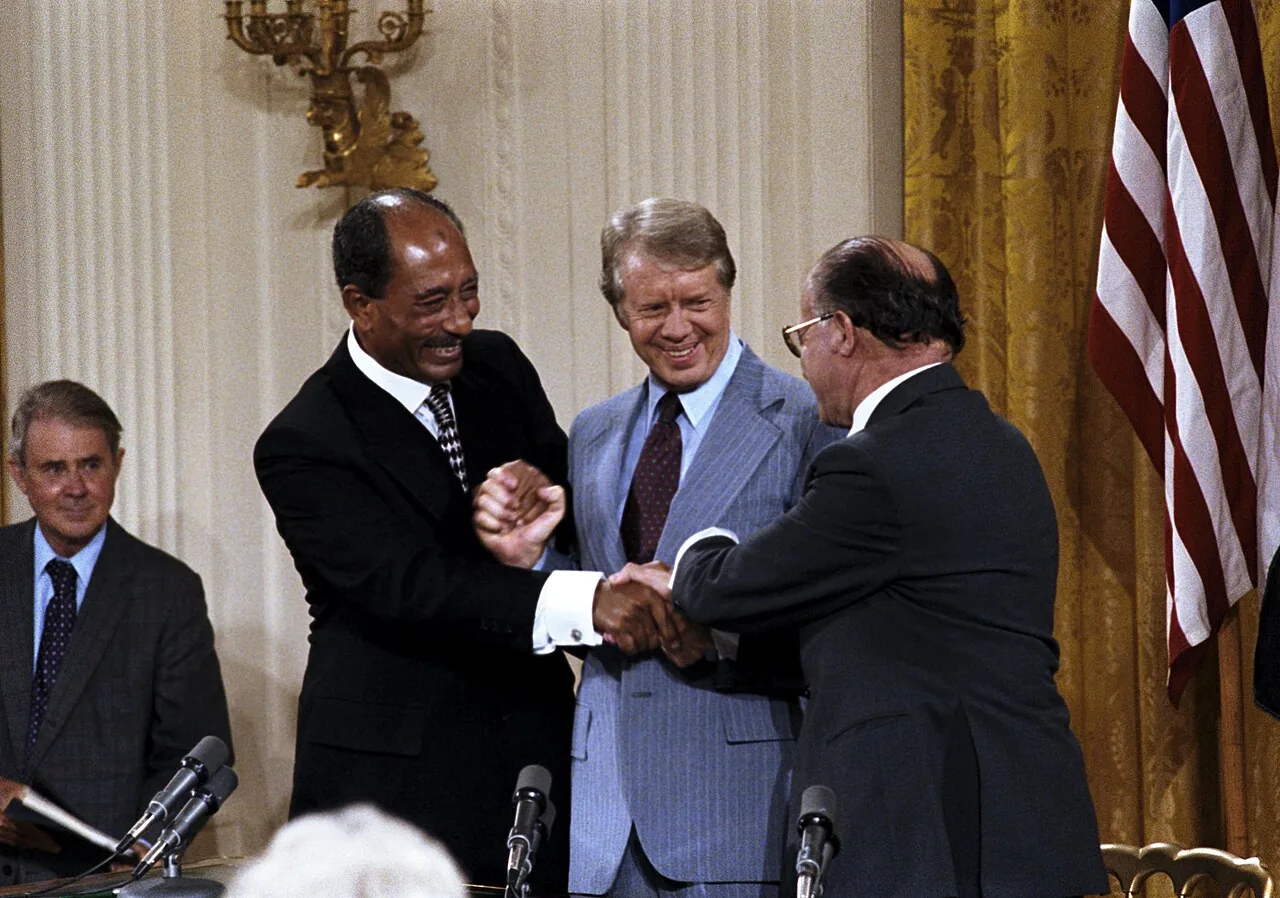
Source: Jimmy Carter Library, September 17, 1978 (image on Wikimedia Commons).
The three men stand together after the signing. The picture records a diplomatic achievement and shows Carter between the two leaders. The White House released it to the press, so it presents the moment as the participants wished it to be remembered.
A crisis followed the Camp David breakthrough. In January 1979, the Shah of Iran, a close American ally, had to leave his country, and in February the Ayatollah Ruhollah Khomeini returned to Tehran to head an Islamic republic. Then in October, Carter allowed the Shah to enter the United States for medical treatment. On November 4, 1979, Iranian students stormed the American embassy in Tehran and took hostages.
Iran held fifty-two Americans for 444 days, and television counted each day. However, a military rescue attempt in April 1980 failed. In December 1979, Soviet troops invaded Afghanistan, ending the period of improved relations known as détente. Carter responded by halting grain sales to the Soviet Union, boycotting the Moscow Olympics, and announcing that the United States would resist any attempt to control the Persian Gulf region.
3. The Reagan Revolution
Conservative ideas had been gaining strength for years. Taxpayers in California approved Proposition 13 in 1978 to cut property taxes. Evangelical Christians, organized into groups such as the Moral Majority, entered politics, and many Southern whites left the Democratic Party. Ronald Reagan, a former actor and a two-term governor of California, offered a simple message: lower taxes, a smaller federal government, and a stronger military. In November 1980 he defeated Carter. Iran released the hostages on January 20, 1981, minutes after he took the oath of office.
Document 11 – Reagan’s first inaugural address
In this present crisis, government is not the solution to our problem; government is the problem. From time to time, we have been tempted to believe that society has become too complex to be managed by self-rule, that government by an elite group is superior to government for, by, and of the people. But if no one among us is capable of governing himself, then who among us has the capacity to govern someone else?
Source: Ronald Reagan, First Inaugural Address, January 20, 1981; text from the Avalon Project, Yale Law School.
*elite: a small group with special power. *equitable: fair.
Commentary. The sentence “government is not the solution to our problem; government is the problem” summed up the program of the new administration. It reversed the idea, dominant since the New Deal and the Great Society, that the federal government should lead in solving social and economic problems. The words that follow praise self-rule and say that the burden must be borne equally.
Reagan’s program rested on supply-side economics, the idea that cutting taxes would encourage investment and work and eventually raise revenue. In 1981 Congress passed the Economic Recovery Tax Act, which lowered the highest income tax rate from 70 percent to 50 percent, and cut domestic spending while increasing defense spending. When the air traffic controllers’ union, PATCO, went on strike in August 1981, Reagan fired more than 11,000 of the strikers, a move that weakened the labor movement.
The economy fell into a deep recession in 1981 and 1982, with unemployment reaching 9.7 percent in 1982, then recovered, and inflation fell. Federal deficits, however, grew large. In 1986 Congress passed a major tax reform that lowered rates and removed many deductions. In 1981 Reagan also named Sandra Day O’Connor, the first woman to serve on the Supreme Court.
Definition: supply-side economics
the theory that lower taxes, especially on businesses and high earners, increase investment and production, and that the resulting growth can offset part of the lost revenue.
4. The Cold War ends, 1981-1989
First, Reagan increased military spending and spoke strongly against the Soviet Union. In March 1983 he called it an “evil empire” in a speech to evangelical ministers, and later that month he announced the Strategic Defense Initiative, a research program for missile defense that critics nicknamed “Star Wars.”
Document 12 – The “evil empire” speech
I urge you to beware the temptation of pride—the temptation of blithely declaring yourselves above it all and label both sides equally at fault, to ignore the facts of history and the aggressive impulses of an evil empire, to simply call the arms race a giant misunderstanding and thereby remove yourself from the struggle between right and wrong and good and evil.
Source: Ronald Reagan, Remarks at the Annual Convention of the National Association of Evangelicals in Orlando, Florida, March 8, 1983; text from the American Presidency Project, University of California, Santa Barbara.
*blithely: casually. *verifiable: able to be checked.
Commentary. Reagan casts the Cold War as a moral contest between right and wrong. He warns his audience against treating the arms race as “a giant misunderstanding” and urges support for his arms policy while also saying that he wants to reduce nuclear arsenals. The speech made him popular with conservatives and angered his critics, who feared it would increase tension.
Reagan also used force in smaller conflicts. In October 1983, a truck bomb killed 241 American servicemen in their barracks in Beirut, Lebanon, where U.S. Marines served in a peacekeeping force; the United States withdrew the troops in 1984. Two days later, American troops invaded the Caribbean island of Grenada, after a violent coup in its Marxist government. In Central America, the United States gave aid to the government of El Salvador against leftist guerrillas and supported the Contras, rebels fighting the leftist Sandinista government of Nicaragua.
The Iran-Contra affair
Meanwhile, Congress passed the Boland Amendments, which limited aid to the Contras. In 1986 it became known that officials of the administration had secretly sold weapons to Iran, hoping to free American hostages held in Lebanon, and had used profits from the sales to fund the Contras in spite of the ban. The scandal, called Iran-Contra, led to hearings and indictments of several officials. Reagan first said that his administration had not traded arms for hostages, and in March 1987 he acknowledged that the facts did not support his earlier statement.
Document 13 – Reagan on the Iran arms sales, 1986
We did not—repeat—did not trade weapons or anything else for hostages, nor will we. Those who think that we have gone soft on terrorism should take up the question with Colonel Qadhafi. We have not, nor will we, capitulate to terrorists. We will, however, get on with advancing the vital interests of our great nation—in spite of terrorists and radicals who seek to sabotage our efforts and immobilize the United States.
Source: Ronald Reagan, Address to the Nation on the Iran Arms and Contra Aid Controversy, November 13, 1986; text from the American Presidency Project, University of California, Santa Barbara.
*capitulate: surrender. *immobilize: stop from acting.
Commentary. This is the first statement by Reagan on the affair, in which he denies trading weapons for hostages. Later investigations, including the one by a commission headed by Senator John Tower, found that the administration had in fact made the sales with the aim of freeing hostages. Historians use the speech to see how the president first presented the matter and how the story changed.
The Soviet Union changed under Mikhail Gorbachev, who became its leader in March 1985 and promised reform. Later, Gorbachev and Reagan met at Geneva in 1985 and at Reykjavik, Iceland, in 1986. On December 8, 1987, they signed the Intermediate-Range Nuclear Forces (INF) Treaty at the White House, the first agreement to eliminate a whole class of nuclear missiles. Then the Senate approved it in 1988. In November 1989, under President George H. W. Bush, the Berlin Wall opened, and in 1991 the Soviet Union dissolved.
Document 14 – The INF Treaty
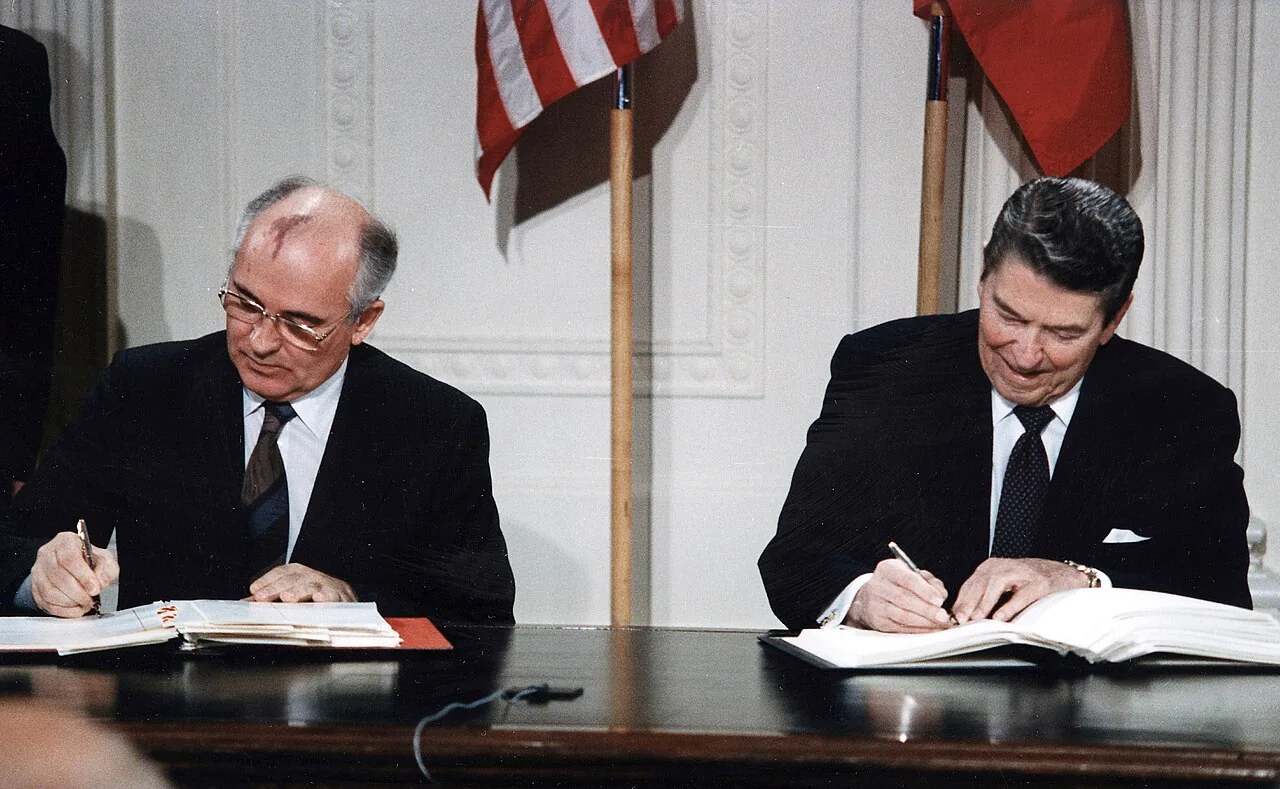
Source: White House Photographic Office, December 8, 1987 (image on Wikimedia Commons).
Reagan and Gorbachev sit at a table to sign the treaty in the East Room of the White House. The treaty banned ground-launched ballistic and cruise missiles with a range between 500 and 5,500 kilometers.
Historians have explained the end of the Cold War in many ways. Some historians give the credit to Reagan’s military buildup and firm stance; others point to the weaknesses of the Soviet economy, to Gorbachev’s reforms, and to movements for freedom in Eastern Europe. Still, most agree that all of these played a part.
5. The nation in the 1980s
Reagan won reelection in 1984 by a large margin, carrying forty-nine states. The decade saw a long period of growth, but the gap between rich and poor widened, and farmers and industrial workers in some regions struggled. Cities faced the crack cocaine epidemic and rising crime, and the government expanded its war on drugs.
In 1981 doctors first reported cases of what became known as AIDS, and public response was slow, in part because of fear and prejudice toward the gay community, where the disease first spread widely in the United States. Reagan left office in January 1989 with high personal popularity. Supporters said that he had restored national confidence and won the Cold War; critics said that he had increased the deficit and neglected the poor. In either case, he had changed the terms of political debate.
- June 17, 1972 Watergate burglars are arrested.
- Oct. 1973 OPEC oil embargo begins.
- Aug. 9, 1974 Nixon resigns; Ford becomes president.
- Sept. 17, 1978 Camp David Accords are signed.
- Nov. 4, 1979 American hostages are taken in Tehran.
- Dec. 1979 Soviet Union invades Afghanistan.
- Jan. 20, 1981 Reagan is inaugurated; hostages are freed.
- Aug. 1981 PATCO strikers are fired.
- Oct. 1983 Beirut bombing and invasion of Grenada.
- Nov. 1986 Iran-Contra affair becomes public.
- Dec. 8, 1987 INF Treaty is signed.
Key takeaways
- Watergate led to the resignation of Nixon (1974) and to reforms that limited executive power, but it also deepened distrust of government.
- Ford pardoned Nixon in September 1974; Carter won in 1976 as an outsider.
- The oil embargo of 1973 and stagflation showed the weakness of the economy in the 1970s.
- Carter made peace between Egypt and Israel at Camp David (1978), but the Iranian hostage crisis and the Soviet invasion of Afghanistan weakened him.
- Reagan, elected in 1980, cut taxes, reduced regulation, increased defense spending, and said that government was the problem.
- Iran-Contra (1986) damaged his administration, yet he signed the INF Treaty with Gorbachev in 1987.
- The Cold War ended soon after, in 1989-1991.

Quick review: flashcards
Tap a card to see the answer.