


This US History Grade 11 lesson covers The United States since 1990, part of the unit “Recent America.” First, read the full lesson with its primary sources, maps and key terms. Then practice with the worksheet, check yourself with the quiz and get ready with the test.
On the evening of January 16, 1991, television networks in the United States cut away from their regular programs. Reporters in a hotel in Baghdad described flashes in the night sky as allied aircraft began to bomb Iraq, and viewers at home watched a war begin in real time. Less than ten years later, in September 2001, Americans would watch another event unfold on their screens: the attacks on New York and Washington. In between, the end of the Cold War seemed to leave the United States as the world’s only superpower, and the nation enjoyed a long economic boom. After 2001, wars, a financial crisis, and deep political divisions tested that confidence.
Guiding question: How did the end of the Cold War, the attacks of September 11, 2001, and the Great Recession change American foreign policy, the economy, and politics after 1990?
1. A new world order? The Gulf War
On August 2, 1990, the army of Iraq, led by President Saddam Hussein, invaded and occupied the small, oil-rich neighboring country of Kuwait. President George H. W. Bush, a former diplomat, congressman, and CIA director who had won election in 1988, organized an international response. The United Nations Security Council demanded that Iraq withdraw and imposed economic sanctions. The United States sent troops to Saudi Arabia to defend that country, in an operation called Desert Shield, and built a coalition that included Britain, France, Egypt, Syria, and Saudi Arabia, among many others. In September, Bush spoke to Congress about the crisis.
Document 1 – A “new world order”
A new partnership of nations has begun. We stand today at a unique and extraordinary moment. The crisis in the Persian Gulf, as grave as it is, also offers a rare opportunity to move toward an historic period of cooperation. Out of these troubled times, our fifth objective — a new world order — can emerge: a new era — freer from the threat of terror, stronger in the pursuit of justice, and more secure in the quest for peace. An era in which the nations of the world, East and West, North and South, can prosper and live in harmony.
Source: George H. W. Bush, Address Before a Joint Session of the Congress on the Persian Gulf Crisis and the Federal Budget Deficit, September 11, 1990; text from the American Presidency Project, University of California, Santa Barbara.
*partnership: a joint effort. *harmony: peaceful agreement.
Commentary. Bush argues that the end of the East-West confrontation had changed the United Nations. A dictator could no longer count on one superpower to protect him from action by the Security Council. He describes the “new world order” as an era freer from terror, stronger in justice, and more secure in peace. The speech presents the crisis as a test for international cooperation as well as a threat to oil supplies.
The Security Council set January 15, 1991, as the date by which Iraq had to leave Kuwait, and it authorized states to use “all necessary means” after that date. Congress voted on January 12 to authorize the use of force. On January 16 and 17, allied aircraft began a campaign of bombing, and Iraq fired Scud missiles at Israel and Saudi Arabia. The ground offensive began on February 24 and lasted about a hundred hours. Coalition forces liberated Kuwait, and a cease-fire followed on February 28.
Document 2 – Bush announces the air war
Just 2 hours ago, allied air forces began an attack on military targets in Iraq and Kuwait. These attacks continue as I speak. Ground forces are not engaged. […] This is an historic moment. We have in this past year made great progress in ending the long era of conflict and cold war. We have before us the opportunity to forge for ourselves and for future generations a new world order — a world where the rule of law, not the law of the jungle, governs the conduct of nations.
Source: George H. W. Bush, Address to the Nation Announcing Allied Military Action in the Persian Gulf, January 16, 1991; text from the American Presidency Project, University of California, Santa Barbara.
*coalition: a group of states acting together. *dictator: a ruler with unlimited power.
Commentary. The president speaks as the first bombs fall. He stresses that the action follows United Nations resolutions and the consent of Congress, and he states the goal: “the liberation of Kuwait,” not “the conquest of Iraq.” The limited goal explains why the allies stopped when Kuwait was freed, though critics said that leaving Saddam Hussein in power was a mistake. He remained in power until 2003, and in the spring of 1991 Iraqi forces crushed uprisings by Shiites in the south and Kurds in the north.
Document 3 – Burning oil wells in Kuwait
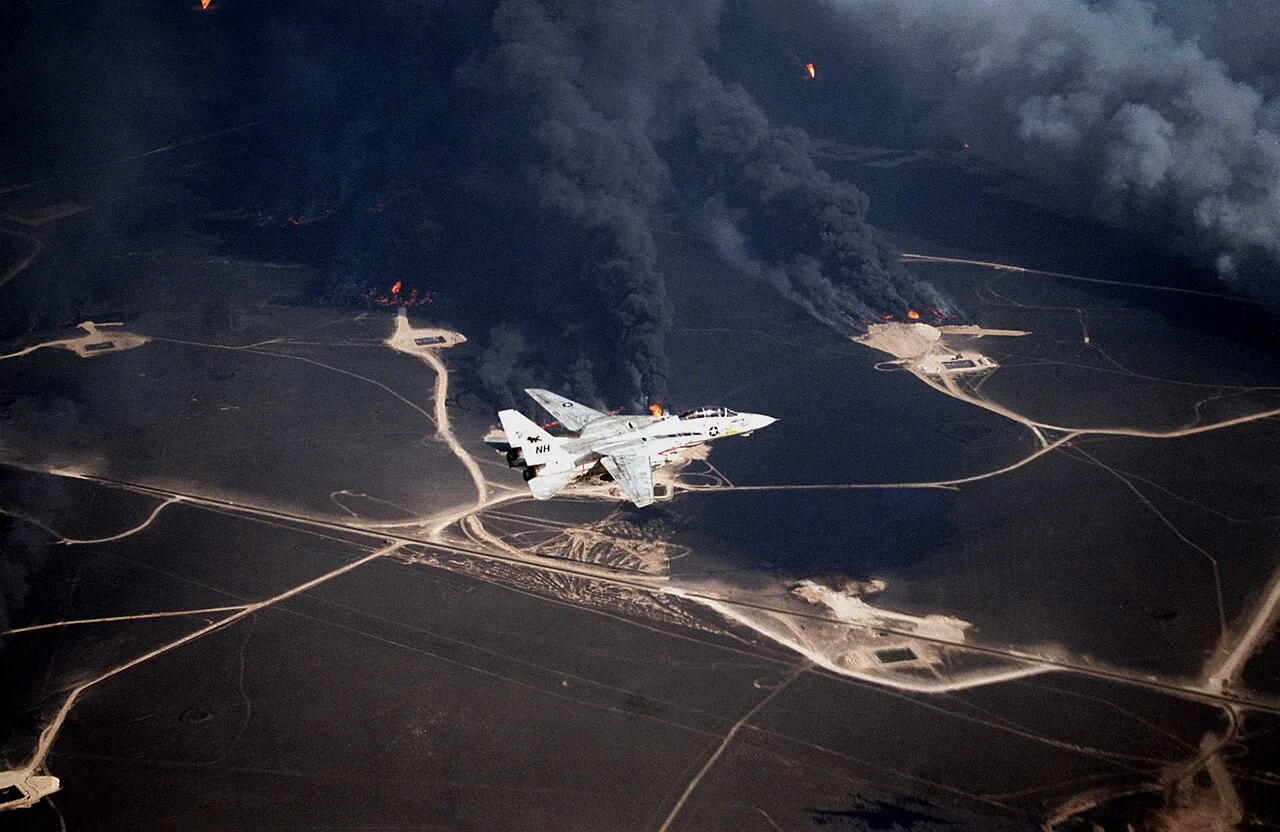
Source: U.S. Navy photograph, 1991 (image on Wikimedia Commons).
Retreating Iraqi troops set fire to hundreds of Kuwaiti oil wells. The black smoke covered the desert for months. The photograph shows the scale of the damage from the air and the presence of American naval aircraft after the war.
The war was a military success, so it restored confidence in the armed forces after Vietnam. Bush’s approval ratings soared. But the voters were more concerned about the economy, which had fallen into a recession in 1990-1991. In December 1991, the Soviet Union dissolved. In 1992 the Democratic candidate, Governor Bill Clinton of Arkansas, defeated Bush, with the independent candidate Ross Perot drawing many votes.
2. The Clinton years, 1993-2001
Clinton called himself a “New Democrat” who combined support for opportunity with fiscal discipline and free trade. His first term brought a defeat on health care reform, a plan led by the First Lady, Hillary Rodham Clinton, that did not pass Congress. In 1993 he persuaded Congress to approve the North American Free Trade Agreement (NAFTA) with Canada and Mexico, which took effect on January 1, 1994 and removed most tariffs among the three countries. Supporters said it would expand trade; critics, especially in labor unions, said that it would send jobs to Mexico.
Definition: globalization
the growing connection of the world’s economies, cultures, and people through trade, investment, travel, and communication, which increased rapidly in the 1990s with the end of the Cold War and the spread of the internet.
In the midterm elections of 1994, the Republicans, led in the House by Newt Gingrich of Georgia, won control of both houses of Congress, and for the first time in forty years they held a majority in the House. They had campaigned with a ten-point program called the Contract with America. A budget fight led to two shutdowns of parts of the federal government in 1995 and 1996. In January 1996, Clinton, preparing for reelection, moved toward the center.
Document 4 – Clinton on big government
We know big Government does not have all the answers. We know there’s not a program for every problem. We know, and we have worked to give the American people a smaller, less bureaucratic Government in Washington. And we have to give the American people one that lives within its means. The era of big Government is over. But we cannot go back to the time when our citizens were left to fend for themselves. Instead, we must go forward as one America, one nation working together to meet the challenges we face together.
Source: William J. Clinton, Address Before a Joint Session of the Congress on the State of the Union, January 23, 1996; text from the American Presidency Project, University of California, Santa Barbara.
*bureaucratic: using many rules and offices. *self-reliance: depending on oneself.
Commentary. The phrase “the era of big Government is over” echoes Reagan’s view, but Clinton adds a limit: “we cannot go back to the time when our citizens were left to fend for themselves.” He proposes a middle path, a “smaller, less bureaucratic Government” that still helps people, and says that “self-reliance and teamwork” are both needed. In August 1996 he signed a welfare reform law that ended the federal guarantee of aid to poor families and set time limits. Voters reelected him in November.
The late 1990s were years of economic growth, driven by the personal computer and the internet, and of low unemployment. Also, the federal government ran budget surpluses from 1998 to 2001. The nation also experienced violence at home: in April 1995 a truck bomb destroyed a federal building in Oklahoma City, an act by an American extremist.
In 1998 the House of Representatives impeached Clinton, charging perjury and obstruction of justice in connection with a relationship with a White House intern, and in February 1999 the Senate voted not to remove him from office. The 2000 election was one of the closest in history. The result depended on Florida, where a recount was stopped by the Supreme Court in Bush v. Gore in December 2000, and George W. Bush, the son of the former president, became president even though Al Gore received more votes nationwide.
3. September 11 and the war on terror
On the morning of September 11, 2001, nineteen terrorists belonging to the group al-Qaeda, led by Osama bin Laden, hijacked four airliners. Two were flown into the twin towers of the World Trade Center in New York, which collapsed; a third struck the Pentagon outside Washington; and a fourth, United Flight 93, crashed in a field in Pennsylvania after passengers fought the hijackers. As a result, the attacks killed 2,977 people from 90 nations, not counting the hijackers. It was the deadliest attack on American soil by a foreign group.
Document 5 – Ground Zero, September 14, 2001
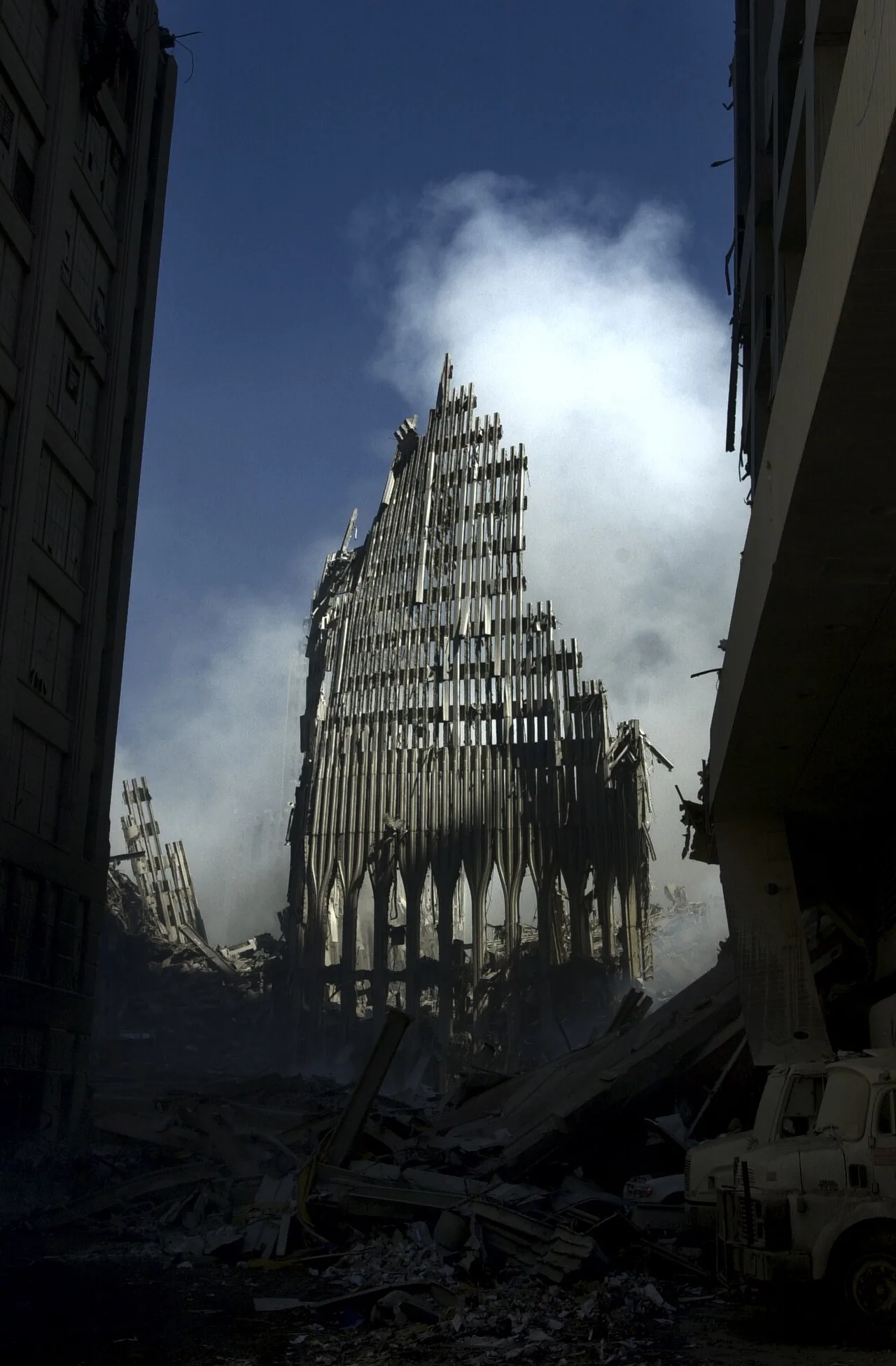
Source: Journalist 1st Class Preston Keres, U.S. Navy, September 14, 2001 (image on Wikimedia Commons).
The photograph shows a section of the steel facade left standing among the debris three days after the attacks. The Navy photographer was documenting the response; the caption compares the remains to a tombstone.
Document 6 – The Pentagon
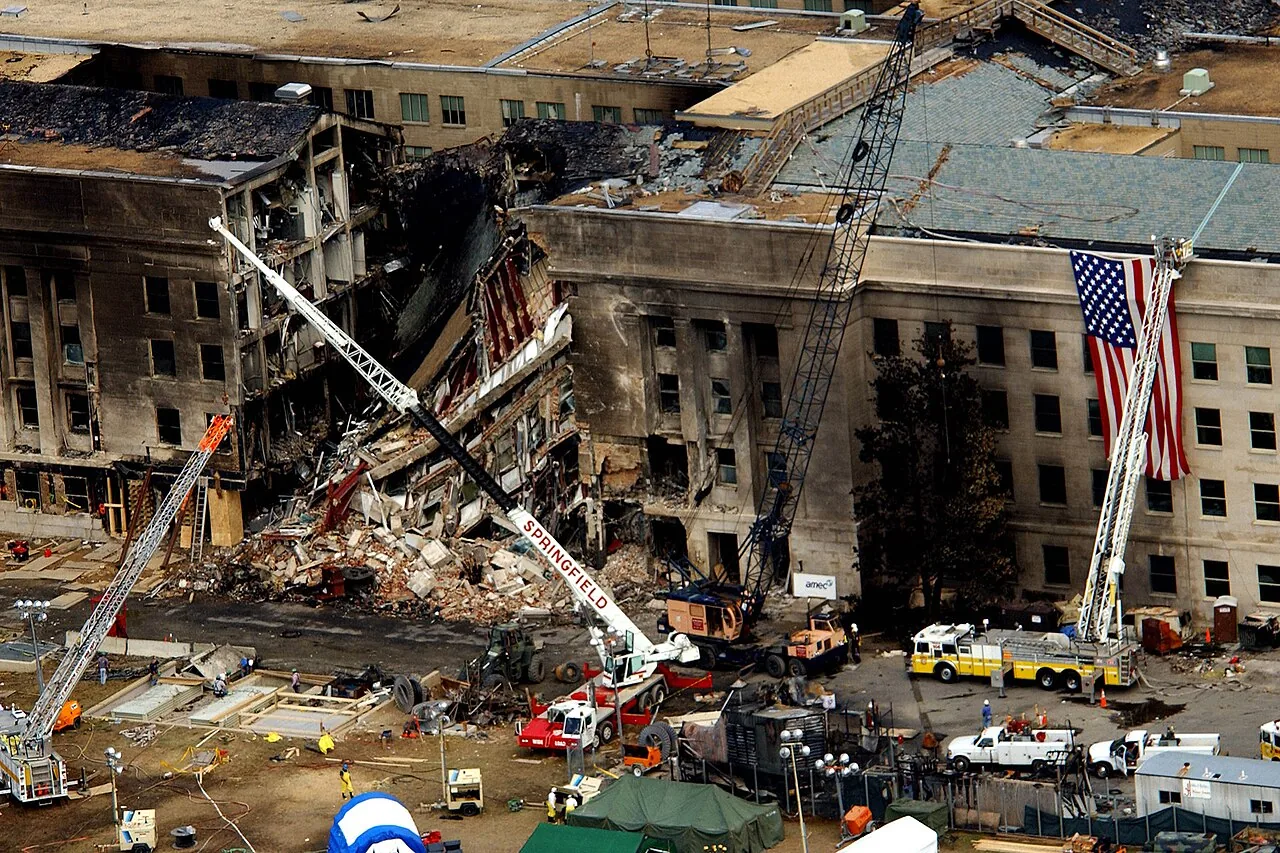
Source: Air Force Tech. Sgt. Cedric H. Rudisill, September 13, 2001 (image on Wikimedia Commons).
The aerial view shows the damage to the western side of the building two days after the attack. A military photographer took it to document the scene for the military and for the public record.
Document 7 – Bush on the night of September 11
Today our fellow citizens, our way of life, our very freedom came under attack in a series of deliberate and deadly terrorist acts. The victims were in airplanes or in their offices: secretaries, business men and women, military and Federal workers, moms and dads, friends and neighbors. Thousands of lives were suddenly ended by evil, despicable acts of terror. The pictures of airplanes flying into buildings, fires burning, huge structures collapsing have filled us with disbelief, terrible sadness, and a quiet, unyielding anger. These acts of mass murder were intended to frighten our Nation into chaos and retreat, but they have failed. Our country is strong. A great people has been moved to defend a great nation. Terrorist attacks can shake the foundations of our biggest buildings, but they cannot touch the foundation of America. These acts shattered steel, but they cannot dent the steel of American resolve.
Source: George W. Bush, Address to the Nation on the Terrorist Attacks, September 11, 2001; text from the American Presidency Project, University of California, Santa Barbara.
*despicable: shameful. *unyielding: not giving way.
Commentary. Bush speaks in the evening, to reassure the country. He names the victims in ordinary terms (“moms and dads, friends and neighbors”), describes the feeling of the public, and insists that the attacks “cannot dent the steel of American resolve.” The address announces that the nation will not be driven into “chaos and retreat.”
Congress authorized the use of force against those responsible, and on September 20 Bush addressed a joint session. He set out a new doctrine, that the United States would make no distinction between terrorists and the nations that harbored them.
Document 8 – Bush to Congress, September 20, 2001
Our response involves far more than instant retaliation and isolated strikes. Americans should not expect one battle but a lengthy campaign, unlike any other we have ever seen. It may include dramatic strikes, visible on TV, and covert operations, secret even in success. We will starve terrorists of funding, turn them one against another, drive them from place to place, until there is no refuge or no rest. And we will pursue nations that provide aid or safe haven to terrorism. Every nation, in every region, now has a decision to make: Either you are with us, or you are with the terrorists. From this day forward, any nation that continues to harbor or support terrorism will be regarded by the United States as a hostile regime.
Source: George W. Bush, Address Before a Joint Session of the Congress on the United States Response to the Terrorist Attacks of September 11, September 20, 2001; text from the American Presidency Project, University of California, Santa Barbara.
*covert: secret. *harbor: to give shelter to.
Commentary. The president describes a long campaign “unlike any other we have ever seen” and divides the world into two camps: “Either you are with us, or you are with the terrorists.” Supporters said that the clear language was needed after the attacks; critics said that it left little room for debate and opened the door to broad military action.
Wars in Afghanistan and Iraq
In October 2001, American and allied forces, together with Afghan opponents of the regime, invaded Afghanistan, where the Taliban government sheltered al-Qaeda. Allied forces drove the Taliban from Kabul within weeks. Bin Laden escaped. At home, however, Congress passed the USA PATRIOT Act in October 2001, which widened the government’s powers of surveillance, and in 2002 it created the Department of Homeland Security. However, critics argued that some measures threatened civil liberties, and a debate began over the proper balance between security and liberty that continues today. The detention of prisoners at the American base at Guantanamo Bay in Cuba led to long legal disputes.
In March 2003, the United States and a smaller coalition invaded Iraq. The administration said that Saddam Hussein had weapons of mass destruction and links to terrorism. However, no such weapons were found, and the justification was widely criticized. Baghdad fell in April and Saddam Hussein was captured in December. But a long insurgency and sectarian violence followed, and thousands of Americans and many more Iraqis were killed.
In 2007 the United States sent more troops, called the “surge,” which reduced the violence, and the last American combat troops left Iraq in December 2011. In May 2011, American commandos killed Osama bin Laden in Abbottabad, Pakistan. The war in Afghanistan became the longest in American history, and in August 2021, after the withdrawal of American troops, the Taliban returned to power in Kabul.
Definition: insurgency
an armed rebellion by irregular fighters against a government or an occupying army, usually using ambushes, bombs, and attacks on civilians and soldiers rather than open battles.
4. Financial crisis and the Obama presidency
In the 2000s, housing prices rose rapidly, and banks lent money to buyers with poor credit and packaged the loans into complicated securities. When prices fell, borrowers could not repay, and banks that had bought the securities suffered huge losses. In September 2008, the investment bank Lehman Brothers collapsed and credit markets froze. Congress, at the request of the Bush administration, approved a $700 billion rescue program, and the government took over or helped some of the largest financial firms. The result was the Great Recession, the worst economic downturn since the 1930s. For example, the unemployment table in the exercises shows its depth.
Definition: Great Recession
the severe economic downturn that began in the United States in late 2007 and deepened after the financial crisis of 2008, with high unemployment, falling home values, and a slow recovery.
In November 2008, Barack Obama, a senator from Illinois, was elected the first Black president of the United States, defeating Senator John McCain. Crowds gathered on the National Mall for his inauguration.
Document 9 – The inauguration of 2009
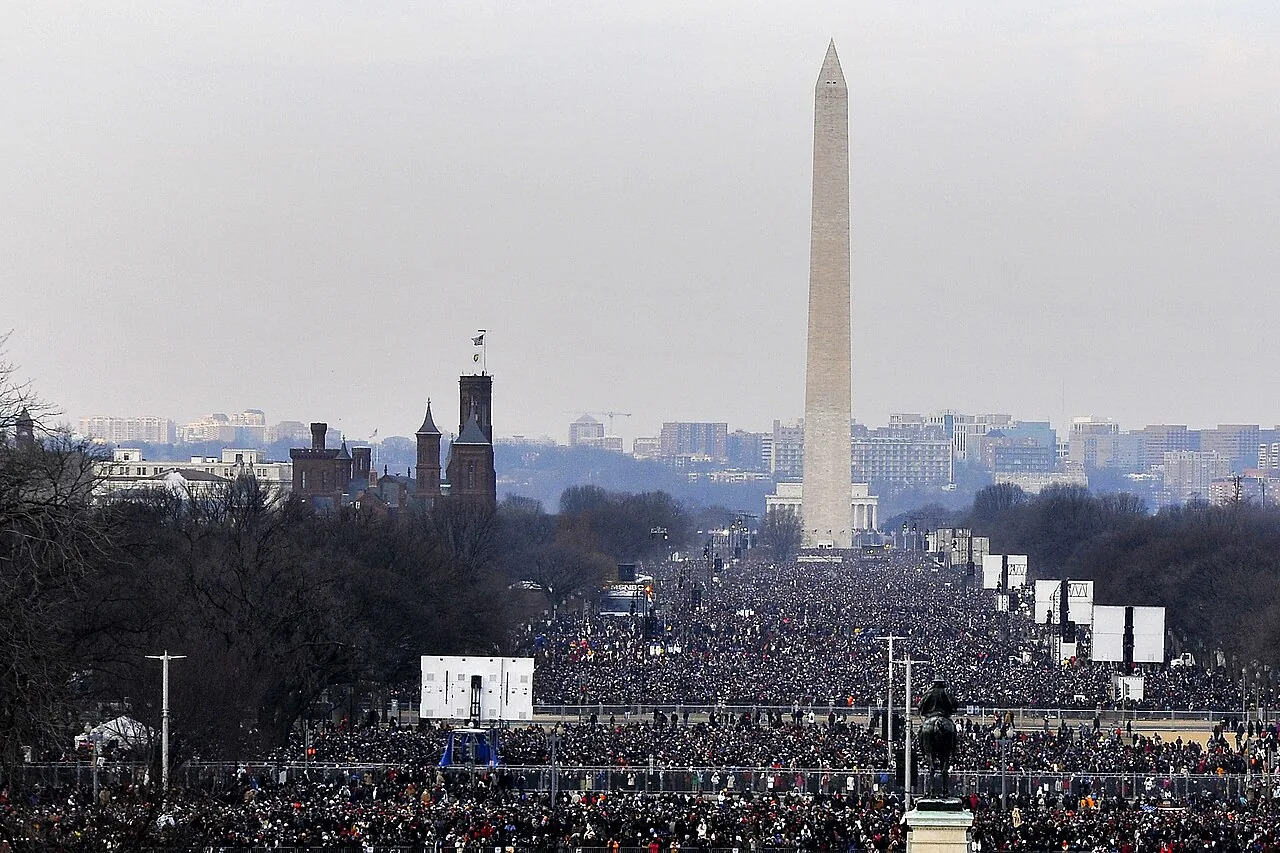
Source: U.S. Department of Defense photograph, January 20, 2009 (image on Wikimedia Commons).
The photograph shows the size of the crowd that gathered in Washington. It was taken from a distance and cannot show the numbers precisely.
Document 10 – Obama’s inaugural address
On this day, we gather because we have chosen hope over fear, unity of purpose over conflict and discord. […] For we know that our patchwork heritage is a strength, not a weakness. We are a nation of Christians and Muslims, Jews and Hindus and nonbelievers. We are shaped by every language and culture, drawn from every end of this Earth.
Source: Barack Obama, Inaugural Address, January 20, 2009; text from the American Presidency Project, University of California, Santa Barbara.
*discord: disagreement. *patchwork: made of many different pieces.
Commentary. Obama says that Americans chose “hope over fear” and “unity of purpose over conflict and discord.” He describes the country’s diversity as “a strength, not a weakness,” naming Christians, Muslims, Jews, Hindus, and nonbelievers. The speech responds to both the economic crisis and the political divisions of the time.
The new administration pushed through a stimulus package in February 2009 to create jobs and passed financial regulation in 2010. Its main domestic achievement was the Patient Protection and Affordable Care Act of 2010, known as the Affordable Care Act, which expanded health insurance through Medicaid expansion, subsidies, and rules for insurers. However, it passed without a single Republican vote in Congress and was a target of opposition for years. A conservative movement called the Tea Party gained strength in 2010, and Republicans won control of the House that year.
Document 11 – Signing the Affordable Care Act
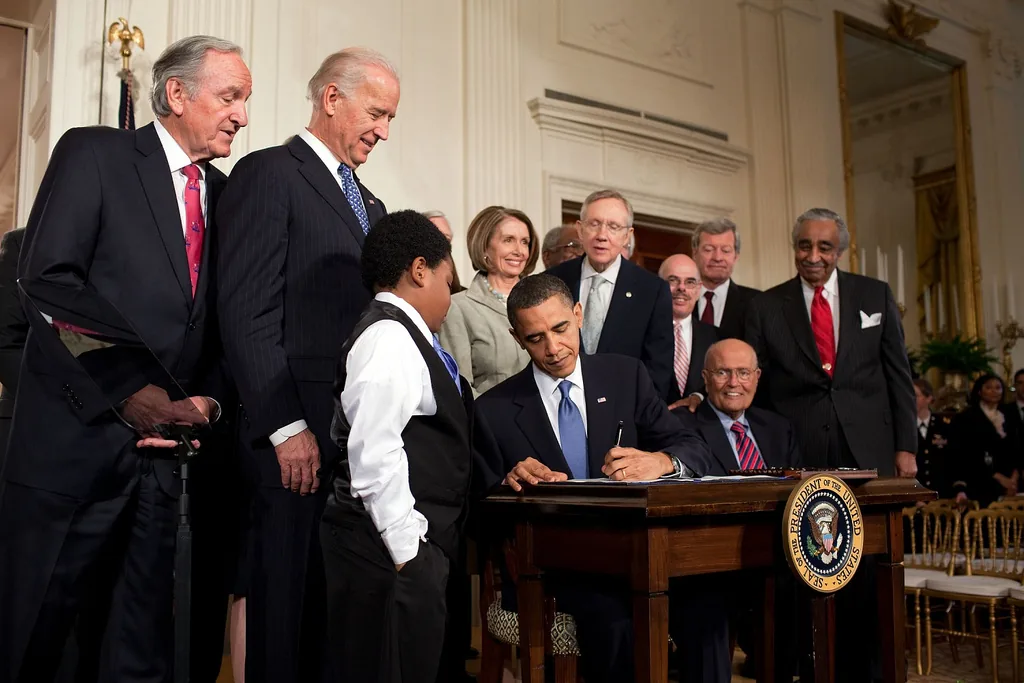
Source: Official White House photograph, March 23, 2010 (image on Wikimedia Commons).
The president signs the bill at a desk while members of Congress and guests look on. A photograph made by the White House shows the event as the administration wished it to be remembered.
5. A divided nation in a changing world
In the following years, Americans disagreed more sharply about politics. The Supreme Court ruled in Obergefell v. Hodges in June 2015 that same-sex couples have a constitutional right to marry. In 2016, Donald Trump, a businessman who had never held public office, defeated Hillary Clinton. His presidency, which ended in January 2021, was marked by disputes over immigration, trade, and the role of the federal government.
In 2020 the COVID-19 pandemic closed schools and businesses, killed a large number of Americans, and raised unemployment sharply. Protests followed the killing of George Floyd by a police officer in Minneapolis on May 25, 2020. After the 2020 election, supporters of the losing candidate attacked the Capitol on January 6, 2021, as Congress counted the electoral votes. Joe Biden took office as president on January 20, 2021.
Technology also changed daily life: smartphones and social media connected people and became sources of news, and of disagreement. Immigration, climate change, and economic inequality remained subjects of national debate. Historians agree that the period since 1990 has been shaped by globalization, terrorism, and a sharper polarization between the two political parties, but they will need more time to judge its meaning.
- Aug. 2, 1990 Iraq invades Kuwait.
- Jan. 17, 1991 Air war against Iraq begins.
- Dec. 1991 The Soviet Union dissolves.
- Jan. 1, 1994 NAFTA takes effect.
- Dec. 1998 House impeaches President Clinton.
- Sept. 11, 2001 Terrorist attacks on New York and Washington.
- Oct. 2001 U.S. forces invade Afghanistan.
- Mar. 2003 U.S.-led invasion of Iraq.
- Sept. 2008 Lehman Brothers collapses.
- Mar. 23, 2010 Affordable Care Act is signed.
- May 2, 2011 Osama bin Laden is killed.
Key takeaways
- After Iraq invaded Kuwait in 1990, a United Nations coalition led by the United States liberated Kuwait in the Gulf War (1991).
- The Soviet Union dissolved in December 1991, leaving the United States as the world’s only superpower.
- Clinton’s years combined NAFTA, welfare reform, a technology boom, and budget surpluses with impeachment and a Republican Congress.
- The attacks of September 11, 2001 killed 2,977 people and led to the war in Afghanistan, the Patriot Act, and the Iraq War.
- The financial crisis of 2008 caused the Great Recession; Obama signed the Affordable Care Act in 2010.
- Since 2010, polarization, the pandemic, and debates over immigration and inequality have shaped politics.

Quick review: flashcards
Tap a card to see the answer.