


This worksheet on The United States since 1990 belongs to the US History Grade 11 course. Its questions use primary sources, maps and timelines, and they move from basic recall to short writing tasks. Before you start, review the lesson; afterward, try the true or false quiz.
Exercise 1 : Vocabulary since 1990
Match each term with its meaning, then use three of the terms in sentences about the period.
- Coalition
- Globalization
- Impeachment
- Insurgency
- Great Recession
- Polarization
(a) the growing connection of economies and cultures; (b) a group of states acting together; (c) a charge of wrongdoing brought by the House against an official; (d) an armed rebellion against a government or an occupying force; (e) the division of a society or of the parties into opposed camps; (f) the severe downturn that followed the financial crisis of 2008.
Exercise 2 : A new world order
Document 1 – Bush, September 11, 1990
A new partnership of nations has begun. We stand today at a unique and extraordinary moment. The crisis in the Persian Gulf, as grave as it is, also offers a rare opportunity to move toward an historic period of cooperation. Out of these troubled times, our fifth objective — a new world order — can emerge: a new era — freer from the threat of terror, stronger in the pursuit of justice, and more secure in the quest for peace. An era in which the nations of the world, East and West, North and South, can prosper and live in harmony.
Source: George H. W. Bush, Address Before a Joint Session of the Congress on the Persian Gulf Crisis and the Federal Budget Deficit, September 11, 1990; text from the American Presidency Project, University of California, Santa Barbara.
*partnership: a joint effort. *harmony: peaceful agreement.
- Present the document (nature, author, date, context).
- What opportunity does Bush see in the crisis?
- Quote the words that describe the “new world order.”
- Why does he say that a dictator can no longer count on “East-West confrontation”?
Exercise 3 : The war begins
Document 1 – Bush, January 16, 1991
Just 2 hours ago, allied air forces began an attack on military targets in Iraq and Kuwait. These attacks continue as I speak. Ground forces are not engaged. […] This is an historic moment. We have in this past year made great progress in ending the long era of conflict and cold war. We have before us the opportunity to forge for ourselves and for future generations a new world order — a world where the rule of law, not the law of the jungle, governs the conduct of nations.
Source: George H. W. Bush, Address to the Nation Announcing Allied Military Action in the Persian Gulf, January 16, 1991; text from the American Presidency Project, University of California, Santa Barbara.
*coalition: a group of states acting together. *dictator: a ruler with unlimited power.
- Present the document (nature, author, date, context).
- What are the stated goals of the war?
- On what two authorities does Bush say the action rests?
- Why did the limits on the goal matter for the way the war ended?
Exercise 4 : Fire in the desert
Document 1 – Kuwaiti oil wells on fire
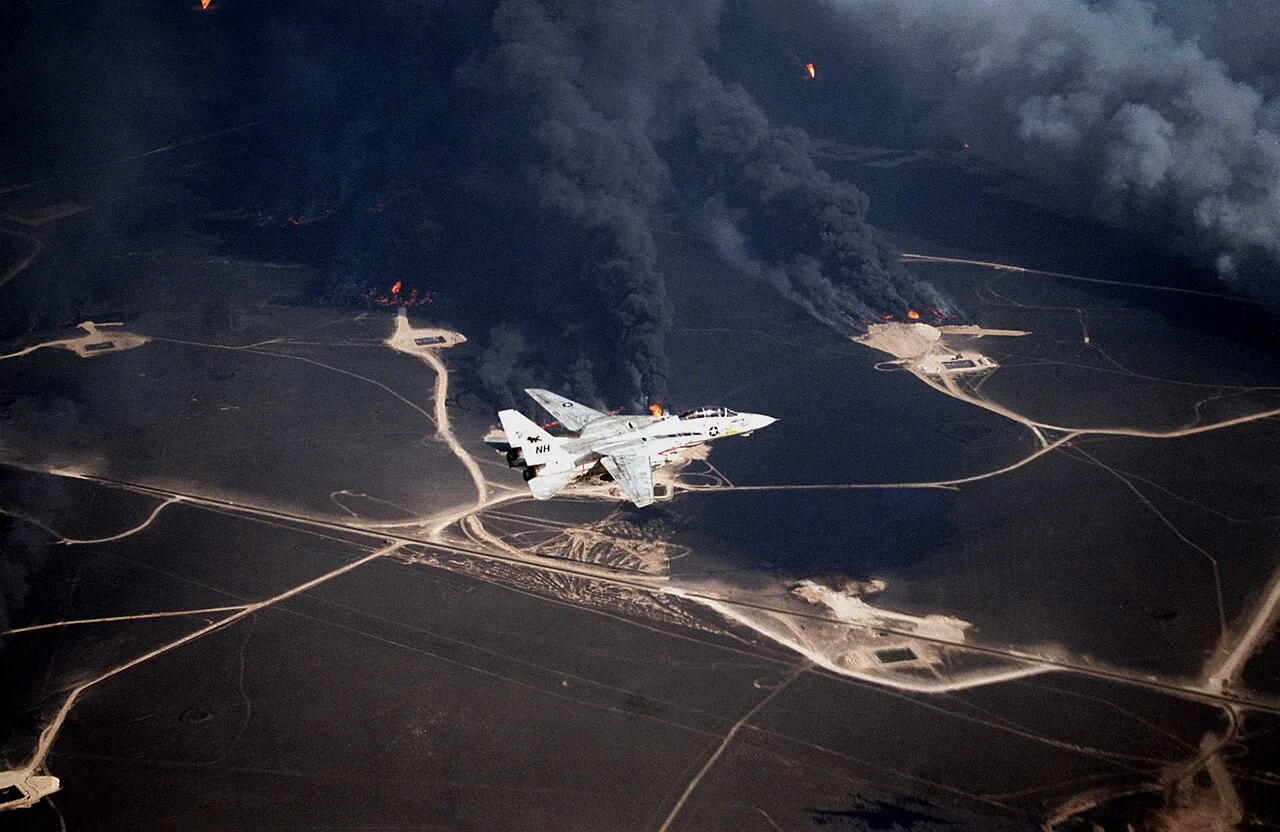
Source: U.S. Navy photograph, 1991 (Wikimedia Commons).
- Present the document (nature, date, place).
- Describe what you see.
- Who set the wells on fire, and why might they have done so?
- What can this image not tell us about the war?
Exercise 5 : Locate the Gulf War
- Name the capital of Iraq (1) and the capital of Kuwait (2).
- Name the capital of Saudi Arabia (3) and the Iraqi port numbered 4.
- What does the letter A show, and why did the United States send troops there in August 1990?
- What is the body of water labeled B?
Exercise 6 : Big government
Document 1 – Clinton, January 23, 1996
We know big Government does not have all the answers. We know there’s not a program for every problem. We know, and we have worked to give the American people a smaller, less bureaucratic Government in Washington. And we have to give the American people one that lives within its means. The era of big Government is over. But we cannot go back to the time when our citizens were left to fend for themselves. Instead, we must go forward as one America, one nation working together to meet the challenges we face together.
Source: William J. Clinton, Address Before a Joint Session of the Congress on the State of the Union, January 23, 1996; text from the American Presidency Project, University of California, Santa Barbara.
*bureaucratic: using many rules and offices. *self-reliance: depending on oneself.
- Present the document (nature, author, date, context).
- Quote the sentence that says the era of big government is over.
- What limit does Clinton set on that statement?
- Why did a Democratic president use language like this in 1996?
Exercise 7 : Three presidents on government
Document 1 – Clinton, 1996
We know big Government does not have all the answers. We know there’s not a program for every problem. We know, and we have worked to give the American people a smaller, less bureaucratic Government in Washington. And we have to give the American people one that lives within its means. The era of big Government is over. But we cannot go back to the time when our citizens were left to fend for themselves. Instead, we must go forward as one America, one nation working together to meet the challenges we face together.
Source: William J. Clinton, Address Before a Joint Session of the Congress on the State of the Union, January 23, 1996; text from the American Presidency Project, University of California, Santa Barbara.
Document 2 – Obama, 2009
On this day, we gather because we have chosen hope over fear, unity of purpose over conflict and discord. […] For we know that our patchwork heritage is a strength, not a weakness. We are a nation of Christians and Muslims, Jews and Hindus and nonbelievers. We are shaped by every language and culture, drawn from every end of this Earth.
Source: Barack Obama, Inaugural Address, January 20, 2009; text from the American Presidency Project, University of California, Santa Barbara.
*discord: disagreement. *patchwork: made of many different pieces.
- Present each document in one sentence.
- What does each president say about the unity of the country?
- Compare the attitudes of the two presidents toward the federal government.
- Why do both presidents end up emphasizing “working together”?
Exercise 8 : The day of the attacks
Document 1 – Bush, September 11, 2001
Today our fellow citizens, our way of life, our very freedom came under attack in a series of deliberate and deadly terrorist acts. The victims were in airplanes or in their offices: secretaries, business men and women, military and Federal workers, moms and dads, friends and neighbors. Thousands of lives were suddenly ended by evil, despicable acts of terror. The pictures of airplanes flying into buildings, fires burning, huge structures collapsing have filled us with disbelief, terrible sadness, and a quiet, unyielding anger. These acts of mass murder were intended to frighten our Nation into chaos and retreat, but they have failed. Our country is strong. A great people has been moved to defend a great nation. Terrorist attacks can shake the foundations of our biggest buildings, but they cannot touch the foundation of America. These acts shattered steel, but they cannot dent the steel of American resolve.
Source: George W. Bush, Address to the Nation on the Terrorist Attacks, September 11, 2001; text from the American Presidency Project, University of California, Santa Barbara.
*despicable: shameful. *unyielding: not giving way.
- Present the document (nature, author, date, context).
- Who does Bush say the victims were?
- What does he say the terrorists wanted, and what does he say happened to their goal?
- Why does the speech use images of buildings and steel?
Exercise 9 : Ground Zero and the Pentagon
Document 1 – The World Trade Center, September 14, 2001
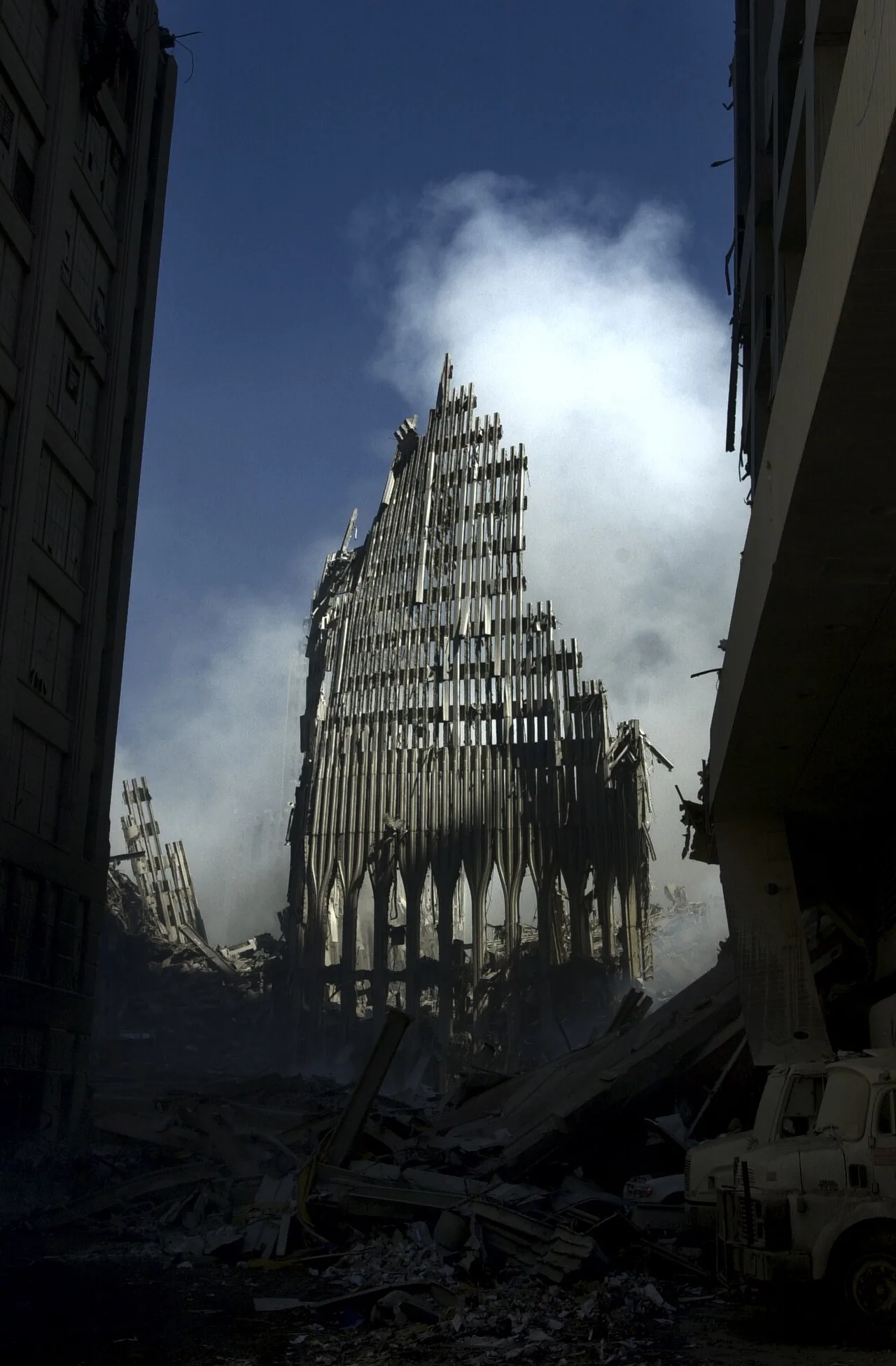
Source: U.S. Navy, September 14, 2001 (Wikimedia Commons).
Document 2 – The Pentagon, September 13, 2001
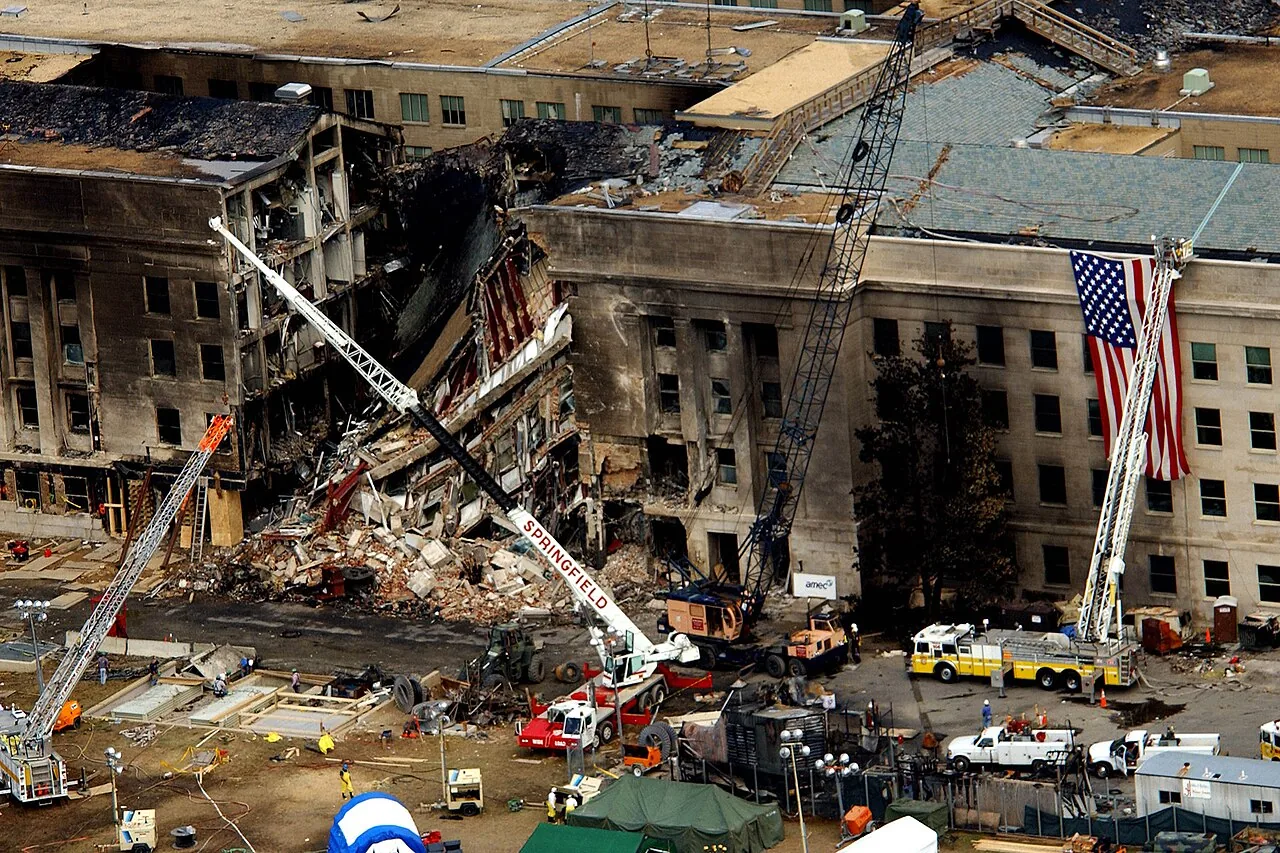
Source: U.S. Air Force, September 13, 2001 (Wikimedia Commons).
- Present each document (nature, date, place).
- Describe what each photograph shows.
- What do the two images show together about the attacks?
- Why should a historian note who took the photographs?
Exercise 10 : With us or with the terrorists
Document 1 – Bush, September 20, 2001
Our response involves far more than instant retaliation and isolated strikes. Americans should not expect one battle but a lengthy campaign, unlike any other we have ever seen. It may include dramatic strikes, visible on TV, and covert operations, secret even in success. We will starve terrorists of funding, turn them one against another, drive them from place to place, until there is no refuge or no rest. And we will pursue nations that provide aid or safe haven to terrorism. Every nation, in every region, now has a decision to make: Either you are with us, or you are with the terrorists. From this day forward, any nation that continues to harbor or support terrorism will be regarded by the United States as a hostile regime.
Source: George W. Bush, Address Before a Joint Session of the Congress on the United States Response to the Terrorist Attacks of September 11, September 20, 2001; text from the American Presidency Project, University of California, Santa Barbara.
*covert: secret. *harbor: to give shelter to.
- Present the document (nature, author, date, audience).
- What kind of response does Bush promise?
- Quote the sentence that divides the world into two camps.
- Why might this policy lead to military action against a state?
Exercise 11 : Two speeches, ten years apart
Document 1 – Bush, January 16, 1991
Just 2 hours ago, allied air forces began an attack on military targets in Iraq and Kuwait. These attacks continue as I speak. Ground forces are not engaged. […] This is an historic moment. We have in this past year made great progress in ending the long era of conflict and cold war. We have before us the opportunity to forge for ourselves and for future generations a new world order — a world where the rule of law, not the law of the jungle, governs the conduct of nations.
Source: George H. W. Bush, Address to the Nation Announcing Allied Military Action in the Persian Gulf, January 16, 1991; text from the American Presidency Project, University of California, Santa Barbara.
Document 2 – Bush, September 20, 2001
Our response involves far more than instant retaliation and isolated strikes. Americans should not expect one battle but a lengthy campaign, unlike any other we have ever seen. It may include dramatic strikes, visible on TV, and covert operations, secret even in success. We will starve terrorists of funding, turn them one against another, drive them from place to place, until there is no refuge or no rest. And we will pursue nations that provide aid or safe haven to terrorism. Every nation, in every region, now has a decision to make: Either you are with us, or you are with the terrorists. From this day forward, any nation that continues to harbor or support terrorism will be regarded by the United States as a hostile regime.
Source: George W. Bush, Address Before a Joint Session of the Congress on the United States Response to the Terrorist Attacks of September 11, September 20, 2001; text from the American Presidency Project, University of California, Santa Barbara.
- Present each document in one sentence.
- Compare the war aims stated in each.
- Compare the role of allies and international organizations in each.
- Which war ended with the aims the president had announced? Explain.
Exercise 12 : Locate the wars after 2001
- Name the capital of Iraq (1) and the capital of Afghanistan (2).
- Name the city numbered 3, a Taliban stronghold, and the capital of Pakistan (4).
- What does the letter A show, and what does its position mean for both wars?
- Which of the two wars began first, and in what year?
Exercise 13 : Hope over fear
Document 1 – Obama, January 20, 2009
On this day, we gather because we have chosen hope over fear, unity of purpose over conflict and discord. […] For we know that our patchwork heritage is a strength, not a weakness. We are a nation of Christians and Muslims, Jews and Hindus and nonbelievers. We are shaped by every language and culture, drawn from every end of this Earth.
Source: Barack Obama, Inaugural Address, January 20, 2009; text from the American Presidency Project, University of California, Santa Barbara.
*discord: disagreement. *patchwork: made of many different pieces.
- Present the document (nature, author, date, context).
- What two choices does Obama say Americans have made?
- How does he describe the “patchwork heritage” of the nation?
- Why is this message important at a moment of economic crisis?
Exercise 14 : A crowd and a signature
Document 1 – The inauguration crowd, 2009
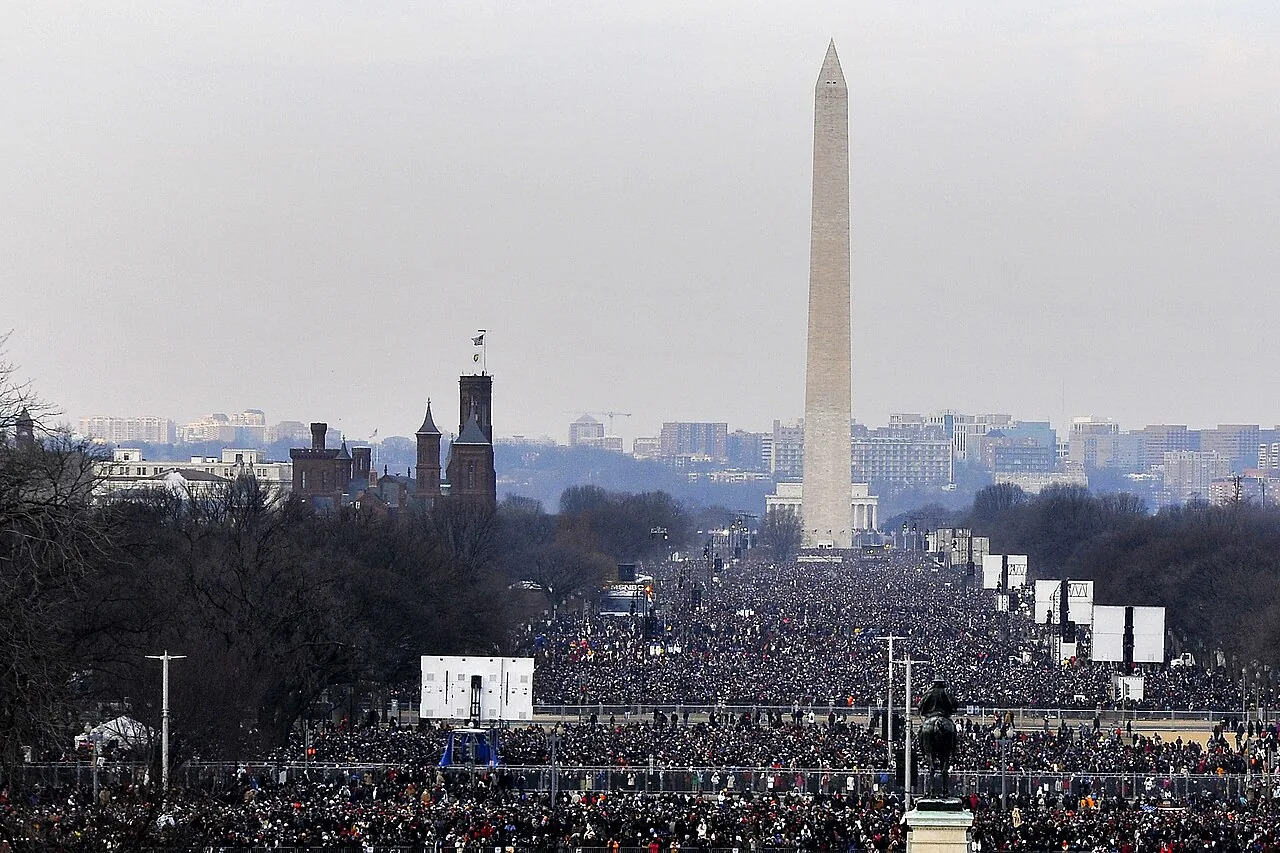
Source: U.S. Department of Defense, January 20, 2009 (Wikimedia Commons).
Document 2 – The signing of the Affordable Care Act, 2010
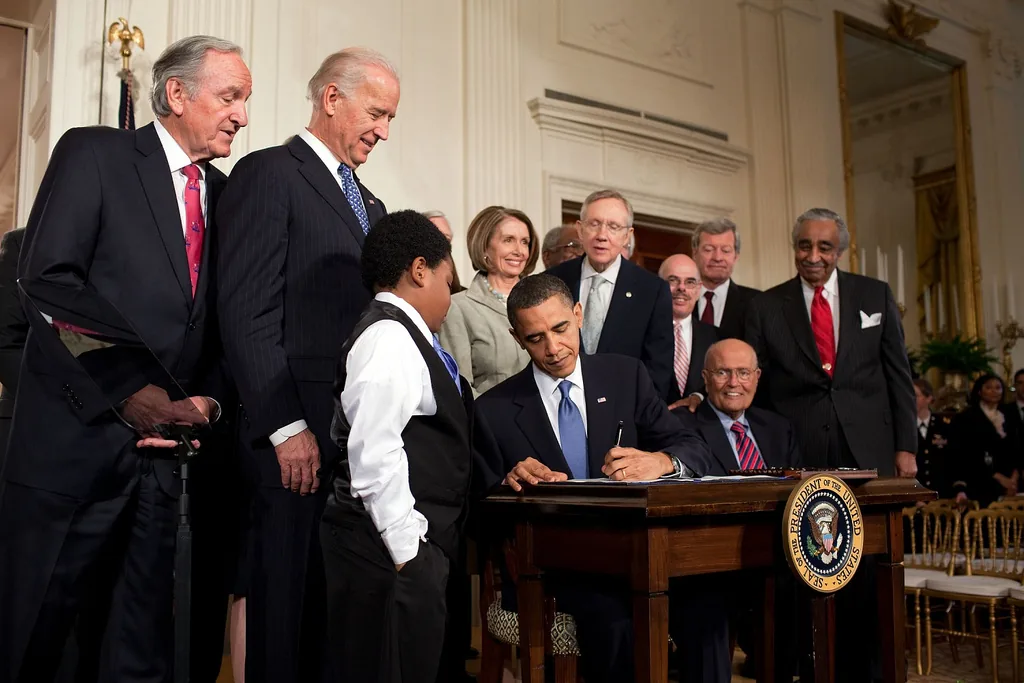
Source: Official White House photograph, March 23, 2010 (Wikimedia Commons).
- Present each document (nature, date, place).
- Describe each photograph in one sentence.
- What does each tell us about Obama’s presidency?
- Why is it useful to compare an image of the public with an image of the government?
Exercise 15 : Reading numbers: unemployment since 1990
The table gives the annual unemployment rate in the United States.
| Year | Unemployment rate (%) |
|---|---|
| 1990 | 5.6 |
| 1992 | 7.5 |
| 2000 | 4.0 |
| 2007 | 4.6 |
| 2009 | 9.3 |
| 2010 | 9.6 |
| 2019 | 3.7 |
| 2020 | 8.1 |
Source: U.S. Bureau of Labor Statistics, annual averages of the civilian unemployment rate (series UNRATE, Federal Reserve Bank of St. Louis, FRED).
- Present the document (nature, source, period).
- Which year had the lowest rate, and which year the highest?
- By how many percentage points did the rate rise from 2007 to 2010?
- Name one cause of the rise between 2007 and 2010 and one cause of the rise in 2020.
Exercise 16 : Order the events
Put these events in order from earliest to latest, then give the year of each.
- Invasion of Iraq
- NAFTA takes effect
- Collapse of Lehman Brothers
- Gulf War air campaign begins
- Attacks of September 11
- Affordable Care Act signed
- Impeachment of Clinton by the House
- Dissolution of the Soviet Union
Exercise 17 : Durations
Use the dates in the lesson to answer.
- How many years passed between September 11, 2001 and the killing of Osama bin Laden (2011)?
- How many years between the invasion of Iraq (2003) and the last American combat troops’ departure (2011)?
- How many years between the invasion of Afghanistan (2001) and the Taliban’s return to Kabul (2021)?
- How many months from the Iraqi invasion of Kuwait (August 1990) to the start of the air war (January 1991)?
Exercise 18 : Guided research: the 2000 election or the financial crisis
Choose one topic and write a short summary using reliable sources.
- Topic A: the 2000 election in Florida. Search: Bush v. Gore 2000 Supreme Court opinion Library of Congress.
- Topic B: the financial crisis of 2008. Search: Financial Crisis Inquiry Commission report National Archives.
Reliable sites: the Supreme Court (supremecourt.gov), the Library of Congress (loc.gov), the National Archives (archives.gov), the Federal Reserve History site (federalreservehistory.org). Note the author and date of each source.
- What happened, and when?
- Who were the main actors?
- What was decided or changed?
- What questions are still debated?
Exercise 19 : CER paragraph: September 11 and civil liberties
Write a Claim-Evidence-Reasoning paragraph: Did the response to September 11 change the balance between security and liberty in the United States? Use at least two pieces of evidence from the lesson.
Evidence: the Patriot Act, the Department of Homeland Security, Guantanamo, the debate over surveillance.
Exercise 20 : SAQ: the Great Recession
Answer all parts in two or three sentences each.
- Identify one cause of the financial crisis of 2008.
- Explain one effect of the crisis on American households.
- Identify one government response to the crisis.
Exercise 21 : True or false? Justify
Say whether each statement is true or false. If it is false, correct it.
- The goal of the Gulf War was to conquer Iraq.
- The House of Representatives impeached President Clinton, but the Senate did not remove him.
- The attacks of September 11 killed 2,977 people, not counting the hijackers.
- No weapons of mass destruction were found in Iraq after the invasion of 2003.
- The Affordable Care Act was signed in 2008.
Exercise 22 : Causes and consequences of the war on terror
Copy and complete the chain with one fact for each step.
- Cause: the attacks of September 11, 2001.
- Response: the invasion of Afghanistan.
- Domestic change: the Patriot Act and the Department of Homeland Security.
- Extension: the invasion of Iraq in 2003.
- Consequence: long wars and a debate over the use of force.
Exercise 23 : The signing of a health law
Document 1 – The Affordable Care Act, March 23, 2010
Source: Official White House photograph, March 23, 2010 (Wikimedia Commons).
- Present the document (nature, date, place).
- Describe who is in the picture and what they are doing.
- Why do presidents invite members of Congress to a signing?
- What can a historian not learn from this photograph about the law itself?


Quick review: flashcards
Tap a card to see the answer.