


This worksheet on From Watergate to Reagan belongs to the US History Grade 11 course. Its questions use primary sources, maps and timelines, and they move from basic recall to short writing tasks. Before you start, review the lesson; afterward, try the true or false quiz.
Exercise 1 : Vocabulary of the 1970s and 1980s
Match each term with its meaning, then use three of the terms in sentences about the period.
- Impeachment
- Executive privilege
- Stagflation
- Detente
- Supply-side economics
- Contras
(a) the claim that a president may keep some communications private; (b) rebels fighting the Sandinista government of Nicaragua; (c) the process by which the House charges an official with wrongdoing; (d) the theory that lower taxes encourage investment and growth; (e) slow growth and inflation at the same time; (f) a period of reduced tension between the United States and the Soviet Union.
Exercise 2 : A president resigns
Document 1 – Nixon, August 8, 1974
I have never been a quitter. To leave office before my term is completed is abhorrent to every instinct in my body. But as President, I must put the interests of America first. America needs a full-time President and a full-time Congress, particularly at this time with problems we face at home and abroad. To continue to fight through the months ahead for my personal vindication would almost totally absorb the time and attention of both the President and the Congress in a period when our entire focus should be on the great issues of peace abroad and prosperity without inflation at home.
Source: Richard M. Nixon, Address to the Nation Announcing Decision To Resign the Office of President, August 8, 1974; text from the American Presidency Project, University of California, Santa Barbara.
*abhorrent: hateful. *vindication: proof of innocence.
- Present the document (nature, author, date, context).
- Does Nixon admit a crime? Quote words to support your answer.
- What reason does he give for resigning?
- Why might historians read such a speech with caution?
Exercise 3 : The Senate hearings
Document 1 – The Senate Watergate Committee
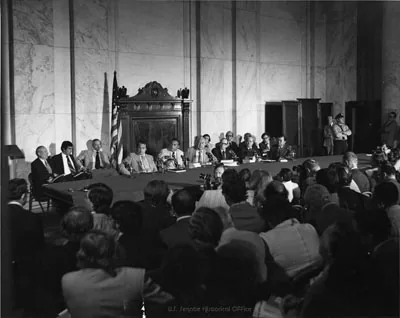
Source: U.S. Senate Historical Office, 1973 (Wikimedia Commons).
- Present the document (nature, date, place).
- Describe what you see.
- Why were televised hearings important to Americans in 1973?
- What can this photograph not tell a historian?
Exercise 4 : A new beginning?
Document 1 – Ford, August 9, 1974
My fellow Americans, our long national nightmare is over. Our Constitution works; our great Republic is a government of laws and not of men. Here the people rule. But there is a higher Power, by whatever name we honor Him, who ordains not only righteousness but love, not only justice but mercy. As we bind up the internal wounds of Watergate, more painful and more poisonous than those of foreign wars, let us restore the golden rule to our political process, and let brotherly love purge our hearts of suspicion and of hate.
Source: Gerald R. Ford, Remarks on Taking the Oath of Office, August 9, 1974; text from the American Presidency Project, University of California, Santa Barbara.
*ordains: commands or establishes. *purge: to cleanse.
- Present the document (nature, author, date, context).
- What does Ford say about the Constitution?
- What is the “national nightmare” he refers to?
- What tone does Ford use, and why?
Exercise 5 : Resignation, oath, pardon
Document 1 – Nixon, August 8, 1974
I have never been a quitter. To leave office before my term is completed is abhorrent to every instinct in my body. But as President, I must put the interests of America first. America needs a full-time President and a full-time Congress, particularly at this time with problems we face at home and abroad. To continue to fight through the months ahead for my personal vindication would almost totally absorb the time and attention of both the President and the Congress in a period when our entire focus should be on the great issues of peace abroad and prosperity without inflation at home.
Source: Richard M. Nixon, Address to the Nation Announcing Decision To Resign the Office of President, August 8, 1974; text from the American Presidency Project, University of California, Santa Barbara.
Document 2 – Ford, September 8, 1974
Theirs is an American tragedy in which we all have played a part. It could go on and on and on, or someone must write the end to it. I have concluded that only I can do that, and if I can, I must.
Source: Gerald R. Ford, Remarks on Signing a Proclamation Granting Pardon to Richard Nixon, September 8, 1974; text from the American Presidency Project, University of California, Santa Barbara.
*conscience: sense of right and wrong.
- Present each document in one sentence.
- What does each speaker say the country needs?
- Compare how each speaker describes the end of Watergate.
- Why did many Americans object to the pardon?
Exercise 6 : Waiting in line
Document 1 – A gas station in 1979
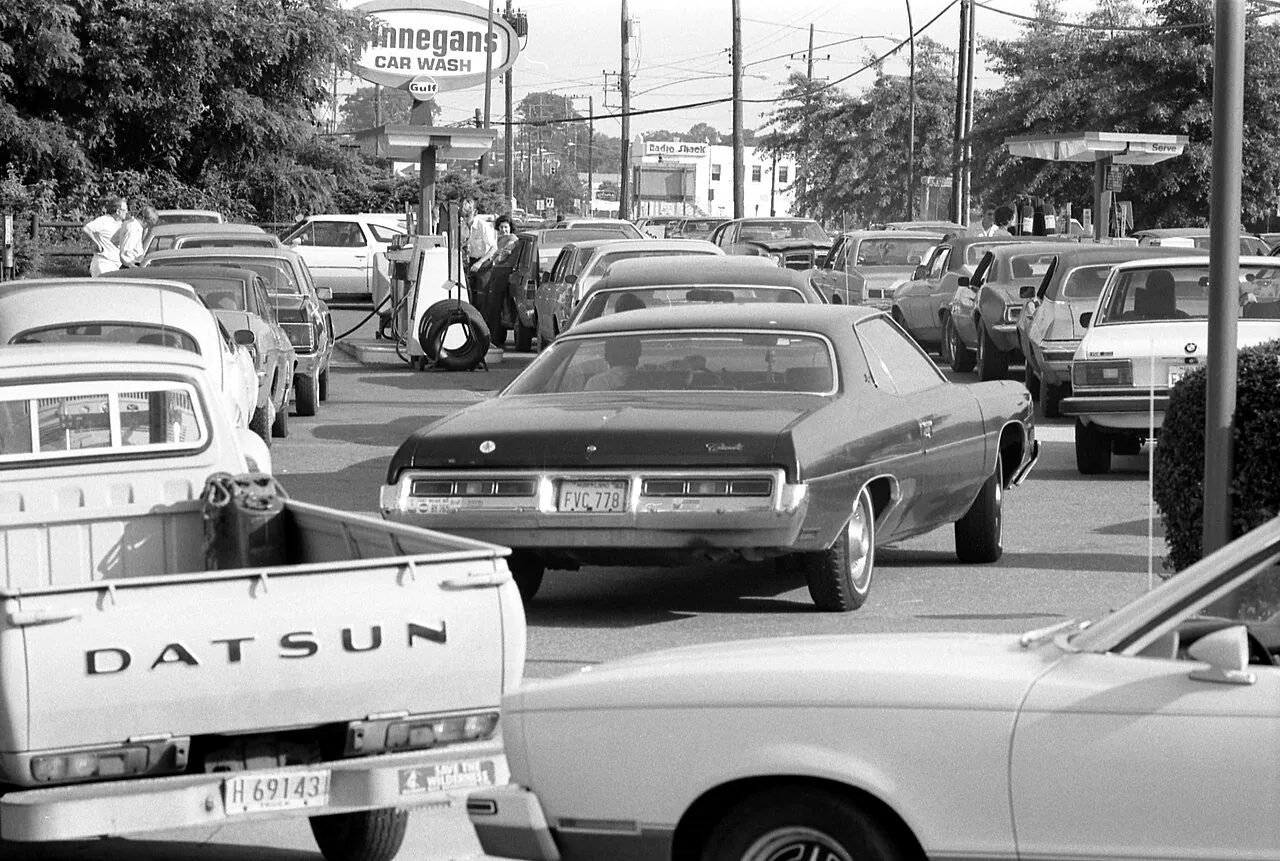
Source: Warren K. Leffler, June 15, 1979, Library of Congress (Wikimedia Commons).
- Present the document (nature, date, place).
- Describe what you see.
- Explain the link between the oil embargo of 1973 and the shortage of 1979.
- Why do such images help explain the mood of the late 1970s?
Exercise 7 : A crisis of confidence
Document 1 – Carter, July 15, 1979
It is a crisis of confidence. It is a crisis that strikes at the very heart and soul and spirit of our national will. We can see this crisis in the growing doubt about the meaning of our own lives and in the loss of a unity of purpose for our Nation. The erosion of our confidence in the future is threatening to destroy the social and the political fabric of America. The confidence that we have always had as a people is not simply some romantic dream or a proverb in a dusty book that we read just on the Fourth of July.
Source: Jimmy Carter, Address to the Nation on Energy and National Goals (the “malaise” speech), July 15, 1979; text from the American Presidency Project, University of California, Santa Barbara.
*erosion: wearing away. *fabric: the structure that holds a society together.
- Present the document (nature, author, date, context).
- What does Carter say is the threat to democracy?
- Quote one phrase that describes the effect of the crisis.
- Why did critics object to the speech?
Exercise 8 : Reading numbers: stagflation
The table gives the annual unemployment and inflation rates in the United States.
| Year | Unemployment rate (%) | Inflation rate (%) |
|---|---|---|
| 1973 | 4.9 | 6.2 |
| 1975 | 8.5 | 9.1 |
| 1979 | 5.9 | 11.3 |
| 1980 | 7.2 | 13.5 |
| 1982 | 9.7 | 6.1 |
| 1989 | 5.3 | 4.8 |
Source: unemployment, U.S. Bureau of Labor Statistics, annual averages (series UNRATE, Federal Reserve Bank of St. Louis, FRED); inflation, annual change in consumer prices (World Bank series on FRED, FPCPITOTLZGUSA); rounded to one decimal.
- Present the document (nature, source, period).
- In which year was inflation the highest? What was the unemployment rate that year?
- Explain why 1975 and 1980 are examples of stagflation.
- What happened between 1980 and 1982? What might explain it?
Exercise 9 : The handshake at the White House
Document 1 – Sadat, Carter, and Begin
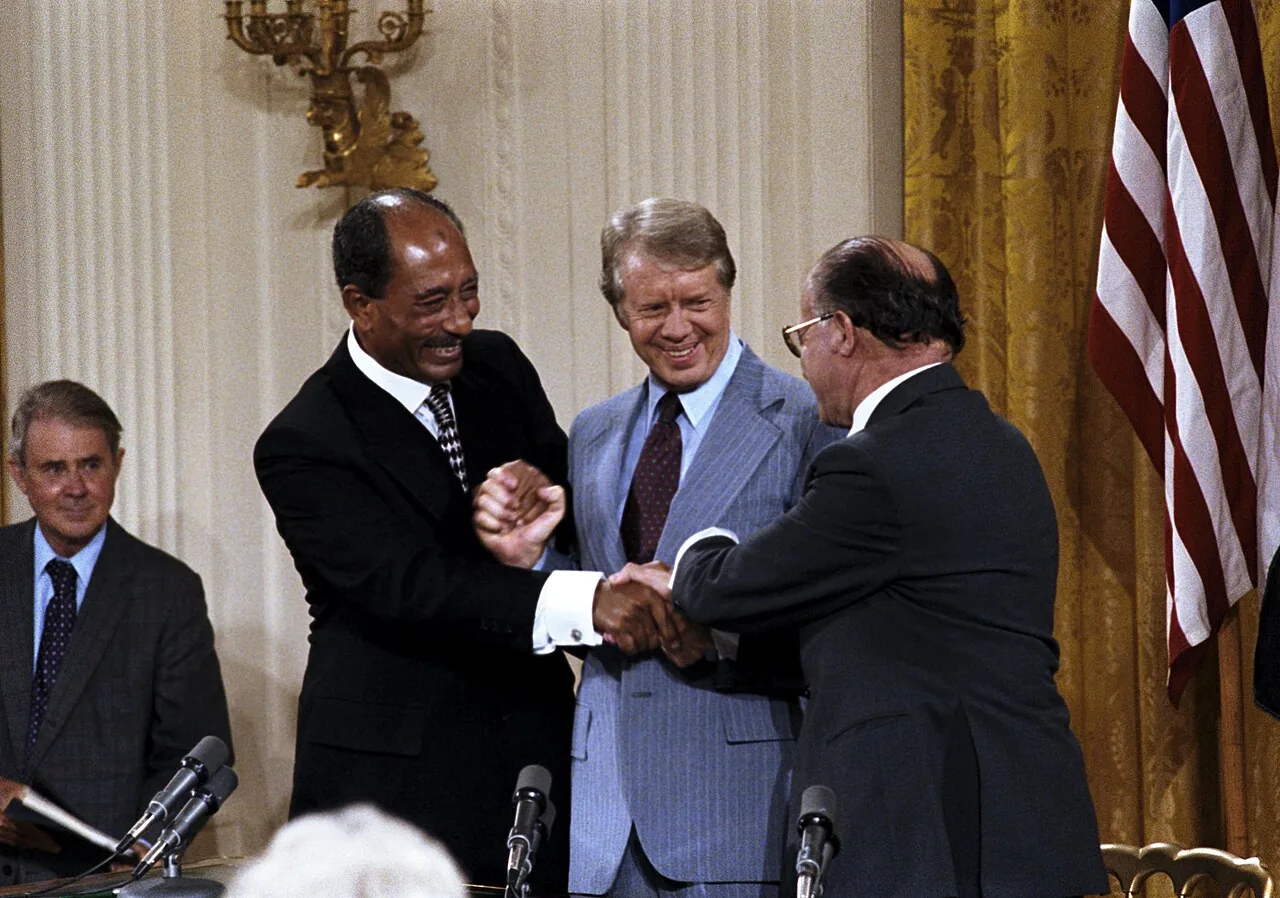
Source: Jimmy Carter Library, September 17, 1978 (Wikimedia Commons).
- Present the document (nature, date, place).
- Identify the three men and say who is in the middle.
- What does the photograph suggest about Carter’s role?
- Why is a photograph from a presidential library not a neutral source?
Exercise 10 : Camp David: the text
Document 1 – The Camp David Accords
Taking these factors into account, the parties are determined to reach a just, comprehensive, and durable settlement of the Middle East conflict through the conclusion of peace treaties based on Security Council resolutions 242 and 338 in all their parts. Their purpose is to achieve peace and good neighborly relations. They recognize that for peace to endure, it must involve all those who have been most deeply affected by the conflict.
Source: The Camp David Accords: A Framework for Peace in the Middle East, September 17, 1978; text from the Avalon Project, Yale Law School.
*durable: lasting. *Security Council resolutions 242 and 338: United Nations resolutions of 1967 and 1973.
- Present the document (nature, date, context).
- What kind of settlement do the parties want?
- What is the basis for peace treaties, according to the text?
- What did the accords not settle?
Exercise 11 : Locate the crises of 1979
- Name the capital of Egypt (1) and the capital of Iran (2).
- Name the capital of Afghanistan (3) and the city numbered 4.
- What happened in each of the countries 1 to 3 in 1978 or 1979?
- What is the strait numbered 5, and why does it matter to the United States?
- What does the letter A show, and what was returned to Egypt in 1982?
Exercise 12 : Reagan's credo
Document 1 – Reagan’s first inaugural address
In this present crisis, government is not the solution to our problem; government is the problem. From time to time, we have been tempted to believe that society has become too complex to be managed by self-rule, that government by an elite group is superior to government for, by, and of the people. But if no one among us is capable of governing himself, then who among us has the capacity to govern someone else?
Source: Ronald Reagan, First Inaugural Address, January 20, 1981; text from the Avalon Project, Yale Law School.
*elite: a small group with special power. *equitable: fair.
- Present the document (nature, author, date, context).
- Quote the sentence that summarizes Reagan’s view of government.
- According to the second sentence, whom does Reagan trust to govern?
- Compare this view with Johnson’s idea of the Great Society.
Exercise 13 : Two presidents, two diagnoses
Document 1 – Carter, 1979
It is a crisis of confidence. It is a crisis that strikes at the very heart and soul and spirit of our national will. We can see this crisis in the growing doubt about the meaning of our own lives and in the loss of a unity of purpose for our Nation. The erosion of our confidence in the future is threatening to destroy the social and the political fabric of America. The confidence that we have always had as a people is not simply some romantic dream or a proverb in a dusty book that we read just on the Fourth of July.
Source: Jimmy Carter, Address to the Nation on Energy and National Goals (the “malaise” speech), July 15, 1979; text from the American Presidency Project, University of California, Santa Barbara.
Document 2 – Reagan, 1981
In this present crisis, government is not the solution to our problem; government is the problem. From time to time, we have been tempted to believe that society has become too complex to be managed by self-rule, that government by an elite group is superior to government for, by, and of the people. But if no one among us is capable of governing himself, then who among us has the capacity to govern someone else?
Source: Ronald Reagan, First Inaugural Address, January 20, 1981; text from the Avalon Project, Yale Law School.
- Present each document in one sentence.
- What problem does each president describe?
- Compare the solution that each suggests.
- Which diagnosis do you find more convincing? Explain using one fact from the lesson.
Exercise 14 : A country called evil
Document 1 – Reagan, March 8, 1983
I urge you to beware the temptation of pride—the temptation of blithely declaring yourselves above it all and label both sides equally at fault, to ignore the facts of history and the aggressive impulses of an evil empire, to simply call the arms race a giant misunderstanding and thereby remove yourself from the struggle between right and wrong and good and evil.
Source: Ronald Reagan, Remarks at the Annual Convention of the National Association of Evangelicals in Orlando, Florida, March 8, 1983; text from the American Presidency Project, University of California, Santa Barbara.
*blithely: casually. *verifiable: able to be checked.
- Present the document (nature, author, date, audience).
- What temptation does Reagan warn his listeners against?
- How does he describe the Soviet Union in this passage?
- Write two sentences explaining why the speech could both increase tension and appeal to voters.
Exercise 15 : Locate the Reagan-era interventions
- Name the capital of Nicaragua (1) and the island numbered 2.
- Name the city numbered 3, where U.S. troops invaded in December 1989, and the capital of El Salvador (4).
- What happened in the island numbered 2 in October 1983?
- What does the letter A show, and why did the United States watch it closely?
Exercise 16 : The Iran-Contra denial
Document 1 – Reagan, November 13, 1986
We did not—repeat—did not trade weapons or anything else for hostages, nor will we. Those who think that we have gone soft on terrorism should take up the question with Colonel Qadhafi. We have not, nor will we, capitulate to terrorists. We will, however, get on with advancing the vital interests of our great nation—in spite of terrorists and radicals who seek to sabotage our efforts and immobilize the United States.
Source: Ronald Reagan, Address to the Nation on the Iran Arms and Contra Aid Controversy, November 13, 1986; text from the American Presidency Project, University of California, Santa Barbara.
*capitulate: surrender. *immobilize: stop from acting.
- Present the document (nature, author, date, context).
- What does Reagan say about trading weapons for hostages?
- What goals does he say the administration has in relation to Iran?
- In March 1987 Reagan said that the facts did not support this statement. Why must a historian read this document with that later admission in mind?
Exercise 17 : From confrontation to treaty
Document 1 – The “evil empire” speech, 1983
I urge you to beware the temptation of pride—the temptation of blithely declaring yourselves above it all and label both sides equally at fault, to ignore the facts of history and the aggressive impulses of an evil empire, to simply call the arms race a giant misunderstanding and thereby remove yourself from the struggle between right and wrong and good and evil.
Source: Ronald Reagan, Remarks at the Annual Convention of the National Association of Evangelicals in Orlando, Florida, March 8, 1983; text from the American Presidency Project, University of California, Santa Barbara.
Document 2 – The INF Treaty signing, 1987
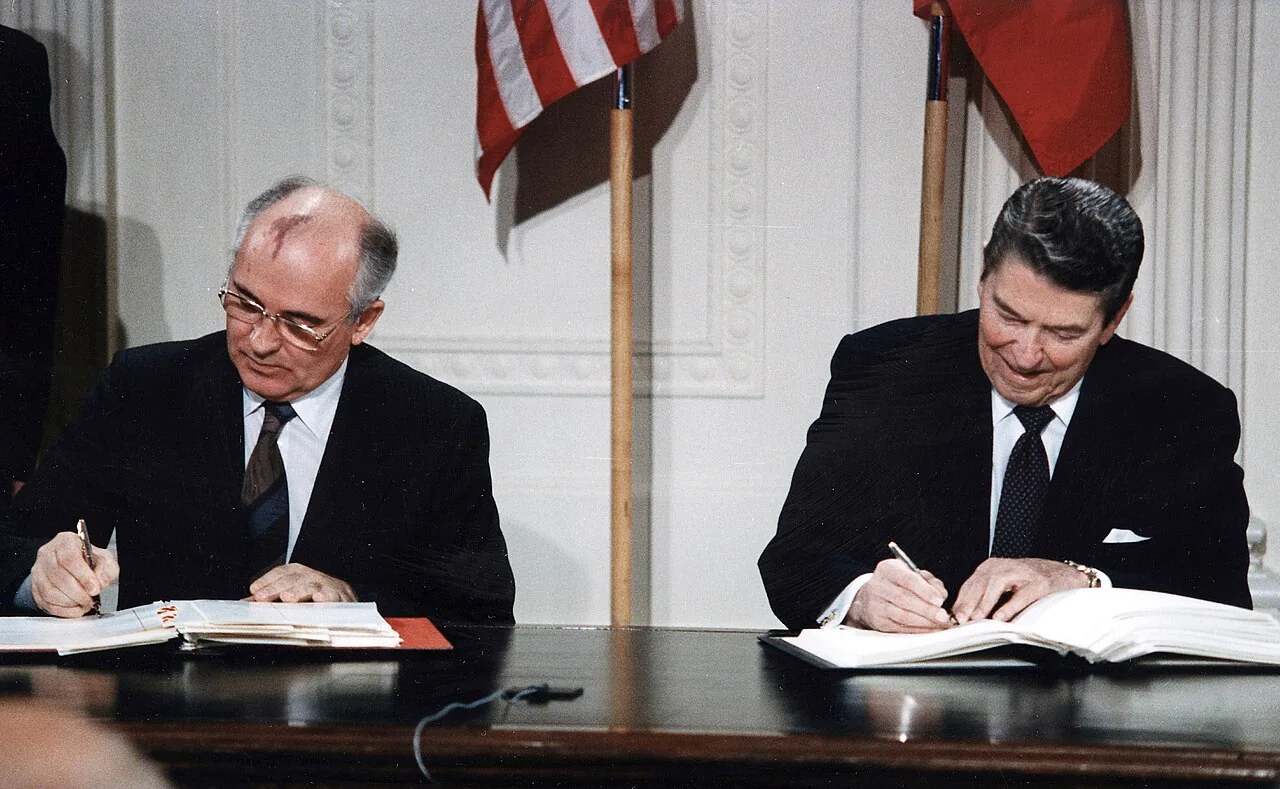
Source: White House Photographic Office, December 8, 1987 (Wikimedia Commons).
- Present each document (nature, author, date).
- What attitude toward the Soviet Union does each document show?
- What changed between 1983 and 1987? Give two reasons.
- Why can the same president appear in both documents?
Exercise 18 : Order the events
Put these events in order from earliest to latest, then give the year of each.
- Camp David Accords
- Resignation of Nixon
- INF Treaty
- OPEC oil embargo
- Seizure of the American embassy in Tehran
- PATCO strike
- Watergate break-in
- Iran-Contra becomes public
Exercise 19 : Durations
Use the dates in the lesson to answer.
- How many days were the American hostages held in Iran (the answer is in the lesson)?
- How many years passed between the Watergate break-in (1972) and Reagan’s inauguration (1981)?
- How many years between the Camp David Accords (1978) and the return of the Sinai to Egypt (1982)?
- How many years between the “evil empire” speech (1983) and the INF Treaty (1987)?
Exercise 20 : Guided research: Watergate or the Camp David Accords
Choose one topic and fill in a research sheet using reliable sources.
- Topic A: the Watergate tapes. Search: Nixon tapes National Archives Watergate smoking gun.
- Topic B: the Camp David negotiations. Search: Camp David Accords 1978 Office of the Historian.
Reliable sites: the National Archives (archives.gov), the Office of the Historian (history.state.gov), the Library of Congress (loc.gov), presidential libraries, the Senate (senate.gov).
- Who took part and what did each person do?
- When did the main events take place?
- What decision or document was the result?
- What questions remain debated?
Exercise 21 : CER paragraph: Reagan and the end of the Cold War
Write a Claim-Evidence-Reasoning paragraph: To what extent did Reagan’s policies contribute to the end of the Cold War? Use at least two pieces of evidence from the lesson.
Evidence: the military buildup, the “evil empire” speech, the INF Treaty, Gorbachev’s reforms, the weakness of the Soviet economy.
Exercise 22 : SAQ: Watergate and the presidency
Answer all parts in two or three sentences each.
- Identify one event of 1973 or 1974 that increased pressure on Nixon.
- Explain how that event changed the balance of power between Congress and the president.
- Identify one reform that came out of Watergate.
Exercise 23 : True or false? Justify
Say whether each statement is true or false. If it is false, correct it.
- Nixon was impeached by the full House of Representatives.
- Carter mediated the Camp David Accords between Egypt and Israel.
- The American hostages in Iran were freed on the day Reagan took office.
- Reagan’s tax law of 1981 raised the top income tax rate.
- The INF Treaty eliminated a class of nuclear missiles.
Exercise 24 : Causes and consequences of the Reagan Revolution
Copy and complete the chain with one fact for each step.
- Cause: Watergate and loss of trust in government.
- Cause: stagflation and the energy crisis.
- Event: the hostage crisis and the election of 1980.
- Policy: tax cuts and deregulation.
- Consequence: a changed debate about the role of government.


Quick review: flashcards
Tap a card to see the answer.