


This US History Grade 11 lesson covers The Civil Rights Movement, part of the unit “Postwar America.” First, read the full lesson with its primary sources, maps and key terms. Then practice with the worksheet, check yourself with the quiz and get ready with the test.
On the afternoon of May 17, 1954, Chief Justice Earl Warren began to read an opinion aloud in the Supreme Court. It was short, and the justices had agreed beforehand to make it plain so that ordinary people could understand it. When he said that in the field of public education the doctrine of “separate but equal” had no place, the long legal structure of segregation in the schools of the United States was declared unconstitutional.
The decision did not change the nation overnight. It started a struggle that lasted for more than a decade, in courtrooms, schools, buses, lunch counters, churches, and city streets, and it brought the Black freedom movement to the center of American life. This unit follows that movement, from the Supreme Court to the Voting Rights Act of 1965.
Guiding question: How did African Americans and their allies use courts, protest, and politics to dismantle legal segregation and win the vote, and what remained unfinished?
1. The roots of the movement
Jim Crow and “separate but equal”
After Reconstruction ended in 1877, Southern states passed laws that separated Black and white Americans in schools, trains, streetcars, hospitals, parks, and public places, and took away the right to vote from Black citizens through poll taxes, literacy tests, and violence. This system was known as Jim Crow. In 1896, in Plessy v. Ferguson, the Supreme Court upheld a Louisiana law that required separate railroad cars, ruling that segregation was constitutional as long as the facilities were equal. In practice, Black schools, for example, received far less money than white schools. Justice John Marshall Harlan, the only dissenter, wrote an opinion that was later quoted by the civil rights movement.
Document 1 – Harlan’s dissent in Plessy
The white race deems itself to be the dominant race in this country. And so it is, in prestige, in achievements, in education, in wealth, and in power. So, I doubt not, it will continue to be for all time, if it remains true to its great heritage, and holds fast to the principles of constitutional liberty. But in view of the constitution, in the eye of the law, there is in this country no superior, dominant, ruling class of citizens. There is no caste here. Our constitution is color-blind, and neither knows nor tolerates classes among citizens. In respect of civil rights, all citizens are equal before the law. The humblest is the peer of the most powerful.
Source: Justice John Marshall Harlan, dissenting opinion, Plessy v. Ferguson, 163 U.S. 537, May 18, 1896; text from the Legal Information Institute, Cornell Law School.
*dominant: ruling. *caste: a rigid hereditary social class.
Commentary. Harlan, a white Kentuckian and a former slaveholder, admitted that the white race considered itself dominant, but he insisted that the Constitution recognized no ruling class of citizens. His phrase “Our constitution is color-blind” became famous. The dissent was a minority opinion at the time, but in 1954 the Court adopted its central idea of equal citizenship.
Definition: Jim Crow
The system of laws and customs that enforced racial segregation and the political and economic subordination of Black Americans, mostly in the South, from the late 1800s until the 1960s. The name comes from a stage character used to mock Black people.
Black Americans in the first half of the century
Black Americans never accepted Jim Crow. Millions moved north and west during the Great Migration, which began during World War I, to seek jobs and fairer treatment, and in cities such as Chicago, Detroit, and New York they built strong communities and gained votes. The National Association for the Advancement of Colored People (NAACP), founded in 1909, fought discrimination in the courts.
Under its lawyers, among them Charles Hamilton Houston and his student Thurgood Marshall, the NAACP won a series of cases that chipped away at segregation in graduate and professional schools in the 1930s and 1940s. World War II strengthened the movement: Black soldiers and workers demanded “Double V” victory over fascism abroad and over racism at home. The NAACP grew rapidly during the war years.
In 1947, Jackie Robinson broke the color line in major league baseball. In July 1948, President Truman, influenced by a report of his civil rights committee and by Black voters in the North, issued an order to end segregation in the armed forces.
Definition: Great Migration
The movement of about six million Black Americans from the rural South to cities of the North, Midwest, and West between about 1910 and 1970, to find jobs and escape Jim Crow.
Document 2 – Executive Order 9981
It is hereby declared to be the policy of the President that there shall be equality of treatment and opportunity for all persons in the armed services without regard to race, color, religion or national origin. This policy shall be put into effect as rapidly as possible, having due regard to the time required to effectuate any necessary changes without impairing efficiency or morale.
Source: Harry S. Truman, Executive Order 9981, Establishing the President’s Committee on Equality of Treatment and Opportunity in the Armed Services, July 26, 1948; text from the National Archives.
*equality of treatment: equal treatment. *efficiency: effective operation.
Commentary. The order declared a policy of equal treatment and opportunity in the armed forces “without regard to race, color, religion or national origin,” but it allowed the change to take place “as rapidly as possible.” The military resisted for several years. The armed forces largely completed integration during the Korean War and became one of the first large American institutions to desegregate.
2. Brown, Montgomery, and Little Rock, 1954-1957
Brown v. Board of Education
Through the 1940s and early 1950s, the NAACP attacked the premise of “separate but equal” in public schools. It brought together five cases from Kansas, South Carolina, Virginia, Delaware, and the District of Columbia. Linda Brown, a Black girl in Topeka, Kansas, had to travel a long way to a Black school although a white school was close to her home, and her parents filed the lead case. In 1954, seventeen states and the District of Columbia required segregated schools; in a few other states, such as Kansas, local communities could choose to separate their schools.
Document 3 – Brown v. Board of Education
Today, education is perhaps the most important function of state and local governments. Compulsory school attendance laws and the great expenditures for education both demonstrate our recognition of the importance of education to our democratic society. It is required in the performance of our most basic public responsibilities, even service in the armed forces. It is the very foundation of good citizenship. Today it is a principal instrument in awakening the child to cultural values, in preparing him for later professional training, and in helping him to adjust normally to his environment. In these days, it is doubtful that any child may reasonably be expected to succeed in life if he is denied the opportunity of an education.
Source: Chief Justice Earl Warren, opinion of the Court, Brown v. Board of Education of Topeka, 347 U.S. 483, May 17, 1954 (on education); text from Wikisource.
*compulsory: required by law. *adjust: adapt.
We conclude that, in the field of public education, the doctrine of “separate but equal” has no place. Separate educational facilities are inherently unequal. Therefore, we hold that the plaintiffs and others similarly situated for whom the actions have been brought are, by reason of the segregation complained of, deprived of the equal protection of the laws guaranteed by the Fourteenth Amendment. This disposition makes unnecessary any discussion whether such segregation also violates the Due Process Clause of the Fourteenth Amendment.
Source: Chief Justice Earl Warren, opinion of the Court, Brown v. Board of Education of Topeka, 347 U.S. 483, May 17, 1954 (holding); text from Wikisource.
*doctrine: official principle. *inherently: by its very nature.
Commentary. Chief Justice Warren wrote for a unanimous Court. The decision rested on the importance of education and on evidence about the effects of segregation on children. The Court concluded that separate educational facilities are “inherently unequal.” In 1955, in a second ruling known as Brown II, the Court ordered desegregation “with all deliberate speed,” a vague phrase that gave opponents room to delay.
Massive resistance
Many white Southern leaders reacted with defiance. In the Deep South, segregationists formed White Citizens’ Councils to pressure Black citizens who tried to enforce Brown. Some states closed public schools rather than integrate them. In March 1956, 101 members of Congress, 19 senators and 82 representatives, from the South signed a statement called the Declaration of Constitutional Principles.
Document 4 – The Southern Manifesto
We regard the decisions of the Supreme Court in the school cases as a clear abuse of judicial power. It climaxes a trend in the Federal Judiciary undertaking to legislate, in derogation of the authority of Congress, and to encroach upon the reserved rights of the States and the people. The original Constitution does not mention education. Neither does the 14th Amendment nor any other amendment. The debates preceding the submission of the 14th Amendment clearly show that there was no intent that it should affect the system of education maintained by the States.
Source: Declaration of Constitutional Principles (the “Southern Manifesto”), read in Congress, March 12, 1956; text from Wikisource.
*derogation: lessening of the authority of something. *encroach: intrude upon.
Commentary. The signers argued that the Court had abused its power and invaded the rights of the states, and they promised to use “all lawful means” to reverse the decision. Their legal argument, based on states’ rights, was the heart of what became known as massive resistance. Notice that the document never speaks about the children involved.
Definition: massive resistance
The organized effort by white Southern politicians and citizens to block the desegregation ordered in Brown v. Board of Education, through laws, school closings, pressure on Black families, and sometimes violence.
In August 1955, a fourteen-year-old Black boy from Chicago, Emmett Till, was kidnapped and murdered in Mississippi after being accused of offending a white woman. His mother insisted on an open casket funeral, and thousands of people saw photographs of his body. An all-white jury acquitted the two white men on trial for the murder. The case shocked the nation and moved a generation of young Black Americans.
The Montgomery bus boycott
On December 1, 1955, in Montgomery, Alabama, Rosa Parks, a seamstress and secretary of the local NAACP, refused to give up her seat on a city bus to a white passenger and was arrested. She was not the first to challenge the system; Claudette Colvin and others had done so months earlier. Black leaders, led by Jo Ann Robinson and the Women’s Political Council and by E. D. Nixon, called a one-day boycott of the buses for December 5. It was so successful that the community continued it. The boycotters chose a young Baptist minister, Martin Luther King Jr., to lead the new Montgomery Improvement Association.
Definition: nonviolent direct action
A method of protest that confronts injustice openly through boycotts, marches, sit-ins, and other acts of peaceful disobedience, accepting arrest or violence without fighting back, in order to move public opinion and force change.
For more than a year, tens of thousands of Black residents walked, carpooled, or found other ways to get to work. The city arrested boycott leaders, and someone bombed King’s house. Finally, in Browder v. Gayle, a federal court ruled bus segregation unconstitutional, and the Supreme Court affirmed the decision. The boycott ended on December 20, 1956. It gave King national prominence and a method: nonviolent direct action, influenced by Christian teaching and by the example of Mohandas Gandhi in India. In 1957, King and other ministers founded the Southern Christian Leadership Conference (SCLC).
Document 5 – Rosa Parks fingerprinted
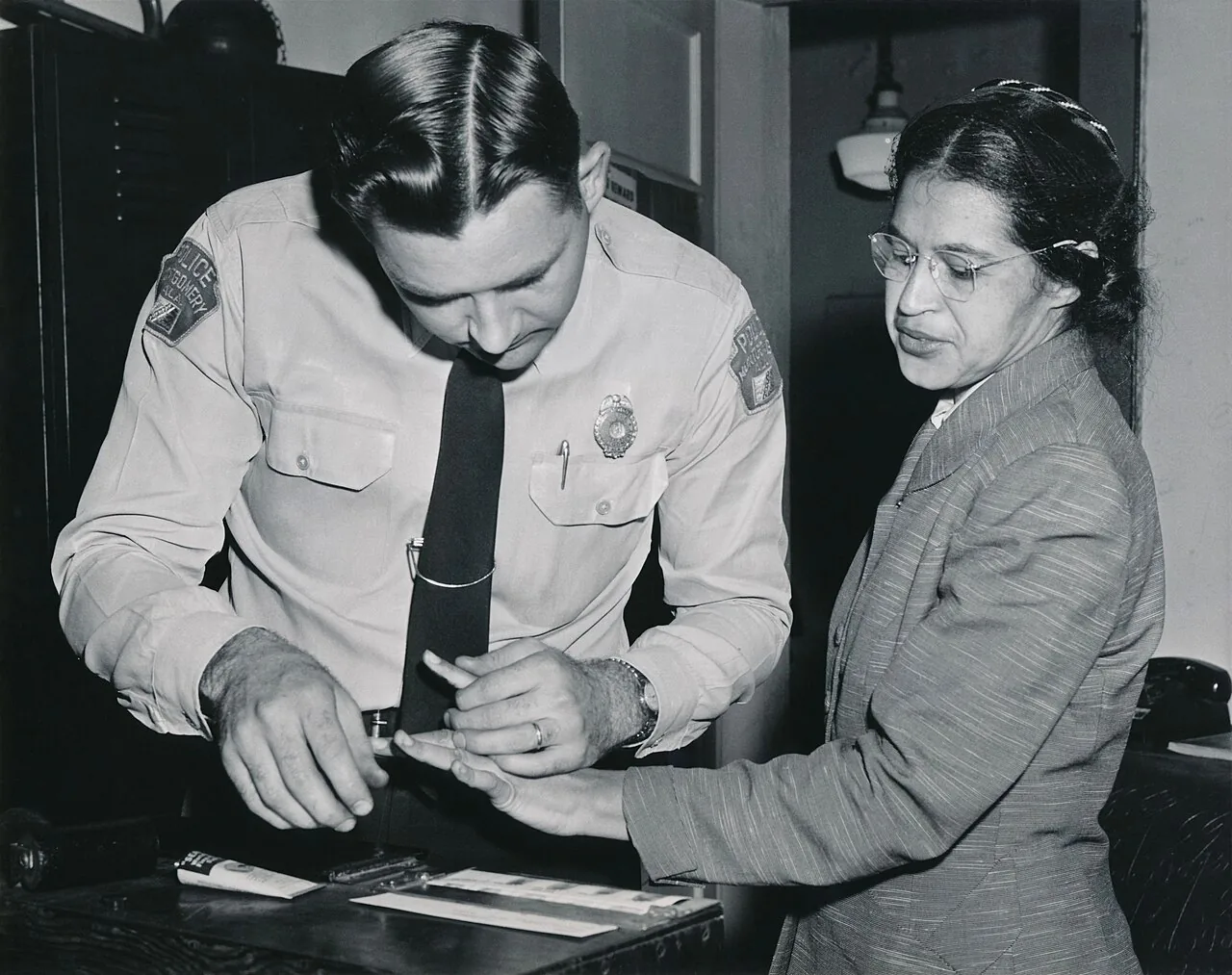
Source: Gene Herrick, Associated Press, February 22, 1956 (image on Wikimedia Commons).
Commentary. In February 1956, Parks and dozens of other boycott leaders were arrested under an old law against conspiring to hinder a business. She appears calm and dignified as an officer takes her fingerprints. Photographs such as this one helped to turn the boycott into a national story.
Little Rock, 1957
In September 1957, nine Black students, known as the Little Rock Nine, were due to enter Central High School in Little Rock, Arkansas, under a court-ordered desegregation plan. Governor Orval Faubus used the Arkansas National Guard to keep them out. On September 4, a mob screamed at the fifteen-year-old Elizabeth Eckford as she walked alone toward the school. After three weeks of crisis, President Eisenhower, who had not been enthusiastic about desegregation, sent about a thousand paratroopers of the 101st Airborne Division to Little Rock and federalized the Arkansas National Guard, to enforce the court order.
Document 6 – Eisenhower on Little Rock
In accordance with that responsibility, I have today issued an Executive Order directing the use of troops under Federal authority to aid in the execution of Federal law at Little Rock, Arkansas. This became necessary when my Proclamation of yesterday was not observed, and the obstruction of justice still continues. It is important that the reasons for my action be understood by all our citizens. As you know, the Supreme Court of the United States has decided that separate public educational facilities for the races are inherently unequal and therefore compulsory school segregation laws are unconstitutional.
Source: Dwight D. Eisenhower, radio and television address to the American people on the situation in Little Rock, September 24, 1957; text from the American Presidency Project.
*obstruction: act of blocking. *compulsory: required by law.
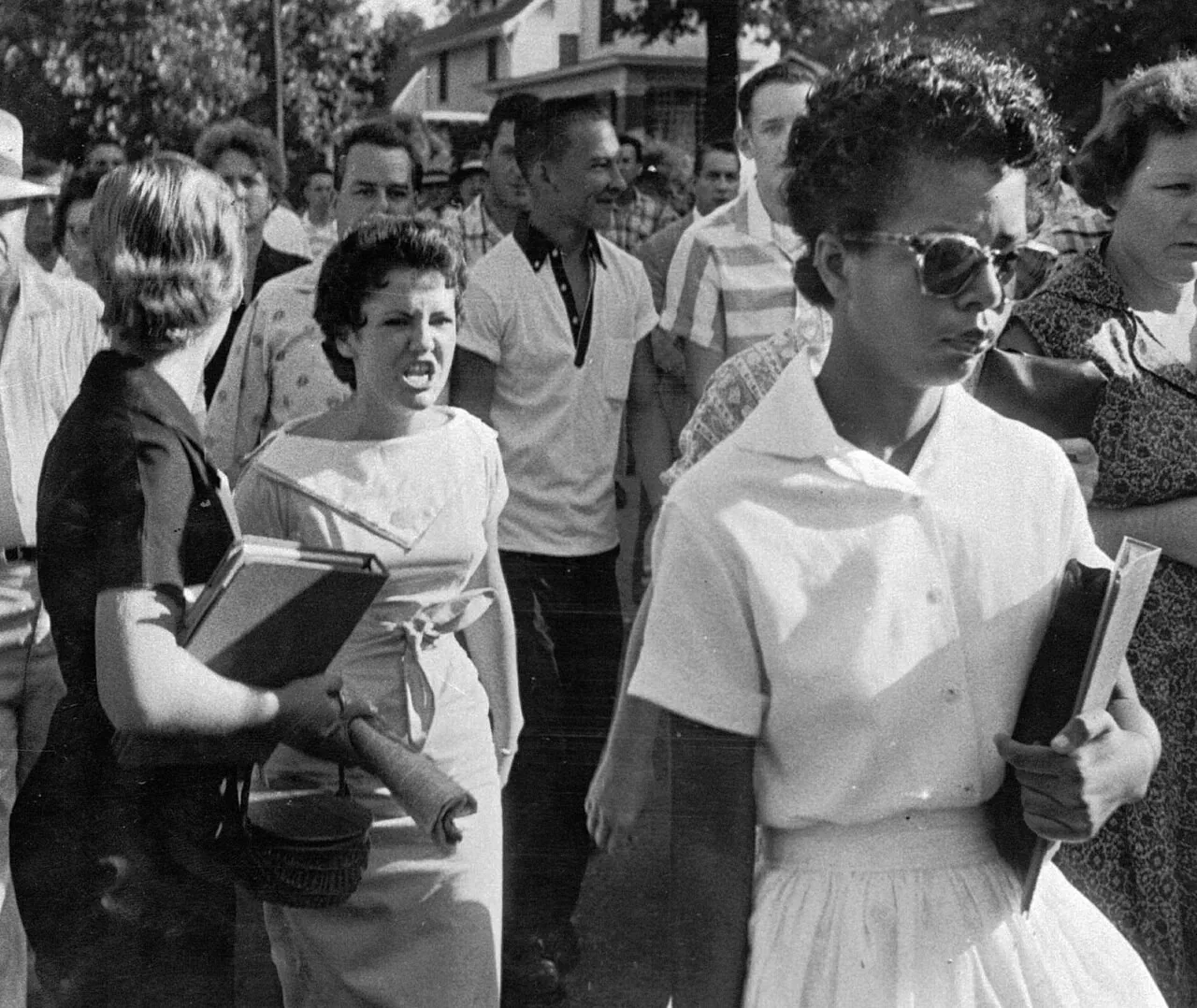
Source: Will Counts, September 4, 1957 (image on Wikimedia Commons).
Commentary. Eisenhower grounded his action in the duty to enforce federal law rather than in a personal view of segregation. The Nine attended school under the protection of soldiers, and they endured daily abuse. In 1958 Faubus closed Little Rock’s high schools for a year to avoid integration. Congress passed a Civil Rights Act in 1957, the first since Reconstruction, but it had little effect.
3. The movement at its height, 1960-1965
Sit-ins and Freedom Rides
On February 1, 1960, four Black students from North Carolina Agricultural and Technical College sat down at the whites-only lunch counter at a Woolworth’s store in Greensboro and asked to be served. The staff refused to serve them, but they stayed. The next day more students joined, and within weeks sit-ins had spread to dozens of cities. In April 1960, student activists, helped by Ella Baker of the SCLC, founded the Student Nonviolent Coordinating Committee (SNCC).
Also in 1961, the Congress of Racial Equality (CORE) sent interracial groups of Freedom Riders on buses across the South to test a Supreme Court ruling that had banned segregation in interstate bus stations. In Anniston, Alabama, on May 14, 1961, a mob attacked a Greyhound bus and burned it, and in Birmingham and Montgomery, riders were beaten. President Kennedy sent federal marshals to protect the riders, and the Interstate Commerce Commission ordered an end to segregation in interstate travel in the fall of 1961.
Document 7 – The Freedom Riders’ bus
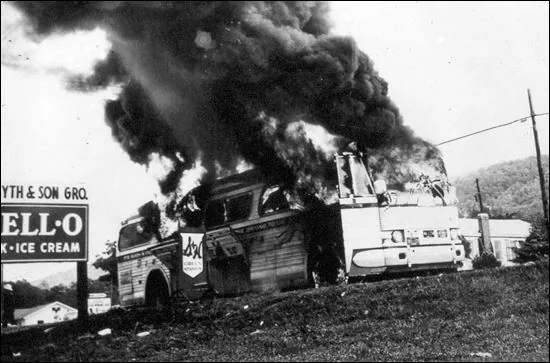
Source: U.S. National Park Service, May 14, 1961 (image on Wikimedia Commons).
Commentary. The burning bus became a symbol of the violence faced by those who challenged segregation. Officials had warned the riders. They chose to go on because they believed that exposing the violence of segregationists would force the national government to act.
Birmingham and the March on Washington
In the spring of 1963, King and the SCLC chose Birmingham, Alabama, one of the most segregated cities in the country, for a campaign of marches, sit-ins, and boycotts. Police Commissioner Eugene “Bull” Connor used police dogs and fire hoses on the marchers, among them hundreds of children, in scenes that were shown on television and in newspapers across the world.
Arrested in April, King wrote his “Letter from Birmingham Jail,” answering white ministers who had urged patience, and arguing that Black citizens could not wait for rights long denied. On June 11, Kennedy gave a national television address calling civil rights a moral issue and announced that he would send a major civil rights bill to Congress. Within hours, a gunman murdered Medgar Evers, the NAACP field secretary in Mississippi, outside his home.
On August 28, 1963, the March on Washington for Jobs and Freedom brought about 250,000 people, black and white, to the Lincoln Memorial, the most widely cited estimate. A. Philip Randolph, Bayard Rustin, and others organized it. There, King delivered his “I Have a Dream” speech. In September, a bomb at the 16th Street Baptist Church in Birmingham killed four Black girls. An assassin killed Kennedy on November 22, 1963.
Document 8 – The March on Washington
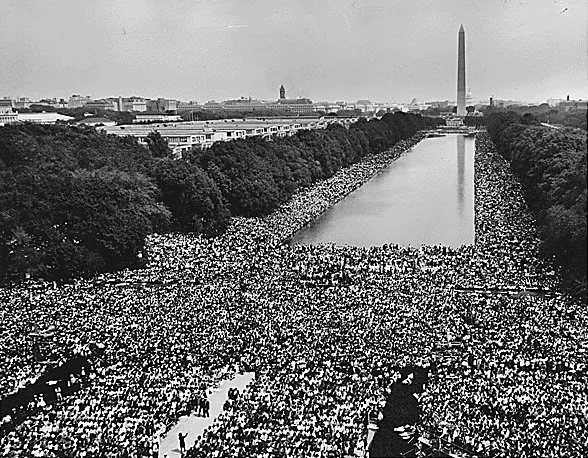
Source: U.S. Information Agency, August 28, 1963 (image on Wikimedia Commons).
Commentary. The photograph, taken from the steps of the Lincoln Memorial, shows the crowd along the Reflecting Pool toward the Washington Monument. The March presented the movement as a call for jobs as well as freedom and showed broad support, although some young activists felt that organizers had softened the speeches.
The Civil Rights Act of 1964
President Lyndon B. Johnson used the memory of Kennedy and all his skills in Congress to push the bill forward. A filibuster by Southern senators lasted for weeks, but the Senate ended it in June 1964. Johnson signed the Civil Rights Act of 1964 on July 2. The law banned discrimination in hotels, restaurants, and other public accommodations (Title II), allowed the federal government to sue to desegregate public schools, banned discrimination by employers and unions (Title VII), including discrimination based on sex, and prohibited discrimination in programs that received federal money (Title VI).
Document 9 – The Civil Rights Act of 1964
SEC. 601. No person in the United States shall, on the ground of race, color, or national origin, be excluded from participation in, be denied the benefits of, or be subjected to discrimination under any program or activity receiving Federal financial assistance.
Source: Civil Rights Act of 1964, signed July 2, 1964, Title VI, Section 601; text from the National Archives.
*discrimination: unfair treatment based on group membership. *federal financial assistance: money from the national government.
Commentary. Title VI gave the federal government a powerful tool: it could cut off funds from schools, hospitals, and other institutions that discriminated. This threat did more than court orders to desegregate hospitals and schools in the South in the following years.
Freedom Summer and Selma
Voting rights was the next battle. In many parts of the Deep South, almost no Black citizens were registered. In the summer of 1964, SNCC, CORE, and other groups brought hundreds of volunteers, many of them white college students from the North, to Mississippi for Freedom Summer, to register voters and to run Freedom Schools. Segregationists murdered three workers, James Chaney, Andrew Goodman, and Michael Schwerner, in Neshoba County in June. The Mississippi Freedom Democratic Party challenged the all-white state delegation at the Democratic convention in Atlantic City. The 24th Amendment, ratified in 1964, banned the poll tax in federal elections.
In early 1965, King and the SCLC chose Selma, Alabama, where only a small fraction of eligible Black residents were registered. On March 7, 1965, known as Bloody Sunday, state troopers attacked about 600 marchers with clubs and tear gas at the Edmund Pettus Bridge as they began a march to Montgomery. Television showed the scene. Eight days later, President Johnson addressed Congress and the nation.
Document 10 – “We shall overcome”
Their cause must be our cause too. Because it is not just Negroes, but really it is all of us, who must overcome the crippling legacy of bigotry and injustice. And we shall overcome. As a man whose roots go deeply into Southern soil I know how agonizing racial feelings are. I know how difficult it is to reshape the attitudes and the structure of our society. But a century has passed, more than a hundred years, since the Negro was freed. And he is not fully free tonight.
Source: Lyndon B. Johnson, special message to Congress, “The American Promise,” March 15, 1965; text from the American Presidency Project.
*legacy: what is left from the past. *bigotry: intolerance of other groups.
Commentary. A Southerner himself, Johnson spoke of the movement as an American cause and used its anthem, “We Shall Overcome,” in a speech to Congress. He asked for a voting rights law with strong federal enforcement. The marchers, protected by federal troops, completed the fifty-four-mile march to Montgomery in late March.
Document 11 – The Voting Rights Act
SEC. 2. No voting qualification or prerequisite to voting, or standard, practice, or procedure shall be imposed or applied by any State or political subdivision to deny or abridge the right of any citizen of the United States to vote on account of race or color.
Source: Voting Rights Act of 1965, signed August 6, 1965, Section 2; text from the National Archives.
*prerequisite: a requirement that must be met first. *abridge: reduce.
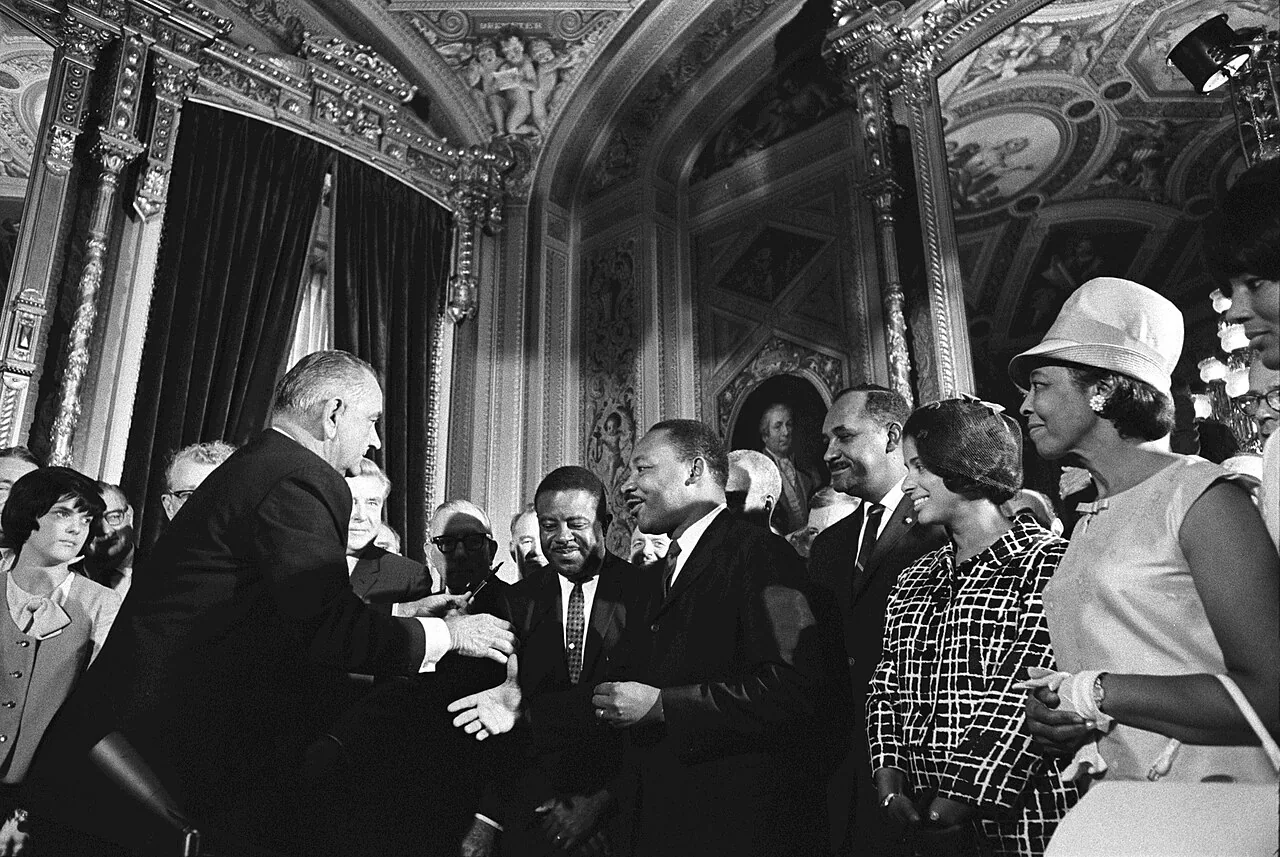
Source: Yoichi Okamoto, August 6, 1965 (image on Wikimedia Commons).
Commentary. The Voting Rights Act of 1965 banned literacy tests and other devices, and required areas with a history of discrimination to get federal approval of changes in voting rules. Federal examiners could register voters. Registration of Black citizens rose quickly: in Mississippi, from 6.7 percent of Black adults in 1964 to 66.5 percent in 1969.
4. After 1965: unfinished work
The laws of 1964 and 1965 ended legal segregation, but did not end inequality. In August 1965, only days after the Voting Rights Act was signed, a riot broke out in the Watts neighborhood of Los Angeles. In northern and western cities, Black residents faced segregated neighborhoods, unequal schools, discrimination in housing, police violence, and unemployment, problems that laws against Southern segregation did not touch.
Young activists, among them Stokely Carmichael of SNCC, called for Black Power, meaning racial pride, political and economic self-determination, and in some cases a break with nonviolence. Malcolm X, assassinated in February 1965, influenced a generation. King turned to poverty and war, and in 1968 he was in Memphis to support sanitation workers on strike when an assassin shot him on April 4. Then Congress passed the Fair Housing Act, banning discrimination in housing, and Johnson signed it on April 11, 1968.
A lasting influence
The movement also inspired others. Latino farmworkers led by Cesar Chavez and Dolores Huerta, Native American activists, women in the new feminist movement, Asian American students, and disability rights activists drew on its songs, strategies, and ideas. The Supreme Court’s decision in Shelby County v. Holder (2013) struck down the formula that decided which places needed federal approval under the Voting Rights Act, and historians and citizens still debate the progress and the unfinished business of the era.
- 1896 Plessy v. Ferguson: “separate but equal”
- 1948 Executive Order 9981 desegregates the armed forces
- May 17, 1954 Brown v. Board of Education
- 1955-56 Emmett Till; Montgomery bus boycott
- 1957 Little Rock Nine
- Feb. 1960 Greensboro sit-in
- 1961 Freedom Rides
- Aug. 28, 1963 March on Washington
- July 2, 1964 Civil Rights Act
- Mar. 7, 1965 Bloody Sunday in Selma
- Aug. 6, 1965 Voting Rights Act
- Apr. 4, 1968 King assassinated; Fair Housing Act a week later
Key takeaways
- Jim Crow segregation, upheld in Plessy v. Ferguson (1896), was attacked by the NAACP in the courts and by Black Americans through migration and protest.
- Brown v. Board of Education (1954) ruled school segregation unconstitutional; white Southern leaders answered with massive resistance, and federal troops enforced integration at Little Rock (1957).
- The Montgomery boycott (1955-56), sit-ins (1960), Freedom Rides (1961), and Birmingham (1963) used nonviolent direct action and won national support.
- The Civil Rights Act of 1964 banned discrimination in public places and employment, and the Voting Rights Act of 1965 ended barriers to voting, with fast results: Black registration in Mississippi rose from 6.7 to 66.5 percent by 1969.
- Legal segregation ended, but inequality in housing, jobs, schools, and policing persisted, and Americans still debate the movement’s unfinished work.

Quick review: flashcards
Tap a card to see the answer.