


This US History Grade 11 lesson covers The Cold War at Home and Abroad, part of the unit “Postwar America.” First, read the full lesson with its primary sources, maps and key terms. Then practice with the worksheet, check yourself with the quiz and get ready with the test.
In the early morning of June 24, 1948, the Soviet Union cut the roads, railways, and canals that linked West Berlin to the rest of Germany. Two million people in the western sectors of the city, which lay deep inside Soviet-occupied territory, had food and coal for only a few weeks. The United States could have abandoned Berlin or tried to force the roads open and risk war. Instead, President Harry S. Truman ordered a huge airlift of supplies.
For fifteen months, transport planes landed every few minutes, and the city survived. The Berlin crisis was an early test of the Cold War, the long rivalry between the United States and the Soviet Union that dominated world affairs from the mid-1940s until 1991. It was a war fought not by direct combat between the two superpowers, but by alliances, aid, spying, propaganda, an arms race, and proxy wars.
Guiding question: How did the Cold War shape American foreign policy and everyday life, and what price did Americans pay for containing communism?
1. The origins of containment, 1945-1949
From allies to rivals
The United States and the Soviet Union had fought together against Nazi Germany, but the two nations differed deeply. The United States was a capitalist democracy; the Soviet Union was a one-party communist dictatorship led by Joseph Stalin. At the wartime conferences at Yalta (February 1945) and Potsdam (July-August 1945), the Allies agreed to divide Germany into occupation zones and to hold free elections in Eastern Europe. But the Red Army occupied Poland, Romania, Hungary, Bulgaria, and eastern Germany, and Stalin installed governments loyal to Moscow. In a speech in Fulton, Missouri, on March 5, 1946, Winston Churchill warned that an “iron curtain” had descended across the continent from the Baltic to the Adriatic.
In February 1946, George F. Kennan, a diplomat at the American Embassy in Moscow, sent the State Department a long telegram to explain Soviet behavior. It became the basis of American strategy.
Document 1 – Kennan’s Long Telegram
At bottom of Kremlin’s neurotic view of world affairs is traditional and instinctive Russian sense of insecurity. Originally, this was insecurity of a peaceful agricultural people trying to live on vast exposed plain in neighborhood of fierce nomadic peoples. To this was added, as Russia came into contact with economically advanced West, fear of more competent, more powerful, more highly organized societies in that area. But this latter type of insecurity was one which afflicted rather Russian rulers than Russian people; for Russian rulers have invariably sensed that their rule was relatively archaic in form fragile and artificial in its psychological foundation, unable to stand comparison or contact with political systems of Western countries.
Source: George F. Kennan, telegram from the American Embassy in Moscow to the Secretary of State (the “Long Telegram”), February 22, 1946, part 1; text from Wikisource.
*Kremlin: the Soviet government. *archaic: very old-fashioned. *fragile: easily broken.
Commentary. Kennan argues that the Soviet leaders were driven less by Marxist theory than by a sense of insecurity, and that their rule rested on keeping the country in a state of tension with the outside world. He concluded that the United States should resist Soviet expansion firmly but patiently. In 1947 he published the idea in an article under the pen name “X”. The strategy came to be called containment.
Definition: containment
The American policy of preventing the spread of communism beyond the areas it already controlled, by economic aid, alliances, military power, and diplomacy, rather than by rolling it back by force. It guided American foreign policy from 1947 into the 1980s.
The Truman Doctrine and the Marshall Plan
In February 1947, Britain told the United States that it could no longer support Greece, which was fighting a civil war against communist guerrillas, and Turkey, which was under Soviet pressure. On March 12, 1947, Truman asked a joint session of Congress for $400 million in aid for the two countries and explained why.
Document 2 – The Truman Doctrine
At the present moment in world history nearly every nation must choose between alternative ways of life. The choice is too often not a free one. One way of life is based upon the will of the majority, and is distinguished by free institutions, representative government, free elections, guarantees of individual liberty, freedom of speech and religion, and freedom from political oppression. The second way of life is based upon the will of a minority forcibly imposed upon the majority. It relies upon terror and oppression, a controlled press and radio; fixed elections, and the suppression of personal freedoms.
Source: Harry S. Truman, address before a joint session of Congress on Greece and Turkey (the Truman Doctrine), March 12, 1947; text from the Avalon Project, Yale Law School.
*subjugation: conquest. *coercion: use of force or threats.
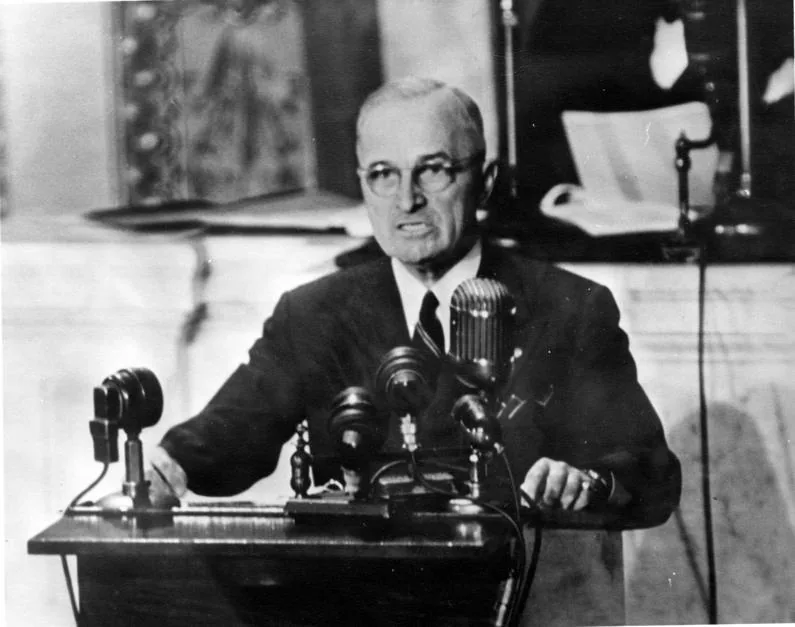
Source: Harry S. Truman Library and Museum, March 12, 1947 (image on Wikimedia Commons).
Commentary. Truman described the world as divided between two ways of life, a free one and one based on terror and oppression, and pledged American support for “free peoples” who were resisting subjugation. The language was broad, and it went further than Greece and Turkey: the Truman Doctrine committed the United States to oppose communist expansion anywhere. Some critics said it was too sweeping; supporters said that Americans needed a strong message to win Congress.
Truman also saw that poverty and hunger in Western Europe, which had been wrecked by the war, would help communist parties. On June 5, 1947, Secretary of State George C. Marshall, speaking at Harvard, proposed an American program of economic aid.
Document 3 – The Marshall Plan speech
Our policy is directed not against any country or doctrine but against hunger, poverty, desperation, and chaos. Its purpose should be the revival of a working economy in the world so as to permit the emergence of political and social conditions in which free institutions can exist. Such assistance, I am convinced, must not be on a piecemeal basis, as various crises develop. Any assistance that this Government may render in the future should provide a cure rather than a mere palliative. Any government that is willing to assist in the task of recovery will find full cooperation, I am sure, on the part of the United States Government.
Source: George C. Marshall, address at Harvard University, June 5, 1947 (the Marshall Plan speech); text from Wikisource.
*palliative: something that relieves without curing. *doctrine: set of beliefs.
The European Recovery Program, known as the Marshall Plan, provided about $13.3 billion to 17 countries of Western Europe between 1948 and 1951. The aid was offered to the Soviet bloc as well, but Stalin refused it and forced the countries of Eastern Europe to refuse. The Marshall Plan restored production, reduced the appeal of communism, and tied Western Europe to the United States. In 1948, a coup in Czechoslovakia brought the communists to power, an event that alarmed Western leaders.
Berlin, NATO, and the division of Germany
Germany had been divided into four occupation zones, and so had Berlin. In June 1948, after the Western powers introduced a new currency in their zones, Stalin blockaded West Berlin. The United States and Britain answered with the Berlin Airlift. By its end, the American and British air forces had delivered more than two million tons of supplies, nearly two-thirds of it coal, on about 278,000 flights. Stalin lifted the blockade on May 12, 1949, although the airlift continued until September. In May 1949, the three Western zones became the Federal Republic of Germany (West Germany), and in October the Soviet zone became the German Democratic Republic (East Germany).
Document 4 – The Berlin Airlift
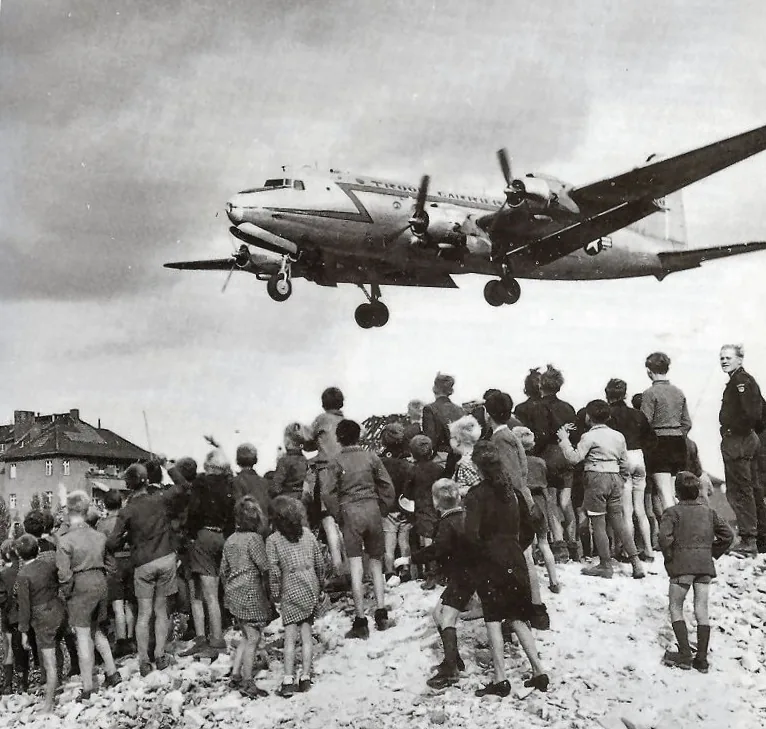
Source: Henry Ries, U.S. Air Force, 1948-49 (image on Wikimedia Commons).
Commentary. A plane arrives over the Tempelhof district of Berlin, where a crowd of children stands in the rubble left by the war. Planes landed at intervals of only a few minutes. The airlift showed that the United States would defend its position in Europe and turned former enemies into partners in the eyes of many Germans.
In April 1949, the United States, Canada, and ten Western European nations formed the North Atlantic Treaty Organization (NATO), a military alliance in which an attack on one would be considered an attack on all. It was the first peacetime military alliance the United States had joined outside the Western Hemisphere since 1778. In 1955, when West Germany joined NATO, the Soviet Union and its allies formed the Warsaw Pact.
Two shocks in 1949 raised the stakes. In August the Soviet Union tested its first atomic bomb, years sooner than the American government expected. Then, in October, the Communist Party under Mao Zedong won the civil war in China. In 1950, a National Security Council study called NSC-68 recommended a large increase in military spending, and Truman accepted its main ideas after the Korean War began.
2. A hot war in a Cold War: Korea and the 1950s
After World War II, Korea had been divided at the 38th parallel into a Soviet-occupied north and an American-occupied south. On June 25, 1950, North Korean forces, backed by Stalin and Mao, invaded South Korea. Truman, citing the lessons of the 1930s, sent American troops under a United Nations resolution, without asking Congress for a declaration of war.
General Douglas MacArthur’s landing at Inchon in September drove the North Koreans back, and the UN forces advanced toward the Chinese border. In November 1950, hundreds of thousands of Chinese troops entered the war, and the fighting settled near the 38th parallel. When MacArthur publicly demanded an expansion of the war, Truman fired him in April 1951. An armistice signed on July 27, 1953, left Korea divided. About 33,739 Americans died in battle, and 2,835 more died of other causes.
Definition: proxy war
A war in which two rival powers support opposing sides in a conflict in another country rather than fighting each other directly. Korea and, later, Vietnam were seen as proxy wars of the Cold War.
Eisenhower and the New Look
President Dwight D. Eisenhower, elected in 1952, ended the Korean fighting and continued containment at a lower cost. His “New Look” relied on nuclear weapons and air power instead of large ground armies, and on the threat of “massive retaliation.” The United States tested a hydrogen bomb in 1952, and the Soviet Union followed in 1953. The Central Intelligence Agency, created in 1947, carried out covert operations that helped to overthrow the governments of Iran in 1953 and Guatemala in 1954. In 1956, the United States did not intervene when Soviet tanks crushed a revolution in Hungary.
On October 4, 1957, the Soviet Union launched Sputnik, the first artificial satellite. Many Americans feared that the Soviets were ahead in science and in missile technology. Congress created NASA in 1958, and passed the National Defense Education Act to fund science, math, and foreign language teaching. The “space race” became another arena of the Cold War.
Document 5 – Sputnik
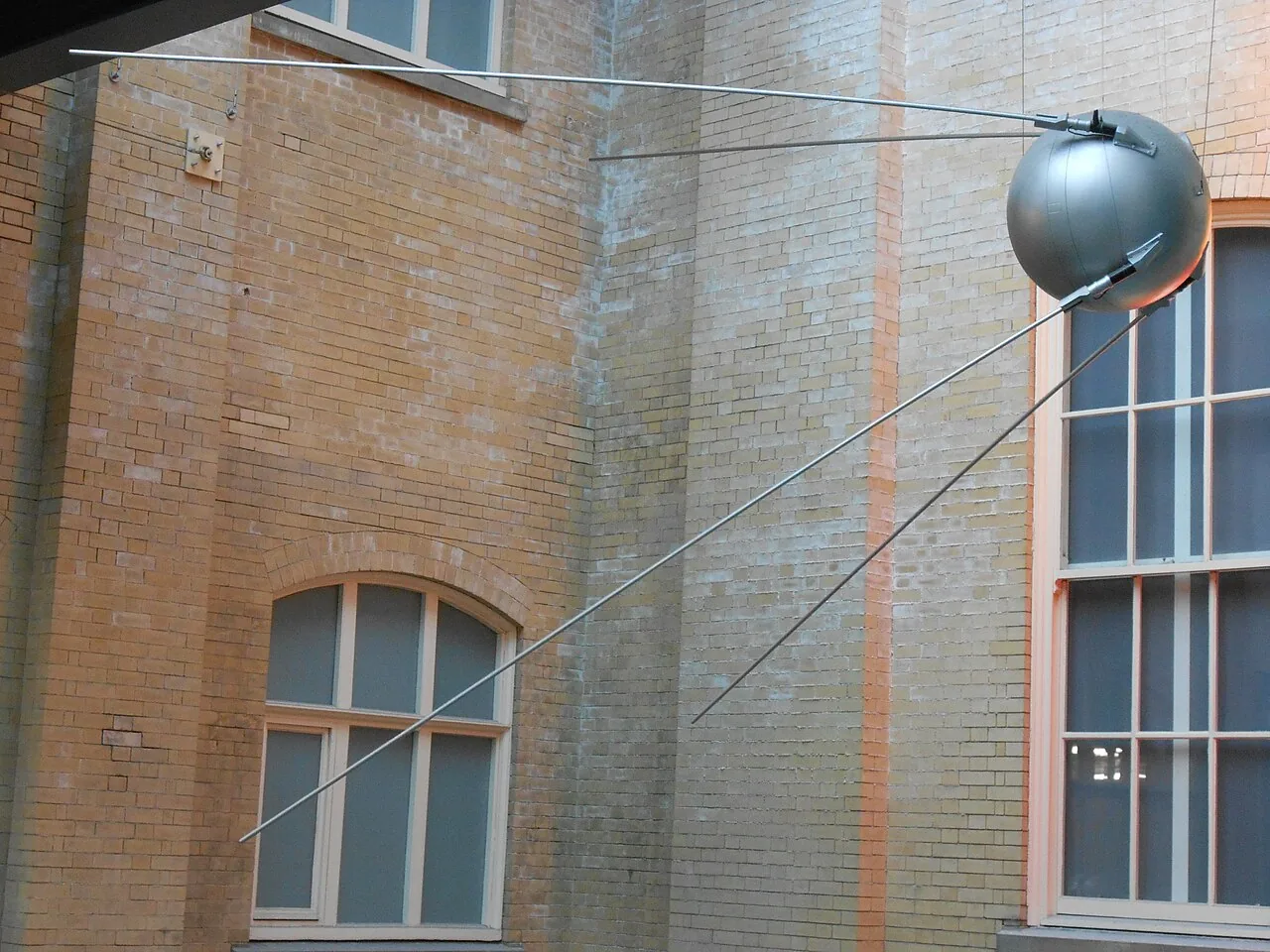
Source: replica of Sputnik 1, World Museum Liverpool, photograph by Rept0n1x (image on Wikimedia Commons).
Commentary. The original satellite was a metal sphere about the size of a beach ball. Its radio beeps could be heard around the world. For many Americans it meant that Soviet rockets might reach the United States, and it started a national debate about schools and science.
Document 6 – Eisenhower’s warning
Until the latest of our world conflicts, the United States had no armaments industry. American makers of plowshares could, with time and as required, make swords as well. But now we can no longer risk emergency improvisation of national defense; we have been compelled to create a permanent armaments industry of vast proportions. Added to this, three and a half million men and women are directly engaged in the defense establishment. We annually spend on military security more than the net income of all United States corporations. This conjunction of an immense military establishment and a large arms industry is new in the American experience.
Source: Dwight D. Eisenhower, Farewell Radio and Television Address to the American People, January 17, 1961; text from the Avalon Project, Yale Law School.
*armaments: weapons. *establishment: large organization.
Commentary. In his farewell address, Eisenhower, a former general, warned about the growing power of what he called the “military-industrial complex,” the alliance of the armed forces and the arms industry. He stressed that this was a new situation in American history and said that only an alert citizenry could keep it in check.
3. The Cold War at home
The Second Red Scare
Fear of communism at home followed the fear abroad. After the war, strikes, the Soviet atomic bomb, the Chinese revolution, and spy cases fed the belief that communists had infiltrated the government. A Red Scare had occurred after World War I, and this was the second. In March 1947, Truman created a loyalty program for federal employees.
The House Un-American Activities Committee (HUAC) investigated alleged communists in Hollywood, and the “Hollywood Ten” who refused to testify in 1947 were jailed and blacklisted. In 1948, a former communist, Whittaker Chambers, accused the former State Department official Alger Hiss, who was convicted of perjury in 1950. In 1951, Julius and Ethel Rosenberg were convicted of conspiracy to commit espionage for passing atomic secrets to the Soviet Union, and they were executed in 1953.
Definition: Red Scare
A period of intense public fear of communists and radicals. The first Red Scare followed World War I (1919-1920); the second, in the late 1940s and 1950s, led to loyalty programs, blacklists, and congressional investigations.
Definition: blacklist
A secret list of people whom employers refuse to hire because of their real or supposed political views. In the 1950s, many actors, writers, and teachers were blacklisted as suspected communists.
Document 7 – The loyalty program
There shall be a loyalty investigation of every person entering the civilian employment of any department or agency of the executive branch of the Federal Government. Investigations of persons entering the competitive service shall be conducted by the Civil Service Commission, except in such cases as are covered by a special agreement between the Commission and any given department or agency. Investigations of persons other than those entering the competitive service shall be conducted by the employing department or agency. Departments and agencies without investigative organizations shall utilize the investigative facilities of the Civil Service Commission.
Source: Harry S. Truman, Executive Order 9835, Prescribing Procedures for the Administration of an Employees Loyalty Program, March 21, 1947, Part I; text from the American Presidency Project.
*competitive service: civil service positions filled by examination. *investigative: for investigating.
Commentary. The order required a loyalty investigation of every federal employee. The standard for dismissal eventually included “reasonable grounds” to doubt a person’s loyalty, and employees often did not know the evidence against them. Truman, who was accused of being soft on communism, used the order to protect himself politically. Civil libertarians argued that it threatened rights of speech and association.
McCarthyism
On February 9, 1950, Senator Joseph McCarthy of Wisconsin claimed in a speech at Wheeling, West Virginia, that communists had infiltrated the State Department. He never proved his claims, but they caught the public’s attention. For four years, McCarthy made accusations without evidence against officials, writers, and generals. The word McCarthyism came to mean a reckless attack on a person’s loyalty without proof. Many Americans lost their jobs, were blacklisted, or had their careers ruined.
Document 8 – A Senator’s protest
I speak as a Republican, I speak as a woman. I speak as a United States Senator. I speak as an American. The United States Senate has long enjoyed worldwide respect as the greatest deliberative body in the world. But recently that deliberative character has too often been debased to the level of a forum of hate and character assassination sheltered by the shield of congressional immunity.
Source: Senator Margaret Chase Smith, Declaration of Conscience, speech in the U.S. Senate, June 1, 1950; text from Wikisource.
*deliberative: carefully debating. *immunity: protection from prosecution.
Commentary. Margaret Chase Smith, a Republican from Maine and the only woman in the Senate, was among the first senators to speak against McCarthy. Six other Republican senators signed her statement. She did not name McCarthy at first, but she criticized the methods of “hate and character assassination” used under the protection of congressional immunity.
Document 9 – McCarthy and Cohn
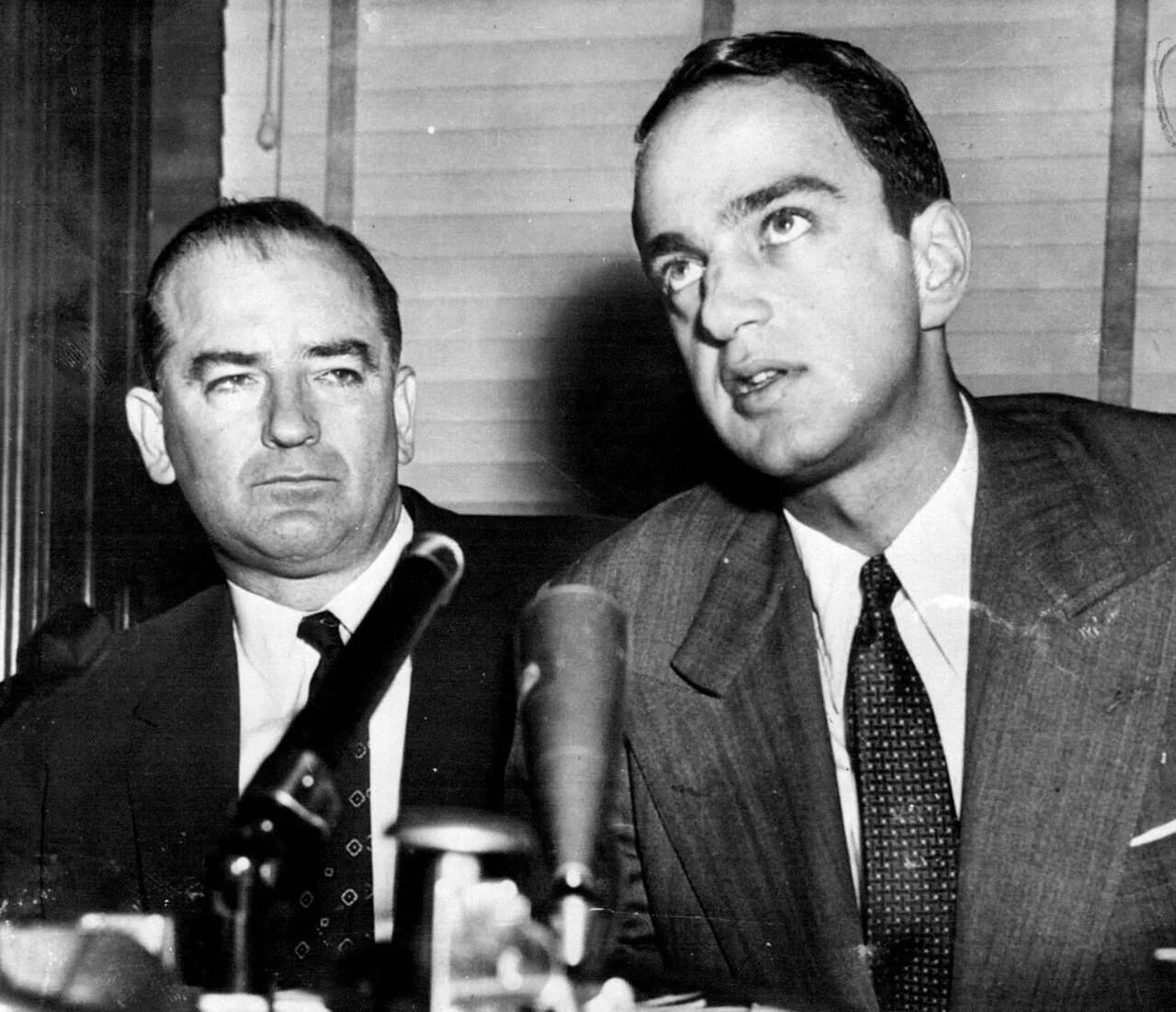
Source: Associated Press wirephoto, March 12, 1954 (image on Wikimedia Commons).
Commentary. McCarthy’s fall came in 1954, when he accused the Army of harboring communists. The Army-McCarthy hearings were televised. Viewers saw the senator’s bullying methods, and the Army’s lawyer, Joseph Welch, asked him, “Have you no sense of decency?” In December 1954, the Senate voted to censure him.
Life in the atomic age
The Cold War shaped daily life. Schoolchildren practiced “duck and cover” drills; some families built fallout shelters; the government set up Civil Defense. At the same time, postwar prosperity produced a boom in suburban housing, such as Levittown, helped by the GI Bill, the baby boom, cheap cars, and the Interstate Highway Act of 1956, which Eisenhower justified partly as a defense measure. Television spread into most homes. Many Americans enjoyed a rising standard of living, but this prosperity was not equally shared by Black families, who were often shut out of the new suburbs.
4. The brink of nuclear war, 1961-1963
In April 1961, the new president, John F. Kennedy, approved an invasion of Cuba by Cuban exiles trained by the CIA, to overthrow Fidel Castro, who had come to power in 1959 and allied with the Soviet Union. The invasion at the Bay of Pigs failed in three days. In June, Kennedy met Khrushchev in Vienna in a tense summit. In August 1961, East Germany, to stop the flow of its citizens to the West, built a wall dividing Berlin.
Document 10 – The Berlin Wall
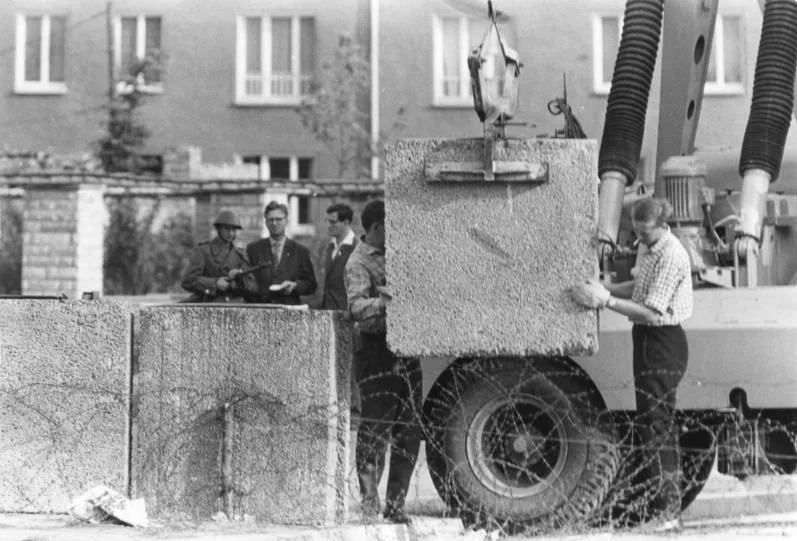
Source: Helmut J. Wolf, Bundesarchiv, 1961 (image on Wikimedia Commons).
Commentary. The wall began as barbed wire on August 13, 1961, and was later rebuilt in concrete. It ended the flow of refugees, who had numbered in the millions since 1945, and became the symbol of the division of Europe. It stood until November 9, 1989.
On October 14, 1962, an American U-2 spy plane photographed Soviet missile sites under construction in Cuba. Kennedy and his advisers spent a week debating a response, which included an air strike or an invasion, and decided on a naval “quarantine” of Cuba. On October 22, he told the nation.
Document 11 – Kennedy’s address on Cuba
Good evening, my fellow citizens: This Government, as promised, has maintained the closest surveillance of the Soviet military buildup on the island of Cuba. Within the past week, unmistakable evidence has established the fact that a series of offensive missile sites is now in preparation on that imprisoned island. The purpose of these bases can be none other than to provide a nuclear strike capability against the Western Hemisphere. Upon receiving the first preliminary hard information of this nature last Tuesday morning at 9 a.m., I directed that our surveillance be stepped up. And having now confirmed and completed our evaluation of the evidence and our decision on a course of action, this Government feels obliged to report this new crisis to you in fullest detail.
Source: John F. Kennedy, radio and television report to the American people on the Soviet arms buildup in Cuba, October 22, 1962 (opening); text from the American Presidency Project.
*surveillance: close watching. *Western Hemisphere: North and South America.
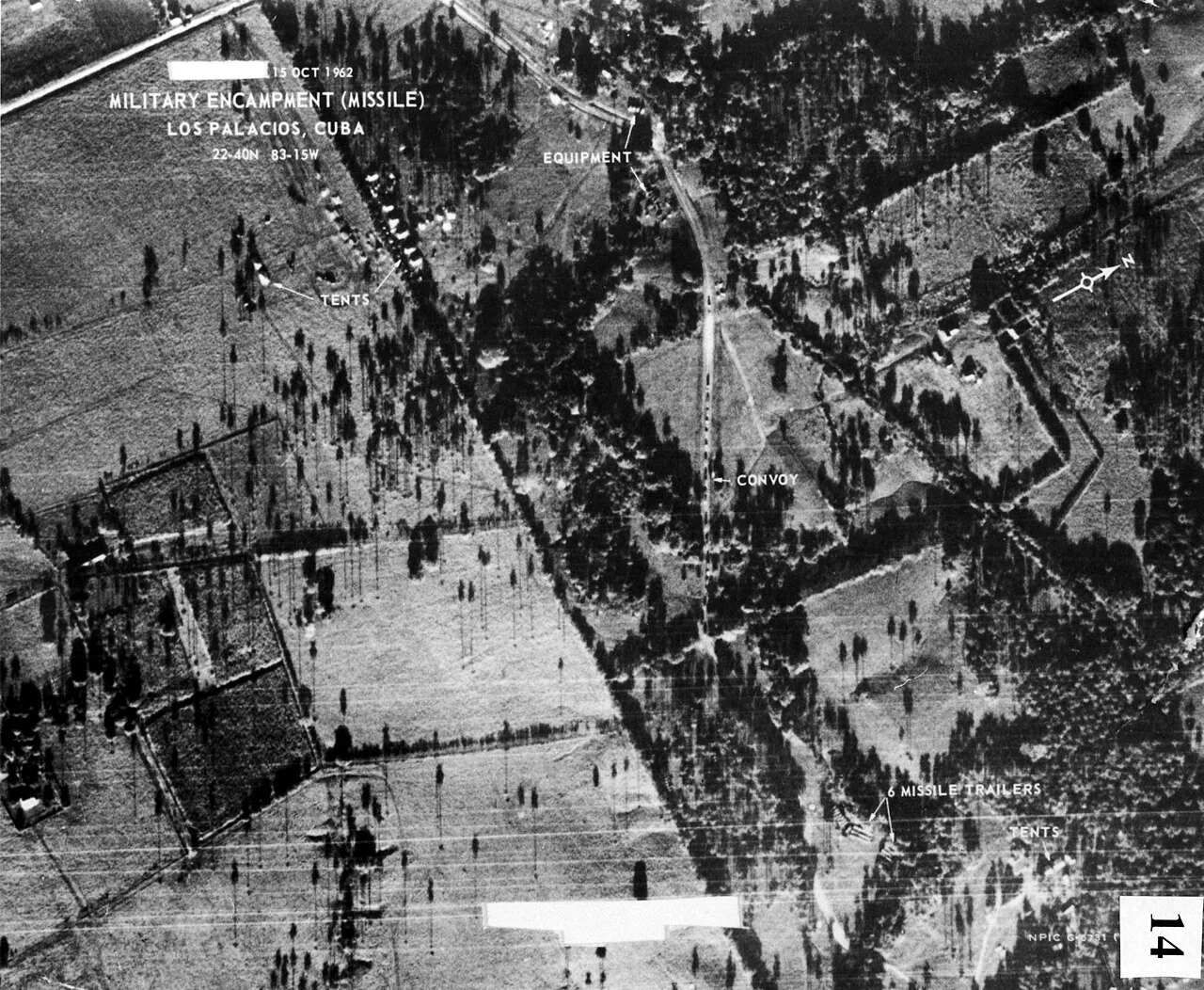
Source: U.S. Air Force, U-2 reconnaissance photograph, October 1962 (image on Wikimedia Commons).
Commentary. Kennedy explained the evidence and announced the quarantine. After several tense days, on October 28, Khrushchev agreed to remove the missiles. In exchange, the United States publicly promised not to invade Cuba and, in a secret understanding, agreed to remove its own missiles from Turkey. The crisis, often called the closest the world has come to nuclear war, lasted thirteen days.
After the crisis
The crisis led to changes: a “hot line” between Washington and Moscow was set up in 1963, and in August 1963 the two powers and Britain signed a Limited Test Ban Treaty banning nuclear tests in the atmosphere, in space, and under water. But the arms race continued, and Americans soon turned their attention to a new place of conflict: Vietnam. The Cold War lasted until the collapse of the Soviet Union in 1991.
- 1946 Kennan’s Long Telegram; Churchill’s Iron Curtain speech
- 1947 Truman Doctrine; Marshall Plan speech; loyalty program
- 1948-49 Berlin blockade and airlift
- 1949 NATO founded; Soviet atomic bomb; Communist victory in China
- 1950-53 Korean War
- 1954 Army-McCarthy hearings; McCarthy censured
- 1957 Sputnik launched
- 1961 Bay of Pigs; Berlin Wall built
- 1962 Cuban Missile Crisis, Oct. 16-28
- 1963 Hot line; Limited Test Ban Treaty
Key takeaways
- The Cold War was a rivalry between the United States and the Soviet Union, fought by alliances, aid, an arms race, covert action, and proxy wars.
- Containment, outlined by Kennan, led to the Truman Doctrine, the Marshall Plan (about $13.3 billion to 17 countries), NATO, and the Berlin Airlift.
- The Korean War (1950-1953) showed the limits of containment and left Korea divided; Eisenhower relied on nuclear deterrence and covert action.
- At home, the Second Red Scare brought loyalty programs, blacklists, and McCarthyism, but also resistance from some senators and a backlash against McCarthy.
- The Berlin Wall (1961) and the Cuban Missile Crisis (1962) brought the superpowers to the brink of war and led to arms control.

Quick review: flashcards
Tap a card to see the answer.