


This worksheet on The Cold War at Home and Abroad belongs to the US History Grade 11 course. Its questions use primary sources, maps and timelines, and they move from basic recall to short writing tasks. Before you start, review the lesson; afterward, try the true or false quiz.
Exercise 1 : Vocabulary of the Cold War
Match each term with its definition, then use each term in a sentence.
- Containment
- NATO
- Proxy war
- McCarthyism
- Arms race
- Blacklist
Definitions: (a) a war in which rival powers back opposing sides in another country; (b) a competition to build more or better weapons; (c) a list of people refused work because of their supposed political views; (d) the policy of stopping communism from spreading; (e) a Western military alliance founded in 1949; (f) reckless accusations of disloyalty without proof.
Exercise 2 : Kennan on Soviet behavior
Document 1 – The Long Telegram, 1946
At bottom of Kremlin’s neurotic view of world affairs is traditional and instinctive Russian sense of insecurity. Originally, this was insecurity of a peaceful agricultural people trying to live on vast exposed plain in neighborhood of fierce nomadic peoples. To this was added, as Russia came into contact with economically advanced West, fear of more competent, more powerful, more highly organized societies in that area. But this latter type of insecurity was one which afflicted rather Russian rulers than Russian people; for Russian rulers have invariably sensed that their rule was relatively archaic in form fragile and artificial in its psychological foundation, unable to stand comparison or contact with political systems of Western countries.
Source: George F. Kennan, telegram from the American Embassy in Moscow to the Secretary of State (the “Long Telegram”), February 22, 1946, part 1; text from Wikisource.
*Kremlin: the Soviet government. *archaic: old-fashioned.
- Present the document (nature, author, date, audience).
- According to Kennan, what lies at the “bottom” of the Kremlin’s view of the world?
- What does he say about the Soviet rulers’ fear of contact with the West?
- What policy toward the Soviet Union does this analysis suggest?
Exercise 3 : Two ways of life
Document 2 – Truman, March 12, 1947
At the present moment in world history nearly every nation must choose between alternative ways of life. The choice is too often not a free one. One way of life is based upon the will of the majority, and is distinguished by free institutions, representative government, free elections, guarantees of individual liberty, freedom of speech and religion, and freedom from political oppression. The second way of life is based upon the will of a minority forcibly imposed upon the majority. It relies upon terror and oppression, a controlled press and radio; fixed elections, and the suppression of personal freedoms.
Source: Harry S. Truman, address before a joint session of Congress on Greece and Turkey (the Truman Doctrine), March 12, 1947; text from the Avalon Project, Yale Law School.
*subjugation: conquest. *coercion: force.
- Present the document (nature, author, date, context).
- Describe the two ways of life as Truman presents them.
- What policy does he propose?
- What might be a weakness of describing the world in two camps?
Exercise 4 : Help for free peoples
Document 3 – Truman, policy statement, 1947
I believe that it must be the policy of the United States to support free peoples who are resisting attempted subjugation by armed minorities or by outside pressures. I believe that we must assist free peoples to work out their own destinies in their own way. I believe that our help should be primarily through economic and financial aid which is essential to economic stability and orderly political processes. The world is not static, and the status quo is not sacred.
Source: Harry S. Truman, address before a joint session of Congress, March 12, 1947 (policy statement); text from the Avalon Project, Yale Law School.
*subjugation: conquest. *status quo: the existing situation.
- Present the document (nature, author, date).
- What kind of help does Truman say is most important?
- What does he mean by “the status quo is not sacred”?
- Explain how this idea became the basis of the Marshall Plan.
Exercise 5 : The case for aid to Europe
Document 4 – Marshall, June 5, 1947
The truth of the matter is that Europe’s requirements for the next three or four years of foreign food and other essential products — principally from America — are so much greater than her present ability to pay that she must have substantial additional help or face economic, social, and political deterioration of a very grave character. The remedy seems to lie in breaking the vicious circle and restoring the confidence of the people of Europe in the economic future of their own countries and of Europe as a whole. The manufacturer and the farmer throughout wide areas must be able and willing to exchange their product for currencies, the continuing value of which is not open to question.
Source: George C. Marshall, address at Harvard University, June 5, 1947 (description of Europe’s needs); text from Wikisource.
*deterioration: decline. *currencies: the money of different countries.
- Present the document (nature, author, date, place).
- What does Marshall say Europe needs and why?
- What does he mean by “breaking the vicious circle”?
- Why did he address this speech to a university audience?
Exercise 6 : Against hunger, not against a country
Document 5 – Marshall, June 5, 1947
Our policy is directed not against any country or doctrine but against hunger, poverty, desperation, and chaos. Its purpose should be the revival of a working economy in the world so as to permit the emergence of political and social conditions in which free institutions can exist. Such assistance, I am convinced, must not be on a piecemeal basis, as various crises develop. Any assistance that this Government may render in the future should provide a cure rather than a mere palliative. Any government that is willing to assist in the task of recovery will find full cooperation, I am sure, on the part of the United States Government.
Source: George C. Marshall, address at Harvard University, June 5, 1947 (the Marshall Plan speech); text from Wikisource.
*palliative: something that relieves without curing.
- Present the document (nature, author, date).
- Against what is the American policy directed?
- What does Marshall say should be the purpose of aid?
- Compare this wording with Truman’s speech three months earlier. What difference do you see in tone?
Exercise 7 : The danger within
Document 6 – Eisenhower, January 17, 1961
Until the latest of our world conflicts, the United States had no armaments industry. American makers of plowshares could, with time and as required, make swords as well. But now we can no longer risk emergency improvisation of national defense; we have been compelled to create a permanent armaments industry of vast proportions. Added to this, three and a half million men and women are directly engaged in the defense establishment. We annually spend on military security more than the net income of all United States corporations. This conjunction of an immense military establishment and a large arms industry is new in the American experience.
Source: Dwight D. Eisenhower, Farewell Radio and Television Address to the American People, January 17, 1961; text from the Avalon Project, Yale Law School.
*armaments: weapons. *establishment: large organization.
- Present the document (nature, author, date).
- What new situation does Eisenhower describe?
- Why is his warning surprising, given his career?
- Do you think the warning is still relevant? Defend your view.
Exercise 8 : Loyalty investigations
Document 7 – Executive Order 9835, 1947
There shall be a loyalty investigation of every person entering the civilian employment of any department or agency of the executive branch of the Federal Government. Investigations of persons entering the competitive service shall be conducted by the Civil Service Commission, except in such cases as are covered by a special agreement between the Commission and any given department or agency. Investigations of persons other than those entering the competitive service shall be conducted by the employing department or agency. Departments and agencies without investigative organizations shall utilize the investigative facilities of the Civil Service Commission.
Source: Harry S. Truman, Executive Order 9835, Prescribing Procedures for the Administration of an Employees Loyalty Program, March 21, 1947, Part I; text from the American Presidency Project.
*competitive service: civil service positions filled by examination.
- Present the document (nature, author, date).
- Whom must the government investigate?
- Who does the investigating?
- What rights might a person under investigation lose?
Exercise 9 : A Declaration of Conscience
Document 8 – Margaret Chase Smith, June 1, 1950
I speak as a Republican, I speak as a woman. I speak as a United States Senator. I speak as an American. The United States Senate has long enjoyed worldwide respect as the greatest deliberative body in the world. But recently that deliberative character has too often been debased to the level of a forum of hate and character assassination sheltered by the shield of congressional immunity.
Source: Senator Margaret Chase Smith, Declaration of Conscience, speech in the U.S. Senate, June 1, 1950; text from Wikisource.
*deliberative: carefully debating. *immunity: protection.
- Present the document (nature, author, date).
- List four ways in which she identifies herself.
- What does she say has happened to the Senate?
- Explain why she used the phrase “shield of congressional immunity.”
Exercise 10 : Kennedy tells the nation
Document 9 – Kennedy, October 22, 1962
Good evening, my fellow citizens: This Government, as promised, has maintained the closest surveillance of the Soviet military buildup on the island of Cuba. Within the past week, unmistakable evidence has established the fact that a series of offensive missile sites is now in preparation on that imprisoned island. The purpose of these bases can be none other than to provide a nuclear strike capability against the Western Hemisphere. Upon receiving the first preliminary hard information of this nature last Tuesday morning at 9 a.m., I directed that our surveillance be stepped up. And having now confirmed and completed our evaluation of the evidence and our decision on a course of action, this Government feels obliged to report this new crisis to you in fullest detail.
Source: John F. Kennedy, radio and television report to the American people on the Soviet arms buildup in Cuba, October 22, 1962 (opening); text from the American Presidency Project.
*surveillance: close watching. *Western Hemisphere: the Americas.
- Present the document (nature, author, date, audience).
- What has the government discovered?
- What is the purpose of the sites, according to Kennedy?
- Why does the president explain the evidence at length?
Exercise 11 : Doctrine and plan
Document 10 – The Truman Doctrine, 1947
I believe that it must be the policy of the United States to support free peoples who are resisting attempted subjugation by armed minorities or by outside pressures. I believe that we must assist free peoples to work out their own destinies in their own way. I believe that our help should be primarily through economic and financial aid which is essential to economic stability and orderly political processes. The world is not static, and the status quo is not sacred.
Source: Harry S. Truman, address before a joint session of Congress, March 12, 1947 (policy statement); text from the Avalon Project, Yale Law School.
*status quo: the existing situation.
Document 11 – The Marshall Plan speech, 1947
Our policy is directed not against any country or doctrine but against hunger, poverty, desperation, and chaos. Its purpose should be the revival of a working economy in the world so as to permit the emergence of political and social conditions in which free institutions can exist. Such assistance, I am convinced, must not be on a piecemeal basis, as various crises develop. Any assistance that this Government may render in the future should provide a cure rather than a mere palliative. Any government that is willing to assist in the task of recovery will find full cooperation, I am sure, on the part of the United States Government.
Source: George C. Marshall, address at Harvard University, June 5, 1947 (the Marshall Plan speech); text from Wikisource.
*palliative: something that relieves without curing.
- Present each document (author, date).
- What do both speeches have in common?
- How do their tones differ?
- Why did the Soviet Union treat the Marshall Plan as a threat even though it was offered to all?
Exercise 12 : Understanding the enemy
Document 12 – Kennan, 1946
At bottom of Kremlin’s neurotic view of world affairs is traditional and instinctive Russian sense of insecurity. Originally, this was insecurity of a peaceful agricultural people trying to live on vast exposed plain in neighborhood of fierce nomadic peoples. To this was added, as Russia came into contact with economically advanced West, fear of more competent, more powerful, more highly organized societies in that area. But this latter type of insecurity was one which afflicted rather Russian rulers than Russian people; for Russian rulers have invariably sensed that their rule was relatively archaic in form fragile and artificial in its psychological foundation, unable to stand comparison or contact with political systems of Western countries.
Source: George F. Kennan, telegram from the American Embassy in Moscow to the Secretary of State (the “Long Telegram”), February 22, 1946, part 1; text from Wikisource.
*Kremlin: the Soviet government.
Document 13 – Kennedy, 1962
Good evening, my fellow citizens: This Government, as promised, has maintained the closest surveillance of the Soviet military buildup on the island of Cuba. Within the past week, unmistakable evidence has established the fact that a series of offensive missile sites is now in preparation on that imprisoned island. The purpose of these bases can be none other than to provide a nuclear strike capability against the Western Hemisphere. Upon receiving the first preliminary hard information of this nature last Tuesday morning at 9 a.m., I directed that our surveillance be stepped up. And having now confirmed and completed our evaluation of the evidence and our decision on a course of action, this Government feels obliged to report this new crisis to you in fullest detail.
Source: John F. Kennedy, radio and television report to the American people on the Soviet arms buildup in Cuba, October 22, 1962 (opening); text from the American Presidency Project.
*surveillance: close watching.
- Present each document (author, date, purpose).
- How does each document describe the Soviet Union’s intentions?
- What kind of American response does each suggest?
- Explain how the first document helps to explain the second.
Exercise 13 : The airlift
Document 14 – The Berlin Airlift, 1948-49
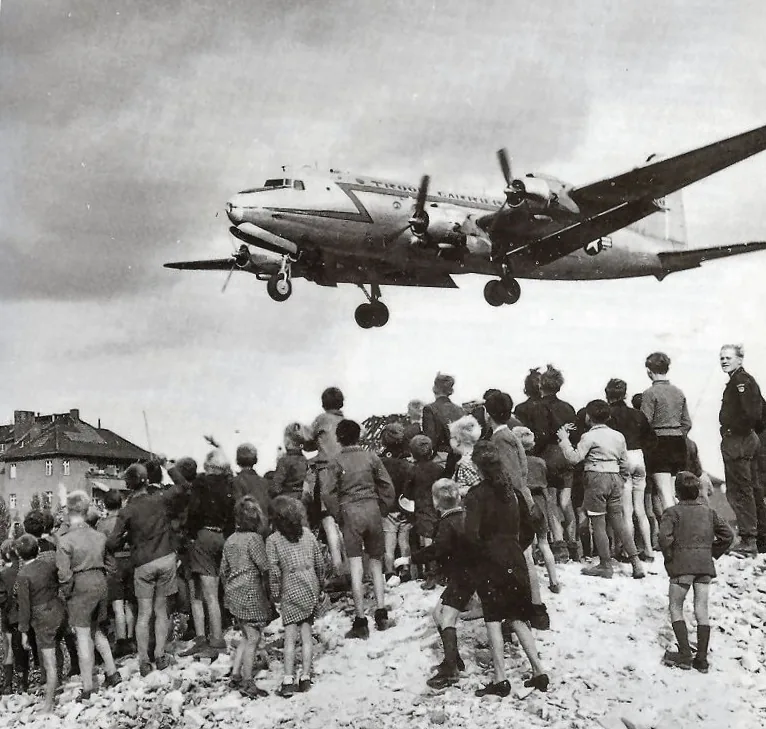
Source: Henry Ries, U.S. Air Force.
- Present the document (nature, photographer, date, place).
- Describe the plane, the children, and the ground.
- What does the photograph tell you about conditions in Berlin?
- Why did Stalin’s blockade fail?
Exercise 14 : A speech to Congress
Document 15 – Truman addresses Congress, 1947
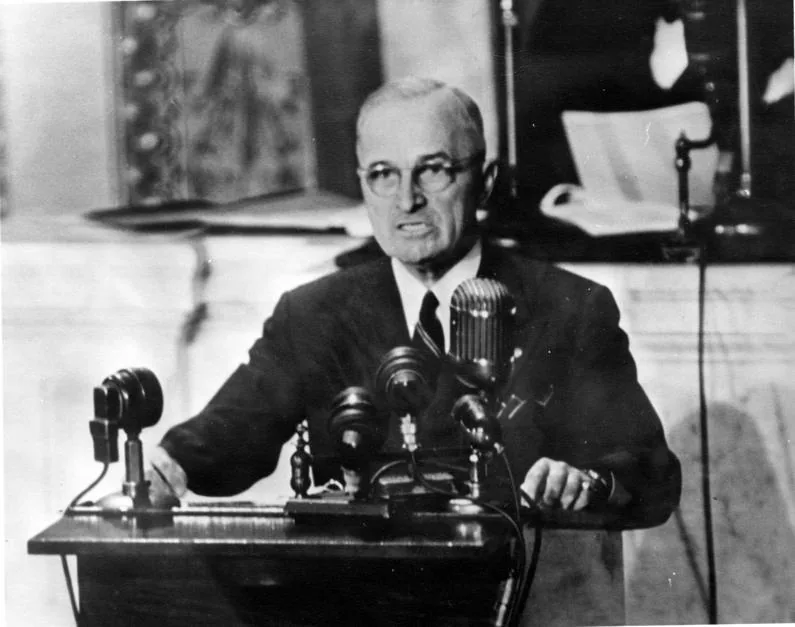
Source: Harry S. Truman Library and Museum, March 12, 1947.
- Present the document (nature, source, date).
- Describe the setting and what you see.
- What does the number of microphones suggest about the audience?
- Explain why the speech marks a turning point in American foreign policy.
Exercise 15 : Two men at a press conference
Document 16 – McCarthy and Cohn, 1954
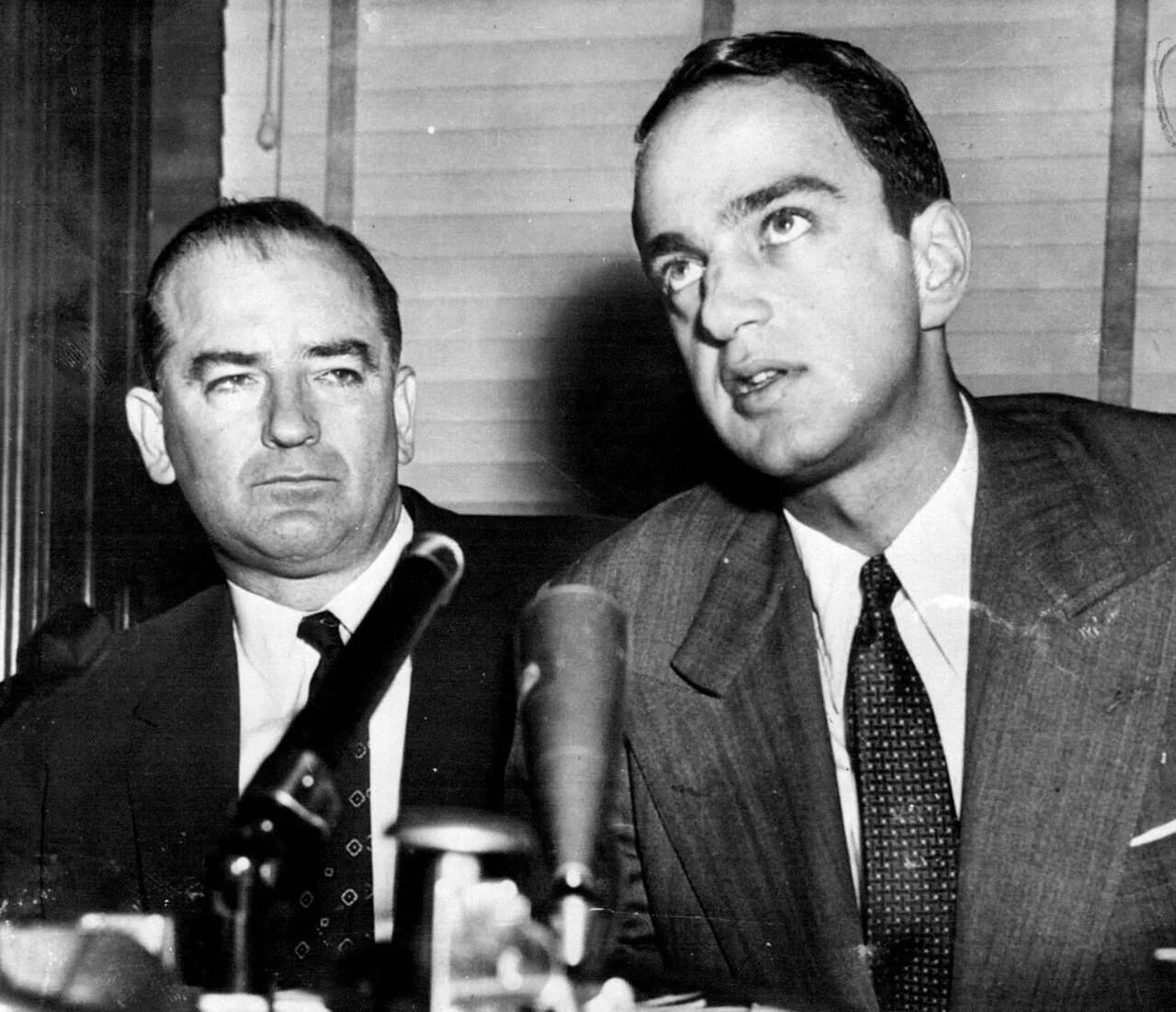
Source: Associated Press wirephoto, March 12, 1954.
- Present the document (nature, source, date).
- Describe the two men and what they are doing.
- The photograph is an official press picture. What can it show and what can it not show?
- Explain how television contributed to McCarthy’s loss of influence in 1954.
Exercise 16 : The Wall
Document 17 – Building the Berlin Wall, 1961
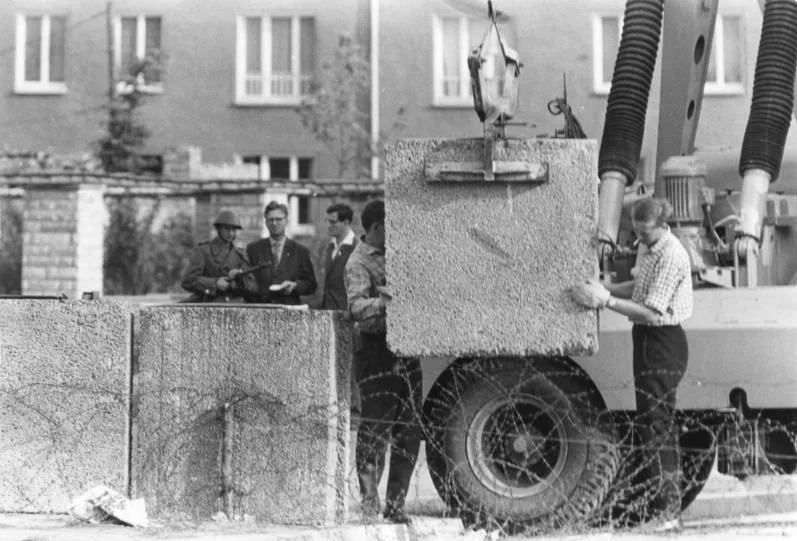
Source: Helmut J. Wolf, Bundesarchiv, 1961.
- Present the document (nature, photographer, date, place).
- Describe the materials and the people shown.
- Why did East Germany build the wall?
- What did it mean for the Cold War?
Exercise 17 : Spy plane evidence
Document 18 – A U-2 photograph, October 1962
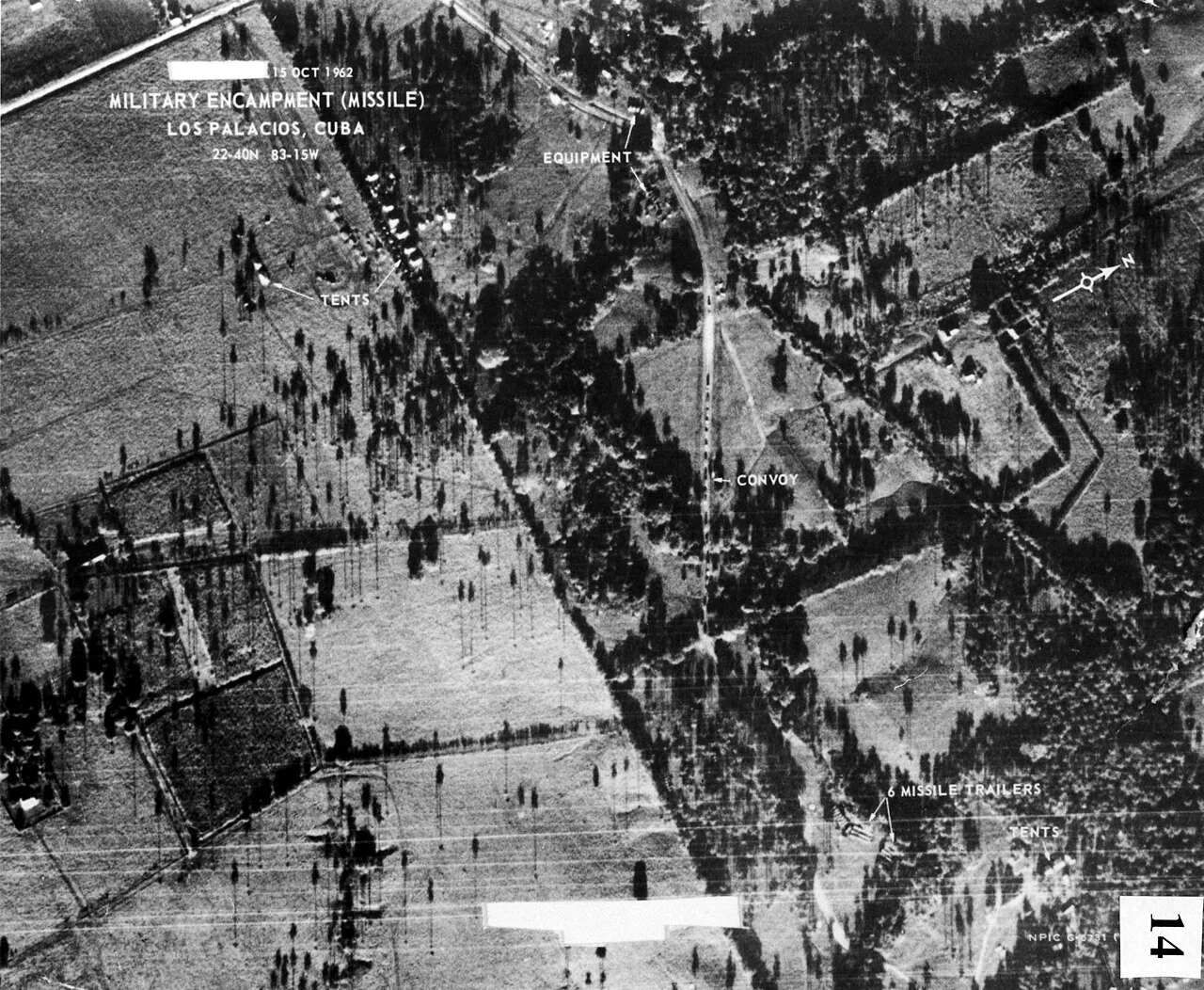
Source: U.S. Air Force, October 1962.
- Present the document (nature, source, date, place).
- Describe the features marked on the photograph.
- Why was photographic evidence so important to Kennedy?
- Explain one way in which the crisis was resolved.
Exercise 18 : Cold War by the numbers
| Measure | Figure |
|---|---|
| Marshall Plan aid to 17 European countries (1948-1951) | US$13.3 billion |
| Berlin Airlift: total delivered by American and British aircraft | 2,334,374 tons |
| Of which, delivered by the U.S. Air Force | 1,783,573 tons (76.4 percent) |
| Flights to Berlin | 278,228 |
| American battle deaths in the Korean War | 33,739 |
| American non-battle deaths in Korea | 2,835 |
Source: Wikipedia, “Marshall Plan,” “Berlin Blockade,” and “Korean War,” citing official and scholarly sources.
- Check the percentage given for the U.S. Air Force by calculation (to the nearest tenth of a percent), and say what share was carried by all other air forces.
- Calculate the average number of tons per flight (round to the nearest ton).
- Add the American deaths in Korea to find the total.
- Why do the figures show that the early Cold War was both an economic and a military struggle?
Exercise 19 : Map: Europe divided
- What color shows NATO members, and what color shows the Warsaw Pact?
- What does the dashed line represent?
- Name two cities in the Warsaw Pact area shown on the map.
- Why was Berlin unusual?
Exercise 20 : Locate the Cold War
- Identify the places: 1 divided German city; 2 capital of Poland; 3 capital of Hungary, site of a 1956 revolution; 4 capital of Czechoslovakia, site of a 1948 communist coup; 5 capital of the Soviet Union; 6 the Greek capital; 7 the capital of Turkey.
- Explain why the Truman Doctrine of 1947 concerned the countries of numbers 6 and 7.
Exercise 21 : Order the events
Put these events in order: (a) Berlin Wall built; (b) Korean War begins; (c) Marshall Plan speech; (d) Sputnik launched; (e) NATO founded; (f) Cuban Missile Crisis; (g) McCarthy censured by the Senate; (h) Long Telegram.
Exercise 22 : Durations
- How many years did the Korean War last (June 1950 to July 1953)?
- How many years passed between the Truman Doctrine and the Berlin Wall?
- How many days did the Cuban Missile Crisis last (October 16 to October 28, 1962, counting both days)?
- The Berlin Wall stood from 1961 to 1989. How many years was that?
Exercise 23 : Guided research: the Cold War at home
Use the Truman Library (trumanlibrary.gov), the Eisenhower Presidential Library (eisenhowerlibrary.gov), or the National Archives (archives.gov).
- Search for: civil defense duck and cover, Hollywood Ten, or Army-McCarthy hearings.
- Choose one document or film and fill in a card: title, creator, date, purpose, audience.
- Explain what it shows about fear of communism or of nuclear war.
- Explain one limit of the source.
Exercise 24 : CER paragraph: Marshall Plan or military power?
Write a paragraph with a Claim, Evidence, and Reasoning, answering the question: Was economic aid or military power more important in containing communism in Europe between 1947 and 1955? Use at least two pieces of evidence from the lesson.
Exercise 25 : SAQ: the Second Red Scare
Answer in complete sentences.
- Identify two events or developments of 1949-1950 that increased fear of communism.
- Explain how McCarthyism affected civil liberties.
- Describe how McCarthy lost his influence.
Exercise 26 : True or false? Justify
Decide whether each statement is true or false. If it is false, correct it.
- The Marshall Plan was offered only to Western Europe.
- The Berlin Airlift supplied West Berlin during the Soviet blockade.
- Congress declared war in the Korean War.
- Sputnik was launched by the United States.
- The Cuban Missile Crisis ended with the removal of Soviet missiles from Cuba.
Exercise 27 : Stimulus-based multiple choice
Stimulus
I believe that it must be the policy of the United States to support free peoples who are resisting attempted subjugation by armed minorities or by outside pressures. I believe that we must assist free peoples to work out their own destinies in their own way. I believe that our help should be primarily through economic and financial aid which is essential to economic stability and orderly political processes. The world is not static, and the status quo is not sacred.
Source: Harry S. Truman, address before a joint session of Congress, March 12, 1947 (policy statement); text from the Avalon Project, Yale Law School.
*subjugation: conquest. *status quo: the existing situation.
- This statement is most closely associated with which policy? (A) isolationism; (B) containment; (C) appeasement; (D) the New Deal.
- Which program was a direct result of this idea of economic aid? (A) the GI Bill; (B) the Marshall Plan; (C) the Wagner Act; (D) the Lend-Lease Act.
- Which criticism of the statement did some historians make? (A) it neglected military needs; (B) it promised too little to Europe; (C) it could commit the United States to opposing communism everywhere; (D) it ignored Greece.


Quick review: flashcards
Tap a card to see the answer.