


This worksheet on The United States in World War II belongs to the US History Grade 11 course. Its questions use primary sources, maps and timelines, and they move from basic recall to short writing tasks. Before you start, review the lesson; afterward, try the true or false quiz.
Exercise 1 : Vocabulary of the war
Match each term with its definition, then use each term in a sentence.
- Isolationism
- Lend-Lease
- Home front
- Axis
- Island hopping
- GI Bill
Definitions: (a) the alliance of Germany, Italy, and Japan; (b) a policy of giving war supplies to countries fighting Germany; (c) the civilian side of the war effort; (d) a law that helped veterans pay for school and homes; (e) capturing some islands and bypassing others; (f) the belief that the country should stay out of foreign wars.
Exercise 2 : The Four Freedoms
Document 1 – Roosevelt, January 6, 1941
In the future days, which we seek to make secure, we look forward to a world founded upon four essential human freedoms. The first is freedom of speech and expression—everywhere in the world. The second is freedom of every person to worship God in his own way—everywhere in the world. The third is freedom from want—which, translated into world terms, means economic understandings which will secure to every nation a healthy peacetime life for its inhabitants-everywhere in the world. The fourth is freedom from fear—which, translated into world terms, means a world-wide reduction of armaments to such a point and in such a thorough fashion that no nation will be in a position to commit an act of physical aggression against any neighbor—anywhere in the world. That is no vision of a distant millennium.
Source: Franklin D. Roosevelt, annual message to Congress (State of the Union), January 6, 1941, the “Four Freedoms” passage; text from Wikisource.
*millennium: a thousand years.
- Present the document (nature, author, date, context).
- List the four freedoms.
- What does the phrase “everywhere in the world” show about Roosevelt’s aims?
- The United States was not yet at war. Why was this speech important?
Exercise 3 : The Atlantic Charter
Document 2 – The Atlantic Charter, 1941
First, their countries seek no aggrandizement, territorial or other; Second, they desire to see no territorial changes that do not accord with the freely expressed wishes of the peoples concerned; Third, they respect the right of all peoples to choose the form of government under which they will live; and they wish to see sovereign rights and self government restored to those who have been forcibly deprived of them;
Source: The Atlantic Charter, joint declaration of President Roosevelt and Prime Minister Churchill, August 14, 1941, first three points; text from the Avalon Project, Yale Law School.
*aggrandizement: increase of power or territory.
- Present the document (nature, authors, date, place).
- What do the two nations promise about territory?
- What right do they say peoples have?
- Why might colonial peoples have welcomed this statement?
Exercise 4 : Reading a declaration of war
Document 3 – Roosevelt, December 8, 1941
Yesterday, December 7th, 1941—a date which will live in infamy—the United States of America was suddenly and deliberately attacked by naval and air forces of the Empire of Japan. The United States was at peace with that nation, and, at the solicitation of Japan, was still in conversation with its Government and its Emperor looking toward the maintenance of peace in the Pacific. Indeed, one hour after Japanese air squadrons had commenced bombing in the American island of Oahu, the Japanese Ambassador to the United States and his colleague delivered to our Secretary of State a formal reply to a recent American message.
Source: Franklin D. Roosevelt, address to Congress asking for a declaration of war, December 8, 1941 (“Day of Infamy” speech), opening; text from Wikisource.
*infamy: shameful reputation. *solicitation: request.
- Present the document (nature, author, date, audience).
- What happened “yesterday,” according to the president?
- What does Roosevelt say about the state of relations between the two countries?
- Why was it useful for the president to stress these facts?
Exercise 5 : Resolve and victory
Document 4 – Roosevelt, December 8, 1941 (conclusion)
As Commander-in-Chief of the Army and Navy, I have directed that all measures be taken for our defense. But always will our whole nation remember the character of the onslaught against us. No matter how long it may take us to overcome this premeditated invasion, the American people in their righteous might will win through to absolute victory. I believe that I interpret the will of the Congress and of the people when I assert that we will not only defend ourselves to the uttermost but will make it very certain that this form of treachery shall never again endanger us. Hostilities exist.
Source: Franklin D. Roosevelt, address to Congress, December 8, 1941, closing passage; text from Wikisource.
*premeditated: planned in advance. *treachery: betrayal.
- Present the document (nature, author, date).
- What does the president promise?
- What does he ask Congress to do after this passage?
- Explain how the language prepares citizens for a long war.
Exercise 6 : Fair employment in 1941
Document 5 – Executive Order 8802, 1941
I do hereby reaffirm the policy of the United States that there shall be no discrimination in the employment of workers in defense industries or government because of race, creed, color, or national origin, and I do hereby declare that it is the duty of employers and of labor organizations, in furtherance of said policy and of this order, to provide for the full and equitable participation of all workers in defense industries, without discrimination because of race, creed, color, or national origin;
Source: Executive Order 8802, Prohibition of Discrimination in the Defense Industry, June 25, 1941; text from the National Archives.
*creed: religion. *equitable: fair.
- Present the document (nature, date, context).
- Whom does the order protect, and in which jobs?
- What does it not cover?
- Explain the role of A. Philip Randolph in the issuing of the order.
Exercise 7 : The order of February 1942
Document 6 – Executive Order 9066, 1942
I hereby authorize and direct the Secretary of War, and the Military Commanders whom he may from time to time designate, whenever he or any designated Commander deems such action necessary or desirable, to prescribe military areas in such places and of such extent as he or the appropriate Military Commander may determine, from which any or all persons may be excluded, and with respect to which, the right of any person to enter, remain in, or leave shall be subject to whatever restrictions the Secretary of War or the appropriate Military Commander may impose in his discretion.
Source: Executive Order 9066, February 19, 1942, authorizing military areas; text from the National Archives.
*prescribe: set out. *discretion: freedom to decide.
- Present the document (nature, date, author).
- Which officials receive power, and what power?
- Does the order name a group of people? What does that tell you?
- How was it actually applied?
Compare the wording of the order with the way it was carried out.
Exercise 8 : Truman on the atomic bomb
Document 7 – Truman, August 6, 1945
It is an atomic bomb. It is a harnessing of the basic power of the universe. The force from which the sun draws its power has been loosed against those who brought war to the Far East. Before 1939, it was the accepted belief of scientists that it was theoretically possible to release atomic energy. But no one knew any practical method of doing it. By 1942, however, we knew that the Germans were working feverishly to find a way to add atomic energy to the other engines of war with which they hoped to enslave the world. But they failed.
Source: Harry S. Truman, Statement by the President Announcing the Use of the A-Bomb at Hiroshima, August 6, 1945; Harry S. Truman Library and Museum.
*harnessing: putting under control. *feverishly: with great haste.
- Present the document (nature, author, date).
- How does Truman describe the bomb?
- What does he say about Germany and the atomic bomb?
- What important facts does the statement not mention?
Exercise 9 : Order and judgment
Document 8 – Executive Order 9066, 1942
I hereby authorize and direct the Secretary of War, and the Military Commanders whom he may from time to time designate, whenever he or any designated Commander deems such action necessary or desirable, to prescribe military areas in such places and of such extent as he or the appropriate Military Commander may determine, from which any or all persons may be excluded, and with respect to which, the right of any person to enter, remain in, or leave shall be subject to whatever restrictions the Secretary of War or the appropriate Military Commander may impose in his discretion.
Source: Executive Order 9066, February 19, 1942, authorizing military areas; text from the National Archives.
*prescribe: set out.
Document 9 – Justice Black, Korematsu, 1944
Compulsory exclusion of large groups of citizens from their homes, except under circumstances of direst emergency and peril, is inconsistent with our basic governmental institutions. But when under conditions of modern warfare our shores are threatened by hostile forces, the power to protect must be commensurate with the threatened danger.
Source: Justice Hugo Black, opinion of the Court, Korematsu v. United States, 323 U.S. 214, December 18, 1944; text from the Legal Information Institute, Cornell Law School.
*commensurate: matching in degree. *exclusion: keeping out.
- Present each document (author, date, nature).
- What does the Court accept as the reason for the exclusion?
- Which phrases show the reasoning of the majority?
- What is missing from the justification? Think about who was removed.
Exercise 10 : Majority and dissent
Document 10 – Justice Black, 1944
Compulsory exclusion of large groups of citizens from their homes, except under circumstances of direst emergency and peril, is inconsistent with our basic governmental institutions. But when under conditions of modern warfare our shores are threatened by hostile forces, the power to protect must be commensurate with the threatened danger.
Source: Justice Hugo Black, opinion of the Court, Korematsu v. United States, 323 U.S. 214, December 18, 1944; text from the Legal Information Institute, Cornell Law School.
*commensurate: matching.
Document 11 – Justice Murphy, dissent, 1944
I dissent, therefore, from this legalization of racism. Racial discrimination in any form and in any degree has no justifiable part whatever in our democratic way of life. It is unattractive in any setting but it is utterly revolting among a free people who have embraced the principles set forth in the Constitution of the United States. All residents of this nation are kin in some way by blood or culture to a foreign land. Yet they are primarily and necessarily a part of the new and distinct civilization of the United States. They must accordingly be treated at all times as the heirs of the American experiment and as entitled to all the rights and freedoms guaranteed by the Constitution.
Source: Justice Frank Murphy, dissenting opinion, Korematsu v. United States, 323 U.S. 214, December 18, 1944; text from the Legal Information Institute, Cornell Law School.
*kin: related. *heirs: those who inherit.
- Present each document (author, role, date).
- How does Murphy answer the argument of military necessity?
- Which principle does he invoke?
- Which opinion do you think is stronger in light of the history? Explain.
Exercise 11 : Aims of the war
Document 12 – The Four Freedoms, 1941
In the future days, which we seek to make secure, we look forward to a world founded upon four essential human freedoms. The first is freedom of speech and expression—everywhere in the world. The second is freedom of every person to worship God in his own way—everywhere in the world. The third is freedom from want—which, translated into world terms, means economic understandings which will secure to every nation a healthy peacetime life for its inhabitants-everywhere in the world. The fourth is freedom from fear—which, translated into world terms, means a world-wide reduction of armaments to such a point and in such a thorough fashion that no nation will be in a position to commit an act of physical aggression against any neighbor—anywhere in the world. That is no vision of a distant millennium.
Source: Franklin D. Roosevelt, annual message to Congress (State of the Union), January 6, 1941, the “Four Freedoms” passage; text from Wikisource.
*millennium: a thousand years.
Document 13 – The Atlantic Charter, 1941
First, their countries seek no aggrandizement, territorial or other; Second, they desire to see no territorial changes that do not accord with the freely expressed wishes of the peoples concerned; Third, they respect the right of all peoples to choose the form of government under which they will live; and they wish to see sovereign rights and self government restored to those who have been forcibly deprived of them;
Source: The Atlantic Charter, joint declaration of President Roosevelt and Prime Minister Churchill, August 14, 1941, first three points; text from the Avalon Project, Yale Law School.
*aggrandizement: increase of power.
- Present each document (nature, date).
- Name one idea they share.
- Which document focuses on economic needs, and which on territory and self-government?
- Explain one contradiction between these ideals and American society in 1941.
Exercise 12 : Pearl Harbor in the photograph
Document 14 – Smoke over Pearl Harbor, 1941
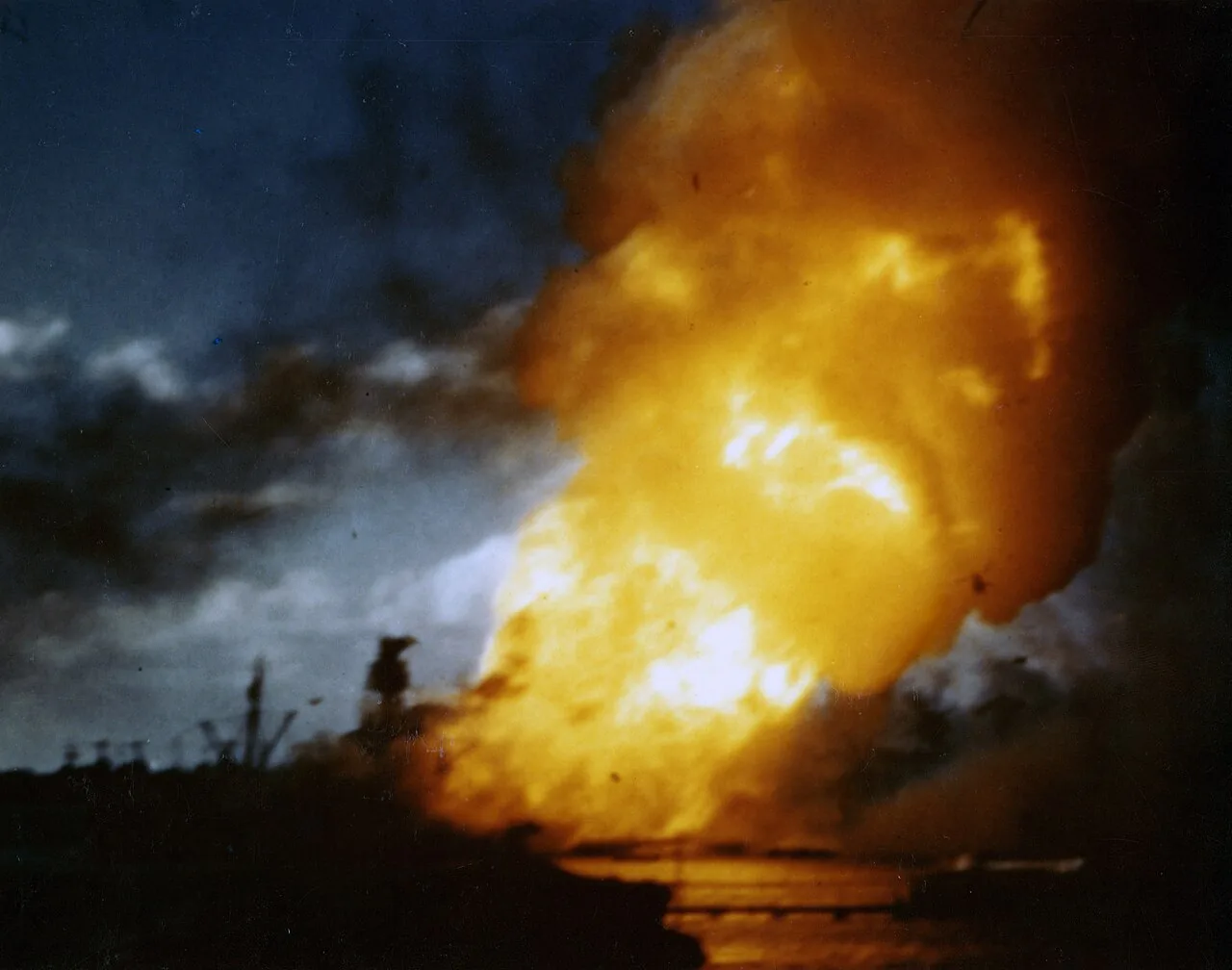
Source: U.S. Navy film frame, December 7, 1941.
- Present the document (nature, source, date, place).
- Describe what you see.
- What can this kind of image tell a historian, and what can it not tell?
- Name one effect of the attack on American policy.
Exercise 13 : Women at work
Document 15 – We Can Do It!, 1943

Source: J. Howard Miller, poster, 1943.
- Present the document (nature, artist, date, sponsor).
- Describe the figure and the words.
- What message does the poster send to women and to employers?
- Why must a historian be careful in using the poster as evidence of women’s actual experience?
Exercise 14 : Closed shop, open sign
Document 16 – Lange, Oakland, 1942
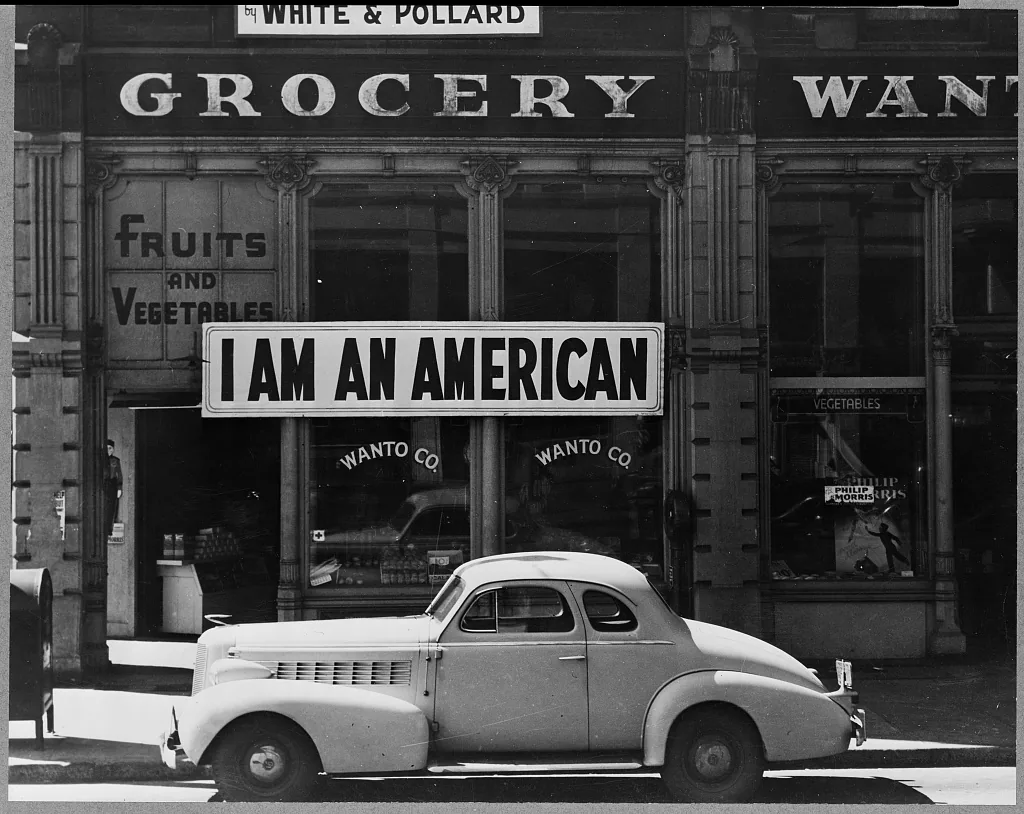
Source: Dorothea Lange, March 1942.
- Present the document (nature, photographer, place, date).
- Read the sign in the window. Who might have put it up, and why?
- What had happened to the owner and his family?
- Explain how this photograph can be used with Executive Order 9066.
Exercise 15 : Iwo Jima
Document 17 – Rosenthal, February 23, 1945
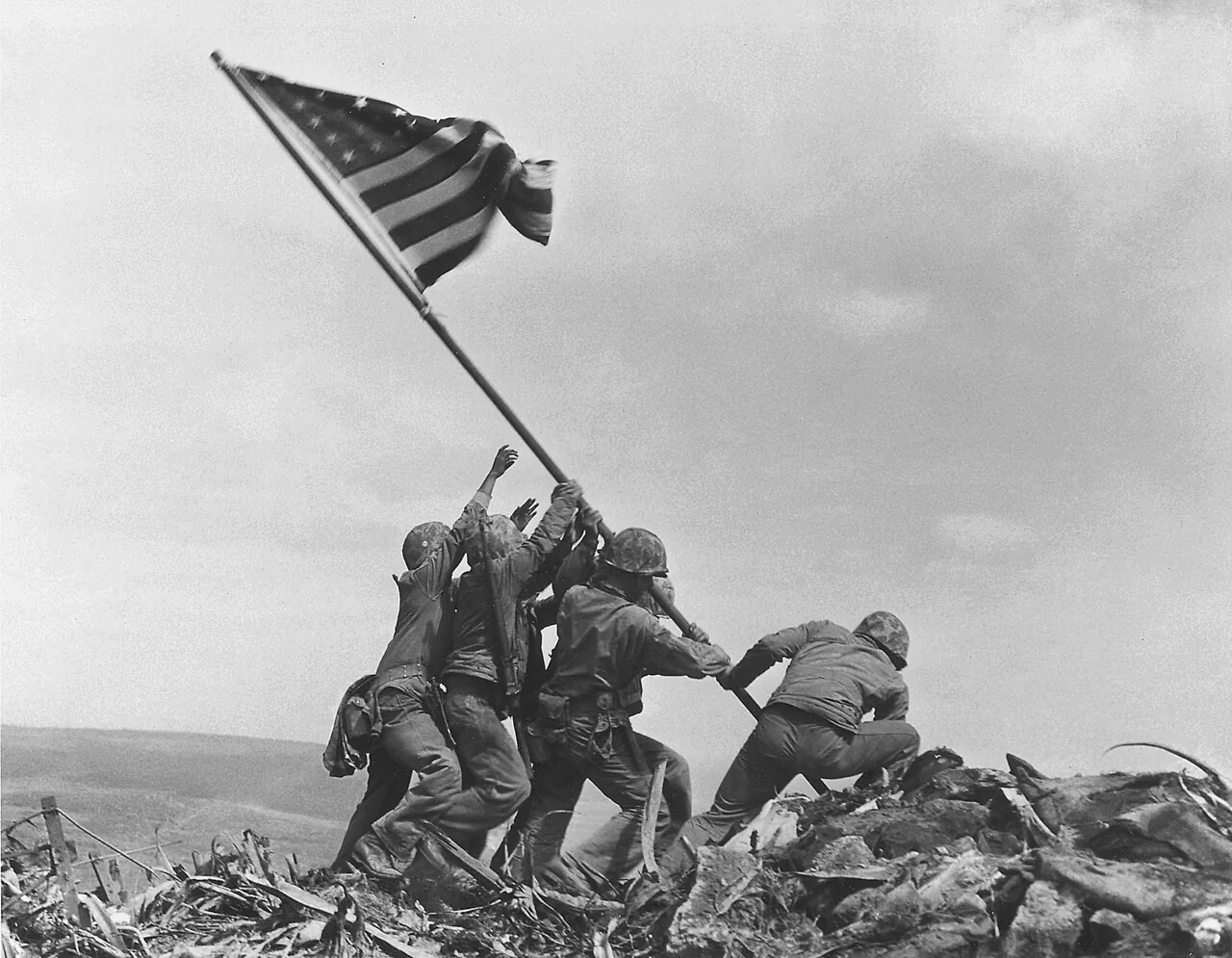
Source: Joe Rosenthal, Associated Press.
- Present the document (nature, photographer, date, place).
- Describe the composition: the men, the flagpole, and the ground.
- Why did the photograph become so famous?
- Does a famous image prove anything about the battle as a whole? Explain.
Exercise 16 : D-Day
Document 18 – Into the Jaws of Death, 1944
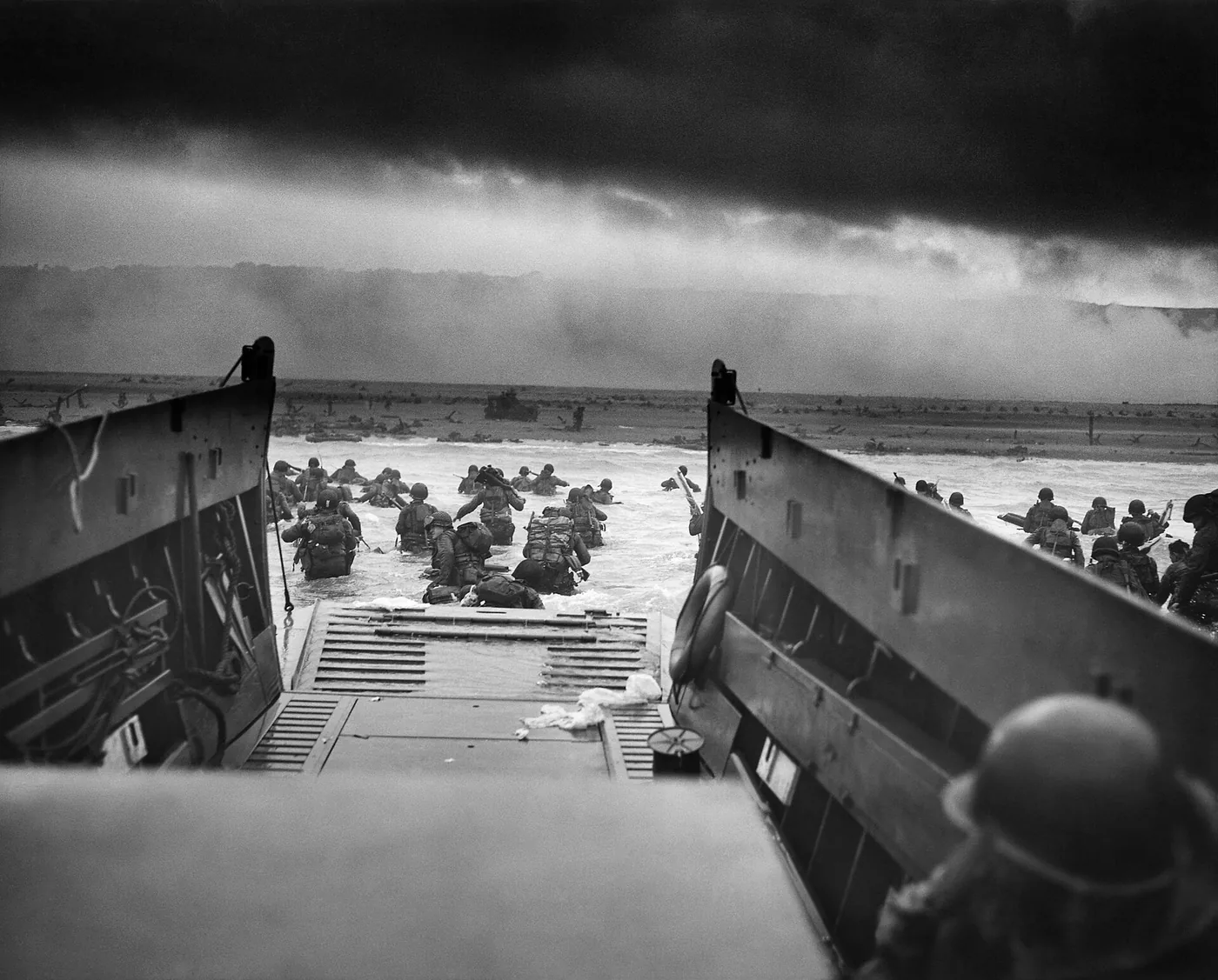
Source: Robert F. Sargent, U.S. Coast Guard, June 6, 1944.
- Present the document (nature, photographer, date, place).
- Describe the view and the point of view of the photographer.
- What operation does it show?
- Use the lesson to explain why the Normandy landings were important.
Exercise 17 : Hiroshima from the air
Document 19 – The cloud over Hiroshima, 1945
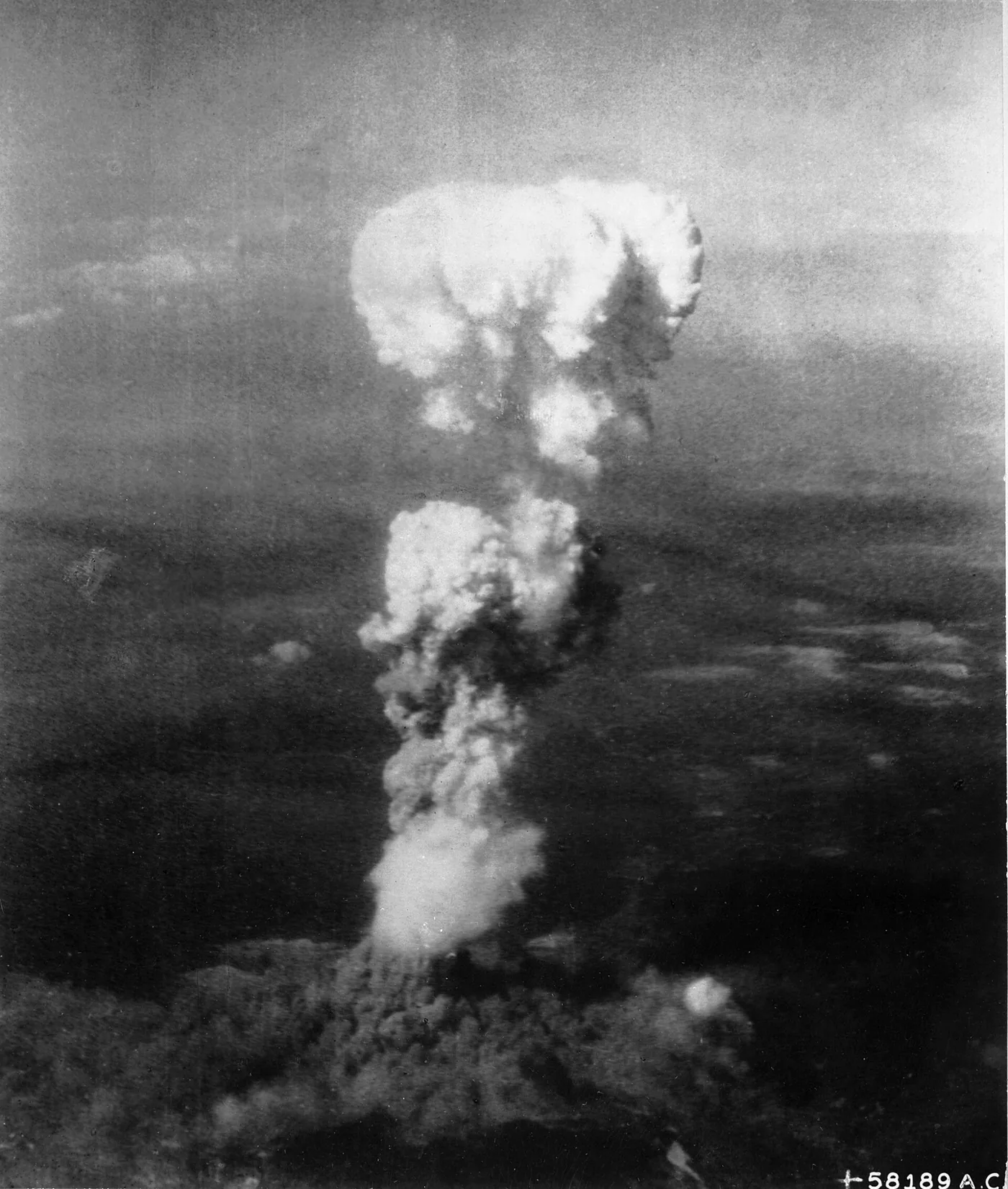
Source: George R. Caron, U.S. Army Air Forces, August 6, 1945.
- Present the document (nature, photographer, date, place).
- Describe what is visible.
- What does the point of view (from the air) suggest about how the bombing was experienced?
- List two arguments historians use about the decision to use the bomb.
Exercise 18 : America in the war: the numbers
| Measure | Figure |
|---|---|
| Americans killed at Pearl Harbor, military and civilians, December 7, 1941 | 2,403 |
| Americans who served in the armed forces, 1941-1945 | 16,112,566 |
| American military dead, all theaters | 407,316 |
| Of those, killed in the European theater (approx.) | 250,000 |
| Of those, killed in the Pacific theater (approx.) | 160,000 |
| Women who took war jobs (approx.) | over 6 million |
| People of Japanese descent forced into camps (approx.) | 120,000 |
Source: U.S. Department of Defense figures as summarized in Wikipedia, “Military history of the United States during World War II”; Wikipedia, “Attack on Pearl Harbor,” citing the National WWII Museum; Wikipedia, “Rosie the Riveter” and “Internment of Japanese Americans.”
- What percentage of those who served died? Round to the nearest tenth of a percent.
- About what share of the American dead was killed in Europe?
- Why are figures such as 120,000 given as approximate?
- Which figure shows the change in the role of women, and why?
Exercise 19 : Map: the war in the Pacific
- Name the place where the Japanese attack began on December 7, 1941.
- Which battle of June 1942 is shown northwest of Hawaii, and why was it a turning point?
- Which two Japanese cities were hit by atomic bombs?
- Which place in the Philippines is named on the map for 1944?
Exercise 20 : Locate the war in Europe
- Identify the places: 1 capital of Britain; 2 the region of the D-Day landings; 3 the French capital; 4 the German capital; 5 the Soviet capital; 6 the city of the great Soviet victory in 1942-43.
- Explain why the Allies needed a landing in Normandy.
- Explain why the Soviet advance mattered for the end of the war.
Exercise 21 : Order the events
Put these events in order: (a) Atomic bomb on Hiroshima; (b) Lend-Lease Act; (c) D-Day; (d) Battle of Midway; (e) Executive Order 9066; (f) Germany invades Poland; (g) V-E Day; (h) Pearl Harbor.
Exercise 22 : Durations
- How many months passed between the German invasion of Poland and the Japanese attack on Pearl Harbor?
- How long was the United States at war, from December 1941 to the formal surrender of Japan in September 1945?
- How many days passed between the bombing of Hiroshima and the bombing of Nagasaki?
- How many years passed between Executive Order 9066 and the Korematsu decision?
Exercise 23 : Guided research: the Navajo code talkers
Use the National Archives (archives.gov), the Library of Congress (loc.gov), or the Smithsonian National Museum of the American Indian (americanindian.si.edu).
- Search for: Navajo code talkers, Tuskegee Airmen, or 442nd Regimental Combat Team.
- Choose one group and fill in a card: who they were, where they served, the dates, and a source.
- Explain how this group was treated at home compared with how they served abroad.
- Explain one limit of the source you used.
Exercise 24 : CER paragraph: the incarceration
Write a paragraph with a Claim, Evidence, and Reasoning, answering the question: Was the incarceration of Japanese Americans justified by military necessity? Use at least two pieces of evidence from Documents 6, 9, and 11 or the lesson.
Exercise 25 : SAQ: the home front
Answer in complete sentences.
- Identify one way in which the war helped to end the Great Depression.
- Explain how Executive Order 8802 responded to pressure from Black leaders.
- Describe one way in which women’s roles changed during the war and one limit to that change.
Exercise 26 : True or false? Justify
Decide whether each statement is true or false. If it is false, correct it.
- The Japanese attack on Pearl Harbor took place on December 7, 1941.
- The Supreme Court ruled against the exclusion order in Korematsu.
- D-Day was the Allied landing in Normandy.
- The Soviet Union played no part in the defeat of Germany.
- The war ended with Japan’s formal surrender on September 2, 1945.
Exercise 27 : Stimulus-based multiple choice
Stimulus
I do hereby reaffirm the policy of the United States that there shall be no discrimination in the employment of workers in defense industries or government because of race, creed, color, or national origin, and I do hereby declare that it is the duty of employers and of labor organizations, in furtherance of said policy and of this order, to provide for the full and equitable participation of all workers in defense industries, without discrimination because of race, creed, color, or national origin;
Source: Executive Order 8802, Prohibition of Discrimination in the Defense Industry, June 25, 1941; text from the National Archives.
*creed: religion. *equitable: fair.
- This order was issued mainly in response to (A) the attack on Pearl Harbor; (B) pressure from Black leaders who planned a march on Washington; (C) the end of the war; (D) the GI Bill.
- Which statement is true of the order? (A) it ended segregation in the army; (B) it banned discrimination in defense industries and government; (C) it protected Japanese Americans; (D) it created the United Nations.
- Which later development is most closely linked to the strategy of this order? (A) the Dust Bowl migration; (B) the use of mass protest in the civil rights movement; (C) the Marshall Plan; (D) the Lend-Lease Act.


Quick review: flashcards
Tap a card to see the answer.