


This US History Grade 11 lesson covers The United States in World War II, part of the unit “Boom, bust and war.” First, read the full lesson with its primary sources, maps and key terms. Then practice with the worksheet, check yourself with the quiz and get ready with the test.
On the morning of Sunday, December 7, 1941, sailors at Pearl Harbor, Hawaii, were having breakfast when Japanese aircraft appeared overhead. Within two hours, battleships lay burning in the harbor and more than two thousand Americans were dead. The next day, President Franklin D. Roosevelt asked Congress for a declaration of war. The nation that had spent years hoping to stay out of the conflicts of Europe and Asia was now in the middle of a global war.
It would fight on two oceans, build more ships, planes, and tanks than any country in history, and put more than sixteen million men and women in uniform. The war would also reveal contradictions: a fight for freedom abroad in which Black soldiers served in segregated units, and in which tens of thousands of American citizens of Japanese ancestry were imprisoned at home.
Guiding question: How did World War II transform the United States at home and abroad, and what did the war reveal about American ideals and their limits?
1. From neutrality to Pearl Harbor, 1939-1941
Isolationism and the drift toward war
After the heavy losses and the disappointments of World War I, many Americans wanted to avoid another European war. In the 1930s, Congress passed a series of Neutrality Acts that banned the sale of weapons to nations at war and loans to them. When Germany invaded Poland on September 1, 1939, Britain and France declared war, and Roosevelt declared the United States neutral. But he also believed that a victory of Nazi Germany would threaten American security. Congress allowed “cash and carry” sales of arms to Britain and France in 1939. In June 1940, France fell to Germany, and Britain stood alone. In September 1940, Congress passed the first peacetime draft in American history.
Definition: isolationism
The belief that the United States should avoid political and military alliances with foreign nations and stay out of their wars. In the 1930s, isolationists in Congress and groups such as America First opposed involvement in the war in Europe.
Roosevelt won an unprecedented third term in November 1940. In March 1941, Congress passed the Lend-Lease Act, which allowed the president to lend or lease war supplies to any country whose defense he considered vital to American security. It meant that the United States became the “arsenal of democracy” for Britain, and after Germany attacked the Soviet Union in June 1941, for the Soviets as well. In January 1941, Roosevelt described the goals of the struggle in his annual message to Congress.
Document 1 – The Four Freedoms
In the future days, which we seek to make secure, we look forward to a world founded upon four essential human freedoms. The first is freedom of speech and expression—everywhere in the world. The second is freedom of every person to worship God in his own way—everywhere in the world. The third is freedom from want—which, translated into world terms, means economic understandings which will secure to every nation a healthy peacetime life for its inhabitants-everywhere in the world. The fourth is freedom from fear—which, translated into world terms, means a world-wide reduction of armaments to such a point and in such a thorough fashion that no nation will be in a position to commit an act of physical aggression against any neighbor—anywhere in the world. That is no vision of a distant millennium.
Source: Franklin D. Roosevelt, annual message to Congress (State of the Union), January 6, 1941, the “Four Freedoms” passage; text from Wikisource.
*millennium: a period of a thousand years. *translated into world terms: applied to the whole world.
Commentary. Roosevelt did not ask Congress to declare war, but he set out moral aims for American policy: freedom of speech, freedom of worship, freedom from want, and freedom from fear, “everywhere in the world.” The speech linked American security to the fate of democracy abroad. The Four Freedoms became a central theme of the Allied war aims and of American propaganda.
In August 1941, Roosevelt and British Prime Minister Winston Churchill met on warships off Newfoundland and issued a joint statement of principles, the Atlantic Charter.
Document 2 – The Atlantic Charter
First, their countries seek no aggrandizement, territorial or other; Second, they desire to see no territorial changes that do not accord with the freely expressed wishes of the peoples concerned; Third, they respect the right of all peoples to choose the form of government under which they will live; and they wish to see sovereign rights and self government restored to those who have been forcibly deprived of them;
Source: The Atlantic Charter, joint declaration of President Roosevelt and Prime Minister Churchill, August 14, 1941, first three points; text from the Avalon Project, Yale Law School.
*aggrandizement: increase of power or territory. *sovereign rights: rights of self-rule.
Commentary. The first three points declare that the two nations seek no new territory, oppose territorial changes against the wishes of the people concerned, and support the right of peoples to choose their government. Colonial peoples in Asia and Africa would soon ask whether these principles applied to them as well, a question that Churchill and Roosevelt did not answer in the same way.
Japan and Pearl Harbor
In Asia, Japan had invaded Manchuria in 1931 and China in 1937, and in 1940 it joined Germany and Italy in the Tripartite Pact, forming the Axis. In July 1941, after Japan occupied southern Indochina, the United States froze Japanese assets and cut off oil exports, on which Japan depended. Negotiations failed, and Japanese leaders decided to strike the American Pacific Fleet at Pearl Harbor to protect their advance in Southeast Asia.
The attack began at about 7:55 in the morning on December 7, 1941. Japanese carrier aircraft sank or damaged eight American battleships and destroyed many aircraft. In all, 2,403 Americans, military and civilian, were killed. The American aircraft carriers were at sea and escaped, which proved important for the months that followed. On December 8, Roosevelt spoke to Congress, which voted for war against Japan with one dissenting vote. On December 11, Germany and Italy declared war on the United States.
Document 3 – “A date which will live in infamy”
Yesterday, December 7th, 1941—a date which will live in infamy—the United States of America was suddenly and deliberately attacked by naval and air forces of the Empire of Japan. The United States was at peace with that nation, and, at the solicitation of Japan, was still in conversation with its Government and its Emperor looking toward the maintenance of peace in the Pacific. Indeed, one hour after Japanese air squadrons had commenced bombing in the American island of Oahu, the Japanese Ambassador to the United States and his colleague delivered to our Secretary of State a formal reply to a recent American message.
Source: Franklin D. Roosevelt, address to Congress asking for a declaration of war, December 8, 1941 (“Day of Infamy” speech), opening; text from Wikisource.
*infamy: shameful and evil reputation. *solicitation: request.
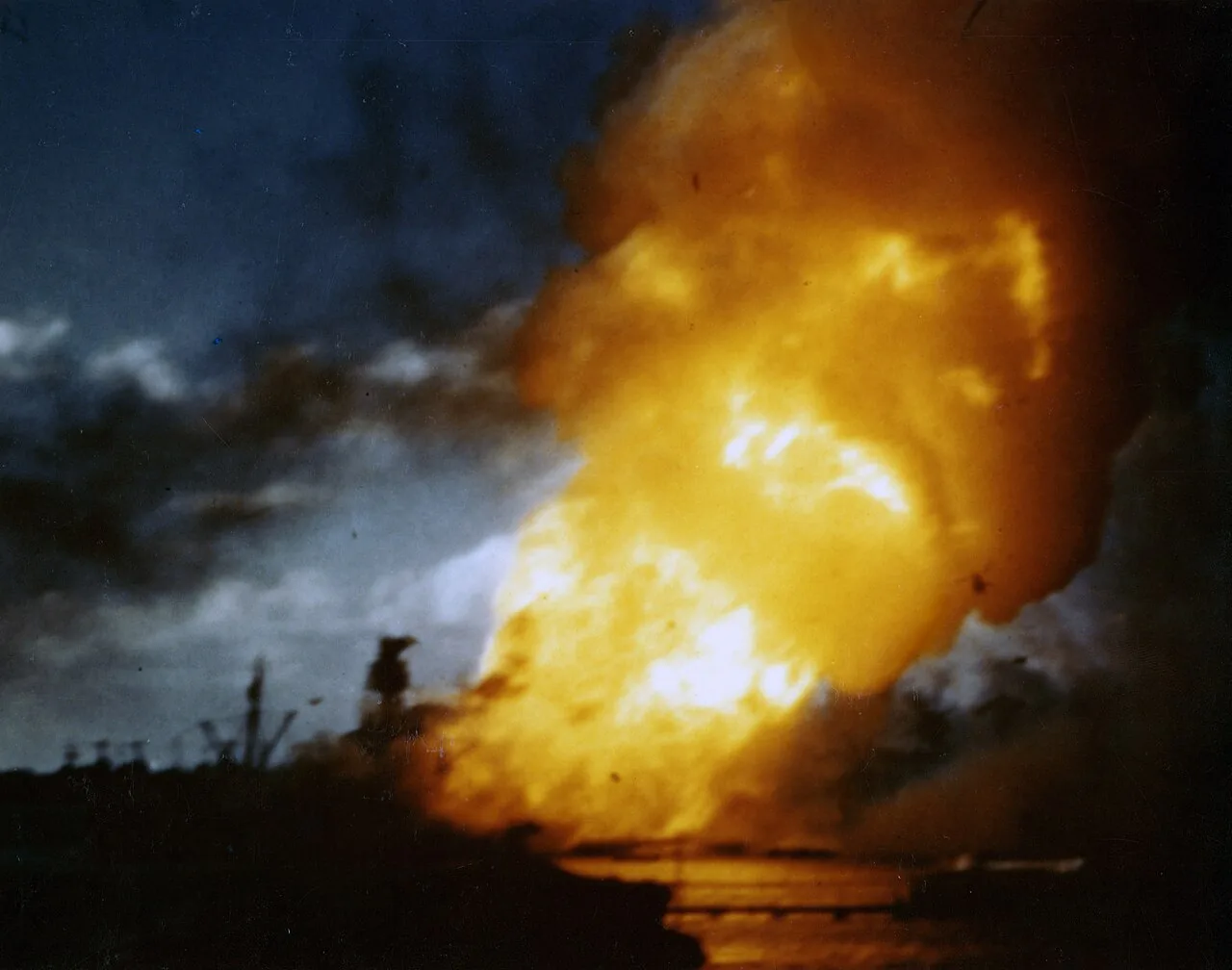
Source: U.S. Navy, frame from a color film taken aboard USS Solace, December 7, 1941 (image on Wikimedia Commons).
Commentary. The speech is short, about five hundred words, and it was written in the style of an indictment, stressing that Japan attacked while it was still negotiating with the United States. The photograph shows the scale of the fire and smoke that day. Together, they explain why the attack ended the debate between isolationists and interventionists almost overnight.
2. The home front
Mobilizing the economy
Once at war, the United States turned its enormous economy to military production. Factories that had made cars made tanks and planes. Shipyards launched Liberty ships in a matter of weeks. The government set up agencies such as the War Production Board to direct industry and the Office of Price Administration to fix prices and ration goods such as gasoline, sugar, meat, and rubber tires.
Citizens bought war bonds and collected scrap metal. The demand for labor ended the Depression: unemployment, which had been above 19 percent in 1938, fell close to zero. Some 16 million Americans served in the armed forces. Millions of families moved to cities with defense factories, including many Black families from the South and Mexican American workers.
Definition: home front
The civilian population and economy of a country at war. In World War II, the home front included war production, rationing, bond drives, and the work of women and minorities in jobs that had been closed to them.
Women and the workplace
With millions of men in uniform, women filled jobs in factories, shipyards, and offices that had been limited to men. More than six million women took war jobs. A poster by J. Howard Miller, We Can Do It!, shows a woman in a work shirt flexing her arm; it was not very famous at the time, but later became linked with the image of “Rosie the Riveter.” Women also served in the armed forces, in the Women’s Army Corps and other branches, though not in combat. Their pay was often lower than men’s, and when the war ended many were encouraged or forced to leave their jobs to returning veterans, although the experience changed expectations for the future.
Document 4 – We Can Do It!
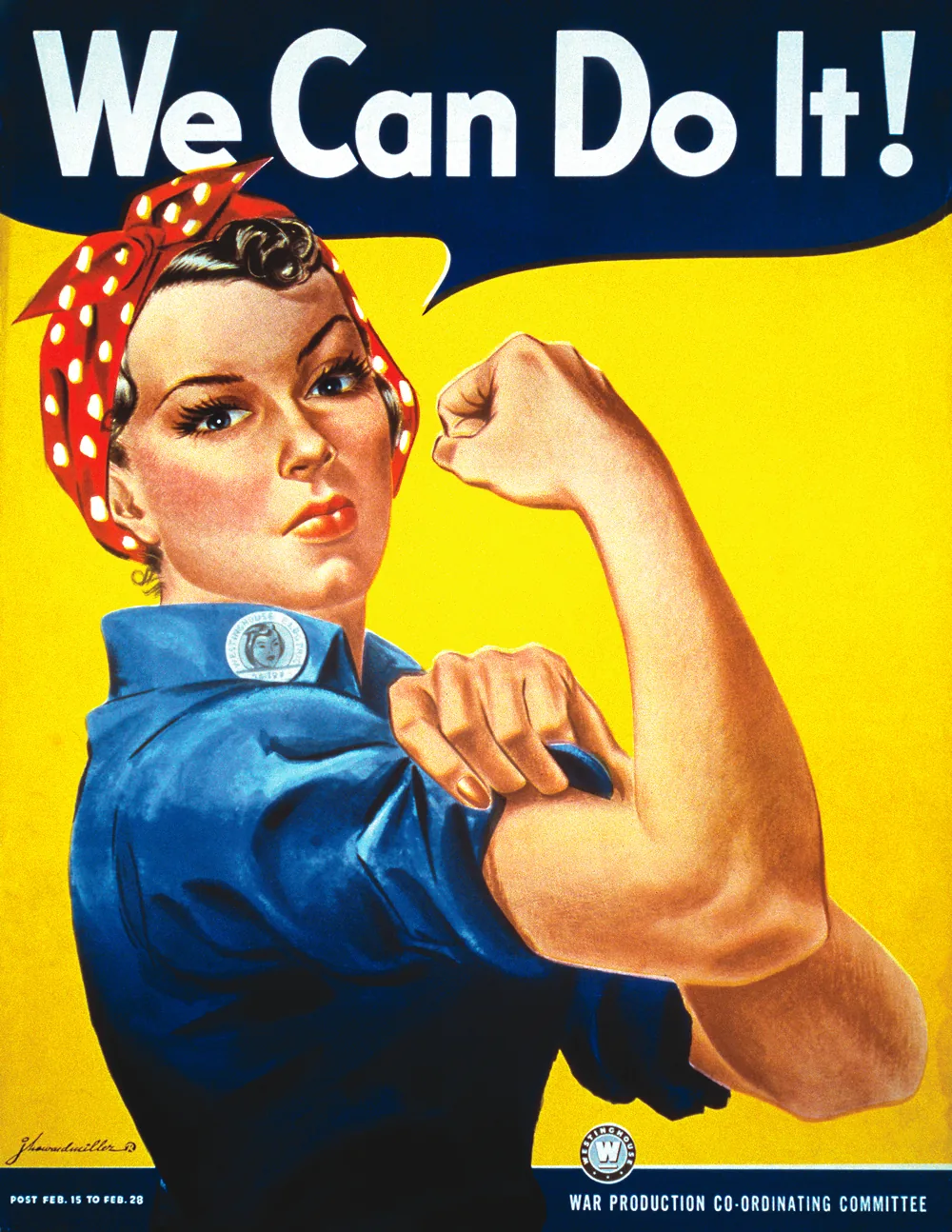
Source: J. Howard Miller, poster, 1943, War Production Co-ordinating Committee (image on Wikimedia Commons).
Commentary. The poster was made for Westinghouse workers and urged them to be productive. Posters like this show how the government and employers tried to recruit women and to persuade them that war work was a patriotic duty. As evidence, the poster shows what the sponsors wanted, not what most women actually experienced.
African Americans, Mexican Americans, and Native Americans
Black Americans entered the war with the demand for “Double V”: victory over fascism abroad and victory over racism at home. In 1941, the labor leader A. Philip Randolph planned a march on Washington to protest discrimination in war industries. To prevent the march, Roosevelt issued Executive Order 8802 on June 25, 1941, which banned discrimination in defense industries and government and created the Fair Employment Practice Committee.
The order was a first step, although enforcement was weak. The armed forces remained segregated. Black soldiers served mostly in support units, but the Tuskegee Airmen, Black pilots trained in Alabama, earned a distinguished record as escorts of bombers. Racial tensions rose in crowded war cities, and in 1943 riots broke out in Detroit and other places.
Document 5 – Executive Order 8802
I do hereby reaffirm the policy of the United States that there shall be no discrimination in the employment of workers in defense industries or government because of race, creed, color, or national origin, and I do hereby declare that it is the duty of employers and of labor organizations, in furtherance of said policy and of this order, to provide for the full and equitable participation of all workers in defense industries, without discrimination because of race, creed, color, or national origin;
Source: Executive Order 8802, Prohibition of Discrimination in the Defense Industry, June 25, 1941; text from the National Archives.
*creed: religion. *equitable: fair.
Commentary. The order is often described as the first federal action of its kind against employment discrimination. Notice that it speaks only of defense industries and government employment; it does not mention the armed forces or segregation in public places. Randolph’s tactic of threatening a mass march became a model for later civil rights leaders.
Mexican American men served in large numbers, and the government started the Bracero Program in 1942 to bring Mexican farm workers to the United States. In Los Angeles in 1943, violence broke out between sailors and young Mexican Americans in the “zoot suit riots.” Native Americans served in the armed forces at a high rate. The Navajo code talkers, who used their language to send messages that the enemy could not decode, became famous in the Pacific.
The incarceration of Japanese Americans
Definition: executive order
A directive issued by the president that has the force of law within the executive branch, without a vote in Congress. Roosevelt used executive orders in 1941 and 1942 for both fair employment and the removal of Japanese Americans.
The war brought an extreme injustice. After Pearl Harbor, fear and long-standing prejudice against people of Asian descent led to demands from West Coast politicians and military leaders for the removal of Japanese Americans from the Pacific coast. On February 19, 1942, Roosevelt signed Executive Order 9066, which allowed the military to designate areas from which any person could be excluded.
Document 6 – Executive Order 9066
I hereby authorize and direct the Secretary of War, and the Military Commanders whom he may from time to time designate, whenever he or any designated Commander deems such action necessary or desirable, to prescribe military areas in such places and of such extent as he or the appropriate Military Commander may determine, from which any or all persons may be excluded, and with respect to which, the right of any person to enter, remain in, or leave shall be subject to whatever restrictions the Secretary of War or the appropriate Military Commander may impose in his discretion.
Source: Executive Order 9066, February 19, 1942, authorizing military areas; text from the National Archives.
*prescribe: set out, order. *discretion: freedom to decide.
Commentary. The order never mentions Japanese Americans. Yet it was applied to them almost alone: about 120,000 people of Japanese descent, most of them living on the West Coast and about two-thirds of them American citizens, were removed from their homes and sent to ten camps in remote areas. Italian and German aliens were treated far more mildly, and there was no mass removal of Japanese Americans in Hawaii.
Document 7 – “I am an American”
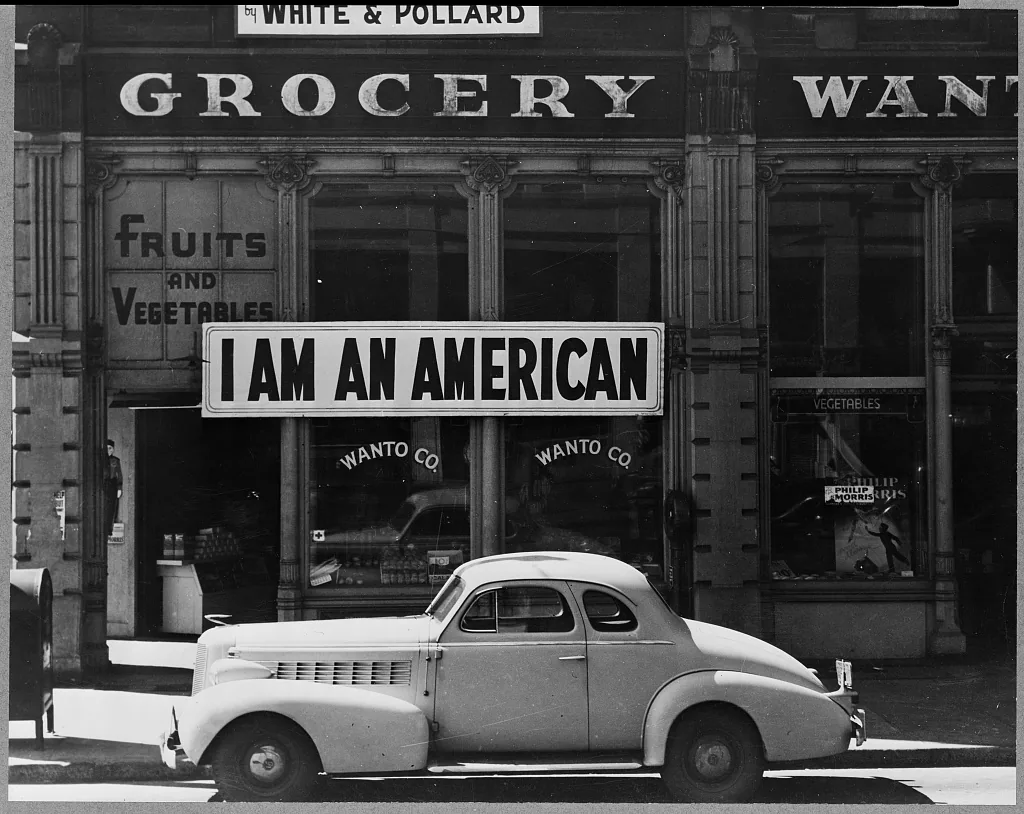
Source: Dorothea Lange, March 1942, War Relocation Authority (image on Wikimedia Commons).
Commentary. Families had days or weeks to sell their homes, farms, and businesses, often at a loss, and could take only what they could carry. The sign in the window was posted by the owner of the store before the evacuation. Lange worked for the government, and many of her photographs were not shown to the public during the war.
In 1944, in Korematsu v. United States, the Supreme Court upheld the exclusion order by a vote of six to three. Justice Hugo Black wrote that the power to protect the country against danger must be commensurate with the danger, and Justice Frank Murphy, dissenting, called the decision a “legalization of racism.” Many Japanese Americans served in the armed forces; the 442nd Regimental Combat Team, made up of Japanese Americans, became one of the most decorated units of its size in American history.
The camps were closed in 1945 and 1946. In 1983 a federal commission concluded that the incarceration was caused by “race prejudice, war hysteria, and a failure of political leadership,” and in 1988 Congress passed a law with a formal apology and payments to surviving prisoners.
3. The war abroad, 1942-1945
Europe: Germany first
The Allies, including the United States, Britain, and the Soviet Union, decided to defeat Germany first. American forces landed in North Africa in November 1942, then invaded Sicily and Italy in 1943. On the Eastern Front, the Soviet victory at Stalingrad in the winter of 1942-43 was a turning point, and the Soviet Union bore the heaviest burden in the land war against Germany.
On June 6, 1944, D-Day, nearly 160,000 Allied troops crossed the English Channel and landed on the beaches of Normandy. Paris was liberated in August. In December, Germany launched a last offensive in the Ardennes forest, the Battle of the Bulge, which failed. Soviet and Western armies met in the heart of Germany. Roosevelt died on April 12, 1945, and Harry S. Truman became president. Germany surrendered on May 8, 1945, V-E Day.
Document 8 – D-Day, Omaha Beach
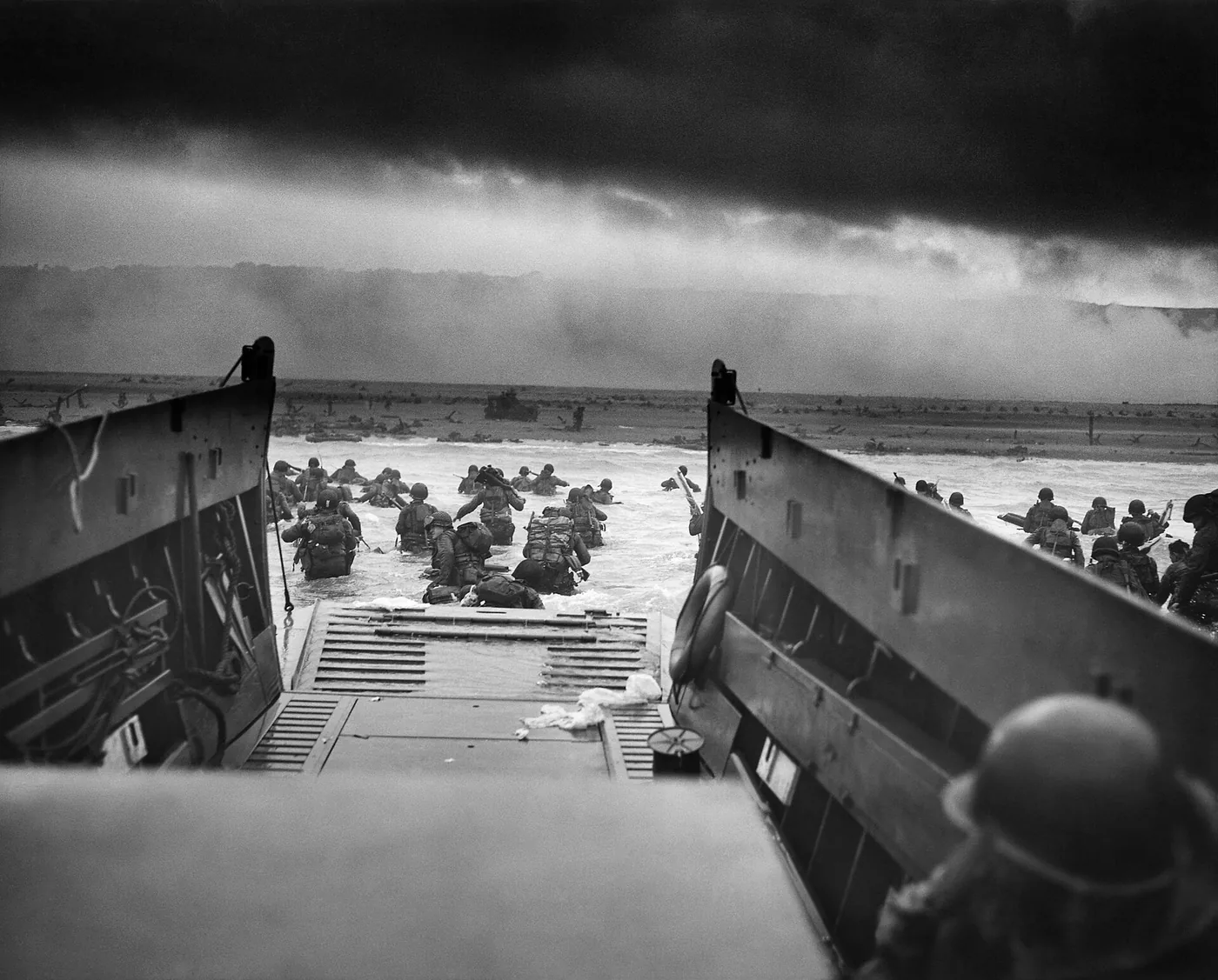
Source: Robert F. Sargent, U.S. Coast Guard, June 6, 1944 (image on Wikimedia Commons).
Commentary. The photograph was taken from inside or near a landing craft as soldiers waded through the surf under fire. Omaha Beach was the most heavily defended of the five landing beaches, and the soldiers who landed there suffered heavy losses.
As Allied armies advanced into Germany and Poland in 1944-45, they uncovered the concentration and death camps in which the Nazi regime had murdered about six million Jews and millions of other people. American leaders had known of the persecution; the United States had admitted relatively few refugees before the war, and the War Refugee Board, created in January 1944, came late. Nazi Germany’s genocide, now called the Holocaust, shaped how Americans understood the purpose of the war after the fact.
Definition: Holocaust
The systematic persecution and murder of about six million Jews, and of millions of other people, by Nazi Germany and its collaborators between 1933 and 1945.
The Pacific: from Midway to Okinawa
In the first months after Pearl Harbor, Japan took the Philippines, Malaya, Singapore, and the Dutch East Indies. American and Filipino prisoners were forced on the brutal Bataan Death March in April 1942. But in June 1942, at the Battle of Midway, American carrier aircraft sank four Japanese carriers, and Japan never regained the initiative. From August 1942, American Marines fought for months on Guadalcanal.
The United States then adopted a strategy of island hopping: capturing selected islands to build air bases and bypassing others. After victories in the Marianas and the Philippines in 1944, American forces took Iwo Jima in February-March 1945 and Okinawa in April-June 1945, at heavy cost. American bombers, based in the Marianas, firebombed Japanese cities, including Tokyo in March 1945.
Document 9 – Iwo Jima
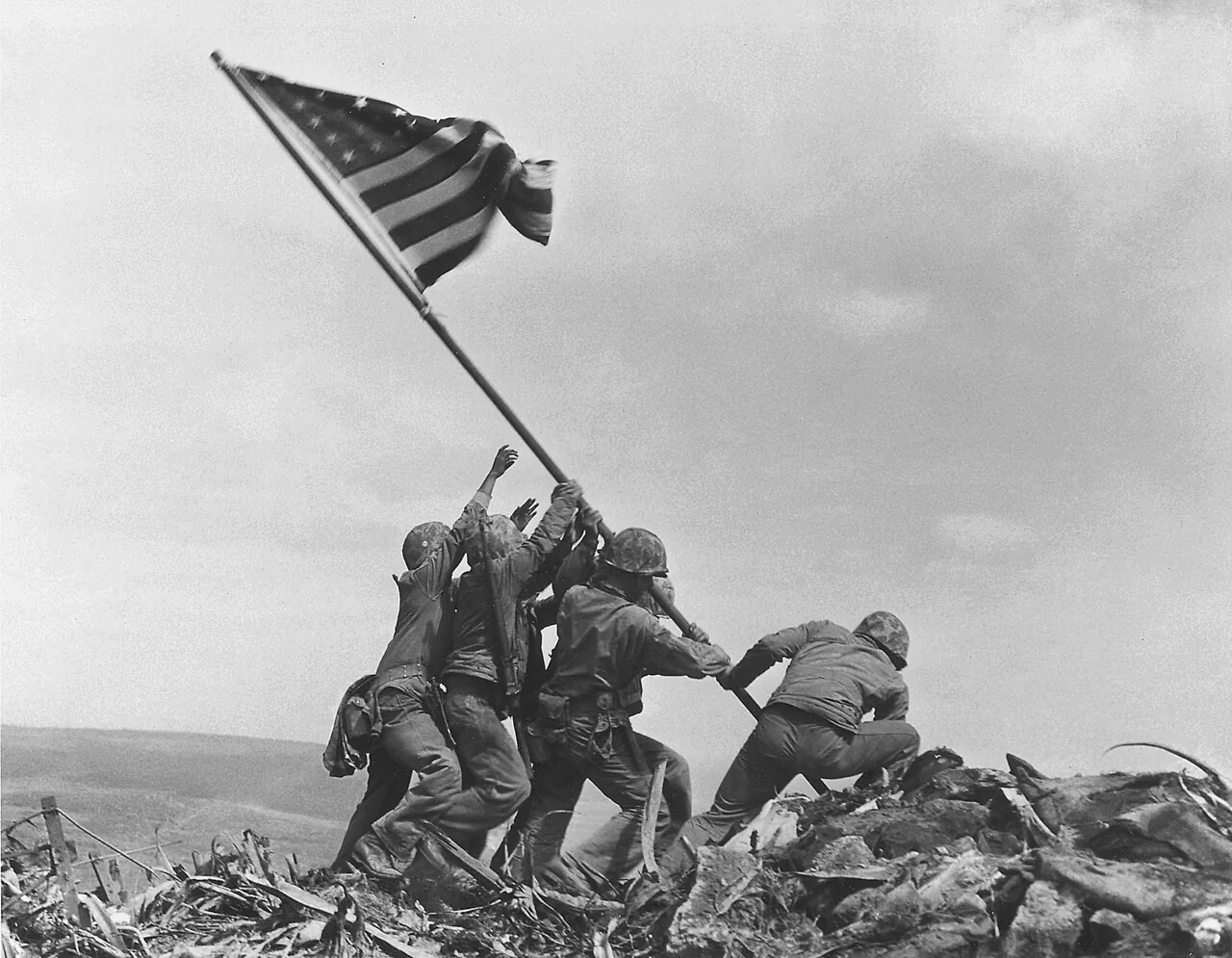
Source: Joe Rosenthal, Associated Press, February 23, 1945 (image on Wikimedia Commons).
Commentary. The photograph became one of the most reproduced images of the war. It shows the second flag raised on Mount Suribachi, in the fifth day of a battle that lasted more than a month. It was used to sell war bonds and it later became the model for a national memorial.
4. The end of the war and its legacy
The Manhattan Project, a secret program begun in 1942 with American, British, and Canadian scientists, produced the first atomic bombs. The first test took place in New Mexico on July 16, 1945. Truman, who had learned of the bomb only after Roosevelt’s death, ordered its use against Japan if the Japanese did not surrender. On August 6, 1945, an American B-29 dropped an atomic bomb on Hiroshima, and on August 9 a second bomb fell on Nagasaki. The Soviet Union declared war on Japan on August 8. On August 15, Emperor Hirohito announced Japan’s surrender, and the formal surrender was signed on September 2, 1945, aboard the battleship USS Missouri in Tokyo Bay.
Document 10 – Truman announces the atomic bomb
It is an atomic bomb. It is a harnessing of the basic power of the universe. The force from which the sun draws its power has been loosed against those who brought war to the Far East. Before 1939, it was the accepted belief of scientists that it was theoretically possible to release atomic energy. But no one knew any practical method of doing it. By 1942, however, we knew that the Germans were working feverishly to find a way to add atomic energy to the other engines of war with which they hoped to enslave the world. But they failed.
Source: Harry S. Truman, Statement by the President Announcing the Use of the A-Bomb at Hiroshima, August 6, 1945; Harry S. Truman Library and Museum.
*harnessing: putting under control. *feverishly: with great haste.
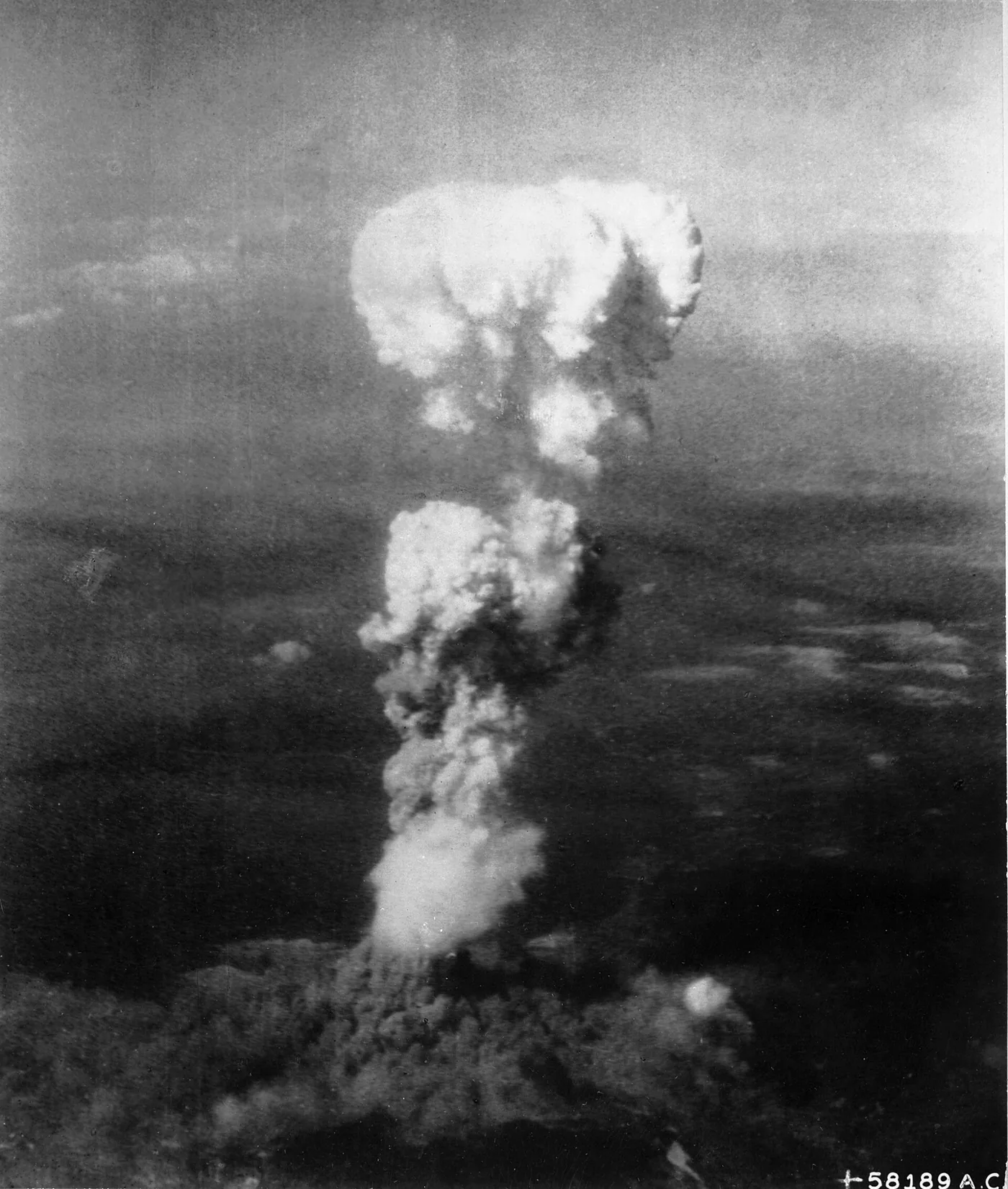
Source: George R. Caron, U.S. Army Air Forces, August 6, 1945 (image on Wikimedia Commons).
Commentary. Truman’s statement was prepared in advance and issued in Washington after the bombing. It presents the weapon as the fruit of a scientific race against Germany and as a means to end the war. The photograph shows the cloud from the air; it shows nothing of the human results on the ground, where tens of thousands of people died in the first moments and many more in the following months.
The debate over the bomb
Historians still debate the decision. Some argue that the bombs saved lives by avoiding an invasion of Japan that would have cost many American and Japanese lives. Others argue that Japan was close to surrender, that the Soviet entry into the war was the decisive shock, and that other options, such as a demonstration or a clarification of the surrender terms for the emperor, were not fully explored. Some also stress that the bombs served to show power to the Soviet Union. The estimates of the dead vary; the figure is generally put in the tens of thousands for the first day in each city and far higher over the following months.
The United States after the war
The United States emerged from the war as the strongest economy in the world and a military superpower. In all, 16,112,566 Americans served in the armed forces, and 407,316 died. The Servicemen’s Readjustment Act of 1944, the GI Bill, gave veterans help with college, home loans, and unemployment payments. At San Francisco in 1945, the United States helped to found the United Nations, and the Nuremberg trials of Nazi leaders began in November 1945. The war also stirred demands for justice at home: Black veterans and workers who had fought against racism abroad pressed for their rights, a movement that would grow into the civil rights movement of the 1950s and 1960s.
- 1939 Germany invades Poland; U.S. declares neutrality
- Mar. 1941 Lend-Lease Act
- June 1941 Executive Order 8802
- Dec. 7, 1941 Attack on Pearl Harbor
- Feb. 1942 Executive Order 9066
- June 1942 Battle of Midway
- June 6, 1944 D-Day landings in Normandy
- May 8, 1945 V-E Day
- Aug. 6 and 9, 1945 Atomic bombs on Hiroshima and Nagasaki
- Sept. 2, 1945 Formal Japanese surrender
Key takeaways
- The United States moved from neutrality to aid for Britain (Lend-Lease) and entered the war after the Japanese attack on Pearl Harbor on December 7, 1941.
- The home front ended the Depression: war production, rationing, and the work of more than six million women changed the economy and society.
- The war exposed contradictions: segregation in the armed forces and the incarceration of about 120,000 Japanese Americans, which the Supreme Court upheld in Korematsu (1944).
- The Allies defeated Germany first (D-Day, June 1944; V-E Day, May 1945) and then Japan, after Midway, island hopping, and the atomic bombs of August 1945.
- The war made the United States a superpower and led to the United Nations, the GI Bill, and new demands for civil rights.

Quick review: flashcards
Tap a card to see the answer.