


This US History Grade 11 lesson covers The Great Depression and the New Deal, part of the unit “Boom, bust and war.” First, read the full lesson with its primary sources, maps and key terms. Then practice with the worksheet, check yourself with the quiz and get ready with the test.
On the morning of Black Thursday, October 24, 1929, crowds gathered on Wall Street as prices on the New York Stock Exchange fell sharply. Five days later, on October 29, prices collapsed again. Fortunes disappeared in hours. Yet the crash did not by itself create the worst economic crisis in American history. What followed was a long chain of bank failures, shrinking sales, and layoffs that lasted for a decade. By the winter of 1932-33, one American worker in four had no job, and millions of families depended on charity, on relatives, or on their own gardens. It was in these conditions that Franklin D. Roosevelt took office in March 1933 and promised a “new deal” for the American people.
Guiding question: What caused the Great Depression, and how far did the New Deal change the role of the federal government in American life?
1. From the boom to the crash, 1929-1932
The weaknesses behind the prosperity
The 1920s had been years of rising production, new consumer goods, and rising stock prices, but the prosperity was uneven. Farmers had been struggling since the end of World War I because crop prices fell while their debts stayed high. Many industrial workers saw their wages rise more slowly than the output of their factories, so ordinary families could not buy everything the factories made. Wealth was concentrated at the top. At the same time, many Americans bought goods on credit, and many investors bought stocks on margin, which means that they borrowed most of the price from a broker and hoped to repay the loan from rising prices.
Definition: buying on margin
Buying stock by paying only part of its price in cash and borrowing the rest from a broker. If the price rises, the buyer profits; if it falls, the broker demands repayment, and the buyer may be forced to sell at a loss. Widespread margin buying made the 1929 crash worse.
Banking was also fragile. Thousands of small banks were not insured, lent money to local farmers and businesses, and held little in reserve. When customers lost confidence and rushed to withdraw their savings, a bank run could shut down a bank, and the news could spread panic to others. Overseas, Europe was still weighed down by war debts and reparations. In 1930, Congress passed the Smoot-Hawley Tariff, which raised duties on imports sharply; other countries answered with their own tariffs, and world trade shrank further.
Document 1 – Hoover on the eve of the crash
Ours is a land rich in resources; stimulating in its glorious beauty; filled with millions of happy homes; blessed with comfort and opportunity. In no nation are the institutions of progress more advanced. In no nation are the fruits of accomplishment more secure. In no nation is the government more worthy of respect. No country is more loved by its people. I have an abiding faith in their capacity, integrity and high purpose. I have no fears for the future of our country. It is bright with hope.
Source: Herbert Hoover, Inaugural Address, March 4, 1929; text from the Avalon Project, Yale Law School.
*stimulating: exciting.
Commentary. Hoover spoke seven months before the crash. His confidence was not unusual: most leaders believed the boom would continue. The speech helps us see how sharply the mood changed within three years, and why Hoover, who sincerely believed in this prosperity, later seemed out of touch to many voters.
The crash and the spread of the crisis
Stock prices had climbed through most of 1929, and in September they began to wobble. On Black Thursday, October 24, panicked investors sold huge numbers of shares. On Black Tuesday, October 29, prices dropped again, and by mid-November much of the paper wealth built up in the boom was gone. The crash shattered confidence. Families cut spending, firms laid off workers, and banks that had lent money to speculators or businesses failed. In the early 1930s thousands of banks closed, and depositors lost their savings, because there was no federal deposit insurance. Falling prices, called deflation, made debts heavier to pay, and the economy fell into a downward spiral.
Document 2 – Wall Street, October 1929
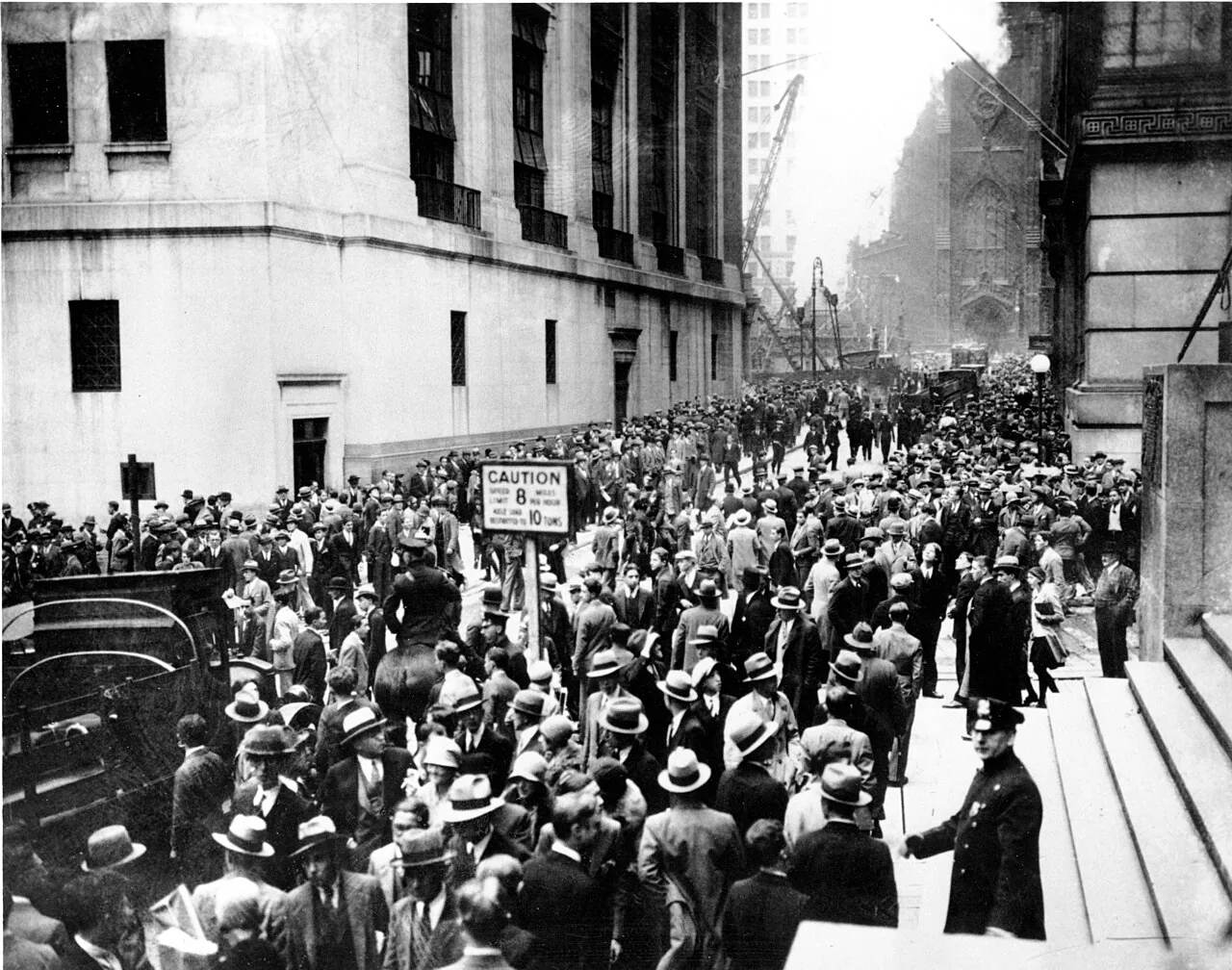
Source: Associated Press photograph, October 1929 (image on Wikimedia Commons).
Commentary. The photograph shows a crowd of men, most in hats and overcoats, packed into the street beside the Exchange. It captures the anxiety of the first days of the crash, but it does not show the more important consequences: the closed factories and banks of the following years.
Hoover and the limits of voluntarism
President Herbert Hoover was an engineer with a record of organizing relief in Europe after World War I, and he did not sit idle. He urged business leaders to keep wages and jobs steady, asked state and local governments to expand public works, and in 1932 created the Reconstruction Finance Corporation to lend money to banks and railroads. But he believed that direct federal relief to individuals would weaken character and local responsibility, and that private charity and local governments should care for the poor. Their resources ran out. By 1932, cities such as Chicago and Detroit could not pay teachers or provide aid, and shantytowns nicknamed Hoovervilles appeared on the edge of many cities.
In the summer of 1932, tens of thousands of veterans of World War I and their families, the “Bonus Army,” camped in Washington to demand early payment of their service bonuses. After Congress refused, the Army, led by General Douglas MacArthur, drove them out of their camp with tanks, cavalry, and tear gas. The scene damaged Hoover badly. In November 1932, Franklin D. Roosevelt, the governor of New York, won the presidency in a landslide.
2. The first New Deal, 1933-1934
Roosevelt was inaugurated on March 4, 1933. The banking system was close to collapse; many states had already closed their banks. In his inaugural speech, the new president tried to restore confidence and to prepare the country for strong action.
Document 3 – The inaugural address
This great Nation will endure as it has endured, will revive and will prosper. So, first of all, let me assert my firm belief that the only thing we have to fear is fear itself–nameless, unreasoning, unjustified terror which paralyzes needed efforts to convert retreat into advance. In every dark hour of our national life a leadership of frankness and vigor has met with that understanding and support of the people themselves which is essential to victory. I am convinced that you will again give that support to leadership in these critical days. In such a spirit on my part and on yours we face our common difficulties.
Source: Franklin D. Roosevelt, First Inaugural Address, March 4, 1933; text from the Avalon Project, Yale Law School.
*unreasoning: not guided by reason. *paralyzes: makes unable to move.
Commentary. The famous sentence about fear is a call to calm, but the speech goes on to demand “direct recruiting by the Government itself” to put people to work. The president also hinted that he would ask Congress for “broad executive power to wage a war against the emergency” if the legislators failed to act, an unusual statement in peacetime.
The bank holiday and the Hundred Days
On March 6, Roosevelt declared a nationwide bank holiday, and on March 9 Congress passed the Emergency Banking Act in a single day. Banks were inspected, and only sound banks were allowed to reopen. On March 12, in the first of his fireside chats, a series of radio talks that spoke directly to the public, he explained in simple language what the government was doing. When the banks reopened, deposits flowed back in. In the first Hundred Days of the new Congress, from March to June 1933, the government passed a remarkable series of laws.
Definition: New Deal
The name given to the policies of President Franklin D. Roosevelt in the 1930s to fight the Depression. They aimed at three goals, often summarized as relief for the unemployed, recovery of the economy, and reform of the financial system and the economy to prevent another collapse.
The laws of the first New Deal
The laws of the first New Deal included the following measures. The Glass-Steagall Banking Act of 1933 separated commercial banking from investment banking and created the Federal Deposit Insurance Corporation (FDIC), which insured bank deposits. The Securities Exchange Act of 1934 set up the Securities and Exchange Commission (SEC) to regulate the stock market. The Civilian Conservation Corps (CCC), created in March 1933, hired young unemployed men to plant trees, build trails, and fight erosion; over nine years about three million young men took part. The Agricultural Adjustment Act (AAA) paid farmers to reduce production in order to raise prices.
The Tennessee Valley Authority (TVA) built dams on the Tennessee River to control floods, produce cheap electricity, and promote development in one of the poorest regions in the country. The National Industrial Recovery Act (NIRA) set up codes for fair competition in industry, with minimum wages, maximum hours, and a guarantee of the right of workers to organize. The Federal Emergency Relief Administration (FERA) sent federal money to states for direct relief, and the Public Works Administration (PWA) funded big construction projects such as dams, bridges, and schools.
Limits of the first measures
Not all of these measures worked. The AAA paid farmers to take land out of production, which helped prices, but many white and Black tenant farmers and sharecroppers in the South were pushed off the land when landlords received the payments and cut back their crops. The NIRA created the National Recovery Administration (NRA), whose blue eagle symbol was displayed in shop windows, but businesses often wrote the codes to protect big firms, and in 1935 the Supreme Court struck down the law in Schechter Poultry Corp. v. United States as an unconstitutional delegation of power. The AAA was also struck down in 1936.
Dust, drought, and migration
Nature added a second disaster. In the 1930s a long drought struck the Great Plains. Farmers had plowed up millions of acres of native prairie grass in the previous decades, and when the rains stopped, wind lifted the dry topsoil in enormous dust storms. The worst storm, on April 14, 1935, was called Black Sunday.
The region of Oklahoma, Kansas, Texas, Colorado, and New Mexico that suffered most became known as the Dust Bowl. Many families lost their farms to the bank and drove west in old trucks, looking for work in California, along Route 66 and other roads. People in California called them “Okies”, although many came from other states, and they often met hostility, low wages, and poor housing.
Definition: Dust Bowl
The region of the southern Great Plains, mainly Oklahoma, Kansas, Texas, Colorado, and New Mexico, where drought and wind stripped away the topsoil in the 1930s, ruining farms and forcing many families to leave.
Definition: collective bargaining
Negotiation between an employer and a union that speaks for all the workers. The Wagner Act of 1935 protected this right.
Document 4 – Migrant Mother
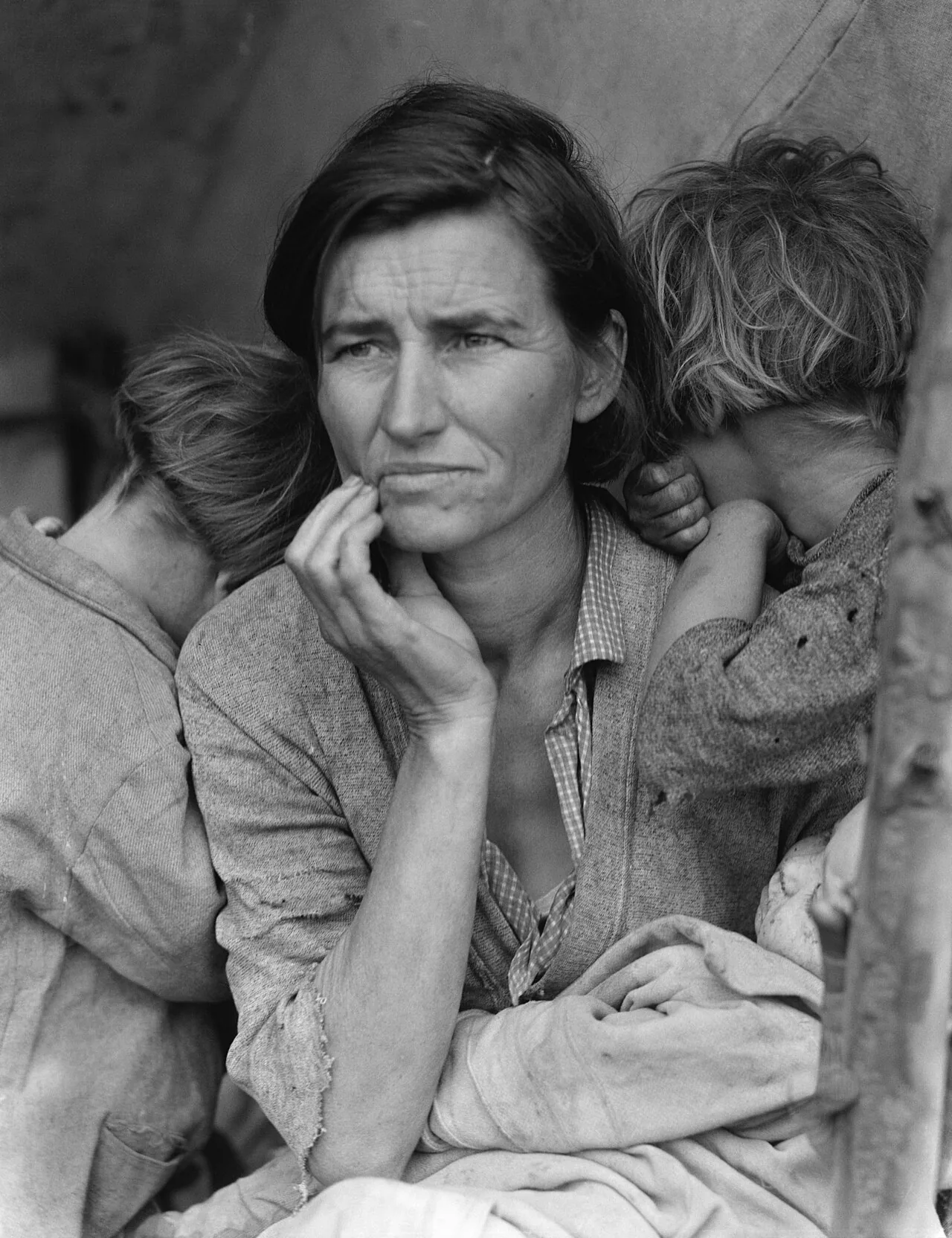
Source: Dorothea Lange, Farm Security Administration photograph, 1936 (image on Wikimedia Commons).
Commentary. Lange worked for a federal agency that sent photographers to document rural poverty. Her pictures showed Americans in other regions what the Depression looked like and helped win public support for relief. The photograph is also a deliberate composition by an artist, and a good historian asks what Lange chose to show.
3. The second New Deal and the labor movement, 1935-1938
By 1935, the economy had improved somewhat, but unemployment remained high, and critics attacked Roosevelt from both the left and the right. The president responded with a second burst of legislation, sometimes called the Second New Deal. The Works Progress Administration (WPA), created in 1935, gave government jobs to the unemployed rather than direct handouts. Between 1935 and 1943 it employed about 8.5 million people, who built roads, bridges, airports, schools, and parks, and also hired artists, writers, musicians, and actors in programs such as the Federal Writers Project. The Rural Electrification Administration helped bring electricity to farms that private companies had passed by.
Document 5 – The Wagner Act
The inequality of bargaining power between employees who do not possess full freedom of association or actual liberty of contract and employers who are organized in the corporate or other forms of ownership association substantially burdens and affects the flow of commerce, and tends to aggravate recurrent business depressions, by depressing wage rates and the purchasing power of wage earners in industry and by preventing the stabilization of competitive wage rates and working conditions within and between industries.
Source: National Labor Relations Act (the Wagner Act), July 5, 1935, Section 1, findings and policy; text from the National Archives.
*bargaining power: strength in negotiating. *collective bargaining: negotiating by a union for all workers.
Commentary. The National Labor Relations Act of 1935 protected the right of workers to join unions and bargain collectively, and it set up the National Labor Relations Board. Notice that Congress justified the law with an economic argument: higher wages would increase purchasing power, which in turn would help end the depression.
With the new law, union membership grew. The Congress of Industrial Organizations (CIO), founded by John L. Lewis and others, organized workers in whole industries, including skilled and unskilled men and, unlike many older unions, many Black and immigrant workers. In the winter of 1936-37, workers in the General Motors plants in Flint, Michigan, occupied the factories in a sit-down strike. After six weeks, in February 1937, the company agreed to recognize the United Auto Workers.
Document 6 – The Social Security Act
to provide for the general welfare by establishing a system of Federal old-age benefits, and by enabling the several States to make more adequate provision for aged persons, blind persons, dependent and crippled children, maternal and child welfare, public health, and the administration of their unemployment compensation laws; to establish a Social Security Board; to raise revenue; and for other purposes
Source: Social Security Act, signed August 14, 1935, opening title of the law; text from the National Archives.
*dependent: relying on others for support. *revenue: government income.
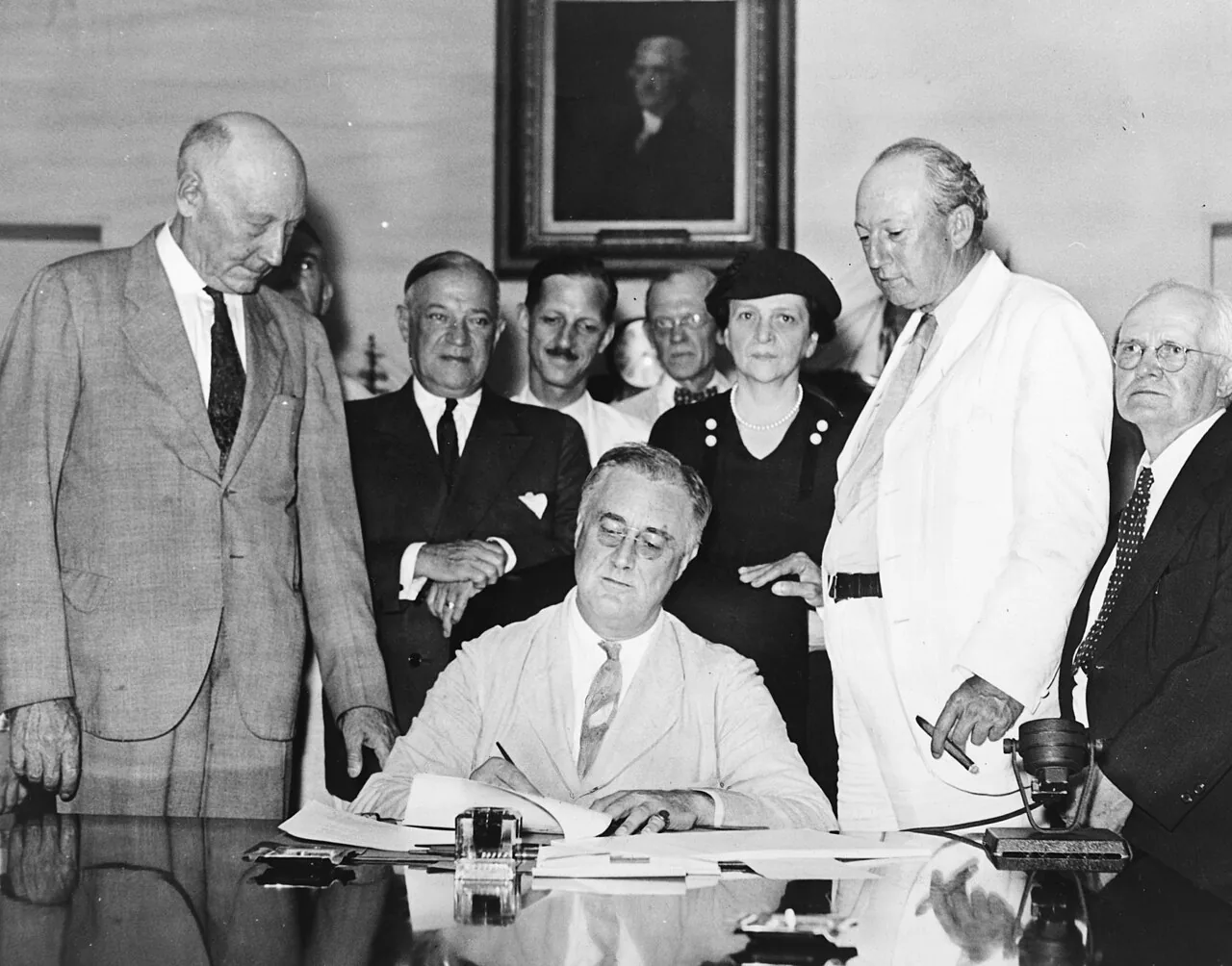
Source: Social Security Online, photograph, August 14, 1935 (image on Wikimedia Commons).
Commentary. The Social Security Act of August 14, 1935, set up old-age insurance financed by payroll taxes on workers and employers, unemployment insurance run by the states, and aid to the blind, to dependent children, and to the poor elderly. Frances Perkins, the first woman to serve in a president’s cabinet, played a large part in drafting it. Agricultural workers and domestic workers were excluded from the old-age program at first, and since these were jobs held by large numbers of African Americans, the law left many of the poorest workers without coverage.
In 1936 Roosevelt won a second term by a very large margin. A coalition of workers, farmers, Southern whites, African Americans in the North, immigrants, and city dwellers gave the Democratic Party a majority that lasted for decades. In his second inaugural address, in January 1937, he spoke of the needs that remained.
Document 7 – “One-third of a nation”
I see one-third of a nation ill-housed, ill-clad, ill-nourished. It is not in despair that I paint you that picture. I paint it for you in hope–because the Nation, seeing and understanding the injustice in it, proposes to paint it out. We are determined to make every American citizen the subject of his country’s interest and concern; and we will never regard any faithful law-abiding group within our borders as superfluous. The test of our progress is not whether we add more to the abundance of those who have much; it is whether we provide enough for those who have too little.
Source: Franklin D. Roosevelt, Second Inaugural Address, January 20, 1937; text from the Avalon Project, Yale Law School.
*superfluous: unnecessary. *abundance: large amount of wealth.
Soon afterward, the president made a serious mistake. Frustrated that the Supreme Court had struck down several New Deal laws, he proposed in February 1937 a plan to add up to six new justices. The plan, called “court packing” by its critics, angered many in his own party, and Congress rejected it. Meanwhile, in 1937 the government cut spending and the Federal Reserve tightened credit, and the economy slid again into the “Roosevelt recession”: unemployment rose from 14.3 percent in 1937 to 19.0 percent in 1938. The government increased spending again in 1938. In the same year the Fair Labor Standards Act set the first national minimum wage and a maximum workweek and limited child labor.
4. Critics, limits, and legacy
The New Deal had critics on every side. Senator Huey Long of Louisiana proposed “Share Our Wealth,” a plan to limit large fortunes and guarantee every family a minimum income. Father Charles Coughlin, a radio priest, first backed Roosevelt and later attacked him. Dr. Francis Townsend proposed a pension for the elderly. On the other side, the American Liberty League, backed by wealthy business leaders, accused Roosevelt of destroying free enterprise and personal liberty. Conservatives in Congress, including many Southern Democrats, blocked bills that challenged the segregated Southern order.
Who was left out
The New Deal also left many people out or helped them unequally. Most programs were administered by state and local officials, who often practiced racial discrimination. African Americans received jobs and relief, and many came to support the Democratic Party for the first time, but Black and Mexican American workers were often given the lowest wages and the worst jobs. In the Southwest, officials and local governments forced or pressured many people of Mexican descent, including American citizens, to leave the country in the 1930s.
The Indian Reorganization Act of 1934 ended the policy of dividing tribal lands into individual allotments and encouraged tribal self-government, although it also imposed outside models on Native nations. Federal housing agencies helped millions of families to buy homes, but their policies and maps steered loans away from many Black neighborhoods, which affected the wealth of families for generations. Women gained jobs in some programs, yet received less pay than men, and married women were often discouraged from working.
Did the New Deal work?
Did the New Deal end the Depression? Most historians say that it eased the suffering, restored confidence in banks, and reformed the system, but that it did not end the downturn by itself. Unemployment was still 19.0 percent in 1938. Full recovery came only with the huge increase in government spending and production for World War II. But the New Deal changed the role of the federal government in lasting ways.
Before the 1930s, many Americans believed that the national government should stay out of the economy and out of ordinary people’s lives. After the New Deal, they expected Washington to protect bank deposits, supervise the stock market, assist the unemployed and the old, protect the right to organize, and set minimum labor standards. Americans still argue about how large that role should be.
Document 8 – Building Hoover Dam
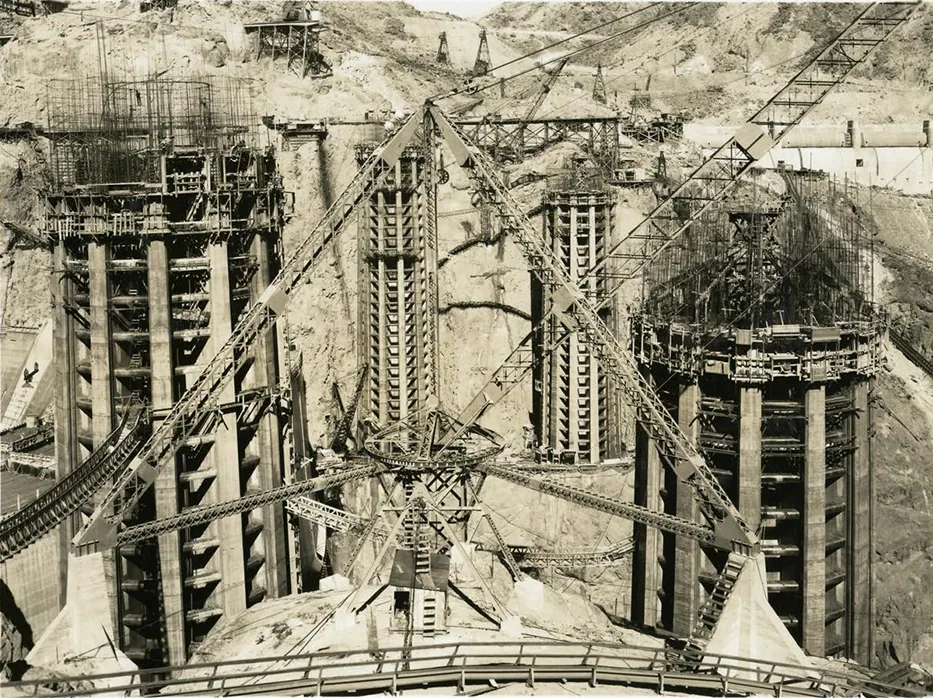
Source: Herbert Hoover Presidential Library and Museum, National Archives, photograph, 1934 (image on Wikimedia Commons).
Commentary. Work on this dam on the Colorado River began under President Hoover and continued under Roosevelt; thousands of workers found jobs on it during the Depression. Large public works such as this one, along with the TVA, linked relief for the unemployed to long-term development of the West and South.
- 1929 Stock market crash, Oct. 24 and Oct. 29
- 1930 Smoot-Hawley Tariff
- 1932 Bonus Army removed; Roosevelt elected
- 1933 Bank holiday, Hundred Days, FDIC, CCC, AAA, TVA
- 1935 WPA, Wagner Act, Social Security Act
- 1937 Court-packing plan; Roosevelt recession
- 1938 Fair Labor Standards Act
- 1941 Entry into World War II ends the Depression era
Key takeaways
- The crash of October 1929 revealed deeper weaknesses: uneven wealth, speculation on margin, fragile banks, falling farm prices, and trade barriers.
- Hoover relied on voluntary action and limited federal loans; by 1932 the crisis had overwhelmed private charity and local governments.
- Roosevelt promised a New Deal for relief, recovery, and reform: the bank holiday, FDIC, SEC, CCC, AAA, TVA, WPA, Social Security, and the Wagner Act.
- The New Deal left out many people, especially farm laborers, domestic workers, and minorities, and it did not end the Depression; wartime mobilization did.
- It permanently expanded the role of the federal government in the economy and in the security of citizens.

Quick review: flashcards
Tap a card to see the answer.