



This US History Grade 11 lesson covers The Roaring Twenties, part of the unit “Boom, bust and war.” First, read the full lesson with its primary sources, maps and key terms. Then practice with the worksheet, check yourself with the quiz and get ready with the test.
On the morning of May 20, 1927, a young airmail pilot named Charles Lindbergh took off from Roosevelt Field on Long Island in a single-engine plane, the Spirit of St. Louis. He carried no radio and no parachute. Thirty-three and a half hours later he landed at Le Bourget airfield near Paris, where a crowd of well over a hundred thousand people rushed onto the field to greet him. He had won the Orteig Prize of $25,000 for the first nonstop flight between New York and Paris.
When he came home, New York gave him a ticker-tape parade. Lindbergh became the most famous person in the world, and his flight showed what many Americans of the 1920s believed: that machines, money, and daring could do anything. The decade is often called the Roaring Twenties, a time of new technology, new music, and new freedoms. It was also a time of fear and conflict over race, religion, and immigration, and it ended in 1929 with the stock market crash.
Guiding question: How did the United States change economically, socially, and culturally in the 1920s, and what conflicts did these changes produce?
1. After the war: normalcy and prosperity
Fear and conflict, 1919-1920
The years right after the First World War were tense. Prices rose, and in 1919 four million workers went on strike, including steelworkers and, in Boston, the police. After the Russian Revolution of 1917, many Americans feared Communist and anarchist plots, and a bomb attack on the home of Attorney General A. Mitchell Palmer fed the fear.
During this Red Scare, in raids in January 1920, federal agents arrested thousands of immigrants and radicals, and many were deported. In the summer of 1919, which was called the Red Summer, white mobs attacked Black communities in dozens of cities, among them Chicago, where a riot lasted for days. Many Black veterans who had fought in the war returned determined to defend their rights. Poet Claude McKay wrote “If We Must Die” in this climate.
Document 1 – Claude McKay, “If We Must Die”
If we must die, let it not be like hogs
Hunted and penned in an inglorious spot,
While round us bark the mad and hungry dogs,
Making their mock at our accursèd lot.
If we must die, O let us nobly die,
So that our precious blood may not be shed
In vain; then even the monsters we defy
Shall be constrained to honor us though dead!
Source: Claude McKay, “If We Must Die,” first published in The Liberator, July 1919 (collected in Harlem Shadows, 1922); text from Wikisource.
*accursed: cursed. *kinsmen: relatives; here, people of the same community.
Commentary. McKay was born in Jamaica and moved to the United States as a young man. The poem uses a traditional form, the sonnet, to make a political statement. The speaker asks his people to resist violence with courage rather than be hunted “like hogs” and to die “nobly,” fighting back. The poem was widely reprinted in African American newspapers, and it is often seen as the opening of the Harlem Renaissance.
The politics of normalcy
Voters were tired of reform and of foreign crusades. In 1920 the Republican Warren G. Harding, a senator from Ohio, won the presidency by a landslide after promising a “return to normalcy.” His administration cut taxes, raised tariffs, and favored business. Harding made some good appointments, but he also gave government jobs to friends, and several of them used their positions to take bribes.
The worst was the Teapot Dome scandal, in which Interior Secretary Albert Fall secretly leased government oil reserves in Wyoming and California to oil men in exchange for gifts and loans. Fall was convicted of bribery in 1929 and became the first cabinet member sent to prison. Harding died suddenly in August 1923 before the extent of the scandals was known.
Document 2 – Harding’s inaugural address
Our supreme task is the resumption of our onward, normal way. Reconstruction, readjustment, restoration all these must follow. I would like to hasten them. If it will lighten the spirit and add to the resolution with which we take up the task, let me repeat for our Nation, we shall give no people just cause to make war upon us; we hold no national prejudices; we entertain no spirit of revenge; we do not hate; we do not covet; we dream of no conquest, nor boast of armed prowess.
Source: Warren G. Harding, Inaugural Address, March 4, 1921; text from Wikisource.
*resumption: starting again. *covet: to want what belongs to others.
Commentary. Harding offers a mood more than a program: after the war and the Progressive reforms, the nation should go back to its “onward, normal way.” The speech also promises peace and no foreign adventures. It shows why voters were drawn to him in 1920. Calvin Coolidge, who became president after Harding’s death and won election in 1924, held the same view of government and said that the main business of Americans was business.
The new consumer economy
The 1920s were years of strong economic growth. Factories produced more goods, and an increasing share of Americans worked in cities; in the 1920 census, for the first time, more than half of the population lived in urban places. The symbol of the age was the automobile. Henry Ford had introduced the Model T in 1908 and in 1913 began to use a moving assembly line at his Highland Park plant, which cut the time to assemble a chassis from more than twelve hours to about an hour and a half.
As the cost of making each car fell, the price fell to less than $300. In 1914 Ford had also offered a wage of five dollars a day, which was high for the time and reduced worker turnover. The number of passenger cars registered in the United States rose from about 8 million in 1920 to more than 23 million in 1929. Cars changed how Americans lived: they created a need for roads, gas stations, motels, and suburbs, and they let people go farther for work and play.
Document 3 – Henry Ford’s idea of the car for everyone
I will build a motor car for the great multitude. It will be large enough for the family but small enough for the individual to run and care for. It will be constructed of the best materials, by the best men to be hired, after the simplest designs that modern engineering can devise. But it will be so low in price that no man making a good salary will be unable to own one–and enjoy with his family the blessing of hours of pleasure in God’s great open spaces.
Source: Henry Ford with Samuel Crowther, My Life and Work, 1922, chapter 4, recalling his announcement of a single low-priced car; text from Project Gutenberg.
*multitude: a large number of people. *devise: to design.
Document 4 – The assembly line
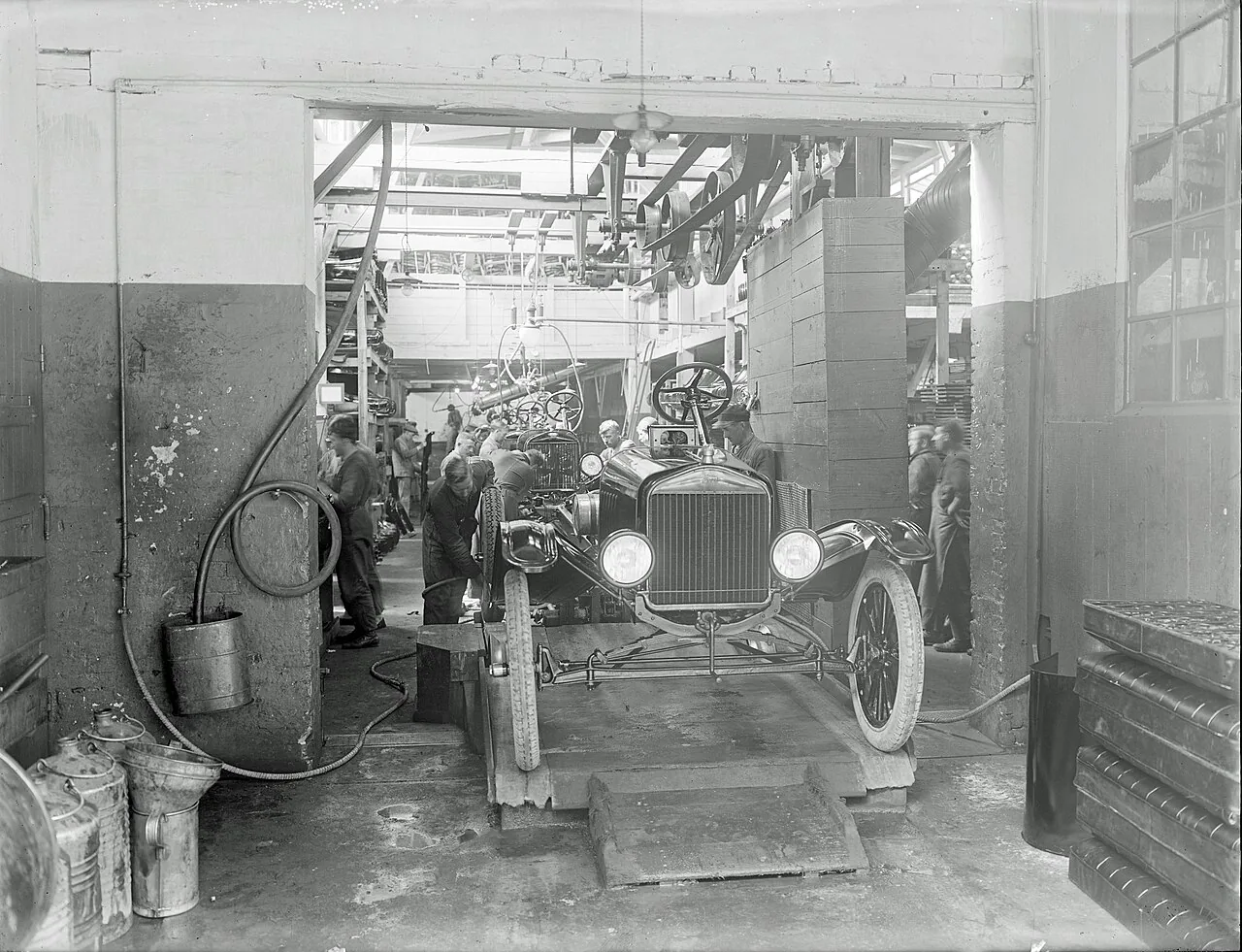
Source: Peter Elfelt, photograph, 1923 (image on Wikimedia Commons).
The assembly line brought the car to the workers instead of the workers to the car. Each worker repeated one small task. The method made cars cheap, but many workers found the work monotonous, and turnover was high.
Definition: assembly line
a method of mass production in which the product moves past a series of workers or machines, each of which performs one step. Ford used it to make cars quickly and cheaply.
Other industries followed. New electrical appliances such as vacuum cleaners, washing machines, and refrigerators went into homes that had electric power. Radio took off after the first commercial station, KDKA in Pittsburgh, broadcast the 1920 presidential election results, and hundreds of stations soon followed. Hollywood movies drew millions on Saturday nights, and in 1927 The Jazz Singer became the first feature film with synchronized speech. To help people pay, merchants sold goods on installment plans, with a small payment at first and the rest over time, and advertising agencies promoted brands. Americans became a nation of consumers. This is called mass consumption.
Definition: mass consumption
a pattern of buying in which large numbers of people purchase goods such as cars, radios, and appliances, helped by mass production, advertising, and installment credit.
Document 5 – Sinclair Lewis, Babbitt
He was forty-six years old now, in April, 1920, and he made nothing in particular, neither butter nor shoes nor poetry, but he was nimble in the calling of selling houses for more than people could afford to pay. […] He seemed prosperous, extremely married and unromantic; and altogether unromantic appeared this sleeping-porch, which looked on one sizable elm, two respectable grass-plots, a cement driveway, and a corrugated iron garage.
Source: Sinclair Lewis, Babbitt, 1922, chapter 1; text from Project Gutenberg.
*nimble: quick and skillful. *sleeping-porch: a porch used for sleeping.
Commentary. Sinclair Lewis, who in 1930 became the first American to win the Nobel Prize in Literature, mocked the businessman of the 1920s. George Babbitt, a real estate agent in an imaginary Midwestern city, is prosperous and comfortable but makes “nothing in particular.” The novel gave the language a word for conformity and boosterism: “Babbittry.” Lewis exaggerates, but his readers recognized the type.
2. A new culture
Young women, jazz, and Prohibition
The decade brought changes in daily life, especially for the young. Women had won the vote in 1920, and many entered the workforce as typists, telephone operators, and salespeople. Some young women, called flappers, shortened their skirts, bobbed their hair, wore makeup, and went out to dance without a chaperone. Older people, especially in small towns, were shocked.
Jazz, a music that grew from African American musical traditions in New Orleans, Chicago, and New York, became the sound of the decade. Louis Armstrong, Duke Ellington, and Bessie Smith were among its stars, and the spread of radio and records brought it to a large audience. Writers such as F. Scott Fitzgerald, Ernest Hemingway, and Sinclair Lewis wrote about the restlessness and disappointment of the age.
Document 6 – A magazine cover of the 1920s
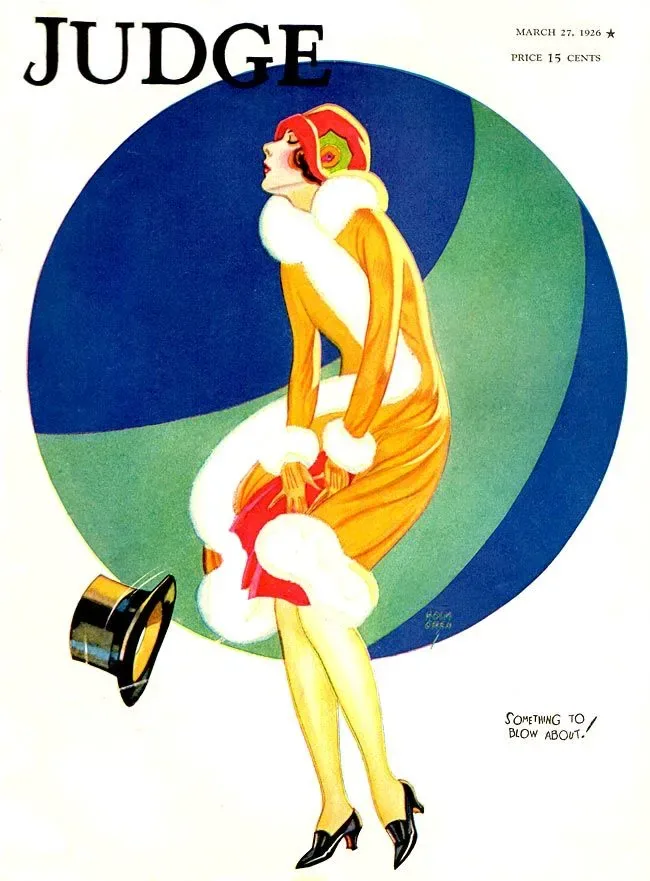
Source: Judge magazine, March 27, 1926 (image on Wikimedia Commons).
Humor magazines such as Judge printed pictures of fashionable young women on their covers. The picture presents an idealized flapper: she is slim, elegant, and confident. It tells us how the style was marketed, not how most young women lived.
At the same time, the Eighteenth Amendment, ratified in 1919, banned the making and sale of alcoholic drinks, and the Volstead Act defined what was illegal. Prohibition began in January 1920. Reformers, many of them women and church members, had campaigned for it for decades. But many Americans kept on drinking. Bootleggers, who smuggled or made alcohol, and speakeasies, the illegal bars, made fortunes for criminals such as Al Capone of Chicago, who ran a gang that used bribery and murder. Police and judges were often bribed. Prohibition failed to stop drinking, and in 1933 the Twenty-first Amendment repealed it.
Document 7 – Pouring out liquor
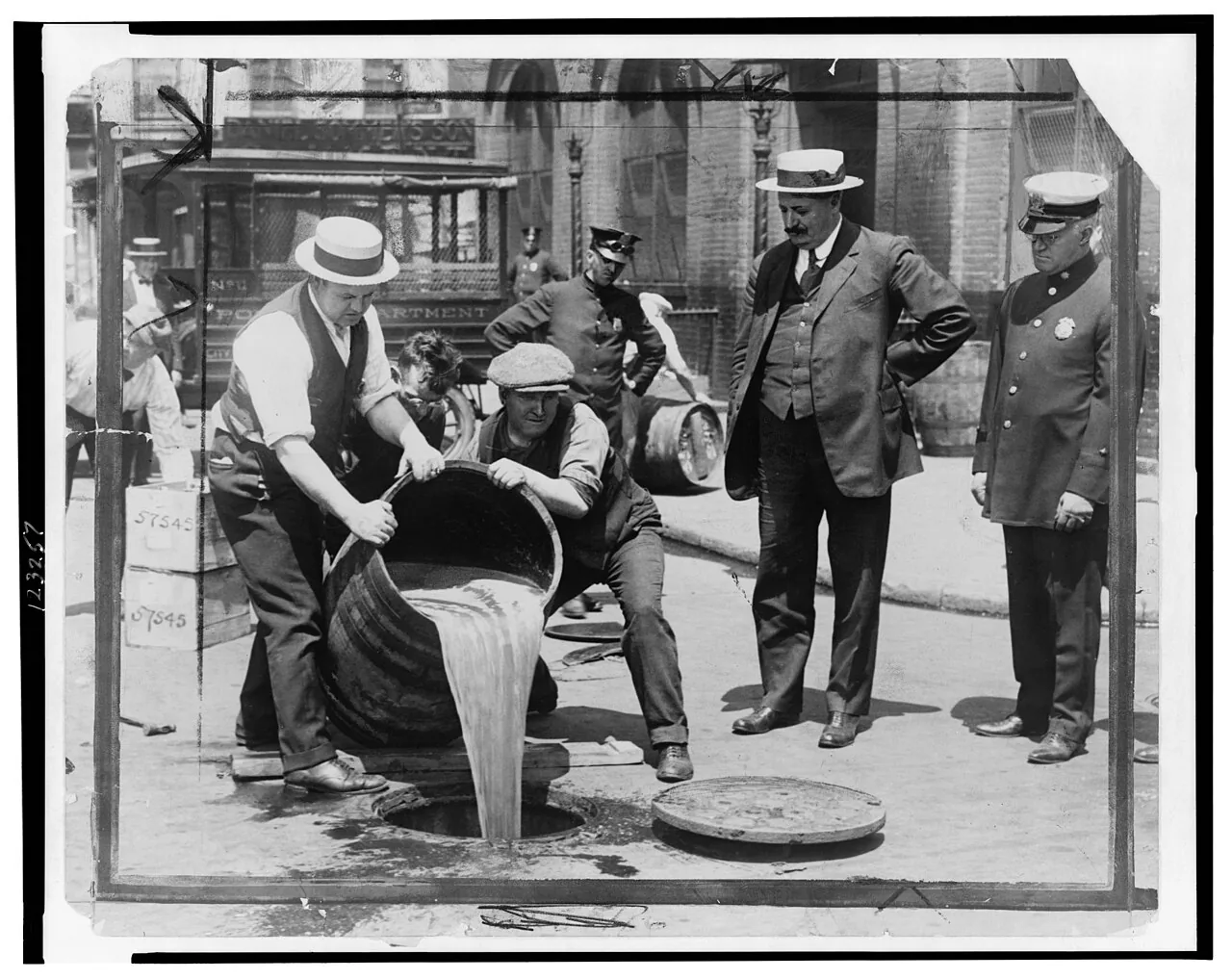
Source: photograph, New York City, Prohibition era, Library of Congress (image on Wikimedia Commons).
Pictures like this one were taken for the press, to show that the law was being enforced. In fact, raids caught only a small share of the alcohol sold, and the profits of smuggling helped build organized crime.
Definition: Prohibition
the national ban on the manufacture, sale, and transport of alcoholic beverages in the United States from 1920 to 1933, established by the Eighteenth Amendment and enforced by the Volstead Act.
The Great Migration and the Harlem Renaissance
The demand for workers in northern factories during the war and the restriction of immigration in the 1920s drew hundreds of thousands of African Americans from the rural South to northern cities, a movement called the Great Migration. They left because of low wages, segregation, and violence, and went to Chicago, Detroit, New York, Philadelphia, and Pittsburgh. In the North they found better wages and the right to vote, but they also met crowded housing, discrimination, and sometimes violence.
Definition: Great Migration
the movement of several million African Americans from the rural South to cities of the North, Midwest, and West, which began about 1916 and continued for decades. In the 1920s it brought hundreds of thousands to cities such as Chicago, Detroit, and New York.
In New York the neighborhood of Harlem became a center of Black culture. The Harlem Renaissance was a flowering of poetry, fiction, music, and art in the 1920s. Its writers included Langston Hughes, Zora Neale Hurston, Claude McKay, and Countee Cullen, its painters included Aaron Douglas, and its musicians included Duke Ellington, who led the orchestra at the Cotton Club.
They wrote about Black life and pride, and they rejected the idea that Black art should imitate white models. Alain Locke called the new spirit “the New Negro.” At the same time, Marcus Garvey, a Jamaican-born leader, built a mass movement, the Universal Negro Improvement Association, which preached race pride and economic independence. Garvey was convicted of mail fraud in 1923 and deported in 1927.
Document 8 – Langston Hughes by Winold Reiss
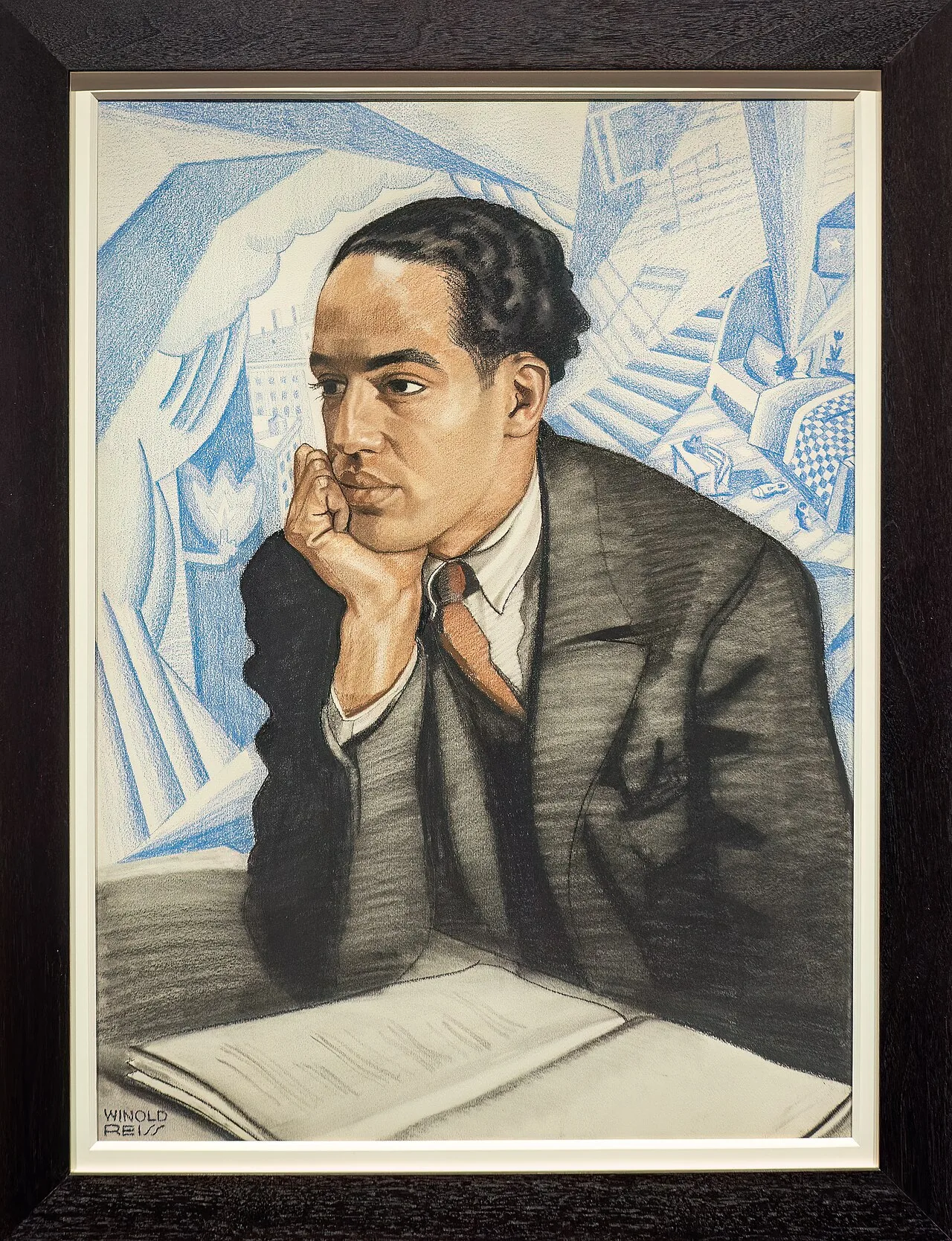
Source: Winold Reiss, portrait, about 1925 (image on Wikimedia Commons).
Hughes published his first poem in 1921 and his first book, The Weary Blues, in 1926. Reiss, a German-born artist, drew portraits of the “New Negro” for a special issue of the magazine Survey Graphic in 1925.
Document 9 – The end of The Great Gatsby
They were careless people, Tom and Daisy—they smashed up things and creatures and then retreated back into their money or their vast carelessness, or whatever it was that kept them together, and let other people clean up the mess they had made
Source: F. Scott Fitzgerald, The Great Gatsby, 1925, chapter 9; text from Project Gutenberg.
*carelessness: lack of care or concern. *retreated: drew back.
Commentary. Fitzgerald’s novel of 1925 describes the glamorous parties of the Jazz Age and the emptiness behind them. Near the end, the narrator, Nick Carraway, judges Tom and Daisy Buchanan, who are rich and who “smashed up things and creatures” and then retreated into their money. It is a verdict on the moral emptiness of some of the wealthy, and one of the best-known passages in American fiction.
3. Clashes of values
While cities grew, many Americans feared that the nation was losing its traditions. The census of 1920 showed that, for the first time, more people lived in towns and cities than in the countryside. Fear of foreigners was strong. Congress passed the Emergency Quota Act of 1921, and the Immigration Act of 1924, also called the Johnson-Reed Act, set strict limits based on national origin.
The 1924 law allowed each European nationality a yearly quota equal to two percent of the number of people of that origin living in the United States in 1890, a date chosen because before that date few southern and eastern Europeans had arrived. It excluded nearly all Asians. The new laws sharply reduced immigration from Italy, Poland, and Russia and ended the open door of earlier years.
Nativism also fed the revival of the Ku Klux Klan. The new Klan, refounded in 1915, attacked not only Black Americans but also Catholics, Jews, and immigrants, and called itself a defender of “100 percent Americanism.” In the mid-1920s it had millions of members across the North and Midwest as well as the South, and some of its members held public office. Its power declined after 1925, when scandals involving its leaders became public, and when the public turned against its violence.
Document 10 – The Klan on Pennsylvania Avenue
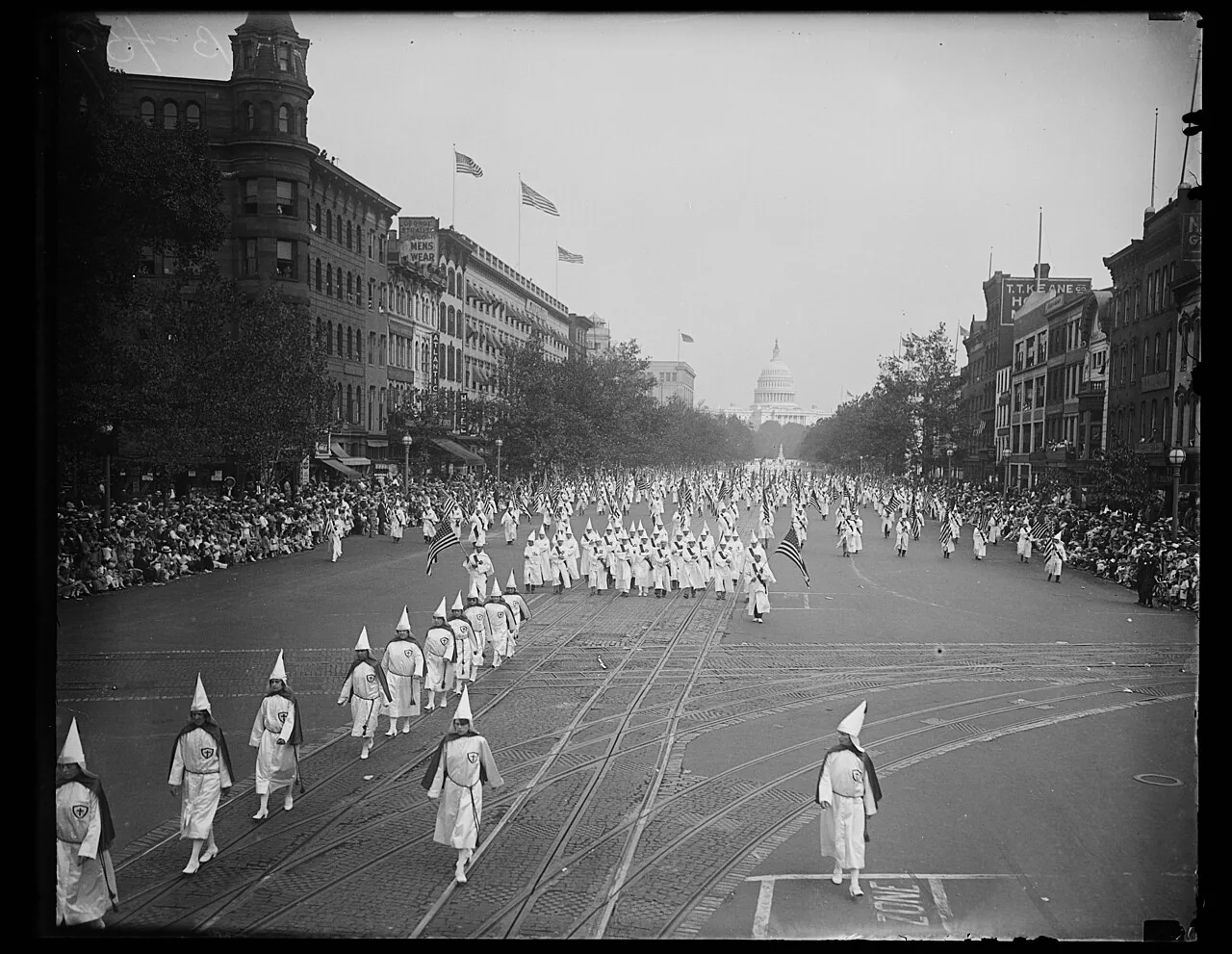
Source: Harris & Ewing, photograph, Washington, D.C., mid-1920s (image on Wikimedia Commons).
The photograph shows that the Klan marched openly, in daylight, in the nation’s capital. Thousands of Klansmen paraded there in 1925 and again in 1926, and some onlookers cheered while others turned away.
Another conflict was religious. In the 1920s many Protestants, called fundamentalists, defended a literal reading of the Bible and rejected the theory of evolution. In 1925 Tennessee passed the Butler Act, which forbade teaching that humans descended from lower animals in public schools. The American Civil Liberties Union offered to defend any teacher who broke the law, and a high school teacher in Dayton, John T. Scopes, agreed to be tried.
The trial in July 1925 became a national spectacle. The former presidential candidate William Jennings Bryan helped the prosecution; Clarence Darrow, a famous lawyer, defended Scopes. In a dramatic moment, Darrow called Bryan himself to the witness stand to question him about the Bible. Scopes was found guilty and fined $100; the Tennessee Supreme Court later overturned the conviction on a technicality. Bryan died five days after the trial ended.
Document 11 – Darrow and Bryan at Dayton
Mr. Bryan—The purpose is to cast ridicule on everybody who believes in the Bible, and I am perfectly willing that the world shall know that these gentlemen have no other purpose than ridiculing every Christian who believes in the Bible. Mr. Darrow—We have the purpose of preventing bigots and ignoramuses from controlling the education of the United States and you know it, and that is all.
Source: The World’s Most Famous Court Trial: Tennessee Evolution Case, official transcript of the Scopes trial, Dayton, Tennessee, day 7, July 20, 1925 (cross-examination of William Jennings Bryan by Clarence Darrow); text from Wikisource.
*ridicule: mocking. *ignoramuses: ignorant people. *bigots: people intolerant of other opinions.
Commentary. The transcript captures the clash. Bryan says that Darrow only wants to ridicule people who believe in the Bible; Darrow answers that he wants to stop “bigots and ignoramuses” from “controlling the education of the United States.” Each man speaks for a part of the country: Bryan for rural, religious Americans, Darrow for urban and modern ones. The case also raised a legal question that is still debated, namely what public schools may teach.
The Sacco and Vanzetti case showed the same fear of radicals and foreigners. Nicola Sacco and Bartolomeo Vanzetti, Italian immigrants and anarchists, were convicted of a robbery and murder in Massachusetts in 1921 on weak evidence, and they were executed in August 1927 despite worldwide protests.
4. From boom to bust
Behind the prosperity were weaknesses. Farmers, who had expanded production during the war, suffered from falling prices after 1920. Workers in older industries such as coal and textiles did not share in the growth, and about a half of American families had little or no savings. Wealth was concentrated, so the buying power of ordinary households did not keep up with production. Buying on credit meant that families had heavy debts. In the stock market, many investors bought shares on margin, that is, with borrowed money, and prices rose far above the value of the companies. At the end of the decade, a flood of unsold goods and an overheated market made the economy fragile.
The election of 1928 showed both the prosperity of the time and the cultural divisions. The Republican Herbert Hoover, an engineer and former head of relief efforts in Europe, promised a continuation of prosperity. The Democrat Alfred E. Smith, governor of New York, was the first Catholic nominated by a major party and opposed Prohibition. Hoover won 444 electoral votes to Smith’s 87, carrying even several Southern states.
Stock prices fell sharply on Thursday, October 24, 1929, known as Black Thursday, and collapsed on Tuesday, October 29. Fortunes were lost in a few days, and the crash was the start of the Great Depression, which is the subject of the next unit.
Document 12 – Crowds on Wall Street, 1929
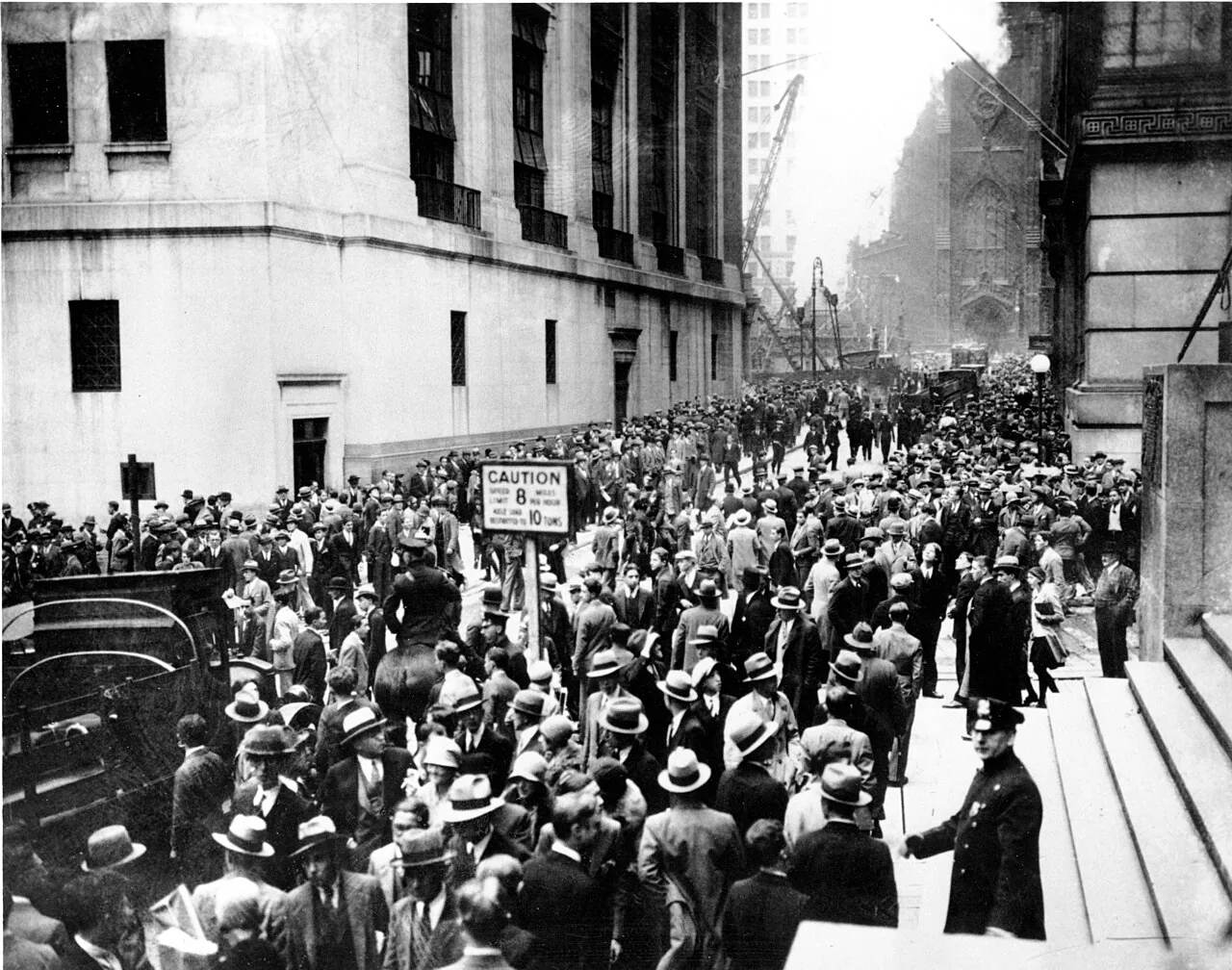
Source: photograph, Wall Street, October 1929 (image on Wikimedia Commons).
People gathered in the street outside the Stock Exchange to learn the news. The crash did not cause the Depression by itself, but it destroyed confidence and savings.
- 1919 Red Summer; Volstead Act passed; steel and police strikes.
- 1920 Prohibition begins; Nineteenth Amendment ratified; Harding elected; KDKA begins broadcasts.
- 1921 Emergency Quota Act.
- 1923 Harding dies; Coolidge becomes president.
- 1924 Immigration Act (Johnson-Reed).
- 1925 Scopes trial; Klan march in Washington; The Great Gatsby.
- 1927 Lindbergh flies the Atlantic; The Jazz Singer; Sacco and Vanzetti executed.
- 1928 Herbert Hoover elected.
- 1929 Stock market crash in October.
Key takeaways
- Mass production, cheap cars, electricity, radio, and credit created a consumer economy in the 1920s.
- Republican presidents Harding and Coolidge favored business and low taxes; Teapot Dome showed corruption.
- Flappers, jazz, and the Harlem Renaissance expressed new freedoms; the Great Migration moved hundreds of thousands of African Americans north.
- Immigration laws (1921, 1924), the revived Klan, and the Scopes trial show conflicts over race, religion, and tradition.
- Weak farm incomes, debts, and speculation made the economy fragile and led to the crash of October 1929.

Quick review: flashcards
Tap a card to see the answer.