


This US History Grade 11 lesson covers America Becomes a World Power, part of the unit “A modern nation.” First, read the full lesson with its primary sources, maps and key terms. Then practice with the worksheet, check yourself with the quiz and get ready with the test.
At about 9:40 on the evening of February 15, 1898, a tremendous explosion tore through the American battleship Maine as it lay at anchor in Havana harbor, Cuba. More than 260 sailors died. The ship had been sent to protect American citizens during a rebellion against Spanish rule. A Navy inquiry that spring blamed an external mine, though a later study in the 1970s suggested that a fire in a coal bunker may have set off the ship’s ammunition. The cause is still debated by historians.
At the time, however, newspapers in New York answered the question for their readers. The papers of William Randolph Hearst and Joseph Pulitzer, in a style called yellow journalism, filled their front pages with headlines and drawings blaming Spain. “Remember the Maine!” became a slogan. Within two months the United States was at war. By the end of the year it ruled colonies in the Caribbean and the Pacific. Twenty years later it sent an army across the Atlantic to fight in Europe. The country that had begun the century as a regional power became a world power.
Guiding question: Why did the United States become a world power between 1898 and 1920, and how did Americans disagree about the meaning of that power?
1. The roots of expansion
For most of the nineteenth century, Americans expanded across the continent. By 1890 the census said that the frontier had closed, and many leaders asked where the country would go next. Several forces pushed the nation overseas. American factories and farms produced more than the home market could buy, and businesses looked for foreign markets. Naval officer Alfred Thayer Mahan argued in The Influence of Sea Power upon History (1890) that great nations needed a strong navy, overseas bases, and a canal across Central America.
Congress began building a modern steel navy in the 1880s. Many missionaries believed in spreading Christianity and American ways abroad. Some Americans, influenced by Social Darwinism, believed that white Anglo-Saxon nations were destined to rule others, an idea that the historian today recognizes as racist. Even before 1898 the country had acquired Alaska, purchased from Russia in 1867 for $7.2 million, and the Midway Islands in the Pacific, claimed in the same year.
Hawaii and the Pacific
Hawaii was the first big test. American planters had built a sugar industry there and in 1887 forced the king to accept a constitution that limited his power. In January 1893, a group of planters and businessmen, supported by U.S. Marines landed from a warship, overthrew Queen Liliuokalani. President Grover Cleveland, who thought the overthrow unjust, refused to annex the islands. However, after William McKinley became president, Congress approved annexation by joint resolution in July 1898, during the war with Spain, partly because Hawaii would serve as a naval base on the way to the Philippines.
Definition: imperialism
a policy by which a nation extends its power by acquiring colonies or by controlling the political and economic life of other countries. American imperialism after 1898 included direct rule over the Philippines and Puerto Rico and indirect control over Cuba and parts of Central America.
Definition: yellow journalism
sensational newspaper reporting that exaggerates or distorts stories to attract readers. The New York newspapers of Hearst and Pulitzer used it to inflame public opinion against Spain.
2. The Spanish-American War, 1898
Cuba had been fighting for independence from Spain since 1895. Spanish General Valeriano Weyler moved the rural population into camps in order to cut off the rebels, and tens of thousands of civilians died of hunger and disease. American newspapers printed shocking accounts, and public sympathy for the Cubans grew.
In February 1898, the New York Journal published a private letter from the Spanish minister in Washington, Enrique Dupuy de Lôme, that insulted President McKinley, and a few days later the Maine exploded. McKinley, who did not want a war, finally asked Congress for authority to intervene. Congress passed a resolution that recognized Cuban independence and, through the Teller Amendment, promised that the United States would not annex the island. War was declared in April.
Document 1 – The explosion of the Maine
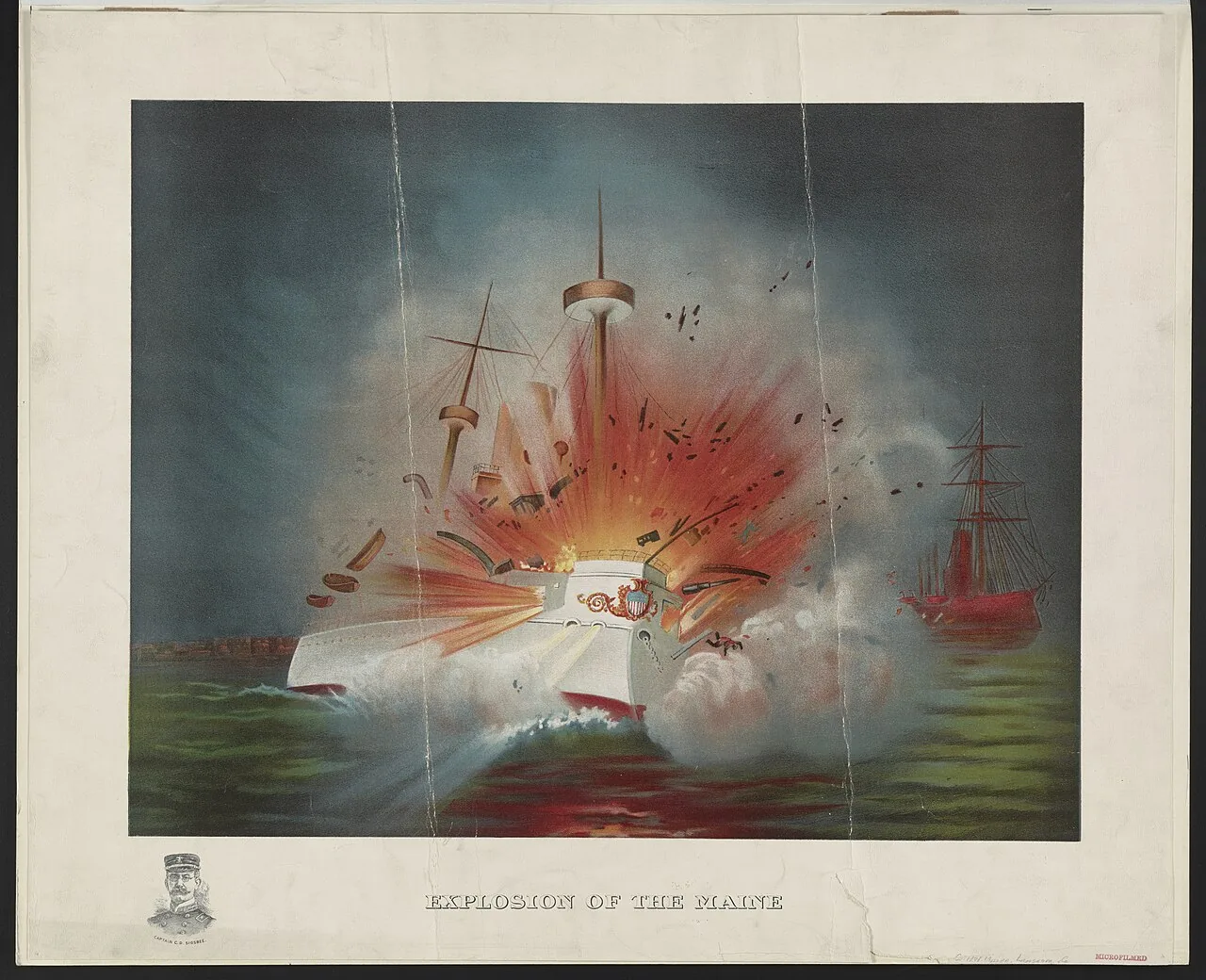
Source: color lithograph, 1898, Library of Congress (image on Wikimedia Commons).
Prints like this one sold quickly in the weeks after the explosion. The artist could not have seen the event, since it happened at night; he drew a dramatic picture to meet public demand. Such images show how the slogan “Remember the Maine” spread.
The war lasted only about ten weeks. On May 1, 1898, Commodore George Dewey led an American squadron into Manila Bay in the Philippines, another Spanish colony, and destroyed the Spanish fleet there without losing a ship. In Cuba, American troops landed near Santiago in June. On July 1 they attacked the heights of El Caney and San Juan; the cavalry regiments of Black soldiers, the Ninth and Tenth, fought beside the volunteer cavalry known as the Rough Riders, led by Lieutenant Colonel Theodore Roosevelt.
Two days later the U.S. Navy destroyed the Spanish fleet as it tried to leave Santiago harbor. Spain asked for peace in August. Secretary of State John Hay called it “a splendid little war.” Fewer than 400 Americans were killed in battle, but many more died of disease, such as typhoid and yellow fever, in poorly supplied camps.
Document 2 – Roosevelt and the Rough Riders
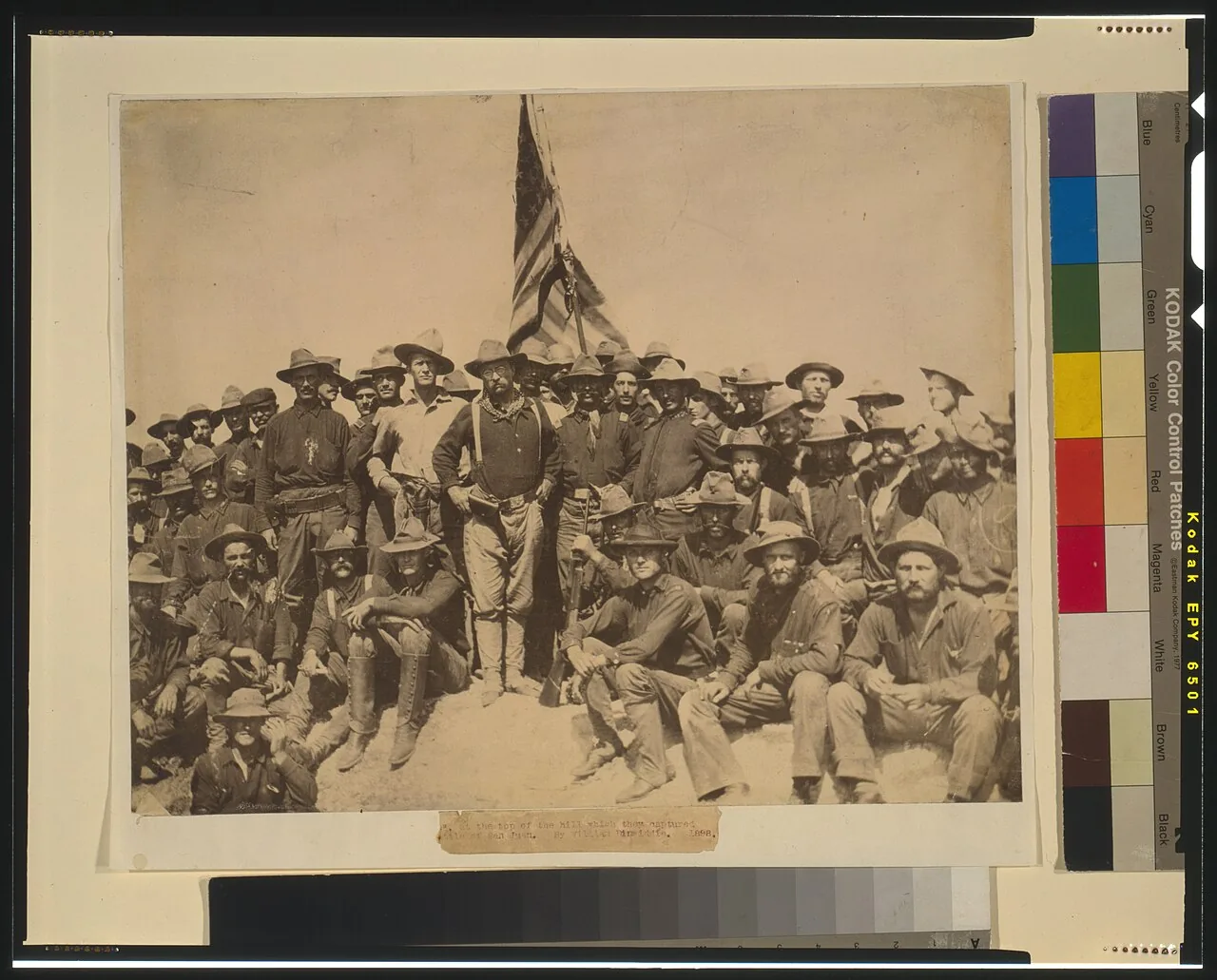
Source: William Dinwiddie, photograph, July 1898, Library of Congress (image on Wikimedia Commons).
Roosevelt, who had resigned as assistant secretary of the Navy to fight, returned a national hero, and in 1898 he was elected governor of New York. Newspapers and photographers made the Rough Riders famous, though the Black regular regiments, whose role was less often shown, played an important part in the battle.
In the Treaty of Paris (December 10, 1898), Spain gave up Cuba, ceded Puerto Rico and Guam to the United States, and sold the Philippines for $20 million. In all, the United States had gained overseas territory in the Caribbean and the Pacific and become a colonial power.
3. The debate over empire
Americans argued bitterly about whether the nation should keep the Philippines. Supporters spoke of trade, strategy, and duty. Albert Beveridge, a Republican senator from Indiana, delivered a famous speech in 1898 in which he argued that the nation could not retreat from its new duties and that peoples thought unready for self-government could rightly be governed without their consent.
Opponents joined the Anti-Imperialist League, founded in 1898, which included Mark Twain, Andrew Carnegie, Jane Addams, and the labor leader Samuel Gompers. They argued that taking colonies betrayed the principle of self-government in the Declaration of Independence and that cheap colonial labor would threaten American workers. The Senate approved the Treaty of Paris on February 6, 1899, by a vote of 57 to 27, only one vote more than the required two-thirds.
Document 3 – Senator Beveridge: the “March of the Flag”
We can not fly from our world duties; it is ours to execute the purpose of a fate that has driven us to be greater than our small intentions. We can not retreat from any soil where Providence has unfurled our banner; it is ours to save that soil for liberty and civilization.
Source: Albert J. Beveridge, “The March of the Flag,” campaign speech at Indianapolis, September 16, 1898; text from Wikisource.
*Providence: God’s guidance. *banner: flag.
Commentary. Beveridge treats expansion as a duty given by Providence, a word meaning God’s guidance of history: the nation “can not retreat” from any soil where Providence has unfurled the banner, and it is the nation’s task to “save that soil for liberty and civilization.” His speech combines economic ambition, religious language, and the assumption that some peoples could be governed without their consent. It was a campaign speech, so he spoke to a friendly audience and was not trying to be balanced.
Document 4 – Mark Twain, the anti-imperialist
Christendom has been playing it badly of late years, and must certainly suffer by it, in my opinion. She has been so eager to get every stake that appeared on the green cloth, that the People who Sit in Darkness have noticed it–they have noticed it, and have begun to show alarm. They have become suspicious of the Blessings of Civilization. More–they have begun to examine them. This is not well.
Source: Mark Twain, “To the Person Sitting in Darkness,” North American Review, February 1901; text from Wikisource.
*Christendom: the Christian nations. *besmirched: dirtied. *boodle: stolen money.
Commentary. Twain, a famous humorist, uses sarcasm. He pictures Christendom as a gambler so eager to win every stake on the green cloth that the “People who Sit in Darkness,” the peoples the missionaries and soldiers claim to be helping, have noticed and have grown suspicious of the “Blessings of Civilization.” He is not attacking those peoples but the claim that conquest is a blessing.
The Filipinos had not been consulted. Their leader, Emilio Aguinaldo, had declared independence in June 1898 and expected American support. Fighting between American and Filipino forces began on February 4, 1899, and became a long and brutal guerrilla war. About 4,200 American soldiers died, and hundreds of thousands of Filipino civilians died, mostly of disease and hunger, though estimates vary widely. Aguinaldo was captured in 1901, and President Roosevelt declared the war over on July 4, 1902. The Philippines remained an American possession until independence in 1946.
Document 5 – Kipling’s advice to America
Take up the White Man’s burden—
Send forth the best ye breed—
Go bind your sons to exile
To serve your captives’ need;
To wait in heavy harness,
On fluttered folk and wild—
Your new-caught, sullen peoples,
Half-devil and half-child.
Source: Rudyard Kipling, “The White Man’s Burden: The United States and the Philippine Islands,” first stanza, published in February 1899; text from Wikisource.
*burden: heavy load. *sullen: gloomy and resentful.
Commentary. The British poet Rudyard Kipling wrote this poem to urge the United States to take the Philippines. He calls the colonial peoples “half-devil and half-child.” The poem asks for sacrifice, but it also expresses the racist belief that white nations had a duty to rule people of color. It was widely printed in American newspapers, and opponents wrote parodies.
Cuba became a protectorate. The United States left in 1902 but required Cuba to add the Platt Amendment to its constitution. Among other terms, it gave the United States the right to intervene in Cuban affairs and to lease naval bases, which led to the base at Guantanamo Bay. Puerto Rico became a territory under the Foraker Act of 1900, and the Supreme Court ruled in the Insular Cases (1901) that the Constitution did not fully apply there or in other new territories.
4. The Open Door, the Big Stick, and the canal
The Philippines gave the United States a base near China, where European powers and Japan had divided areas of trade. In 1899 and 1900 Secretary of State John Hay sent notes to the powers asking them to keep an Open Door: equal trade for all nations in China and respect for China’s territory. The powers answered vaguely, but Hay announced that they had agreed. When the Boxer Rebellion, an uprising against foreigners, besieged the foreign legations in Peking in 1900, American troops joined an international force that relieved them.
Definition: Open Door
the American policy, announced by Secretary of State John Hay in 1899-1900, that all nations should have equal trading rights in China and that China’s territory should be respected.
Theodore Roosevelt believed that the nation should “speak softly and carry a big stick.” His greatest project was the Panama Canal. The United States wanted a route between the Atlantic and the Pacific, and in 1903 Colombia, which then controlled Panama, rejected a treaty offered by Hay. In November 1903 Panamanian rebels declared independence, and a U.S. warship prevented Colombian troops from landing.
The United States recognized Panama within days, and a treaty signed by the new nation gave the United States control of a canal zone about ten miles wide. Workers from the Caribbean islands did much of the digging, led by American engineers. Yellow fever and malaria had killed thousands of workers in an earlier French attempt, and the army doctor William Gorgas cleared the mosquitoes that carried the diseases. Still, thousands of workers died building the canal, which opened on August 15, 1914.
Document 6 – The Roosevelt Corollary
Chronic wrongdoing, or an impotence which results in a general loosening of the ties of civilized society, may in America, as elsewhere, ultimately require intervention by some civilized nation, and in the Western Hemisphere the adherence of the United States to the Monroe Doctrine may force the United States, however reluctantly, in flagrant cases of such wrongdoing or impotence, to the exercise of an international police power.
Source: Theodore Roosevelt, Annual Message to Congress, December 6, 1904 (the Roosevelt Corollary to the Monroe Doctrine); text from Wikisource.
*impotence: powerlessness. *Monroe Doctrine: the 1823 declaration that Europe should not interfere in the Americas.
Commentary. In 1904 European nations were threatening to use force to collect debts from the Dominican Republic. Roosevelt answered that the United States would act as an “international police power” in the Western Hemisphere. The Monroe Doctrine of 1823 had warned Europe to stay out; the Roosevelt Corollary claimed a right for the United States to intervene in Latin American countries. Latin American leaders protested.
Document 7 – The Big Stick in the Caribbean
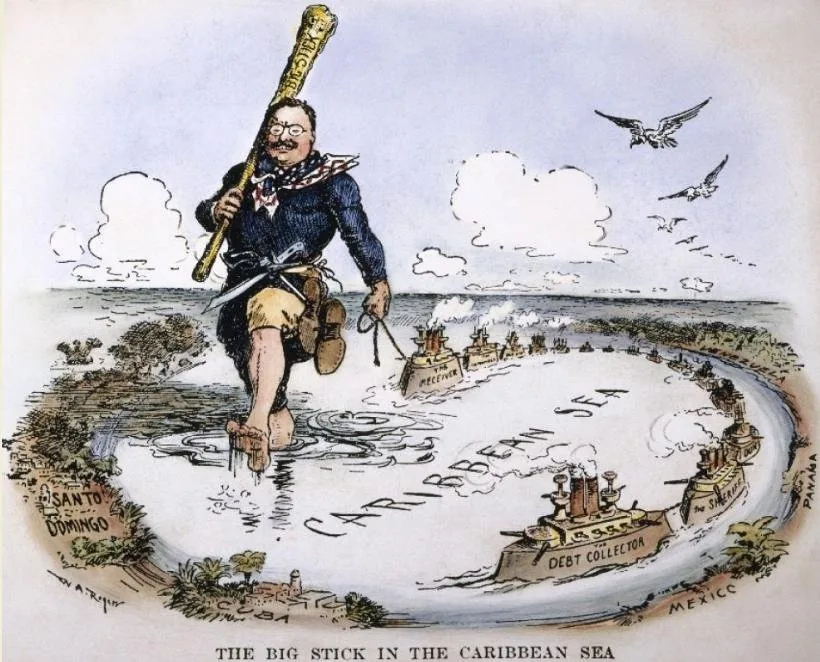
Source: William Allen Rogers, cartoon, 1904 (image on Wikimedia Commons).
The cartoonist shows Roosevelt as a giant towering over the small islands and republics of the Caribbean. The phrase “big stick” comes from the saying “speak softly and carry a big stick.” The cartoon may be read as praise or as criticism, depending on the viewer.
Document 8 – Roosevelt at the Culebra Cut
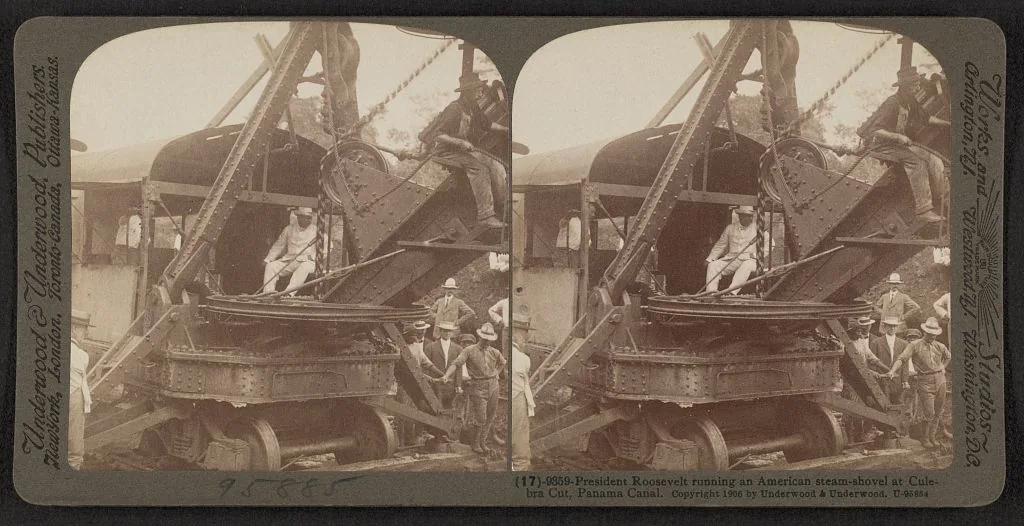
Source: stereograph, 1906, Library of Congress (image on Wikimedia Commons).
The Culebra Cut was the deepest part of the canal, cut through the continental divide. Roosevelt’s visit was the first time a sitting president left the country, and the photographs made the canal a symbol of American energy and skill.
Roosevelt’s successors used force and money. President William Howard Taft practiced what was called dollar diplomacy, using American loans to increase American influence abroad. Woodrow Wilson promised a more moral policy but sent troops to Mexico (Veracruz, 1914), Haiti (1915), and the Dominican Republic (1916), and he purchased the Virgin Islands from Denmark in 1917 for $25 million.
Marines remained in Haiti until 1934 and in Nicaragua with some breaks from 1912 to 1933. Roosevelt also helped to end the Russo-Japanese War through the Treaty of Portsmouth (1905), for which he won the Nobel Peace Prize in 1906, and sent the Great White Fleet of sixteen battleships on a voyage around the world from 1907 to 1909 to show American naval power.
5. The United States in the First World War
When war broke out in Europe in 1914, President Wilson declared neutrality and asked Americans to be “impartial in thought as well as in action.” The United States traded with both sides, but British control of the seas meant most trade went to Britain and France, and American banks lent them large sums. The German navy used submarines against British shipping. On May 7, 1915, a German submarine sank the British liner Lusitania off Ireland, killing 1,198 people, among them 128 Americans. Wilson sent strong protests, and in 1916 Germany promised to limit submarine attacks. Wilson won reelection in 1916 with the slogan “He kept us out of war.”
In early 1917, Germany decided to gamble. It announced on January 31 that from February 1 its submarines would sink without warning any ship in the war zone, hoping to starve Britain before the United States could act. In secret, Foreign Secretary Arthur Zimmermann sent a telegram to the German minister in Mexico proposing an alliance if the United States entered the war. British intelligence decoded the message and passed it to Washington, and newspapers published it on March 1. Americans were outraged. After German submarines sank several American merchant ships, Wilson asked Congress for a declaration of war on April 2, 1917, and Congress voted for war on April 6.
Document 9 – The Zimmermann telegram
We intend to begin on the first of February unrestricted submarine warfare. We shall endeavor in spite of this to keep the United States of America neutral. In the event of this not succeeding, we make Mexico a proposal of alliance on the following basis: make war together, make peace together, generous financial support and an understanding on our part that Mexico is to reconquer the lost territory in Texas, New Mexico, and Arizona. The settlement in detail is left to you.
Source: telegram from German Foreign Secretary Arthur Zimmermann to the German minister in Mexico, January 16, 1917, as decoded by British intelligence and released to the American press on March 1, 1917; English text from Wikisource.
*neutral: not taking either side in a war. *reconquer: conquer again.
Commentary. The message offers Mexico a “generous financial support” and the return of Texas, New Mexico, and Arizona if it joins Germany. Mexico, weakened by its own revolution, did not take the offer seriously, but the telegram helped to turn American opinion in favor of the war because it seemed to show that Germany threatened the United States directly.
Document 10 – Wilson asks for war
The world must be made safe for democracy. Its peace must be planted upon the tested foundations of political liberty. We have no selfish ends to serve. We desire no conquest, no dominion. We seek no indemnities for ourselves, no material compensation for the sacrifices we shall freely make. We are but one of the champions of the rights of mankind. We shall be satisfied when those rights have been made as secure as the faith and the freedom of nations can make them.
Source: Woodrow Wilson, address to a joint session of Congress asking for a declaration of war, April 2, 1917; text from Wikisource.
*dominion: rule over others. *indemnities: payments for damages.
Commentary. Wilson gives the war a moral purpose: not conquest but the defense of democracy and the rights of mankind. The sentence “The world must be made safe for democracy” became famous. At the same time, the claim that the United States had “no selfish ends” passed over the real causes, such as the submarine attacks and economic ties with the Allies.
The country had a small army, so Congress passed the Selective Service Act in May 1917, and about four million Americans served in uniform, more than two million of them in Europe under General John J. Pershing in the American Expeditionary Forces. Americans arrived in numbers in 1918 and took part in the Allies’ final offensives, including the Meuse-Argonne campaign (September to November 1918). Germany signed an armistice on November 11, 1918. About 116,000 Americans died in the war, more than half of them from disease, especially the influenza epidemic of 1918.
On the home front, the government mobilized the economy through agencies that set prices and controlled railroads and food. The Committee on Public Information, headed by George Creel, ran propaganda campaigns, and the Treasury sold billions of dollars in Liberty Bonds. The Espionage Act (1917) and the Sedition Act (1918) made it a crime to interfere with the war effort or criticize the government, and hundreds of people, among them the Socialist leader Eugene V. Debs, were sentenced to prison for speaking against the war. Women filled factory jobs, and hundreds of thousands of African Americans left the South for Northern industries, starting the Great Migration.
Document 11 – Uncle Sam wants you
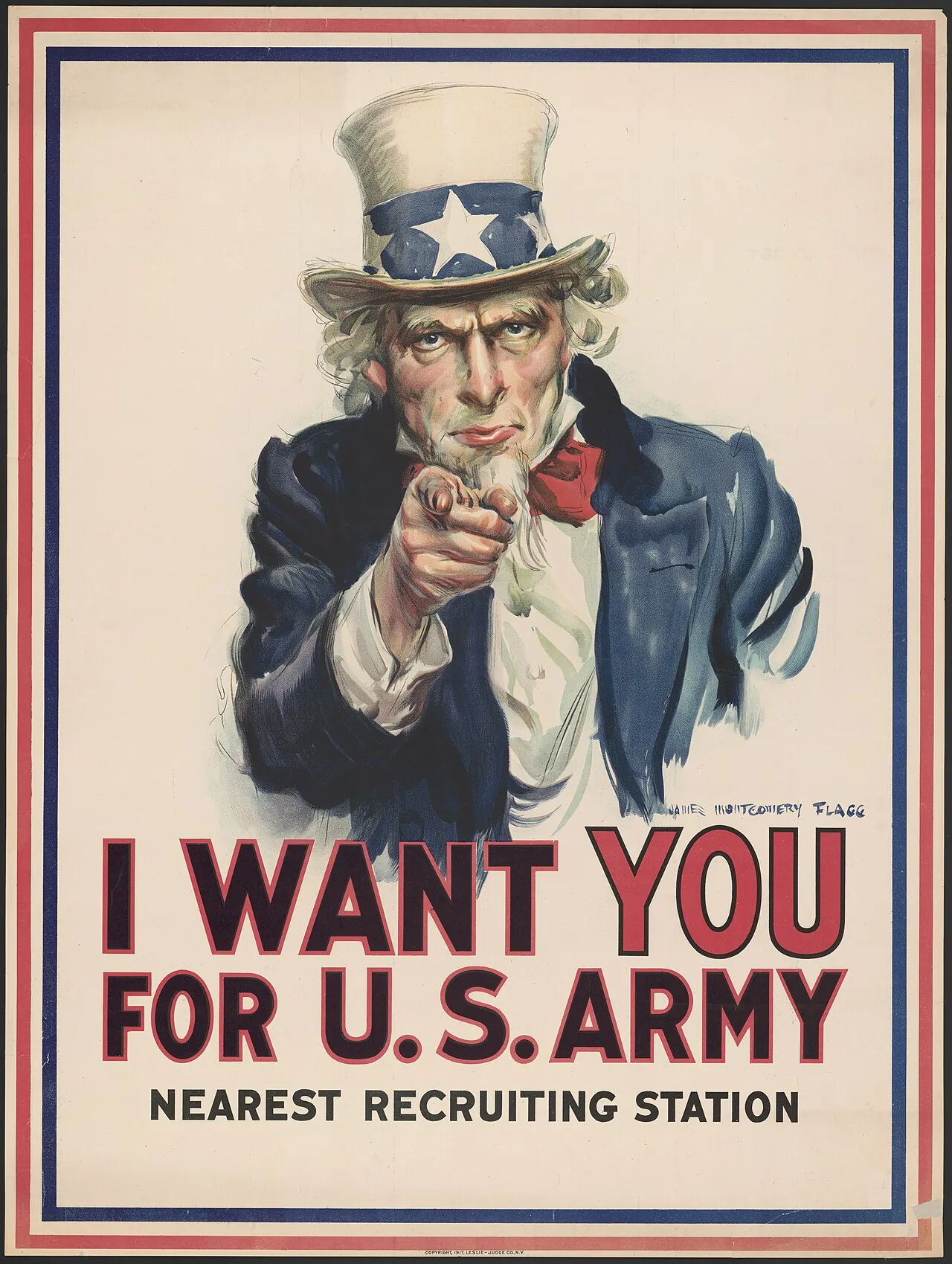
Source: James Montgomery Flagg, poster, 1917 (image on Wikimedia Commons).
Flagg modeled Uncle Sam on a British poster of Lord Kitchener and used his own face. Millions of copies were printed and posted in the United States during the war.
Document 12 – Selling the war
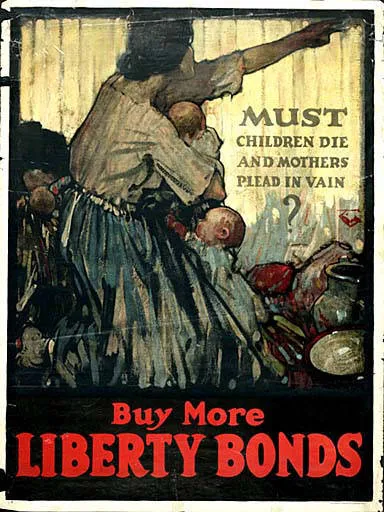
Source: U.S. Treasury Department poster, World War I (image on Wikimedia Commons).
The poster appeals to fear and pity. It shows how the government used emotion and persuasion to sell Liberty Bonds, which helped to pay for the war.
6. Peace and the League of Nations
Wilson set out his goals for peace in an address to Congress on January 8, 1918, known as the Fourteen Points. They included open diplomacy, freedom of the seas, free trade, arms reductions, self-determination for the peoples of Europe, and, in the last point, a general association of nations to guarantee the independence of all states.
Document 13 – Wilson’s Fourteen Points
I. Open covenants of peace, openly arrived at, after which there shall be no private international understandings of any kind but diplomacy shall proceed always frankly and in the public view. […] XIV. A general association of nations must be formed under specific covenants for the purpose of affording mutual guarantees of political independence and territorial integrity to great and small states alike.
Source: Woodrow Wilson, address to Congress on war aims (the Fourteen Points), January 8, 1918, points I and XIV; text from the Avalon Project, Yale Law School.
*covenants: formal agreements. *territorial integrity: the right of a state to keep its borders.
At the Paris Peace Conference in 1919, Wilson, the first president to travel to Europe while in office, met with the leaders of Britain, France, and Italy. They had suffered far more than the United States and wanted security and payment for damage. The Treaty of Versailles, signed on June 28, 1919, took territory from Germany, limited its army, required it to pay reparations, and included Article 231, which stated that Germany and its allies were responsible for the loss and damage of the war. Many Germans called the article a “war guilt clause” and resented it. The treaty also created the League of Nations, which Wilson had insisted on.
Document 14 – Article 231 of the Treaty of Versailles
The Allied and Associated Governments affirm and Germany accepts the responsibility of Germany and her allies for causing all the loss and damage to which the Allied and Associated Governments and their nationals have been subjected as a consequence of the war imposed upon them by the aggression of Germany and her allies.
Source: Treaty of Versailles, June 28, 1919, Part VIII (Reparation), Article 231; text from the Avalon Project, Yale Law School.
*aggression: an attack without just cause. *allies: nations fighting on the same side.
In the United States the treaty met strong opposition in the Senate. Republican Senator Henry Cabot Lodge and others were willing to approve it only with reservations, especially about Article 10 of the League covenant, which they feared would commit the country to defend other nations without a vote in Congress. A small group of senators, the “irreconcilables,” opposed any League. Wilson refused to compromise and toured the country to win support; in October 1919 he suffered a stroke, which left him weak. The Senate voted against the treaty in November 1919 and again in March 1920. The United States never joined the League, and in 1921 it made a separate peace with Germany.
- 1867 The United States buys Alaska from Russia.
- 1893 Planters overthrow Queen Liliuokalani in Hawaii.
- 1898 Explosion of the Maine; Spanish-American War; annexation of Hawaii.
- 1899 Philippine-American War begins; Open Door notes.
- 1903 Panama declares independence; the canal treaty is signed.
- 1904 Roosevelt Corollary.
- 1914 The Panama Canal opens; war begins in Europe.
- 1917 Zimmermann telegram; the United States enters World War I.
- 1918 Fourteen Points; armistice on November 11.
- 1919-1920 Senate rejects the Treaty of Versailles.
Key takeaways
- Economic growth, naval power, and ideas of national mission pushed the United States to expand overseas after 1890.
- The Spanish-American War of 1898 gave the United States colonies in the Caribbean and the Pacific, including the Philippines.
- Anti-imperialists argued that colonies contradicted American ideals; the Philippine-American War (1899-1902) was long and costly.
- Roosevelt’s Big Stick policy, the Panama Canal, and the Roosevelt Corollary made the United States the dominant power in the Caribbean.
- German submarine warfare and the Zimmermann telegram brought the United States into World War I in April 1917.
- The Senate rejected the Treaty of Versailles and the League of Nations, though the United States had become the world’s leading economic power.

Quick review: flashcards
Tap a card to see the answer.