


This US History Grade 11 lesson covers The Progressive Era, part of the unit “A modern nation.” First, read the full lesson with its primary sources, maps and key terms. Then practice with the worksheet, check yourself with the quiz and get ready with the test.
On Saturday afternoon, March 25, 1911, a fire broke out in a scrap bin on the eighth floor of the Asch Building, just east of Washington Square in New York. The Triangle Shirtwaist Company, which made women’s blouses, filled the top three floors, and about five hundred workers, most of them young immigrant women, were at their machines. The fire spread quickly through the cloth and paper. One stairway door was locked, a fire escape collapsed, and the fire department’s ladders reached only to the sixth floor.
A hundred and forty-six people died within half an hour, some of them jumping from the windows. Crowds of New Yorkers saw it happen. Within a few months the state set up a Factory Investigating Commission, and over the next few years New York passed some of the strongest worker-safety laws in the country. The fire became a symbol of a movement that tried to answer the problems of the Gilded Age with action by citizens and government. This movement is called Progressivism.
Guiding question: How did Progressive reformers try to fix the problems of industrial America between about 1900 and 1920, and whose problems did they leave unsolved?
1. The roots of Progressivism
By 1900 many Americans believed that the country had grown rich but not fair. Cities were crowded, factories were dangerous, and a few large corporations controlled whole industries. Progressivism was not one organized party. It was a broad set of reform efforts that arose in cities and states first and then in Washington.
Its supporters came mostly from the growing urban middle class: lawyers, teachers, doctors, ministers, journalists, and social workers. They shared three beliefs. First, they believed that problems could be solved through knowledge and expert study. They believed that government should regulate business and protect those who could not protect themselves. Finally, they believed that democracy needed to be more direct. Voters, and not party bosses, should control politics.
Definition: Progressivism
the reform movement of about 1900 to 1920 that sought to use government, expert knowledge, and citizen action to correct the problems of industrialization, such as corruption, unsafe working conditions, monopoly, and urban poverty.
Journalists played a key role. Writers whom Theodore Roosevelt called muckrakers investigated and exposed abuses. Ida Tarbell published a history of the Standard Oil company in McClure’s Magazine in 1902-1904. Lincoln Steffens wrote about corrupt city governments in The Shame of the Cities (1904). In 1906 the novelist Upton Sinclair published The Jungle, a story about immigrant workers in the Chicago stockyards. Sinclair, a socialist, hoped to win sympathy for the workers. Readers were most struck by his descriptions of the meat itself, and public disgust helped Congress pass new laws on food safety.
Document 1 – Upton Sinclair in the stockyards
These rats were nuisances, and the packers would put poisoned bread out for them; they would die, and then rats, bread, and meat would go into the hoppers together. This is no fairy story and no joke; the meat would be shoveled into carts, and the man who did the shoveling would not trouble to lift out a rat even when he saw one—there were things that went into the sausage in comparison with which a poisoned rat was a tidbit.
Source: Upton Sinclair, The Jungle, 1906, chapter 14; text from Project Gutenberg.
*nuisances: pests. *tidbit: a choice small piece of food.
Commentary. Sinclair writes in short, blunt sentences to make a point: the packers did not clean up before grinding meat into sausage. His claim that rats, poisoned bread, and meat all went into the hoppers together is the kind of detail that troubled readers in 1906. Sinclair wrote a novel, so historians check his details against government investigations, which found real problems with sanitation in the plants.
Definition: muckraker
a journalist or writer of the early 1900s who investigated and exposed corruption, abuses of power, and unsafe conditions. The name was given by Theodore Roosevelt in 1906 and was meant as a criticism, though it became a badge of honor.
Reformers also worked in neighborhoods. In 1889 Jane Addams and Ellen Gates Starr opened Hull House in a poor immigrant district of Chicago. Hull House was a settlement house: a community center where educated, middle-class volunteers lived among the poor and offered kindergartens, classes in English, a gym, and a place to meet. Addams and her colleagues also collected data about housing, child labor, and sanitation and lobbied for laws. Many Protestant ministers took up the Social Gospel, the idea that Christians must work to improve society, and Jewish and Catholic organizations also ran charities and schools.
2. Reform in cities and states
Progressives first tried to clean up local government. After a hurricane destroyed Galveston, Texas, in 1900, the city turned its government over to a commission of experts. The idea of a commission or a city manager then spread to hundreds of cities. In Wisconsin, Governor Robert La Follette brought university professors into state government and pushed through the direct primary, laws to regulate railroads, and a state income tax. Observers called these efforts the “Wisconsin Idea.” Several western states, led by Oregon, adopted three new tools. The initiative lets citizens propose a law by petition. The referendum lets voters approve or reject a law. The recall allows voters to remove an official before the end of a term.
Definition: direct democracy
political reforms that let citizens vote on laws or officials without going through the legislature or party bosses. The initiative, the referendum, the recall, and the direct primary are examples.
The same spirit produced four amendments to the Constitution between 1913 and 1920. The Sixteenth Amendment (1913) allowed Congress to levy an income tax, which the Populists had demanded. The Seventeenth (1913) required the direct election of senators by voters, instead of by state legislatures. The Eighteenth (1919) prohibited the manufacture and sale of alcohol, a cause supported by many reformers who blamed drink for poverty and violence in homes. The Nineteenth (1920) guaranteed women the right to vote.
Working conditions and child labor
Reform of working life was slow, because courts often struck down laws that limited hours or wages. In Lochner v. New York (1905) the Supreme Court overturned a New York law limiting the working hours of bakers, ruling that it interfered with the “freedom of contract.” In Muller v. Oregon (1908), after the lawyer Louis Brandeis presented a brief full of medical and social evidence, the Court upheld a law limiting women’s hours in laundries.
The National Child Labor Committee, founded in 1904, hired the photographer Lewis Hine to document young workers in mills, mines, and canneries. His pictures were shown at meetings and in magazines. Congress passed a federal child labor law in 1916, but the Supreme Court struck it down in 1918. A lasting national law did not come until the New Deal.
Document 2 – A girl in a Georgia cotton mill
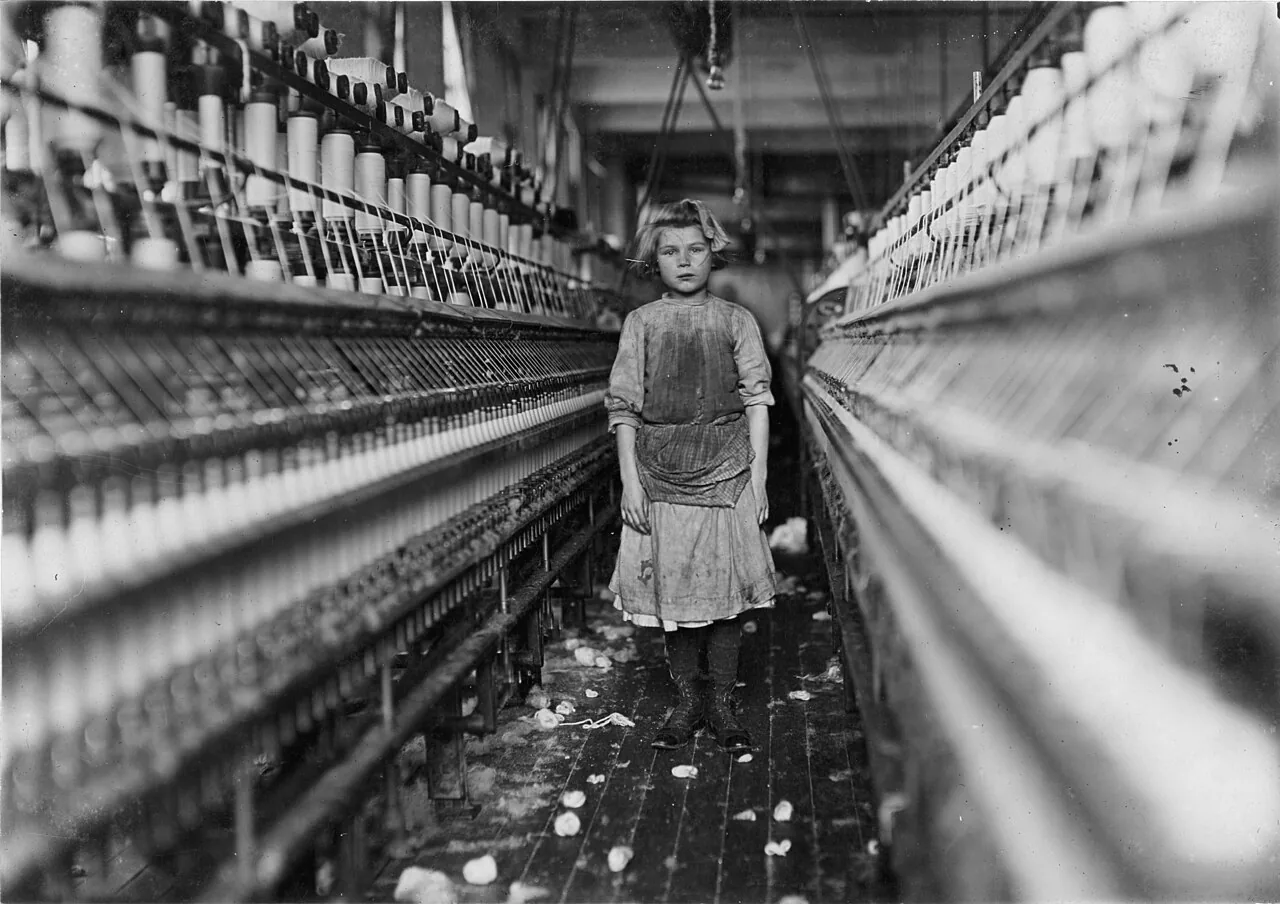
Source: Lewis Hine, 1909, photograph for the National Child Labor Committee (image on Wikimedia Commons).
Hine often posed workers next to machinery to show their small size. He sometimes lied about why he was visiting a mill in order to get past guards. He also noted the children’s names, ages, and wages in his captions.
Document 3 – Fire at the Triangle factory
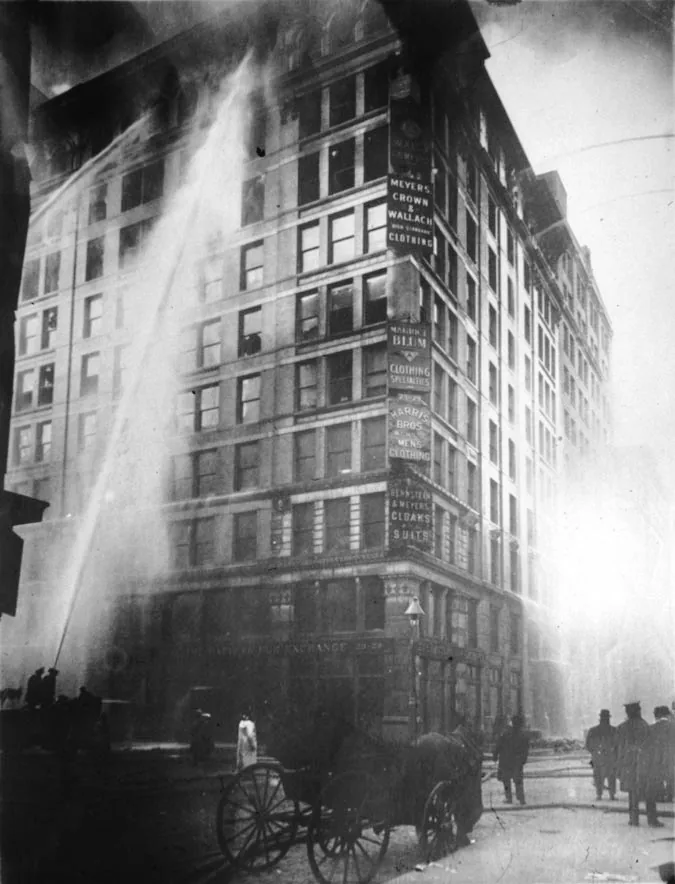
Source: photograph, New York City, March 25, 1911 (image on Wikimedia Commons).
The owners of the company were tried for manslaughter and acquitted in December 1911. They later paid small damages in civil suits. The investigation that followed made workers’ safety a public issue.
3. Progressivism in Washington
Theodore Roosevelt and the Square Deal
Theodore Roosevelt became president in September 1901 after the assassination of William McKinley, and at 42 he was the youngest president in history. He believed that the president should act as “steward of the public welfare.” He called his program the Square Deal: fair treatment for workers, business owners, and consumers. In 1902 coal miners went on strike. Roosevelt called both sides to the White House and threatened to run the mines with the army.
The owners agreed to arbitration, and the miners won a pay raise and shorter hours. The president also had the Justice Department sue the Northern Securities Company, a giant railroad holding company, and the Supreme Court ordered it dissolved in 1904. This earned him a reputation as a “trust-buster.” However, he believed that big companies were acceptable if they behaved well, and he preferred regulation to breaking them up.
Document 4 – The Standard Oil octopus
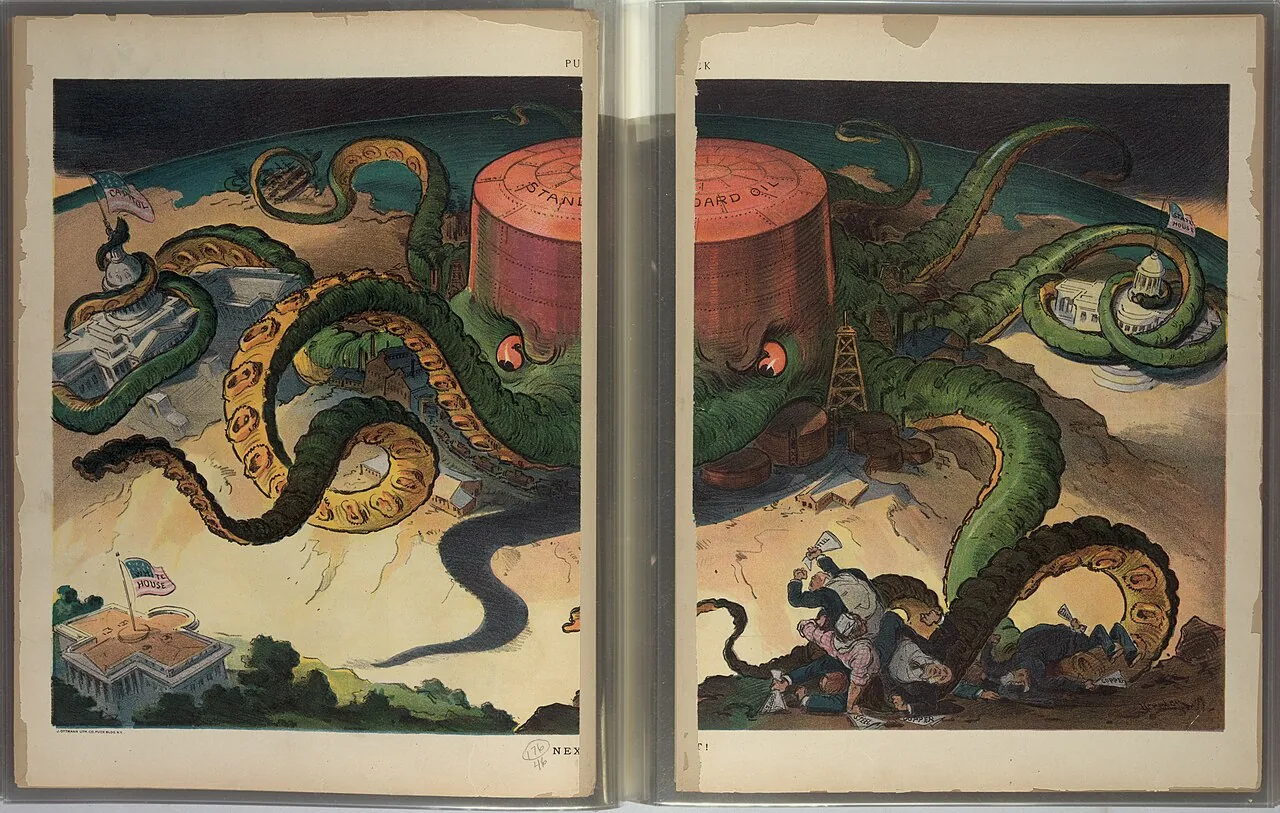
Source: Udo J. Keppler, Puck, 1904 (image on Wikimedia Commons).
Keppler’s octopus, with arms reaching into industries and legislatures, is the best known image of the fear of monopoly. Standard Oil was ordered broken up by the Supreme Court in 1911.
In 1906, Roosevelt signed the Meat Inspection Act and the Pure Food and Drug Act, which set sanitary standards for meatpackers and banned false labels on foods and medicines, and the Hepburn Act, which gave the Interstate Commerce Commission power to set maximum railroad rates. He also began a program of conservation. With the forester Gifford Pinchot, who headed the new Forest Service in 1905, he placed about 230 million acres of land under federal protection as national forests, parks, monuments, and wildlife refuges. The Antiquities Act of 1906 allowed presidents to set aside historic and natural sites as national monuments.
Document 5 – Roosevelt and the muckrakers
There are in the body politic, economic and social, many and grave evils, and there is urgent necessity for the sternest war upon them. There should be relentless exposure of and attack upon every evil man, whether politician or business man, every evil practice, whether in politics, business, or social life.
Source: Theodore Roosevelt, “The Man with the Muck-Rake,” speech at the laying of the cornerstone of the House Office Building, Washington, April 14, 1906; text from Wikisource.
*evils: harmful conditions. *politician: here, a professional office-seeker.
Commentary. Roosevelt shows two sides of his reform thinking. He agrees that there are “many and grave evils” that need “the sternest war.” In the same speech, however, he warns against writers who see only filth and who forget the good in the country; the muck-rake is the tool in John Bunyan’s Pilgrim’s Progress held by a man who never looks up. Progressives often wanted to reform without destroying the system.
Definition: conservation
the managed protection and wise use of natural resources such as forests, water, and wildlife. Roosevelt’s conservation program set aside about 230 million acres of public land.
The election of 1912
William Howard Taft, whom Roosevelt chose as his successor, won the election of 1908, but he lost the support of many progressives when he signed a high tariff and sided with a conservative cabinet member in a conservation dispute. Roosevelt broke with Taft. After the Republicans renominated Taft in 1912, he formed the Progressive Party, nicknamed the Bull Moose Party because Roosevelt said he felt “as fit as a bull moose.” On the campaign trail in Milwaukee in October 1912 he was shot in the chest and finished his speech before going to the hospital.
In his speech at Osawatomie, Kansas, in 1910, Roosevelt had set out a program he called the New Nationalism: a strong national government to regulate big business and protect workers. The Democratic candidate, Governor Woodrow Wilson of New Jersey, a former president of Princeton University, offered the New Freedom: break up the trusts and restore competition. The split in the Republican vote let Wilson win with only about 42 percent of the popular vote.
Document 6 – The New Nationalism, 1910
We are face to face with new conceptions of the relations of property to human welfare, chiefly because certain advocates of the rights of property as against the rights of men have been pushing their claims too far. The man who wrongly holds that every human right is secondary to his profit must now give way to the advocate of human welfare, who rightly maintains that every man holds his property subject to the general right of the community to regulate its use to whatever degree the public welfare may require it.
Source: Theodore Roosevelt, “The New Nationalism,” speech at Osawatomie, Kansas, August 31, 1910; text from Wikisource.
*advocate: supporter. *regulate: control by rules.
Commentary. This passage reverses an old argument. Business leaders said property rights came first; Roosevelt says that human welfare comes first and that every owner holds his property “subject to the general right of the community to regulate its use.” Conservatives answered that such language threatened liberty and property. The speech shows how Progressives enlarged the idea of the role of government.
Wilson’s first term, 1913-1917, was among the most productive of any president. The Underwood Tariff lowered duties and, with the Sixteenth Amendment, created an income tax; the Federal Reserve Act of 1913 created a central banking system of twelve regional banks; the Federal Trade Commission Act and the Clayton Antitrust Act of 1914 set up a body to police unfair business practices and strengthened antitrust law, and the Clayton Act also said that labor unions are not trusts. Wilson, however, accepted racial segregation in the federal government, which spread through some federal offices during his administration, and he did not support a federal suffrage amendment until 1918.
4. Women, African Americans, and the limits of reform
The vote for women
The movement for women’s suffrage began at the Seneca Falls Convention in New York in July 1848, where Elizabeth Cady Stanton and Lucretia Mott led a meeting that adopted a Declaration of Sentiments modeled on the Declaration of Independence. After the Civil War the movement split over whether to support the Fifteenth Amendment, which gave Black men but not women the vote. The two groups reunited in 1890 as the National American Woman Suffrage Association (NAWSA). Western states granted women the vote first, beginning with Wyoming Territory in 1869. Progressives argued that women, as mothers and workers, would bring fresh reform to politics, and opponents argued that women belonged at home.
Document 7 – The Declaration of Sentiments, 1848
We hold these truths to be self-evident; that all men and women are created equal; that they are endowed by their Creator with certain inalienable rights; that among these are life, liberty, and the pursuit of happiness; that to secure these rights governments are instituted, deriving their just powers from the consent of the governed.
Source: Declaration of Sentiments, Seneca Falls Convention, July 19-20, 1848; text from Wikisource.
*inalienable: that cannot be taken away. *instituted: set up.
Commentary. The authors copy the form of the Declaration of Independence but add two words: “men and women.” They use the principle of consent of the governed, which the founders had stated, to claim the vote. The convention’s resolution on the vote was the only one that did not pass unanimously, since some supporters thought it too radical. It took seventy-two years from this meeting to the Nineteenth Amendment.
In the 1910s the movement grew and divided over tactics. Carrie Chapman Catt, who led NAWSA after 1915, organized state-by-state campaigns and then a push for a federal amendment. Alice Paul, who had seen militant suffragists in Britain, led a younger group that later formed the National Woman’s Party. On March 3, 1913, the day before Woodrow Wilson’s inauguration, Paul organized a large suffrage parade in Washington, and a mob of onlookers attacked some of the marchers.
From January 1917 the “Silent Sentinels” picketed the White House; some were arrested and jailed, and their treatment brought sympathy. When the United States entered the First World War, women’s work in factories, hospitals, and offices strengthened the case. Wilson endorsed a federal amendment in January 1918. Congress approved it in June 1919, and Tennessee became the thirty-sixth state to ratify on August 18, 1920.
Document 8 – The 1913 suffrage procession
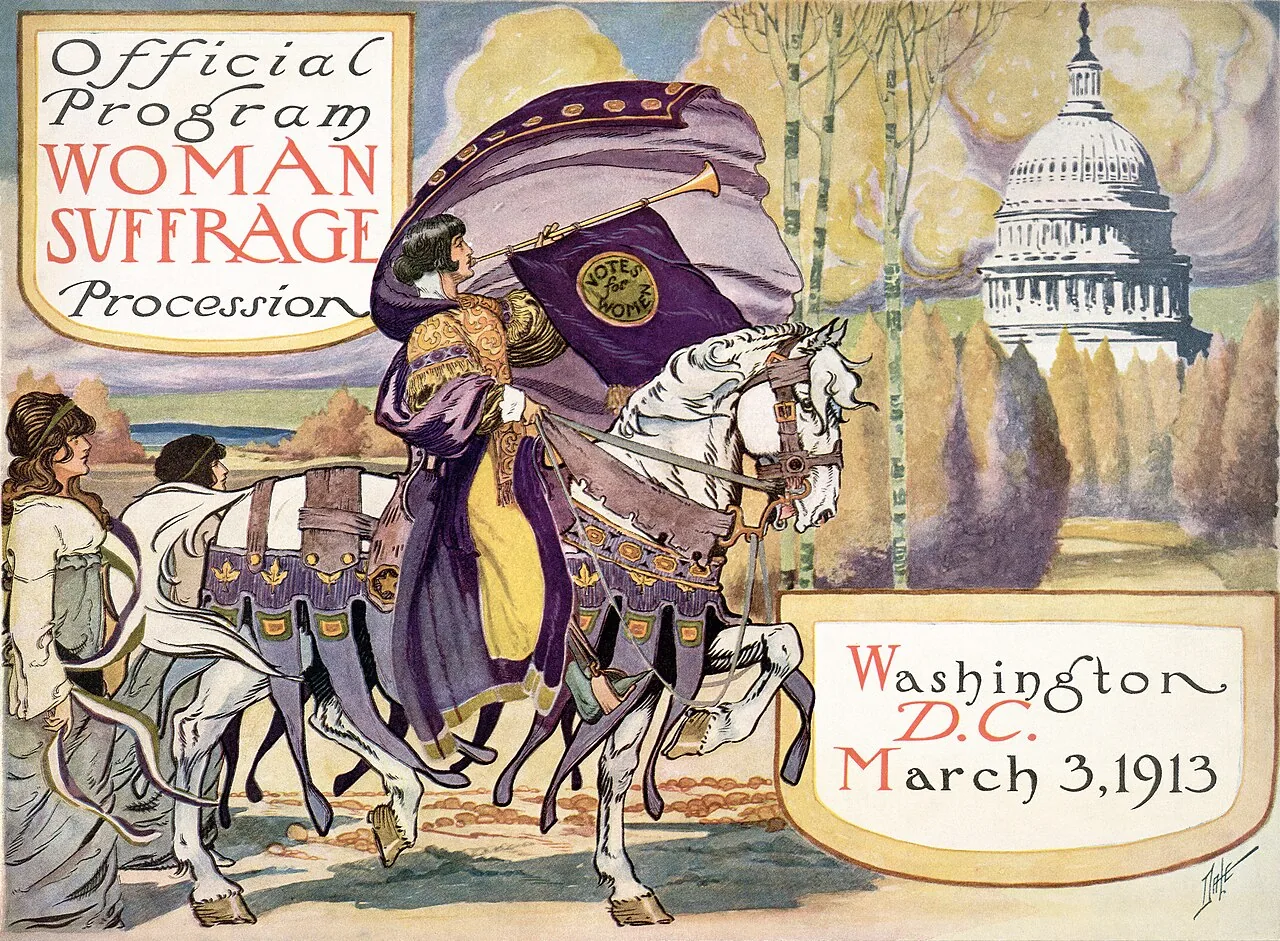
Source: official program, March 3, 1913 (image on Wikimedia Commons).
The herald on a white horse refers to Inez Milholland, who led the parade in a white cape on a white horse. Using the Capitol dome shows that the marchers wanted to make their demand to Congress. The Nineteenth Amendment did not remove the barriers of poll taxes and intimidation that kept many Black women in the South from voting for decades.
Race and reform
Most Progressive reformers ignored or accepted racial segregation. Black Americans had to act for themselves. W. E. B. Du Bois, who in 1895 became the first African American to receive a Ph.D. from Harvard, criticized the program of Booker T. Washington in his book The Souls of Black Folk (1903). In 1905 he helped found the Niagara Movement, which demanded full civil rights.
In 1909, after a violent race riot in Springfield, Illinois, in 1908, a group of Black and white reformers founded the National Association for the Advancement of Colored People (NAACP), with Du Bois as editor of its magazine, The Crisis. Journalist Ida B. Wells-Barnett continued her campaign against lynching. These organizations used the courts and the press and prepared the way for the civil rights movement.
Document 9 – Du Bois on Booker T. Washington
Mr. Washington represents in Negro thought the old attitude of adjustment and submission; but adjustment at such a peculiar time as to make his programme unique. This is an age of unusual economic development, and Mr. Washington’s programme naturally takes an economic cast, becoming a gospel of Work and Money to such an extent as apparently almost completely to overshadow the higher aims of life.
Source: W. E. B. Du Bois, The Souls of Black Folk, 1903, chapter 3, “Of Mr. Booker T. Washington and Others”; text from Project Gutenberg.
*programme: program, plan. *adjustment: accepting existing conditions.
Commentary. Du Bois does not say that Washington was a bad man. He says that Washington’s program is an old attitude of “adjustment and submission” at a time when Black Americans were losing political rights, and that his emphasis on “Work and Money” overshadows “the higher aims of life.” Compare this with Washington’s own words in the Atlanta speech, which you studied in the previous unit.
Summary and legacy
Progressives did not solve every problem. They left much unchanged for farm workers, Native Americans, and Black Americans, and some reforms, such as Prohibition, were later repealed. Yet they created institutions that Americans still use: the income tax, the Federal Reserve, food and drug regulation, national parks, direct primaries, and the vote for women. They also created the idea, powerful in the New Deal and afterward, that the federal government has a responsibility for the welfare of citizens.
- 1889 Jane Addams opens Hull House in Chicago.
- 1901 Theodore Roosevelt becomes president after McKinley’s assassination.
- 1902 Roosevelt settles the anthracite coal strike; Northern Securities suit begins.
- 1905 Lochner v. New York; Niagara Movement founded.
- 1906 The Jungle; Meat Inspection Act and Pure Food and Drug Act.
- 1909 NAACP founded.
- 1911 Triangle Shirtwaist fire kills 146 workers.
- 1912 Wilson defeats Roosevelt and Taft.
- 1913 Sixteenth and Seventeenth Amendments; Federal Reserve Act.
- 1920 The Nineteenth Amendment is ratified.
Key takeaways
- Progressivism was a broad reform movement, led mostly by middle-class Americans, that used government and expertise to address the problems of industrial society.
- Muckrakers such as Tarbell, Steffens, and Sinclair exposed abuses and helped win support for reform.
- States and cities adopted direct democracy and regulation; four amendments (1913-1920) changed the income tax, the Senate, alcohol, and the vote.
- Theodore Roosevelt’s Square Deal and Woodrow Wilson’s New Freedom expanded the national government’s role over business, food, and natural resources.
- Women won the vote in 1920 after a seventy-year struggle; Black Americans organized the NAACP while reforms mostly left segregation untouched.

Quick review: flashcards
Tap a card to see the answer.