



This US History Grade 11 lesson covers The Gilded Age and Industrialization, part of the unit “A modern nation.” First, read the full lesson with its primary sources, maps and key terms. Then practice with the worksheet, check yourself with the quiz and get ready with the test.
On May 10, 1869, a small crowd gathered at Promontory Summit in the Utah Territory to watch workers drive a ceremonial last spike into a rail tie. The spike joined the Union Pacific line, built west from Omaha, to the Central Pacific line, built east from Sacramento. Telegraph operators sent a single word to cities across the country: “Done.” A trip from New York to San Francisco had taken months by wagon or ship.
Now a train could make it in about a week. Over the next three decades, railroads, steel mills, oil refineries, and factories changed the United States faster than ever before. In 1873 Mark Twain and Charles Dudley Warner published a novel about the greed and corruption of the age and called it The Gilded Age. The title stuck. Something gilded is covered with a thin layer of gold, but what lies beneath is cheaper metal.
Guiding question: How did industrialization transform American life between the end of Reconstruction and 1900, and who gained and who lost from the change?
1. The new industrial economy
Railroads, steel, and electricity
The railroad was the first big business in America and the engine of the whole economy. Railroads carried raw materials to factories and finished goods to markets, and they needed enormous amounts of iron, steel, coal, and lumber. They also forced the country to run on one clock. In November 1883 the railroads adopted four standard time zones so that timetables made sense. Congress did not make the zones national law until 1918.
Several lines reached the Pacific in the 1880s and early 1890s, including the Northern Pacific, the Santa Fe, the Southern Pacific, and the Great Northern. Builders received huge grants of public land from Congress, and many of them became rich. Some of the money was earned honestly and some was not. For example, the Crédit Mobilier scandal of the early 1870s revealed that insiders of the Union Pacific had paid themselves inflated construction profits and had given shares to members of Congress.
Steel, bridges, and electricity
Steel made possible the new age of rails, bridges, and tall buildings. The Bessemer process, first used on a large scale in the United States in the 1860s, made steel cheap enough to replace iron. The Brooklyn Bridge, finished in 1883 with steel-wire cables, was the longest suspension bridge in the world. In 1885 the Home Insurance Building in Chicago, with an iron and steel frame, was an early skyscraper.
Alexander Graham Bell patented the telephone in 1876, and Thomas Edison’s company opened a power station on Pearl Street in lower Manhattan in 1882. By the 1890s electricity lit streets, ran streetcars, and began to power factories. The United States had been mainly a farming country in 1860. By the end of the century it had become the largest manufacturing economy in the world. The population grew in the same years from about 31 million in 1860 to about 76 million in 1900, partly through immigration.
Document 1 – Brooklyn Bridge, 1883
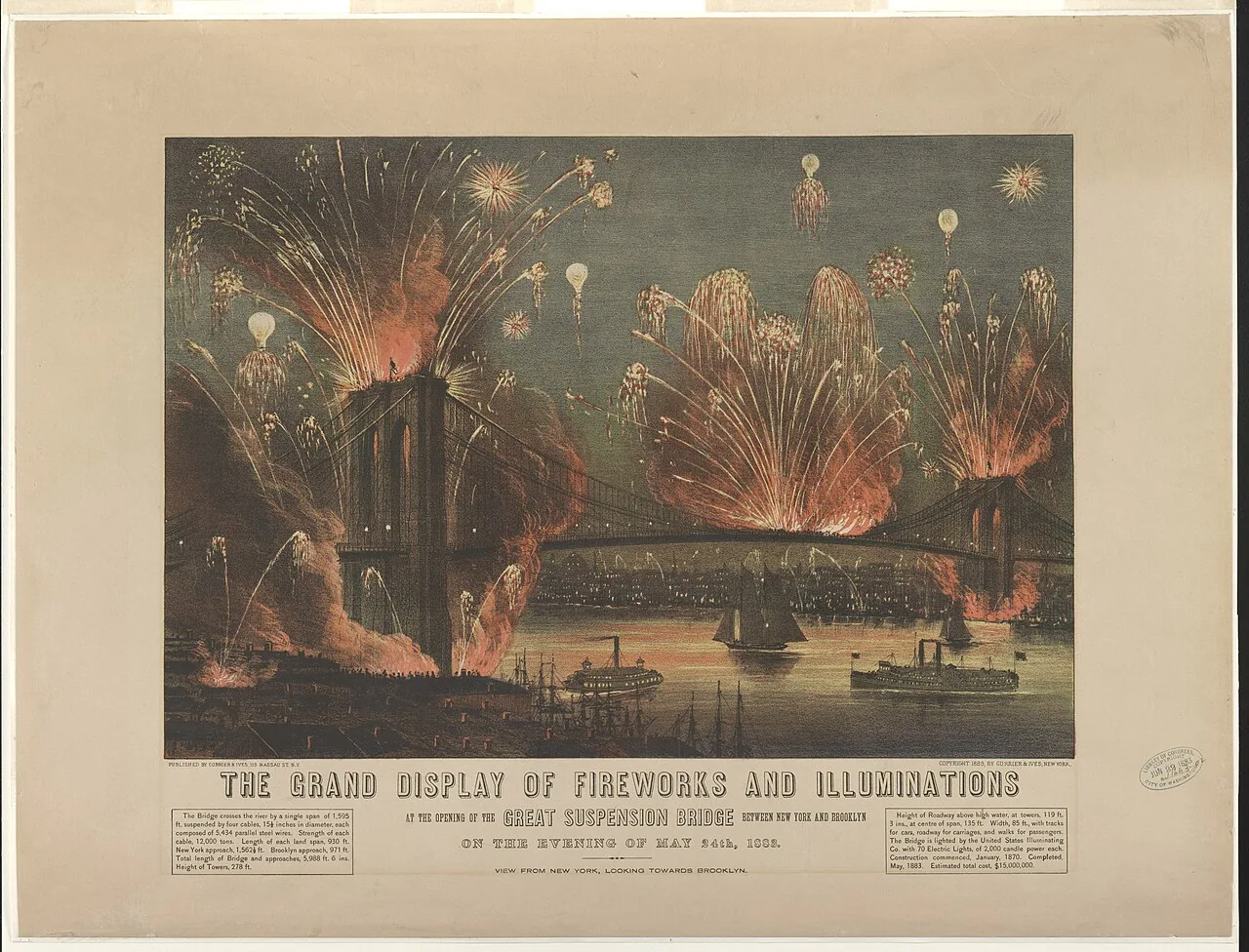
Source: lithograph, 1883, Library of Congress (image on Wikimedia Commons).
The bridge, designed by John Roebling and completed by his son Washington Roebling and daughter-in-law Emily Warren Roebling, linked two separate cities, New York and Brooklyn, which merged in 1898. Americans of the 1880s saw it as proof that engineers could master nature.
Big business
Entrepreneurs who found ways to cut costs and crush competitors built the great industrial fortunes. Andrew Carnegie was a Scottish immigrant who began as a bobbin boy in a textile mill. He built Carnegie Steel by owning every step of production, from iron ore mines and coal fields to railroads and mills. People call this strategy vertical integration. John D. Rockefeller took a different path with Standard Oil, founded in 1870.
He bought or drove out competing refineries until his company controlled most of the American oil refining business, a method called horizontal integration. In 1882 Rockefeller’s lawyers organized the Standard Oil Trust, a legal device that let a single board of trustees run many companies. The word “trust” became a common name for large combinations of firms. Critics called the most powerful business owners “robber barons.” Admirers called them “captains of industry.” Both labels contained some truth. The same men created thousands of jobs and cheaper goods, and they also used bribes, secret rebates from railroads, and violence against unions.
Definition: vertical integration
a business strategy in which one company controls every stage of making a product, from raw materials to transportation and sales, in order to lower costs. Carnegie Steel is the classic example.
Definition: monopoly
control of an industry by a single company or a small group of companies, so that buyers have little or no choice and competitors cannot survive. Standard Oil came close to a monopoly in oil refining.
Laissez-faire and the Gospel of Wealth
Business leaders defended their power with an idea called laissez-faire (French for “let do”), the belief that the government should leave the economy alone. Some also drew on Social Darwinism, a misuse of Charles Darwin’s ideas of natural selection. It claimed that the rich were rich because they were fit and the poor were poor because they were unfit. Andrew Carnegie did not go that far. He believed that great fortunes were the natural result of competition. However, he also argued that the rich had a duty to give their surplus wealth back to society. He gave away most of his fortune, paying for more than 2,500 public libraries. People soon called his essay the Gospel of Wealth.
Document 2 – Andrew Carnegie on wealth
The problem of our age is the proper administration of wealth, so that the ties of brotherhood may still bind together the rich and poor in harmonious relationship. […] to consider all surplus revenues which come to him simply as trust funds, which he is called upon to administer, and strictly bound as a matter of duty to administer in the manner which, in his judgment, is best calculated to produce the most beneficial results for the community—the man of wealth thus becoming the mere agent and trustee for his poorer brethren, bringing to their service his superior wisdom, experience, and ability to administer, doing for them better than they would or could do for themselves.
Source: Andrew Carnegie, “Wealth,” North American Review, June 1889 (later reprinted as “The Gospel of Wealth”); text from Wikisource.
*trustee: a person who manages property for the benefit of others. *brethren: brothers, fellow human beings.
Commentary. Carnegie begins by naming the problem of the age: great wealth next to great poverty. His answer is not to change the system, since competition produces progress, but to appeal to the conscience of the wealthy. Notice that the rich man acts as the “agent and trustee” for the poor. Carnegie assumes they cannot manage the money as well. Labor leaders and farmers replied that the poor would be better served by higher wages and fair prices than by libraries.
Government at first did little. Congress passed the Interstate Commerce Act in 1887 to regulate railroad rates and created the Interstate Commerce Commission, the first federal regulatory agency, but the commission had little power to enforce its rulings. The Sherman Antitrust Act of 1890 outlawed combinations “in restraint of trade.” In the 1890s the courts used it more often against labor unions than against corporations. The Republican and Democratic parties dominated politics, and their leaders traded jobs for votes in what people called the spoils system. In 1881 a man who thought he deserved a government job shot President James Garfield. Afterward Congress passed the Pendleton Civil Service Act of 1883, which began to fill some federal jobs through examinations.
Document 3 – The Senate and the trusts
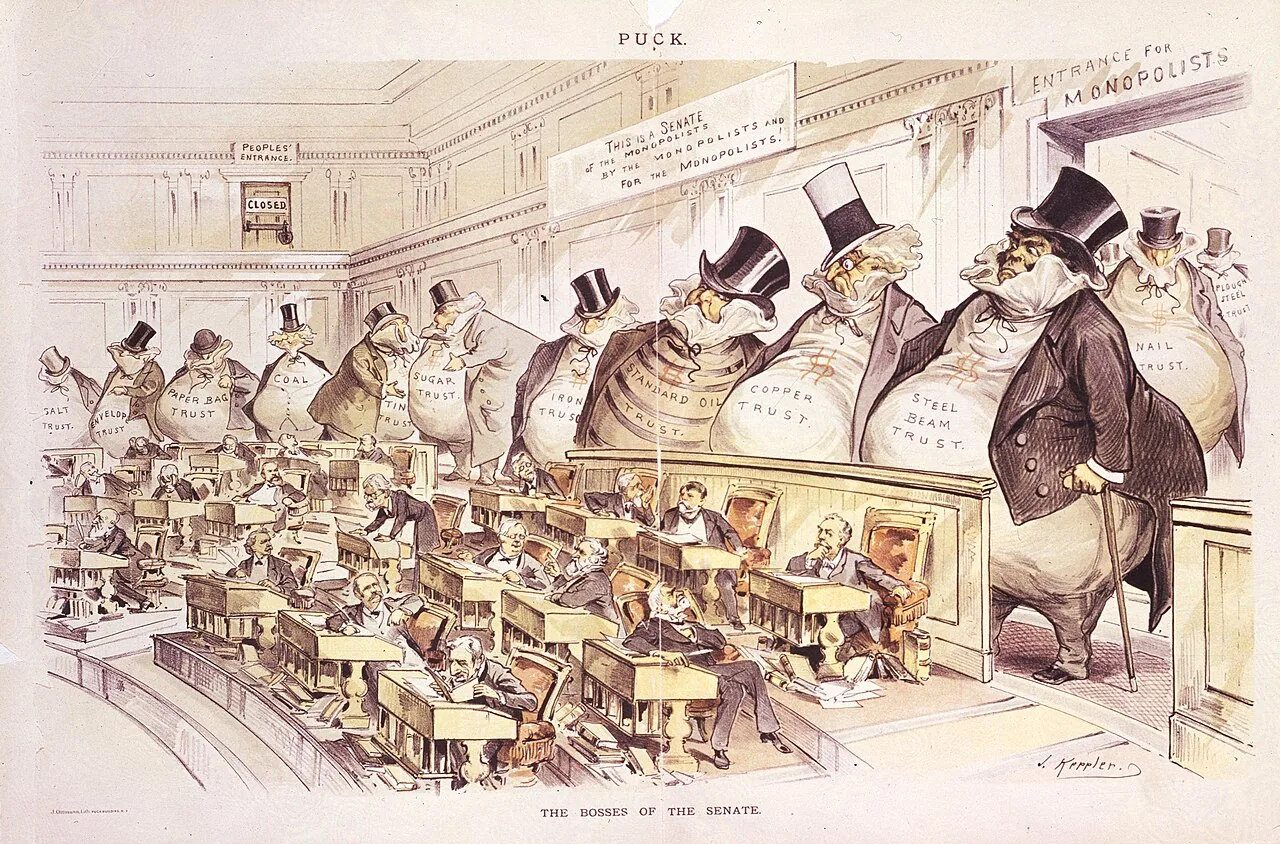
Source: Joseph Keppler, Puck, January 23, 1889 (image on Wikimedia Commons).
Keppler, an immigrant from Austria, used the humor magazine Puck to attack political corruption. Here the senators, whom state legislatures elected until the Seventeenth Amendment (1913), look tiny beside the trusts. The cartoon shows how many Americans felt about the influence of money on government.
2. Workers and the labor movement
Industrial work was dangerous and hard. In many factories and mills, men, women, and children worked ten to twelve hours a day, six days a week, with no insurance for injuries and no pensions. Railroads and mines killed and maimed workers every year. Wages for unskilled workers were low, and the economy was unstable. Severe depressions began in 1873 and 1893, and each threw hundreds of thousands out of work. Employers could fire anyone who complained, and they sometimes hired “strikebreakers” to replace men who walked off the job.
Workers organized to defend themselves. The Knights of Labor, founded in 1869, welcomed skilled and unskilled workers, women and African Americans, and grew rapidly in the 1880s. The American Federation of Labor (AFL) formed in 1886 under Samuel Gompers. It organized only skilled workers by craft and focused on practical goals: higher wages, shorter hours, and better conditions. The decade was full of conflict.
The Great Railroad Strike of 1877 spread across several states, and President Rutherford B. Hayes sent federal troops against the strikers. In Chicago, a bomb thrown into a crowd of police on May 4, 1886, during a rally in Haymarket Square killed several officers; police gunfire killed and wounded others. A court convicted eight anarchists, though the evidence linking them to the bomb was weak, and four were hanged. Many Americans, frightened by the violence, turned against the Knights of Labor, which declined quickly.
Document 4 – The Homestead strike
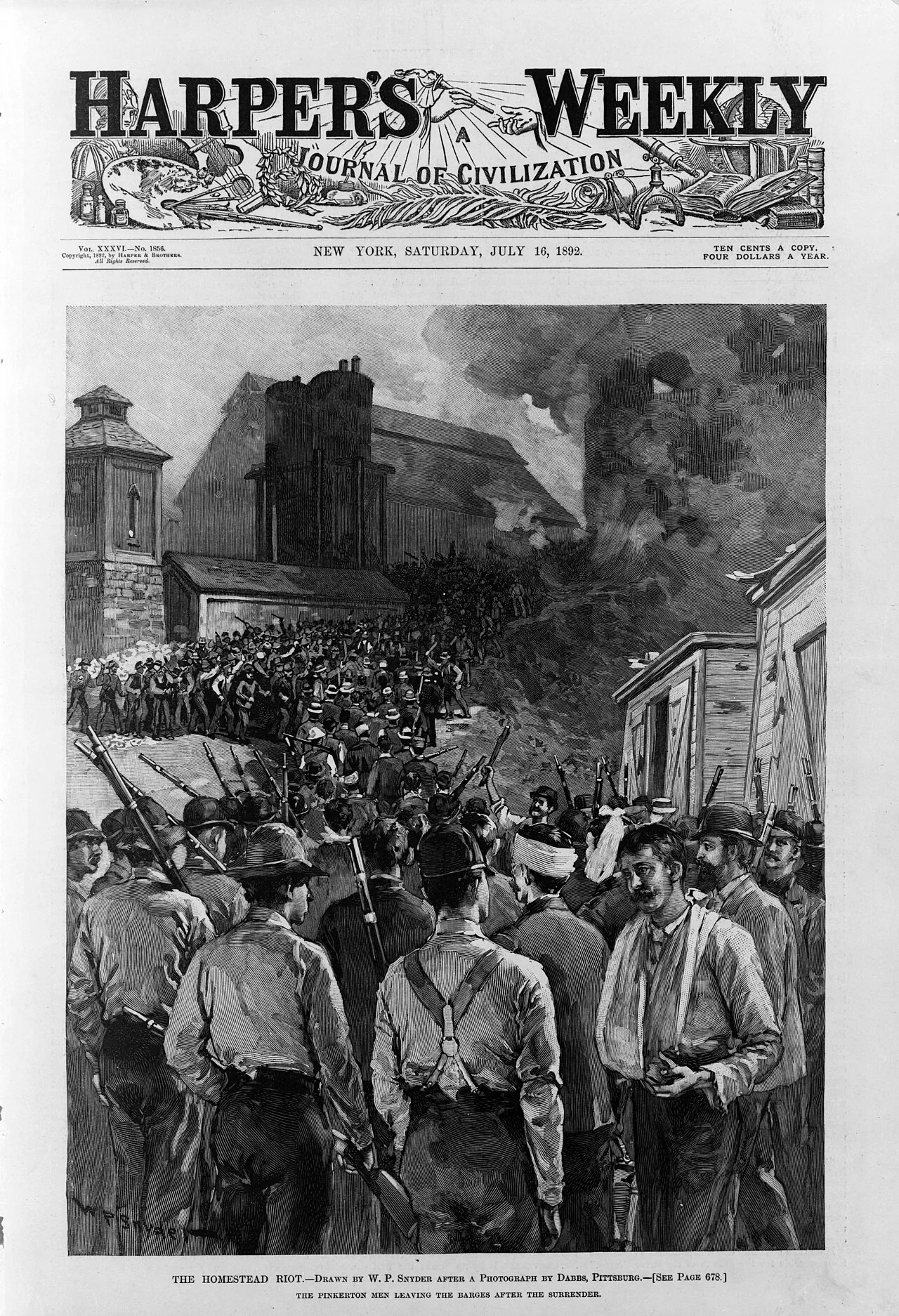
Source: Harper’s Weekly, July 1892; drawn by W. P. Snyder after a photograph by Dabbs (image on Wikimedia Commons).
In July 1892 the Carnegie Steel Company, managed by Henry Clay Frick, locked out the union at its Homestead, Pennsylvania, mill after a wage dispute. Frick brought in about three hundred armed Pinkerton agents by river barge. A battle with the workers and townspeople left several dead on both sides. The state militia then took control and the company broke the union.
The last big clash of the age came in 1894. George Pullman had cut wages at his railroad car factory near Chicago without lowering the rents in his company town. Workers struck in May, and Eugene V. Debs, leader of the American Railway Union, called on its members to refuse to handle Pullman cars. The boycott stopped much of the nation’s rail traffic. The federal government obtained a court injunction ordering the strikers back to work, and President Grover Cleveland sent troops to Chicago. The strike collapsed, and Debs went to prison for six months. Courts and presidents had shown they would use the power of the government to side with employers.
Definition: labor union
an organization of workers formed to bargain with employers over wages, hours, and working conditions. A strike is a union’s refusal to work until demands are met.
Definition: injunction
a court order that forbids people to carry out a certain action. In the late 1800s federal courts used injunctions to end strikes, as in the Pullman strike of 1894.
3. Cities and immigrants
Industry pulled people into cities. In 1860, about one American in five lived in a town of 2,500 people or more; by 1900, about two in five did. Chicago, which had a few thousand residents in the 1830s, passed one million by 1890. New York became a city of tenements, narrow, poorly ventilated apartment houses where several families shared a few rooms. Cities also grew upward, thanks to steel frames and elevators, and outward, thanks to electric streetcars and subways. Boston opened the first American subway in 1897.
Many of the new city dwellers came from other countries. Until about 1880, most immigrants came from northern and western Europe, especially Britain, Ireland, Germany, and Scandinavia. After 1880 more arrived from southern and eastern Europe, among them Italians, Poles, Russian and Eastern European Jews, and Slovaks. A smaller number came from Asia and Mexico. They arrived for jobs, and many fled poverty, military service, or persecution. Ellis Island in New York harbor opened as the main federal immigration station on January 1, 1892. Inspectors let most newcomers enter after a short inspection, but they turned back people judged ill, likely to need public support, or otherwise barred by law.
Document 5 – “How the Other Half Lives”
The first tenement New York knew bore the mark of Cain from its birth, though a generation passed before the writing was deciphered. It was the “rear house,” infamous ever after in our city’s history. There had been tenant-houses before, but they were not built for the purpose. Nothing would probably have shocked their original owners more than the idea of their harboring a promiscuous crowd; for they were the decorous homes of the old Knickerbockers, the proud aristocracy of Manhattan in the early days. It was the stir and bustle of trade, together with the tremendous immigration that followed upon the war of 1812 that dislodged them.
Source: Jacob A. Riis, How the Other Half Lives, 1890, chapter 1; text from Project Gutenberg.
*Knickerbockers: descendants of the early Dutch settlers of New York. *promiscuous: mixed, without order.
Commentary. Jacob Riis, a Danish immigrant who worked as a police reporter, described the slums of New York with words and with flash photographs. In this opening passage he explains how old homes of the wealthy became crowded tenements after the arrival of immigrants. His book shocked middle-class readers and helped lead to New York’s Tenement House Act of 1901. Riis, like many reformers of his day, also repeated ethnic stereotypes about the groups he described, so his writing must be read critically.
Document 6 – A Lower East Side alley
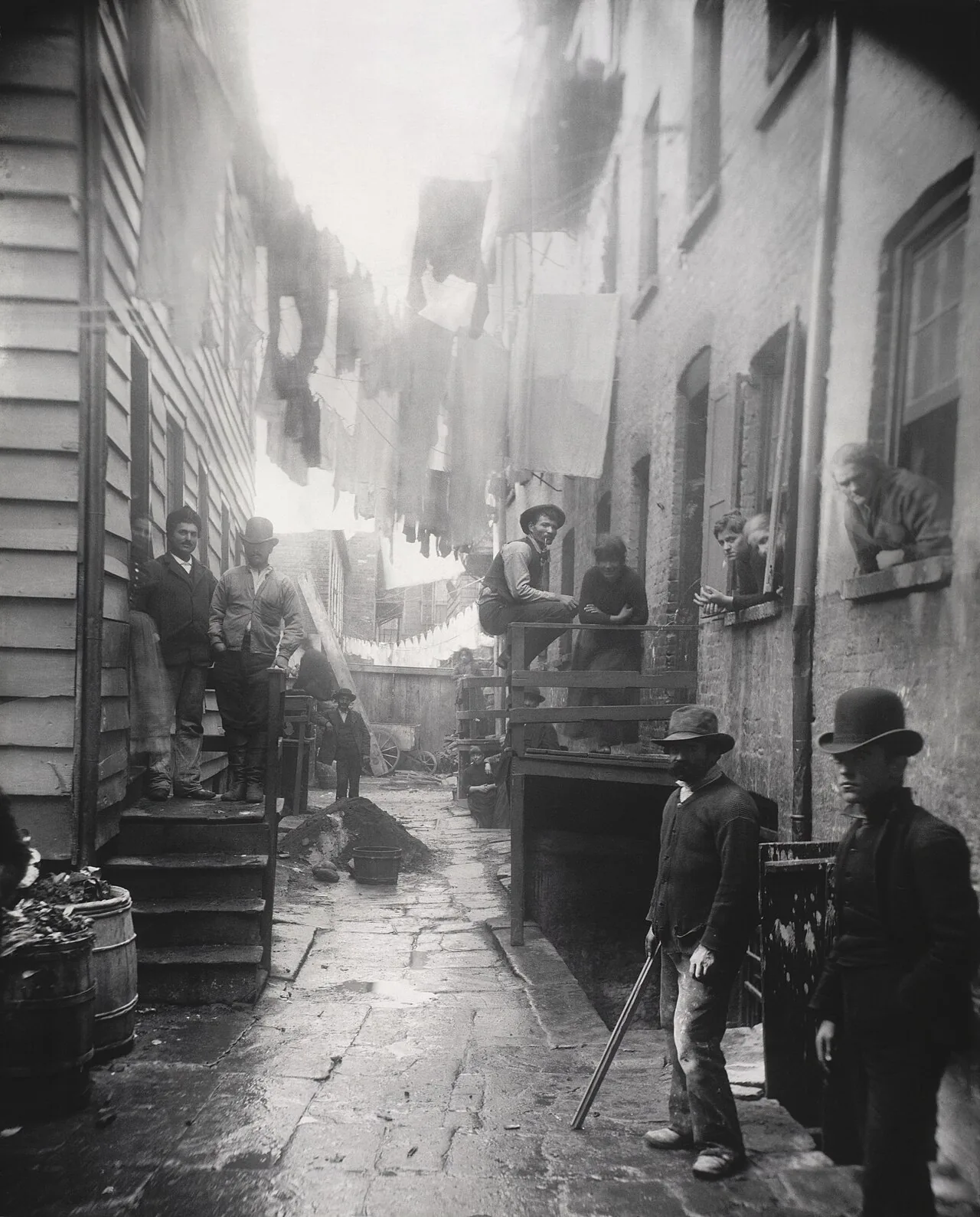
Source: Jacob Riis, about 1888 (image on Wikimedia Commons).
The alley was one of the worst blocks in the city. Riis counted the deaths there, especially of small children, to show that crowding and dirt killed people. The photograph is posed to some degree, since Riis used flash powder and his subjects knew he was there.
Many native-born Americans feared the newcomers, and nativism, hostility to immigrants, shaped law. The first major immigration law to ban a group by nationality was the Chinese Exclusion Act of 1882, which suspended the immigration of Chinese laborers for ten years. Congress renewed it several times and did not repeal it until 1943.
Chinese workers had built much of the Central Pacific line, and their labor was welcome until they began to compete for jobs in the West. At the same time, the Statue of Liberty, a gift from France, was dedicated in New York harbor on October 28, 1886. Emma Lazarus’s poem about it, written in 1883 for a fundraising auction, was added on a plaque in 1903 and gave the statue a meaning as a symbol of welcome.
Document 7 – A poem of welcome
Not like the brazen giant of Greek fame,
With conquering limbs astride from land to land;
Here at our sea-washed, sunset gates shall stand
A mighty woman with a torch, whose flame
Is the imprisoned lightning, and her name
Mother of Exiles. From her beacon-hand
Glows world-wide welcome; her mild eyes command
The air-bridged harbor that twin cities frame.
“Keep, ancient lands, your storied pomp!” cries she
With silent lips. “Give me your tired, your poor,
Your huddled masses yearning to breathe free,
The wretched refuse of your teeming shore.
Send these, the homeless, tempest-tost to me,
I lift my lamp beside the golden door!”
Source: Emma Lazarus, “The New Colossus,” 1883; a bronze plaque with the poem was placed in the pedestal of the Statue of Liberty in 1903; text from Wikisource.
*brazen: made of brass. *tempest-tost: thrown about by storms.
Document 8 – A law of exclusion
Whereas in the opinion of the Government of the United States the coming of Chinese laborers to this country endangers the good order of certain localities within the territory thereof: Therefore, Be it enacted by the Senate and House of Representatives of the United States of America in Congress assembled, That from and after the expiration of ninety days next after the passage of this act, and until the expiration of ten years next after the passage of this act, the coming of Chinese laborers to the United States be, and the same is hereby, suspended;
Source: Chinese Exclusion Act, May 6, 1882 (22 Stat. 58), opening lines; text from the National Archives.
*laborers: here, workers doing manual labor.
City life also gave rise to political machines, organizations such as Tammany Hall in New York that traded services, jobs, and favors for votes. Machine bosses helped immigrants find housing, work, and coal in winter, but they also took bribes and padded contracts. William M. “Boss” Tweed and his ring stole millions from New York City until newspaper exposure and prosecution sent him to jail in the 1870s.
Definition: political machine
a party organization that controls local government by trading jobs, services, and favors for votes, often with corruption. Tammany Hall in New York City was the most famous.
Definition: nativism
a policy or attitude that favors native-born people over immigrants. In the Gilded Age, nativism led to laws such as the Chinese Exclusion Act.
4. Farmers and the Populist revolt
The Homestead Act of 1862 offered 160 acres of western land to settlers who farmed it for five years, and railroads sold millions more acres. Settlers poured onto the Great Plains, where the federal government forced Native nations onto reservations after a series of wars. The Dawes Act of 1887 divided reservation land into individual plots of 160 acres or less for each head of family and opened the rest to white settlement.
As a result, Native nations lost most of their remaining land. The army’s killing of Lakota men, women, and children at Wounded Knee, South Dakota, on December 29, 1890, ended the era of major Plains wars. The 1890 census reported that the frontier line, a continuous line of settlement, no longer existed.
Farmers who grew wheat and cotton for national and world markets faced falling crop prices and high costs. They paid railroads high shipping fees, paid banks high interest on loans, and blamed a currency system that, in their view, kept money scarce. Organizing through the Grange and then the Farmers’ Alliances, they formed the People’s Party, whose members were called Populists. At Omaha on July 4, 1892, they adopted a platform. It demanded government ownership of railroads and telegraphs, a graduated income tax, the secret ballot, and the free coinage of silver to expand the money supply. Their candidate, James B. Weaver, won about 8 percent of the national vote and carried four states.
Document 9 – The Omaha Platform, 1892
The conditions which surround us best justify our co-operation; we meet in the midst of a nation brought to the verge of moral, political, and material ruin. Corruption dominates the ballot-box, the Legislatures, the Congress, and touches even the ermine of the bench. […] The fruits of the toil of millions are boldly stolen to build up colossal fortunes for a few, unprecedented in the history of mankind; and the possessors of those, in turn, despise the republic and endanger liberty. From the same prolific womb of governmental injustice we breed the two great classes—tramps and millionaires.
Source: Preamble to the Platform of the People’s Party, adopted at Omaha, Nebraska, July 4, 1892; text from Wikisource.
*ermine: the fur trim on the robes of judges. *bench: the courts. *demoralized: discouraged.
Commentary. The Populists were angry, and their language was sharp. They accused both major parties of corruption and warned of a “vast conspiracy against mankind.” Not every charge was fair, but many of their proposals, including the income tax, the secret ballot, and the direct election of senators, later became law. In 1896 the Democrats nominated William Jennings Bryan, who had the Populist support, after his “Cross of Gold” speech in favor of silver. Republican William McKinley, backed by business and the gold standard, won the election, and the Populists faded.
5. Jim Crow and the limits of the Gilded Age
For African Americans the age brought bitter disappointment. After the end of Reconstruction in 1877, white Democrats regained control of Southern governments. Then a system of segregation, or legal separation of the races, spread across the South, soon known as Jim Crow. States passed poll taxes, literacy tests, and other rules that kept Black citizens from voting. Louisiana required separate railroad cars for white and Black passengers in 1890.
A group of citizens in New Orleans organized a test case. Homer Plessy, a man of mixed ancestry, boarded a whites-only car, and police arrested him. In Plessy v. Ferguson (1896) the Supreme Court upheld the law by a vote of 7 to 1, ruling that segregation was constitutional if the separate facilities were “equal.” In practice, the facilities for Black Americans were far inferior. The “separate but equal” rule stood until Brown v. Board of Education in 1954.
Document 10 – The Court and its dissenter
The object of the amendment was undoubtedly to enforce the absolute equality of the two races before the law, but, in the nature of things, it could not have been intended to abolish distinctions based upon color, or to enforce social, as distinguish d from political, equality, or a commingling of the two races upon terms unsatisfactory to either. Laws permitting, and even requiring, their separation, in places where they are liable to be brought into contact, do not necessarily imply the inferiority of either race to the other, and have been generally, if not universally, recognized as within the competency of the state legislatures in the exercise of their police power.
Source: Plessy v. Ferguson, 163 U.S. 537 (1896), opinion of the Court by Justice Henry Billings Brown; text from the Legal Information Institute, Cornell Law School.
*competency: lawful authority. *police power: a state’s power to make laws for public health, safety, and order.
But in view of the constitution, in the eye of the law, there is in this country no superior, dominant, ruling class of citizens. There is no caste here. Our constitution is color-blind, and neither knows nor tolerates classes among citizens. In respect of civil rights, all citizens are equal before the law. The humblest is the peer of the most powerful.
Source: Plessy v. Ferguson, 163 U.S. 537 (1896), dissenting opinion of Justice John Marshall Harlan; text from the Legal Information Institute, Cornell Law School.
*caste: a hereditary social class. *peer: an equal.
Commentary. Justice Brown argues that the Fourteenth Amendment guaranteed equality before the law but not social equality, and that separation does not mean inferiority. Justice Harlan, a Kentuckian and a former slaveholder, answers that the Constitution is “color-blind.” Harlan’s dissent, nearly forgotten in 1896, became a model for the lawyers who argued against segregation in the twentieth century.
Black leaders disagreed about how to respond. Booker T. Washington, the head of Tuskegee Institute in Alabama, urged African Americans to build economic strength through farming and trades and to avoid open political protest. White leaders praised his speech in Atlanta in 1895. Others, including W. E. B. Du Bois, who is discussed in the next unit, believed that Black Americans should demand full political rights at once. Ida B. Wells, a journalist, led a campaign against lynching, the murder of Black men and women by mobs, which killed hundreds in these years.
Document 11 – Booker T. Washington in Atlanta
To those of my race who depend on bettering their condition in a foreign land or who underestimate the importance of cultivating friendly relations with the Southern white man, who is their next-door neighbor, I would say: “Cast down your bucket where you are” — cast it down in making friends in every manly way of the people of all races by whom we are surrounded.
Source: Booker T. Washington, address at the Cotton States and International Exposition, Atlanta, September 18, 1895; text from Wikisource.
*mechanics: skilled manual trades. *domestic service: work as household servants.
Commentary. The famous call to “cast down your bucket where you are” tells African Americans to look for opportunity in the South instead of leaving. The speech was praised by many white Americans and criticized by those who thought it accepted segregation and gave up voting rights. It shows how limited the choices were at a time when violence and the law were both used to keep Black Americans down.
Summary and legacy
The Gilded Age made the United States an industrial giant and a country of cities, and it also exposed deep problems: monopoly, corruption, dangerous work, crowded slums, discrimination, and anger on the farms. These problems prompted the reforms of the next period, the Progressive Era. The rapid change also produced new national institutions, from the national railroad network to the American Federation of Labor, that shaped the twentieth century.
- 1869 The Union Pacific and Central Pacific railroads meet at Promontory Summit, Utah Territory.
- 1873 The Panic of 1873 begins a long depression.
- 1877 The Great Railroad Strike; Reconstruction ends.
- 1882 Chinese Exclusion Act; Standard Oil Trust formed.
- 1886 Haymarket bombing in Chicago; American Federation of Labor founded.
- 1890 Sherman Antitrust Act; Wounded Knee; census declares the frontier closed.
- 1892 Homestead strike; People’s Party platform adopted at Omaha; Ellis Island opens.
- 1894 Pullman strike and boycott.
- 1896 Plessy v. Ferguson; William McKinley defeats William Jennings Bryan.
Key takeaways
- The railroads, steel, and electricity turned the United States into the world’s leading manufacturing economy, and big businesses grew by vertical and horizontal integration.
- Defenders of the new wealth relied on laissez-faire ideas and the Gospel of Wealth; critics attacked monopoly and corruption.
- Workers formed unions such as the Knights of Labor and the AFL, but strikes at Haymarket, Homestead, and Pullman ended in defeat.
- Cities and immigration grew together; nativism produced the Chinese Exclusion Act of 1882.
- Farmers formed the People’s Party in 1892 and demanded reforms that later became law.
- Jim Crow segregation spread, and Plessy v. Ferguson (1896) allowed “separate but equal” facilities.

Quick review: flashcards
Tap a card to see the answer.