



This US History Grade 11 test covers The Gilded Age and Industrialization. Like a classroom assessment, it includes documents to analyze, knowledge questions and a short writing task. To prepare, review the lesson first, then practice with the worksheet.
Time : 50 min
The test has three parts: knowledge (34 points), documents (46 points), and a written argument (20 points). Answer in complete sentences and cite the documents.
Document 1 – Document 1 – The election of 1892
Schematic map prepared for this unit with Natural Earth data; results from standard reference works.
Document 2 – Document 2 – The Senate and the trusts
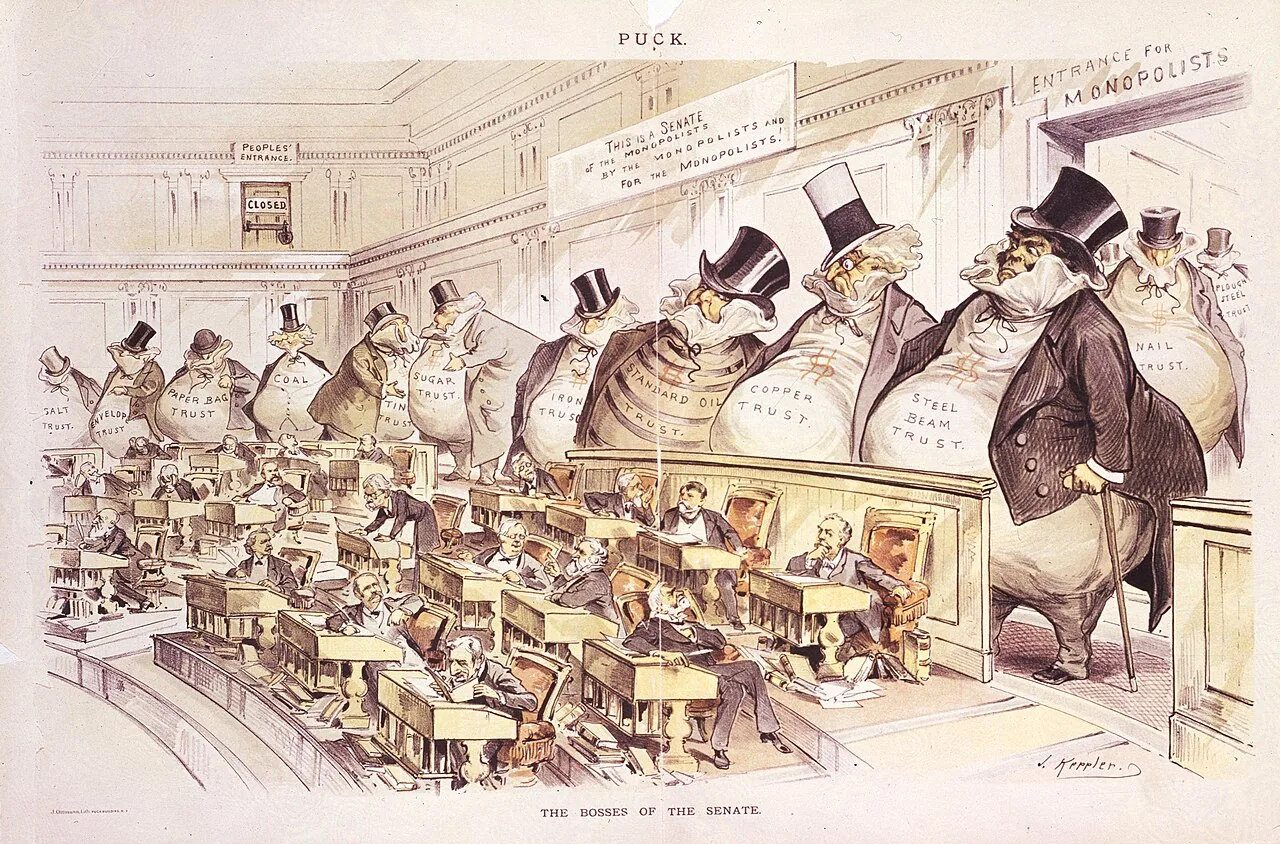
Joseph Keppler, Puck, January 23, 1889; Library of Congress via Wikimedia Commons.
Document 3 – Document 3 – Jacob Riis on tenements
The first tenement New York knew bore the mark of Cain from its birth, though a generation passed before the writing was deciphered. It was the “rear house,” infamous ever after in our city’s history. There had been tenant-houses before, but they were not built for the purpose. Nothing would probably have shocked their original owners more than the idea of their harboring a promiscuous crowd; for they were the decorous homes of the old Knickerbockers, the proud aristocracy of Manhattan in the early days. It was the stir and bustle of trade, together with the tremendous immigration that followed upon the war of 1812 that dislodged them.
Source: Jacob A. Riis, How the Other Half Lives, 1890, chapter 1; text from Project Gutenberg.
*Knickerbockers: descendants of the Dutch settlers. *promiscuous: mixed.
Jacob A. Riis, How the Other Half Lives, 1890, chapter 1.
Document 4 – Document 4 – Key dates
- 1869 Transcontinental railroad completed
- 1886 Haymarket bombing; American Federation of Labor founded
- 1890 Sherman Antitrust Act
- 1892 Homestead strike; Omaha platform
- 1894 Pullman strike
- 1896 Plessy v. Ferguson
Dates as given in standard reference works.
Questions
- Part 1 – Knowledge. Define monopoly, laissez-faire, and nativism. (12 pts)
- Part 1. Name two inventions or industries that drove the economic growth of the Gilded Age and explain how one of them changed daily life. (10 pts)
- Part 1. Name two labor organizations of the period and one major strike. Explain the outcome of the strike. (12 pts)
- Part 2 – Documents. Document 1: name the states Weaver carried and explain why the Populists were strongest in the West. (12 pts)
- Part 2. Document 2: present the cartoon and explain what it says about the relationship between business and government. (14 pts)
- Part 2. Document 3: present the text, say what Riis wanted to show, and name one limit of this source. (12 pts)
- Part 2. Document 4: calculate how many years passed between the transcontinental railroad and the Plessy decision, and between Haymarket and Pullman. (8 pts)
- Part 3 – Written argument. Evaluate the extent to which industrialization benefited the American people between 1865 and 1900. Use the documents and the lesson. (20 pts)


Quick review: flashcards
Tap a card to see the answer.