



This worksheet on The Gilded Age and Industrialization belongs to the US History Grade 11 course. Its questions use primary sources, maps and timelines, and they move from basic recall to short writing tasks. Before you start, review the lesson; afterward, try the true or false quiz.
Exercise 1 : Vocabulary of the Gilded Age
- Define each term in one sentence: monopoly, laissez-faire, tenement, nativism, injunction, Populist.
- Choose two of the terms and use each in a sentence about the Gilded Age.
- Which term describes a business strategy, which an immigration policy, and which a court action? Match them.
Reread the definition boxes in the lesson.
Exercise 2 : Carnegie on the duty of the rich
Document A
The problem of our age is the proper administration of wealth, so that the ties of brotherhood may still bind together the rich and poor in harmonious relationship. […] to consider all surplus revenues which come to him simply as trust funds, which he is called upon to administer, and strictly bound as a matter of duty to administer in the manner which, in his judgment, is best calculated to produce the most beneficial results for the community—the man of wealth thus becoming the mere agent and trustee for his poorer brethren, bringing to their service his superior wisdom, experience, and ability to administer, doing for them better than they would or could do for themselves.
Source: Andrew Carnegie, “Wealth,” North American Review, June 1889 (later reprinted as “The Gospel of Wealth”); text from Wikisource.
*trustee: a person who manages property for others. *brethren: brothers.
- Present the document (nature, author, date, context).
- What does Carnegie see as “the problem of our age”?
- What does he say the rich man should do with his surplus wealth?
- Who might disagree with him? Explain why.
Think about the workers at his mills.
Exercise 3 : A reporter in the slums
Document A
The first tenement New York knew bore the mark of Cain from its birth, though a generation passed before the writing was deciphered. It was the “rear house,” infamous ever after in our city’s history. There had been tenant-houses before, but they were not built for the purpose. Nothing would probably have shocked their original owners more than the idea of their harboring a promiscuous crowd; for they were the decorous homes of the old Knickerbockers, the proud aristocracy of Manhattan in the early days. It was the stir and bustle of trade, together with the tremendous immigration that followed upon the war of 1812 that dislodged them.
Source: Jacob A. Riis, How the Other Half Lives, 1890, chapter 1; text from Project Gutenberg.
*Knickerbockers: descendants of early Dutch settlers of New York.
- Present the document.
- According to Riis, what was the “rear house” and where did the tenement come from?
- Which event does he blame for the change?
- Why might a reader in 1890 have found this book shocking? Why must a historian read it with care?
Exercise 4 : The Populist Preamble
Document A
The conditions which surround us best justify our co-operation; we meet in the midst of a nation brought to the verge of moral, political, and material ruin. Corruption dominates the ballot-box, the Legislatures, the Congress, and touches even the ermine of the bench. […] The fruits of the toil of millions are boldly stolen to build up colossal fortunes for a few, unprecedented in the history of mankind; and the possessors of those, in turn, despise the republic and endanger liberty. From the same prolific womb of governmental injustice we breed the two great classes—tramps and millionaires.
Source: Preamble to the Platform of the People’s Party, adopted at Omaha, Nebraska, July 4, 1892; text from Wikisource.
*ermine: judges’ fur trim. *co-operation: working together.
- Present the document.
- List three complaints the Populists make about the United States in 1892.
- Which phrase is the most extreme? Why might they have used such strong language?
- Which of their demands later became law?
Exercise 5 : Cast down your bucket
Document A
To those of my race who depend on bettering their condition in a foreign land or who underestimate the importance of cultivating friendly relations with the Southern white man, who is their next-door neighbor, I would say: “Cast down your bucket where you are” — cast it down in making friends in every manly way of the people of all races by whom we are surrounded.
Source: Booker T. Washington, address at the Cotton States and International Exposition, Atlanta, September 18, 1895; text from Wikisource.
*mechanics: skilled trades. *domestic service: household work.
- Present the document (author, date, audience).
- What advice does Washington give to African Americans?
- Why do you think white Southerners and Northerners in the audience approved?
- Why have some historians called the speech the “Atlanta Compromise”?
Exercise 6 : The Court and Justice Harlan
Document A – the majority
The object of the amendment was undoubtedly to enforce the absolute equality of the two races before the law, but, in the nature of things, it could not have been intended to abolish distinctions based upon color, or to enforce social, as distinguish d from political, equality, or a commingling of the two races upon terms unsatisfactory to either. Laws permitting, and even requiring, their separation, in places where they are liable to be brought into contact, do not necessarily imply the inferiority of either race to the other, and have been generally, if not universally, recognized as within the competency of the state legislatures in the exercise of their police power.
Source: Plessy v. Ferguson, 163 U.S. 537 (1896), opinion of the Court by Justice Henry Billings Brown; text from the Legal Information Institute, Cornell Law School.
*competency: lawful authority. *police power: a state’s power over public order.
Document B – the dissent
But in view of the constitution, in the eye of the law, there is in this country no superior, dominant, ruling class of citizens. There is no caste here. Our constitution is color-blind, and neither knows nor tolerates classes among citizens. In respect of civil rights, all citizens are equal before the law. The humblest is the peer of the most powerful.
Source: Plessy v. Ferguson, 163 U.S. 537 (1896), dissenting opinion of Justice John Marshall Harlan; text from the Legal Information Institute, Cornell Law School.
*caste: a hereditary social class. *peer: equal.
- Present both documents.
- How does the majority justify laws that separate the races?
- What principle does Harlan defend?
- Whose argument fits the words of the Fourteenth Amendment better? Justify your answer.
The Fourteenth Amendment promises every person “the equal protection of the laws.”
Exercise 7 : Wealth or reform?
Document A
The problem of our age is the proper administration of wealth, so that the ties of brotherhood may still bind together the rich and poor in harmonious relationship. […] to consider all surplus revenues which come to him simply as trust funds, which he is called upon to administer, and strictly bound as a matter of duty to administer in the manner which, in his judgment, is best calculated to produce the most beneficial results for the community—the man of wealth thus becoming the mere agent and trustee for his poorer brethren, bringing to their service his superior wisdom, experience, and ability to administer, doing for them better than they would or could do for themselves.
Source: Andrew Carnegie, “Wealth,” North American Review, June 1889 (later reprinted as “The Gospel of Wealth”); text from Wikisource.
*trustee: manager of property for others.
Document B
The conditions which surround us best justify our co-operation; we meet in the midst of a nation brought to the verge of moral, political, and material ruin. Corruption dominates the ballot-box, the Legislatures, the Congress, and touches even the ermine of the bench. […] The fruits of the toil of millions are boldly stolen to build up colossal fortunes for a few, unprecedented in the history of mankind; and the possessors of those, in turn, despise the republic and endanger liberty. From the same prolific womb of governmental injustice we breed the two great classes—tramps and millionaires.
Source: Preamble to the Platform of the People’s Party, adopted at Omaha, Nebraska, July 4, 1892; text from Wikisource.
*ermine: judges’ fur trim.
- Present both documents.
- How does each author explain the gap between rich and poor?
- What solution does each propose, and who is supposed to act?
- Which argument do you find more convincing for the 1890s? Support your answer with evidence from both texts.
Exercise 8 : Welcome and exclusion
Document A
Not like the brazen giant of Greek fame,
With conquering limbs astride from land to land;
Here at our sea-washed, sunset gates shall stand
A mighty woman with a torch, whose flame
Is the imprisoned lightning, and her name
Mother of Exiles. From her beacon-hand
Glows world-wide welcome; her mild eyes command
The air-bridged harbor that twin cities frame.
“Keep, ancient lands, your storied pomp!” cries she
With silent lips. “Give me your tired, your poor,
Your huddled masses yearning to breathe free,
The wretched refuse of your teeming shore.
Send these, the homeless, tempest-tost to me,
I lift my lamp beside the golden door!”
Source: Emma Lazarus, “The New Colossus,” 1883; a bronze plaque with the poem was placed in the pedestal of the Statue of Liberty in 1903; text from Wikisource.
*brazen: made of brass. *tempest-tost: tossed by storms.
Document B
Whereas in the opinion of the Government of the United States the coming of Chinese laborers to this country endangers the good order of certain localities within the territory thereof: Therefore, Be it enacted by the Senate and House of Representatives of the United States of America in Congress assembled, That from and after the expiration of ninety days next after the passage of this act, and until the expiration of ten years next after the passage of this act, the coming of Chinese laborers to the United States be, and the same is hereby, suspended;
Source: Chinese Exclusion Act, May 6, 1882 (22 Stat. 58), opening lines; text from the National Archives.
- Present each document.
- What message about immigrants does the poem send?
- What does the law say about Chinese laborers, and what reason does it give?
- How can the same country produce both texts? Write three sentences.
Exercise 9 : A night in Bandits’ Roost
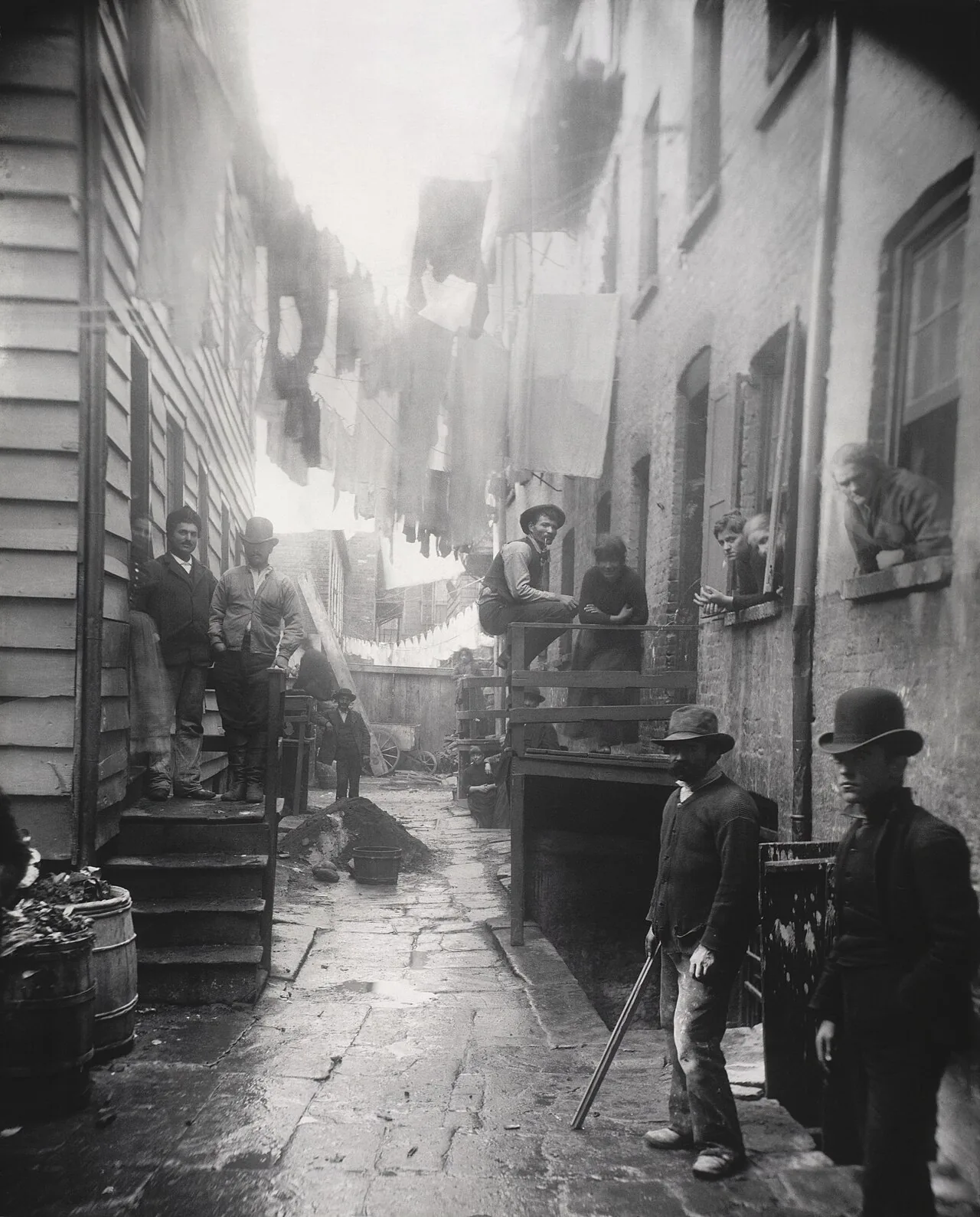
- Present the document (nature, author, date, place).
- Describe what you see: people, buildings, objects.
- What does Riis want viewers to conclude about life in the tenements?
- Why must a historian be careful with a photograph taken by a reformer?
Exercise 10 : The trusts in the Senate
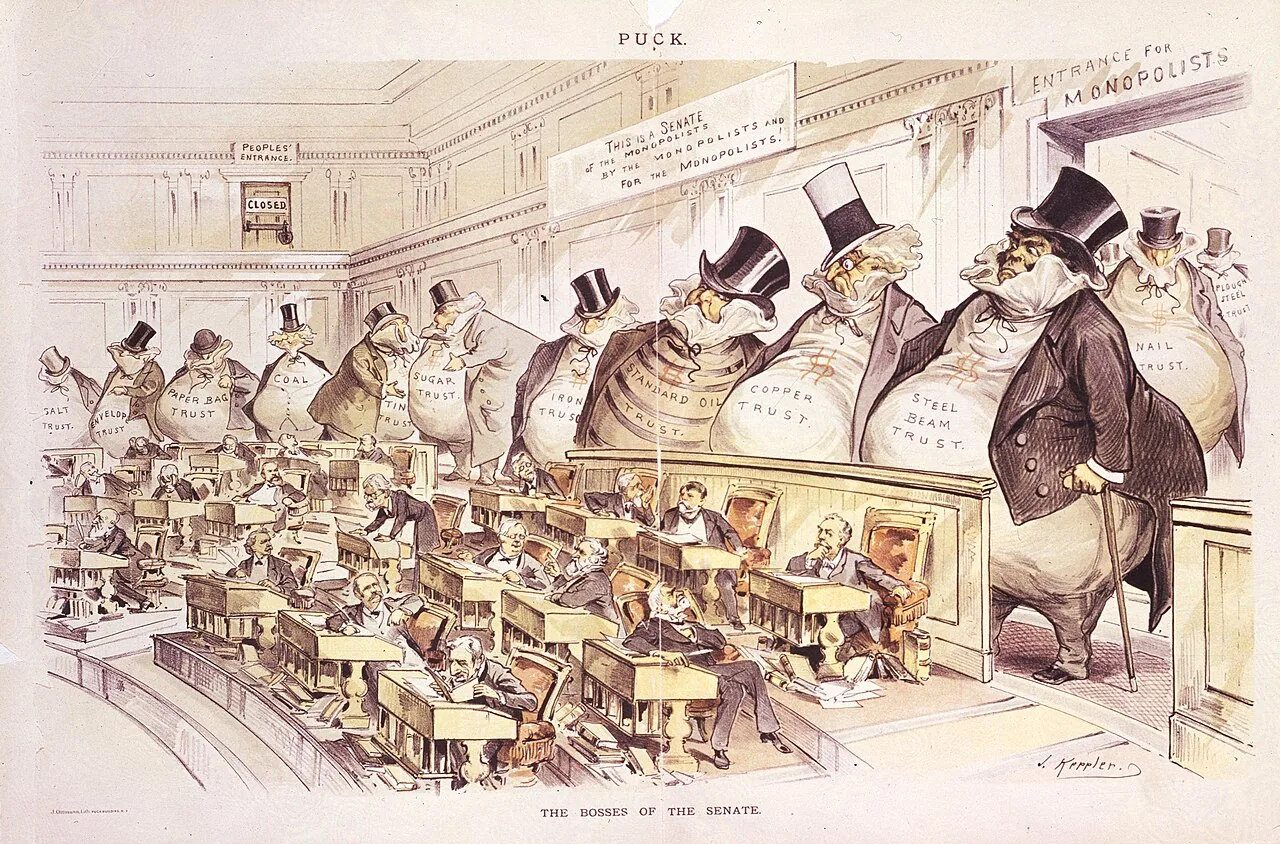
- Present the cartoon.
- Identify the symbols: the large figures, the small senators, the two entrances.
- What is the cartoonist saying about American government in 1889?
- Which groups would have agreed? Which would have disagreed?
Exercise 11 : Homestead, 1892
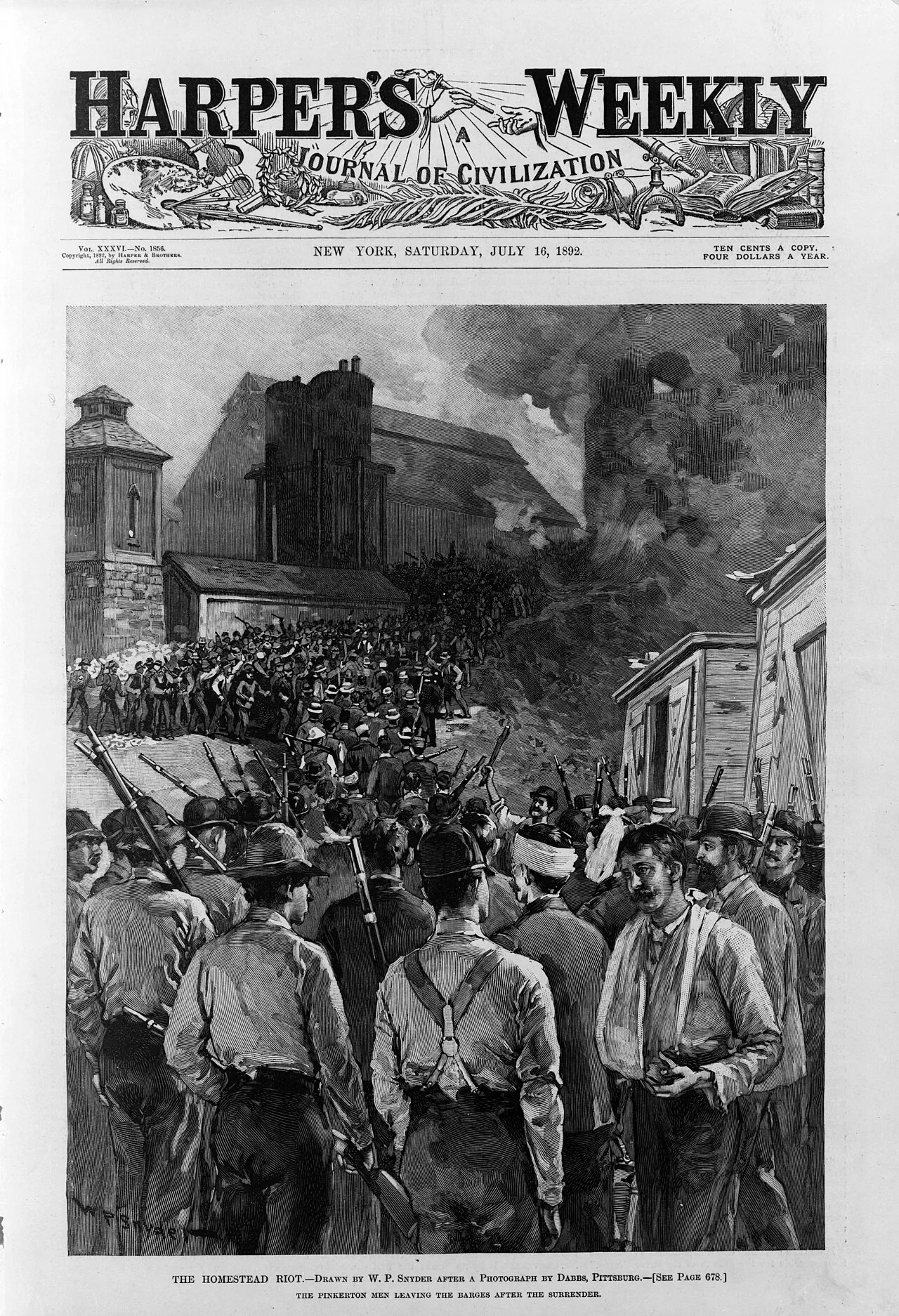
- Present the document.
- Describe the scene.
- Use the lesson to explain what happened at Homestead.
- The picture comes from a magazine. How might that affect the way it shows the strikers?
Exercise 12 : Waiting at Ellis Island
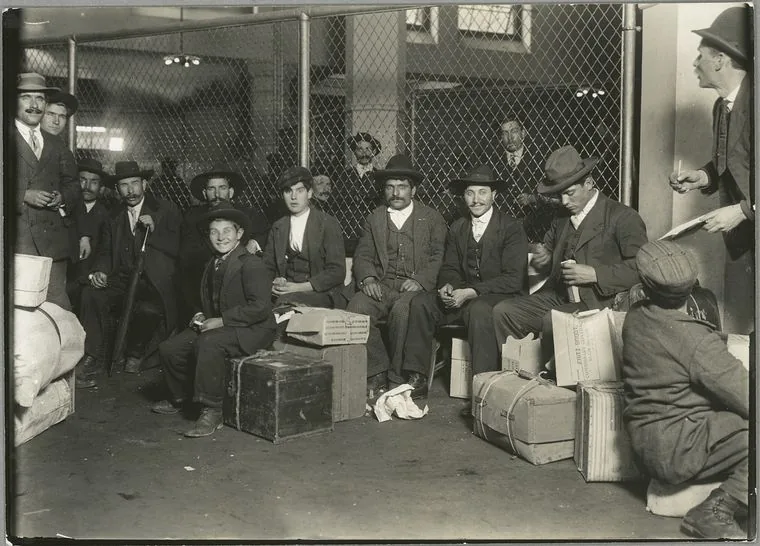
- Present the photograph.
- Describe the people and their belongings.
- What can you learn about immigrants from this picture, and what can you not learn?
- Compare this photograph with the Riis photograph of 1888. How do the two photographers show people differently?
Exercise 13 : Pullman and the cartoonist
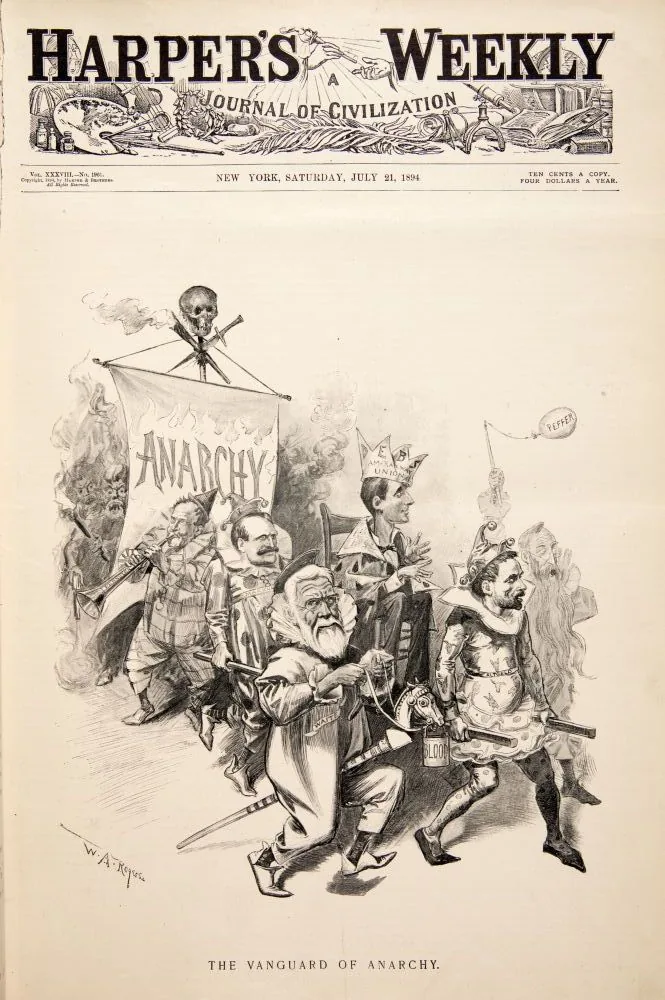
- Present the document.
- What does the banner say, and who leads the crowd?
- What does the cartoon want readers to think of the strikers?
- Write two questions a historian would ask about this source before using it.
Exercise 14 : A growing, urban nation
Study the table.
| Census year | Population of the United States | Percent living in urban places |
|---|---|---|
| 1860 | 31,443,321 | 19.8 |
| 1870 | 38,558,371 | 25.7 |
| 1880 | 50,189,209 | 28.2 |
| 1890 | 62,979,766 | 35.1 |
| 1900 | 76,212,168 | 39.6 |
Source: U.S. Census Bureau, Historical Statistics of the United States; urban places are those with 2,500 or more inhabitants.
- By how many people did the population grow between 1860 and 1900?
- In which decade did the share of urban residents rise the most?
- Give two causes of the growth of cities, using the lesson.
Exercise 15 : The railroad map
- Which railroad was completed first: the Union Pacific/Central Pacific or the Northern Pacific? Give the dates.
- Name two cities that served as eastern starting points for lines to the Pacific.
- Which line reached the Gulf of Mexico?
- Explain how the railroads helped the settlement of the Great Plains.
Exercise 16 : The Populist vote
- Name the states that Weaver carried completely.
- In what region of the country were they located?
- Why did the Populists do well there? Give two reasons.
- Why do you think they did not win any states in the South or Northeast?
Exercise 17 : Order the events
Put the events in chronological order, then give the date of each: the Haymarket bombing; the Homestead strike; the Plessy decision; the Sherman Antitrust Act; the golden spike at Promontory; the Pullman strike.
Then answer: which two events happened in the same year as the event you placed last? (Hint: consider 1892 and 1894 only for your answer.)
Exercise 18 : How long?
- How many years passed between the golden spike (1869) and the Plessy decision (1896)?
- Reconstruction ended in 1877. How many years later was the Plessy decision?
- The Chinese Exclusion Act (1882) was repealed in 1943. How long did it remain in force?
- Plessy (1896) was overturned by Brown v. Board of Education in 1954. How many years did “separate but equal” govern the law?
Exercise 19 : Guided research: a Gilded Age life
Choose one person: Andrew Carnegie, Jane Addams, Samuel Gompers, Ida B. Wells, or Jacob Riis. Use keywords such as “Library of Congress [name] biography”, “National Archives DocsTeach [name]”, and “Smithsonian [name]”. Reliable sites: loc.gov, archives.gov, si.edu, and biography pages of the National Park Service.
- Write the person’s name, birth and death dates, and main occupation.
- Find one primary source by or about the person and copy its title and date.
- Explain the person’s role in the Gilded Age in three sentences.
- List two sources you used and say whether each is reliable.
Exercise 20 : Claim, evidence, reasoning paragraph
Write a paragraph (6 to 8 sentences) that answers the question: Was the Gilded Age a golden age or only a gilded one?
- State a claim in your first sentence.
- Give at least two pieces of evidence from the lesson or the documents.
- Explain how each piece of evidence supports your claim.
- End with a concluding sentence.
You may argue that it was both, but you must decide which was stronger.
Exercise 21 : SAQ: the rise of labor unions
- Identify one cause of the growth of labor unions in the late 1800s.
- Identify one way in which employers or the government resisted unions.
- Explain one reason why strikes often failed.
Exercise 22 : True or false? Justify
Say whether each statement is true or false and correct the false ones.
- The Sherman Antitrust Act of 1890 was used mainly to break up Standard Oil in the 1890s.
- The Statue of Liberty was dedicated in 1886.
- Ellis Island opened in 1892.
- The Court in Plessy ruled that segregation was unconstitutional.
- The Dawes Act divided reservation land into individual plots.
Exercise 23 : Stimulus-based multiple choice
Stimulus
But in view of the constitution, in the eye of the law, there is in this country no superior, dominant, ruling class of citizens. There is no caste here. Our constitution is color-blind, and neither knows nor tolerates classes among citizens. In respect of civil rights, all citizens are equal before the law. The humblest is the peer of the most powerful.
Source: Plessy v. Ferguson, 163 U.S. 537 (1896), dissenting opinion of Justice John Marshall Harlan; text from the Legal Information Institute, Cornell Law School.
*caste: a hereditary social class.
- This dissent was written in response to a decision that: (A) allowed the federal government to break up trusts; (B) upheld state laws requiring separate facilities for the races; (C) struck down the Chinese Exclusion Act; (D) limited the power of the railroads.
- Harlan’s argument is most similar to the reasoning of: (A) the Gospel of Wealth; (B) the Fourteenth Amendment’s equal protection clause; (C) the Dawes Act; (D) the Homestead Act.
- Which later event most directly reversed the decision Harlan opposed? (A) Brown v. Board of Education (1954); (B) the Pullman strike; (C) the Sherman Act; (D) the Spanish-American War.


Quick review: flashcards
Tap a card to see the answer.