


This worksheet on America Becomes a World Power belongs to the US History Grade 11 course. Its questions use primary sources, maps and timelines, and they move from basic recall to short writing tasks. Before you start, review the lesson; afterward, try the true or false quiz.
Exercise 1 : Vocabulary of empire
- Define: imperialism, yellow journalism, protectorate, Open Door, dollar diplomacy, armistice.
- Use two of the terms in a sentence about the years 1898-1918.
- Which term describes a way in which newspapers helped push the nation toward war?
Exercise 2 : The March of the Flag
Document A
We can not fly from our world duties; it is ours to execute the purpose of a fate that has driven us to be greater than our small intentions. We can not retreat from any soil where Providence has unfurled our banner; it is ours to save that soil for liberty and civilization.
Source: Albert J. Beveridge, “The March of the Flag,” campaign speech at Indianapolis, September 16, 1898; text from Wikisource.
*Providence: God’s guidance of events.
- Present the document (author, date, occasion, audience).
- What does Beveridge say the nation cannot do?
- What role does he give to Providence?
- Why must a historian note that this was a campaign speech?
Exercise 3 : To the Person Sitting in Darkness
Document A
Christendom has been playing it badly of late years, and must certainly suffer by it, in my opinion. She has been so eager to get every stake that appeared on the green cloth, that the People who Sit in Darkness have noticed it–they have noticed it, and have begun to show alarm. They have become suspicious of the Blessings of Civilization. More–they have begun to examine them. This is not well.
Source: Mark Twain, “To the Person Sitting in Darkness,” North American Review, February 1901; text from Wikisource.
*Christendom: Christian nations. *boodle: stolen money.
- Present the document.
- What does Twain say Christendom has been doing?
- Find two phrases that show his tone and explain what each means.
- Whom is he criticizing: the Filipino people or the imperial nations? Justify your answer.
Exercise 4 : The Roosevelt Corollary
Document A
Chronic wrongdoing, or an impotence which results in a general loosening of the ties of civilized society, may in America, as elsewhere, ultimately require intervention by some civilized nation, and in the Western Hemisphere the adherence of the United States to the Monroe Doctrine may force the United States, however reluctantly, in flagrant cases of such wrongdoing or impotence, to the exercise of an international police power.
Source: Theodore Roosevelt, Annual Message to Congress, December 6, 1904 (the Roosevelt Corollary to the Monroe Doctrine); text from Wikisource.
*impotence: powerlessness. *Monroe Doctrine: 1823 declaration against European interference in the Americas.
- Present the document.
- Under what conditions does Roosevelt say the United States may intervene?
- How does this extend the Monroe Doctrine?
- How might a Latin American reader have reacted?
Exercise 5 : The Zimmermann telegram
Document A
We intend to begin on the first of February unrestricted submarine warfare. We shall endeavor in spite of this to keep the United States of America neutral. In the event of this not succeeding, we make Mexico a proposal of alliance on the following basis: make war together, make peace together, generous financial support and an understanding on our part that Mexico is to reconquer the lost territory in Texas, New Mexico, and Arizona. The settlement in detail is left to you.
Source: telegram from German Foreign Secretary Arthur Zimmermann to the German minister in Mexico, January 16, 1917, as decoded by British intelligence and released to the American press on March 1, 1917; English text from Wikisource.
*neutral: not taking sides. *reconquer: conquer again.
- Present the document.
- What does Germany announce, and what does it propose to Mexico?
- Why would the telegram anger Americans?
- Why did Mexico not accept the offer, according to the lesson?
Exercise 6 : Wilson asks for war
Document A
The world must be made safe for democracy. Its peace must be planted upon the tested foundations of political liberty. We have no selfish ends to serve. We desire no conquest, no dominion. We seek no indemnities for ourselves, no material compensation for the sacrifices we shall freely make. We are but one of the champions of the rights of mankind. We shall be satisfied when those rights have been made as secure as the faith and the freedom of nations can make them.
Source: Woodrow Wilson, address to a joint session of Congress asking for a declaration of war, April 2, 1917; text from Wikisource.
*dominion: rule. *indemnities: payments for damages.
- Present the document.
- What reasons for fighting does Wilson give?
- What does he say the United States does not want?
- Do you find his claim of “no selfish ends” fully convincing? Use the lesson to explain.
Exercise 7 : Two views of empire
Document A
We can not fly from our world duties; it is ours to execute the purpose of a fate that has driven us to be greater than our small intentions. We can not retreat from any soil where Providence has unfurled our banner; it is ours to save that soil for liberty and civilization.
Source: Albert J. Beveridge, “The March of the Flag,” campaign speech at Indianapolis, September 16, 1898; text from Wikisource.
*Providence: God’s guidance.
Document B
Christendom has been playing it badly of late years, and must certainly suffer by it, in my opinion. She has been so eager to get every stake that appeared on the green cloth, that the People who Sit in Darkness have noticed it–they have noticed it, and have begun to show alarm. They have become suspicious of the Blessings of Civilization. More–they have begun to examine them. This is not well.
Source: Mark Twain, “To the Person Sitting in Darkness,” North American Review, February 1901; text from Wikisource.
*Christendom: Christian nations.
- Present both documents.
- How does each author describe the expansion of the United States?
- What language does each use (religious, humorous, patriotic)?
- Which argument persuades you more and why? Cite both texts.
Exercise 8 : Peace aims and punishment
Document A
I. Open covenants of peace, openly arrived at, after which there shall be no private international understandings of any kind but diplomacy shall proceed always frankly and in the public view. […] XIV. A general association of nations must be formed under specific covenants for the purpose of affording mutual guarantees of political independence and territorial integrity to great and small states alike.
Source: Woodrow Wilson, address to Congress on war aims (the Fourteen Points), January 8, 1918, points I and XIV; text from the Avalon Project, Yale Law School.
*covenants: agreements.
Document B
The Allied and Associated Governments affirm and Germany accepts the responsibility of Germany and her allies for causing all the loss and damage to which the Allied and Associated Governments and their nationals have been subjected as a consequence of the war imposed upon them by the aggression of Germany and her allies.
Source: Treaty of Versailles, June 28, 1919, Part VIII (Reparation), Article 231; text from the Avalon Project, Yale Law School.
*aggression: attack without just cause.
- Present both documents.
- What kind of postwar world does Wilson want?
- What does Article 231 say about Germany?
- Explain why Wilson’s hopes and the treaty could be considered contradictory.
Exercise 9 : Kipling and the cartoon
Document A
Take up the White Man’s burden—
Send forth the best ye breed—
Go bind your sons to exile
To serve your captives’ need;
To wait in heavy harness,
On fluttered folk and wild—
Your new-caught, sullen peoples,
Half-devil and half-child.
Source: Rudyard Kipling, “The White Man’s Burden: The United States and the Philippine Islands,” first stanza, published in February 1899; text from Wikisource.
*burden: heavy load. *sullen: gloomy.
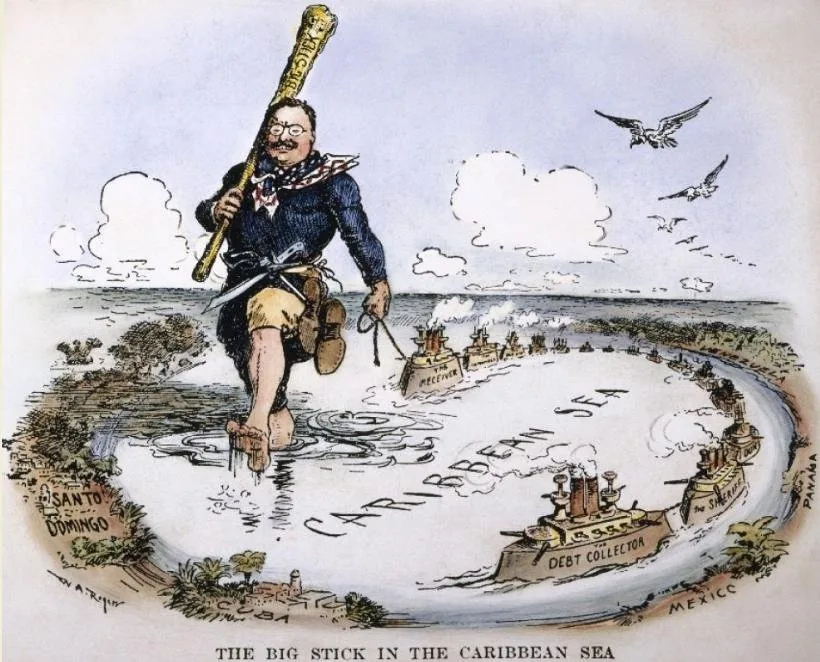
- Present both documents.
- How does each portray the people being ruled?
- What attitude toward power do the two documents share?
- Why might Americans of the time have enjoyed these images?
Exercise 10 : The Maine
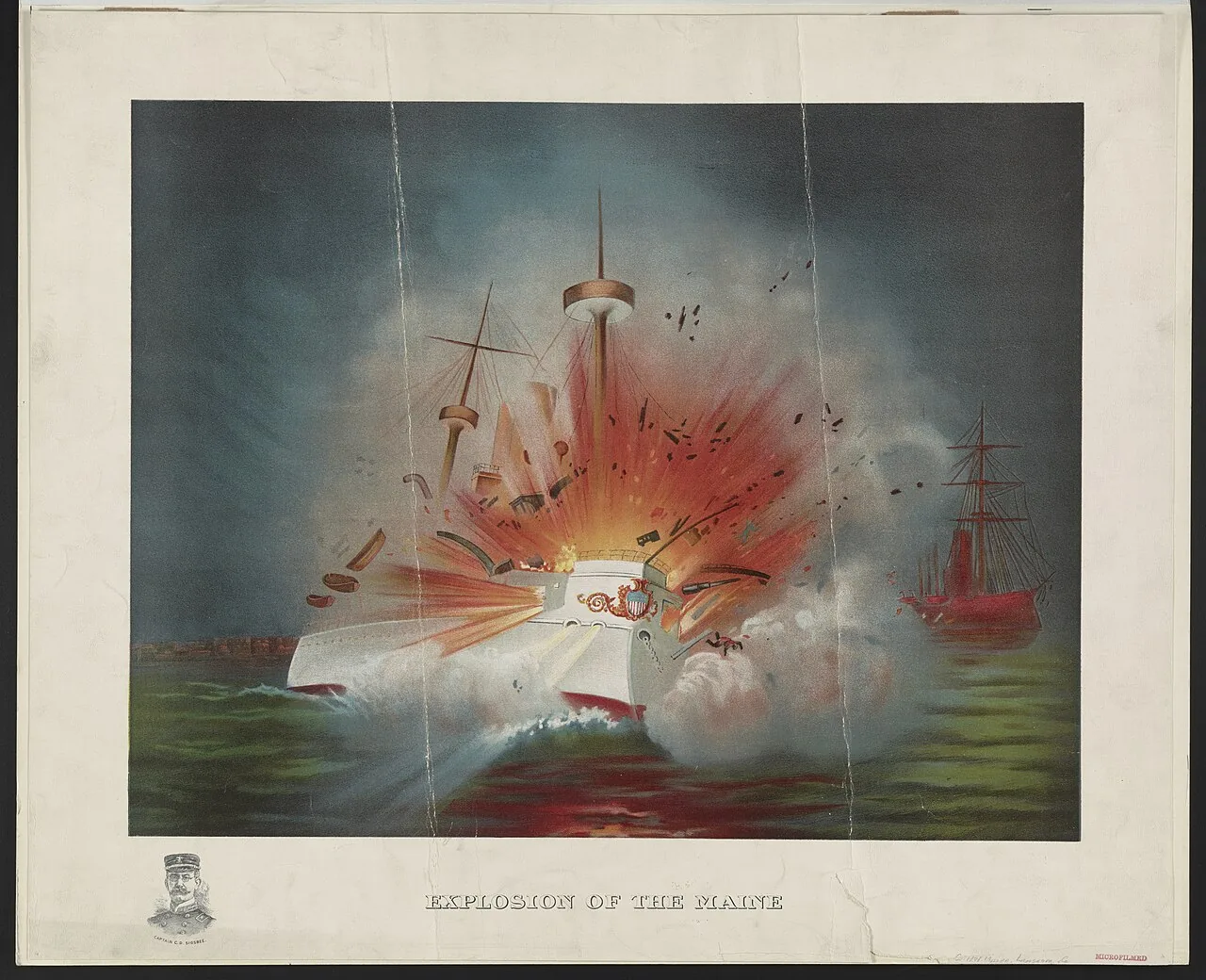
- Present the document.
- Describe the image.
- Why might the artist have chosen such colors and such a view?
- How could such a print help to push the country toward war?
Exercise 11 : Rough Riders on the hill
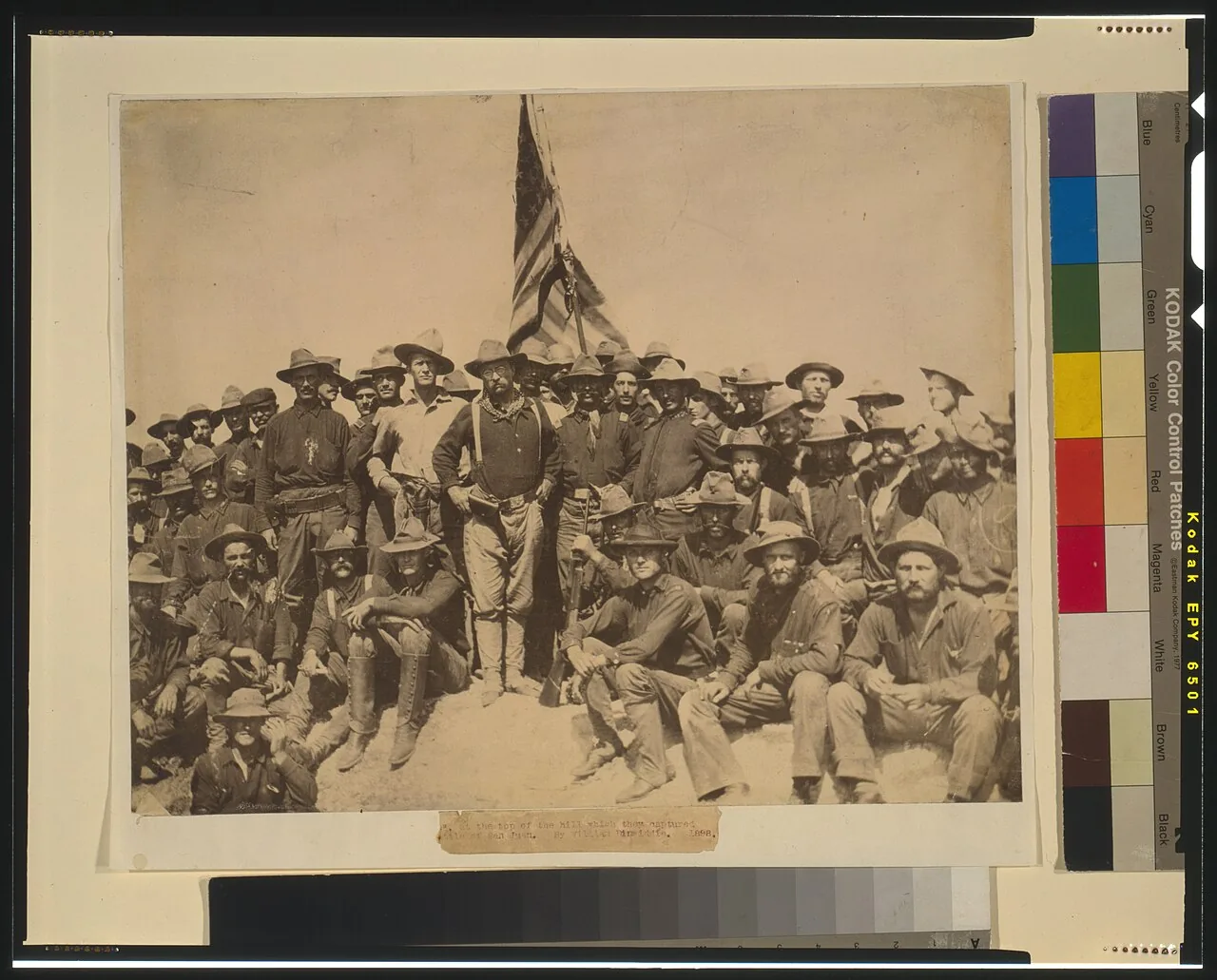
- Present the photograph.
- Describe the group and its setting.
- Explain why Roosevelt became a national hero.
- What does the picture leave out about the battle?
Exercise 12 : The Big Stick
- Present the cartoon.
- Describe Roosevelt and the sea around him.
- What does the phrase “big stick” mean here?
- Is the cartoon in favor of Roosevelt’s policy or against it? Use details.
Exercise 13 : A president at the Culebra Cut
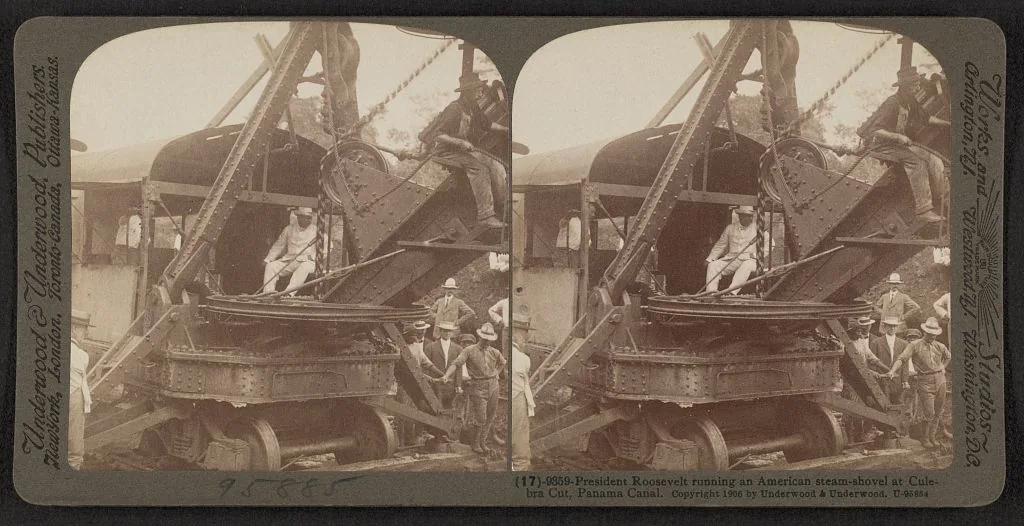
- Present the photograph.
- Describe the machine and the people.
- Why did the canal matter to the United States?
- What does the picture leave out about the cost of the project?
Exercise 14 : Uncle Sam wants you
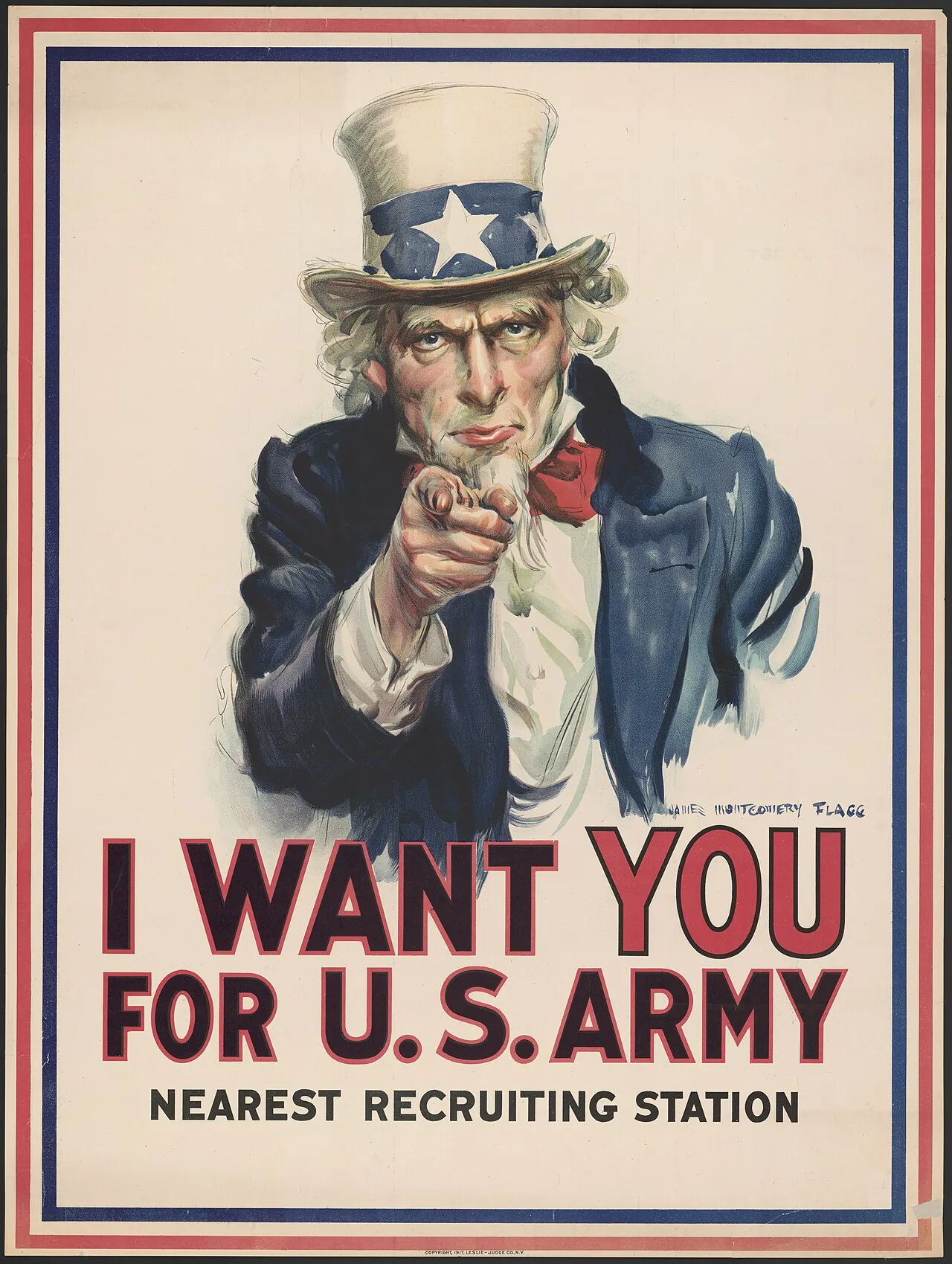
- Present the poster.
- Describe how the artist addresses the viewer.
- Why was such a poster effective for recruitment?
- Which other poster in the lesson used a different approach? Compare them briefly.
Exercise 15 : Territories acquired, 1867-1917
Study the table.
| Territory | Year | How it was acquired |
|---|---|---|
| Alaska | 1867 | Purchased from Russia for $7.2 million |
| Hawaii | 1898 | Annexed by joint resolution of Congress |
| Puerto Rico and Guam | 1898 | Ceded by Spain in the Treaty of Paris |
| Philippines | 1898 | Ceded by Spain; the United States paid $20 million |
| Panama Canal Zone | 1903 | Treaty with Panama: $10 million and yearly payments |
| U.S. Virgin Islands | 1917 | Purchased from Denmark for $25 million |
Source: U.S. Department of State, Office of the Historian, and standard reference works.
- Which year saw the most acquisitions?
- Which territories were bought and which were taken by war or treaty?
- Which price was the highest?
Exercise 16 : The Pacific in 1898
- Name the Pacific territories shown on the map and say which were acquired in 1898.
- Why did Hawaii matter on the way from the United States to the Philippines?
- Which Asian country lies closest to the Philippines on this map?
- Explain how the map shows the link between the Philippines and the Open Door policy.
Exercise 17 : The Caribbean and the canal
- Identify the places numbered 1 to 7.
- Which of them became an American territory after 1898?
- Which was the site of the canal?
- Why did the United States intervene so often in this region?
Exercise 18 : Order the events
Put these events in order and give each date: the sinking of the Lusitania; the opening of the Panama Canal; the explosion of the Maine; the Zimmermann telegram published; the Senate rejects the Treaty of Versailles; Dewey at Manila Bay.
Exercise 19 : How long?
- How many years passed between the purchase of Alaska (1867) and the annexation of Hawaii (1898)?
- The Philippine-American War began in 1899 and was declared over in 1902. How long was that?
- How many years did the United States control the Philippines (1898 to independence in 1946)?
- How many years separate the Roosevelt Corollary (1904) and the American entry into World War I (1917)?
Exercise 20 : Guided research: the Panama Canal
Keywords: “Panama Canal construction 1904-1914”, “William Gorgas yellow fever Panama”, “Office of the Historian Panama Canal”. Reliable sites: history.state.gov, loc.gov, archives.gov, si.edu.
- When did construction under the United States begin and end?
- What disease problem did the builders have to solve, and who led the effort?
- Find one primary source (photograph, map, or document) and note its title and date.
- Write two sentences on the human cost of the project.
Exercise 21 : CER paragraph: was imperialism justified?
Write a paragraph of 6 to 8 sentences that answers: Was the American acquisition of the Philippines consistent with American ideals? Give a claim, two pieces of evidence (one from a document), explain the connection, and conclude.
Exercise 22 : SAQ: why the United States entered World War I
- Identify one cause of the American entry into the war in 1917.
- Identify a second cause and explain how it was linked to the first.
- Explain one way in which Wilson tried to give the war a larger purpose.
Exercise 23 : True or false? Justify
Say whether each statement is true or false and correct the false ones.
- The Teller Amendment promised that the United States would not annex Cuba.
- The Senate approved the Treaty of Paris of 1898 by a very large margin.
- The Panama Canal opened in 1914.
- The United States joined the League of Nations in 1920.
- About 116,000 Americans died in World War I.
Exercise 24 : Stimulus-based multiple choice
Stimulus
Chronic wrongdoing, or an impotence which results in a general loosening of the ties of civilized society, may in America, as elsewhere, ultimately require intervention by some civilized nation, and in the Western Hemisphere the adherence of the United States to the Monroe Doctrine may force the United States, however reluctantly, in flagrant cases of such wrongdoing or impotence, to the exercise of an international police power.
Source: Theodore Roosevelt, Annual Message to Congress, December 6, 1904 (the Roosevelt Corollary to the Monroe Doctrine); text from Wikisource.
*Monroe Doctrine: 1823 policy against European interference in the Americas.
- This passage was written to justify: (A) the purchase of Alaska; (B) American intervention in Latin America; (C) the annexation of Hawaii; (D) American entry into World War I.
- The statement most clearly extended: (A) the Open Door policy; (B) the Monroe Doctrine; (C) the Teller Amendment; (D) the Fourteen Points.
- Which later action best fits the policy described? (A) The occupation of Haiti in 1915; (B) The Treaty of Portsmouth; (C) The Zimmermann telegram; (D) The Sedition Act.


Quick review: flashcards
Tap a card to see the answer.