


This Grade 6 Ancient Civilizations test covers Ancient China: the Shang and Zhou Dynasties. Like a classroom assessment, it includes documents to analyze, knowledge questions and a short writing task. To prepare, review the lesson first, then practice with the worksheet.
Time : 50 min
The test has three parts: knowledge (32 points), documents (48 points), and a written argument (20 points). Answer in complete sentences and cite the documents.
Document 1 – Map of early China
Schematic map prepared for this unit.
Document 2 – The Houmuwu ding
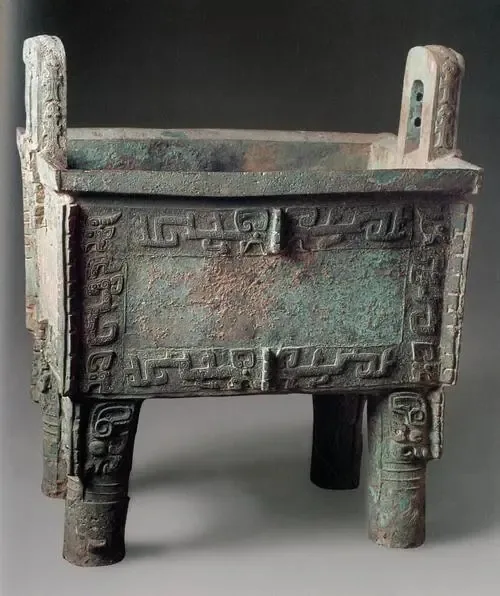
Wikimedia Commons, National Museum of China, Beijing.
Document 3 – King Wu's speech at Muye
The ancients have said, “The hen does not announce the morning. The crowing of a hen in the morning (indicates) the subversion of the family.” Now Shau, the king of Shang, follows only the words of his wife. In his blindness he has neglected the sacrifices which he ought to offer […]. They are only the vagabonds from all quarters, loaded with crimes, whom he honours and exalts, whom he employs and trusts, making them great officers and high nobles, so that they can tyrannize over the people, and exercise their villainies in the cities of Shang. Now, I, Fa, am simply executing respectfully the punishment appointed by Heaven.
*Shau: the last Shang king, usually called Di Xin or King Zhou (the same sound as the Zhou dynasty, but a different word). *Fa: the personal name of King Wu. *subversion: ruin. *vagabonds: wanderers without a home. *tyrannize: rule cruelly.
Book of Documents (<em>Shujing</em>), “The Speech at Mu,” a speech attributed to King Wu of Zhou before the battle of 1046 BCE, written down in the Zhou period (translation by James Legge, 1879).
Document 4 – Confucius on government
If the people be led by laws, and uniformity sought to be given them by punishments, they will try to avoid the punishment, but have no sense of shame. If they be led by virtue, and uniformity sought to be given them by the rules of propriety, they will have the sense of shame, and moreover will become good.
*uniformity: making everyone behave the same way. *propriety: proper behavior. *virtue: moral goodness.
Confucius, <em>Analects</em>, Book II, chapter 3, about 500 BCE (translation by James Legge, 19th century).
Document 5 – Early Chinese dynasties
| Period | Dates (approximate) | Capital or center |
|---|---|---|
| Xia (traditional, evidence debated) | about 2070-1600 BCE | unknown |
| Shang | about 1600-1046 BCE | Anyang (Yin), later |
| Western Zhou | 1046-771 BCE | Haojing |
| Eastern Zhou | 770-256 BCE | Luoyi |
Dates as commonly given in reference works such as <em>The Cambridge History of Ancient China</em> (1999); approximate. Table prepared for this unit.
Questions
- Part 1 – Knowledge. Define dynasty and oracle bones, and explain why the Yellow River was called “China’s Sorrow.” (12 pts)
- Part 1. Document 1: name the two rivers, name the sea to the east, and name the capital of the Western Zhou and the capital of the Eastern Zhou. (12 pts)
- Part 1. Explain the Mandate of Heaven and say why the Zhou needed it. (8 pts)
- Part 2 – Documents. Document 2: present the document, describe what you see, and explain what it shows about the Shang dynasty. (14 pts)
- Part 2. Document 3: present the document, give two reasons that King Wu gives for attacking the Shang king, and explain why a historian should be careful with this speech. (14 pts)
- Part 2. Document 4: present the document and explain the difference between ruling by laws and ruling by virtue. Use Document 5 to say how long the Zhou dynasty lasted in total. (12 pts)
- Part 2. Using Documents 3 and 4, explain what the two documents have in common about what makes a good ruler. (8 pts)
- Part 3 – Written argument. Which had a more lasting effect on China: the Shang invention of writing, the Zhou idea of the Mandate of Heaven, or the teachings of Confucius? Write a paragraph or two with a claim, at least two pieces of evidence from the documents or the lesson, and your reasoning. (20 pts)


Quick review: flashcards
Tap a card to see the answer.