


This Grade 6 Ancient Civilizations lesson covers Ancient China: the Shang and Zhou Dynasties, part of the unit “River valley civilizations.” First, read the full lesson with its primary sources, maps and key terms. Then practice with the worksheet, check yourself with the quiz and get ready with the test.
According to a famous story, in 1899 a scholar in Beijing who was sick bought a medicine called “dragon bones,” made from ground-up old bones. Before they were ground up, he noticed small scratches on the surface. They were not decorations. They were an early form of Chinese writing, carved about 3,200 years ago by priests who asked the spirits of the royal ancestors about the weather, war, and illness. Those scratches opened the history of the Shang dynasty, the first dynasty of China for which we have written records and archaeological proof.
Guiding question: How did the Shang and Zhou dynasties build early Chinese civilization, and why did the Zhou say they had the right to rule?
1. The Yellow River and the shape of early China
Chinese civilization began along two great rivers. In the north is the Yellow River, or Huang He, which begins in the highlands of the west, loops north through the grasslands, then flows east across a wide plain to the sea. People call it yellow because it carries a huge load of fine yellow soil called loess, blown by winds from the deserts of the north.
The loess made the land around the river very fertile, and farmers there grew millet, a hardy grain. But when the river overflowed its banks, it flooded farms and towns and killed thousands of people. The Chinese called the Yellow River “China’s Sorrow.” To the south is the Yangtze, the longest river in Asia, where wetter weather allowed farmers to grow rice.
Geography and isolation
Geography also isolated China. Deserts and grasslands lay to the north and west, the Tibetan Plateau and high mountains to the southwest, and the Pacific Ocean to the east. This isolation meant that early Chinese people developed their own writing, art, and ideas, without much influence from Mesopotamia, Egypt, or India. Many scholars think that it also encouraged the belief that China was at the center of the world. As a result, the Chinese later called their land the “Middle Kingdom.”
Long before writing, farming villages dotted the river valleys. People raised pigs and dogs, made pottery, and by about 5000 BCE grew millet in the north and rice in the south. Later Chinese tradition told of an even earlier dynasty, the Xia, founded by Yu the Great, who tamed the floods by digging channels. Archaeologists have found a large early town at Erlitou, which some scholars connect to the Xia, but no inscription proves it, so the Xia remain a matter of debate.
2. The Shang dynasty
The Shang dynasty ruled much of the Yellow River plain from about 1600 to 1046 BCE. Later Chinese writers said that the Shang began when a leader named Tang overthrew a cruel last king of the Xia. We read this story in a speech that the Book of Documents attributes to Tang.
Document 1 – King Tang explains why he will attack the last king of Xia
Now, ye multitudes, you are saying, “Our prince does not compassionate us, but (is calling us) away from our husbandry to attack and punish Hsia.” I have indeed heard (these) words of you all; (but) the sovereign of Hsia is guilty, and, as I fear God, I dare not but punish him. […] The king of Hsia in every way exhausts the strength of his people, and exercises oppression in the cities of Hsia. His multitudes are become entirely indifferent (to his service), and feel no bond of union (to him). They are saying, ‘When wilt thou, O sun, expire? We will all perish with thee.’
Source: Book of Documents (Shujing), “The Speech of Thang,” a speech attributed to the founder of the Shang dynasty, about 1600 BCE, put into writing many centuries later (translation by James Legge, 1879).
*ye: you (old English plural). *compassionate: feel sorry for. *husbandry: farming. *Hsia: the Xia dynasty, which came before the Shang. *God: Heaven or the high god. *sovereign: ruler.
Commentary. The speech shows an idea that appears again and again in Chinese history: a ruler who oppresses the people loses the right to rule, and a good ruler can overthrow him as the agent of Heaven. But we have to be careful. The speech was written down many centuries after Tang’s time, probably in the Zhou period, by writers who wanted to show that the Shang had come to power for good reasons. It tells us what later Chinese believed about their past, not exactly what Tang said.
Kings and capitals
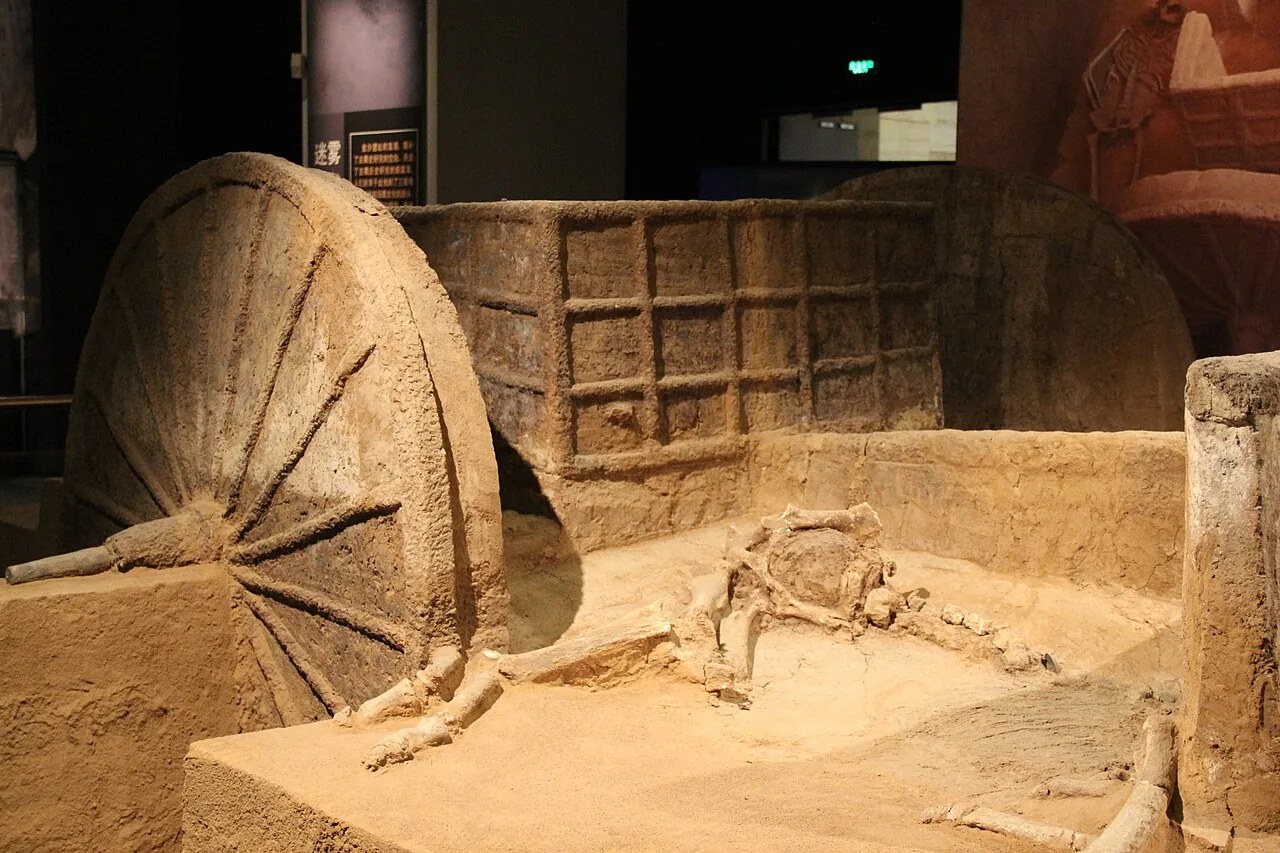
The Shang kings moved their capitals several times. The last and best known was at Anyang, which the Shang called Yin. People lived there from about 1250 BCE. Its ruins, called Yinxu, include royal tombs, workshops, and palaces. The king was both a political and religious leader. He led the army and made sacrifices to his ancestors and to the high god, Shangdi. Under him were nobles who commanded troops and governed districts, craftworkers who made bronze objects, farmers who worked the land, and slaves who were often captives. The king’s tombs contained the remains of horses, chariots, and, shockingly, many human beings whom priests sacrificed to accompany him.
Warriors and Fu Hao
The Shang were great warriors. Their armies used bows, bronze weapons, and, after about 1200 BCE, horse-drawn chariots. One woman commanded troops: Fu Hao, a wife of King Wu Ding, who ruled about 1250 to 1192 BCE. Archaeologists discovered her tomb at Anyang in 1976. Robbers had never opened it, unlike most royal tombs, and it held more than 1,600 objects, including hundreds of bronzes and jades.
Bronze casting
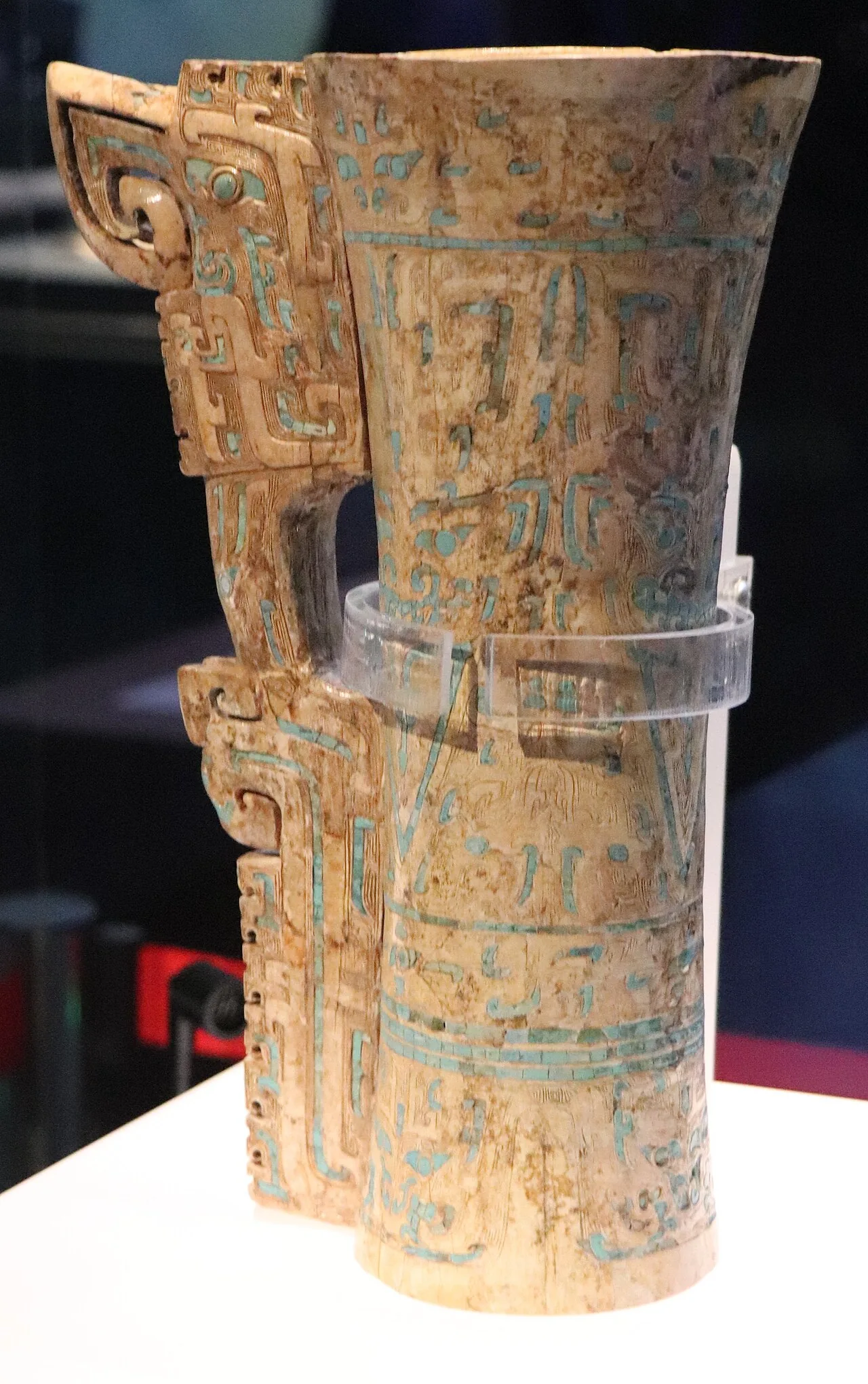
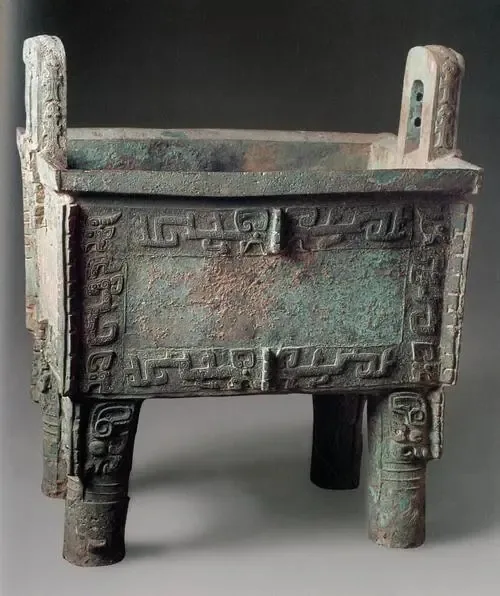
The Shang were also expert metalworkers. They learned to cast bronze by pouring molten metal into clay molds made in pieces, which allowed them to make very elaborate shapes. Smiths made weapons of bronze, but also ritual vessels in which people offered food and wine to the ancestors. The biggest ever found is the Houmuwu ding, a cauldron that weighs about 1,900 pounds.
Writing on oracle bones
Most important for historians is Shang writing. Kings wanted to know whether the ancestors approved of a hunt, a harvest, or a battle. A diviner would carve a question on an ox shoulder blade or a turtle shell, heat it with a hot rod until it cracked, and read the pattern of the cracks as the answer. Sometimes he then carved the answer, and later whether it came true. People buried these oracle bones and forgot them until farmers began to dig them up. About 150,000 pieces have been found, carrying more than 4,500 different characters. Scholars have deciphered about a third of them. In fact, many Shang characters look like pictures and are the ancestors of modern Chinese characters.
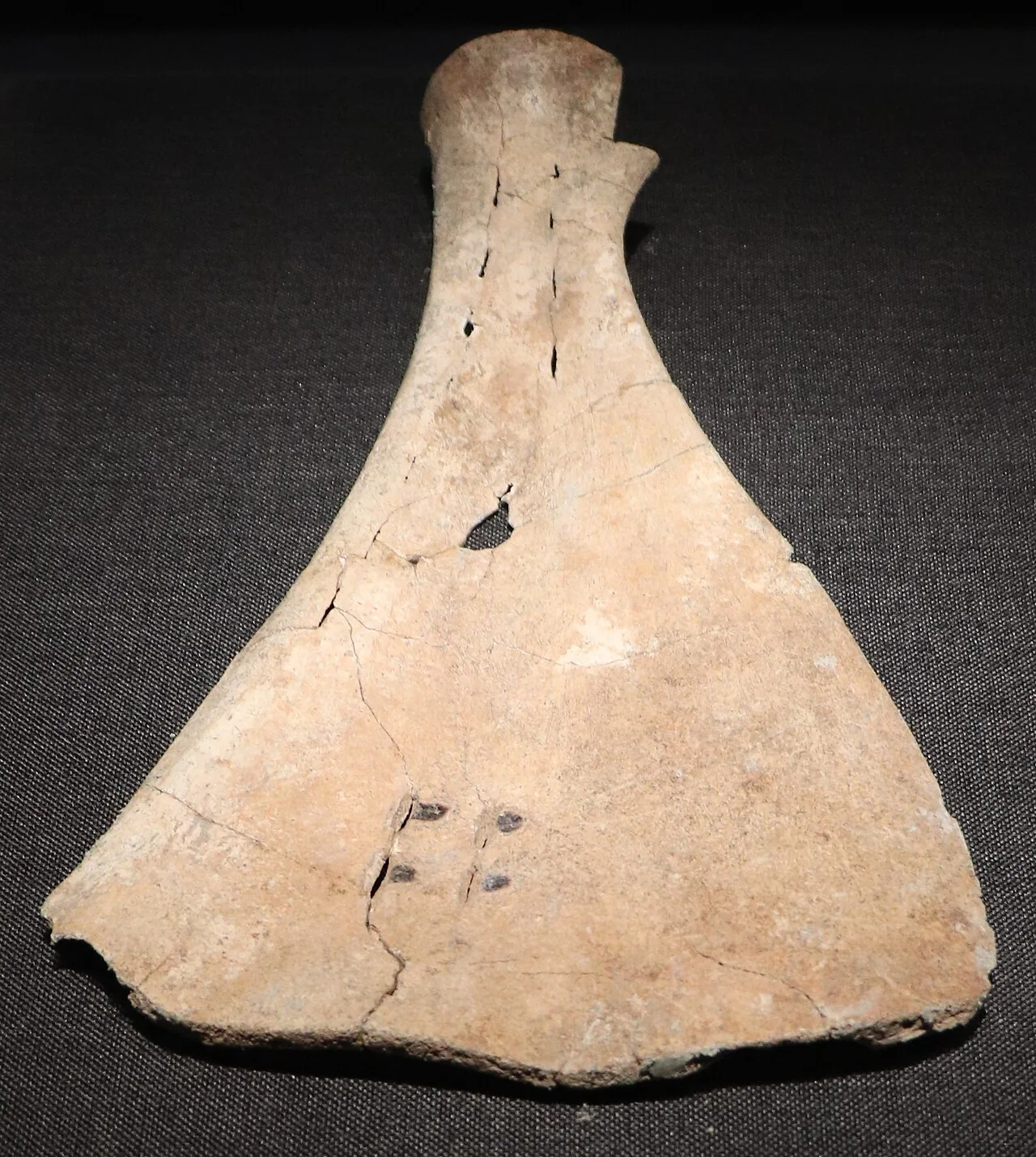
Definition: oracle bones
Animal bones and turtle shells used by the Shang kings for divination. Questions to the ancestors were carved on them, making them the oldest known Chinese writing.
Definition: bronze
A metal made by mixing copper and tin, harder than copper alone. The Shang cast it into weapons and ritual vessels.
3. The Zhou conquest and the Mandate of Heaven
The Shang were challenged by a people to the west, the Zhou, who lived in the valley of the Wei River, a tributary of the Yellow River. About 1046 BCE the Zhou king, Wu, led an army, along with allies, against the last Shang king at the battle of Muye. Before the fight, he gave a speech, and the Book of Documents records it.
Document 2 – King Wu speaks to his army before the Battle of Muye
The ancients have said, “The hen does not announce the morning. The crowing of a hen in the morning (indicates) the subversion of the family.” Now Shau, the king of Shang, follows only the words of his wife. In his blindness he has neglected the sacrifices which he ought to offer […]. They are only the vagabonds from all quarters, loaded with crimes, whom he honours and exalts, whom he employs and trusts, making them great officers and high nobles, so that they can tyrannize over the people, and exercise their villainies in the cities of Shang. Now, I, Fa, am simply executing respectfully the punishment appointed by Heaven.
Source: Book of Documents (Shujing), “The Speech at Mu,” a speech attributed to King Wu of Zhou before the battle of 1046 BCE, written down in the Zhou period (translation by James Legge, 1879).
*Shau: the last Shang king, usually called Di Xin or King Zhou (the same sound as the Zhou dynasty, but a different word). *Fa: the personal name of King Wu. *subversion: ruin. *vagabonds: wanderers without a home. *tyrannize: rule cruelly.
Commentary. King Wu says that the Shang king ignores the sacrifices, takes the advice of his wife and of criminals instead of wise officials, and harms the people, so he, Wu, is only carrying out “the punishment appointed by Heaven.” The speech is a piece of persuasion intended to win the soldiers’ loyalty. Writers probably wrote or edited it later, so historians read it as an expression of what the Zhou wanted people to believe. Note that the “Shau” of Legge’s translation is the Shang king Di Xin, not the Zhou dynasty.
After the victory, the Zhou needed to explain why they, who had been the Shang’s western neighbors, now had the right to rule. They did so with the idea of the Mandate of Heaven: Heaven, a supreme power that watches over human affairs, gives the right to rule to a just king. If a king becomes cruel or lazy, Heaven withdraws the mandate and gives it to a better person. People saw floods, famines, and rebellions as signs that the mandate might be lost. A Zhou statesman explained it in these words:
Document 3 – A Zhou statesman explains the Mandate of Heaven
Oh! God (dwelling in) the great heavens has changed his decree respecting his great son and the great dynasty of Yin. Our king has received that decree. Unbounded is the happiness connected with it, and unbounded is the anxiety:—Oh! how can he be other than reverent? When Heaven rejected and made an end of the decree in favour of the great dynasty of Yin, there were many of its former wise kings in heaven. The king, however, who had succeeded to them, the last of his race […] proceeded in such a way as at last to keep the wise in obscurity and the vicious in office. The poor people in such a case, carrying their children and leading their wives, made their moan to Heaven.
Source: Book of Documents (Shujing), “The Announcement of the Duke of Shao,” early Western Zhou, about 1040 BCE (translation by James Legge, 1879).
*decree: command or appointment (the Mandate). *Yin: another name for the Shang dynasty. *reverent: respectful. *obscurity: being unknown or ignored. *vicious: wicked.
Commentary. The speaker says that Heaven “changed his decree” from Yin (the Shang) to the Zhou because the last Shang king favored the vicious, and the poor complained to Heaven. The text also warns that the Zhou must be careful, for the same thing could happen to them. The Mandate of Heaven lasted as an idea for 3,000 years and was used by later dynasties to explain why they replaced earlier ones. Historians describe a repeating dynastic cycle: a new dynasty rises, rules well, then weakens and is replaced. Note that the winners wrote this explanation.
Feudalism under the Zhou
The Zhou dynasty ruled for almost 800 years, longer than any other. Its first capital was Haojing, near present-day Xi’an. To govern a large territory, the Zhou kings used a system later called feudalism (fengjian). The king gave land to relatives and allies. These allies became lords, ruled their own regions, paid tribute, and sent soldiers when the king asked. The Duke of Zhou, King Wu’s brother, ruled as regent for the young king that followed and helped set up this system. The Zhou kept the Shang writing and bronzes. However, they moved the writing from bones to the bronze vessels themselves, where long inscriptions record royal gifts, orders, and ceremonies.
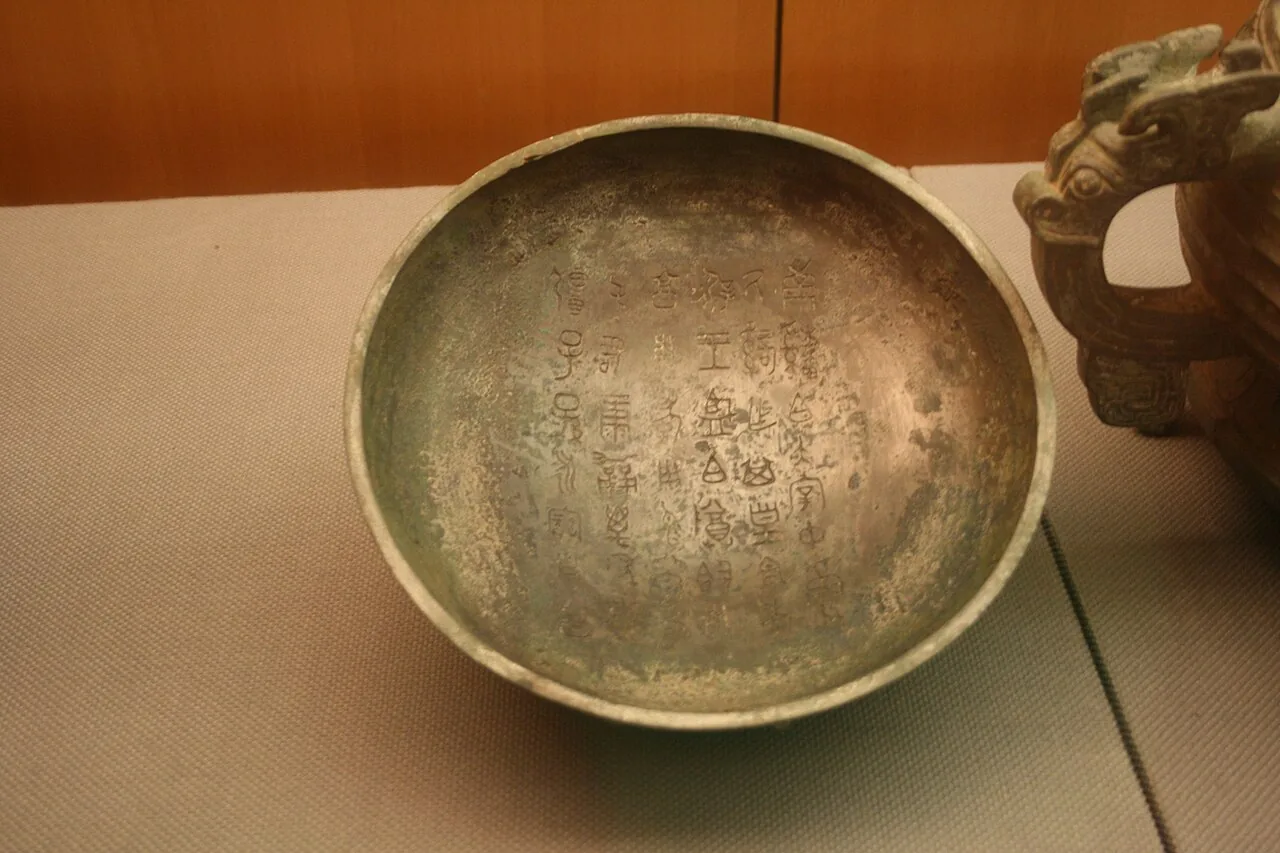
Definition: Mandate of Heaven
The Zhou idea that Heaven gives a just ruler the right to rule, and takes it away from a ruler who is cruel or unfit.
Definition: feudalism
A system in which a ruler gives land to nobles in exchange for loyalty, tribute, and military service. In China it is called fengjian.
4. Eastern Zhou and the age of great thinkers
Over time, the lords grew strong and the Zhou king grew weak. In 771 BCE invaders from the west and rebellious nobles killed King You and destroyed Haojing. His son moved the capital east to Luoyi, near modern Luoyang, in 770 BCE. From then on historians speak of the Eastern Zhou. The kings kept their title but little real power.
Historians call the years 770 to 476 BCE the Spring and Autumn period. They call the years 475 to 221 BCE the Warring States period, when seven big states fought one another. New iron tools and plows helped farmers. Trade grew and coins appeared. In addition, the armies became larger and used cavalry. The Zhou line finally ended in 256 BCE, and in 221 BCE the state of Qin united China.
These centuries of war also produced China’s most important thinkers, often called the Hundred Schools of Thought. The most influential was Confucius (about 551 to 479 BCE), a teacher from the state of Lu. He lived in a time of violence and wanted to restore order by teaching people to be moral. He taught that society works when each person fulfills his or her role: rulers must be good examples, parents must care for children, and children must respect their parents (filial piety). His students collected his sayings in the Analects.
Document 4 – Confucius on government by laws and by virtue
If the people be led by laws, and uniformity sought to be given them by punishments, they will try to avoid the punishment, but have no sense of shame. If they be led by virtue, and uniformity sought to be given them by the rules of propriety, they will have the sense of shame, and moreover will become good.
Source: Confucius, Analects, Book II, chapter 3, about 500 BCE (translation by James Legge, 19th century).
*uniformity: making everyone behave the same way. *propriety: proper behavior. *virtue: moral goodness.
Commentary. Confucius compares two ways of governing: by laws and punishments, or by virtue and good manners. Laws make people avoid punishment, but he says they do not teach them shame. A ruler who sets a good example will make people want to be good. This idea of rule by moral example fits with the Mandate of Heaven: a ruler must be virtuous to keep the right to rule. Note that his students compiled the Analects after his death, so scholars cannot be sure of every word.
Other schools disagreed. Followers of Daoism, named after the Dao, or “the Way,” taught that people should live simply and in harmony with nature. The Legalists believed that people are selfish and need strict laws and harsh punishments. Their ideas helped the state of Qin win and become the first empire. These traditions, especially Confucianism, shaped Chinese government, family life, and education for more than 2,000 years.
- About 1600 BCE The Shang dynasty begins in the Yellow River plain (traditional date).
- About 1250 BCE Anyang (Yin) is the Shang capital; oracle bones record questions to the ancestors.
- About 1046 BCE King Wu of Zhou defeats the last Shang king at Muye.
- About 1040 BCE The Duke of Zhou helps to establish Zhou rule and the Mandate of Heaven.
- 771 BCE Invaders destroy Haojing and kill King You.
- 770 BCE The Zhou capital moves east to Luoyi: Eastern Zhou begins.
- About 551-479 BCE Life of Confucius.
- 256 BCE The last Zhou ruler is removed; Qin unites China in 221 BCE.
Key takeaways
- The Yellow River’s fertile loess and its floods shaped early Chinese farming and government; mountains, deserts, and sea kept China relatively isolated.
- The Shang dynasty (about 1600-1046 BCE) had kings, bronze casting, chariots, and the oldest Chinese writing, carved on oracle bones to ask the ancestors for guidance.
- About 1046 BCE the Zhou overthrew the Shang and justified it with the Mandate of Heaven: a ruler can keep power only if he rules justly.
- The Zhou governed through a feudal system in which lords received land in exchange for loyalty; in 771 BCE the dynasty lost its western capital and moved east.
- The Eastern Zhou was a period of war and new ideas; Confucius taught that rulers should lead by moral example, while Daoism and Legalism offered other answers.

Quick review: flashcards
Tap a card to see the answer.